Admissions Open: MAD-X for UPSC Prelims 2027 · Batch starts 1st Nov 2026 Explore MAD-X
US
UnderStand UPSC Daily Current Affairs Practice
0.00Score / 12
0 / 6MCQs Attempted
0%Accuracy
3 November 2026 • UPSC CSE

Read the news. Test the concept. Write the Mains answer.

This interactive edition converts each current-affairs item into one Prelims-level MCQ, one Mains-level question, and a compact value-addition section for revision.

+2 correct −0.66 incorrect Explanation after attempt Image/PDF answer upload
NEWS 1 GS2 • Fundamental Rights | GS3 • Air Pollution Source: The Hindu

Supreme Court Permits Green Crackers for Two Days in Delhi-NCR

Context: The Supreme Court has conditionally allowed certified green crackers in Delhi-NCR on 7 and 8 November (6–7 a.m. and 8–10 p.m.), holding that bursting crackers is a religious practice but cannot override public health and the right to a clean environment.
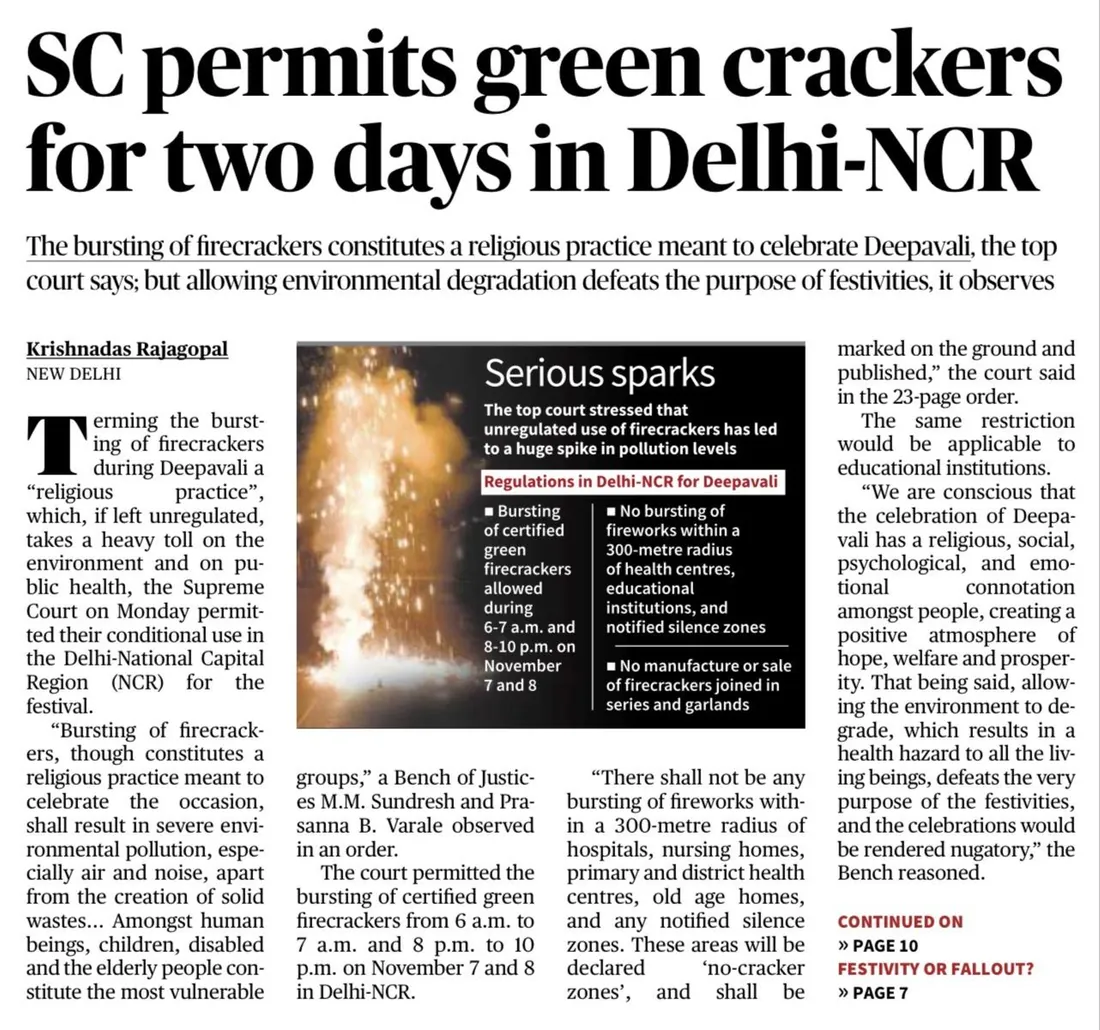
Supreme Court permits certified green crackers for two days in Delhi-NCR for Deepavali 2026 (The Hindu)
SC allows green crackers on 7–8 November in Delhi-NCR with strict timings. Source: The Hindu
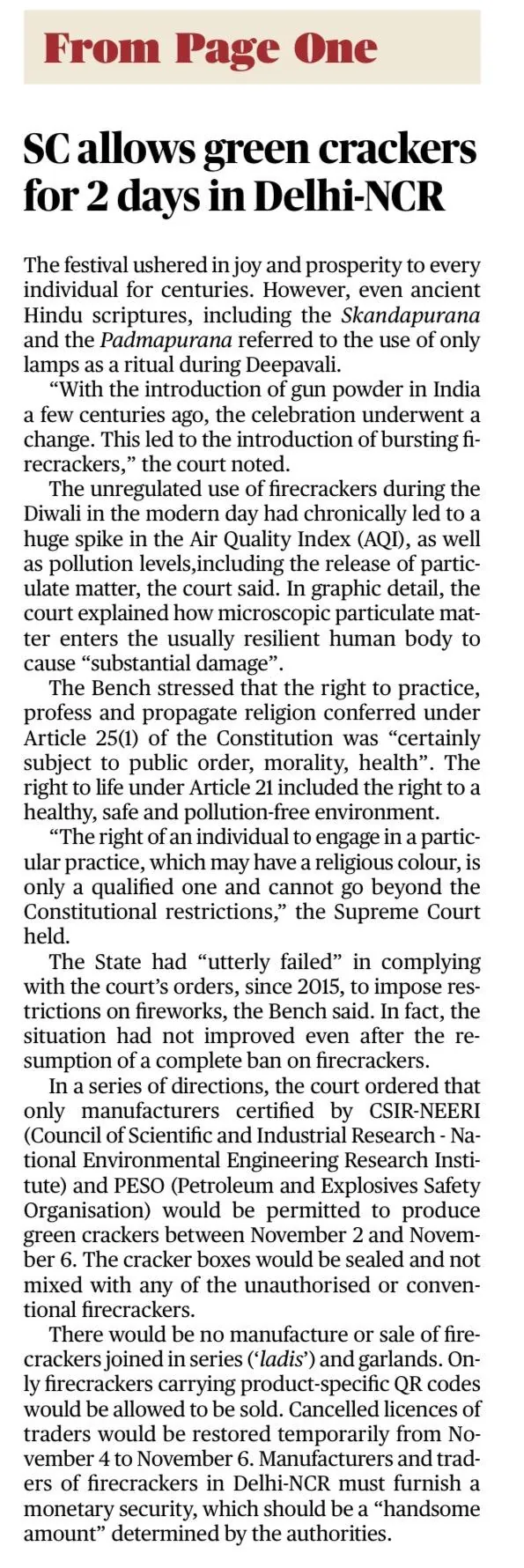
Supreme Court on green crackers – Article 25 subject to health, Article 21 right to clean environment, CSIR-NEERI and PESO directions (The Hindu)
Court's directions: CSIR-NEERI/PESO-certified makers, QR codes, no 'ladis' or garlands. Source: The Hindu

The Court's Directions

Dates & timings
Only certified green crackers on 7 and 8 November, from 6–7 a.m. and 8–10 p.m.
No-cracker zones
No bursting within 300 metres of hospitals, nursing homes, health centres, old age homes, educational institutions and notified silence zones.
Banned products
No manufacture or sale of crackers joined in series ('ladis') or garlands; only crackers with product-specific QR codes.
Who can make them
Only manufacturers certified by CSIR-NEERI and PESO; sealed boxes; traders to give a monetary security.

Green Crackers: Types (CSIR-NEERI)

SWAS
Safe Water Releaser — releases water vapour to suppress dust.
SAFAL
Safe Minimal Aluminium — less aluminium, lower emissions.
STAR
Safe Thermite Cracker — modified formulation, lower emissions.

Constitutional Basis

Article 25(1)
Freedom of religion is subject to public order, morality and health.
Article 21
Right to life includes a healthy, pollution-free environment.
Articles 48A & 51A(g)
Environment protection — a Directive Principle for the State and a Fundamental Duty for citizens.

Landmark Environmental Judgments

M.C. Mehta (1987)
Oleum gas leak — Absolute Liability.
Vellore Citizens Welfare Forum (1996)
Precautionary and Polluter Pays principles; sustainable development.
T.N. Godavarman (1996)
Wide meaning of 'forest'; continuing mandamus for forest protection.
Arjun Gopal (2018)
Restricted firecrackers in Delhi-NCR; introduced green crackers and time limits.

Previous-Year Questions

UPSC Prelims 2018 — NGT & CPCB
NGT was set up by an Act (2010); CPCB is also statutory (Water Act, 1974), not an executive order. Answer: Statement 2 only.
UPSC Mains 2022 — GS II
'The most significant achievement of modern law in India is the constitutionalization of environmental problems by the Supreme Court.' Discuss with case laws.
Key Takeaway: The Court did not ban the festival practice — it regulated it. Religion under Article 25 is protected, but only within the limits of health, which is why the order works through time slots, certified products and no-cracker zones.

Prelims Practice MCQ

+2 correct • −0.66 wrong

With reference to the Supreme Court's recent order on firecrackers in Delhi-NCR, consider the following statements:
1. Only green crackers made by manufacturers certified by CSIR-NEERI and PESO can be sold.
2. Crackers joined in series ('ladis') are permitted if they are green crackers.
3. Bursting is not allowed within 300 metres of hospitals and notified silence zones.
Which of the statements given above are correct?

Explanation: Statements 1 and 3 are correct. The Court prohibited the manufacture and sale of firecrackers joined in series ('ladis') and garlands altogether.

UPSC Mains Question

10 Marks • 150 Words

The right to practise religion under Article 25 is subject to public health. Discuss this in the light of the Supreme Court's directions on firecrackers in Delhi-NCR.

Attempt before opening the value-addition tab.
Accepted: JPG, JPEG, PNG, WEBP or PDF. The standalone file previews your answer locally; connect the API hook for real server submission.
Use after attempting the Mains answer
  • Order — green crackers only, 7–8 Nov, 6–7 a.m. & 8–10 p.m.; 300 m no-cracker zones; no 'ladis'; QR codes; CSIR-NEERI + PESO.
  • Constitution — Art. 25(1) subject to health; Art. 21 clean environment; Art. 48A, 51A(g).
  • Cases — Arjun Gopal (2018), M.C. Mehta, Vellore Citizens, essential religious practice test.
  • Issue — State 'utterly failed' to enforce orders since 2015; enforcement gap.
  • Way forward — CAQM/GRAP coordination, community displays, awareness, strict penalties.
NEWS 2 GS3 • Environment & Sustainable Development Source: The Hindu

Firecrackers: Festivity or Environmental Fallout?

Context: An opinion piece argues that India need not choose between a blanket ban and unrestricted use: proportionate, science-based regulation can protect both lawful celebration and the right to breathe clean air.

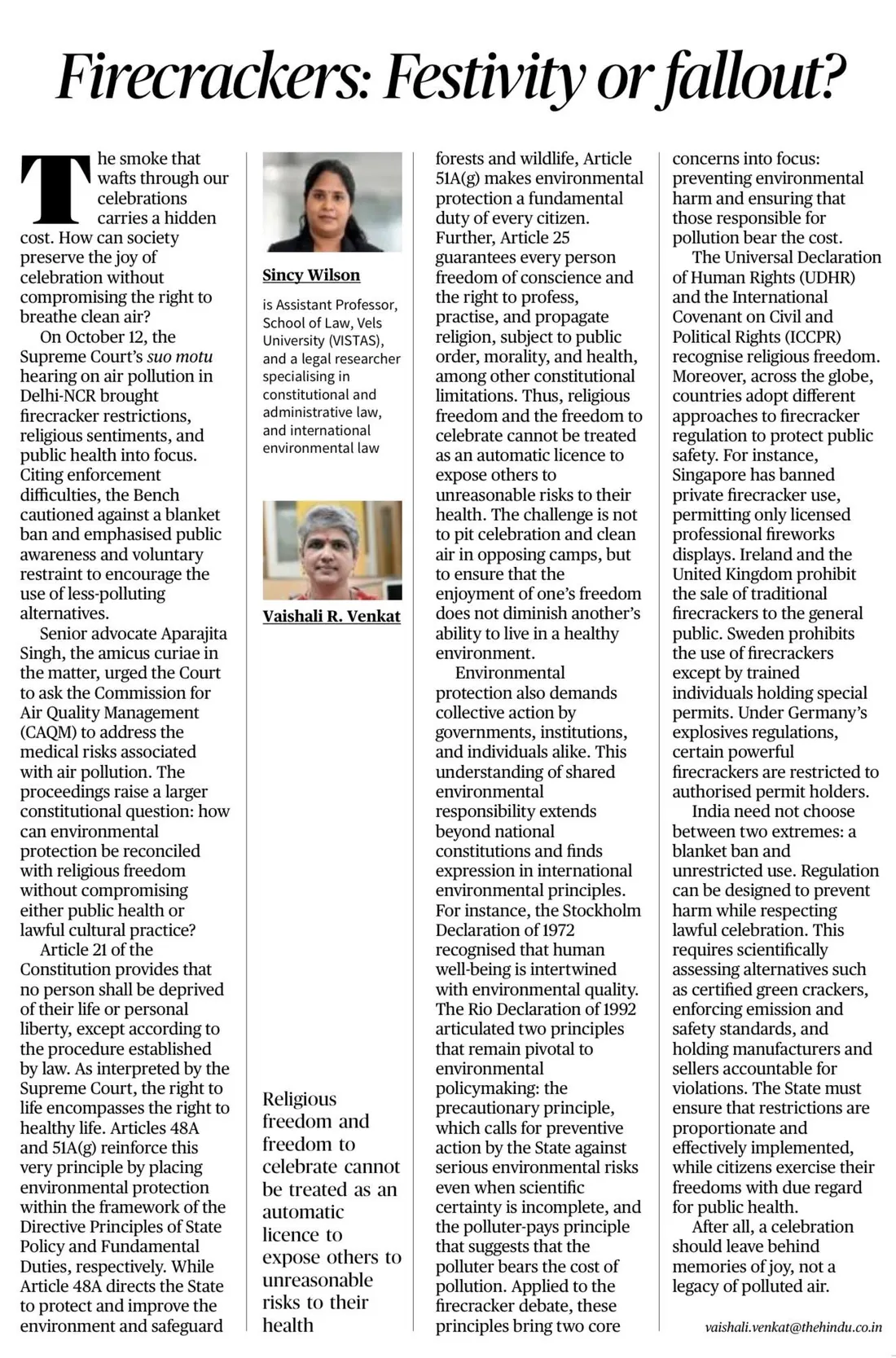
Firecrackers: festivity or fallout – Article 21, Article 25, precautionary principle and polluter pays principle (The Hindu op-ed)
Balancing celebration with clean air: constitutional and international principles. Source: The Hindu

Environmental Principles

Precautionary Principle
Act to prevent harm even when scientific certainty is incomplete (Rio Declaration, 1992).
Polluter Pays Principle
Those who pollute bear the cost of damage and restoration.
Sustainable Development
Balance cultural and economic activity with environmental protection.
Intergenerational Equity
Protect resources for future generations.

International Framework

Stockholm Declaration (1972)
Linked human well-being with environmental quality.
Rio Declaration (1992)
Gave the precautionary and polluter-pays principles.
UDHR & ICCPR
Recognise religious freedom, subject to limits for public health.

How Other Countries Regulate

Singapore
Private use banned; only licensed professional displays.
U.K. & Ireland
Restrict sale of traditional fireworks to the public.
Sweden
Use only by trained individuals with special permits.
Germany
Powerful fireworks limited to authorised permit holders.

Way Forward

Science
Assess alternatives such as certified green crackers; enforce emission and safety standards.
Accountability
Hold manufacturers and sellers liable for violations.
Proportionality
Restrictions should be proportionate and effectively enforced; citizens should celebrate with regard for public health.
Key Takeaway: The real choice is not between joy and clean air but between careless and careful celebration. Regulation that targets the most polluting products and times works better than a ban that cannot be enforced.

Prelims Practice MCQ

+2 correct • −0.66 wrong

Which one of the following international instruments articulated both the 'precautionary principle' and the 'polluter pays principle'?

Explanation: The Rio Declaration on Environment and Development (1992) set out the precautionary principle (Principle 15) and the polluter pays principle (Principle 16).

UPSC Mains Question

15 Marks • 250 Words

"A celebration should leave behind memories of joy, not a legacy of polluted air." Suggest a regulatory framework for firecrackers that balances cultural practice with environmental rights.

Attempt before opening the value-addition tab.
Accepted: JPG, JPEG, PNG, WEBP or PDF. The standalone file previews your answer locally; connect the API hook for real server submission.
Use after attempting the Mains answer
  • Frame — Art. 21 vs Art. 25; Art. 48A, 51A(g).
  • Principles — precautionary, polluter pays, sustainable development, intergenerational equity.
  • Global models — Singapore, U.K./Ireland, Sweden, Germany.
  • Tools — certified green crackers, QR codes, time windows, community displays, penalties.
  • Conclusion — proportionality; neither blanket ban nor unrestricted use.
NEWS 3 GS2 • Right to Privacy | GS3 • Artificial Intelligence Source: The Hindu

How AI Training Models Could Compromise Privacy

Context: Using personal and publicly available data to train AI models exposes gaps in India's data protection law: the DPDP Act, 2023 does not cover publicly available data, has no sensitive-data category and gives no right to object to AI training.

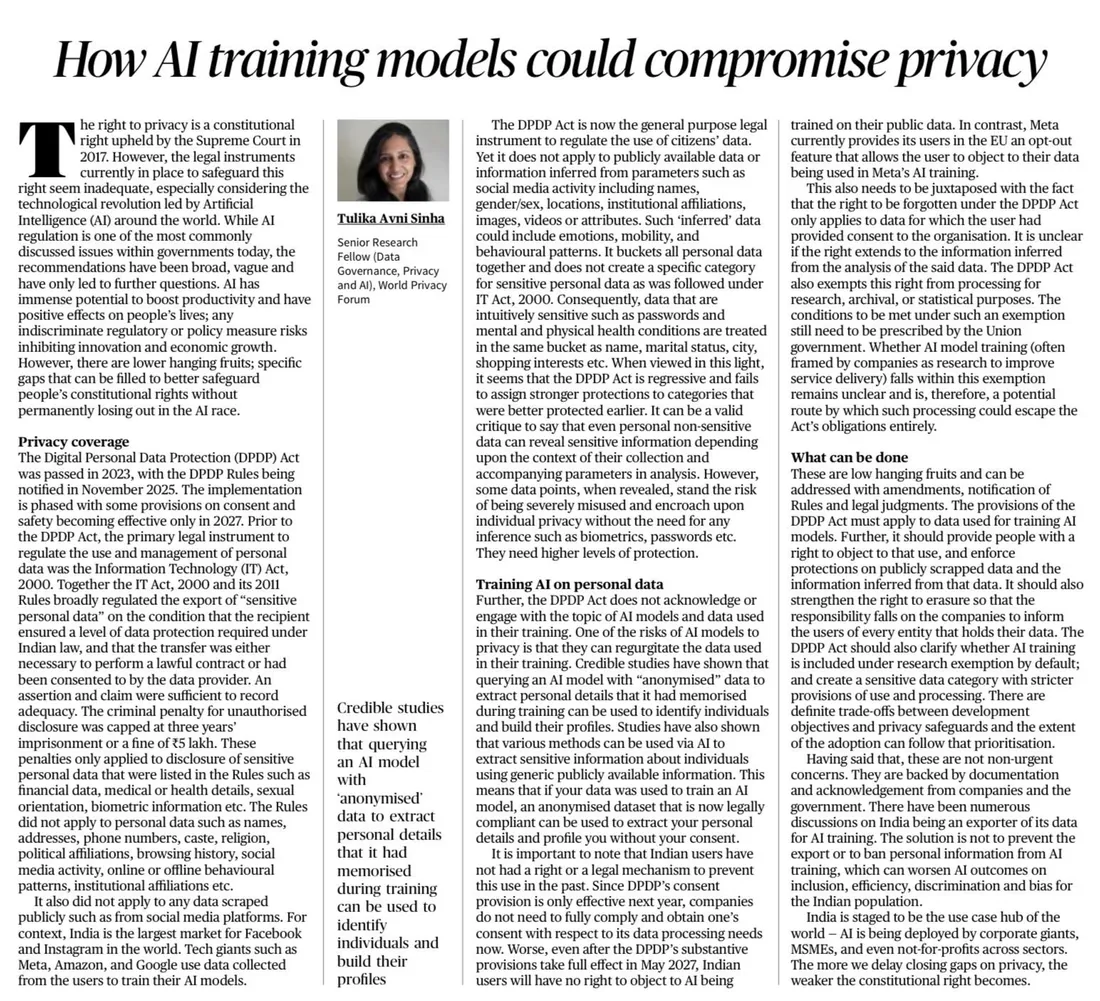
How AI training models could compromise privacy – gaps in DPDP Act 2023 and DPDP Rules 2025 (The Hindu op-ed)
AI training and privacy: what the DPDP Act covers and what it misses. Source: The Hindu

How AI Training Threatens Privacy

Memorisation
Models can regurgitate personal data they were trained on.
Re-identification
'Anonymised' data can be combined to identify individuals and build profiles.
Inference
Ordinary data (location, activity) can reveal sensitive traits — health, emotions, behaviour.
Erasure
Removing data from an already-trained model is technically hard.

Gaps in India's Framework

Public data
DPDP Act does not apply to publicly available data — e.g. social media posts used for training.
No sensitive category
All personal data in one bucket; the IT Act-era 'sensitive personal data' (2011 Rules) category is gone.
Right to object
No right to object to AI training; Meta offers EU users an opt-out, Indians do not have one.
Research exemption
Exemption for research/statistical purposes may let AI training escape the Act.

Legal Framework

Puttaswamy (2017)
Privacy is a Fundamental Right under Article 21 and Part III.
DPDP Act, 2023
General law on digital personal data; DPDP Rules notified November 2025.
Phased roll-out
Main consent obligations take effect only in 2027 (May).
IT Act, 2000
Earlier regime: 2011 Rules protected only listed sensitive data; penalty up to 3 years or ₹5 lakh.

What Can Be Done

Coverage
Apply DPDP to data used for AI training, including scraped public data and inferences.
Rights
Give a right to object; strengthen the right to erasure across all data holders.
Clarity
Clarify whether AI training falls under the research exemption; create a sensitive data category.

Previous-Year Questions

UPSC Prelims 2021
Right to Privacy is protected under Article 21.
UPSC Mains 2017 — GS II
Examine the scope of Fundamental Rights in the light of the Supreme Court judgment on the Right to Privacy.
Key Takeaway: Privacy law built for databases struggles with AI, which learns from public data and infers what was never shared. The fix is not banning AI training but bringing it inside the DPDP Act with a right to object and stronger erasure.

Prelims Practice MCQ

+2 correct • −0.66 wrong

With reference to the Digital Personal Data Protection (DPDP) Act, 2023, consider the following statements:
1. It creates a separate category of 'sensitive personal data' with stricter rules.
2. Personal data made publicly available by the user is excluded from its scope.
3. It provides an exemption for processing for research, archival or statistical purposes.
Which of the statements given above are correct?

Explanation: Statements 2 and 3 are correct. Unlike the IT Act-era 2011 Rules, the DPDP Act treats all personal data alike and has no separate 'sensitive personal data' category.

UPSC Mains Question

15 Marks • 250 Words

AI training on personal data raises new challenges for the right to privacy. Examine the adequacy of the DPDP Act, 2023 in addressing them.

Attempt before opening the value-addition tab.
Accepted: JPG, JPEG, PNG, WEBP or PDF. The standalone file previews your answer locally; connect the API hook for real server submission.
Use after attempting the Mains answer
  • Base — Puttaswamy (2017): privacy under Art. 21; proportionality test.
  • Risks — memorisation, re-identification, inferred sensitive data, hard erasure.
  • Gaps — public data excluded, no sensitive category, no right to object, research exemption.
  • Comparisons — EU GDPR (legitimate interest, right to object), Meta EU opt-out.
  • Reforms — amend DPDP for AI training, notify safeguards, Data Protection Board capacity, IndiaAI governance.
NEWS 4 GS3 • Energy, Climate Change & Economy Source: The Indian Express

PM: India to Add 500 GW Non-Fossil Fuel Capacity in the Next 10–11 Years

Context: Inaugurating the Bharat Renewable Energy Summit & Expo 2026, PM Modi said India will add another 500 GW of non-fossil capacity over the next 10–11 years. India met its Paris goal of 50% non-fossil installed capacity in 2025, five years early.

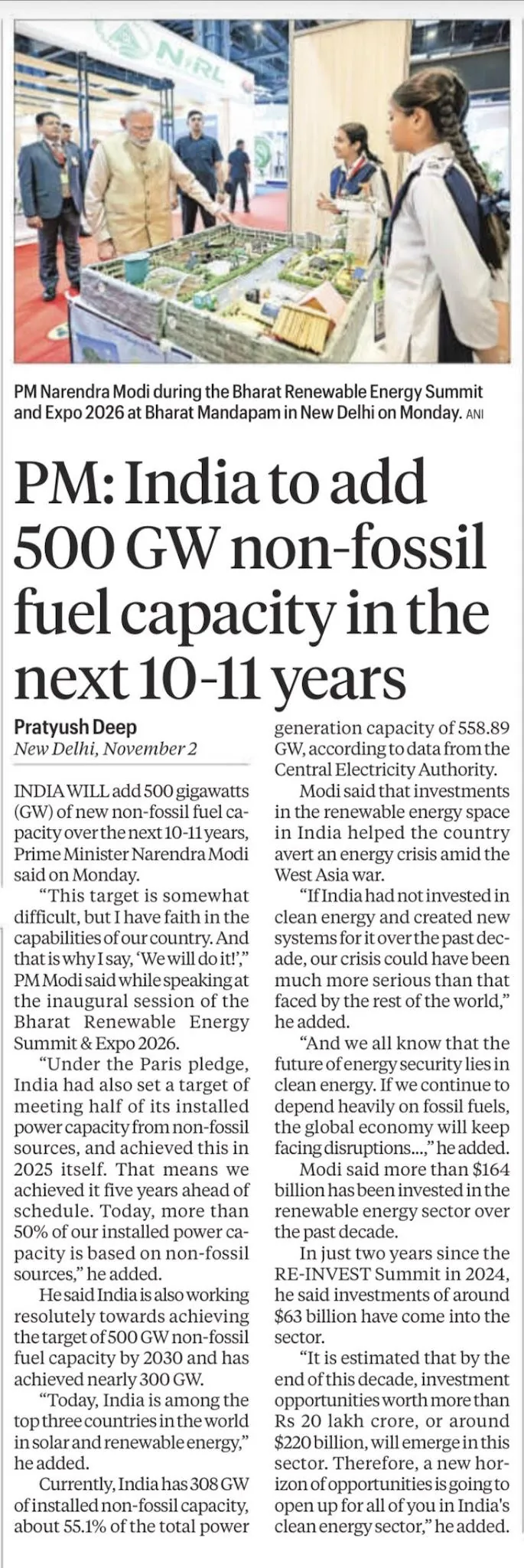
PM Modi at Bharat Renewable Energy Summit 2026 – India to add 500 GW non-fossil fuel capacity in 10–11 years (The Indian Express)
India has 308 GW non-fossil capacity — 55.1% of total installed capacity. Source: The Indian Express

Key Data

Installed capacity
Total 558.89 GW; non-fossil 308 GW = 55.1% (CEA data).
Paris goal
50% non-fossil installed capacity achieved in 2025 — five years early.
Targets
500 GW non-fossil by 2030 (COP26 Panchamrit) + another 500 GW in 10–11 years.
Investment
Over $164 billion in a decade; $63 billion since RE-INVEST 2024; ₹20 lakh crore (~$220 bn) opportunity by 2030.

Major Initiatives

Households & farmers
PM Surya Ghar (rooftop solar) and PM-KUSUM (solar pumps).
Green hydrogen
National Green Hydrogen Mission — 5 MMT a year by 2030.
Grid
Green Energy Corridors for evacuating renewable power.
Manufacturing
PLI for high-efficiency solar modules and cells.

Why It Matters

Energy security
Clean energy helped India avert a crisis amid the West Asia war; less import dependence.
Climate
Supports the Paris NDC and net zero by 2070.
Economy
Investment, manufacturing and green jobs.

Challenges

Intermittency & storage
Solar and wind vary; affordable battery and pumped storage needed.
Transmission
Generation hubs need stronger grid links to demand centres.
Supply chain
Import dependence for cells, wafers, batteries; land and biodiversity conflicts.

Previous-Year Questions

UPSC Prelims 2016 — Net metering
Promotes production and use of solar energy by households. Answer: (a).
UPSC Prelims 2016 — ISA
Launched at COP21, Paris (2015); not all UN members are part of it. Answer: (a) 1 only.
Key Takeaway: Capacity is now ahead of target; the harder part is making it usable round the clock. The next 500 GW will be judged by storage, transmission and domestic manufacturing, not just by gigawatts added.

Prelims Practice MCQ

+2 correct • −0.66 wrong

With reference to India's power sector, consider the following statements:
1. India's non-fossil installed capacity has crossed 50% of its total installed power capacity.
2. India's target of 500 GW non-fossil capacity by 2030 was announced at COP26.
3. Net metering promotes the use of solar energy by households.
Which of the statements given above are correct?

Explanation: All three are correct. Non-fossil sources make up about 55.1% (308 GW of 558.89 GW); the 500 GW goal is part of India's Panchamrit at COP26 (Glasgow, 2021).

UPSC Mains Question

15 Marks • 250 Words

India has met its 50% non-fossil capacity target early. What must be done to ensure that the next phase of the energy transition delivers reliable and affordable power?

Attempt before opening the value-addition tab.
Accepted: JPG, JPEG, PNG, WEBP or PDF. The standalone file previews your answer locally; connect the API hook for real server submission.
Use after attempting the Mains answer
  • Data — 308 GW of 558.89 GW (55.1%); 50% achieved in 2025; 500 GW by 2030 + 500 GW more in 10–11 years.
  • Money — $164 bn in a decade, $63 bn since RE-INVEST 2024, ₹20 lakh crore opportunity.
  • Schemes — PM Surya Ghar, PM-KUSUM, NGHM, Green Energy Corridors, PLI.
  • Gaps — storage, transmission, cells/wafers, land, DISCOM finances.
  • Link — energy security (West Asia war), net zero 2070, ISA.
NEWS 5 GS3 • Biodiversity & Conservation Source: The Indian Express

Why Kuno's Collared Cheetahs Cannot Be Live-Tracked

Context: After the death of male cheetah KNG22 and the suspension of six forest officials, the Kuno National Park Director explained that satellite collars send location only at intervals and cannot provide continuous live tracking.

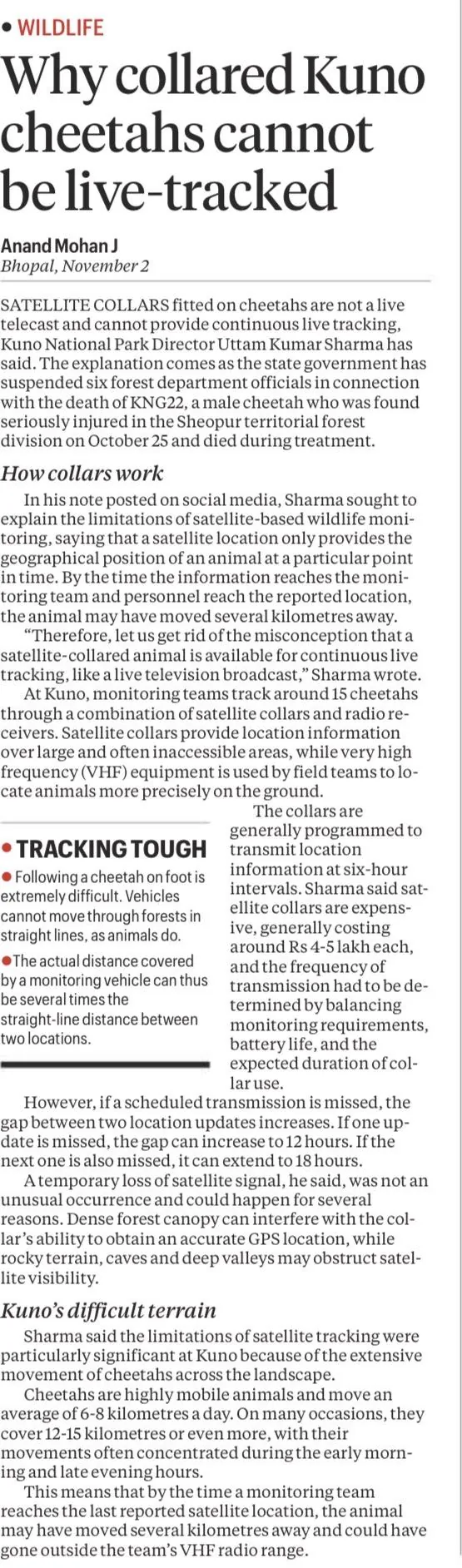
Why collared Kuno cheetahs cannot be live-tracked – satellite collars, VHF tracking and Project Cheetah challenges (The Indian Express)
Satellite collars send location every six hours; field teams use VHF receivers. Source: The Indian Express

How the Collars Work

Interval
Location sent about every six hours — a missed update stretches the gap to 12 or 18 hours.
Ground tracking
Field teams use VHF radio receivers to locate animals precisely.
Cost
About ₹4–5 lakh per collar; more frequent transmission drains the battery.
Scale
Around 15 cheetahs are monitored at Kuno.

Why Tracking Is Hard

Signal loss
Dense canopy, rocky terrain, caves and valleys block satellite/GPS signals.
Movement
Cheetahs move 6–8 km a day, sometimes 12–15 km, mostly early morning and evening.
Terrain
Vehicles cannot follow straight lines; the animal may have moved several km by the time teams arrive.

Cheetah & Project Cheetah

Species
Acinonyx jubatus; African cheetah Vulnerable, Asiatic cheetah Critically Endangered (IUCN).
Extinction in India
Declared extinct in 1952.
Project Cheetah
Launched 2022; cheetahs from Namibia and South Africa; first site Kuno National Park, MP.

Previous-Year Questions

UPSC Prelims 2024 — Big cats
Lions have no particular breeding season; cheetahs do not roar; male leopards do scent-mark. Answer: two statements (1 and 2).
UPSC Prelims 2012
Naturally found in India: black-necked crane, flying squirrel, snow leopard — not cheetah. Answer: 1, 3 and 4 only.
Key Takeaway: A collar gives a dot on a map every few hours, not a live feed. Reintroduction success depends as much on ground teams, terrain knowledge and prey base as on technology.

Prelims Practice MCQ

+2 correct • −0.66 wrong

With reference to the monitoring of cheetahs at Kuno National Park, consider the following statements:
1. Satellite collars provide continuous, real-time live tracking of the animals.
2. Field teams use Very High Frequency (VHF) receivers to locate animals on the ground.
3. Dense forest canopy and rocky terrain can obstruct satellite signals.
Which of the statements given above are correct?

Explanation: Statements 2 and 3 are correct. Satellite collars send locations only at scheduled intervals (generally every six hours), not continuously.

UPSC Mains Question

10 Marks • 150 Words

Project Cheetah has faced both ecological and technological challenges. Evaluate the project and suggest measures to improve its outcomes.

Attempt before opening the value-addition tab.
Accepted: JPG, JPEG, PNG, WEBP or PDF. The standalone file previews your answer locally; connect the API hook for real server submission.
Use after attempting the Mains answer
  • Basics — Acinonyx jubatus; extinct in India 1952; Project Cheetah 2022; Namibia & South Africa; Kuno (and Gandhi Sagar).
  • Tracking — 6-hour satellite fixes, VHF ground tracking, ₹4–5 lakh collars, battery trade-off.
  • Issues — deaths (incl. KNG22), wide ranging outside the park, human–wildlife conflict, prey base.
  • Fixes — landscape-level management, community involvement, better veterinary care, adaptive monitoring.
  • Link — M-STrIPES for tigers; species reintroduction ethics.
NEWS 6 GS4 • Ethics — Accountability & Justice | GS2 • IR Source: The Hindu

Britain Open to Apologising for Slavery, but Rules Out Reparations

Context: U.K. Prime Minister Andy Burnham said his government is open to formally apologising for Britain's role in the slave trade but ruled out financial reparations, ahead of CHOGM in Antigua and Barbuda. Shashi Tharoor welcomed the move but criticised the omission of colonialism.

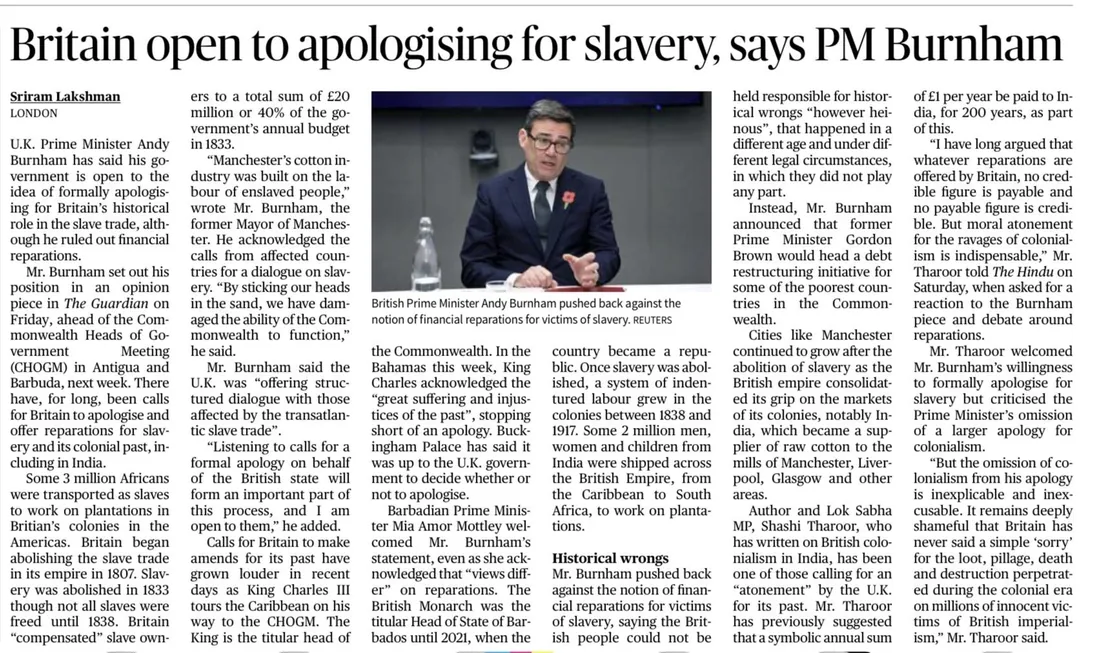
Britain open to apologising for slavery, says PM Burnham – reparations and colonialism debate ahead of CHOGM (The Hindu)
U.K. PM Andy Burnham pushed back against financial reparations for slavery. Source: The Hindu

Historical Background

Slave trade
About 3 million Africans were shipped to British plantations in the Americas.
Abolition
Slave trade abolished 1807; slavery 1833; full freedom only by 1838.
Compensation
Britain paid £20 million (about 40% of its 1833 budget) to slave owners, not to the enslaved.
Indentured labour
About 2 million Indians were sent across the Empire (1838–1917) to work on plantations.

Recent Developments

U.K. position
Open to a formal apology and 'structured dialogue'; no financial reparations.
Alternative
Gordon Brown to lead a debt restructuring initiative for poorer Commonwealth countries.
Monarchy
King Charles acknowledged the 'great suffering' of the past in the Bahamas, but did not apologise.
India's view
Shashi Tharoor: apology welcome, but omitting colonialism is 'inexcusable'; earlier suggested a symbolic £1 a year for 200 years.

Ethical Dimensions (GS IV)

Legal vs moral responsibility
Legal liability may fade across generations; moral responsibility to acknowledge injustice can remain.
Apology vs reparations
An apology gives symbolic recognition; reparations address material consequences.
Restorative justice
Repairing harm and restoring dignity, not just admitting wrongdoing.
Ethical leadership
Acknowledging historical wrongs needs integrity, empathy and moral courage.

Previous-Year Question

UPSC Mains 2015 — GS IV
'A mere compliance with law is not enough, the public servant also has to have a well-developed sensibility to ethical issues.' — Ethics goes beyond legal compliance.
Key Takeaway: The debate shows the gap between legal and moral accountability: no court can order Britain to pay, yet the ethical case for acknowledgement remains. For GS IV, it is a ready example of restorative justice and conscience-based leadership.

Prelims Practice MCQ

+2 correct • −0.66 wrong

With reference to the abolition of slavery in the British Empire, consider the following statements:
1. Britain abolished the slave trade in 1807.
2. Under the abolition of slavery in 1833, compensation was paid to the enslaved people.
3. After the abolition of slavery, Indian indentured labourers were sent to British colonies to work on plantations.
Which of the statements given above are correct?

Explanation: Statements 1 and 3 are correct. The £20 million compensation was paid to slave owners, not to the enslaved people.

UPSC Mains Question

10 Marks • 150 Words

"The absence of legal liability does not end moral responsibility." Discuss with reference to the debate on apologies and reparations for historical injustices such as slavery and colonialism.

Attempt before opening the value-addition tab.
Accepted: JPG, JPEG, PNG, WEBP or PDF. The standalone file previews your answer locally; connect the API hook for real server submission.
Use after attempting the Mains answer
  • Facts — 3 million Africans; 1807/1833/1838; £20 million to owners; 2 million Indian indentured labourers.
  • Positions — U.K.: apology yes, reparations no; Brown's debt initiative; Tharoor on colonialism.
  • Concepts — legal vs moral responsibility, restorative justice, collective guilt vs collective responsibility.
  • Examples — Germany's Holocaust reparations; Jallianwala Bagh (no formal apology).
  • Conclusion — sincere acknowledgement + practical repair (debt relief, education, cultural restitution).

Copyright © 2026 USARAMBHA EDUCATION (UnderStand UPSC). All Rights Reserved.

MAD-X Orientation

Talk to Our Counsellor

Share your details and our counselling team will call you back in 10 minutes.

Please enter your name.
+91
Please enter a valid 10-digit mobile number.
When do you plan to enroll in MAD-X?
Please select an option.

Thank you, !

Our counselling team will call you within 10 minutes.
Please keep your phone handy.