India Made Remarkable Progress in Reducing Poverty: World Bank
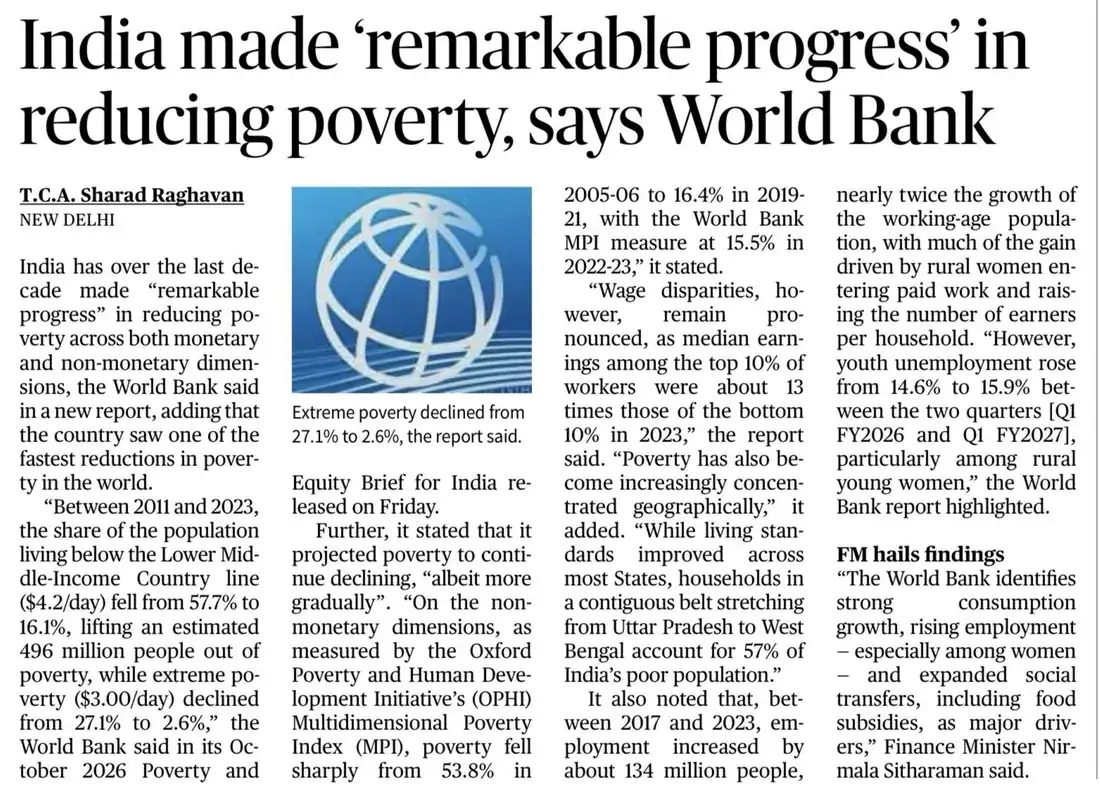
Context: The World Bank's October 2026 Poverty and Equity Brief for India says about 496 million people moved out of poverty between 2011 and 2023 — one of the fastest reductions in the world — driven by employment, earnings, consumption and social transfers.
India's Progress in Poverty Reduction (2011–2023)
Fell from 57.7% to 16.1% — about 496 million people lifted out of poverty.
Fell from 27.1% to 2.6%.
OPHI MPI fell from 53.8% (2005–06) to 16.4% (2019–21); World Bank's MPI measure at 15.5% in 2022–23.
Employment rose by about 134 million (2017–2023) — nearly twice the growth of the working-age population, led by rural women.
Drivers of Poverty Reduction
More jobs and more earners per household, especially rural women entering paid work.
Food subsidies, PDS and social transfers.
Better access to education, health, sanitation, housing and water; rising consumption.
Challenges
Median earnings of the top 10% about 13 times those of the bottom 10% (2023).
A belt from Uttar Pradesh to West Bengal accounts for 57% of India's poor.
Rose from 14.6% to 15.9% (Q1 FY2026 to Q1 FY2027), especially among rural young women; poverty to keep falling, 'albeit more gradually'.
Way Forward
Labour-intensive manufacturing, MSMEs, rural non-farm jobs; education, health, nutrition and skilling.
Focus on poverty-concentrated regions; women's formal employment; stronger social security delivery.
Previous-Year Questions
MPI uses the Alkire-Foster method; NITI Aayog's MPI has 12 indicators; Maternal Health and Bank Account are not common to the UNDP Global MPI (10 indicators). Answer: (a) 1 and 2 only.
Inequality in the ownership pattern of resources is one of the major causes of poverty. Discuss in the context of 'paradox of poverty'.
Poverty and malnutrition create a vicious cycle, adversely affecting human capital formation. What steps can be taken to break the cycle?
The incidence and intensity of poverty are more important in determining poverty based on income alone. Analyse the latest UN Multidimensional Poverty Index Report.
Prelims Practice MCQ
+2 correct • −0.66 wrongWith reference to the World Bank's October 2026 Poverty and Equity Brief for India, consider the following statements:
1. Extreme poverty, measured at $3.00 per day, fell to 2.6% in 2023.
2. About 496 million people moved out of poverty between 2011 and 2023.
3. The UP–West Bengal belt accounts for less than one-fourth of India's poor.
Which of the statements given above are correct?
UPSC Mains Question
15 Marks • 250 WordsIndia has reduced extreme poverty sharply, but poverty is becoming geographically concentrated. Discuss the drivers of this decline and suggest strategies for the remaining poor.
- Data — $4.20 line: 57.7% → 16.1%; $3.00 line: 27.1% → 2.6%; 496 million lifted (2011–2023).
- MPI — OPHI 53.8% (2005–06) → 16.4% (2019–21); World Bank MPI 15.5% (2022–23).
- Drivers — 134 million more jobs (2017–23), rural women's work, food subsidies/PDS, transfers.
- Concerns — 13x top-bottom earnings gap, 57% of poor in UP–WB belt, youth unemployment 15.9%.
- Way forward — labour-intensive growth, human capital, women's jobs, regional targeting.