Context
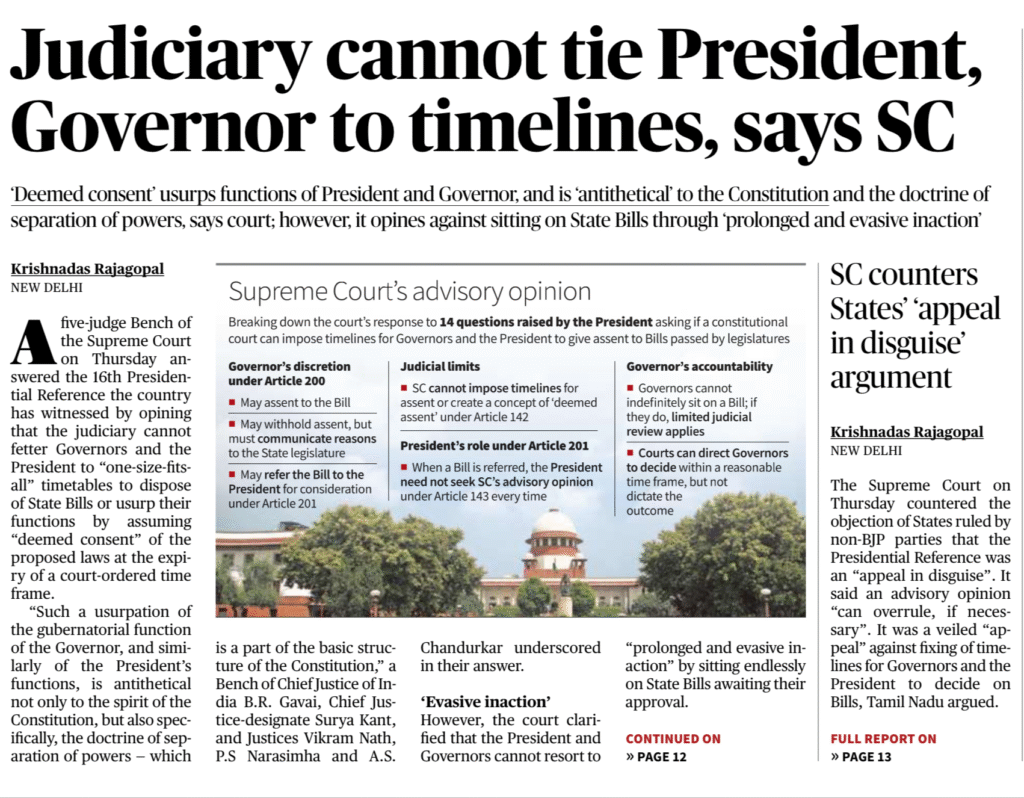
The Supreme Court issued its advisory opinion on the 16th Presidential Reference, triggered by the Tamil Nadu case where the court invoked “deemed assent” due to long delays by the Governor in acting on Bills.
Key Constitutional Questions
- Can Governors/President be bound to strict timelines?
- Can courts create the concept of deemed assent?
- Can judicial directions override constitutional discretion under Articles 200 & 201?
SC’s Clarification
- Judiciary cannot impose fixed timelines on President/Governors.
- Doing so violates separation of powers and the constitutional scheme.
- However, constitutional heads cannot engage in prolonged inaction.
- Courts may direct them to act within a reasonable time, but not dictate outcomes.
- Article 142 cannot be used to invent doctrines like “deemed assent.”
Balance Restored Between
- Legislative process
- Gubernatorial/Presidential discretion
- Limits of judicial review
Prelims Notes
- Article 143 – Advisory jurisdiction of SC
- Article 200 – Governor’s roles on State Bills
- Article 361 – Immunity of President/Governor
- Article 142 – “Complete Justice” power