Context: Special Intensive Revision
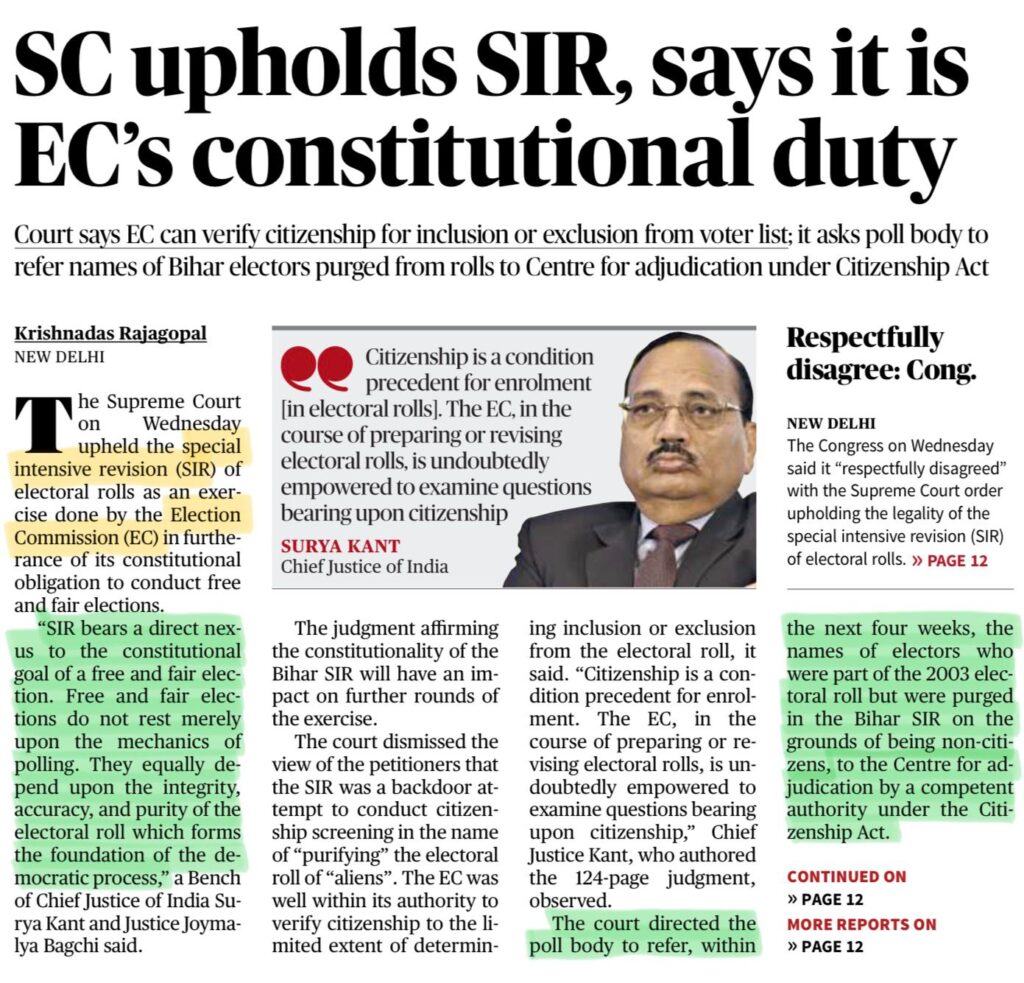
Supreme Court upheld the Special Intensive Revision (SIR) of electoral rolls in Bihar, holding that the Election Commission has constitutional authority to verify citizenship for maintaining pure and accurate electoral rolls.
Special Intensive Revision
- Detailed verification and revision of electoral rolls conducted by Election Commission.
- Objective: Remove duplicate, deceased, shifted and ineligible voters; ensure purity and accuracy of electoral rolls.
- Citizenship is mandatory for inclusion in electoral rolls.
- Bihar SIR linked to verification of voters added after 2003 electoral rolls.
- Names removed on citizenship grounds are to be referred under Citizenship Act for adjudication by competent authority.
Important Constitutional and Legal Basis
- Article 324: Election Commission has superintendence, direction and control over elections.
- Article 326: Only Indian citizens aged 18+ are eligible to vote.
- RPA, 1950 — Section 16: Disqualification from electoral rolls, including non-citizens.
- RPA, 1950 — Section 19: Conditions for voter registration.
- RPA, 1950 — Section 21: Empowers Election Commission to prepare and revise electoral rolls, including special revision.
- Registration of Electors Rules, 1960: Procedure for claims, objections and correction of electoral rolls.
Supreme Court’s Key Observations
- SIR has direct nexus with constitutional goal of free and fair elections.
- Integrity and purity of electoral rolls form the foundation of democratic process.
- Election Commission can examine citizenship issues during electoral roll revision.
Important Judgments
- Indira Nehru Gandhi vs Raj Narain, 1975: Free and fair elections are part of the Basic Structure.
- Mohinder Singh Gill vs CEC, 1978: Election Commission has wide powers under Article 324.
- PUCL vs Union of India, 2003: Strengthened electoral transparency and voter rights.