Context: Tribunals Reforms Bill 2026
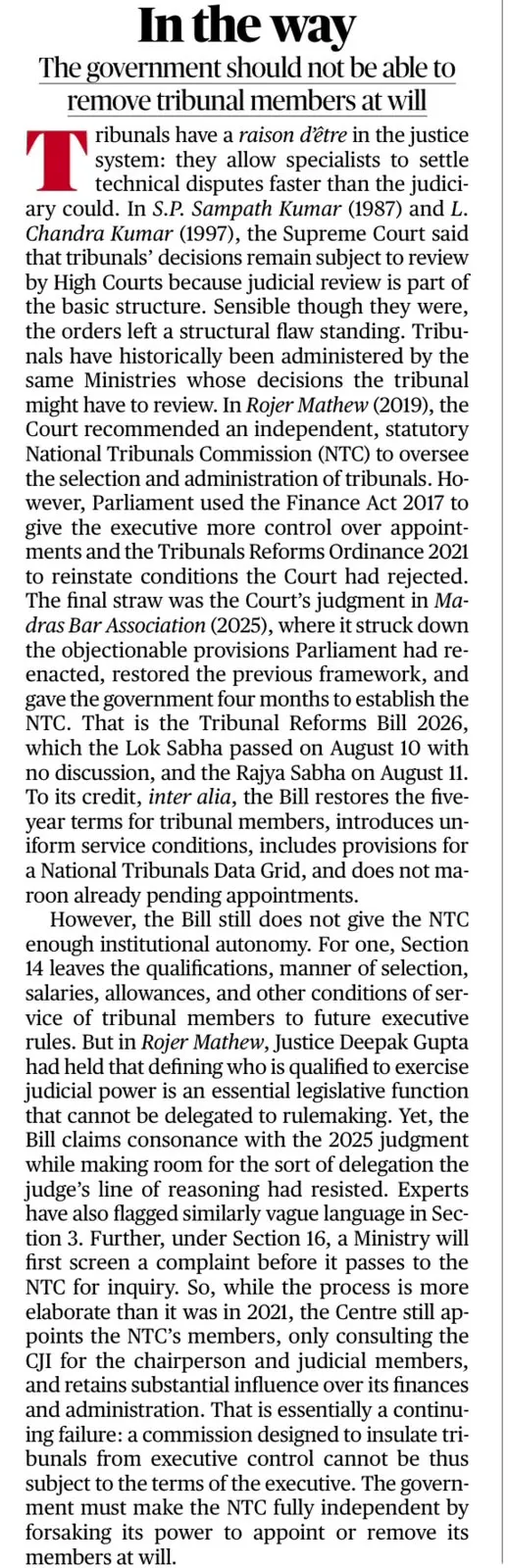
The Tribunals Reforms Bill, 2026, passed by Parliament on 10–11 August 2026, seeks to establish a National Tribunals Commission to improve the efficiency, transparency, uniformity and administration of tribunals.
Constitutional and Judicial Framework
Articles 323A and 323B
Articles 323A and 323B provide the constitutional basis for Administrative Tribunals and tribunals dealing with specified matters such as taxation and industrial disputes.
Judicial Review
Under Articles 226–227, High Courts can review tribunal decisions.
In L. Chandra Kumar, 1997, the Supreme Court held that this power is part of the basic structure.
Judicial Evolution
Rojer Mathew, 2019 and the Madras Bar Association judgment, 2025 stressed the need for greater institutional independence in tribunal administration.
Key Provisions of the Bill
National Tribunals Commission
The Bill creates a central institutional mechanism for:
- Appointments
- Administration
- Performance review
- Complaints concerning tribunals
Five-Year Tenure
The Bill restores a five-year term for tribunal Chairpersons and Members, subject to prescribed age limits.
National Tribunals Data Grid
The Bill creates a common data system to improve monitoring, transparency and evidence-based administration.
16 Tribunals and Appellate Bodies
The framework seeks common standards across the covered tribunals and appellate bodies.
Core Concern: Institutional Independence
Executive Control
The Central Government retains important powers relating to appointments, service conditions and removal.
This can affect the perceived independence of tribunals.
Removal Power
Members can be removed on specified grounds, including:
- Misconduct
- Incapacity
- Abuse of position
- Incompetence
- Inefficiency
Therefore, safeguards in the inquiry process become important.
Financial Autonomy
If administration and finances remain substantially dependent on the executive, an institution intended to provide independent adjudication may remain vulnerable to executive influence.
What Effective Tribunal Reform Requires
Independence
Appointment, tenure, removal and financial arrangements should provide sufficient institutional insulation from the executive.
Efficiency
Vacancies should be filled quickly.
Infrastructure should be strengthened.
The National Tribunals Data Grid should be used for monitoring pendency and performance.
Accountability
Independence must be accompanied by transparent selection, performance standards and grievance mechanisms.
Constitutional Balance
Tribunalisation should supplement, not weaken:
- High Court judicial review
- Separation of powers
- Access to justice
Key Takeaway
The Tribunals Reforms Bill aims to improve tribunal administration through the National Tribunals Commission, but effective reform depends on protecting institutional independence along with efficiency and accountability.