1 July 2026 | Daily Current Affairs

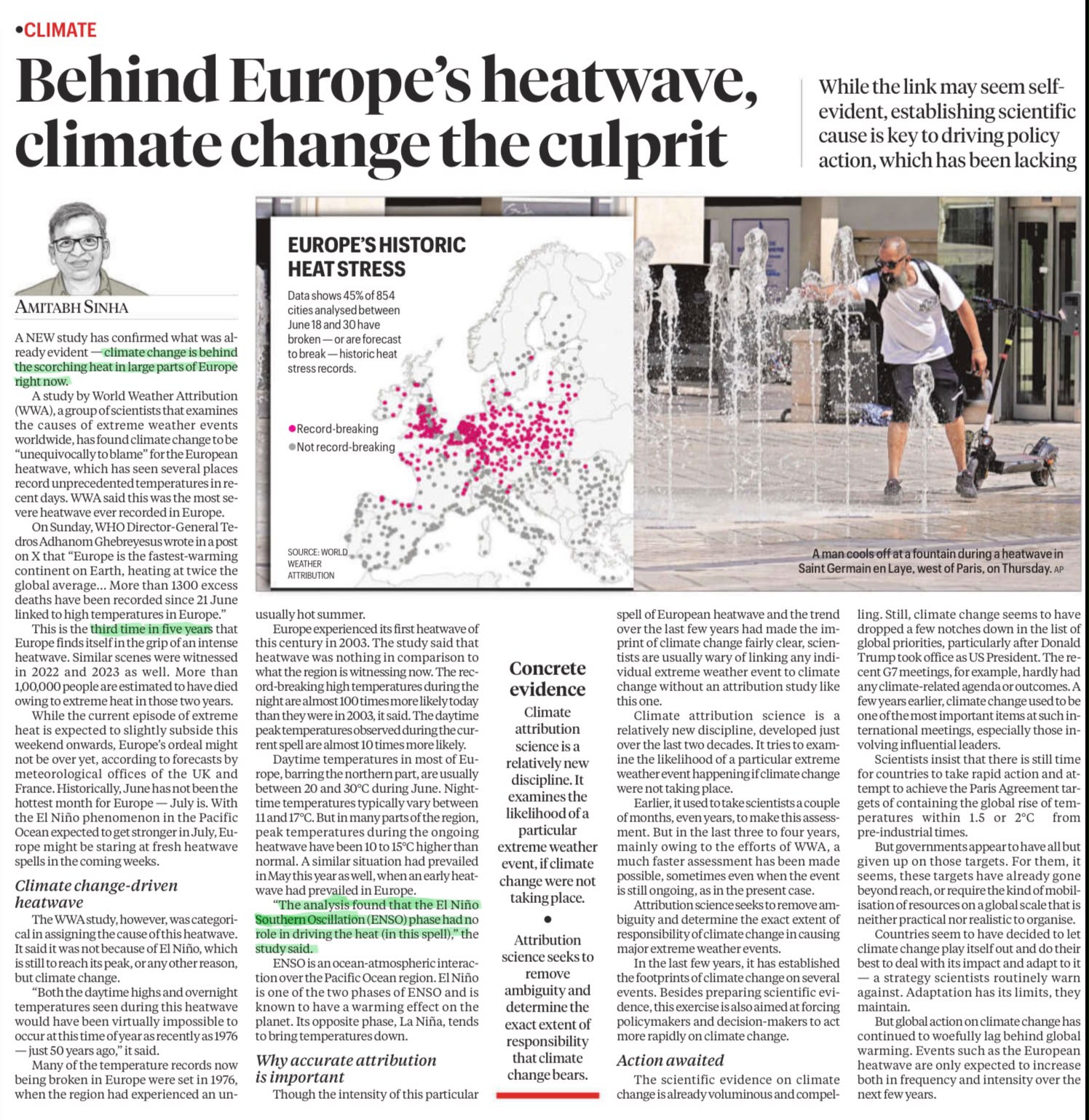
Europe Heatwave Climate Change: WWA Study Explained

Context: Europe Heatwave Climate Change
A World Weather Attribution study concluded that the ongoing European heatwave is primarily driven by human-induced climate change, while El Niño–Southern Oscillation had no significant role.

The study strengthens scientific evidence linking climate change with extreme weather events.

Why Is Europe Facing an Extreme Heatwave?

Primary Cause

Anthropogenic greenhouse gas emissions have increased global temperatures, making heatwaves:

  • More frequent
  • More intense
  • Longer lasting

Why Not ENSO?

Scientists found that the present European heatwave cannot be attributed to El Niño.

Climate change is the dominant driver.

Climate Attribution Science

Climate attribution science estimates how much climate change has increased the probability or intensity of an extreme weather event.

Key Findings

  • 45% of 854 European cities recorded or equalled historic June heat records.
  • More than 1,300 heat-related deaths reported since 21 June.
  • The present heatwave is about 100 times more likely than a similar event in 2003.
  • Daytime temperatures were 2–4°C higher due to climate change.
  • Night temperatures increased by 1–4°C, increasing heat stress.

Why Night Temperatures Matter

High night temperatures are dangerous because the human body gets less time to recover from daytime heat.

This increases risks of:

  • Heat stroke
  • Dehydration
  • Cardiovascular stress
  • Mortality among elderly people
  • Health risks for outdoor workers

Climate Change and Heatwaves

Climate change intensifies heatwaves by:

  • Raising baseline temperatures
  • Increasing atmospheric heat retention
  • Worsening urban heat island effects
  • Increasing frequency of extreme temperature events
  • Creating longer warm spells

Disaster Management Relevance

Governments need:

  • Heat Action Plans
  • Early warning systems
  • Cooling centres
  • Public health advisories
  • Urban greening
  • Heat-resilient housing
  • Worker safety norms
  • Protection for elderly and vulnerable groups

Indian Context

India also faces increasing heatwave risk due to climate change.

This makes heatwave preparedness important for:

  • Urban planning
  • Public health
  • Labour welfare
  • Agriculture
  • Water management
  • Disaster risk reduction

Key Takeaway

Europe’s heatwave shows that climate change is no longer a distant environmental issue. It is already increasing extreme weather risks, public health burdens and disaster-management challenges.
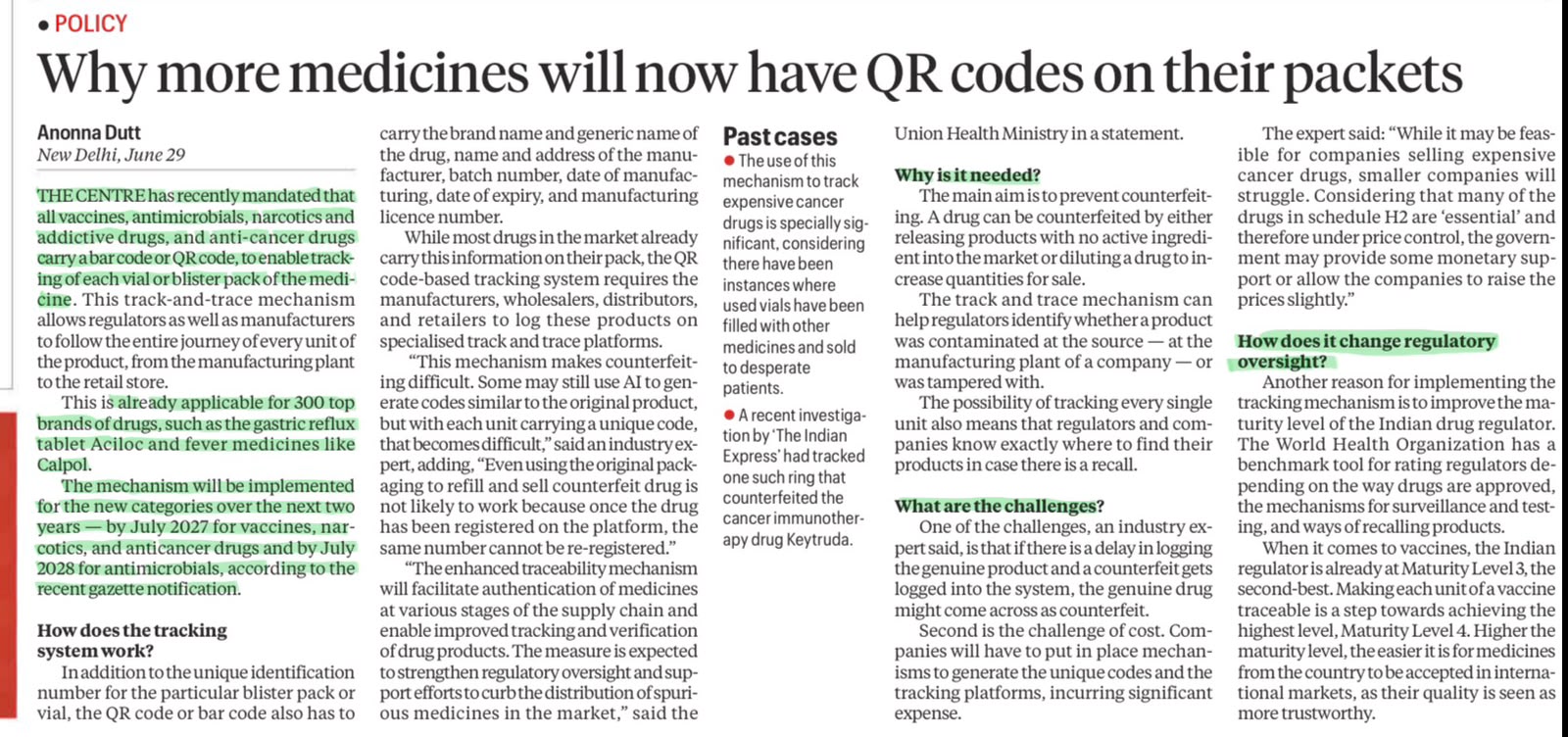
QR Codes on Medicine Packs: New Health Ministry Rule

Context: QR Codes on Medicine Packs
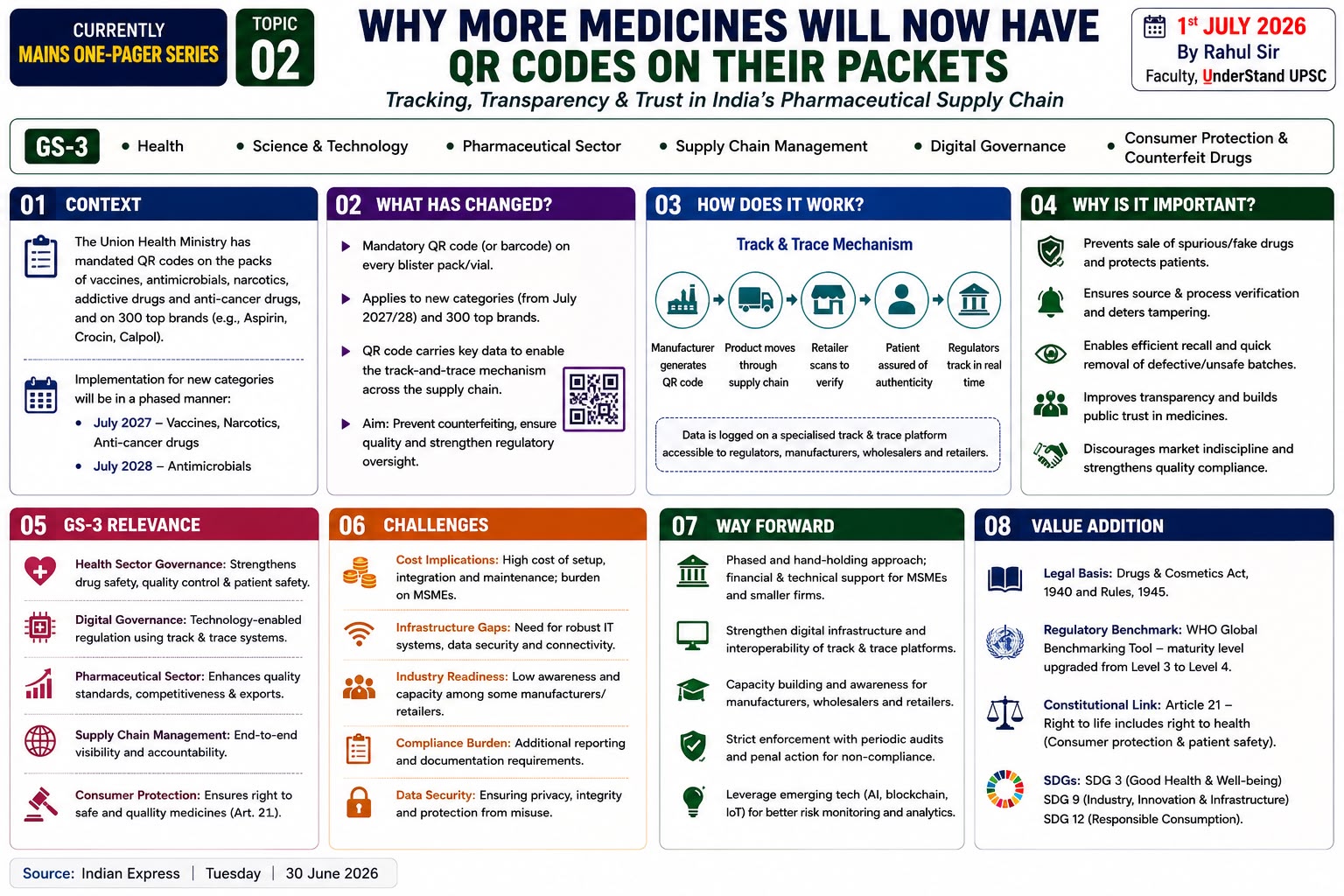
The Union Health Ministry has mandated QR codes on medicine packs to improve traceability, prevent counterfeit drugs and strengthen quality control in the pharmaceutical supply chain.

The requirement will be implemented in phases for selected categories of medicines.

What Has Changed?

More medicines will carry QR codes or barcodes on their packaging.

These QR codes will allow tracking and tracing of medicine packs through the supply chain.

Categories Covered

The rule applies to selected medicines, including:

  • Narcotics
  • Psychotropic substances
  • Anti-cancer drugs
  • Antibiotics
  • Other critical medicines

Implementation Timeline

July 2027

QR codes for:

  • Vaccines
  • Narcotics
  • Anti-cancer drugs

July 2028

QR codes for:

  • Antimicrobials / antibiotics

How QR-Based Tracking Works

Each medicine pack gets a unique identification code.

The code can help verify:

  • Manufacturer details
  • Batch number
  • Expiry date
  • Supply-chain movement
  • Authenticity of the product

Track-and-Trace Mechanism

The medicine can be traced from:

Manufacturer
→ Distributor
→ Stockist
→ Retailer
→ Patient

Why Is It Important?

1. Prevents Counterfeit Drugs

QR codes help identify fake or substandard medicines.

2. Improves Patient Safety

Patients and regulators can verify authenticity.

3. Strengthens Supply Chain

It improves monitoring from manufacturing to retail sale.

4. Faster Recalls

If a batch is defective, it can be quickly traced and recalled.

5. Better Regulatory Oversight

Regulators can track high-risk medicines more effectively.

6. Builds Public Trust

Greater transparency improves confidence in medicine quality.

Legal Basis

Drugs and Cosmetics Act, 1940

  • Regulates import, manufacture, distribution and sale of drugs and cosmetics.

Drugs Rules, 1945

  • Provide detailed rules for regulation of medicines.

Institutions Involved

  • Union Health Ministry
  • Central Drugs Standard Control Organisation
  • State drug regulators
  • Pharmaceutical companies
  • Retail pharmacies

Challenges

  • Cost of QR-code implementation.
  • Integration with existing supply-chain systems.
  • Ensuring data security.
  • Training retailers and regulators.
  • Preventing fake QR codes.
  • Ensuring compliance by small manufacturers.
  • Building consumer awareness.

Way Forward

  • Phased implementation.
  • Strong digital infrastructure.
  • Regular compliance audits.
  • Public awareness campaigns.
  • Integration with regulator databases.
  • Penalties for non-compliance.
  • Use of AI and analytics for suspicious supply-chain patterns.

Mains Value Addition

This topic can be used in answers on:

  • Health governance
  • Pharmaceutical regulation
  • Consumer protection
  • Digital governance
  • Supply-chain transparency
  • Patient safety
  • Counterfeit drug control

Fiscal Federalism in India: State Finance Challenges

Context: Fiscal Federalism in India
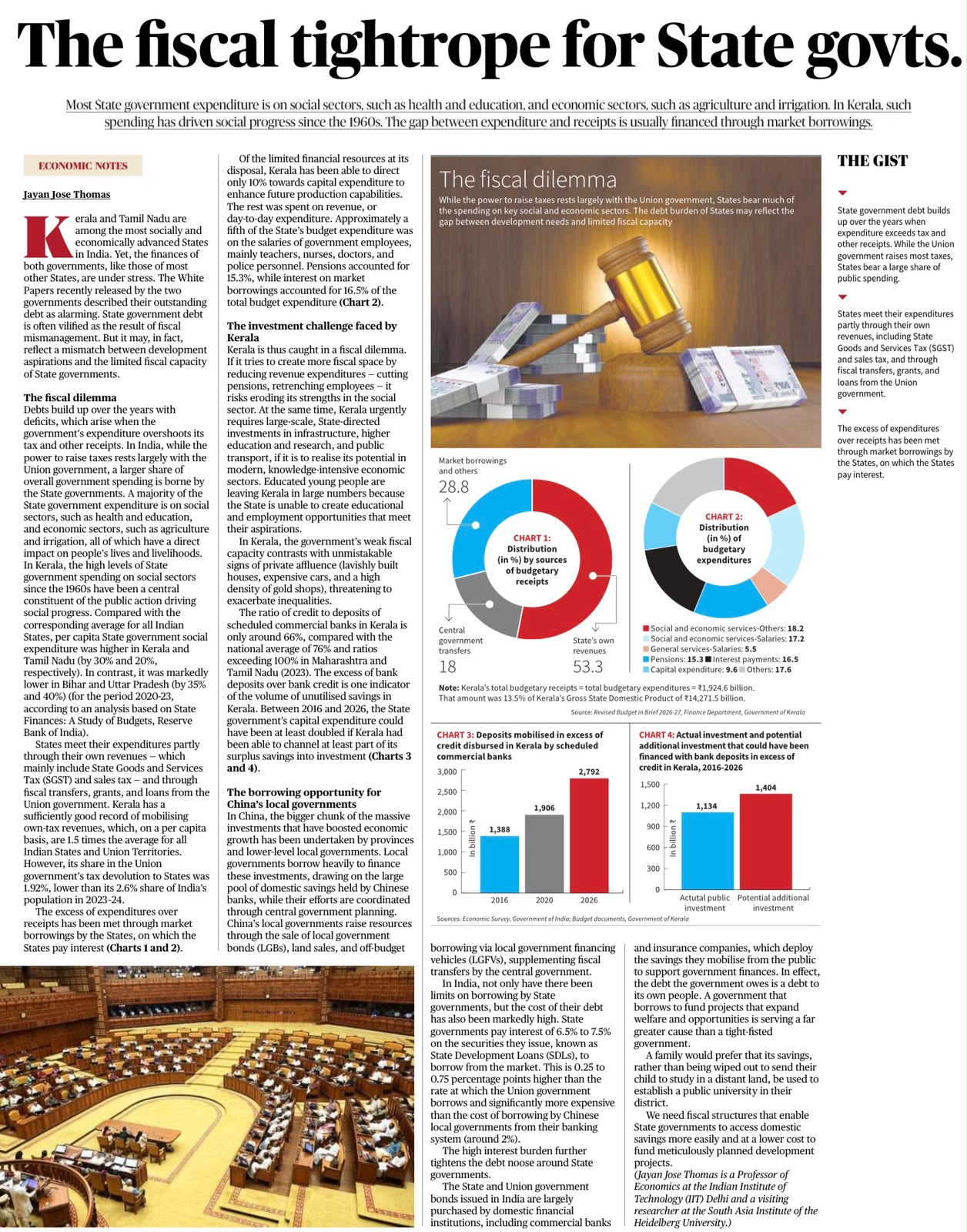
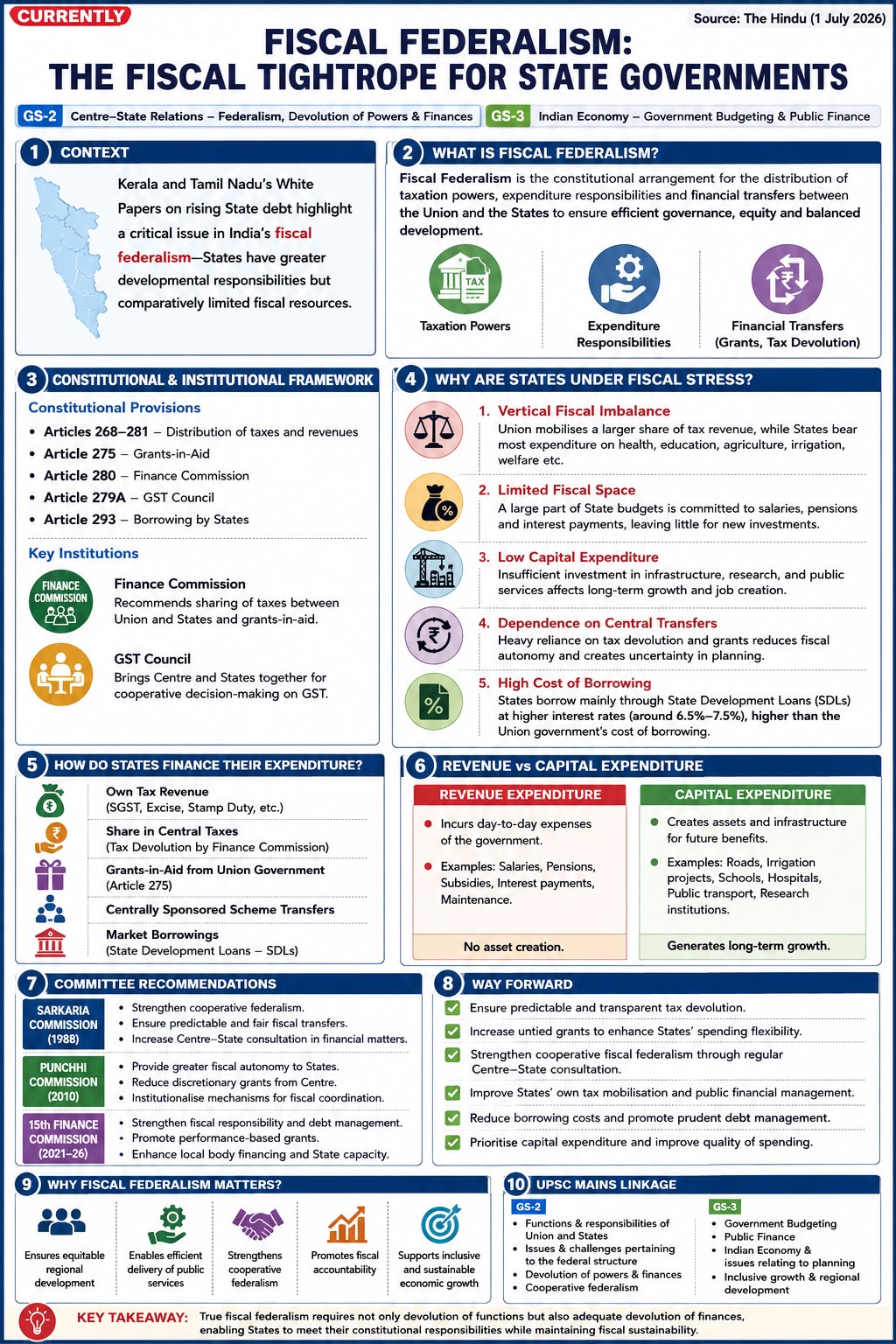
The article highlights the fiscal stress faced by State governments, especially due to rising expenditure on welfare schemes, salaries, pensions, interest payments and limited revenue flexibility.

It uses Kerala and Tamil Nadu as examples to show the larger issue of fiscal federalism in India.

Fiscal Federalism

Fiscal federalism means the constitutional arrangement for distribution of:

  • Taxation powers
  • Expenditure responsibilities
  • Financial transfers

between the Union and State governments.

Why Are States Under Fiscal Stress?

1. Vertical Fiscal Imbalance

The Union collects a larger share of tax revenue, while States bear major expenditure responsibilities in sectors such as:

  • Health
  • Education
  • Agriculture
  • Rural development
  • Police
  • Local infrastructure
  • Welfare delivery

2. Limited Fiscal Space

A large part of State budgets is committed to:

  • Salaries
  • Pensions
  • Interest payments
  • Subsidies
  • Welfare schemes

This reduces funds for capital expenditure and development projects.

3. Low Capital Expenditure

States often spend heavily on revenue expenditure, leaving less money for:

  • Roads
  • Irrigation
  • Health infrastructure
  • School infrastructure
  • Digital infrastructure
  • Public transport

4. Dependence on Central Transfers

States depend on:

  • Tax devolution
  • Grants-in-aid
  • Centrally Sponsored Schemes
  • GST compensation-related mechanisms

5. Borrowing Constraints

States borrow under Article 293 of the Constitution.

Borrowing limits and conditions can restrict State fiscal flexibility.

Constitutional Provisions

Article 268–281

  • Distribution of taxes and revenues between Union and States.

Article 275

  • Grants-in-aid from the Union to States.

Article 280

  • Finance Commission.

Article 293

  • Borrowing by States.

Important Institutions

Finance Commission

Recommends sharing of taxes between Union and States and grants-in-aid.

GST Council

Decides GST-related matters and reflects cooperative fiscal federalism.

How States Finance Expenditure

States rely on:

  • Own tax revenue
  • GST
  • Excise duty
  • Stamp duty
  • State goods and services taxes
  • Tax devolution from Centre
  • Grants-in-aid
  • Market borrowings
  • State Development Loans

Revenue Expenditure vs Capital Expenditure

Revenue Expenditure

Recurring expenditure that does not create assets.

Examples:

  • Salaries
  • Pensions
  • Subsidies
  • Interest payments
  • Administrative expenditure

Capital Expenditure

Expenditure that creates long-term assets.

Examples:

  • Roads
  • Bridges
  • Irrigation projects
  • Schools
  • Hospitals
  • Power infrastructure

Why Fiscal Federalism Matters

  • Supports State autonomy.
  • Ensures regional development.
  • Enables last-mile delivery of public services.
  • Strengthens cooperative federalism.
  • Allows States to respond to local needs.
  • Helps balance accountability with financial capacity.

Way Forward

  • Ensure predictable and transparent tax devolution.
  • Increase untied grants to States.
  • Give States greater borrowing flexibility with safeguards.
  • Strengthen GST compensation and revenue stability.
  • Improve States’ own tax mobilisation.
  • Reduce excessive dependence on centrally designed schemes.
  • Improve quality of expenditure by prioritising capital expenditure.
  • Strengthen local governments and fiscal decentralisation.

Key Takeaway

States carry major welfare and development responsibilities, but their fiscal powers remain limited. Sustainable fiscal federalism requires greater flexibility, predictable transfers and better balance between accountability and autonomy.

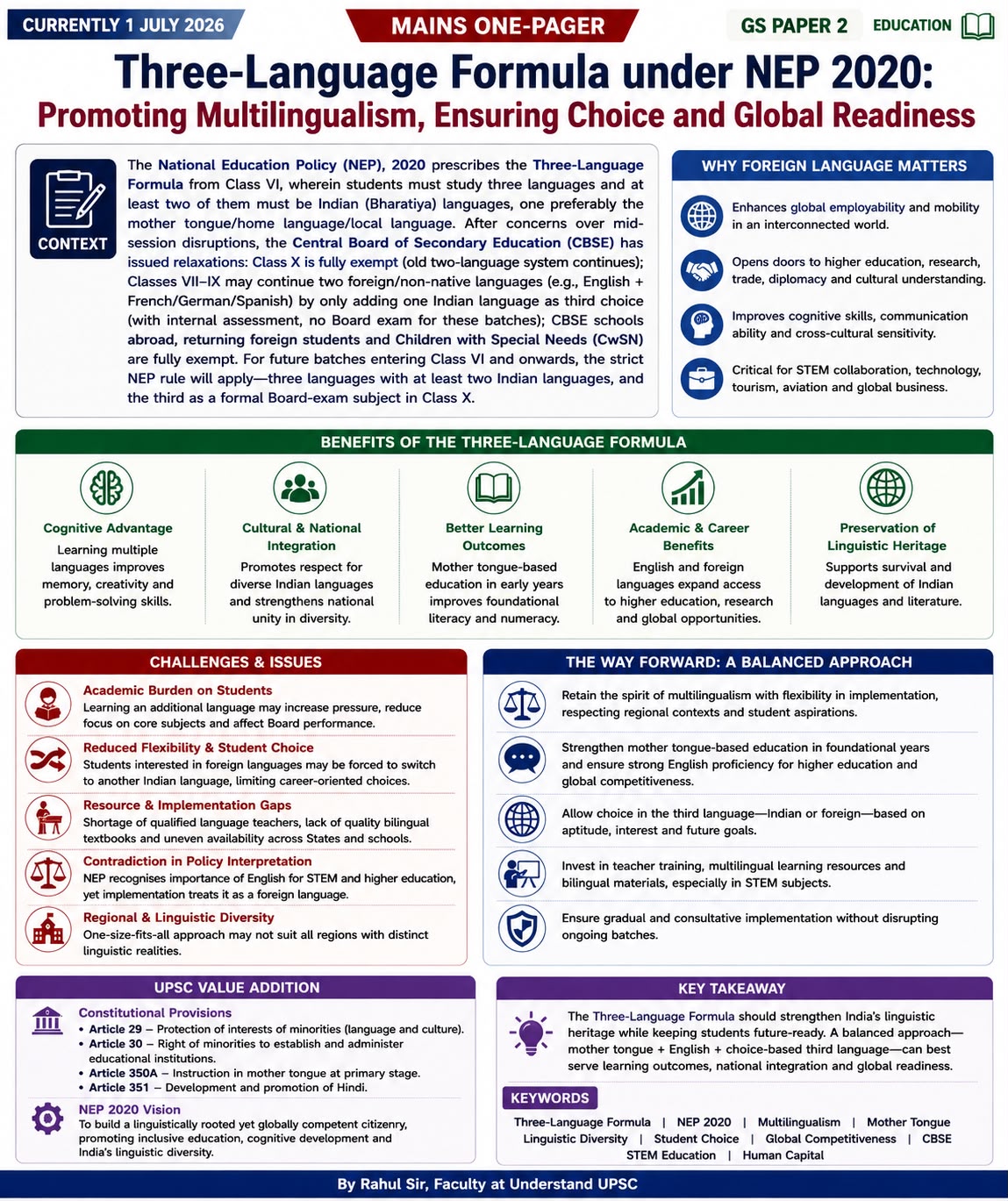
Three Language Formula NEP 2020: CBSE Rules Explained

Context: Three Language Formula NEP 2020
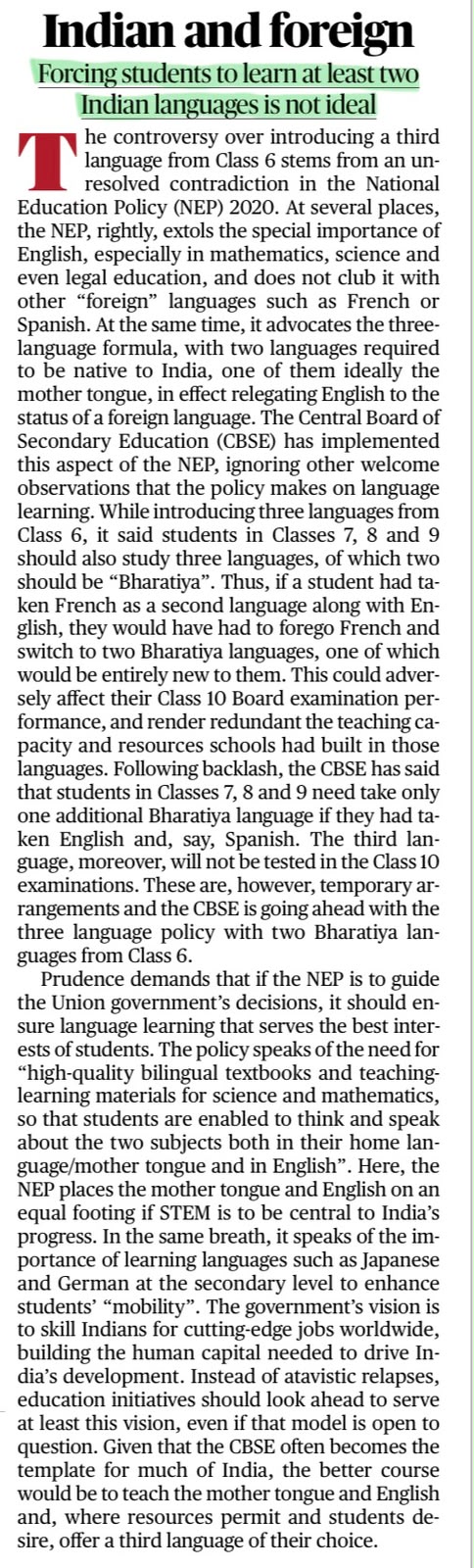
The article discusses the implementation of the Three-Language Formula under National Education Policy 2020, especially the debate around Indian and foreign languages in school education.

The Central Board of Secondary Education has informed schools that from 2026, Class 9 and Class 10 students will study three languages, including at least two Indian languages.

Three-Language Formula under NEP 2020

The National Education Policy 2020 recommends multilingual education.

Core Rule

Students should learn three languages, out of which:

  • At least two must be Indian languages.
  • The choice of languages should be flexible.
  • No language should be imposed on any State or student.

CBSE Implementation

From 2026:

  • Classes 9 and 10 will study three languages.
  • At least two languages must be Indian languages.
  • Foreign languages such as French or German may be offered as an additional or third language depending on school capacity.

Benefits of the Three-Language Formula

1. Cognitive Advantage

Learning multiple languages improves:

  • Memory
  • Creativity
  • Analytical ability
  • Problem-solving skills

2. Cultural and National Integration

Indian languages help students understand:

  • Local culture
  • Literature
  • Heritage
  • Regional identity
  • National diversity

3. Better Learning Outcomes

Mother tongue or familiar language-based education improves conceptual understanding, especially in early education.

4. Academic and Career Benefits

Multilingual ability supports:

  • Higher education
  • Research
  • Diplomacy
  • Translation
  • Tourism
  • International business
  • Global careers

5. Preservation of Linguistic Heritage

The policy can help protect Indian languages, many of which face declining use.

Challenges

1. Academic Burden on Students

Adding another compulsory language may increase pressure on students.

2. Reduced Flexibility

Some students interested in foreign languages may be forced to prioritise another Indian language.

3. Resource Constraints

Many schools lack trained teachers, textbooks and learning materials for multiple languages.

4. Regional and Political Sensitivity

Language policy in India is politically sensitive, especially in States with strong linguistic identities.

5. Impact on Foreign Language Learning

If foreign languages are pushed out of the main curriculum, students may lose exposure to globally useful languages.

Way Forward

  • Keep the formula flexible and non-impositional.
  • Strengthen mother-tongue and Indian-language teaching.
  • Provide trained teachers and quality learning material.
  • Allow foreign languages as additional choices.
  • Use technology and digital platforms for language learning.
  • Implement gradually without disrupting students.
  • Respect linguistic diversity and federal sensitivities.

Constitutional Link

Article 29

  • Protects interests of minorities, including language and culture.

Article 30

  • Gives minorities the right to establish and administer educational institutions.

Article 350A

  • Provides instruction in mother tongue at the primary stage.

Article 351

  • Directs promotion of Hindi while drawing upon other Indian languages.

Key Takeaway

The Three-Language Formula can promote multilingualism, national integration and global readiness, but only if implemented with flexibility, adequate resources and respect for linguistic diversity.

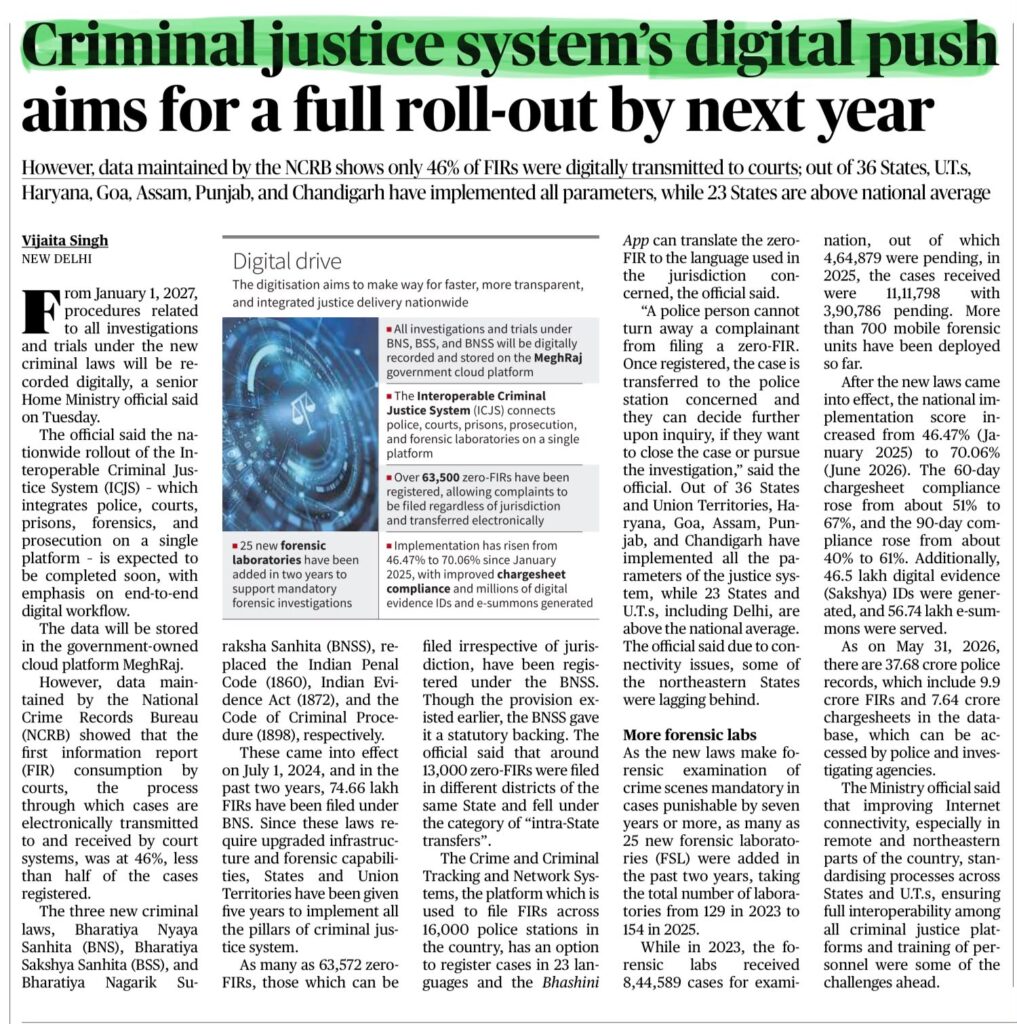
Interoperable Criminal Justice System: ICJS Rollout

Context: Interoperable Criminal Justice System
The Union Home Ministry will roll out the Interoperable Criminal Justice System nationwide from 1 January 2027, enabling end-to-end digital investigation and trial under the new criminal laws.

Interoperable Criminal Justice System

ICJS is a digital platform that integrates major pillars of the criminal justice system.

Institutions Integrated

  • Police
  • Courts
  • Prisons
  • Prosecution
  • Forensic Science Laboratories

Key Features

Digital Records

The system will include:

  • Digital FIRs
  • Chargesheets
  • Case diaries
  • Digital evidence
  • Sakshya ID
  • e-Summons

Cloud Storage

Records will be stored on MeghRaj Cloud.

Citizen-Friendly Features

  • Zero FIR support
  • Bhashini support for 23 Indian languages
  • Digital case tracking
  • Faster access to legal processes

Implementation Status

  • Implementation increased from 46.47% in January 2025 to 70.06% in June 2026.
  • 37.68 crore police records digitised.
  • 9.9 crore FIRs digitised.
  • 7.64 crore chargesheets digitised.

Significance

1. Faster Justice Delivery

Digital integration reduces paperwork and delays.

2. Better Coordination

Police, courts, prisons, prosecutors and forensic labs can work on a connected platform.

3. Transparency

Digital records improve traceability and reduce manipulation.

4. Forensic-led Investigation

Integration with forensic laboratories supports evidence-based investigation.

5. Citizen Access

Language support and digital systems can make criminal justice more accessible.

Challenges

  • Digital infrastructure gaps across States.
  • Cybersecurity risks.
  • Data privacy concerns.
  • Capacity building of police and judicial staff.
  • Uneven implementation across States.
  • Digital divide among citizens.
  • Risk of errors in digitised criminal records.

Way Forward

  • Strengthen cybersecurity architecture.
  • Ensure data protection and access control.
  • Train police, prosecutors and court staff.
  • Improve digital infrastructure in smaller districts.
  • Standardise implementation across States.
  • Build citizen grievance and correction mechanisms.
  • Ensure digital systems do not exclude vulnerable groups.

Key Takeaway

ICJS can make the criminal justice system faster, paperless and more transparent, but its success depends on cybersecurity, uniform State-level implementation and capacity building.

About the UPSC Civil Services Examination (UPSC CSE)

The UPSC Civil Services Examination (CSE) is one of the most competitive and esteemed examinations in India, conducted by the Union Public Service Commission to recruit officers for services such as the Indian Administrative Service (IAS), Indian Police Service (IPS), Indian Foreign Service (IFS), and others. The exam comprises three stages — Prelims, Mains, and the Personality Test (Interview) — designed to test a candidate’s knowledge, aptitude, decision-making, and leadership skills.


How to Prepare Effectively for UPSC CSE

Cracking the UPSC CSE requires a deep understanding of the syllabus, consistent revision, structured answer writing, and smart test-taking strategies. The Prelims test analytical and conceptual clarity, the Mains focuses on critical thinking, articulation, and subject mastery, while the Interview assesses presence of mind, ethical judgment, and personality traits relevant to public service.

At UnderStand UPSC, we empower aspirants with a personalized and focused approach to each stage of the exam.


Why Choose UnderStand UPSC?

UnderStand UPSC is a mentorship-driven platform offering a clear, clutter-free strategy to tackle the Civil Services Examination. Our programs like Transform (for beginners and intermediate learners) and Conquer (for advanced mains preparation) provide structured study plans, syllabus-wise video content, interactive live sessions, and answer writing support.

We emphasize:

  • Concept clarity through topic-wise lectures

  • Test series designed around real UPSC standards

  • Personalized mentorship in small groups

  • Regular performance tracking and peer benchmarking

  • Doubt-clearing sessions, current affairs analysis, and monthly magazines


Join the UnderStand UPSC Learning Community

Our mission is to make UPSC preparation less overwhelming and more strategic. We combine mentorship, discipline, and academic rigor to help you clear CSE with confidence. Whether you’re preparing from Delhi, Mumbai, Bangalore, or a remote village — our online-first model ensures quality guidance reaches every corner of India.

Join the thousands of aspirants who trust UnderStand UPSC to guide their journey toward becoming civil servants.

Stay connected with us through our Telegram, YouTube, and Instagram channels for daily tips, strategies, and updates.

Copyright © 2026 USARAMBHA EDUCATION (UnderStand UPSC). All Rights Reserved.

Fill out the form for

Downloading the free Agriculture Short Notes


Fill out the form

If you have any queries...