17 July 2026 | Daily Current Affairs

Table of Contents

India First Hydrogen Powered Train: UPSC Notes

Context: India First Hydrogen Powered Train
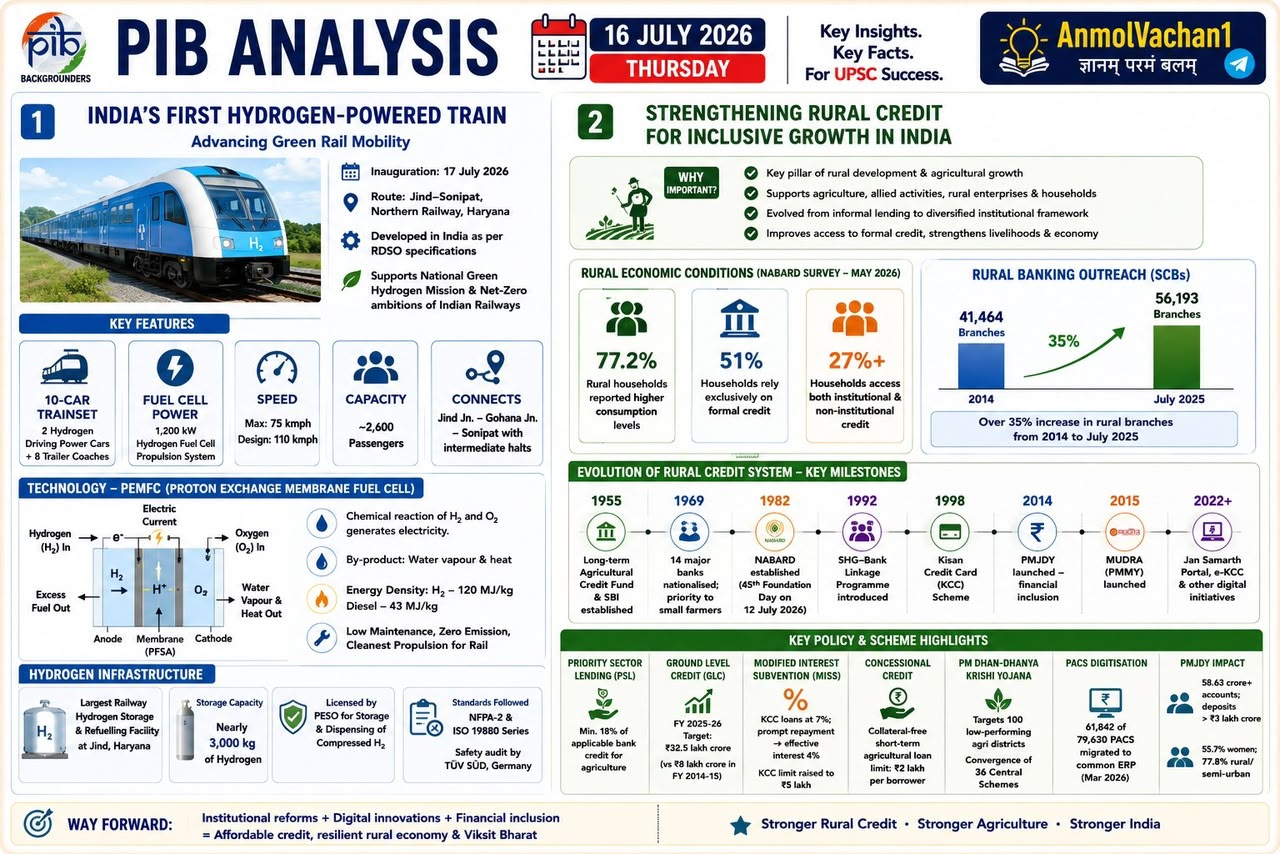
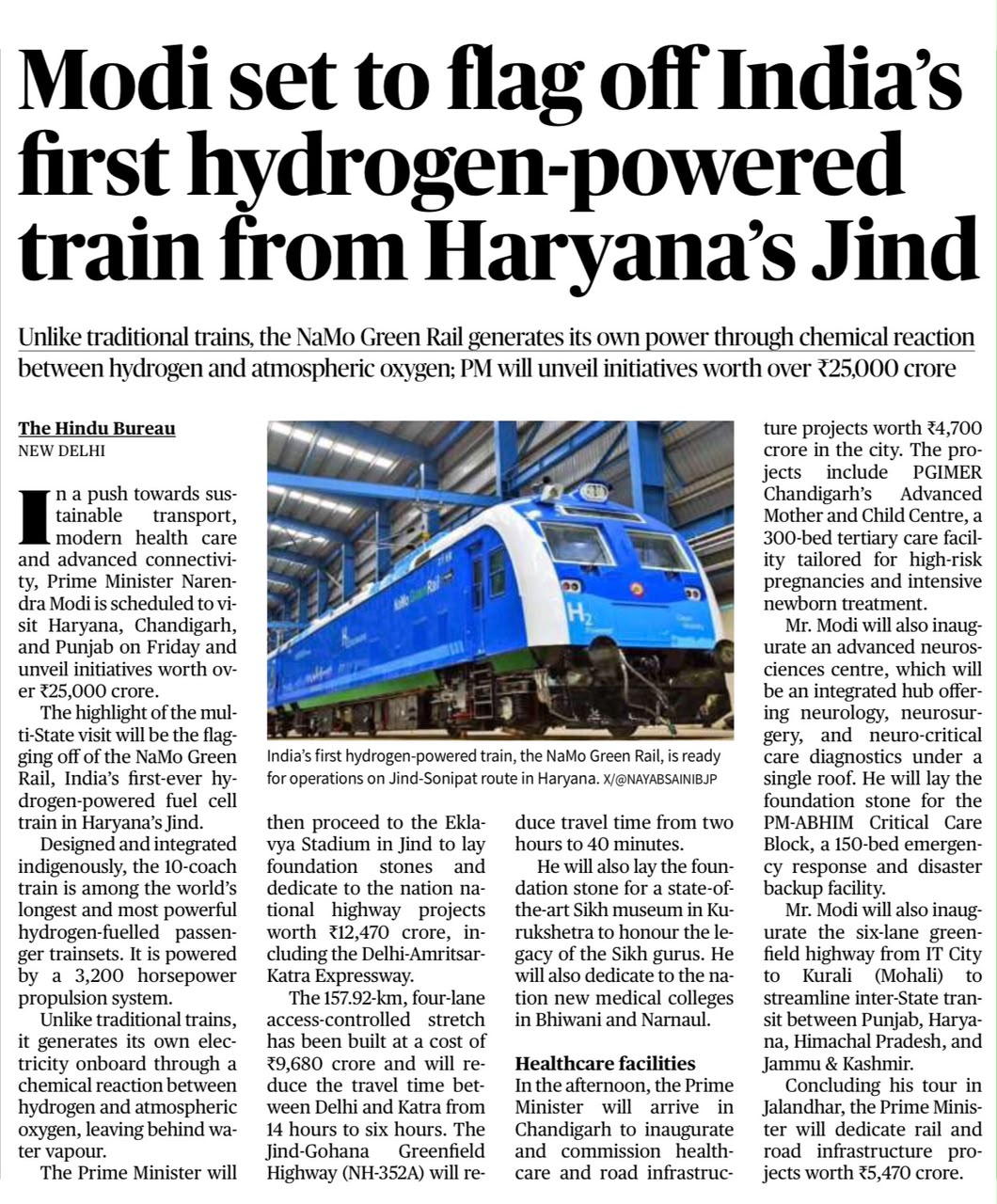
India’s first hydrogen fuel-cell train, NaMo Green Rail, will be flagged off from Jind, Haryana.

The indigenous 10-coach, 3,200 HP train generates electricity onboard using hydrogen, with water vapour as its only direct emission.

How a Hydrogen Fuel-Cell Train Works

Hydrogen stored in onboard tanks combines with atmospheric oxygen inside a fuel cell.

The electrochemical reaction produces:

  • Electricity
  • Heat
  • Water

The electricity powers the traction motors.

Excess energy is stored in batteries.

The only direct emission is water vapour, meaning there are no direct carbon dioxide emissions during train operation.

Why Is It Different?

1. Produces Electricity Onboard

Unlike conventional electric trains, it does not depend only on overhead electric wires.

2. Useful for Non-Electrified Routes

Hydrogen trains can be useful on railway routes where full electrification is difficult or expensive.

3. Cleaner Alternative to Diesel

It can replace diesel locomotives on certain routes and reduce fossil-fuel dependence.

Significance

1. Green Rail Transport

It supports cleaner railway mobility and reduces transport-sector emissions.

2. National Green Hydrogen Mission

The project supports India’s broader hydrogen economy push.

3. Reduced Fossil-Fuel Dependence

Hydrogen-powered transport can reduce dependence on diesel and imported fossil fuels.

4. Climate Goals

It supports India’s clean energy transition and decarbonisation of public transport.

Key Takeaway

Hydrogen-powered trains can become an important clean transport option, especially for non-electrified routes, if hydrogen production, storage and supply infrastructure are strengthened.
India First Hydrogen Powered Train

BIMSTEC Security Chiefs Meeting: UPSC Analysis

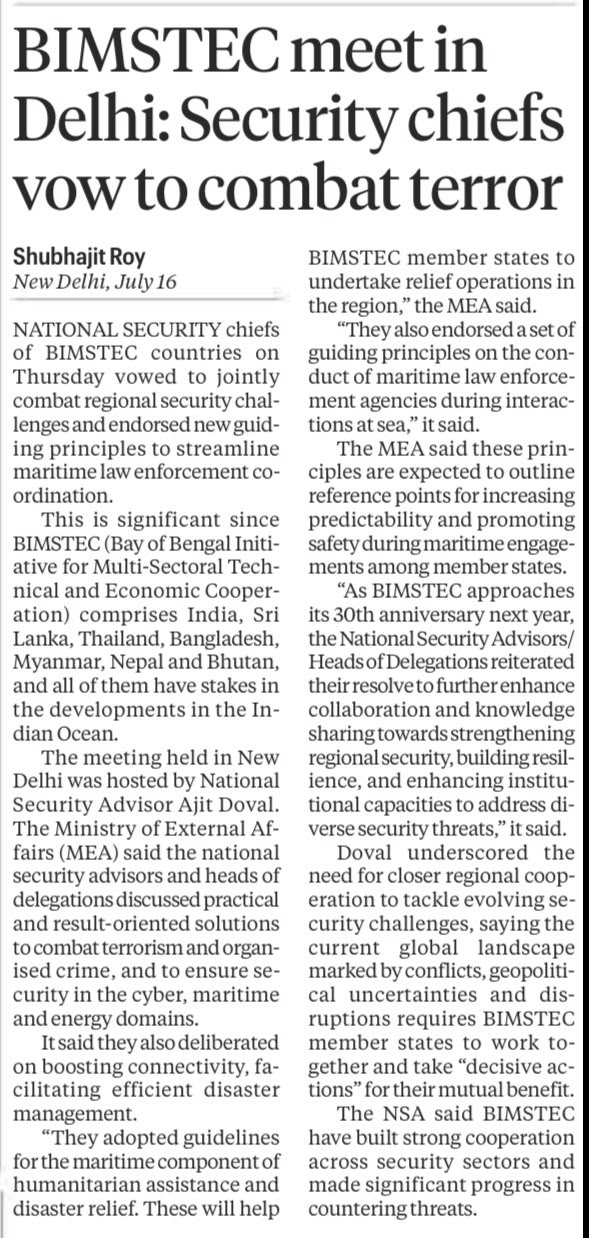
Context:BIMSTEC Security Chiefs Meeting
The National Security Advisers of BIMSTEC countries met in New Delhi, chaired by India’s NSA Ajit Doval.

They agreed to strengthen cooperation in:

  • Counter-terrorism
  • Cyber security
  • Maritime security
  • Disaster management
  • Regional connectivity

They also adopted Guiding Principles for Maritime Law Enforcement and Maritime Humanitarian Assistance and Disaster Relief Guidelines.

BIMSTEC – Basics

Full Form

Bay of Bengal Initiative for Multi-Sectoral Technical and Economic Cooperation.

Established

1997 through the Bangkok Declaration.

Secretariat

Dhaka, Bangladesh.

Members

BIMSTEC has 7 members:

  • Bangladesh
  • Bhutan
  • India
  • Myanmar
  • Nepal
  • Sri Lanka
  • Thailand

Priority Sectors

The 7 priority sectors are:

  • Trade and Investment
  • Security
  • Connectivity
  • Environment and Climate Change
  • Agriculture and Food Security
  • Science and Technology
  • People-to-People Contact

Significance for India

1. Links South and Southeast Asia

BIMSTEC connects India’s neighbourhood with Southeast Asia.

2. Supports Key Policies

It supports:

3. Bay of Bengal Cooperation

It is a key platform for cooperation in the Bay of Bengal region.

Key Outcomes

1. Counter-Terrorism Cooperation

Members agreed to enhance cooperation against terrorism, organised crime and cyber threats.

2. Maritime Law Enforcement

Guiding principles were adopted to improve maritime law enforcement cooperation.

3. Maritime HADR

Maritime humanitarian assistance and disaster relief guidelines were approved.

4. Intelligence Sharing

Members agreed on greater intelligence sharing and institutional capacity building.

Key Takeaway

BIMSTEC is becoming important not only for economic cooperation but also for security, maritime governance and disaster-response coordination in the Bay of Bengal region.

BIMSTEC Security Chiefs Meeting

Vikram-1 Orbital Rocket Launch: UPSC Notes

Context: Vikram-1 Orbital Rocket Launch
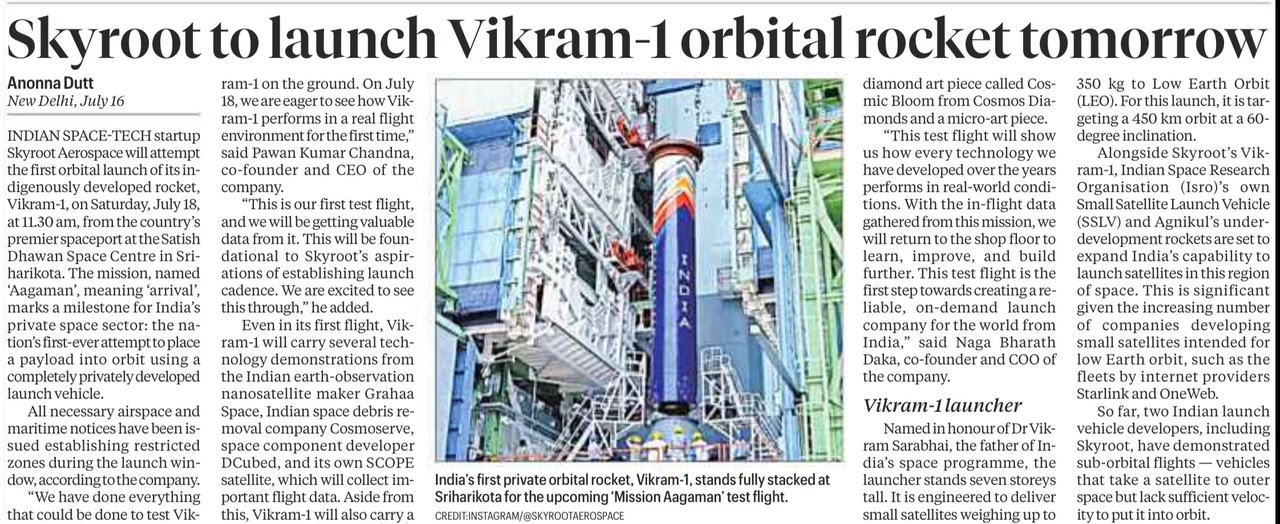
Skyroot Aerospace is set to launch Vikram-1, India’s first privately developed orbital launch vehicle, from Satish Dhawan Space Centre, Sriharikota under Mission Aagaman.

The mission marks a major milestone in India’s private space sector by attempting to place a payload into Low Earth Orbit using an indigenous private rocket.

Vikram-1 – Basics

Developer

Skyroot Aerospace, a Hyderabad-based private space start-up.

Named After

Dr. Vikram Sarabhai, father of India’s space programme.

Mission

Aagaman, meaning “Arrival”.

It is the first orbital test flight.

Payload Capacity

Up to 350 kg to Low Earth Orbit.

Target Orbit

450 km altitude at 60° inclination.

Purpose

To launch small satellites into orbit and demonstrate indigenous private orbital launch capability.

Why Is It Significant?

1. First Private Orbital Attempt

It is the first attempt by an Indian private company to place a payload into orbit.

2. Private Space Ecosystem

It strengthens India’s commercial space ecosystem after space-sector reforms.

3. Complements ISRO

It complements ISRO’s Small Satellite Launch Vehicle for the growing small-satellite market.

4. Commercial Launch Market

It improves India’s competitiveness in global commercial launch services.

Broader Importance

Private participation in space can help India expand:

  • Small satellite launches
  • Commercial launch services
  • Space manufacturing
  • Space start-up ecosystem
  • Global space-market share

Key Takeaway

Vikram-1 represents the shift from a government-only space model to a more commercial and start-up-driven space ecosystem in India.

Vikram-1 Orbital Rocket Launch

India Semiconductor Mission 2.0: UPSC Explained

Context: India Semiconductor Mission 2.0
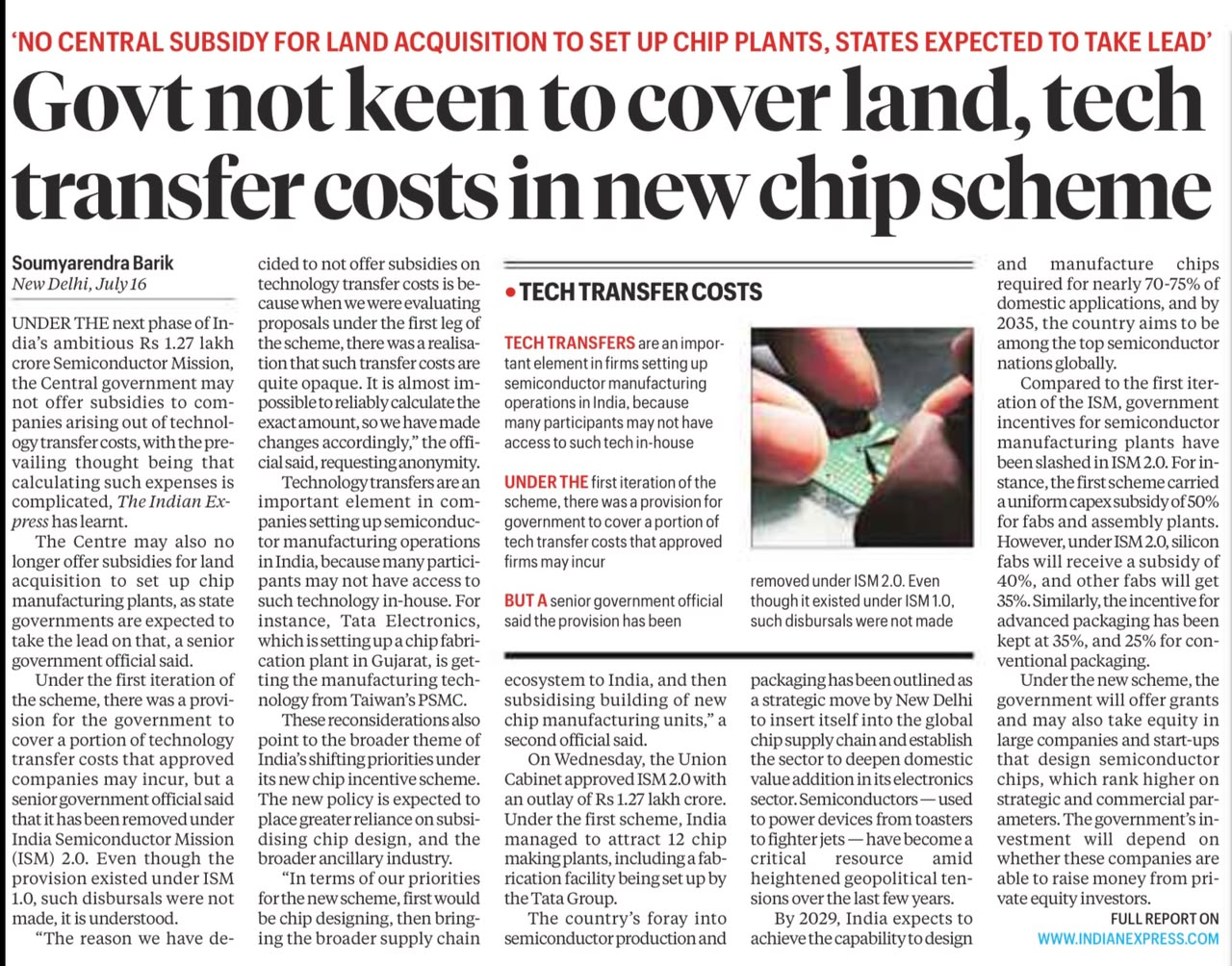
The Union Cabinet has approved India Semiconductor Mission 2.0 with an outlay of ₹1.27 lakh crore.

Compared to ISM 1.0, the new scheme proposes no Central subsidy for land acquisition and technology transfer costs, with States expected to provide land.

The policy shifts focus towards:

  • Chip design
  • Domestic value addition
  • Complete semiconductor ecosystem building

India Semiconductor Mission

Launched

2021

Nodal Ministry

Ministry of Electronics and Information Technology.

Objective

To develop an end-to-end semiconductor ecosystem covering:

  • Chip design
  • Fabrication
  • ATMP / OSAT
  • Supply chain
  • Research and development

ATMP / OSAT

ATMP means Assembly, Testing, Marking and Packaging.

OSAT means Outsourced Semiconductor Assembly and Test.

Target

India aims to meet 70–75% of its semiconductor demand by 2035 and emerge as a leading global semiconductor hub.

What Changes in ISM 2.0?

1. No Land Subsidy

The Centre will not provide subsidy for land acquisition.

States are expected to arrange land for chip projects.

2. No Technology Transfer Cost Support

Technology transfer costs have been removed from eligible incentives because these costs are difficult to assess transparently.

3. Reduced Capital Subsidy

Compared to ISM 1.0:

  • Silicon fabs: 50% to 40%
  • Other fabs: 50% to 35%
  • Advanced packaging: 35%
  • Conventional packaging: 25%

4. Support for Design Companies

Government may provide grants and equity support to semiconductor design companies, subject to their ability to attract private investment.

Why This Policy Shift?

1. Chip Design First

The policy prioritises chip design before manufacturing and supply-chain development.

2. State Participation

States are expected to play a greater role in infrastructure creation.

3. Domestic Value Addition

The focus is on long-term domestic value addition rather than subsidising opaque one-time costs such as technology transfer.

Significance

  • Strengthens semiconductor ecosystem.
  • Encourages private investment.
  • Promotes chip design capacity.
  • Supports electronics manufacturing.
  • Reduces import dependence.
  • Builds strategic technological capability.

Key Takeaway

ISM 2.0 shows a shift from broad subsidies towards a more ecosystem-focused semiconductor strategy based on design, domestic value addition and State-led infrastructure support.

Rural Credit Inclusive Growth India: UPSC Notes

Context:Rural Credit Inclusive Growth India
On the occasion of NABARD’s 45th Foundation Day, the Government highlighted reforms in rural credit, digital outreach and financial inclusion for a stronger and sustainable rural economy.

Why Rural Credit Matters

Rural credit is important because it ensures timely and affordable finance for:

  • Agriculture
  • Allied activities
  • MSMEs
  • Rural enterprises

It helps reduce dependence on informal moneylenders and supports productivity, rural income and employment.

Rural Credit – Key Data

As per NABARD Rural Economic Conditions Survey:

  • 77.2% rural households reported higher consumption.
  • 51% households depend exclusively on formal institutional credit.
  • 27%+ households access both institutional and informal credit.

Rural Banking Network

Scheduled Commercial Bank rural branches increased from:

  • 41,464 branches in 2014
  • 56,193 branches by July 2025

This reflects over 35% increase in rural branches from 2014 to July 2025.

Evolution of Rural Credit

1955

Long-Term Agricultural Credit Fund and State Bank of India.

1969

Nationalisation of 14 major banks.

1982

NABARD established as the Bank for Agriculture and Rural Development.

1992

Self-Help Group–Bank Linkage Programme.

1998

Kisan Credit Card Scheme.

2014

Pradhan Mantri Jan Dhan Yojana.

2015

Pradhan Mantri Mudra Yojana.

2022 onwards

Jan Samarth Portal, e-KCC and other digital initiatives.

Key Policy and Scheme Highlights

1. Priority Sector Lending

Minimum 18% of Adjusted Net Bank Credit is targeted for agriculture.

2. Ground Level Credit

Ground level credit reached ₹32.5 lakh crore.

3. Modified Interest Subvention Scheme

Crop loans are available at 7%.

Interest can reduce to 4% on prompt repayment.

4. Collateral-Free Agricultural Loan

Limit increased to ₹2 lakh per borrower.

5. PM Dhan-Dhaanya Krishi Yojana

Targets 100 low-performing agricultural districts through convergence of 36 Central schemes.

6. PACS Digitisation

61,842 out of 79,630 PACS migrated to a common ERP system by March 2026.

7. PMJDY Impact

Pradhan Mantri Jan Dhan Yojana has enabled:

  • 58.63 crore accounts
  • ₹3 lakh crore deposits
  • 55.7% women beneficiaries
  • 77.8% accounts in rural and semi-urban areas

NABARD – Key Facts

Established

1982

Headquarters

Mumbai

Parent Act

National Bank for Agriculture and Rural Development Act, 1981

Role

NABARD is the apex development financial institution for agriculture and rural development.

Challenges

  • Dependence on informal credit still persists.
  • Regional disparities in credit flow.
  • Limited access for tenant farmers and smallholders.
  • Need for stronger digital infrastructure.
  • Need for improved financial literacy.

Way Forward

  • Ensure universal access to affordable institutional credit.
  • Expand digital credit through e-KCC, PACS and Jan Samarth.
  • Strengthen Farmer Producer Organisations and rural MSME value chains.
  • Integrate credit with insurance, markets and agri-infrastructure.
  • Improve financial literacy and digital access.

Key Takeaway

Stronger rural credit means stronger agriculture, stronger rural enterprise and stronger inclusive growth.

Rural Credit Inclusive Growth India
About the UPSC Civil Services Examination (UPSC CSE)

The UPSC Civil Services Examination (CSE) is one of the most competitive and esteemed examinations in India, conducted by the Union Public Service Commission to recruit officers for services such as the Indian Administrative Service (IAS), Indian Police Service (IPS), Indian Foreign Service (IFS), and others. The exam comprises three stages — Prelims, Mains, and the Personality Test (Interview) — designed to test a candidate’s knowledge, aptitude, decision-making, and leadership skills.


How to Prepare Effectively for UPSC CSE

Cracking the UPSC CSE requires a deep understanding of the syllabus, consistent revision, structured answer writing, and smart test-taking strategies. The Prelims test analytical and conceptual clarity, the Mains focuses on critical thinking, articulation, and subject mastery, while the Interview assesses presence of mind, ethical judgment, and personality traits relevant to public service.

At UnderStand UPSC, we empower aspirants with a personalized and focused approach to each stage of the exam.


Why Choose UnderStand UPSC?

UnderStand UPSC is a mentorship-driven platform offering a clear, clutter-free strategy to tackle the Civil Services Examination. Our programs like Transform (for beginners and intermediate learners) and Conquer (for advanced mains preparation) provide structured study plans, syllabus-wise video content, interactive live sessions, and answer writing support.

We emphasize:

  • Concept clarity through topic-wise lectures

  • Test series designed around real UPSC standards

  • Personalized mentorship in small groups

  • Regular performance tracking and peer benchmarking

  • Doubt-clearing sessions, current affairs analysis, and monthly magazines


Join the UnderStand UPSC Learning Community

Our mission is to make UPSC preparation less overwhelming and more strategic. We combine mentorship, discipline, and academic rigor to help you clear CSE with confidence. Whether you’re preparing from Delhi, Mumbai, Bangalore, or a remote village — our online-first model ensures quality guidance reaches every corner of India.

Join the thousands of aspirants who trust UnderStand UPSC to guide their journey toward becoming civil servants.

Stay connected with us through our Telegram, YouTube, and Instagram channels for daily tips, strategies, and updates.

Copyright © 2026 USARAMBHA EDUCATION (UnderStand UPSC). All Rights Reserved.

IMPETUS (ONLINE)
IMPETUS (OFFLINE)

Fill out the form

Fill out the form for

Downloading the free Agriculture Short Notes