18 July 2026 | UPSC Daily Current Affairs

18 July 2026 | UPSC Daily Current Affairs

Special Intensive Revision Data: SC Limits Non-Poll Use

Context: Special Intensive Revision data
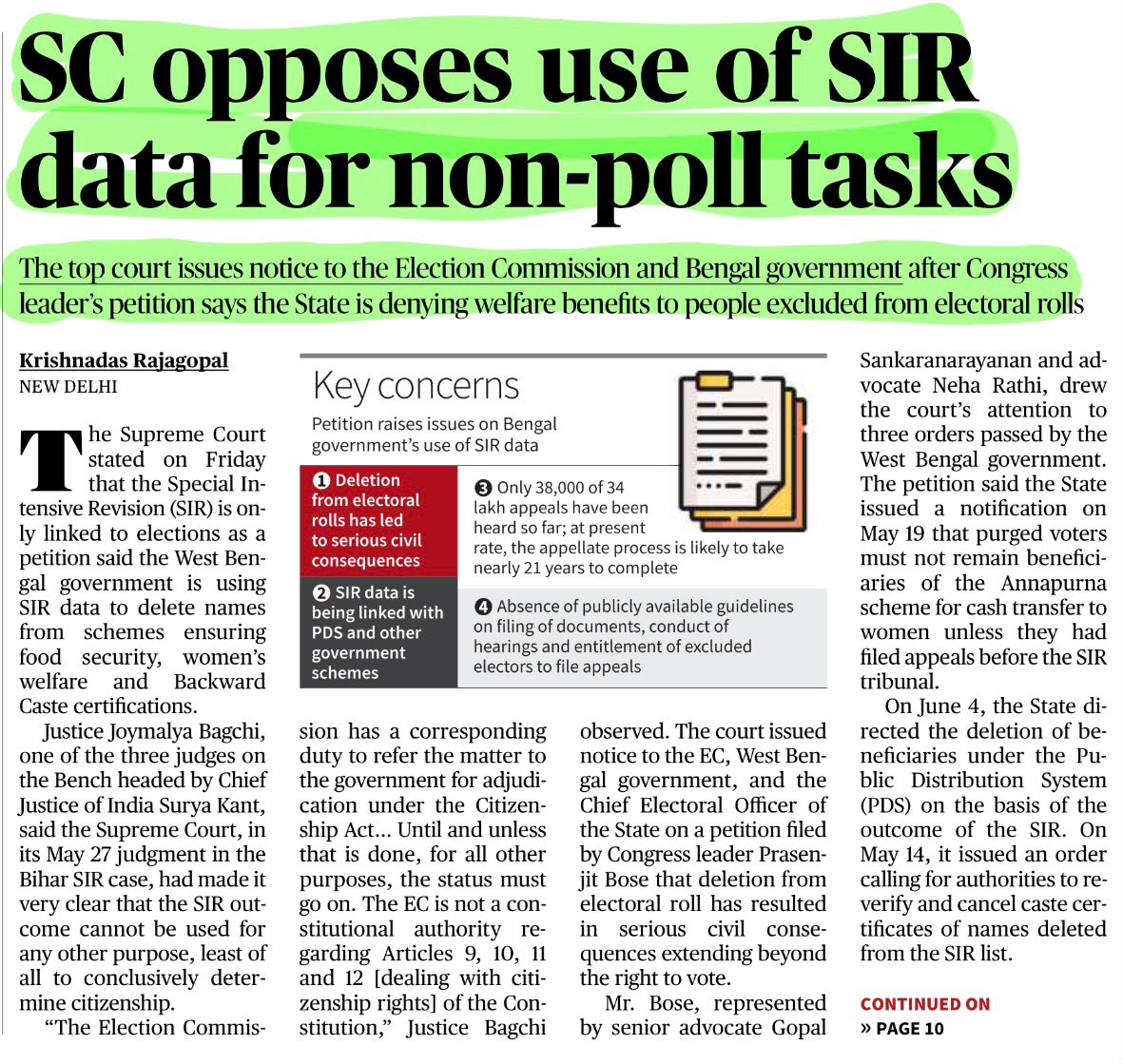
The Supreme Court issued notice to the Election Commission, the West Bengal Government and the Chief Electoral Officer on a plea alleging that Special Intensive Revision data was being used to deny welfare benefits.

The Court observed that SIR is meant only for electoral roll revision and cannot be used for non-electoral purposes.

Basics

Special Intensive Revision

Special Intensive Revision is a comprehensive revision of electoral rolls undertaken by the Election Commission to ensure that only eligible voters are enrolled.

Constitutional Provisions

Article 324

Gives powers of superintendence, direction and control of elections to the Election Commission.

Article 326

Provides for elections based on adult suffrage.

Parliamentary Law

The Representation of the People Act, 1950 deals with electoral rolls.

Important sections:

  • Section 21 — Preparation and revision of electoral rolls
  • Section 22 — Correction of entries
  • Section 23 — Inclusion of names in electoral rolls

Supreme Court’s Recent Directions

1. SIR Is Only an Electoral Exercise

SIR cannot be used for administrative or welfare purposes.

2. Electoral Deletion Is Not Citizenship Loss

Deletion of a name from the electoral roll does not automatically mean loss of Indian citizenship.

3. Election Commission Cannot Decide Citizenship

The Election Commission is not the authority to determine citizenship.

Citizenship can be determined only by the competent authority under the Citizenship Act, 1955.

4. Welfare Benefits Cannot Be Denied Using SIR Data

SIR data cannot be used to deny:

  • Ration cards
  • Welfare schemes
  • Civil entitlements
  • Other non-electoral benefits

Significance

This issue is important because it protects the boundary between electoral administration and citizenship/welfare rights.

Electoral rolls are meant for voting purposes. If they are used for welfare exclusion, it may create serious civil consequences for citizens, especially poor and vulnerable groups.

Key Takeaway

SIR data belongs to the electoral domain. It cannot become a tool for denying welfare, ration cards or civil entitlements.
Judicial Impeachment After Resignation: Constitutional Debate

Context: Judicial impeachment after resignation
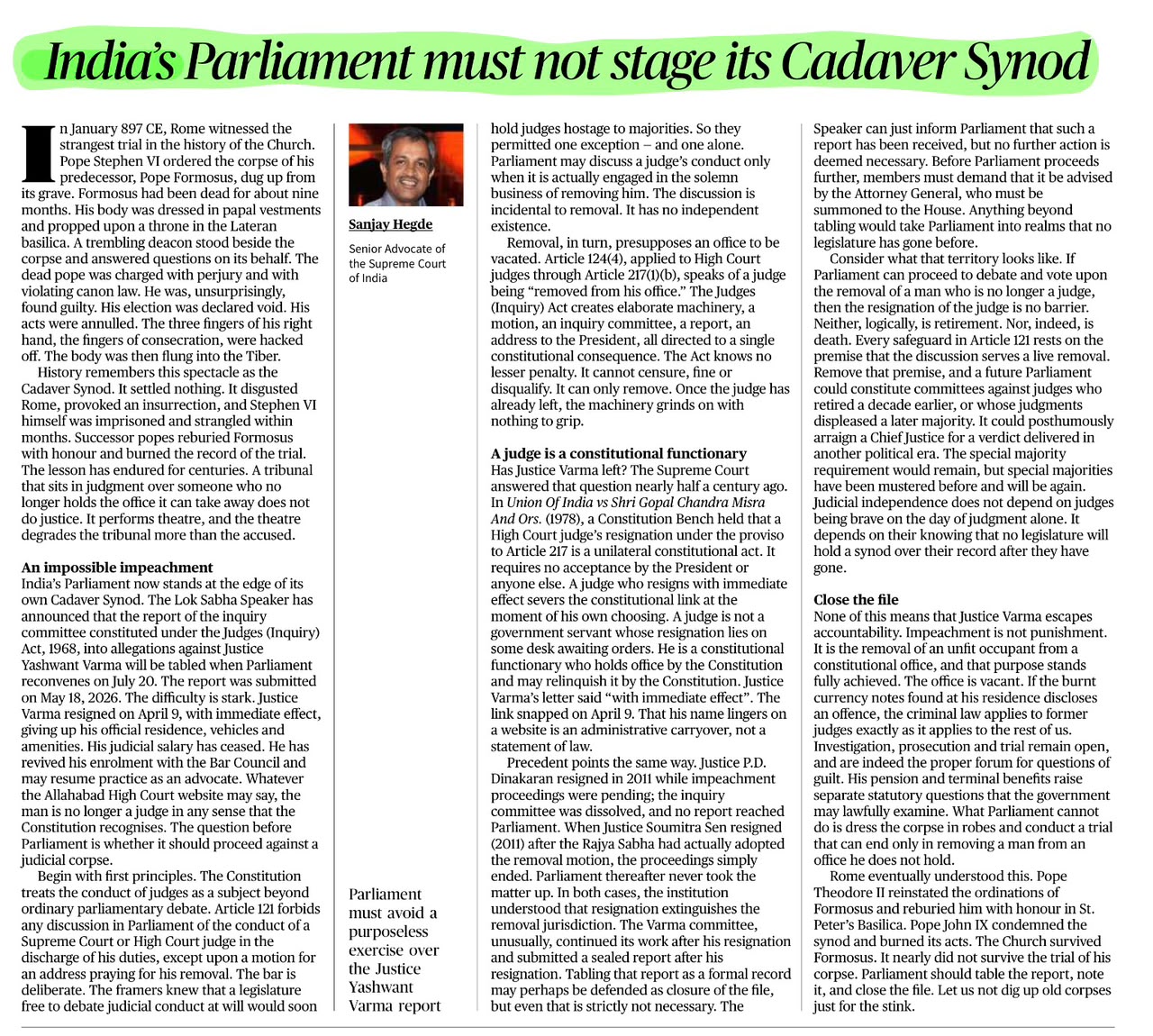
The editorial argues that Parliament should not continue impeachment proceedings against former Justice Yashwant Varma after his resignation.

The central argument is that impeachment is meant only to remove a sitting judge, not to examine the conduct of a person who no longer holds judicial office.

Basics

Constitutional Provisions

Article 121

Parliament cannot discuss the conduct of a Supreme Court or High Court judge except on a motion for removal.

Article 124(4)

Provides for removal of a Supreme Court judge.

Article 124(5)

Allows Parliament to regulate the removal procedure by law.

Article 217(1)(b)

A High Court judge may resign by writing to the President.

Parliamentary Law

Judges (Inquiry) Act, 1968

This Act prescribes the procedure for investigation and removal of judges.

Purpose of Impeachment

Impeachment is not a punishment.

Its sole objective is to remove a sitting judge on the ground of:

  • Proved misbehaviour
  • Incapacity

Editorial’s Key Arguments

1. Resignation Ends the Removal Process

Once a judge resigns, the constitutional purpose of impeachment becomes infructuous because there is no sitting judge left to remove.

2. Parliament Should Avoid Debating Former Judge’s Conduct

The editorial argues that Parliament should not debate the conduct of a person who is no longer a judge.

3. Criminal Misconduct Should Follow Criminal Law

If any criminal misconduct is disclosed, it should be dealt with under ordinary criminal law, not through impeachment.

4. Risk to Judicial Independence

Continuing impeachment after resignation may create an undesirable constitutional precedent and may affect judicial independence.

Significance

This topic is important for understanding:

  • Separation of powers
  • Judicial accountability
  • Parliamentary privilege
  • Judicial independence
  • Constitutional limits on impeachment

Key Takeaway

Impeachment is a constitutional removal mechanism, not a post-retirement punishment mechanism. Once the judge resigns, ordinary law should deal with any criminality.

Vishwas 2026 EPFO Scheme: One-Time Dispute Settlement

Context: Vishwas 2026 EPFO Scheme
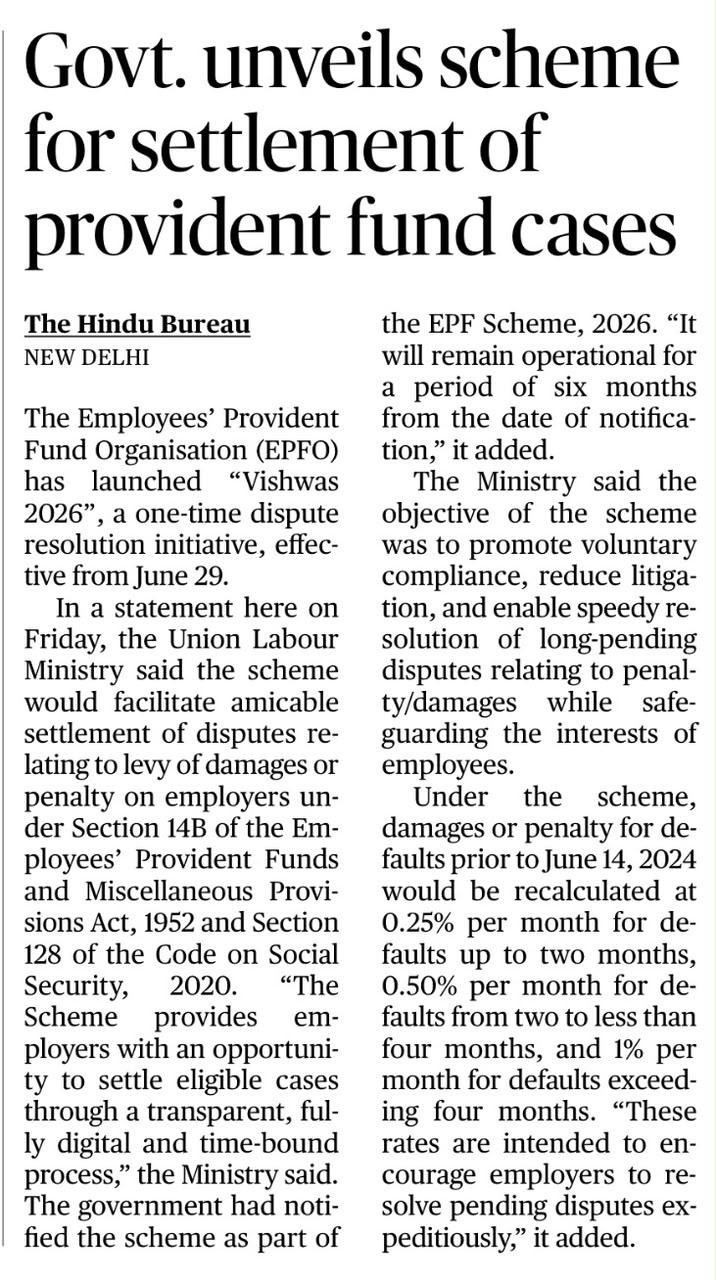
The Employees’ Provident Fund Organisation has launched Vishwas 2026, a one-time dispute resolution scheme.

The scheme aims to facilitate faster settlement of pending provident fund penalty and damages cases and promote voluntary compliance.

Vishwas 2026 Scheme

Nature

It is a one-time dispute resolution scheme notified under the EPF Scheme, 2026.

Coverage

It covers disputes relating to damages and penalties under:

Applicability

The scheme applies to defaults committed before 14 June 2024.

It will remain operational for six months from the date of notification.

Purpose

The scheme seeks to:

  • Reduce litigation
  • Ensure speedy settlement of disputes
  • Encourage voluntary compliance
  • Provide a fully digital and time-bound process

Basics: Employees’ Provident Fund Organisation

EPFO

EPFO is a statutory body under the Ministry of Labour and Employment.

Law Administered

It administers the Employees’ Provident Funds and Miscellaneous Provisions Act, 1952.

Major Schemes Managed by EPFO

EPFO manages major social security schemes such as:

  • Employees’ Provident Fund
  • Employees’ Pension Scheme
  • Employees’ Deposit Linked Insurance Scheme

Role of EPFO

EPFO provides:

  • Retirement savings
  • Pension benefits
  • Social security cover

mainly for organised sector employees.

Significance

The scheme can help employers settle pending cases more easily while reducing the burden of long litigation.

It also supports labour compliance reforms by encouraging employers to resolve disputes through a transparent and digital mechanism.

Key Takeaway

Vishwas 2026 is a labour compliance and dispute-resolution initiative aimed at reducing litigation and improving social security governance.

China Global AI Governance: New AI Order Explained

Context: China Global AI Governance
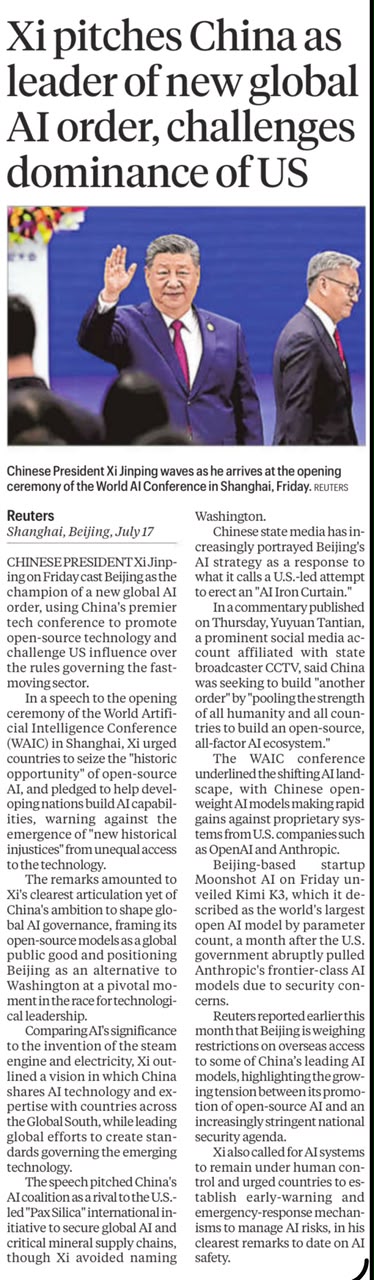
At the World Artificial Intelligence Conference, President Xi Jinping projected China as a leader of a new global AI order.

China promoted open-source AI and expanded AI cooperation with the Global South.

China’s Long-Term Global South AI Governance Initiative

1. Open-Source AI as a Global Public Good

China wants to promote open-source AI to reduce dependence on proprietary AI models.

This is also presented as an alternative to the U.S.-led AI ecosystem.

2. AI Capacity Building in Developing Countries

China aims to build AI capacity in developing countries through:

  • Technology transfer
  • Training
  • Infrastructure support

3. Participation of Global South

China wants greater participation of developing countries in framing international AI rules and standards.

4. Bridging the AI and Digital Divide

The initiative seeks to improve equitable access to AI technologies.

This is important because AI infrastructure, compute power and advanced models are currently concentrated in a few advanced economies and large technology companies.

5. Global AI Safety Mechanisms

China has called for AI safety mechanisms while keeping AI under human control.

6. China as AI Partner for Global South

China is positioning itself as the leading AI partner for the Global South and as an alternative to the U.S.-led AI governance model.

Significance

This development is important because AI governance is becoming a major part of global geopolitics.

The issue is not only technological. It is also about:

  • Global rule-making
  • Data power
  • Digital sovereignty
  • Technology access
  • Strategic influence
  • Global South leadership

India Angle

For India, this raises the need to build its own AI capacity while also shaping inclusive AI governance.

India’s interests lie in:

  • Responsible AI
  • Digital public infrastructure
  • Global South participation
  • Data protection
  • Strategic autonomy
  • Affordable AI access

Key Takeaway

China is trying to use AI governance as a geopolitical tool by presenting itself as the AI partner of the Global South.

Chabahar Port Attack Impact on India and West Asia

Context: Chabahar Port attack impact
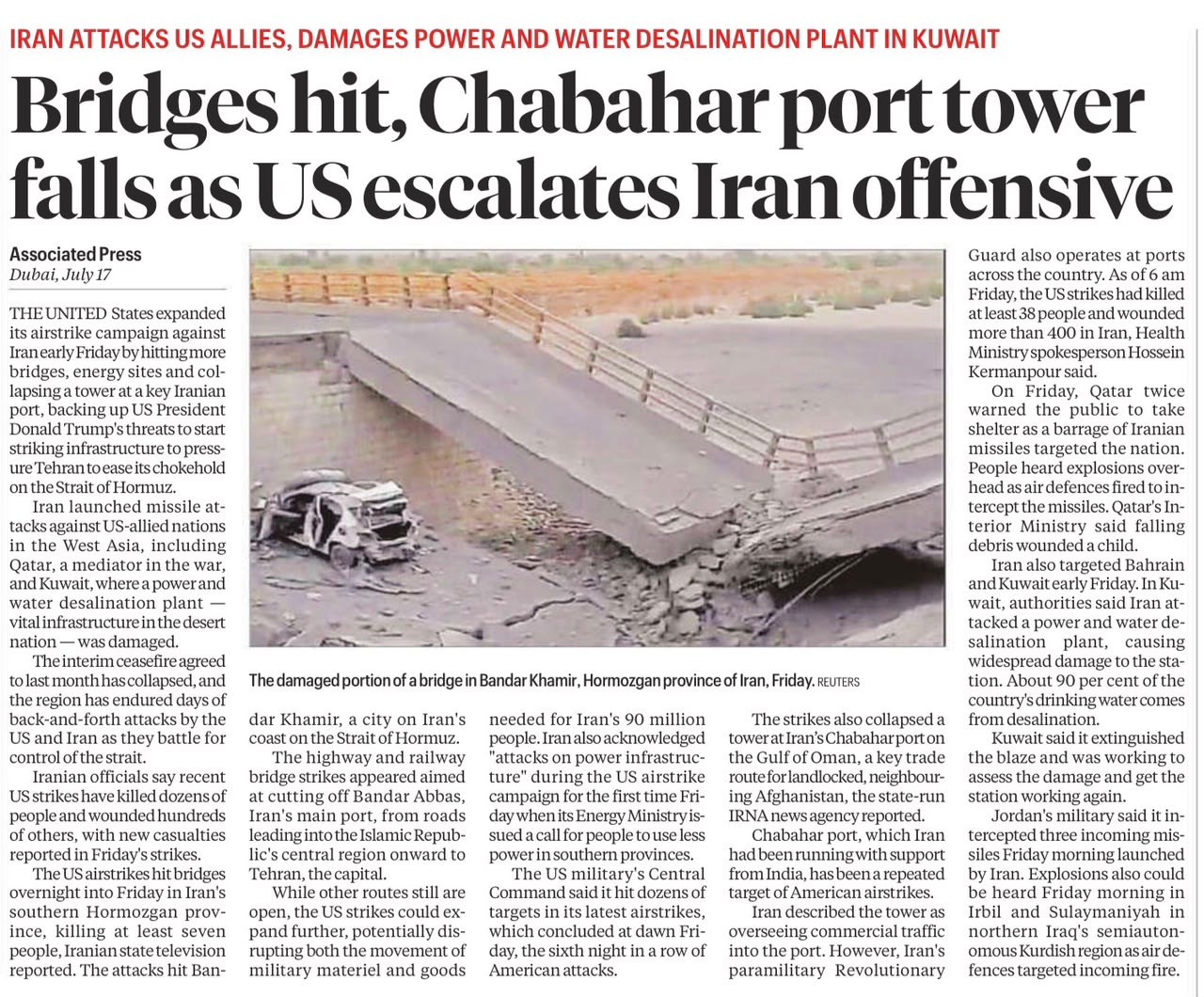
The U.S. intensified airstrikes on Iran, targeting key transport and energy infrastructure.

Iran retaliated by attacking U.S. allies in West Asia, escalating the regional conflict.

Major Infrastructure Destroyed

1. Road and Railway Bridges

Road and railway bridges in Iran’s Hormozgan Province were struck.

This disrupted connectivity to Bandar Abbas, Iran’s largest port.

2. Power Infrastructure

Power infrastructure was targeted.

Iran had to appeal for reduced electricity consumption.

3. Chabahar Port Tower

The commercial traffic control tower at Chabahar Port collapsed due to the strikes.

This disrupted port operations.

4. Retaliatory Missile Attacks

Iran launched retaliatory missile attacks on:

  • Kuwait
  • Bahrain
  • Qatar
  • Jordan

A power and water desalination plant in Kuwait was damaged.

Chabahar Port: Importance

1. Location

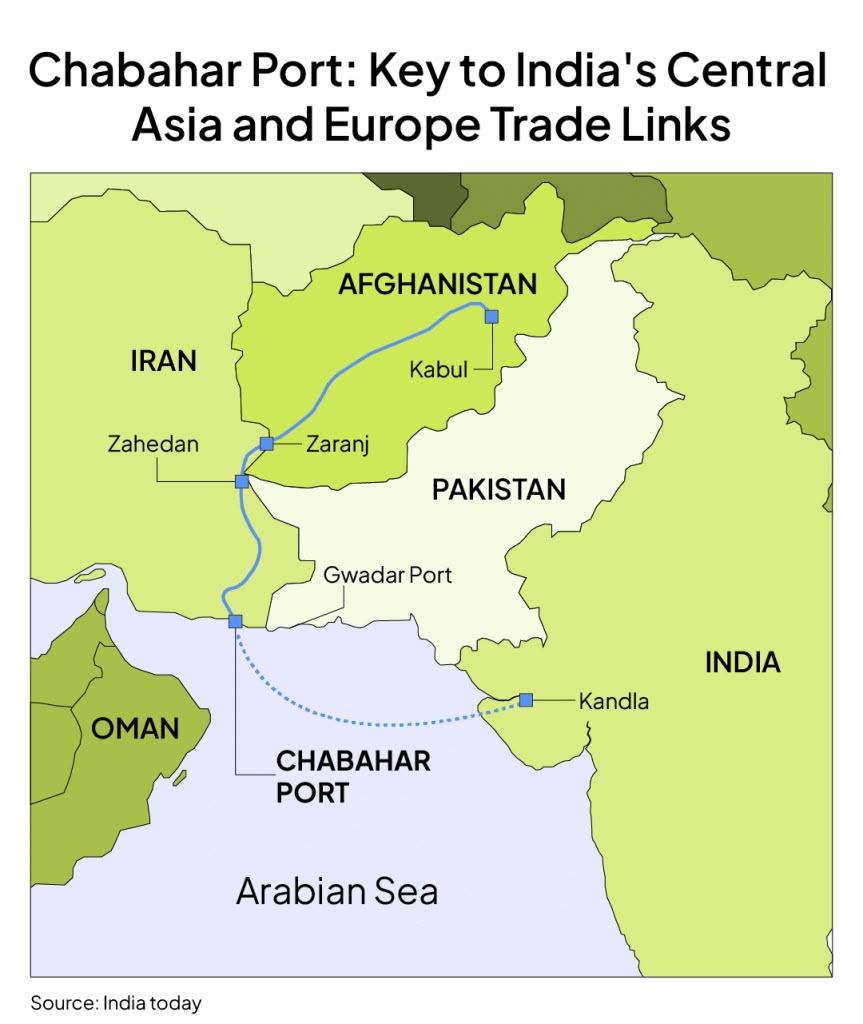
Chabahar Port is located on the Gulf of Oman, outside the Strait of Hormuz.

2. Access to Afghanistan and Central Asia

It gives India direct access to Afghanistan and Central Asia while bypassing Pakistan.

3. INSTC Link

Chabahar is a key component of the International North-South Transport Corridor and India’s regional connectivity strategy.

4. Strategic Importance for India

The attack raises concerns over:

  • Regional trade
  • Energy security
  • India’s strategic interests in West Asia
  • Connectivity to Central Asia
  • Stability of maritime and port infrastructure

Why This Matters for India

West Asia is crucial for India because of:

  • Energy imports
  • Indian diaspora
  • Remittances
  • Maritime trade routes
  • Connectivity projects
  • Chabahar-linked Central Asia access

Any escalation in the region can affect India’s trade, fuel prices and strategic connectivity.

Key Takeaway

The attack on Chabahar-related infrastructure shows how West Asian instability can directly affect India’s trade routes, energy security and Central Asia strategy.

About the UPSC Civil Services Examination (UPSC CSE)

The UPSC Civil Services Examination (CSE) is one of the most competitive and esteemed examinations in India, conducted by the Union Public Service Commission to recruit officers for services such as the Indian Administrative Service (IAS), Indian Police Service (IPS), Indian Foreign Service (IFS), and others. The exam comprises three stages — Prelims, Mains, and the Personality Test (Interview) — designed to test a candidate’s knowledge, aptitude, decision-making, and leadership skills.


How to Prepare Effectively for UPSC CSE

Cracking the UPSC CSE requires a deep understanding of the syllabus, consistent revision, structured answer writing, and smart test-taking strategies. The Prelims test analytical and conceptual clarity, the Mains focuses on critical thinking, articulation, and subject mastery, while the Interview assesses presence of mind, ethical judgment, and personality traits relevant to public service.

At UnderStand UPSC, we empower aspirants with a personalized and focused approach to each stage of the exam.


Why Choose UnderStand UPSC?

UnderStand UPSC is a mentorship-driven platform offering a clear, clutter-free strategy to tackle the Civil Services Examination. Our programs like Transform (for beginners and intermediate learners) and Conquer (for advanced mains preparation) provide structured study plans, syllabus-wise video content, interactive live sessions, and answer writing support.

We emphasize:

  • Concept clarity through topic-wise lectures

  • Test series designed around real UPSC standards

  • Personalized mentorship in small groups

  • Regular performance tracking and peer benchmarking

  • Doubt-clearing sessions, current affairs analysis, and monthly magazines


Join the UnderStand UPSC Learning Community

Our mission is to make UPSC preparation less overwhelming and more strategic. We combine mentorship, discipline, and academic rigor to help you clear CSE with confidence. Whether you’re preparing from Delhi, Mumbai, Bangalore, or a remote village — our online-first model ensures quality guidance reaches every corner of India.

Join the thousands of aspirants who trust UnderStand UPSC to guide their journey toward becoming civil servants.

Stay connected with us through our Telegram, YouTube, and Instagram channels for daily tips, strategies, and updates.

Copyright © 2026 USARAMBHA EDUCATION (UnderStand UPSC). All Rights Reserved.

IMPETUS (ONLINE)
IMPETUS (OFFLINE)

Fill out the form

Fill out the form for

Downloading the free Agriculture Short Notes