23 June 2026 | Daily Current Affairs

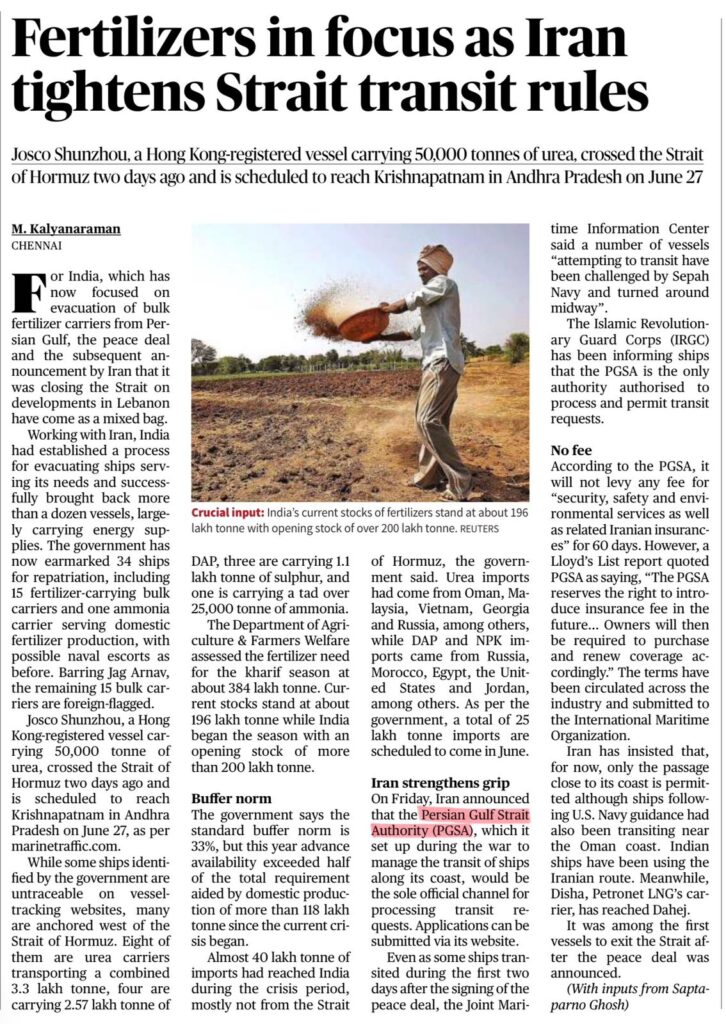
Strait of Hormuz Transit Rules and India Energy Security

Context: Strait of Hormuz Transit Rules
Iran tightened transit rules through the Strait of Hormuz by setting up a maritime authority to regulate vessel movement. This comes amid rising West Asia tensions and has implications for global energy security, shipping and India’s fertiliser imports.

Strait of Hormuz

Location

  • Between Iran and Oman’s Musandam Peninsula

Connects

Importance

The Strait of Hormuz is one of the world’s most important strategic chokepoints.

It is crucial for:

  • Global crude oil movement
  • LNG movement
  • Gulf trade routes
  • India’s energy security
  • Fertiliser imports
  • Maritime security

Persian Gulf Strait Authority

Meaning

A maritime authority designated by Iran to regulate and approve vessel transit through the Strait of Hormuz.

Constituted By

  • Government of Iran / Iranian maritime authorities

Why Was It Constituted?

  • To act as a single-window authority for transit clearances.
  • To strengthen monitoring of ship movements.
  • To enhance maritime security and surveillance.
  • To ensure vessels follow designated routes.
  • To ensure reporting procedures.
  • To regulate movement amid rising West Asia tensions.

India’s Concern

India depends heavily on the Gulf region for:

  • Crude oil
  • LNG
  • Fertilisers
  • Trade routes
  • Indian diaspora employment
  • Remittance flows

Fertiliser Angle

The article highlights concerns over fertiliser shipments because India imports key fertilisers and raw materials through West Asian sea routes.

Disruption in Strait of Hormuz transit may affect:

  • Urea supply
  • DAP supply
  • Phosphatic fertilisers
  • Shipping costs
  • Insurance costs
  • Agricultural input prices

Strategic Implications

  • Higher crude oil prices.
  • Higher Current Account Deficit.
  • Imported inflation.
  • Higher fertiliser subsidy burden.
  • Shipping delays.
  • Maritime security risks.
  • Pressure on India’s West Asia diplomacy.

Way Forward for India

  • Diversify energy sources.
  • Maintain strategic petroleum reserves.
  • Secure fertiliser supply chains.
  • Strengthen maritime domain awareness.
  • Continue diplomatic balancing with Iran, GCC, Israel and the U.S.
  • Promote alternative trade and energy corridors.
  • Enhance naval presence in the Indian Ocean Region.
Strait of Hormuz Transit Rules

India Maritime Sector Growth Engine for Security and Trade

Context: India Maritime Sector Growth Engine
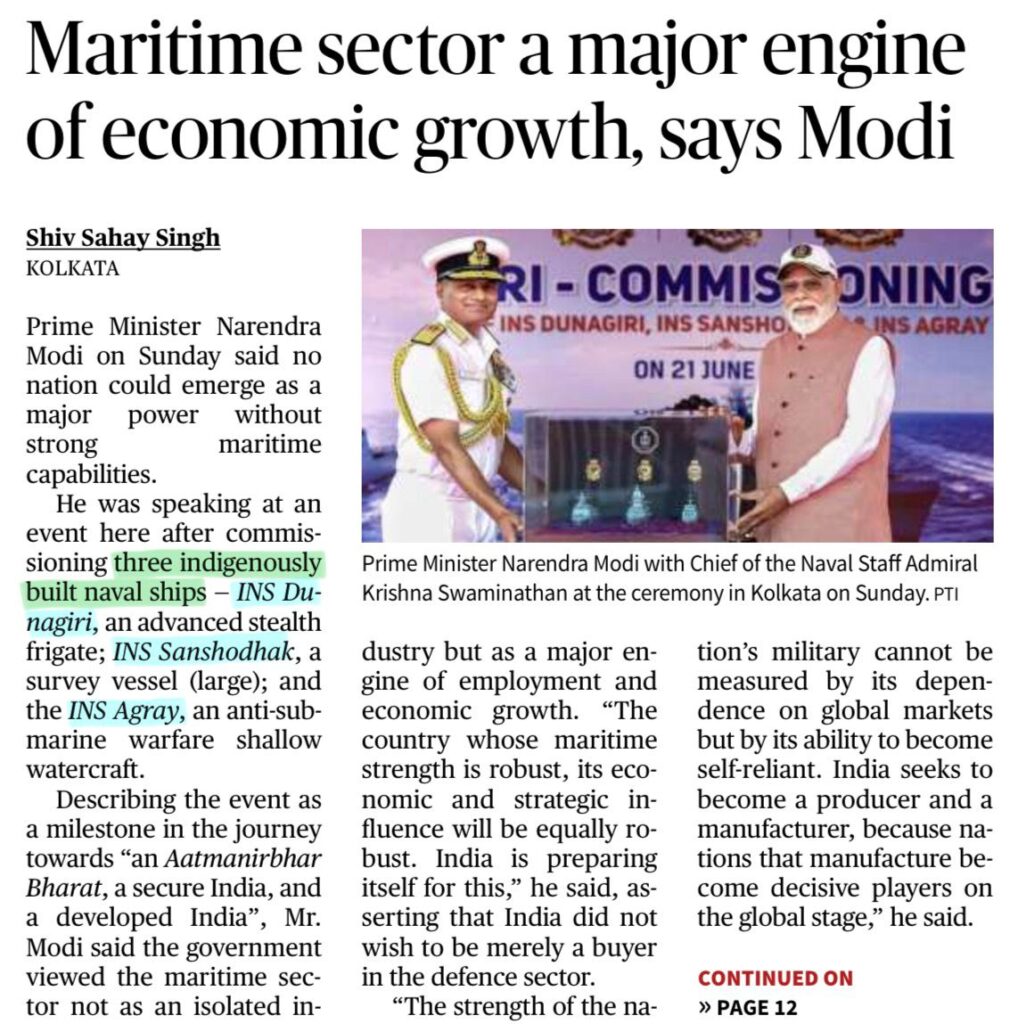
Prime Minister Narendra Modi commissioned three indigenously built naval platforms — INS Dunagiri, INS Sanshodhak and INS Agray — highlighting maritime capability as a key pillar of Aatmanirbhar Bharat, economic growth and national security.

Why Maritime Sector Matters

The maritime sector supports:

  • Trade and logistics
  • Coastal development
  • Shipbuilding
  • Defence preparedness
  • Maritime security
  • Blue economy
  • Strategic presence in the Indian Ocean Region

Commissioned Naval Platforms

1. INS Dunagiri

Type

  • Advanced Stealth Frigate

Project

  • Project 17A

Role

Designed for:

  • Surface warfare
  • Air warfare
  • Anti-submarine warfare

Other Stealth Frigates

  • Nilgiri
  • Udaygiri
  • Himgiri
  • Taragiri
  • Mahendragiri
  • Dunagiri
  • Shivalik
  • Satpura
  • Sahyadri

2. INS Sanshodhak

Type

  • Survey Vessel Large

Role

Used for:

  • Hydrographic surveys
  • Seabed mapping
  • Nautical charting

Other Survey Vessels

  • Sandhayak
  • Nirdeshak
  • Ikshak
  • Sanshodhak

3. INS Agray

Type

  • Anti-Submarine Warfare Shallow Water Craft

Role

Designed to:

  • Detect enemy submarines
  • Track enemy submarines
  • Neutralise enemy submarines in coastal waters

Other ASW Shallow Water Craft

  • Arnala
  • Agray

Value Addition

Stealth Frigate

  • Fight

Survey Vessel

  • Map

ASW Craft

  • Hunt submarines

Significance

  • Strengthens indigenous defence manufacturing.
  • Supports Aatmanirbhar Bharat.
  • Enhances Indian Navy’s operational readiness.
  • Improves coastal defence.
  • Supports India’s maritime security in the Indian Ocean Region.
  • Reduces dependence on imported platforms.
India Maritime Sector Growth Engine

Rakhigarhi Skeletons Scientific Analysis and Harappan Insights

Context: Rakhigarhi Skeletons Scientific Analysis
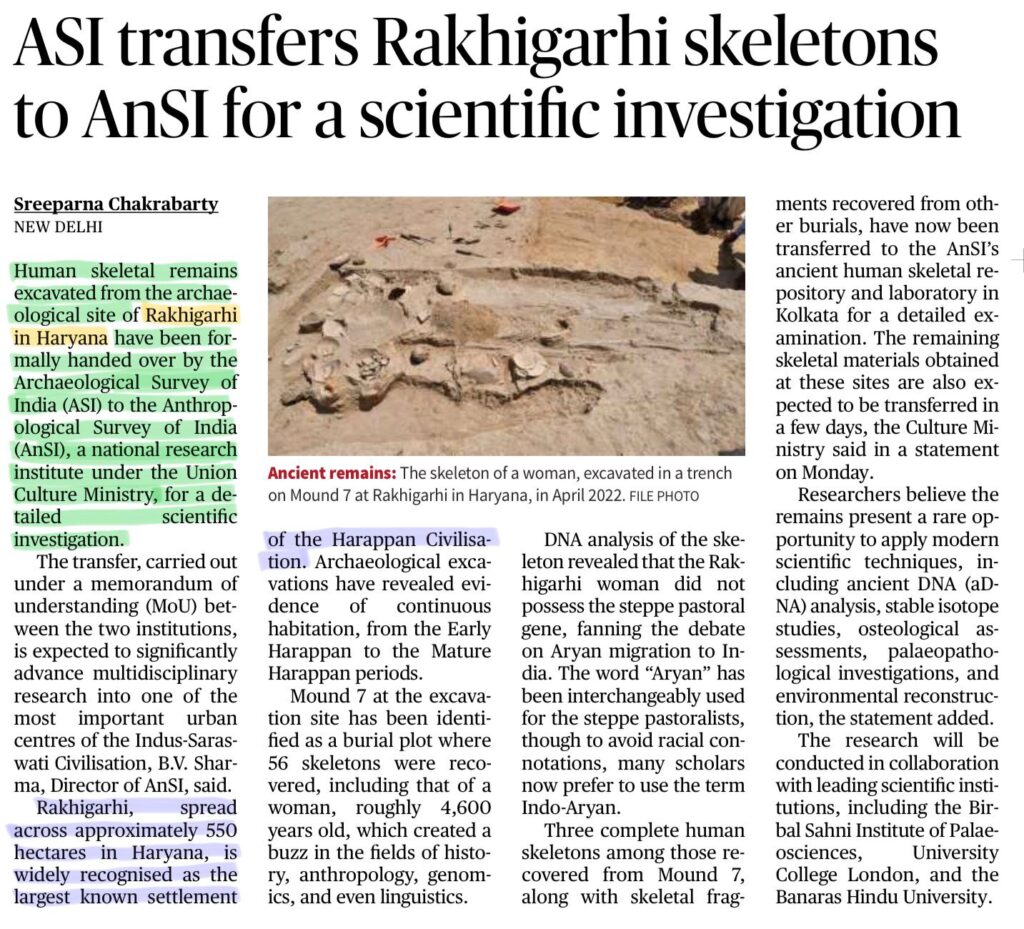
The Archaeological Survey of India transferred human skeletal remains excavated from Rakhigarhi, Haryana to the Anthropological Survey of India for advanced scientific studies.

These studies include:

  • Ancient DNA analysis
  • Isotope analysis
  • Palaeopathological analysis

The findings may provide fresh insights into the Harappan Civilisation and population history.

Rakhigarhi

Location

  • Hisar, Haryana

Area

  • Around 550 hectares

Importance

  • Widely regarded as the largest known Harappan settlement.
  • Shows continuous habitation from Early Harappan to Mature Harappan phase.
  • 56 skeletons were recovered from Mound-7 burial site.
  • A famous 4,600-year-old female skeleton was discovered here.

Why Rakhigarhi Matters

Rakhigarhi is important for understanding:

  • Harappan urbanisation
  • Burial practices
  • Population history
  • Diet and health patterns
  • Ancient DNA evidence
  • Migration debates

Important Finding

Earlier ancient DNA study found no Steppe pastoralist ancestry in the sampled individual.

This makes Rakhigarhi significant in debates on population history and the Aryan migration question.

Indus Valley Civilisation: Important Sites

Pakistan

Harappa

  • Granary
  • Cemetery R-37

Mohenjo-daro

  • Great Bath
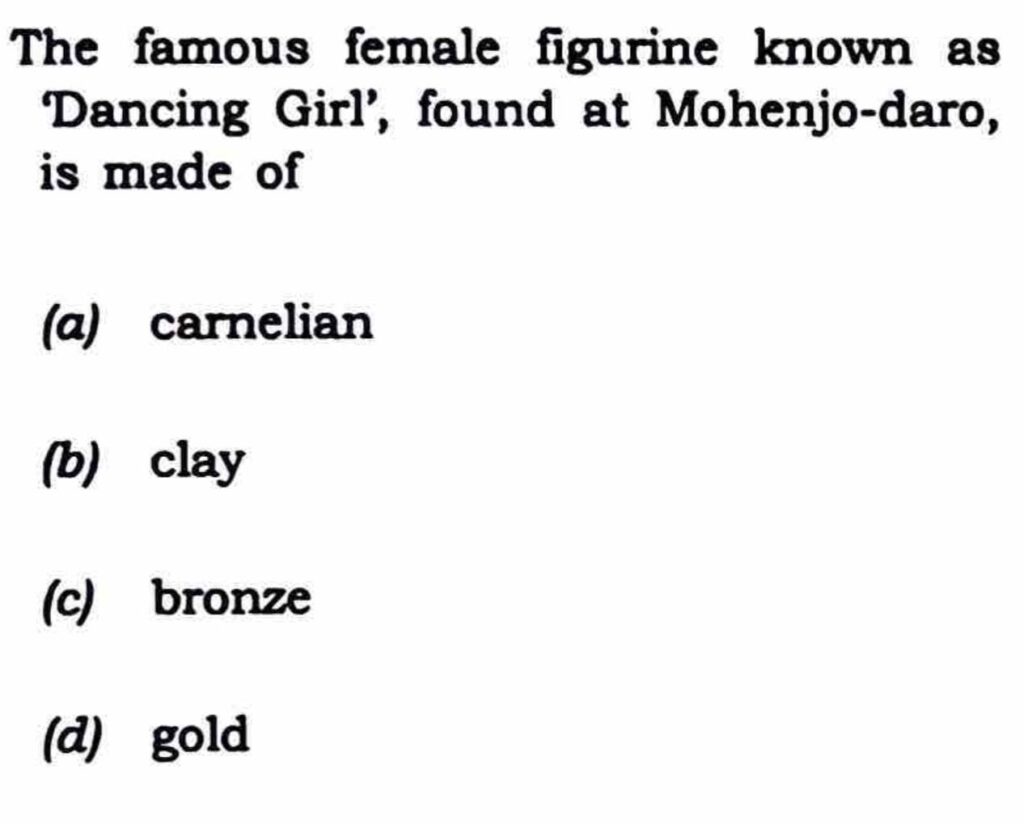
  • Bronze Dancing Girl

Chanhudaro

  • Bead-making centre

Kot Diji

  • Pre-Harappan site

Sutkagendor

  • Westernmost port

India

Gujarat

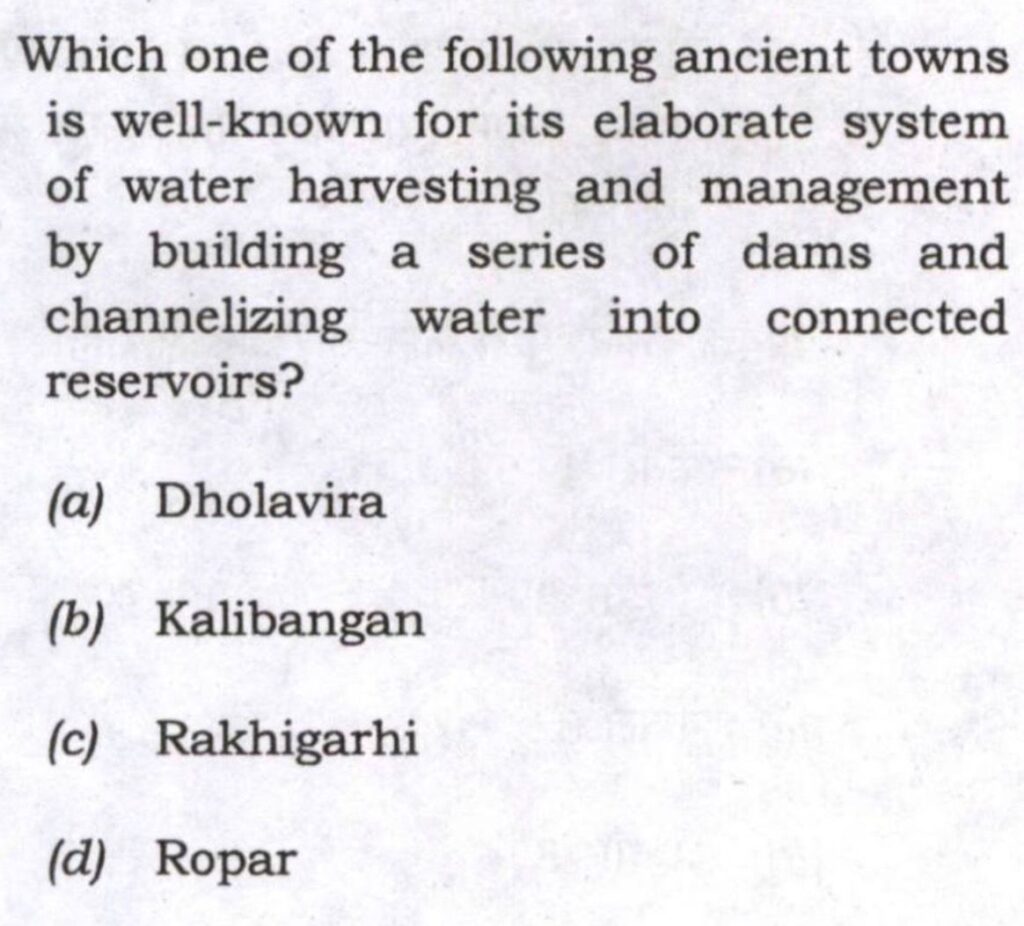
Dholavira

  • Water management system
  • UNESCO World Heritage Site

Lothal

  • Dockyard

Surkotada

  • Horse bones

Rangpur

  • Rice cultivation

Haryana

Rakhigarhi

  • Largest Harappan site

Bhirrana

  • Earliest Harappan evidence

Banawali

  • Radial town planning

Rajasthan

Kalibangan

  • Ploughed field
  • Fire altars

Punjab

Ropar

  • Harappan–later cultural sequence

Jammu and Kashmir

Manda

  • Northernmost Harappan site

Uttar Pradesh

Alamgirpur

  • Easternmost Harappan site

PYQ Facts

Dholavira

  • Known for elaborate water harvesting and management system.

Dancing Girl

  • Found at Mohenjo-daro.
  • Made of bronze.
Rakhigarhi Skeletons Scientific Analysis

India Core Sector Growth May 2026 Slows to 0.5 Percent

Context: India Core Sector Growth May 2026
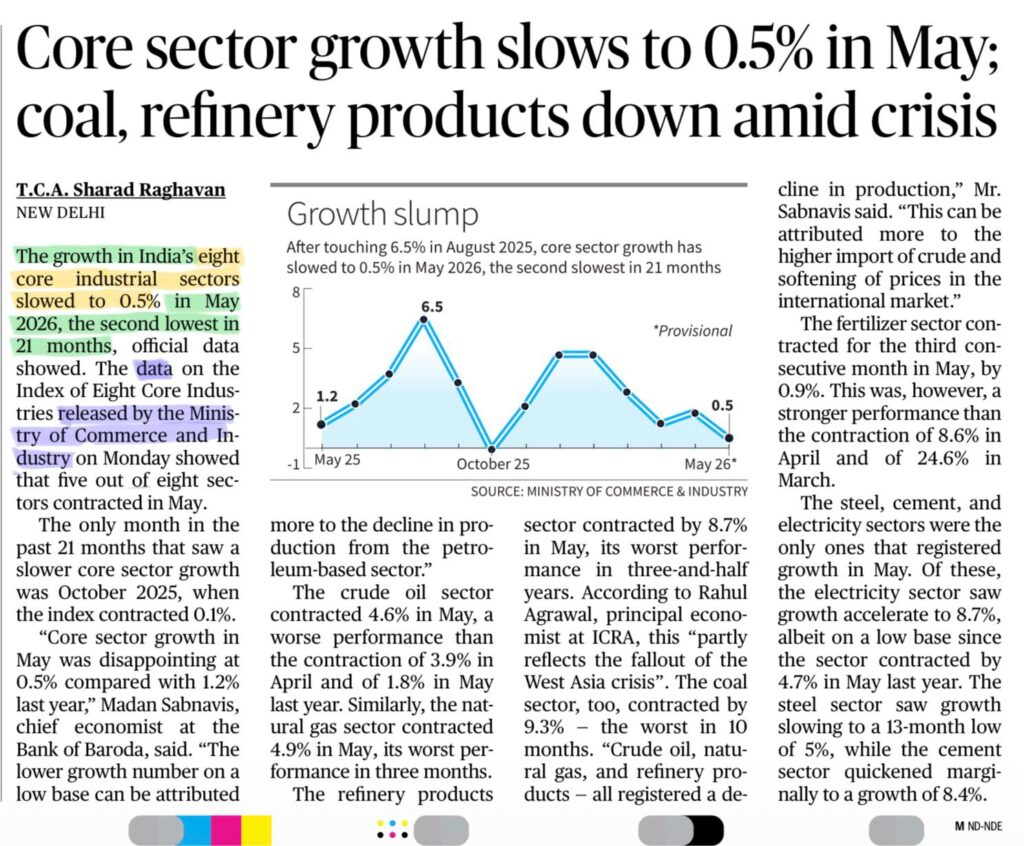
India’s Eight Core Industries growth slowed to 0.5% in May 2026, the second-lowest in 21 months. Five of the eight sectors contracted, led by Coal and Refinery Products, reflecting weakness in energy-related sectors.

Key Data

Core Sector Growth

  • May 2026: 0.5%
  • Second-lowest in 21 months

Sectors Contracted

Five out of eight sectors contracted.

Major contraction:

  • Coal: -9.3%
  • Refinery Products: -8.7%

Index of Industrial Production

IIP measures overall industrial output in:

  • Mining
  • Manufacturing
  • Electricity

Released By

Base Year

  • 2022–23

Eight Core Industries in IIP

Eight Core Industries together account for 40.27% of IIP.

Index of Eight Core Industries

It measures output of eight core sectors.

Released By

Base Year

  • 2011–12

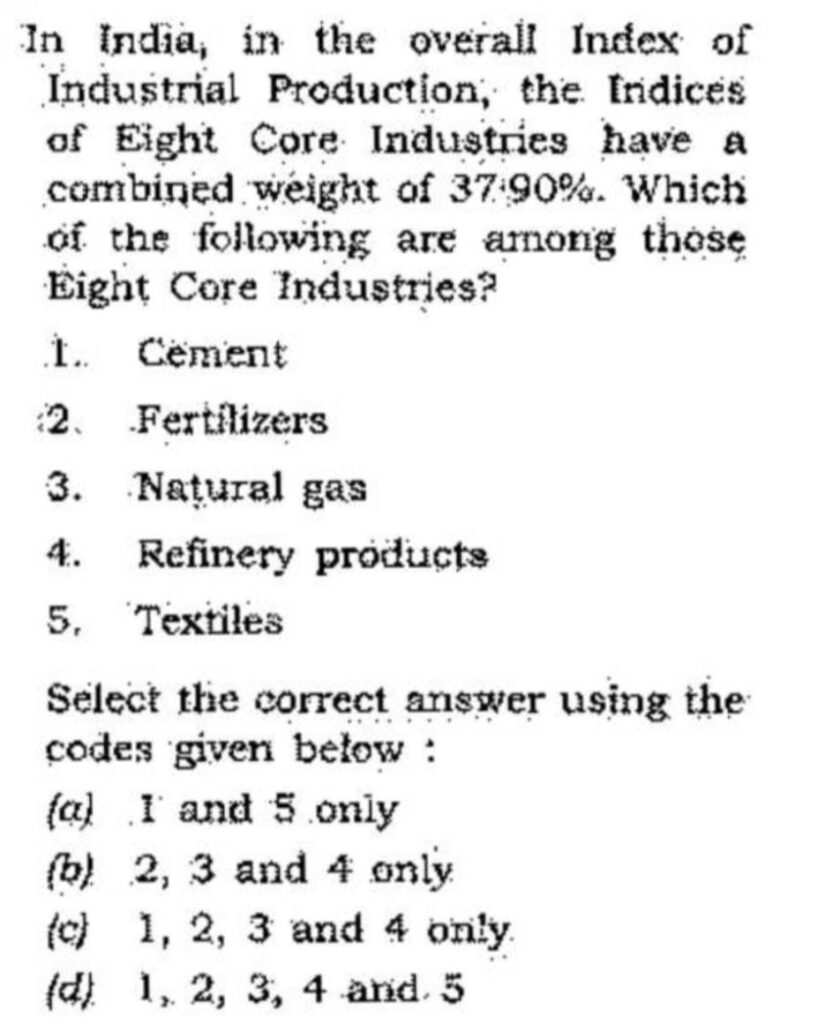
Eight Core Industries

  • Refinery Products
  • Electricity
  • Steel
  • Coal
  • Crude Oil
  • Natural Gas
  • Cement
  • Fertilisers

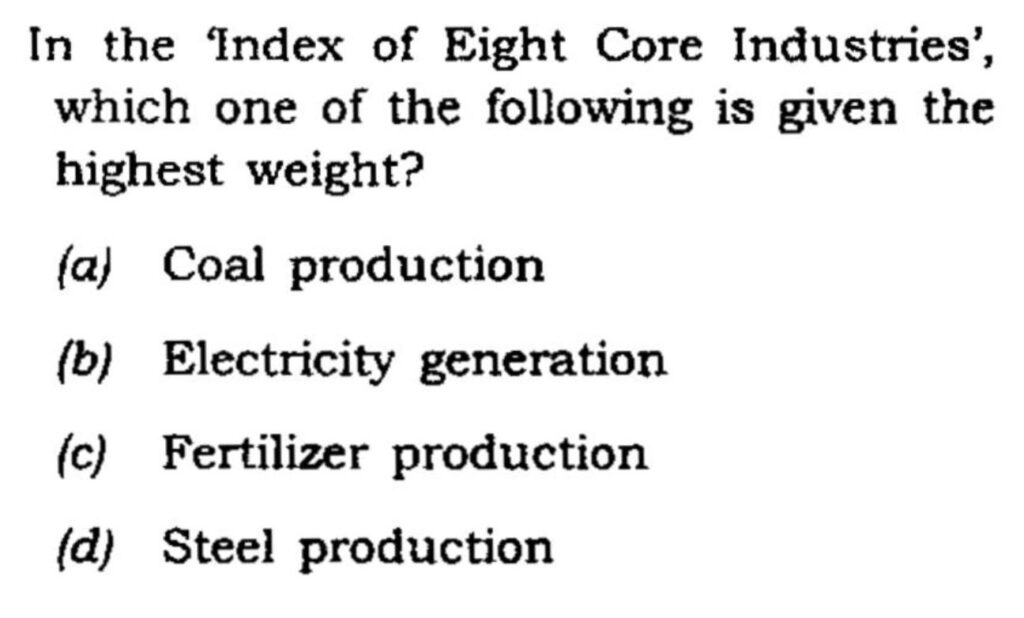
Weights: Highest to Lowest

  1. Refinery Products — 28.04%
  2. Electricity — 19.85%
  3. Steel — 17.92%
  4. Coal — 10.33%
  5. Crude Oil — 8.98%
  6. Natural Gas — 6.88%
  7. Cement — 5.37%
  8. Fertilisers — 2.63%

PYQ Link

Among the Eight Core Industries, Refinery Products carry the highest weight.

Textiles are not part of the Eight Core Industries.

Significance

Core sector growth matters because it indicates:

  • Industrial momentum
  • Infrastructure demand
  • Energy-sector performance
  • Manufacturing activity
  • Investment cycle
  • Future IIP trend
India Core Sector Growth May 2026

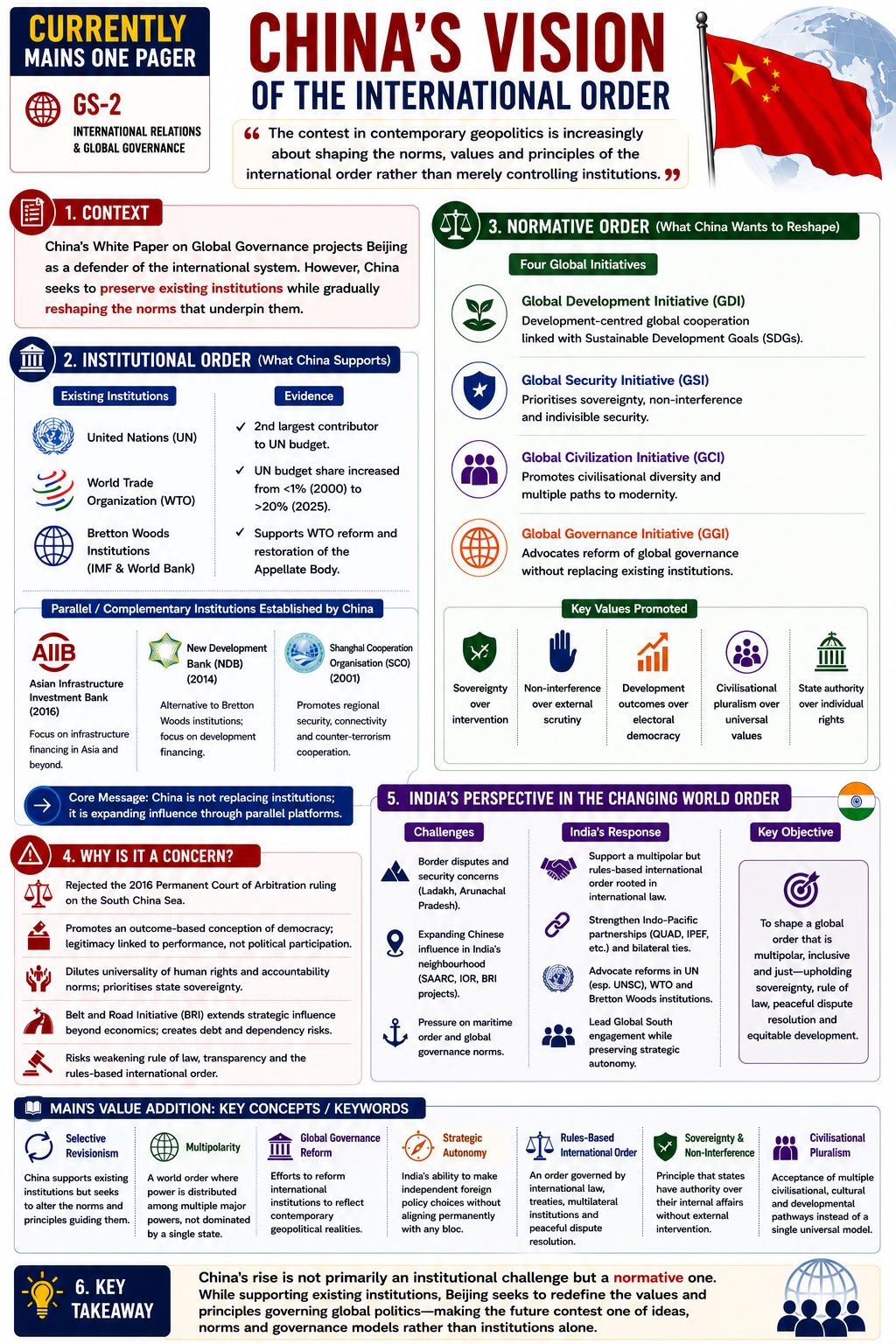
China International Order Strategy and Global Governance Shift

Context: China International Order Strategy
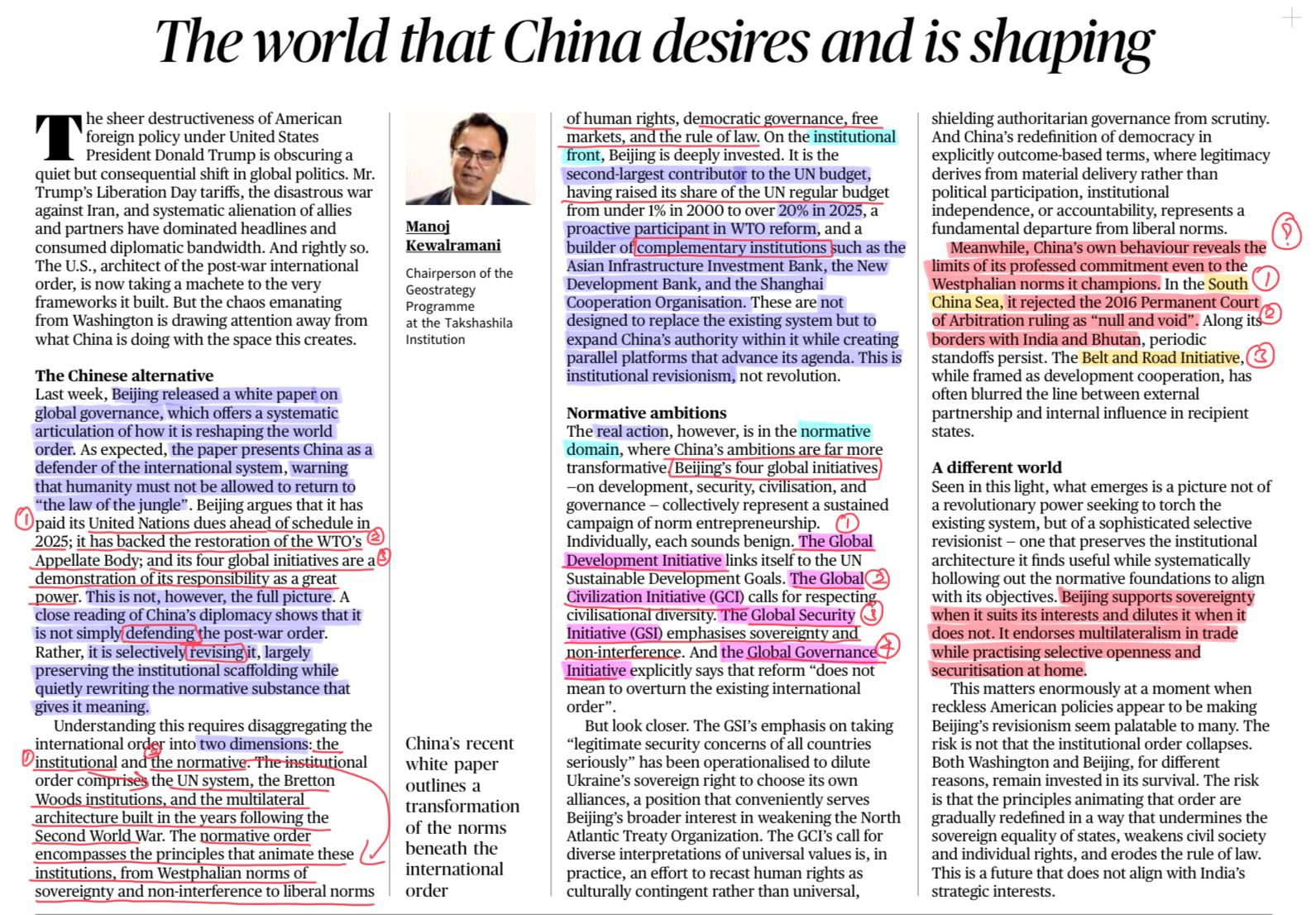
The article analyses China’s attempt to reshape the international order. China does not openly seek to destroy existing institutions, but it tries to preserve them while gradually reshaping norms, power distribution and institutional influence in its favour.

China’s Broad Approach

China’s strategy is not primarily institutional replacement.

It is based on:

  • Reshaping global norms
  • Expanding influence within existing institutions
  • Creating parallel institutions
  • Promoting sovereignty-first governance
  • Reducing Western dominance in global rule-making

Existing Institutions China Supports and Uses

China actively participates in:

Evidence of China’s Institutional Role

  • Second-largest contributor to UN budget.
  • Increased WTO share.
  • Supports WTO reform and restoration of appellate body functions.

Parallel / Complementary Institutions Created or Supported by China

Asian Infrastructure Investment Bank

  • Founded in 2015.
  • Focuses on infrastructure financing in Asia and beyond.

New Development Bank

  • Established by BRICS in 2014.
  • Provides development finance to emerging economies.

Shanghai Cooperation Organisation

  • Promotes regional security, connectivity and cooperation.

China’s Four Global Initiatives

1. Global Development Initiative

Linked with development-centred global cooperation and Sustainable Development Goals.

2. Global Security Initiative

Promotes security through state sovereignty, non-interference and opposition to bloc politics.

3. Global Civilisation Initiative

Promotes civilisational diversity and opposes Western universalism.

4. Global Governance Initiative

Advocates reform of global governance without replacing existing institutions.

Key Values Promoted by China

  • Sovereignty over intervention
  • Non-interference over external scrutiny
  • Development outcomes over democracy
  • Civilisational pluralism over universal values
  • State authority over individual rights

Why Is This a Concern?

1. South China Sea

China rejected the 2016 Permanent Court of Arbitration ruling on the South China Sea.

2. Human Rights

China promotes a state-centric view of human rights where sovereignty and development are prioritised over individual freedoms.

3. Belt and Road Initiative

BRI extends China’s strategic and economic influence through connectivity, infrastructure and debt diplomacy.

4. Institutional Capture

China seeks greater influence in rule-making bodies and standard-setting institutions.

5. Normative Challenge

China challenges the liberal international order based on democracy, human rights and open political systems.

India’s Perspective

Challenges for India

  • Border disputes and security concerns.
  • Expanding Chinese influence in India’s neighbourhood.
  • Pressure on maritime routes and global supply chains.
  • China’s close partnership with Pakistan.
  • Chinese influence in multilateral institutions.

India’s Response

  • Support a multipolar but rules-based international order.
  • Strengthen strategic partnerships with the U.S., France, Japan, Australia and Europe.
  • Use platforms like Quad, BRICS, SCO and G20 carefully.
  • Lead Global South engagement.
  • Push for UNSC reform.
  • Protect strategic autonomy.

Key Objective for India

India seeks a global order that is:

  • Multipolar
  • Rules-based
  • Inclusive
  • Respectful of sovereignty
  • Supportive of development
  • Resistant to domination by any one power
China International Order Strategy

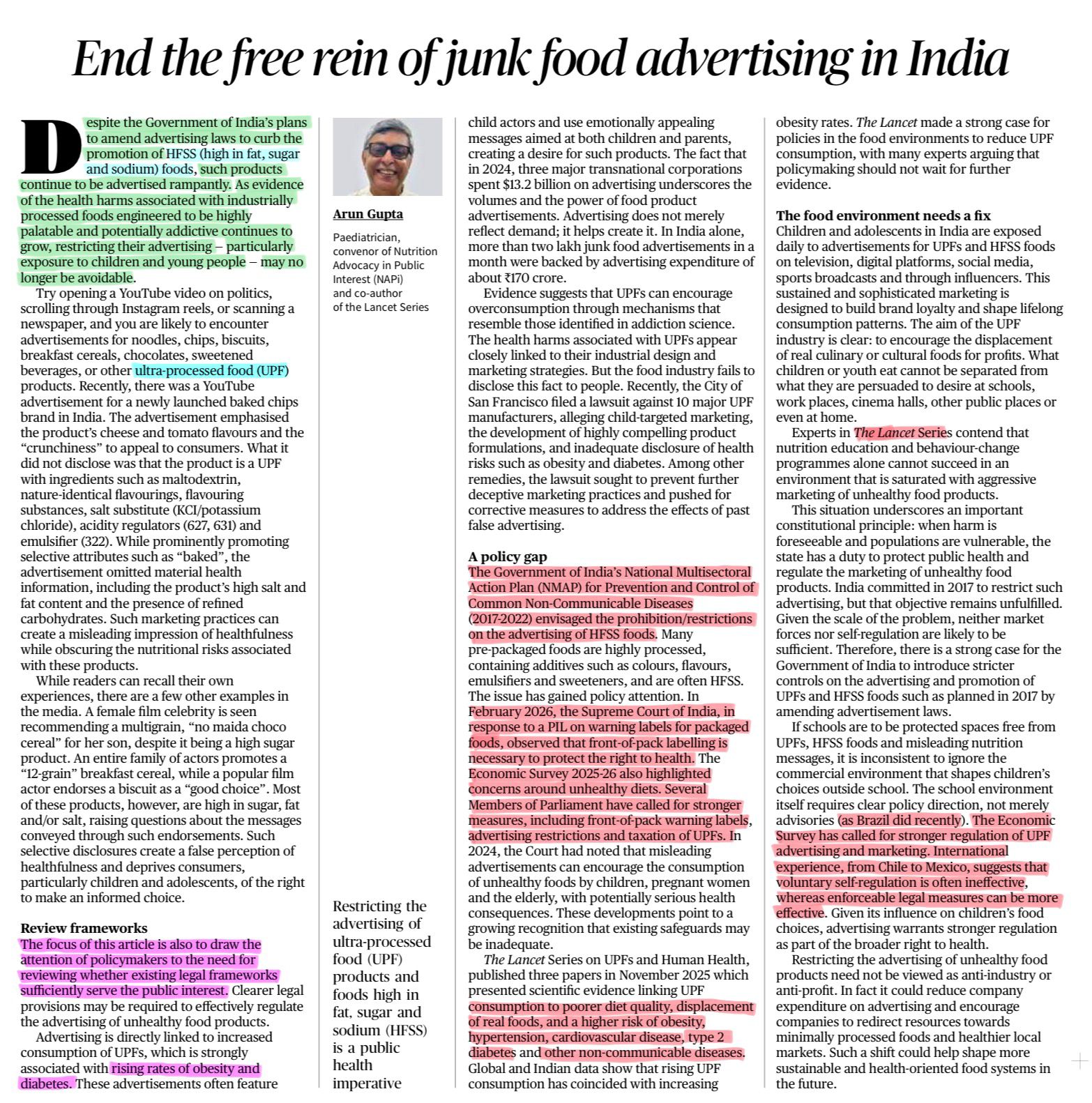
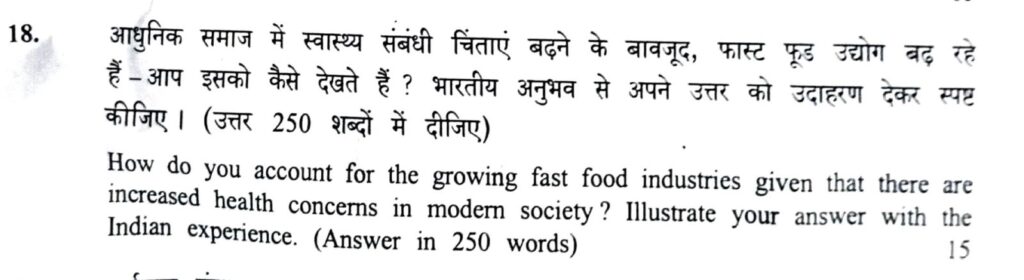
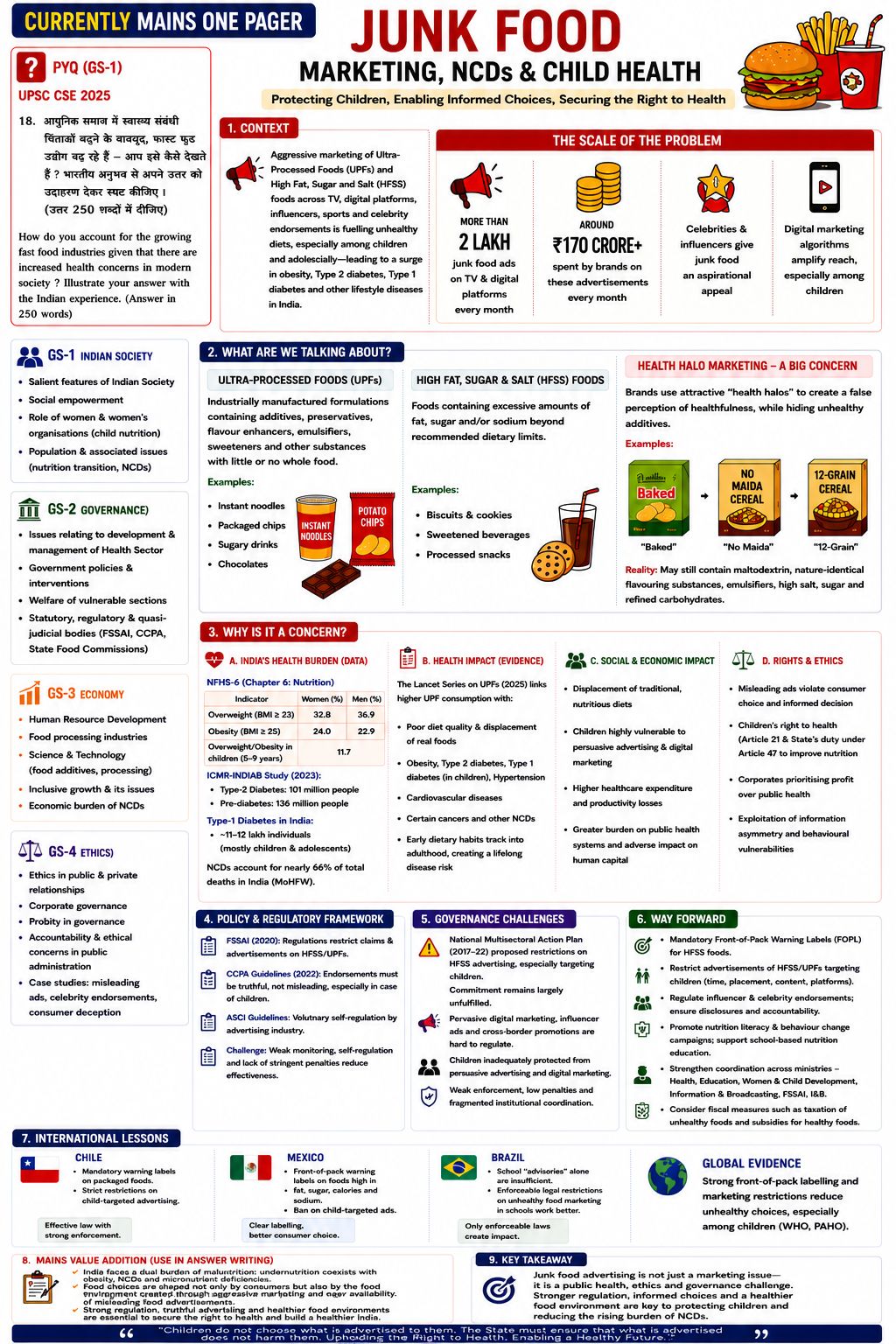
Junk Food Advertising Regulations India: Child Health Concerns

Context: Junk Food Advertising Regulations India
The article argues that India needs stricter regulation of junk food advertising, especially advertisements targeting children, because aggressive marketing of unhealthy foods is worsening obesity, diabetes and other non-communicable diseases.

Junk Food / HFSS Foods

HFSS foods refer to foods high in:

  • Fat
  • Salt
  • Sugar

These include:

  • Packaged snacks
  • Sugary drinks
  • Fast food
  • Ultra-processed foods
  • Sweetened breakfast cereals
  • Chocolates and confectionery
  • Fried and salty snacks

Why Is This a Concern?

India is facing a rising burden of non-communicable diseases.

Junk food advertising influences:

  • Children’s food choices
  • Family consumption habits
  • Brand loyalty from a young age
  • Normalisation of unhealthy diets

Health Concerns

Excessive consumption of junk food is linked to:

  • Obesity
  • Type-2 diabetes
  • Hypertension
  • Cardiovascular diseases
  • Fatty liver disease
  • Poor gut health
  • Childhood malnutrition in the form of hidden hunger

Child Health Angle

Children are especially vulnerable because:

  • They cannot always distinguish advertisements from information.
  • Digital marketing targets them through influencers, gaming and social media.
  • Cartoon characters, celebrity endorsements and attractive packaging shape preferences.
  • Peer pressure and aspirational branding increase demand.

Regulatory Framework in India

FSSAI

Food Safety and Standards Authority of India

FSSAI Draft Norms

The Food Safety and Standards Authority of India has proposed front-of-pack labelling and warning-based mechanisms for high fat, salt and sugar foods.

CCPA

Central Consumer Protection Authority

  • Can act against misleading advertisements and unfair trade practices.

Consumer Protection Act, 2019

Provides protection against:

  • Misleading advertisements
  • Unfair trade practices
  • Harmful consumer messaging

ASCI

Advertising Standards Council of India

  • Self-regulatory body for advertising.
  • Issues guidelines against misleading advertisements.

Key Problem

India’s regulatory approach remains fragmented.

There is no strong comprehensive law that directly restricts junk food advertising targeted at children across television, digital platforms, schools and influencer marketing.

Global Examples

Chile

  • Front-of-pack warning labels.
  • Restrictions on marketing unhealthy foods to children.
  • Ban on cartoon characters on unhealthy food packaging.

Mexico

  • Strong warning labels.
  • Restrictions on child-directed marketing.

Brazil

  • Child-focused junk food advertising is treated as abusive advertising.

Way Forward

  • Mandatory front-of-pack warning labels.
  • Ban misleading health claims on junk food.
  • Restrict celebrity and influencer endorsements of unhealthy food targeted at children.
  • Regulate digital advertising and gaming-based food marketing.
  • Ban junk food ads during children’s programming.
  • Strengthen FSSAI, CCPA and ASCI coordination.
  • Promote nutrition literacy in schools.
  • Encourage reformulation of processed foods with lower sugar, salt and fat.

Mains Value Addition

This topic can be used in answers on:

  • Public health governance
  • NCD prevention
  • Consumer protection
  • Child rights
  • Behavioural regulation
  • Nutrition security
  • Preventive healthcare
Junk Food Advertising Regulations India
About the UPSC Civil Services Examination (UPSC CSE)

The UPSC Civil Services Examination (CSE) is one of the most competitive and esteemed examinations in India, conducted by the Union Public Service Commission to recruit officers for services such as the Indian Administrative Service (IAS), Indian Police Service (IPS), Indian Foreign Service (IFS), and others. The exam comprises three stages — Prelims, Mains, and the Personality Test (Interview) — designed to test a candidate’s knowledge, aptitude, decision-making, and leadership skills.


How to Prepare Effectively for UPSC CSE

Cracking the UPSC CSE requires a deep understanding of the syllabus, consistent revision, structured answer writing, and smart test-taking strategies. The Prelims test analytical and conceptual clarity, the Mains focuses on critical thinking, articulation, and subject mastery, while the Interview assesses presence of mind, ethical judgment, and personality traits relevant to public service.

At UnderStand UPSC, we empower aspirants with a personalized and focused approach to each stage of the exam.


Why Choose UnderStand UPSC?

UnderStand UPSC is a mentorship-driven platform offering a clear, clutter-free strategy to tackle the Civil Services Examination. Our programs like Transform (for beginners and intermediate learners) and Conquer (for advanced mains preparation) provide structured study plans, syllabus-wise video content, interactive live sessions, and answer writing support.

We emphasize:

  • Concept clarity through topic-wise lectures

  • Test series designed around real UPSC standards

  • Personalized mentorship in small groups

  • Regular performance tracking and peer benchmarking

  • Doubt-clearing sessions, current affairs analysis, and monthly magazines


Join the UnderStand UPSC Learning Community

Our mission is to make UPSC preparation less overwhelming and more strategic. We combine mentorship, discipline, and academic rigor to help you clear CSE with confidence. Whether you’re preparing from Delhi, Mumbai, Bangalore, or a remote village — our online-first model ensures quality guidance reaches every corner of India.

Join the thousands of aspirants who trust UnderStand UPSC to guide their journey toward becoming civil servants.

Stay connected with us through our Telegram, YouTube, and Instagram channels for daily tips, strategies, and updates.

Copyright © 2026 USARAMBHA EDUCATION (UnderStand UPSC). All Rights Reserved.

Fill out the form for

Downloading the free Agriculture Short Notes


Fill out the form

If you have any queries related to
Our Programs We Offer