🚨 ONLY 2 DAYS LEFT! | FREE UPSC OFFLINE MEETUP 2028/29 REGISTER NOW →

26 Nov 2025

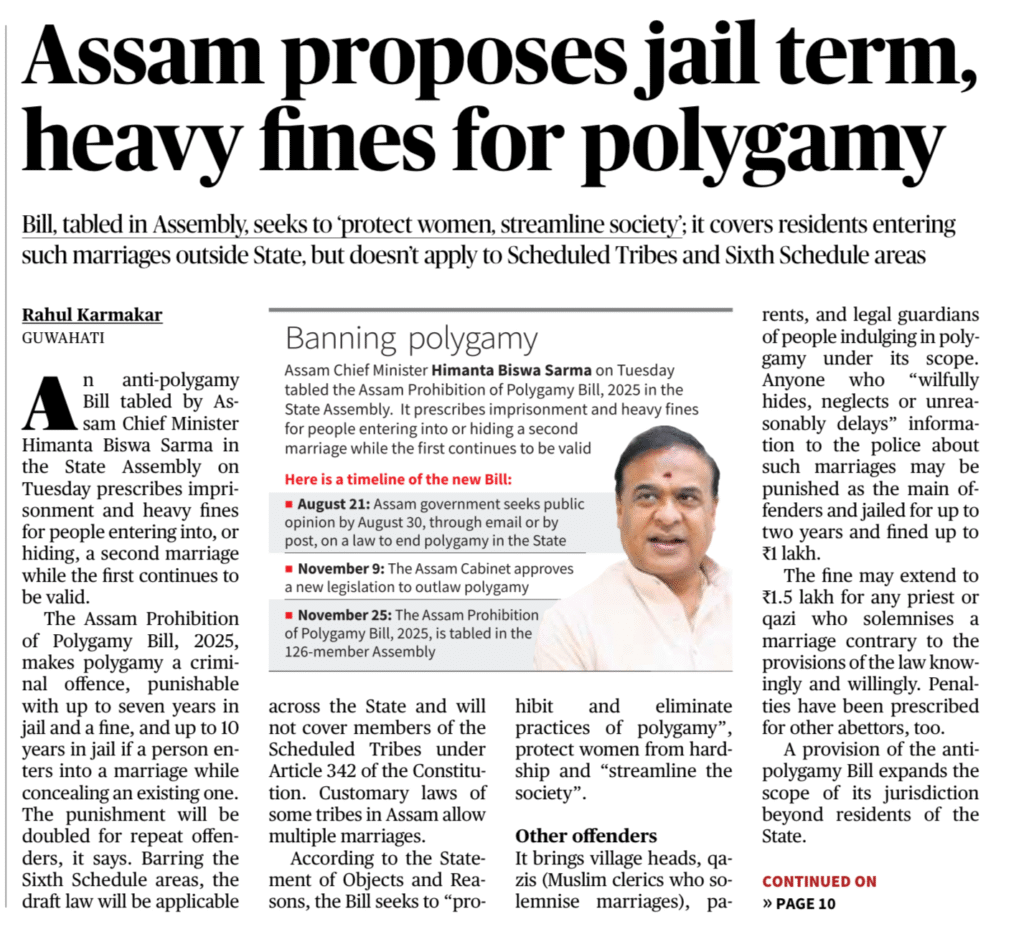
Assam Polygamy Ban: Key Highlights for UPSC Current Affairs 2025

Assam Prohibition of Polygamy Bill, 2025 seeks to criminalise polygamy to protect women and curb fraudulent marriages.

Core Provisions
• Criminal offence: Second marriage during subsistence of first.
• Penalty:
• Up to 7 years jail + ₹1 lakh fine (general offence).
• Up to 10 years for hiding an existing marriage.
• Up to ₹1.5 lakh fine for priests/qazis who knowingly solemnise such marriages.
• Abetment liability: Parents/guardians delaying or hiding information punishable.
• Jurisdiction extended to Assam residents even if marriage occurs outside the State.

Exemptions
• Scheduled Tribes under Article 342.
Sixth Schedule areas (due to customary marital practices).

Rationale
• To protect women, reduce marital exploitation, and standardise personal law practices for social order.
Screenshot 2025 11 26 at 09.42.25

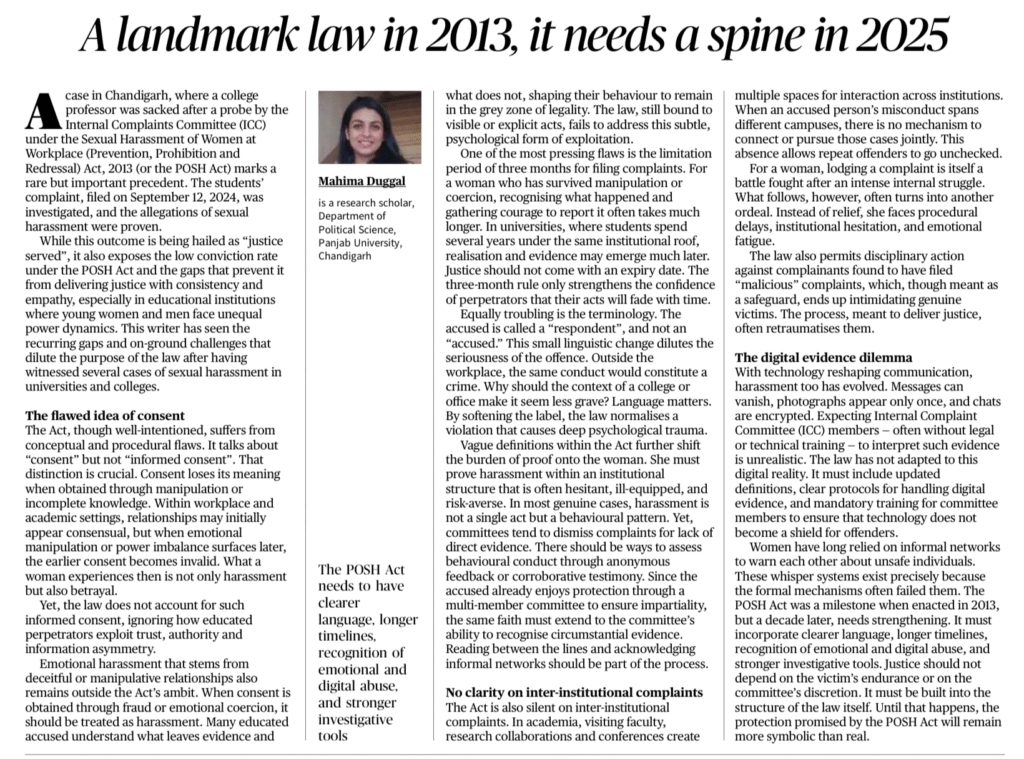
POSH Act 2013 Needs Stronger Implementation: Governance Current Affairs for UPSC

Context
Chandigarh case shows POSH Act works rarely; highlights low conviction, procedural gaps, and power imbalance in campuses.

Key Issues in POSH Act
• Consent ≠ informed consent → law ignores manipulation, emotional coercion, power imbalance.
• 3-month filing limit unrealistic; trauma delays reporting.
• Terminology (“respondent”) softens seriousness.
• Burden of proof on woman; law ignores behavioural patterns & circumstantial evidence.
• No mechanism for inter-institutional complaints (common in academia).
• Fear of “malicious complaint” clause retraumatises victims.

Digital Age Gaps
• Harassment now via disappearing messages, encrypted chats.
• ICCs lack training; no standard protocol for digital evidence.
• Risk: tech loopholes allow offenders to escape.

What Needs Reform (2025)
• Clearer definitions: informed consent, emotional & digital abuse.
• Extend complaint timelines.
• Accept behavioural & circumstantial evidence.
• Joint ICCs across institutions.
• Digital forensics training + national guidelines.
• Victim-centric processes to prevent re-trauma.

Screenshot 2025 11 26 at 07.57.35

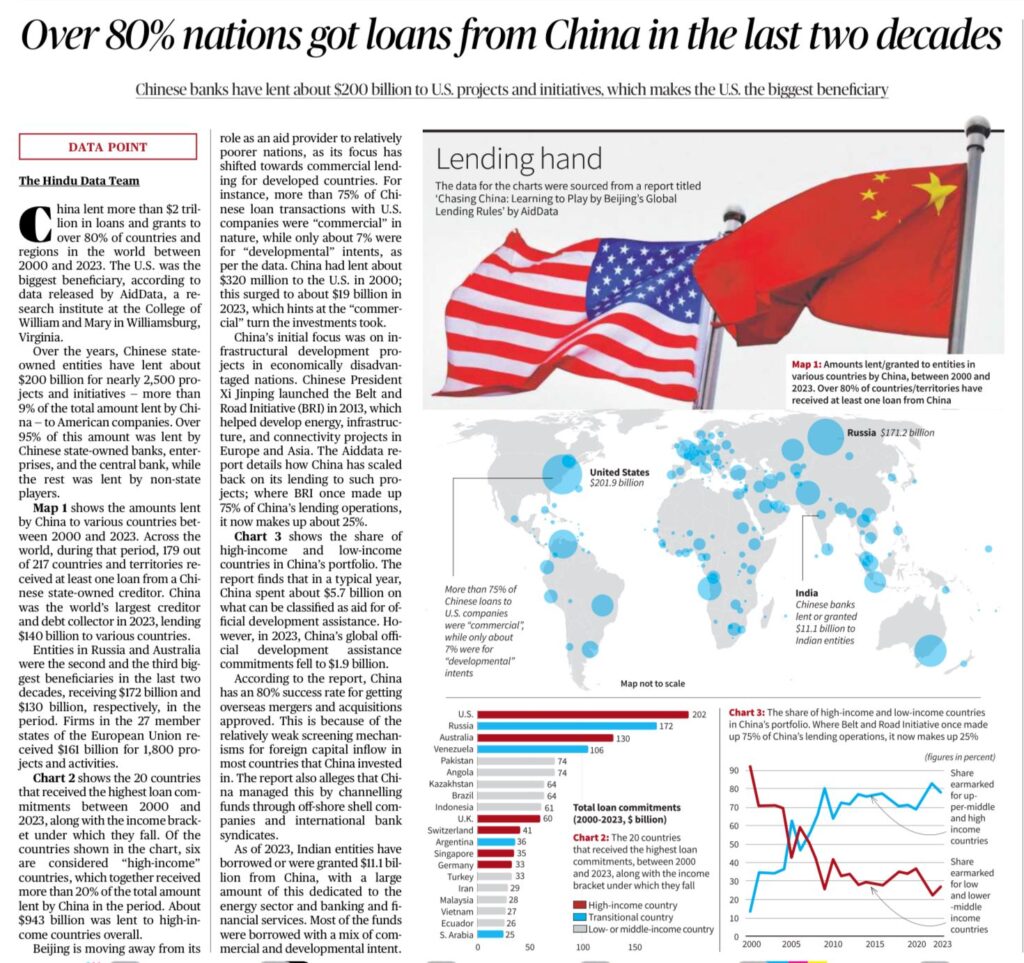
China’s Global Lending Rise: 80% Nations Took Loans – UPSC Economy Current Affairs

Core Context
China has emerged as a major global lender (2000–2023), giving loans to over 80% of the world’s countries, shifting from development lending to commercial and strategic lending linked to BRI.

Most Important Data
• Total global lending (2000–2023): $2.7 trillion
• Share of state-owned banks/entities: 95% of all loans
• Projects financed: ~2,500 worldwide

Top Recipients
• U.S.: $203.9 billion (largest)
• Russia: $171.2 billion
• Australia: $72 billion
• Venezuela: $60 billion
• India: $11.1 billion

Nature of U.S. loans
• 75% commercial, only 7% developmental

Shift in Lending Pattern
• Share of loans to low-income countries dropped from 75% (early 2000s) to 25% (2023).
• China increasingly lends to middle- and high-income countries + BRI infrastructure.

Debt Relief
• 2023 debt relief: $5.7 billion

WhatsApp Image 2025 11 26 at 4.53.13 PM

India’s Net FDI Turns Negative Again: Important UPSC Economy Update

Core Point
• Net FDI in September 2025 = –$2.4 billion, meaning more investment left India than entered for the second month in a row.

Key Data
Gross FDI inflow (Sept 2025): $6.6 billion
• 4.3% higher than Sept 2024
• 9.1% higher than August 2025
• Outflows (Sept 2025): $9 billion

Due to
• Profit repatriation by foreign companies
• Indian companies investing abroad
• FDI invested abroad by Indian companies:
• $3.8 billion (up 64.4% YoY)

Repatriation of profits by foreign companies
• $5.2 billion, slightly down by 0.2%
Net FDI in August 2025: –$0.6 billion (also negative)

3 4

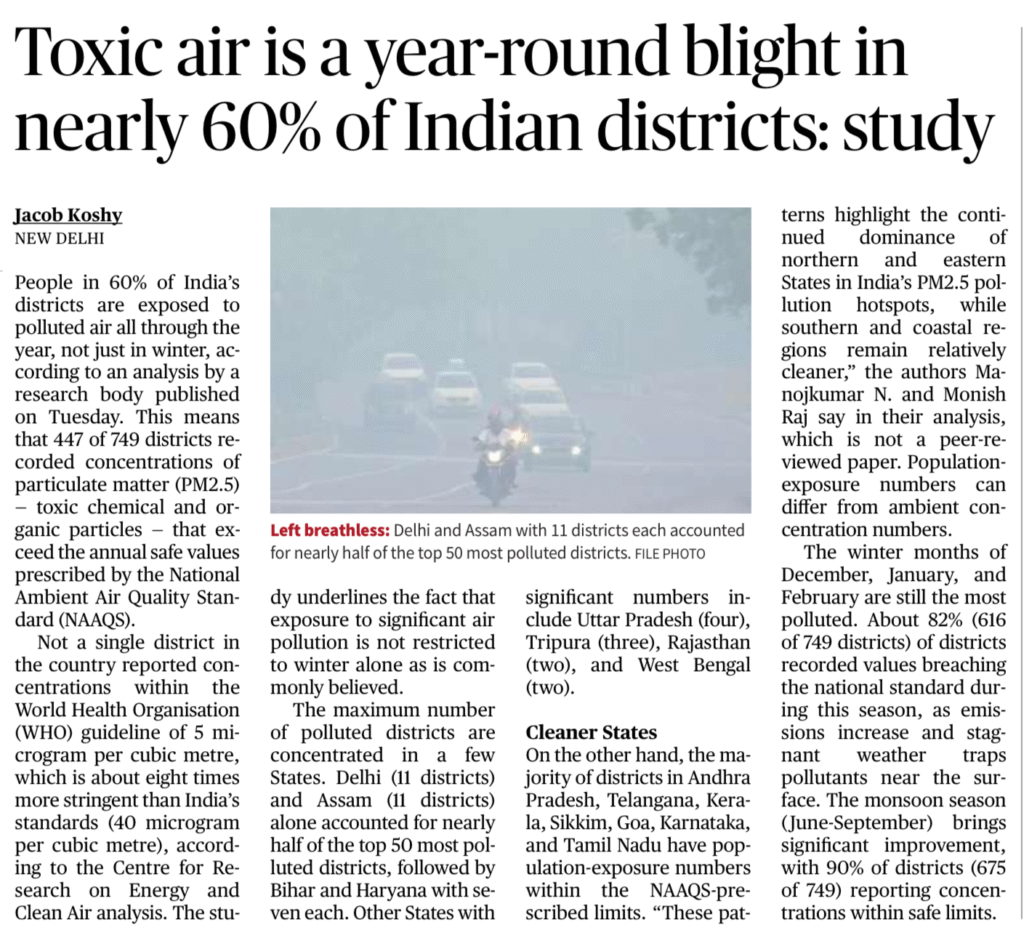
Toxic Air in 60% Indian Districts: Environment Issue for UPSC Prelims & Mains

Core Context
• A study by the Centre for Research on Energy and Clean Air (CREA) shows that 60% of India’s districts (447 of 749) experience unsafe PM2.5 levels throughout the year, not just in winter.

Most Important Findings
• Not a single district meets WHO PM2.5 guideline (5 µg/m³).
• 447 districts exceed India’s own NAAQS annual limit (40 µg/m³).
• Winter (Dec–Feb) worst season: 82% districts (616/749) breach standards.
• Monsoon (June–Sept) best season: 90% districts within safe limits.

Most Polluted Clusters
• Delhi (11 districts) + Assam (11 districts) → nearly half of top 50 polluted districts.
• Other high-pollution clusters:
• Bihar & Haryana (7 each)
• Uttar Pradesh (4)
• Tripura (3)
• Rajasthan (2)
• West Bengal (2)

4 3

Copyright © 2026 USARAMBHA EDUCATION (UnderStand UPSC). All Rights Reserved.

Offline Meetup

Reserve Your Meetup Seat