8 August 2026 | UPSC Daily Current Affairs

8 August 2026 | UPSC Daily Current Affairs

Saudi Pakistan Turkey defence deal: UPSC GS2 Analysis

Context: Saudi Pakistan Turkey defence deal
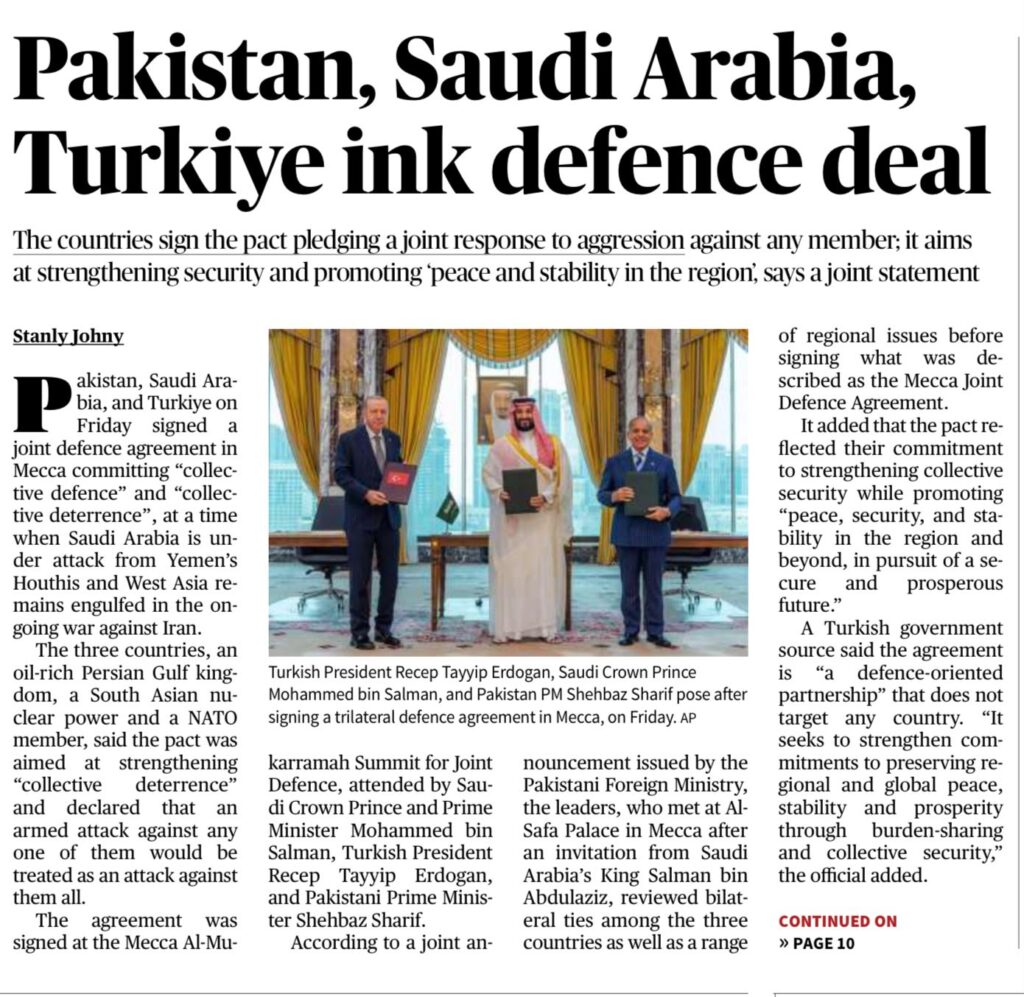
Saudi Arabia, Turkey and Pakistan have signed a joint defence agreement amid growing instability in West Asia.

The agreement comes at a time when Gulf states are facing security threats, existing security guarantees are being questioned and regional powers are looking for greater strategic autonomy.

Makkah Joint Defence Agreement

The agreement was signed in Makkah.

It is based on the principle of collective deterrence.

This means an armed attack on any one signatory will be treated as an attack on all three.

Key Features

Collective Deterrence

An attack on Saudi Arabia, Turkey or Pakistan will be treated as an attack on all three countries.

This is meant to strengthen deterrence against regional threats.

Defensive Character

The agreement is officially described as defensive.

It is not aimed at any specific country.

It is also not meant to create a sectarian or military bloc.

Strategic Convergence

The agreement brings together three different strengths:

  • Saudi Arabia’s economic and energy power
  • Turkey’s military and defence-industrial strength
  • Pakistan’s military and nuclear capability

Broader Objective

The pact aims to strengthen:

  • Defence coordination
  • Regional deterrence
  • Maritime security
  • Protection of energy routes
  • Strategic autonomy in West Asia

Core Strategic Interests

Saudi Arabia

Saudi Arabia wants to diversify its security partnerships.

It also wants to reduce excessive dependence on U.S. security guarantees.

The deal strengthens its deterrence against regional threats.

Pakistan

Pakistan gains strategic relevance in West Asia.

It also seeks to deepen energy, investment and employment linkages with Saudi Arabia.

This can increase Pakistan’s role in regional security architecture.

Turkey

Turkey wants to expand its influence in West Asia.

It is also trying to build an independent regional security role while remaining a NATO member.

Is It a “Muslim NATO”?

It resembles NATO’s collective-defence idea in a limited sense.

But it is not a Muslim NATO.

It lacks NATO-like:

  • Institutional structure
  • Automatic military intervention mechanism
  • Unified command system
  • Formal military alliance framework

Significance

The agreement reflects a shift towards a more multipolar and regionally driven West Asian security order.

It shows that regional powers are no longer depending only on traditional external security providers.

Instead, they are trying to build their own security arrangements.

Key Takeaway

The Saudi Arabia–Turkey–Pakistan defence deal is not a formal Islamic military alliance. It is a regional strategic partnership for deterrence, security coordination and greater strategic autonomy in West Asia.
Saudi Pakistan Turkey defence deal

UPI MDR service charge debate: UPSC GS3 Analysis

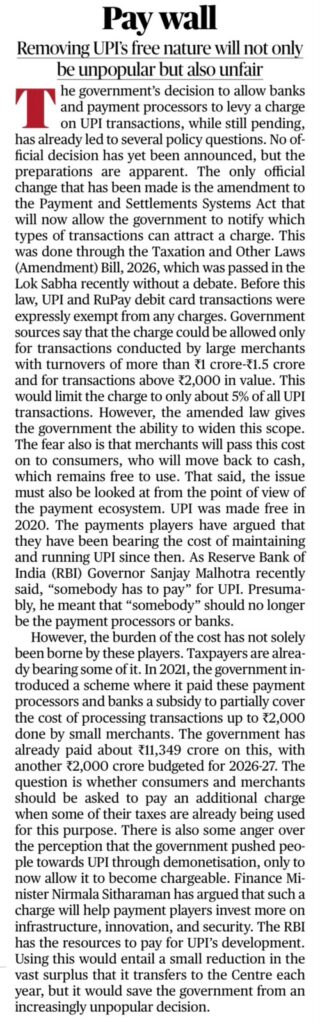
Context: UPI MDR service charge debate
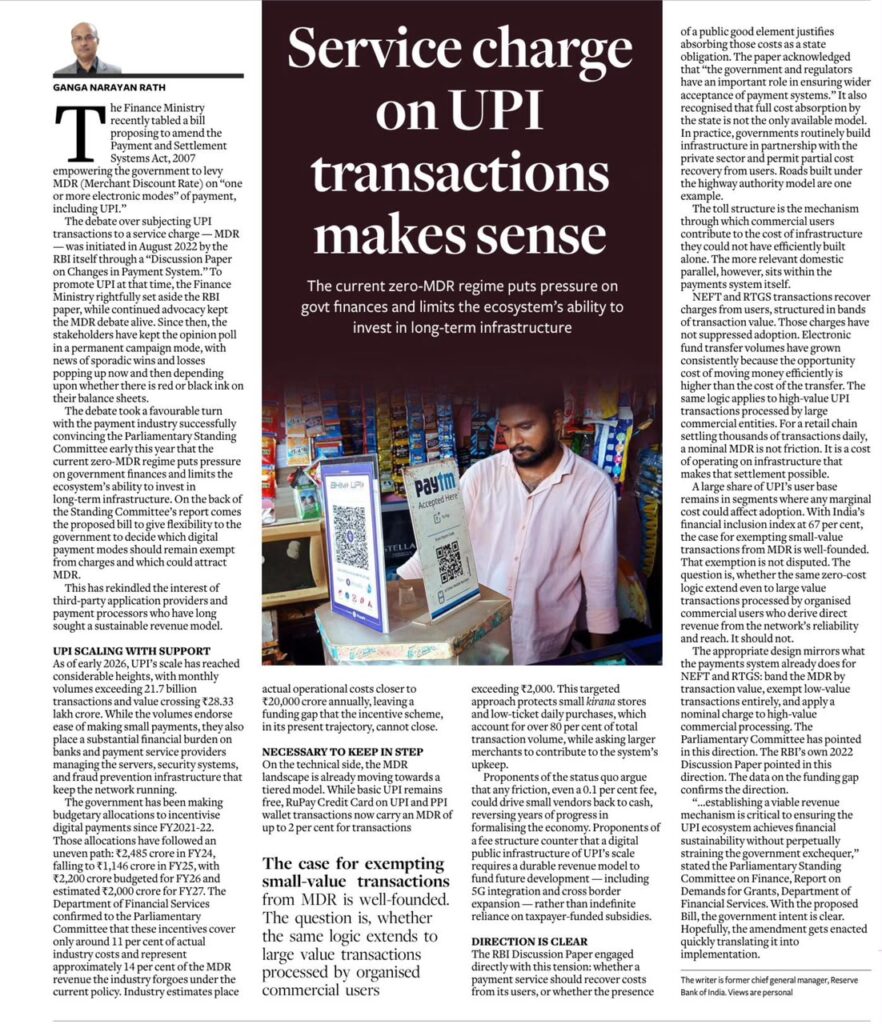
A proposed amendment to the Payment and Settlement Systems Act, 2007 seeks to empower the government to notify electronic payment transactions that may attract charges.

This has revived debate over whether the current zero-Merchant Discount Rate regime on UPI is financially sustainable for banks and payment processors.

Merchant Discount Rate

Merchant Discount Rate, or MDR, is the fee paid by a merchant to banks or payment processors for processing digital payments.

It is a cost linked to digital payment infrastructure.

Unified Payments Interface

UPI is a real-time bank-to-bank digital payment system.

It has become one of India’s most successful digital public infrastructure platforms.

Current Regime

At present, UPI transactions carry zero MDR.

This means merchants do not pay a processing charge for UPI transactions.

The cost of maintaining the ecosystem is partly supported through government incentives.

Why the Debate Has Emerged

The zero-MDR model has helped UPI adoption.

But it also puts financial pressure on banks and payment service providers.

They still have to invest in:

  • Infrastructure
  • Cybersecurity
  • Fraud prevention
  • Innovation
  • System reliability
  • Transaction processing capacity

The concern is that a completely free model may limit long-term investment in UPI infrastructure.

Proposal Under Consideration

A limited MDR may be considered for UPI transactions above ₹2,000 made by large merchants.

The charge may potentially remain below 0.5%.

Small merchants and consumers are expected to remain exempt.

This is still under consideration and is not yet a final notified policy.

Positive Aspects

Sustainability

A limited service charge can create revenue for maintaining and expanding UPI infrastructure.

Investment

It can support investment in cybersecurity, innovation and technological upgrades.

Lower Fiscal Burden

It can reduce dependence on government incentives.

Fair Cost-Sharing

Large commercial users who heavily use UPI infrastructure may contribute to its cost.

Negative Aspects

Cost Pass-Through

Large merchants may indirectly pass the MDR cost to consumers.

Cash Revival

If digital payments become costly, some users may return to cash.

Digital Inclusion Concerns

If charges are expanded too widely, small merchants and low-value users may be discouraged.

Public-Good Concern

UPI’s success is based on simplicity, affordability and frictionless use.

Any charge must not weaken mass adoption.

Core Argument

The issue is not simply MDR vs zero MDR.

The real question is how to make UPI financially sustainable without damaging its affordability and mass adoption.

The best approach may be to keep small-value transactions and small merchants free, while allowing a limited MDR on high-value transactions of large merchants.

Key Takeaway

UPI needs a sustainable funding model, but charges must be carefully designed. Small users should remain protected while large commercial users may share infrastructure costs.

India US strategic partnership shift: UPSC GS2 Analysis

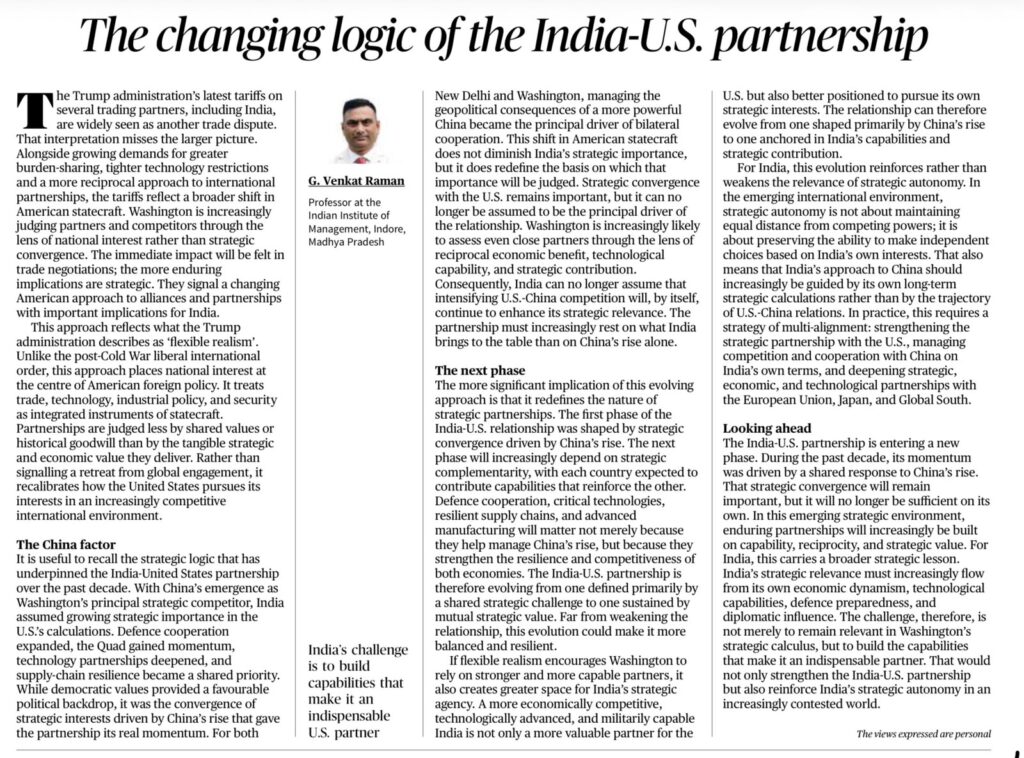
Context: India US strategic partnership shift
China’s rise initially pushed India and the United States closer.

However, the partnership is now moving beyond China alone. India’s economic scale, technology base, defence capability and strategic geography are increasingly valuable in their own right.

Changing Nature of the Partnership

Earlier, India–U.S. convergence was mainly driven by shared concerns over China.

Now, the relationship is becoming broader.

India is being seen as a long-term partner in supply chains, technology, manufacturing, defence and Indo-Pacific security.

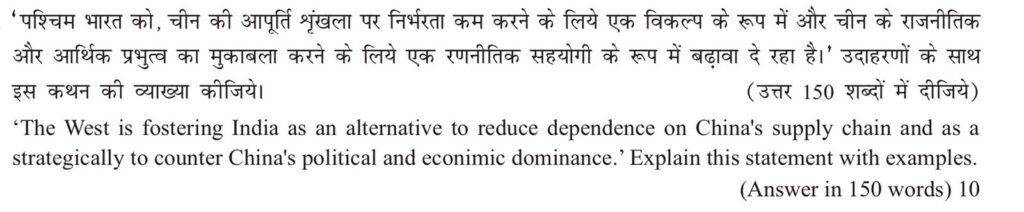
India as an Alternative to China’s Supply Chain

Manufacturing

The China+1 strategy is pushing companies to diversify production away from excessive dependence on China.

Apple’s expanding manufacturing presence in India is an important example.

Critical Minerals

The Minerals Security Partnership helps diversify critical mineral supply chains.

This is important because critical minerals are essential for semiconductors, batteries, clean energy and advanced manufacturing.

Pax Silica

Pax Silica aims to build resilient supply chains across:

iCET

The Initiative on Critical and Emerging Technology supports cooperation in:

  • Semiconductors
  • Artificial Intelligence
  • Quantum technology
  • Telecom
  • Space

India as a Strategic Ally

Indo-Pacific

India’s location in the Indian Ocean and its military capability make it important for balancing China in the Indo-Pacific.

Quad

The Quad brings together:

  • India
  • United States
  • Japan
  • Australia

It supports cooperation in maritime security, technology and resilient supply chains.

Defence and Technology

India–U.S. cooperation in defence co-production and technology transfer strengthens India’s strategic capability.

Examples include GE–HAL cooperation and broader defence industrial collaboration.

Why India Matters to the West

India is not only a market.

It is also seen as:

  • A manufacturing alternative
  • A strategic partner
  • A democratic counterweight
  • A technology collaborator
  • A security actor in the Indo-Pacific

Way Forward

India should convert Western interest into domestic manufacturing and technological capability.

It should move from being only a buyer to becoming a co-developer and co-producer.

Technology transfer should be prioritised.

India should use platforms like MSP and Pax Silica to integrate into high-value supply chains.

At the same time, India must preserve strategic autonomy and multi-alignment.

Key Takeaway

The India–U.S. partnership is no longer only about balancing China. It is increasingly about India’s own strategic value in manufacturing, technology, defence and the Indo-Pacific.

GDP and prosperity limitations: UPSC GS3 Analysis

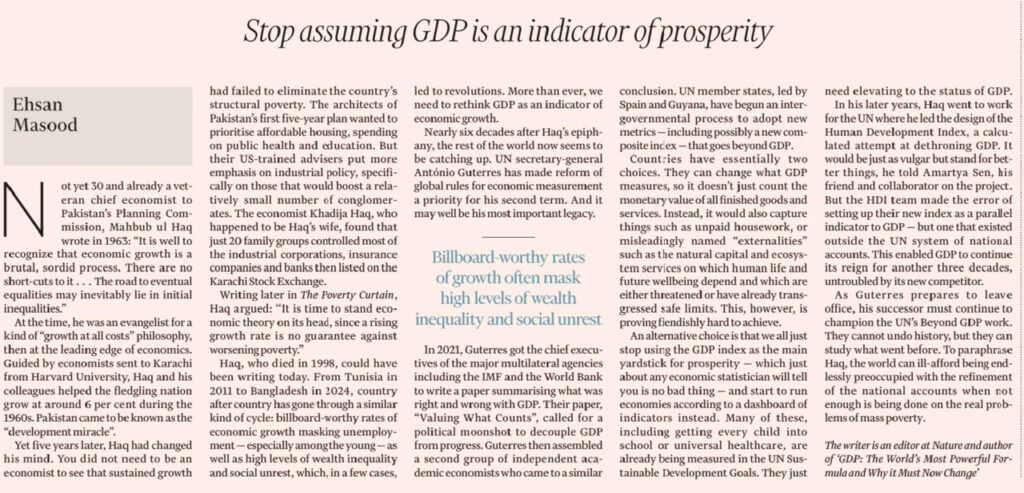
Context: GDP and prosperity limitations
High economic growth does not automatically translate into prosperity or better quality of life.

GDP measures economic output, but it does not fully capture people’s actual wellbeing, distribution of income, social progress or environmental sustainability.

Gross Domestic Product

Gross Domestic Product, or GDP, is the monetary value of all final goods and services produced within a country’s territory during a given period.

It measures the size and growth of an economy.

Limitation of GDP

GDP does not adequately reflect:

  • Income distribution
  • Poverty
  • Health
  • Education
  • Unpaid household work
  • Environmental sustainability
  • Quality of life
  • Overall wellbeing

Why GDP Alone Is Inadequate

Growth Does Not Always Mean Prosperity

A country can record high GDP growth and still face poverty, unemployment and social unrest.

The document gives Pakistan as an example, where growth has not automatically eliminated structural poverty.

GDP Does Not Show Distribution

GDP is an aggregate measure.

It does not show who benefits from economic growth.

A rising GDP can coexist with high income inequality and wealth concentration.

GDP Misses Social Wellbeing

GDP does not properly capture healthcare access, education quality, living standards and unpaid household or care work.

This means economic expansion may not automatically translate into human development.

GDP Ignores Environmental Costs

GDP can rise even when growth damages ecosystems or depletes natural resources.

Activities that increase output may also increase pollution, ecological degradation and climate risk.

Sustainable prosperity requires accounting for natural capital and environmental wellbeing.

Way Forward

GDP should be retained as a measure of economic activity.

But it should not be treated as the sole measure of prosperity.

Countries need a dashboard of indicators covering:

  • Income distribution
  • Health
  • Education
  • Employment
  • Environment
  • Wellbeing

Frameworks such as the Human Development Index and Sustainable Development Goals can complement GDP.

Key Takeaway

GDP is useful for measuring economic output, but it is not enough to measure prosperity. Real development must include equality, health, education, jobs, environment and wellbeing.

Anil Menon ISS spacewalk: UPSC Science and Tech

Context: Anil Menon ISS spacewalk
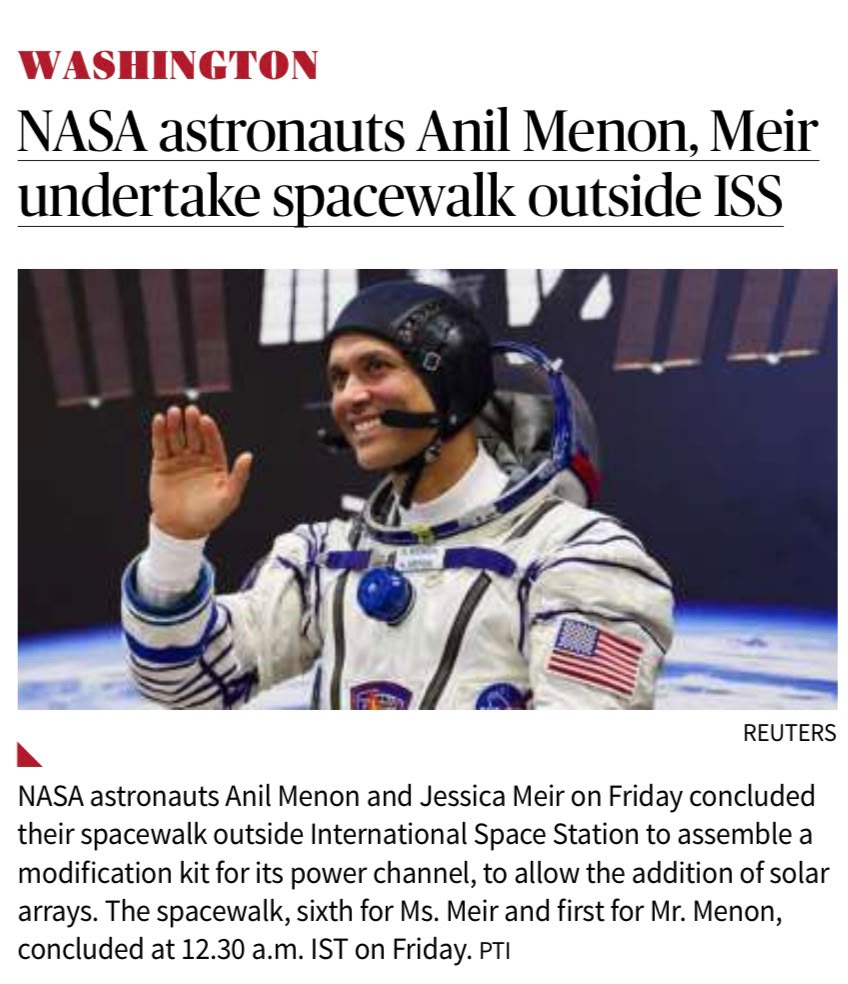
NASA astronaut Anil Menon, an Indian-origin American, completed his first spacewalk outside the International Space Station with astronaut Jessica Meir.

The spacewalk involved modifying the ISS power system to enable installation of additional solar arrays and strengthen future power-generation capacity.

Anil Menon: Mission and Background

Anil Menon is an Indian-origin American astronaut.

He is also a physician and former flight surgeon.

He was selected in the NASA Astronaut Candidate Class of 2021.

His first spaceflight was the Soyuz MS-29 mission to the ISS.

Spacewalk

A spacewalk is also called an Extravehicular Activity.

It refers to work performed by an astronaut outside a spacecraft or space station.

Spacewalks are used for:

  • Repairs
  • Maintenance
  • Installation of equipment
  • Scientific experiments
  • Space station upgrades

Purpose of This Spacewalk

The spacewalk was conducted to modify the ISS power system.

This will allow the addition of more solar arrays.

Solar arrays are important because they provide power to the International Space Station.

Indian-Origin Astronauts and ISS

Kalpana Chawla

Kalpana Chawla was the first Indian-American in space.

Her missions were aboard the Space Shuttle and not to the ISS.

Sunita Williams

Sunita Williams is an Indian-American astronaut who undertook multiple ISS missions and long-duration stays.

Raja Chari

Raja Chari is an Indian-American NASA astronaut who served aboard the ISS during Expedition 66.

Anil Menon

Anil Menon is the latest Indian-American astronaut to undertake an ISS mission and has now conducted his first spacewalk.

Shubhanshu Shukla

Shubhanshu Shukla became the first Indian national to visit the ISS through the Axiom-4 mission in 2025.

This is distinct from Indian-origin American astronauts.

Significance

The development is important from the perspective of space technology and Indian-origin contributions to global space missions.

It also highlights the importance of the ISS as a platform for scientific research, technology testing and international cooperation.

Key Takeaway

Anil Menon’s first spacewalk is significant because it connects Indian-origin participation in global space missions with the technical maintenance and future power capacity of the International Space Station.

Astrobase EVEREST rocket engine: UPSC Science and Tech

Context: Astrobase EVEREST rocket engine
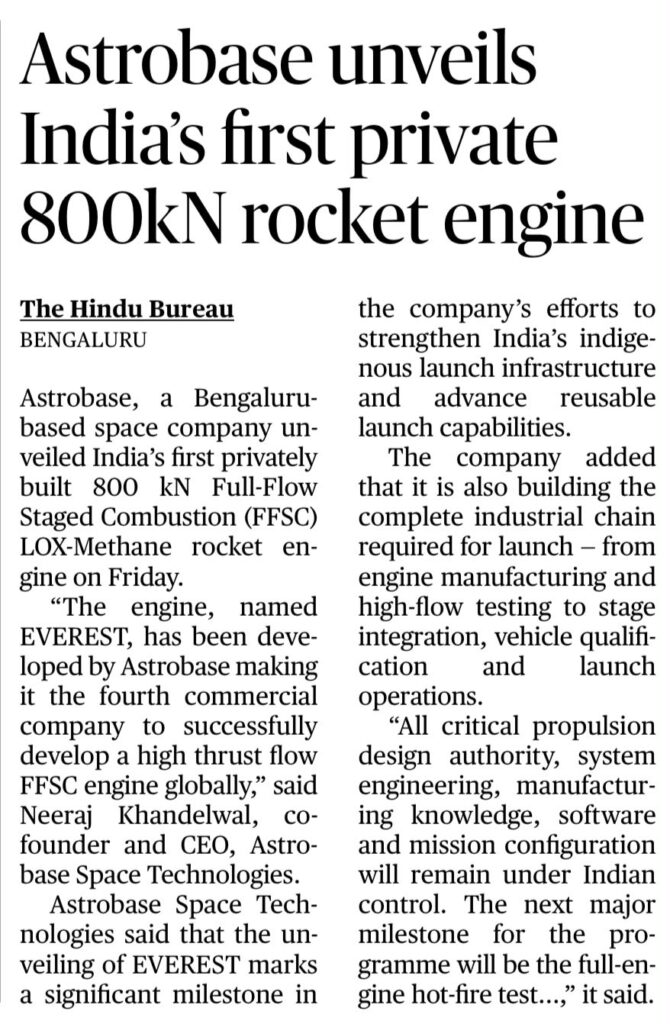
Bengaluru-based Astrobase Space Technologies has unveiled EVEREST, India’s first privately built 800 kilonewton rocket engine.

This marks an important step in India’s private space sector moving from satellite manufacturing and launch services towards indigenous rocket propulsion.

EVEREST Rocket Engine

EVEREST is an advanced rocket engine developed by Astrobase Space Technologies.

It has 800 kN thrust.

Key Features

Engine

EVEREST is an 800 kN rocket engine.

This makes it a high-thrust engine suitable for advanced launch applications.

Propellant

It uses Liquid Oxygen and Methane.

Liquid Oxygen, or LOX, acts as the oxidiser.

Methane acts as the fuel.

Combustion Cycle

EVEREST uses Full-Flow Staged Combustion, or FFSC.

This is an advanced combustion cycle that offers high efficiency and high performance.

Reusability

The engine is designed for multiple operating cycles.

It is intended to support reusable launch vehicles.

However, its reusability has not yet been flight-demonstrated.

Application

The engine is intended for:

  • High-thrust launch vehicles
  • Medium-lift launch vehicles
  • Future reusable launch systems

Significance for India

The engine reflects the growing maturity of India’s private space sector.

It strengthens indigenous launch infrastructure.

It can support future reusable launch capabilities.

It also shows that private companies are now entering advanced propulsion technology, which is one of the most complex areas of space launch systems.

Why Private Space Sector Matters

Private participation can expand India’s space economy.

It can reduce pressure on ISRO and allow ISRO to focus more on advanced missions.

It can improve innovation, competition and commercial launch capacity.

It can also help India become a bigger player in the global space market.

Key Takeaway

Astrobase’s EVEREST engine is a major private-sector propulsion milestone. It shows that India’s private space ecosystem is moving towards advanced launch technology and reusable rocket capabilities.

Copyright © 2026 USARAMBHA EDUCATION (UnderStand UPSC). All Rights Reserved.

Inquiry form for
Takshila Residential Program