16 March 2026 | Daily Current Affairs

Climate Resilience and the Role of Water Systems in India’s Adaptation Strategy

Core Argument

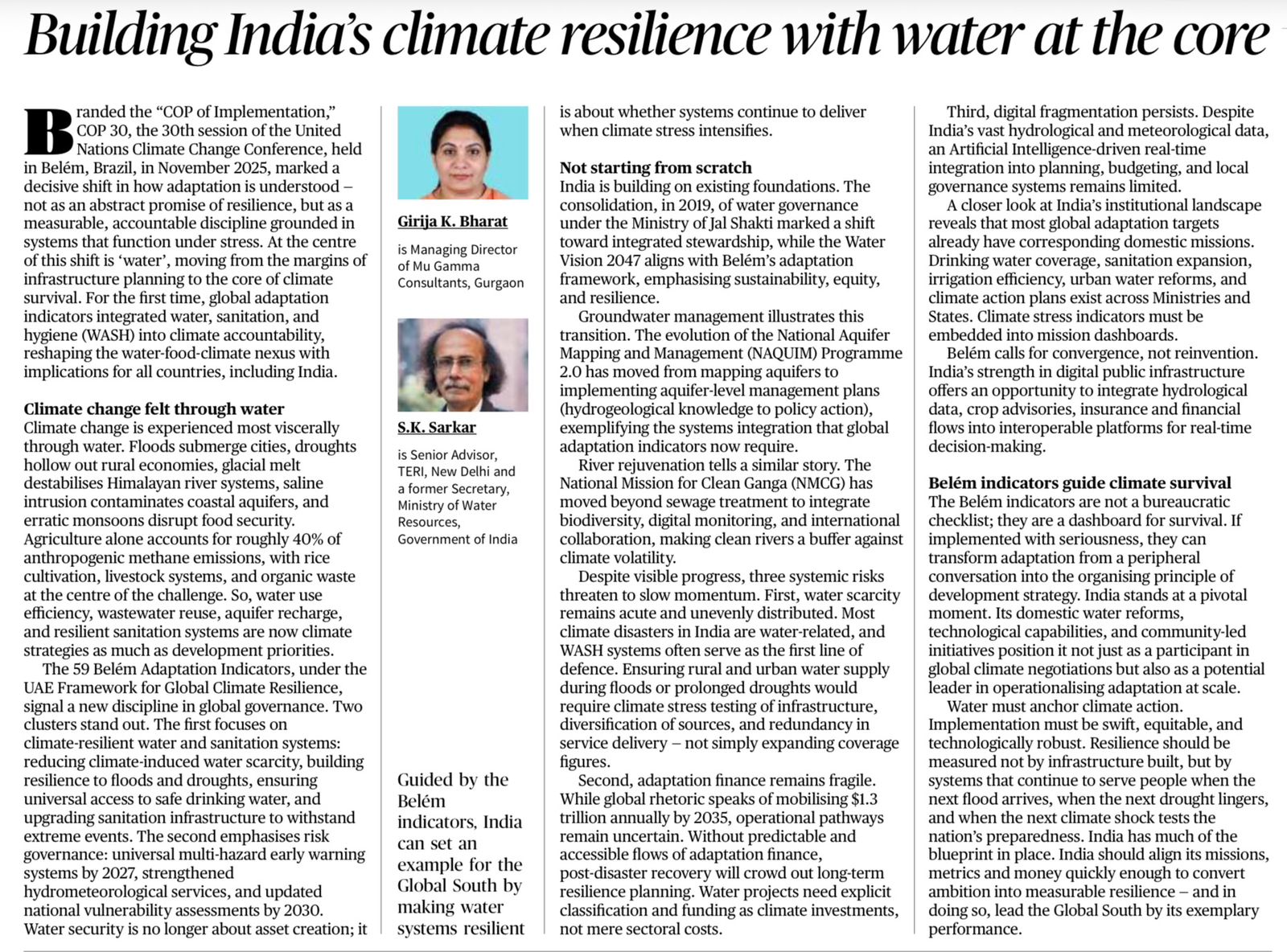
The article argues that water must be placed at the centre of India’s climate adaptation strategy, shifting resilience from infrastructure expansion to integrated, accountable water systems that continue functioning under climate stress.

Key Points

  1. Shift in adaptation thinking
    COP-30 reframes resilience as measurable system performance under stress, with water at the core of the climate-food-energy nexus.
  2. Climate change felt through water
    Floods, droughts, glacier melt, saline intrusion and erratic monsoons reveal climate impacts primarily through water systems.
  3. Belém Adaptation Indicators
    Focus on climate-resilient WASH systems, flood and drought preparedness, universal safe drinking water, early warning systems and updated vulnerability assessments.
  4. India not starting from scratch
    Institutional progress includes Jal Shakti Ministry reforms, Water Vision 2047, NAQUIM aquifer mapping and the National Mission for Clean Ganga.
  5. Systemic risks remain
    Water scarcity remains uneven; WASH systems require climate stress testing, diversified sources and redundancy.
  6. Finance gap
    Adaptation finance remains uncertain. Water investments must be treated as climate investments.
  7. Governance and data integration
    Fragmented data weakens planning; AI-driven integration of hydrological, crop and financial data can improve decision-making.
  8. Implementation priority
    India must align missions, metrics and financing to translate climate ambitions into measurable resilience outcomes.
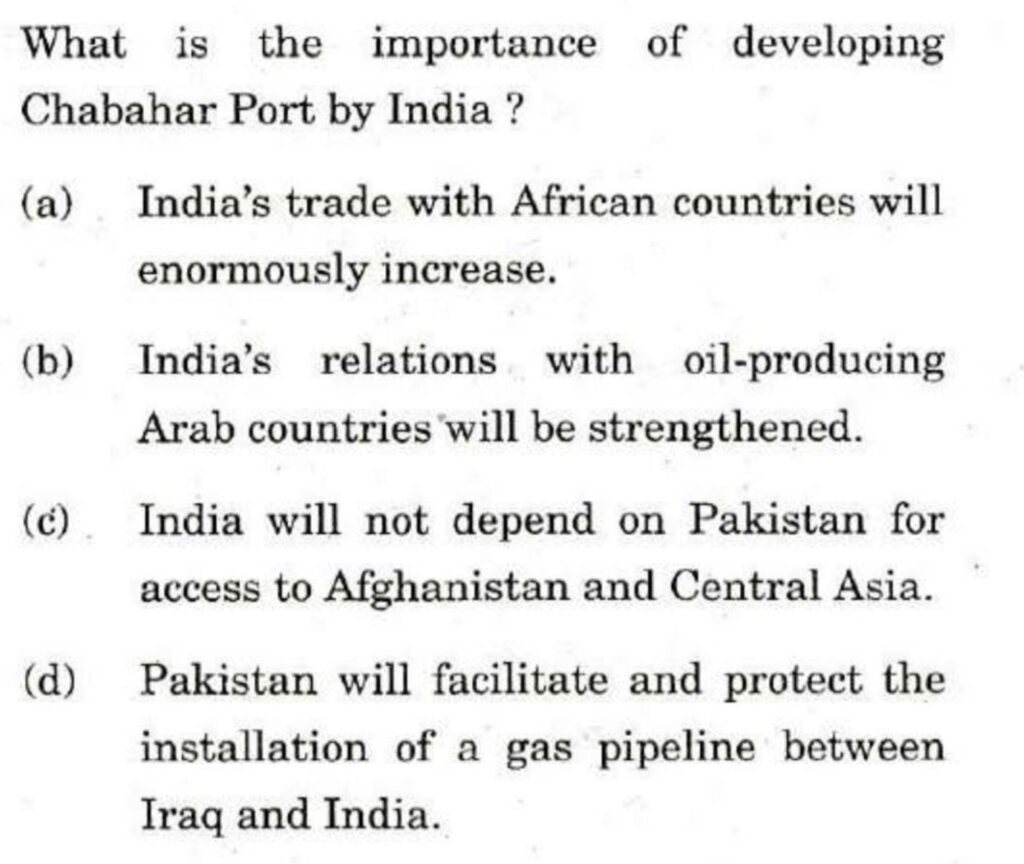
Chabahar Port and Its Strategic Importance for India’s Connectivity to Central Asia

Context

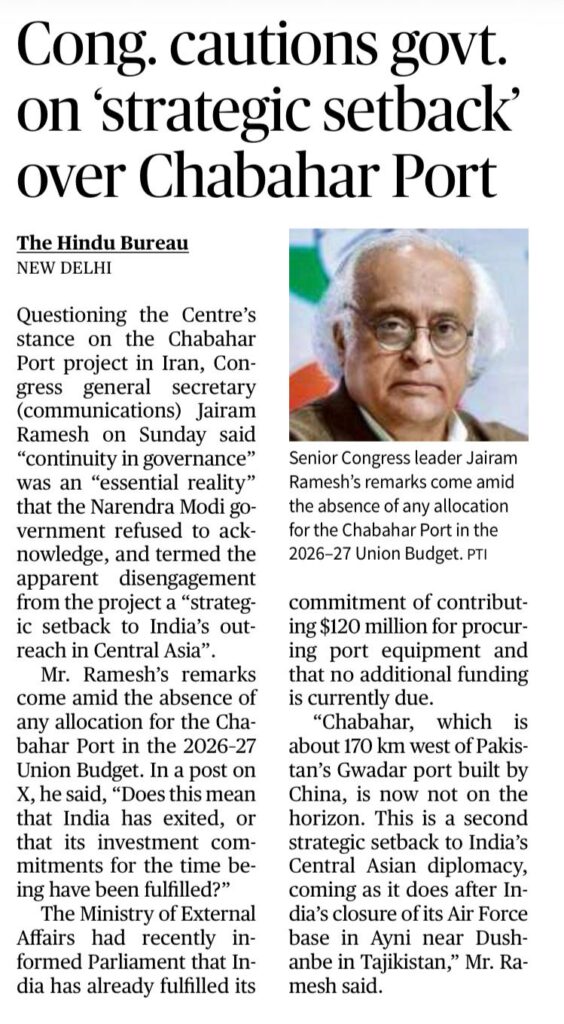
The report highlights political criticism over India’s reduced engagement with Iran’s Chabahar Port project, seen as a setback to India’s connectivity strategy toward Central Asia and beyond.

Chabahar Port

Location & Features

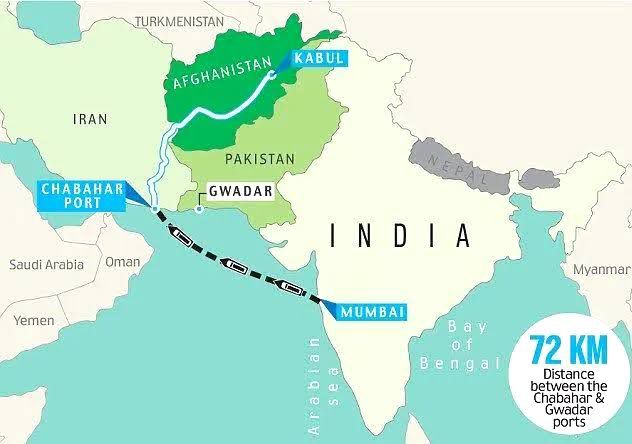
  1. Chabahar Port is located in Sistan–Baluchestan province of Iran on the Gulf of Oman and is Iran’s only oceanic port with direct access to the Indian Ocean.
  2. It has two terminals:
    Shahid Beheshti
    Shahid Kalantari
  3. Lies close to Pakistan’s Gwadar Port.

India’s Role

  1. India has invested in developing berths and logistics facilities.
  2. Operates part of the port through India Ports Global Limited.

Gwadar Port — Basics

  1. Located in Pakistan’s Balochistan province on the Arabian Sea.
  2. Developed mainly under the China–Pakistan Economic Corridor (CPEC).
  3. Provides China access to the Indian Ocean and has major geostrategic importance.
  4. Often compared with Chabahar due to proximity and regional rivalry dynamics.

Why Chabahar is Important for India

Strategic Connectivity
Provides India direct access to Afghanistan, Central Asia and Russia, bypassing Pakistan.

Gateway to INSTC
Chabahar is a key node in the International North–South Transport Corridor linking India, Iran, Central Asia, Russia and Europe.

Economic & Energy Interests
Enhances access to hydrocarbon-rich Central Asia and Eurasian markets.

Strategic Balance
Acts as a counterweight to China’s influence via Gwadar and CPEC.

PYQ – 2017, Ans – C

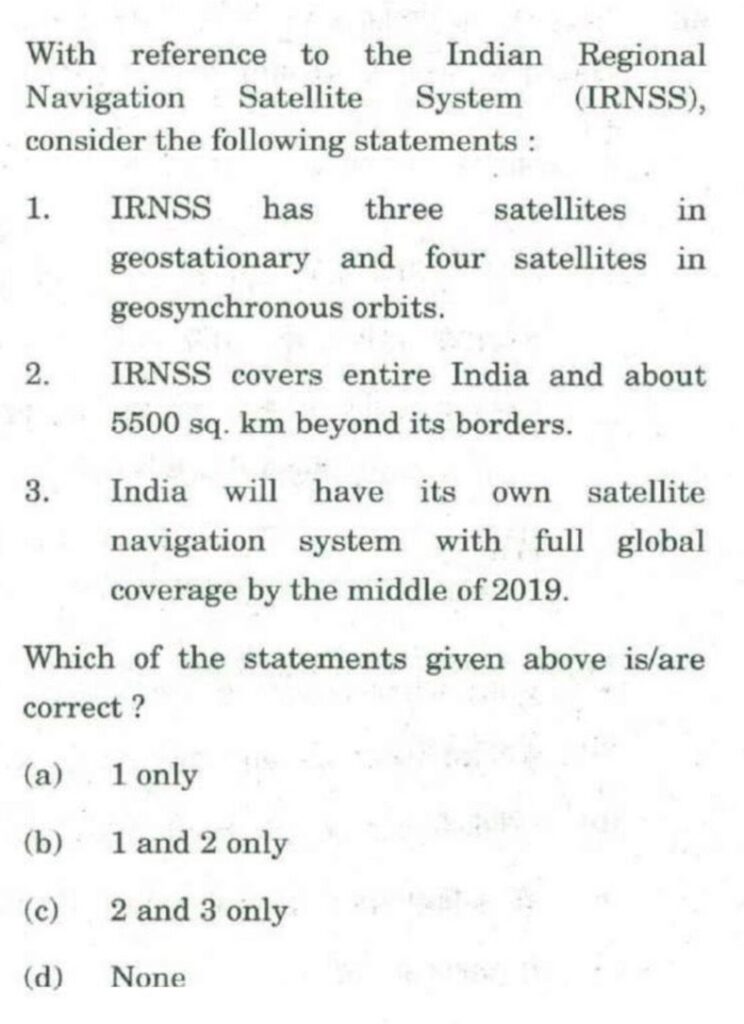
NavIC Satellite Atomic Clock Failure and Its Impact on India’s Navigation System

Context

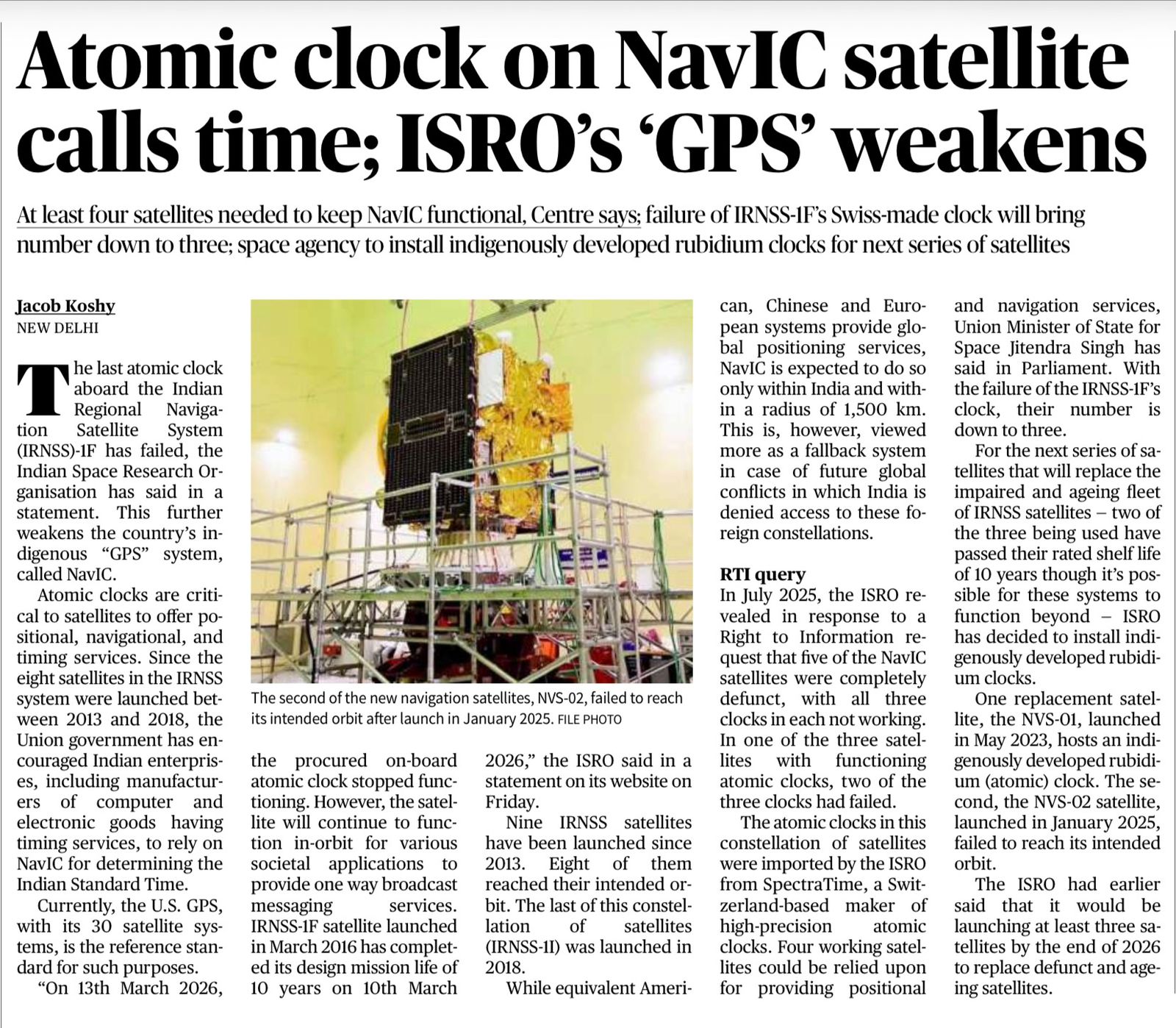
Failure of an atomic clock on an IRNSS (NavIC) satellite has weakened India’s regional navigation capability; the Indian Space Research Organisation (ISRO) plans indigenous replacements for future satellites.

Navigation Satellite System (NavSat) — Basics

  1. A satellite-based system that provides Positioning, Navigation and Timing (PNT) services.
  2. Satellites transmit time-stamped signals; receivers determine location using trilateration.
  3. Key uses include aviation, maritime transport, mapping, disaster management, telecom synchronization and defence.

India’s Navigation System — NavIC (IRNSS)

  1. Full form: Navigation with Indian Constellation (NavIC); earlier called Indian Regional Navigation Satellite System (IRNSS).
  2. Coverage: India and about 1,500 km beyond its borders.

Services

Standard Positioning Service (SPS) for civilians
Restricted Service (RS) for authorised users

Orbit-wise Distribution

Geostationary Orbit (GEO)
3 satellites
IRNSS-1C
IRNSS-1F
IRNSS-1G

Inclined Geosynchronous Orbit (IGSO)
4 satellites
IRNSS-1A
IRNSS-1B
IRNSS-1D
IRNSS-1E

GEO satellites remain fixed over the equator.
IGSO satellites trace a figure-8 pattern over India for better regional coverage.

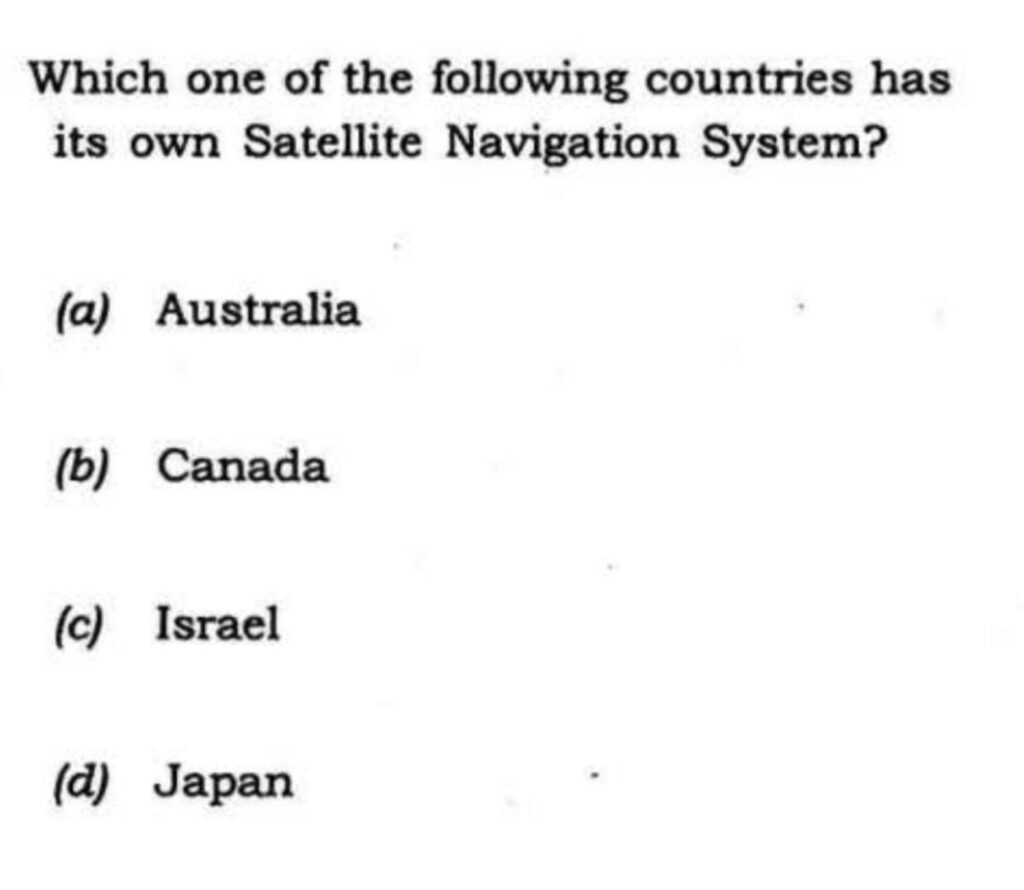
Major Global Navigation Satellite Systems (GNSS)

GPS — United States
GLONASS — Russia
GalileoEuropean Union
BeiDou — China
NavIC (IRNSS) — India

Atomic Clocks — Role

  1. Highly precise rubidium/cesium clocks onboard satellites.
  2. Provide exact timing signals essential for accurate positioning.
  3. Even nanosecond errors can cause large location inaccuracies.
  4. Also support telecom networks, banking systems, power grids and scientific applications.
PYQ – 2023, Ans – D
PYQ – 2018, Ans – A

Election Commission of India Announces Assembly Election Schedule for Five States

Context

The Election Commission of India announced the Assembly election programme for Assam, Kerala, Tamil Nadu, Puducherry and West Bengal with phased polling and counting later.

Basics

A. Election Commission of India (Constitutional Position)

  1. Belongs to Part XV (Elections) of the Constitution of India.
  2. Article 324 gives superintendence, direction and control of elections to
    • Parliament
    • State Legislatures
    • President and Vice-President

    to the Election Commission of India.

B. Notification under Representation of the People Act, 1951

  1. Section 14 (Lok Sabha):
    Election held on notification of the President of India.
  2. Section 15 (State Legislative Assembly):
    Election held on notification of the Governor of the State.

C. Schedule and Announcement

  1. Election schedule (phases, polling, counting) announced by the Election Commission of India.
  2. Authority derived mainly from Article 324 of the Constitution.
PYQ – 2017, Ans – D

Kharg Island: Strategic Oil Export Hub of Iran in the Persian Gulf

Context

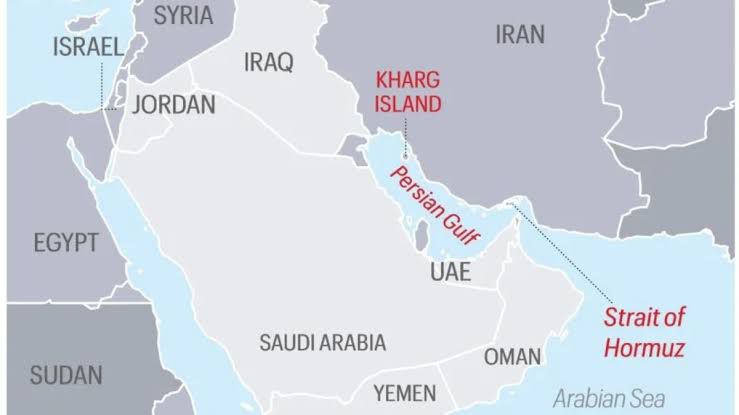
The news highlights rising U.S.–Iran tensions, with remarks by Donald Trump warning of possible strikes on Iran’s Kharg Island amid ongoing conflict dynamics in West Asia.

Kharg Island

Location & Basic Facts

  1. Kharg Island is a small Iranian island in the Persian Gulf, about 25 km off the mainland coast in Bushehr province.
  2. It lies near major offshore oilfields and serves as a major export terminal.

Strategic & Economic Importance

  1. Kharg Island handles around 90% of Iran’s crude oil exports, making it the backbone of Iran’s oil economy.
  2. The island has large storage facilities (tens of millions of barrels) and can load multiple supertankers simultaneously.
  3. Pipelines connect it to both offshore and mainland oilfields, concentrating export infrastructure at one point.
About the UPSC Civil Services Examination (UPSC CSE)

The UPSC Civil Services Examination (CSE) is one of the most competitive and esteemed examinations in India, conducted by the Union Public Service Commission to recruit officers for services such as the Indian Administrative Service (IAS), Indian Police Service (IPS), Indian Foreign Service (IFS), and others. The exam comprises three stages — Prelims, Mains, and the Personality Test (Interview) — designed to test a candidate’s knowledge, aptitude, decision-making, and leadership skills.


How to Prepare Effectively for UPSC CSE

Cracking the UPSC CSE requires a deep understanding of the syllabus, consistent revision, structured answer writing, and smart test-taking strategies. The Prelims test analytical and conceptual clarity, the Mains focuses on critical thinking, articulation, and subject mastery, while the Interview assesses presence of mind, ethical judgment, and personality traits relevant to public service.

At UnderStand UPSC, we empower aspirants with a personalized and focused approach to each stage of the exam.


Why Choose UnderStand UPSC?

UnderStand UPSC is a mentorship-driven platform offering a clear, clutter-free strategy to tackle the Civil Services Examination. Our programs like Transform (for beginners and intermediate learners) and Conquer (for advanced mains preparation) provide structured study plans, syllabus-wise video content, interactive live sessions, and answer writing support.

We emphasize:

  • Concept clarity through topic-wise lectures

  • Test series designed around real UPSC standards

  • Personalized mentorship in small groups

  • Regular performance tracking and peer benchmarking

  • Doubt-clearing sessions, current affairs analysis, and monthly magazines


Join the UnderStand UPSC Learning Community

Our mission is to make UPSC preparation less overwhelming and more strategic. We combine mentorship, discipline, and academic rigor to help you clear CSE with confidence. Whether you’re preparing from Delhi, Mumbai, Bangalore, or a remote village — our online-first model ensures quality guidance reaches every corner of India.

Join the thousands of aspirants who trust UnderStand UPSC to guide their journey toward becoming civil servants.

Stay connected with us through our Telegram, YouTube, and Instagram channels for daily tips, strategies, and updates.

Copyright © 2026 USARAMBHA EDUCATION (UnderStand UPSC). All Rights Reserved.

Join the Success Journey!