Women Workforce Participation India: Rising Trends but Low Leadership Representation
Context: Women Workforce Participation India
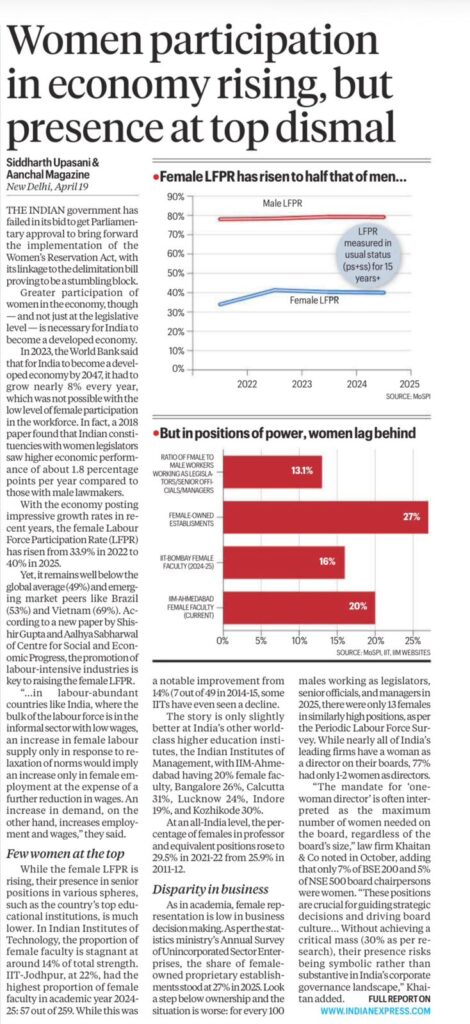
Using data from the Periodic Labour Force Survey (PLFS) — Ministry of Statistics and Programme Implementation (MoSPI), World Bank (2023), and Centre for Social and Economic Progress (CSEP), the article shows a clear trend: more women are entering the workforce, but very few are reaching positions of power.
1. Participation improving, but still low
- Female Labour Force Participation Rate (LFPR):
33.9% (2022) → ~40% (2025) - Still behind:
Global ~49% | Brazil ~53% | Vietnam ~69%
2. Growth linkage (Why it matters)
- World Bank (2023):
India needs ~8% annual growth till 2047 - Low female participation = constraint on growth
3. Clear leadership deficit
- Women in legislators/senior officials/managers: 13.1%
- Corporate boards:
- 77% firms → only 1–2 women directors
- Women chairpersons:
BSE 200: ~7% | NSE 500: ~5%
4. Business & ownership gap
- Female-owned establishments: 27% (2025)
(Annual Survey of Unincorporated Sector Enterprises — MoSPI)
5. Academia (elite institutions)
- IITs: ~14% female faculty (stagnant)
- IIMs: range 19%–31%
(Highest: Calcutta ~31%, Kozhikode ~30%)
6. Structural constraint
- Labour force largely informal & low-wage
- Supply ↑ without demand → wage pressure
- Need labour-intensive job creation
7. Policy bottleneck
- Women’s Reservation Act implementation delayed
(linked with delimitation)