1 June 2026 | Daily Current Affairs

Adivasi Identity and Scheduled Tribe Status under Article 342 for UPSC

Context: The Majoritarian Shadow Over Adivasi Identity, Faith
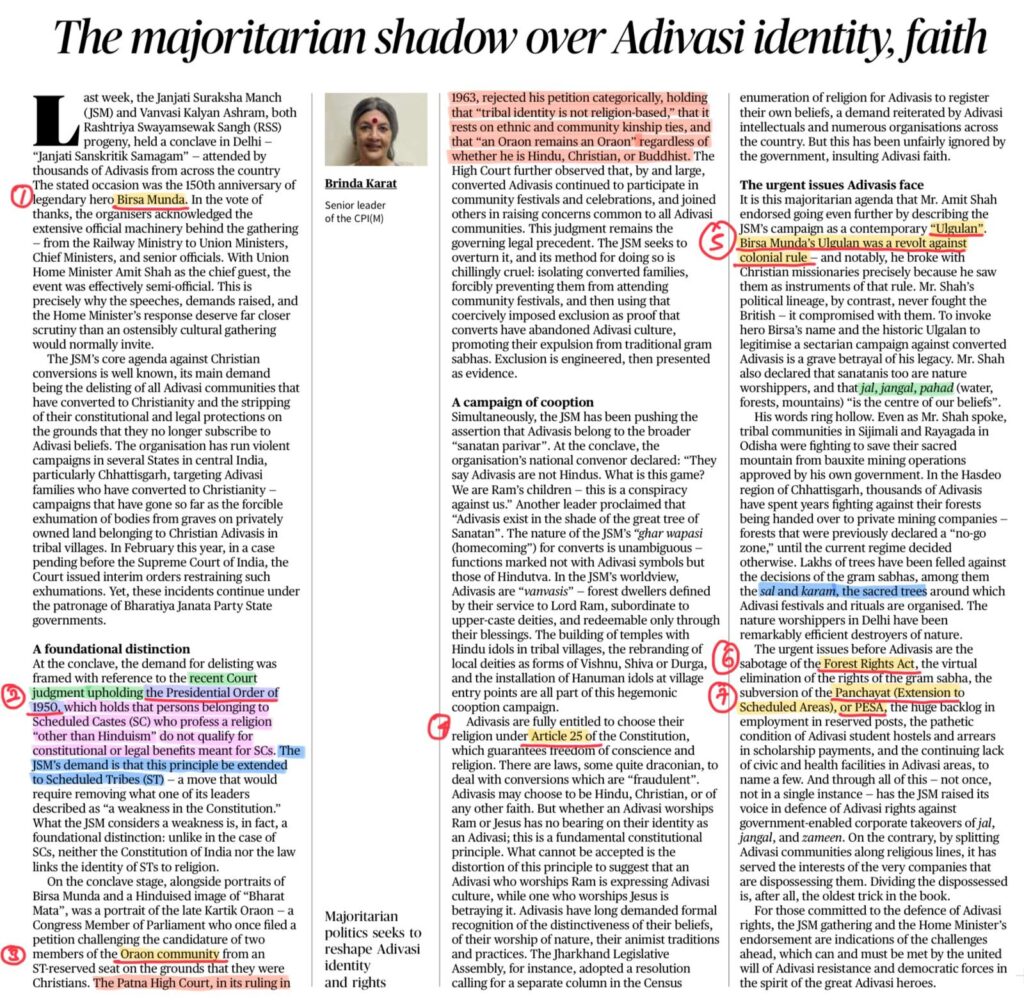
The editorial critiques demands to delist Christian Adivasis from the Scheduled Tribe category and argues that tribal identity under Article 342 is rooted in ethnicity, ancestry, customary practices and community identity, unlike the Scheduled Castes framework under Article 341.

Core Constitutional and Judicial Debate

Article 341

  • President notifies Scheduled Castes through the Constitution (Scheduled Castes) Order, 1950.
  • Initially applicable only to Hindus.
  • Extended to Sikhs in 1956 and Buddhists in 1990.
  • State of Kerala v. Chandramohanan, 2024: Reaffirmed that SC status is governed by the Presidential Order.

Article 342

  • President notifies Scheduled Tribes.
  • ST recognition is based on tribe, ethnicity, distinct culture, customary institutions and community identity, not religion.
  • Therefore, Article 341 logic cannot automatically apply to Article 342.

Judicial Support for Tribal Identity

Kartik Oraon Case, Patna High Court, 1963

  • “An Oraon remains an Oraon whether Hindu, Christian or Buddhist.”
  • Held that religious conversion does not automatically extinguish tribal identity.

Oraon / Kurukh Tribe

  • Found in Jharkhand, Chhattisgarh, Odisha, Bihar and West Bengal.
  • Language: Kurukh, a Dravidian language.

Birsa Munda and Ulgulan

Birsa Munda, 1875–1900

  • Tribal leader from the Munda community.

Ulgulan, 1899–1900

  • Also called “The Great Tumult”.
  • Against British rule.
  • Against land alienation and exploitation of tribals.
  • Centred in the Chotanagpur region, present-day Jharkhand.

Tribal Rights Framework

PESA Act, 1996

  • Panchayats Extension to Scheduled Areas Act.
  • Applies to Fifth Schedule Areas.
  • Gram Sabha as the core institution.
  • Consultation before land acquisition and mining.
  • Control over Minor Forest Produce.

Forest Rights Act, 2006

  • Corrects historical injustice against forest dwellers.
  • Individual Forest Rights: Cultivated forest land up to 4 hectares.
  • Community Forest Rights: Forest resources, grazing land, water bodies and Minor Forest Produce.
  • Habitat Rights for Particularly Vulnerable Tribal Groups.

Way Forward

  • Do not make religion the basis for ST identification.
  • Strengthen implementation of PESA Act, 1996 and Forest Rights Act, 2006.
  • Empower Gram Sabhas in Scheduled Areas.
  • Protect tribal land from alienation and displacement.
  • Improve education, healthcare and livelihood opportunities.
  • Strengthen Fifth Schedule safeguards and tribal self-governance.
Chief of Defence Staff: General N.S. Raja Subramani and JAI Vision for UPSC

Context: General N.S. Raja Subramani Takes Charge as CDS; Lays Emphasis on ‘JAI’
General N.S. Raja Subramani became India’s 3rd Chief of Defence Staff and Secretary, Department of Military Affairs, stressing JAI — Jointness, Atmanirbharta and Innovation.

Chief of Defence Staff

  • Established in 2019.
  • Heads the Department of Military Affairs.

Role of CDS

  • Permanent Chairman of Chiefs of Staff Committee.
  • Principal Military Adviser to Defence Minister on tri-service matters.
  • Promotes integration among Army, Navy and Air Force.
  • Does not command the three Service Chiefs.

Quick Facts

  • 1st CDS: General Bipin Rawat
  • 2nd CDS: General Anil Chauhan
  • 3rd CDS: General N.S. Raja Subramani
  • 27th Chief of Naval Staff: Admiral Krishna Swaminathan

Asiatic Lion Conservation in Gir Landscape: Viral Outbreak and UPSC Notes

Context: No Lion Deaths Reported in Last 3 Days Amid Viral Outbreak in Gir
Following a viral outbreak in the Gir Landscape, 8 lion cubs died and 17 lions were infected; surveillance and veterinary intervention have been intensified.

Asiatic Lion

Scientific name: Panthera leo persica

IUCN Status:
Endangered

Distribution:
Gir Landscape, Gujarat — only wild population.

Characteristics

  • Smaller than African lion.
  • Distinct belly fold.
  • Shorter mane with visible ears.
  • Lives in prides.
  • Apex predator of Gir ecosystem.

Gir Landscape

Location:
Gujarat

Includes:

  • Gir National Park
  • Gir Wildlife Sanctuary
  • Paniya Wildlife Sanctuary
  • Mitiyala Wildlife Sanctuary

India-Oman CEPA Comes into Effect: Key Trade and Strategic Benefits for UPSC

Context: India-Oman CEPA Comes into Effect
The India-Oman Comprehensive Economic Partnership Agreement came into force on 1 June 2026, becoming India’s 15th bilateral trade agreement.

Key Provisions

Oman:

  • 0% duty on 98% tariff lines covering 99.4% of India’s exports.

India:

  • 0% duty on 77% tariff lines covering 94% of Oman’s exports.

GCC — Gulf Cooperation Council

  • Established: 1981
  • Headquarters: Riyadh, Saudi Arabia

Members:

  • Saudi Arabia
  • UAE
  • Oman
  • Qatar
  • Kuwait
  • Bahrain

India–Oman Strategic Linkages

Duqm Port, Oman

  • Access granted to Indian Navy and commercial vessels for logistics, maintenance and maritime cooperation.

Duqm Special Economic Zone

  • Important hub for India–Oman trade, investment and energy cooperation.

Strait of Hormuz

  • Oman occupies a strategic position near one of the world’s most important energy chokepoints.

Significance

Supports India’s broader engagement with the Gulf region.

India’s first trade agreement with a GCC member.

Boosts exports, investment and supply chains.

Strengthens India’s maritime presence in the Arabian Sea and Western Indian Ocean.

India Oman CEPA
India Oman CEPA

India–Nepal Boundary Dispute: Kalapani, Lipulekh, and Limpiyadhura for UPSC

Context: Nepal PM Sparks Row Over India–Nepal Boundary Issue
Nepal PM Balendra Shah stated that Nepal too has encroached upon Indian territory, reviving the Kalapani–Lipulekh–Limpiyadhura dispute.

India–Nepal Boundary Dispute

Disputed Areas:

Core Issue:
Different interpretations of the Treaty of Sugauli, 1816, and the source of the Kali / Mahakali / Sharda River.

Lipulekh Pass:

  • India–Nepal–China tri-junction.
  • Route for Kailash Mansarovar Yatra.

India–Nepal Connectivity

  • Mechi Bridge: Panitanki, West Bengal — Kakarbhitta, Nepal.
  • Jaynagar–Kurtha Railway.
  • Motihari–Amlekhgunj Petroleum Pipeline — South Asia’s first cross-border petroleum pipeline.
  • Raxaul–Kathmandu Railway — proposed.

Neighbourhood Connectivity

Quick Facts

  • Border length: 1,751 km.
  • Border States: Uttarakhand, Uttar Pradesh, Bihar, West Bengal and Sikkim.
  • Open border allows free movement of citizens.
  • Key rivers: Mahakali / Sharda, Kosi and Gandak.

Significance

Despite disputes over Kalapani–Lipulekh–Limpiyadhura, connectivity, trade, energy cooperation and people-to-people ties remain the foundation of India–Nepal relations.

India–Nepal Boundary Dispute
About the UPSC Civil Services Examination (UPSC CSE)

The UPSC Civil Services Examination (CSE) is one of the most competitive and esteemed examinations in India, conducted by the Union Public Service Commission to recruit officers for services such as the Indian Administrative Service (IAS), Indian Police Service (IPS), Indian Foreign Service (IFS), and others. The exam comprises three stages — Prelims, Mains, and the Personality Test (Interview) — designed to test a candidate’s knowledge, aptitude, decision-making, and leadership skills.


How to Prepare Effectively for UPSC CSE

Cracking the UPSC CSE requires a deep understanding of the syllabus, consistent revision, structured answer writing, and smart test-taking strategies. The Prelims test analytical and conceptual clarity, the Mains focuses on critical thinking, articulation, and subject mastery, while the Interview assesses presence of mind, ethical judgment, and personality traits relevant to public service.

At UnderStand UPSC, we empower aspirants with a personalized and focused approach to each stage of the exam.


Why Choose UnderStand UPSC?

UnderStand UPSC is a mentorship-driven platform offering a clear, clutter-free strategy to tackle the Civil Services Examination. Our programs like Transform (for beginners and intermediate learners) and Conquer (for advanced mains preparation) provide structured study plans, syllabus-wise video content, interactive live sessions, and answer writing support.

We emphasize:

  • Concept clarity through topic-wise lectures

  • Test series designed around real UPSC standards

  • Personalized mentorship in small groups

  • Regular performance tracking and peer benchmarking

  • Doubt-clearing sessions, current affairs analysis, and monthly magazines


Join the UnderStand UPSC Learning Community

Our mission is to make UPSC preparation less overwhelming and more strategic. We combine mentorship, discipline, and academic rigor to help you clear CSE with confidence. Whether you’re preparing from Delhi, Mumbai, Bangalore, or a remote village — our online-first model ensures quality guidance reaches every corner of India.

Join the thousands of aspirants who trust UnderStand UPSC to guide their journey toward becoming civil servants.

Stay connected with us through our Telegram, YouTube, and Instagram channels for daily tips, strategies, and updates.

Copyright © 2026 USARAMBHA EDUCATION (UnderStand UPSC). All Rights Reserved.

Fill the form

Our team will reach out to you soon