14 July 2026 | Daily Current Affairs

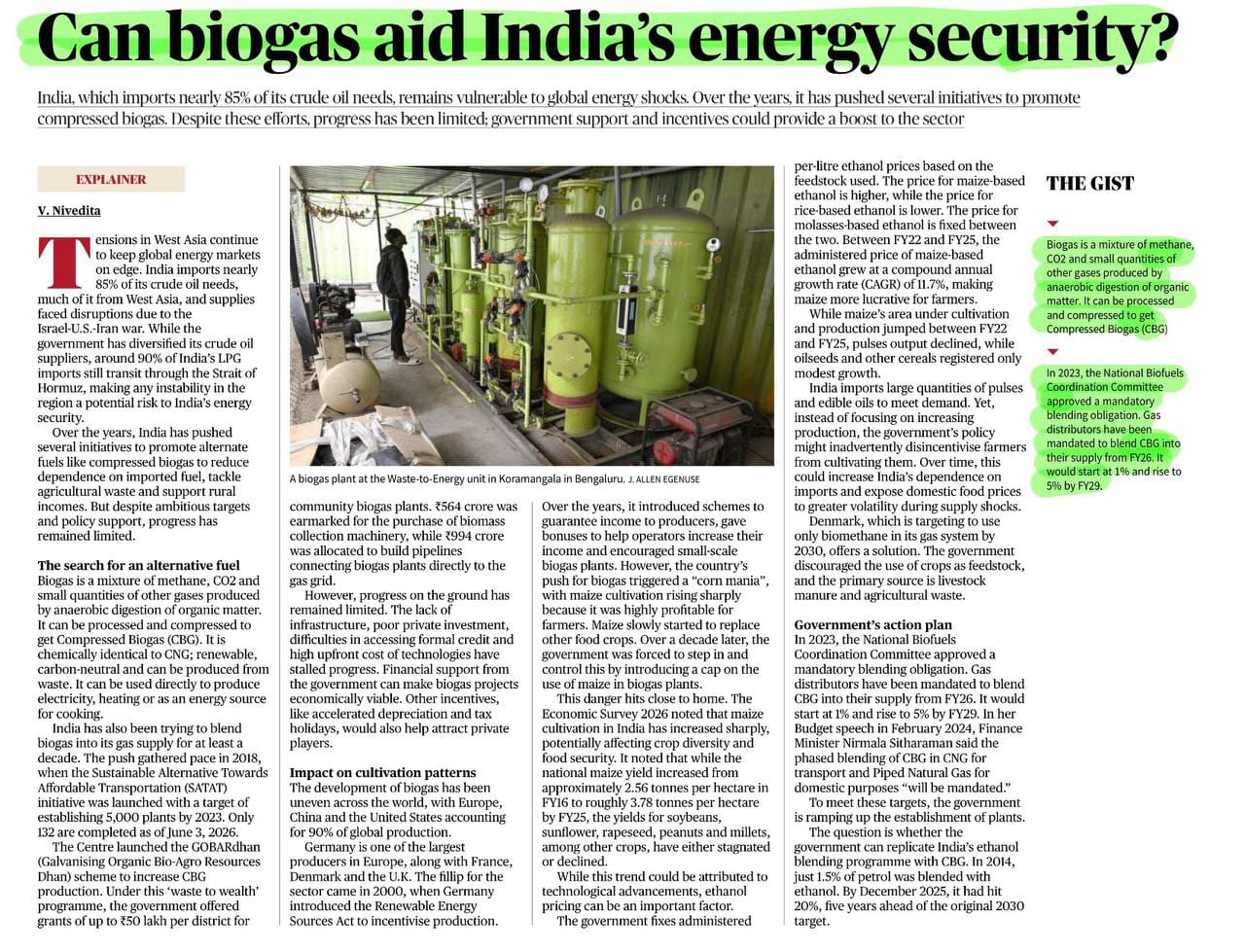
Compressed Biogas Energy Security: UPSC Notes

Context: Compressed Biogas Energy Security
India imports nearly 85% of its crude oil requirement. Compressed Biogas is being promoted to enhance energy security, reduce fossil-fuel imports and utilise organic waste.

Biogas

Biogas is produced through anaerobic digestion of biodegradable waste.

It primarily contains:

  • Methane
  • Carbon Dioxide

Compressed Biogas

Compressed Biogas is purified and compressed biogas with properties comparable to Compressed Natural Gas.

Sources of Biogas

Biogas can be produced from:

  • Cattle dung
  • Agricultural residue
  • Municipal solid waste
  • Press mud
  • Food waste
  • Sewage sludge
  • Organic industrial waste

Government Initiatives

1. SATAT Scheme, 2018

Full Form

  • Sustainable Alternative Towards Affordable Transportation

Objective

Promotes production and marketing of Compressed Biogas.

2. GOBARdhan

Full Form

  • Galvanising Organic Bio-Agro Resources Dhan

Objective

Supports:

  • Waste-to-wealth
  • Rural bioenergy
  • Organic waste management
  • Circular economy

3. Mandatory CBG Blending

Compressed Biogas blending in City Gas Distribution network:

  • 1% in FY26
  • Gradually rising to 5% by FY29

Significance

1. Energy Security

CBG can reduce dependence on crude oil and natural gas imports.

2. Circular Economy

Organic waste is converted into useful fuel.

3. Methane Reduction

Capturing methane from waste reduces greenhouse gas emissions.

4. Stubble Burning Reduction

Agricultural residue can be used as feedstock.

5. Rural Income

Farmers can earn additional income from biomass and waste supply.

6. Employment

CBG plants can generate rural jobs in collection, transport, processing and distribution.

Challenges

  • High capital cost.
  • Inadequate infrastructure.
  • Weak biomass supply chain.
  • Limited private investment.
  • Difficulty in feedstock aggregation.
  • Excessive use of maize as feedstock may affect crop diversification and food security.
  • Need for assured offtake and pricing support.

Way Forward

  • Build reliable biomass supply chains.
  • Provide viability-gap support for CBG plants.
  • Promote decentralised waste-to-energy models.
  • Integrate CBG with city gas networks.
  • Encourage crop-residue-based CBG instead of food-grain diversion.
  • Strengthen local government and private-sector participation.

Key Takeaway

Compressed Biogas can strengthen India’s energy security, but its success depends on feedstock management, infrastructure, pricing support and sustainable biomass use.
India Australia Uranium Agreement for UPSC Explained

Context:
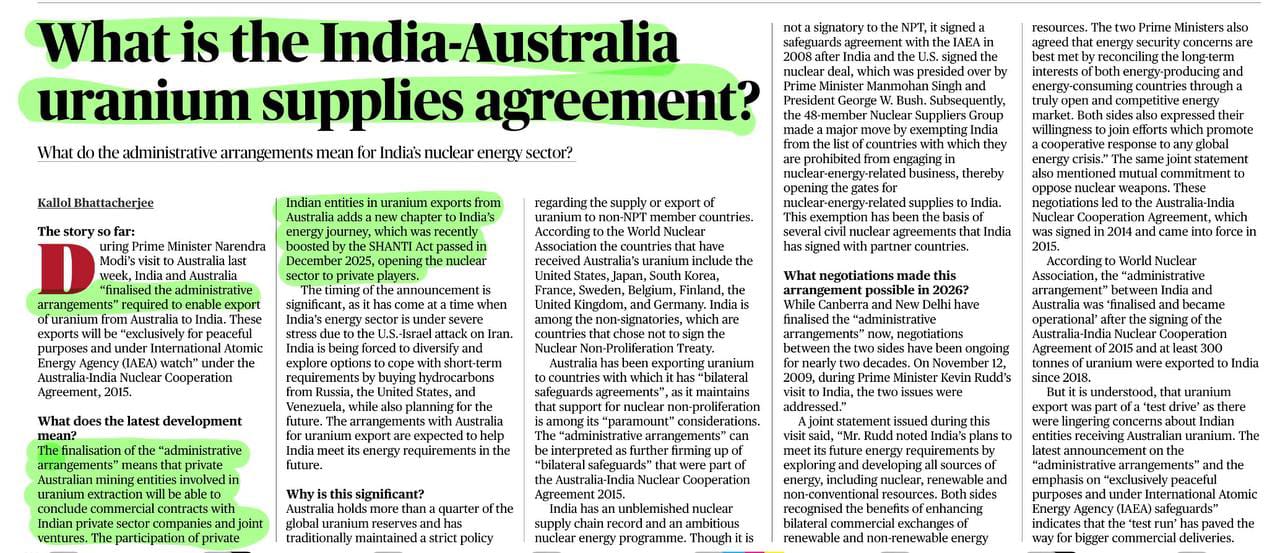
India and Australia have finalised administrative arrangements under the Australia–India Nuclear Cooperation Agreement, 2015, paving the way for commercial uranium exports from Australia to India for peaceful civilian nuclear use.

Australia–India Nuclear Cooperation Agreement

Signed

  • 2014

Came Into Force

  • 2015

Purpose

Allows Australia to export uranium to India exclusively for peaceful civilian nuclear purposes.

Safeguards

Exports will be under International Atomic Energy Agency safeguards.

NSG Waiver Link

The agreement builds on the Nuclear Suppliers Group waiver of 2008, which allowed civil nuclear commerce with India despite India not being a signatory to the Nuclear Non-Proliferation Treaty.

Administrative Arrangements, 2026

The new arrangements operationalise the 2015 agreement.

They provide procedures for:

  • Commercial uranium exports.
  • Export contracts by Australian private mining companies.
  • Supply to Indian public and private entities.
  • Tracking and accounting of uranium.
  • End-use verification under IAEA safeguards.

Significance for India

1. Energy Security

Assured uranium supply supports India’s expanding nuclear power programme.

2. Clean Energy Transition

Nuclear energy provides low-carbon baseload power.

3. Private Participation

The arrangement coincides with the SHAKTI Act, 2025, which opens India’s civilian nuclear sector to greater private participation.

4. Strategic Partnership

Deepens India–Australia Comprehensive Strategic Partnership.

5. Critical Minerals and Clean Energy

Builds wider cooperation in:

International Atomic Energy Agency

Established

  • 1957

Headquarters

  • Vienna, Austria

Role

IAEA promotes safe, secure and peaceful use of nuclear energy.

It conducts safeguards and inspections to ensure civilian nuclear material is not diverted for military purposes.

Key Takeaway

The uranium supply arrangement strengthens India’s long-term clean energy security while deepening strategic cooperation with Australia.

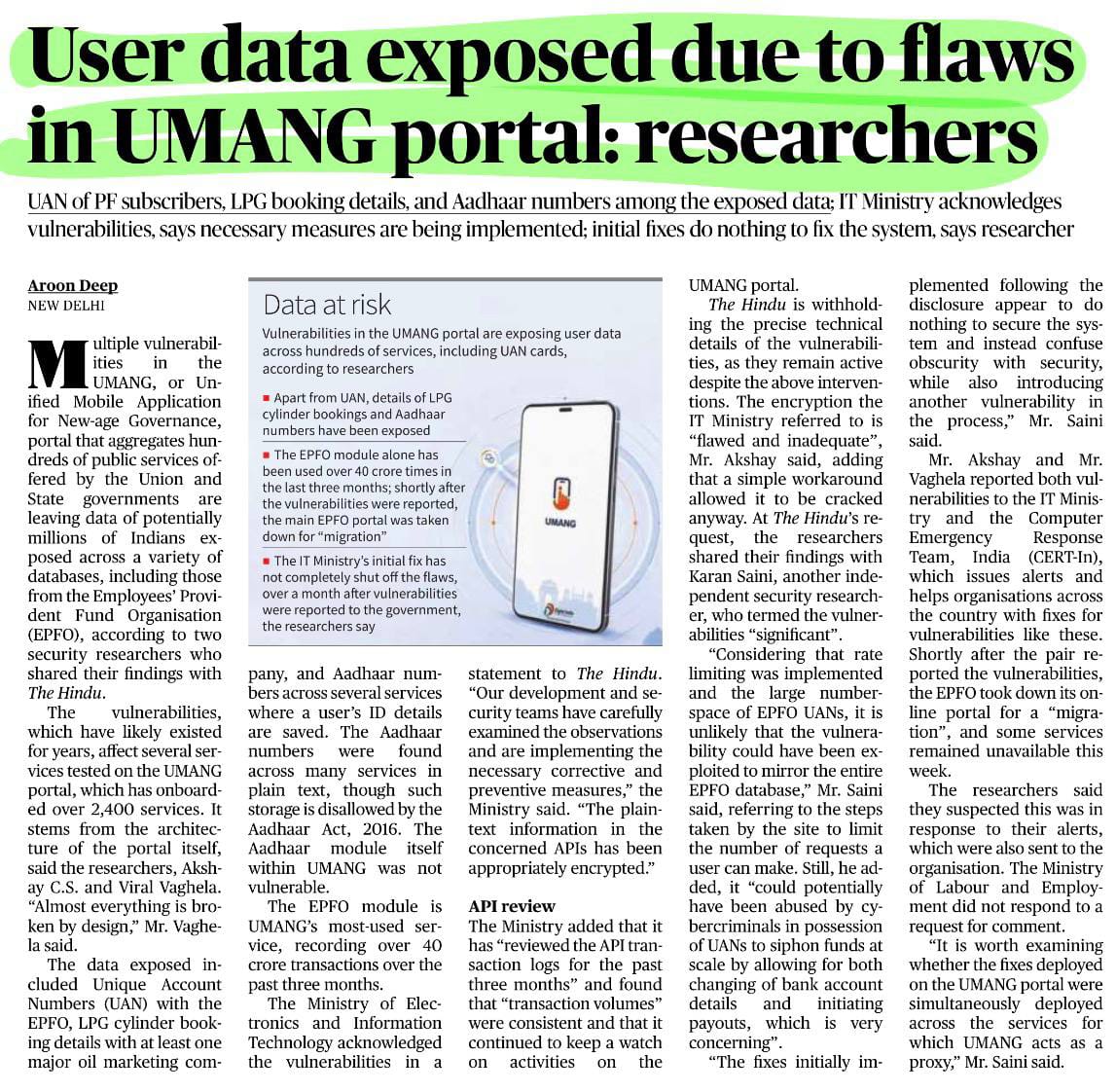
UMANG Portal Data Exposure: UPSC Cyber Security Notes

Context: UMANG Portal Data Exposure
Researchers reported security vulnerabilities in the UMANG portal that allegedly exposed users’ personal data. The Ministry of Electronics and Information Technology has initiated corrective measures.

UMANG

Full Form

Launched

  • 2017

Under

  • Digital India Programme

Ministry

  • Ministry of Electronics and Information Technology

Developed By

  • National e-Governance Division

Objective

To provide a single-window platform for Central, State and local government services.

Coverage

UMANG provides access to more than 2,400 services, including:

  • Employees’ Provident Fund Organisation
  • Aadhaar
  • DigiLocker
  • Passport
  • PAN
  • Utilities
  • Pension services

Significance of UMANG

  • Promotes citizen-centric digital governance.
  • Improves access to public services.
  • Enhances transparency.
  • Supports Ease of Living.
  • Strengthens Digital India ecosystem.

Issues Highlighted

1. Personal Data Exposure

Researchers flagged alleged exposure of personal data due to technical vulnerabilities.

2. API Vulnerabilities

Weaknesses in Application Programming Interfaces can expose sensitive information.

3. Privacy Concerns

Government platforms handle large volumes of citizen data, making privacy protection essential.

4. Cybersecurity Risk

Vulnerabilities can reduce trust in digital governance platforms.

What Needs to Be Done?

  • Stronger security audits.
  • Timely vulnerability patching.
  • API security testing.
  • Encryption of sensitive data.
  • Access control and authentication strengthening.
  • Independent cybersecurity review.
  • Transparent breach response.
  • Better compliance with data protection principles.

Mains Relevance

This topic can be used in answers on:

  • Digital India
  • E-governance
  • Cybersecurity
  • Data protection
  • Privacy
  • Citizen trust
  • Platform accountability

Key Takeaway

Digital governance must be built not only on accessibility and scale, but also on privacy, cybersecurity and institutional accountability.

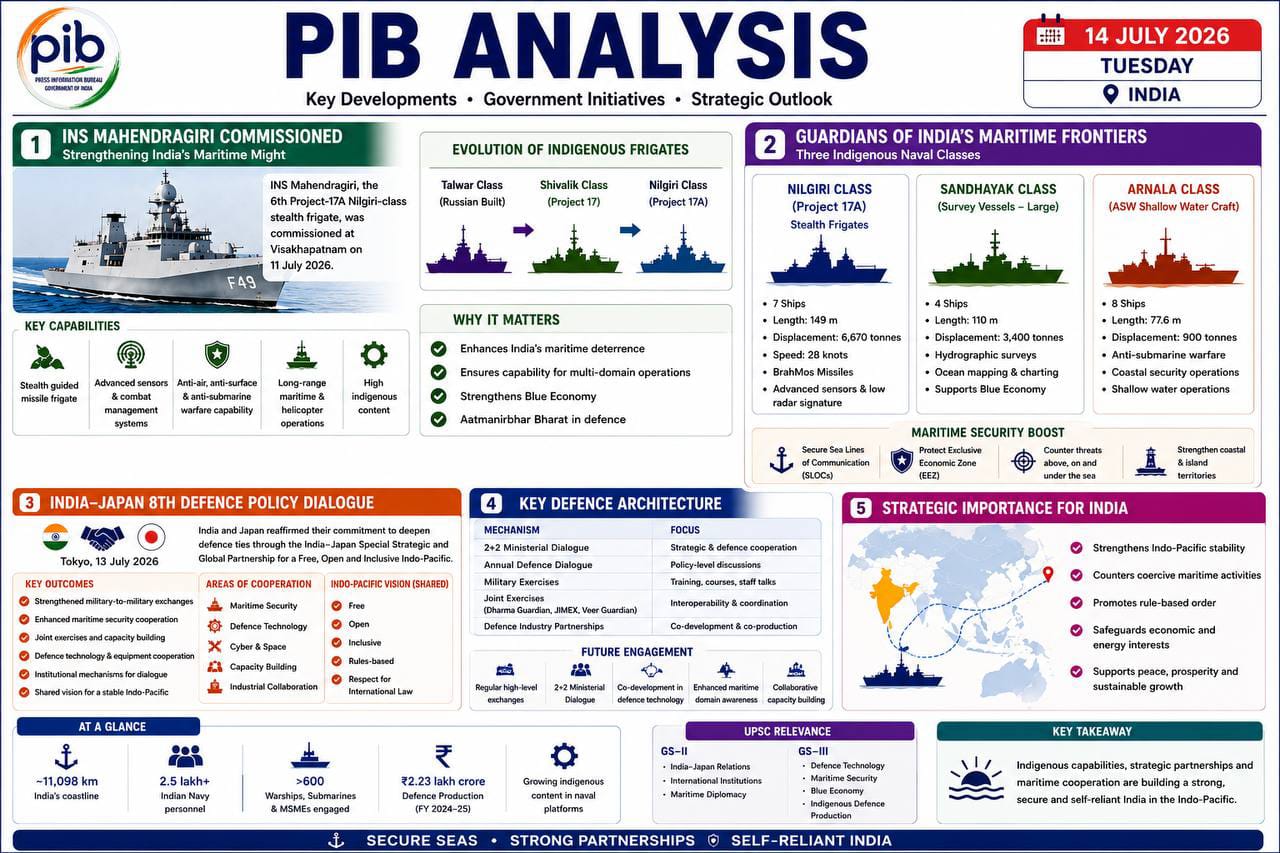
India Japan Defence Policy Dialogue: UPSC Notes

Context: India Japan Defence Policy Dialogue
India and Japan held the 8th Defence Policy Dialogue, focusing on defence cooperation, maritime security, Indo-Pacific stability and strategic partnership.

India–Japan Defence Relations

India and Japan are key partners in the Indo-Pacific.

Their defence cooperation supports:

  • Maritime security
  • Rules-based order
  • Freedom of navigation
  • Regional stability
  • Defence technology cooperation

Key Areas of Discussion

  • Defence policy coordination.
  • Maritime cooperation.
  • Joint exercises.
  • Defence equipment and technology cooperation.
  • Indo-Pacific security.
  • Defence industry collaboration.
  • Regional and global security issues.

Strategic Importance

1. Indo-Pacific Cooperation

Both countries support a free, open and rules-based Indo-Pacific.

2. China Factor

India and Japan share concerns over assertive behaviour and maritime tensions in the region.

3. Maritime Security

Japan is important for India’s maritime engagement in the Pacific, while India is central to Indian Ocean security.

4. Technology and Defence Industry

Japan’s advanced technology and India’s defence manufacturing ecosystem can create useful partnerships.

Important India–Japan Defence Exercises

  • Dharma Guardian
  • JIMEX
  • Malabar Exercise
  • Veer Guardian

Key Takeaway

India–Japan defence cooperation is becoming a crucial pillar of Indo-Pacific security, combining maritime strategy, defence dialogue and technology partnership.

India Maritime Frontiers Naval Classes: UPSC Notes

Context: India Maritime Frontiers Naval Classes
The PIB analysis highlighted India’s key indigenous naval platforms and classes, especially Nilgiri, Sandhayak and Arnala, as part of India’s maritime security and naval modernisation.

Nilgiri Class

Project

Type

  • Stealth frigates

Role

Designed for:

  • Surface warfare
  • Anti-submarine warfare
  • Air defence
  • Maritime security operations

Importance

Nilgiri-class frigates strengthen blue-water capability and support indigenous shipbuilding.

Sandhayak Class

Type

  • Survey Vessel Large

Role

Used for:

  • Hydrographic surveys
  • Seabed mapping
  • Nautical charting
  • Maritime data collection

Importance

Survey vessels support safe navigation, blue economy, coastal development and naval operations.

Arnala Class

Type

  • Anti-Submarine Warfare Shallow Water Craft

Role

Designed to detect and neutralise submarines in shallow coastal waters.

Importance

Arnala-class vessels strengthen coastal defence and anti-submarine capability.

Why These Naval Classes Matter

They support:

  • Maritime security
  • Indian Ocean surveillance
  • Blue economy
  • Coastal defence
  • Indigenous defence manufacturing
  • Aatmanirbhar Bharat
  • Naval modernisation

Strategic Significance

India’s maritime frontiers are important for:

  • Sea lines of communication
  • Energy imports
  • Trade routes
  • Maritime domain awareness
  • Security in the Indian Ocean Region
  • Protection of offshore assets

Key Takeaway

India’s indigenous naval platforms are strengthening maritime security, blue-water capability and self-reliance in defence manufacturing.

INS Mahendragiri Project 17A: UPSC Notes

Context:
INS Mahendragiri is part of India’s indigenous naval modernisation and reflects progress in stealth frigate construction under Project 17A.

INS Mahendragiri

Class

  • Nilgiri-class stealth frigate

Project

  • Project 17A

Built By

Type

  • Advanced stealth frigate

Key Capabilities

INS Mahendragiri is designed for:

  • Surface warfare
  • Anti-submarine warfare
  • Air defence
  • Long-range maritime operations
  • Fleet escort
  • Multi-threat environment operations

Features

  • Stealth design.
  • Advanced sensors.
  • Modern weapons.
  • Improved survivability.
  • Better automation.
  • Integrated combat systems.

Significance

1. Indigenous Defence Manufacturing

Shows India’s growing shipbuilding capacity.

2. Aatmanirbhar Bharat

Reduces dependence on imported naval platforms.

3. Maritime Security

Strengthens operational readiness in the Indian Ocean Region.

4. Blue-Water Navy Capability

Supports India’s ability to operate far from its coast.

5. Defence Industrial Base

Boosts domestic shipyards, suppliers and defence ecosystem.

Key Takeaway

INS Mahendragiri reflects India’s shift towards indigenous, technology-intensive and strategically capable naval modernisation.

About the UPSC Civil Services Examination (UPSC CSE)

The UPSC Civil Services Examination (CSE) is one of the most competitive and esteemed examinations in India, conducted by the Union Public Service Commission to recruit officers for services such as the Indian Administrative Service (IAS), Indian Police Service (IPS), Indian Foreign Service (IFS), and others. The exam comprises three stages — Prelims, Mains, and the Personality Test (Interview) — designed to test a candidate’s knowledge, aptitude, decision-making, and leadership skills.


How to Prepare Effectively for UPSC CSE

Cracking the UPSC CSE requires a deep understanding of the syllabus, consistent revision, structured answer writing, and smart test-taking strategies. The Prelims test analytical and conceptual clarity, the Mains focuses on critical thinking, articulation, and subject mastery, while the Interview assesses presence of mind, ethical judgment, and personality traits relevant to public service.

At UnderStand UPSC, we empower aspirants with a personalized and focused approach to each stage of the exam.


Why Choose UnderStand UPSC?

UnderStand UPSC is a mentorship-driven platform offering a clear, clutter-free strategy to tackle the Civil Services Examination. Our programs like Transform (for beginners and intermediate learners) and Conquer (for advanced mains preparation) provide structured study plans, syllabus-wise video content, interactive live sessions, and answer writing support.

We emphasize:

  • Concept clarity through topic-wise lectures

  • Test series designed around real UPSC standards

  • Personalized mentorship in small groups

  • Regular performance tracking and peer benchmarking

  • Doubt-clearing sessions, current affairs analysis, and monthly magazines


Join the UnderStand UPSC Learning Community

Our mission is to make UPSC preparation less overwhelming and more strategic. We combine mentorship, discipline, and academic rigor to help you clear CSE with confidence. Whether you’re preparing from Delhi, Mumbai, Bangalore, or a remote village — our online-first model ensures quality guidance reaches every corner of India.

Join the thousands of aspirants who trust UnderStand UPSC to guide their journey toward becoming civil servants.

Stay connected with us through our Telegram, YouTube, and Instagram channels for daily tips, strategies, and updates.

Copyright © 2026 USARAMBHA EDUCATION (UnderStand UPSC). All Rights Reserved.

IMPETUS (ONLINE)
IMPETUS (OFFLINE)

Fill out the form

Fill out the form for

Downloading the free Agriculture Short Notes