Sustainable Kutki Cultivation Model: UPSC Notes
Context: Sustainable Kutki cultivation model
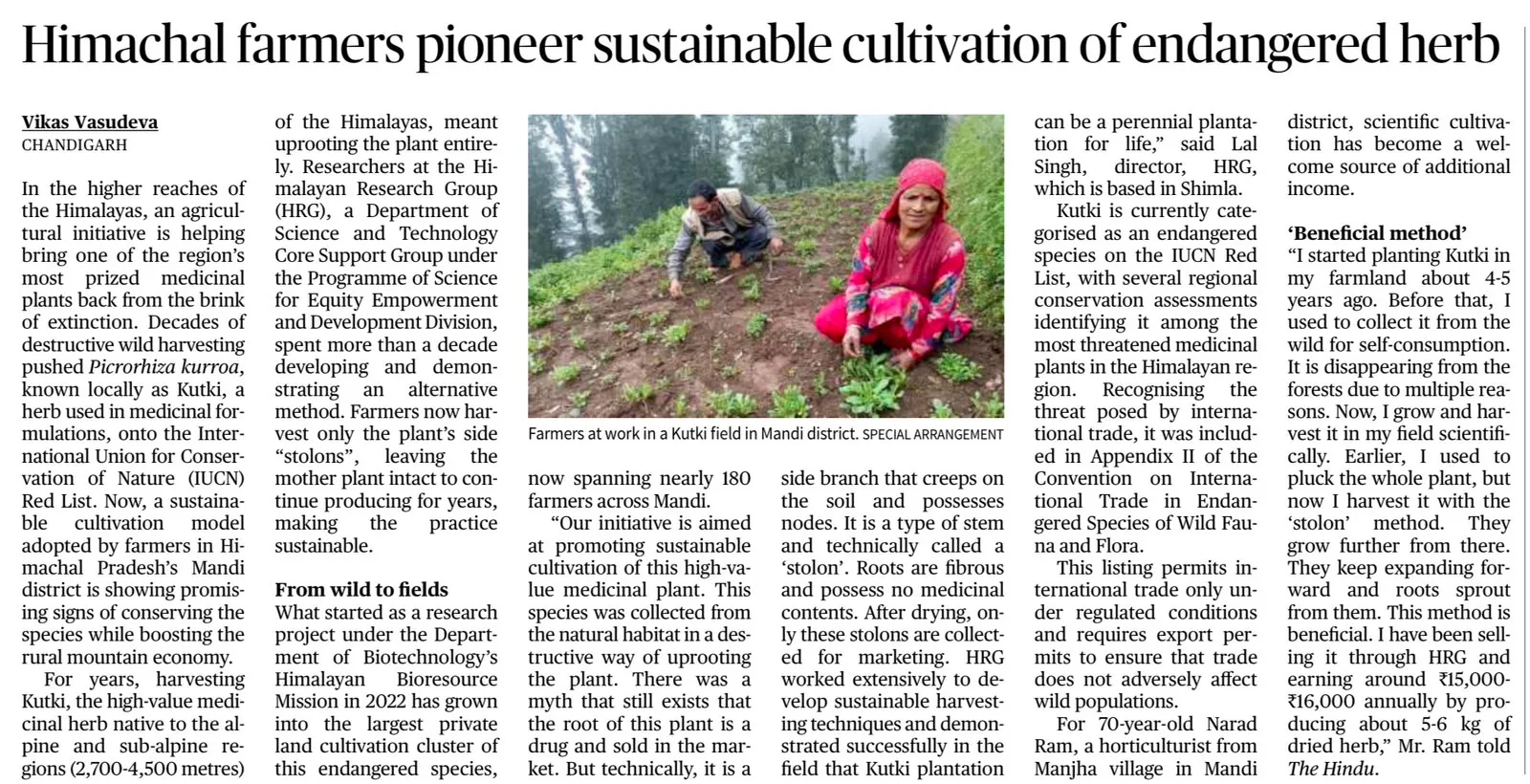
Researchers from the Himalayan Research Group have developed a sustainable cultivation model for Kutki, an endangered Himalayan medicinal herb.
Earlier, wild harvesting often involved uprooting the entire plant. Under the new method, farmers harvest only its stolons, allowing the parent plant to survive and regenerate naturally.
This helps conserve biodiversity, reduces pressure on wild populations, and provides an additional income source for farmers.
Kutki
Kutki, scientifically known as Picrorhiza kurroa, is a small perennial medicinal herb.
It belongs to the Plantaginaceae family.
It is native to the alpine and sub-alpine Himalayan region, mainly found at elevations of around 2,700–4,500 metres.
Distribution in India
In India, Kutki is naturally found in the Himalayan region, including:
- Jammu & Kashmir
- Himachal Pradesh
- Uttarakhand
- Sikkim
- Arunachal Pradesh
Medicinal Importance
The rhizome and stolons are the medicinally important parts of the plant.
Kutki is used in Ayurvedic, Tibetan and traditional medicine.
It is known for:
- Liver-protecting properties
- Antioxidant properties
- Anti-inflammatory properties
- Immunomodulatory properties
- Use in liver and digestive disorders
Conservation Status
Kutki is classified as Endangered on the IUCN Red List.
It is also listed in Appendix II of CITES, which means its international trade is regulated.
Stolons
A stolon is a slender, horizontal stem that grows along or just below the ground.
It has nodes from which new roots and shoots can develop.
This helps the plant spread naturally through vegetative propagation.
Examples include:
- Strawberry
- Mint
- Bermuda grass
- Kutki
Why Sustainable Harvesting Matters
Harvesting only the stolons leaves the parent plant intact.
This allows:
- Repeated harvests
- Natural regeneration
- Reduced pressure on wild populations
- Better farmer income
- Conservation of endangered medicinal plants
Key Takeaway
The Kutki cultivation model shows how biodiversity conservation and livelihood generation can work together when traditional medicinal plants are harvested scientifically.