30 July 2026 | UPSC Daily Current Affairs

30 July 2026 | UPSC Daily Current Affairs

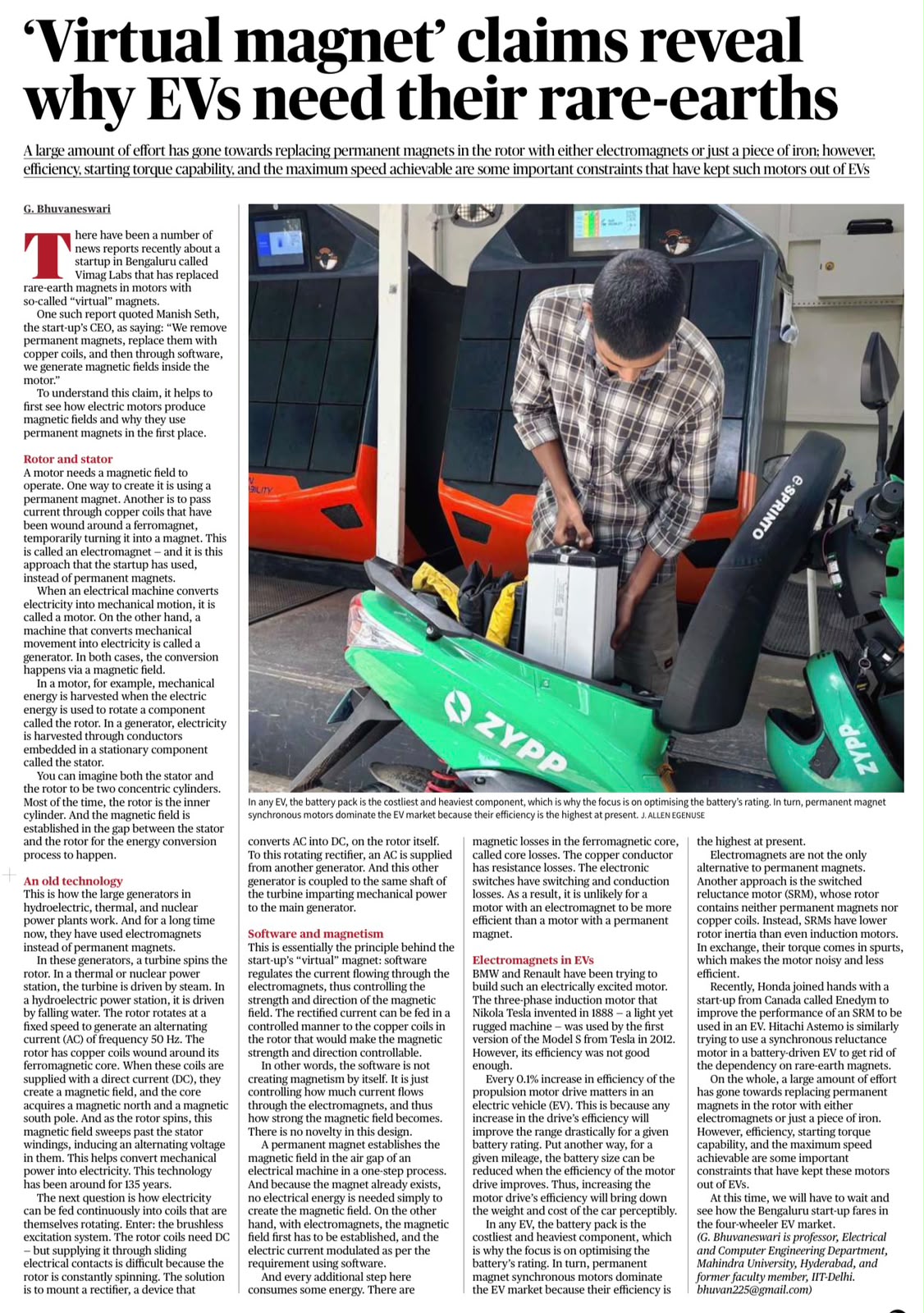
Virtual Magnet Technology for EVs: Rare Earth Alternative

Context: Virtual Magnet Technology for EVs
A Bengaluru-based startup, Vaying Labs, has claimed to develop a virtual magnet technology that can replace rare-earth permanent magnets in EV motors with software-controlled electromagnets.

The idea is to reduce dependence on rare-earth minerals while trying to maintain motor performance. This is important because EV motors currently depend heavily on rare-earth permanent magnets for efficiency, torque and range.

What Is a Virtual Magnet?

A virtual magnet is not a physical magnet.

It is a magnetic field created through software-controlled electromagnets.

In this system, software controls the electric current passing through copper coils.

This allows the coils to behave like a permanent magnet inside the motor.

Why It Matters for EVs

Electric vehicle motors commonly use rare-earth permanent magnets.

These magnets are important because they provide strong magnetic fields without continuous electricity use.

This helps EVs achieve:

  • Higher efficiency
  • Better torque
  • Longer driving range
  • Better motor performance

But the problem is that rare-earth minerals are concentrated in limited global supply chains.

So virtual magnet technology may help reduce dependence on critical minerals.

Why Permanent Magnets Are Still Preferred

Permanent magnets remain dominant in EV motors because they do not need continuous electricity to generate magnetic fields.

This makes them more energy efficient than electromagnets.

They also offer better performance in compact motor designs.

Limitation of Virtual Magnets

Electromagnets need continuous electricity.

This creates energy losses.

So even though virtual magnet technology can reduce rare-earth dependence, it has not yet fully matched the efficiency of permanent-magnet EV motors.

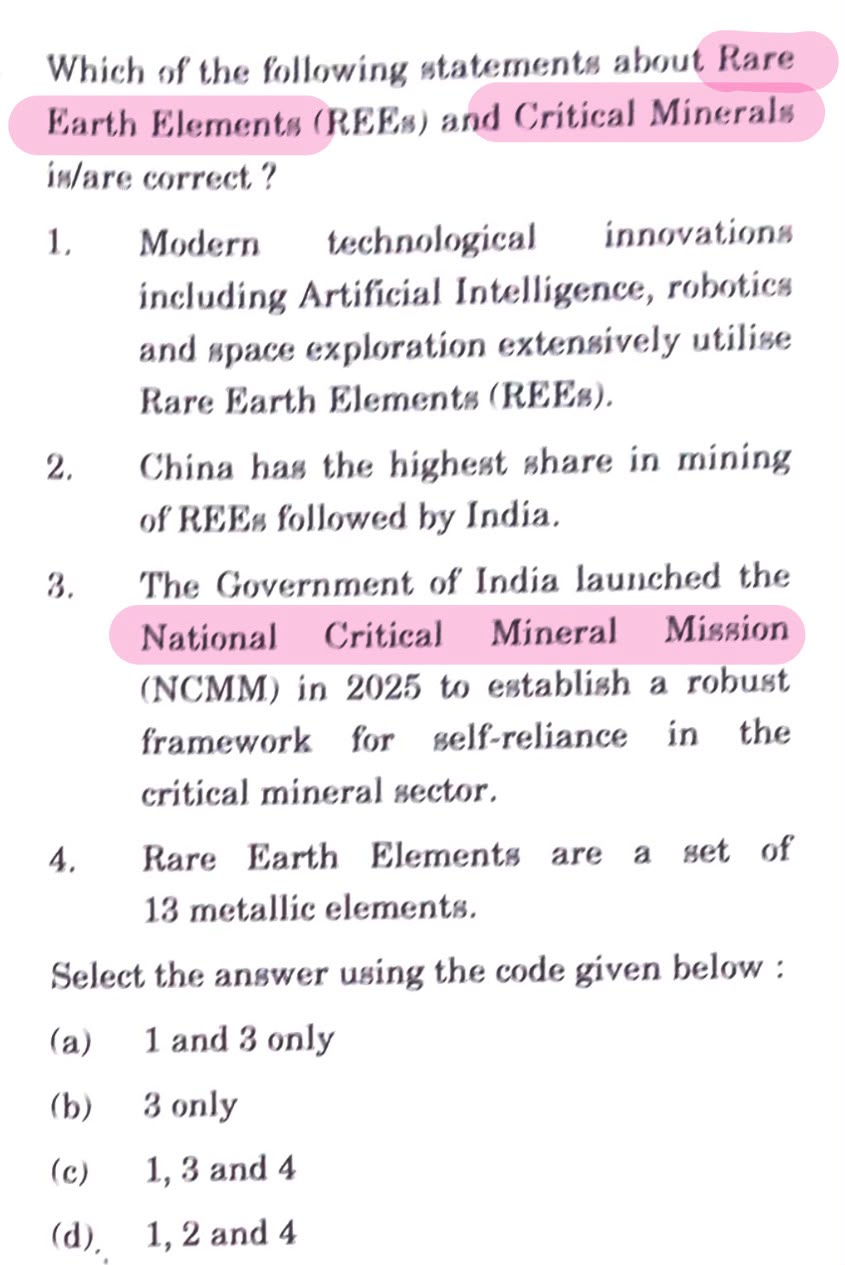
Rare Earth Elements

Rare Earth Elements are a group of 17 metallic elements.

They include:

  • 15 lanthanides
  • Scandium
  • Yttrium

They are not actually rare in the Earth’s crust, but economically viable deposits are limited.

Uses of Rare Earth Elements

Rare earths are used in:

  • EV motors
  • Wind turbines
  • Electronics
  • Defence systems
  • Permanent magnets
  • Robotics
  • Space technology

Important rare earths used in EV motors include:

  • Neodymium
  • Praseodymium
  • Dysprosium

Key Takeaway

Virtual magnets may reduce EV dependence on rare-earth minerals, but permanent magnets still dominate because of their superior efficiency, torque and range.
Virtual Magnet Technology for EVs

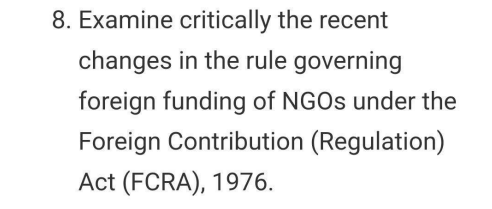
FCRA Amendment Bill 2026: Key NGO Changes Explained

Context: FCRA Amendment Bill 2026
The Foreign Contribution Regulation Amendment Bill, 2026 has been listed for consideration in Parliament.

The Bill seeks to amend the Foreign Contribution Regulation Act, 2010 by expanding government control over NGOs receiving foreign funds. This has raised concerns about the autonomy of civil society organisations.

Why FCRA Was Enacted

FCRA was enacted to regulate the acceptance and use of foreign contributions.

The aim is to ensure that foreign funds do not adversely affect India’s:

  • Sovereignty
  • Integrity
  • Security
  • Public interest
  • Democratic processes

India first enacted FCRA in 1976.

It was later replaced by the Foreign Contribution Regulation Act, 2010.

FCRA 2010: Basic Features

FCRA is administered by the Ministry of Home Affairs.

Any NGO or organisation that wants to receive foreign contributions must obtain either registration or prior permission.

Registration is generally valid for five years and must be renewed.

The Act prohibits foreign contributions to:

  • Election candidates
  • Legislators
  • Political parties
  • Judges
  • Government servants
  • Certain public functionaries

It also provides for suspension or cancellation of registration in specified cases.

Major Changes Proposed in FCRA Amendment Bill 2026

The Bill proposes that assets created from foreign contributions may vest in a designated government authority if an organisation’s registration is:

  • Cancelled
  • Expired
  • Not renewed
  • Voluntarily surrendered

It expands the government’s power to cancel registration in the public interest.

However, the term “public interest” is not clearly defined.

The Bill also empowers the government to exempt any individual or organisation from the Act if it considers such exemption to be in public interest.

Concerns

The Bill may increase executive discretion over NGOs and civil society organisations.

The undefined phrase “public interest” may allow arbitrary cancellation of registrations.

Vesting NGO assets in the government may discourage charitable and humanitarian work.

The exemption clause may be challenged under Article 14 because it may lack clear and objective criteria.

It may disproportionately affect NGOs working in:

  • Education
  • Health
  • Environment
  • Religion
  • Social welfare

Governance Angle

The issue reflects the tension between regulation and civil society autonomy.

The government has a legitimate interest in ensuring that foreign funds are not misused.

But excessive control can weaken democratic participation, humanitarian work and independent civil society action.

Key Takeaway

FCRA regulation is necessary for transparency and national interest, but the 2026 Bill raises concerns because it may expand executive control over NGOs without enough safeguards against arbitrary action.

FCRA Amendment Bill 2026

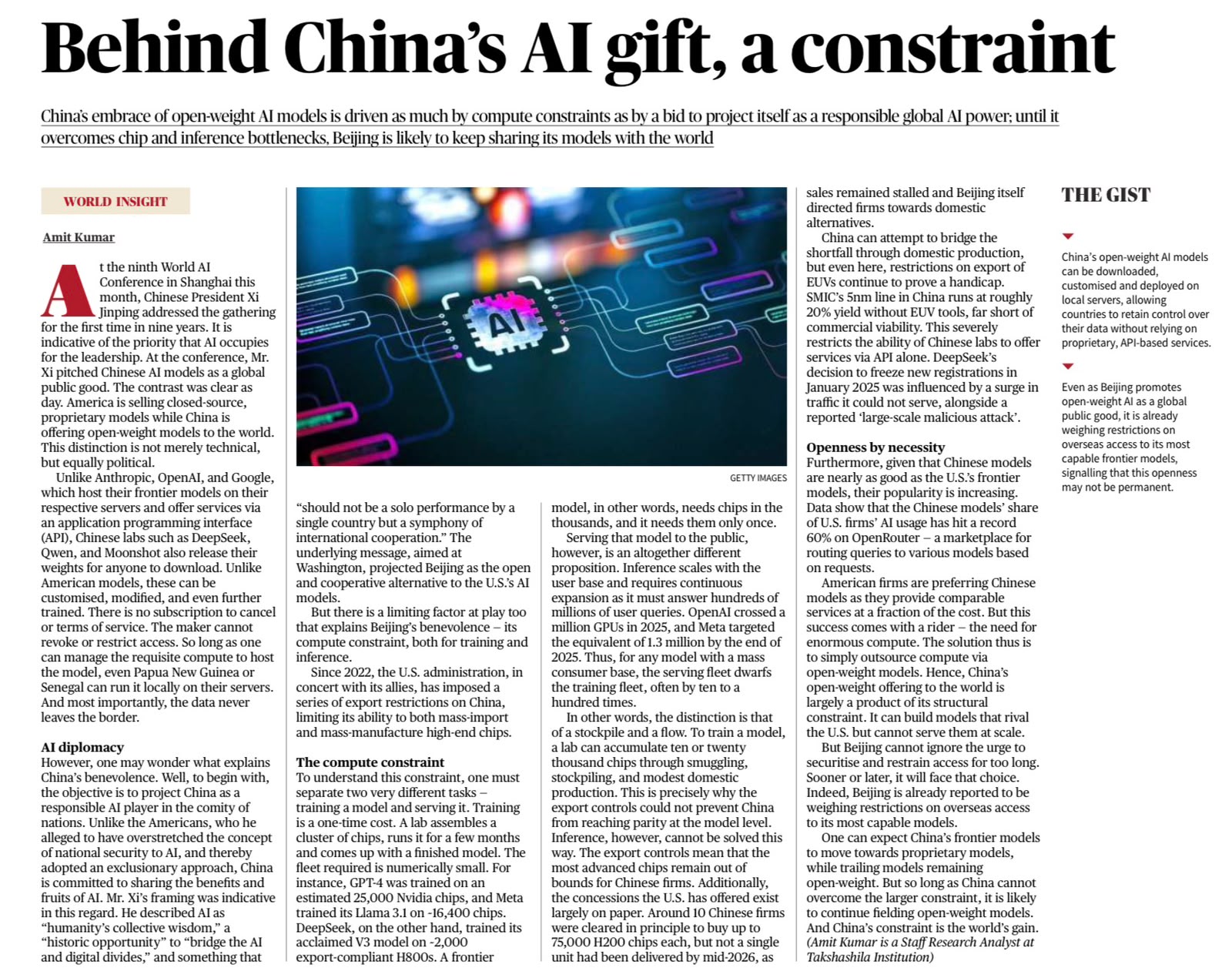
China Open-Weight AI Models: AI Strategy Explained

Context: China Open-Weight AI Models
China is increasingly releasing open-weight AI models such as DeepSeek and Qwen.

China presents this as support for open AI and global public access. However, the article argues that this strategy is also shaped by U.S. chip export restrictions and China’s limited computing capacity.

What Are Open-Weight AI Models?

Open-weight AI models are models whose trained weights are publicly available.

Users can download, modify and deploy these models on their own servers.

This is different from closed AI models, where users depend on the company’s servers and platforms.

Open-weight models give users more control over:

  • Data
  • Customisation
  • Deployment
  • Local use

Why China Is Promoting Open-Weight Models

China wants to project itself as a responsible global AI power.

By releasing open-weight AI models, it presents AI as a global public good.

This also helps China expand its technological influence across the world.

It can build an international ecosystem around Chinese AI models.

The Real Constraint

China’s AI strategy is shaped by U.S. restrictions on advanced AI chips and semiconductor manufacturing equipment.

China can train competitive AI models, but it lacks sufficient high-end computing infrastructure to serve millions of users efficiently.

This is especially important for AI inference, which means running the model for users after it has been trained.

By releasing open-weight models, Chinese companies shift the computing burden to users.

Instead of Chinese firms serving everyone through their own servers, users download and run the models on their own infrastructure.

AI Diplomacy

Open-weight releases allow China to gain goodwill among countries and developers looking for alternatives to U.S.-based AI platforms.

This can increase China’s influence in the Global South and among technology communities.

Strategic Concern

Open AI is not only a technology issue.

It is also linked to:

  • Chip supply chains
  • Semiconductor restrictions
  • Data sovereignty
  • AI geopolitics
  • Global technological influence
  • Competition between the U.S. and China

Key Takeaway

China’s open-weight AI push is both diplomacy and necessity. It helps China project technological openness while also reducing the burden created by limited access to advanced computing chips.

China Open-Weight AI Models

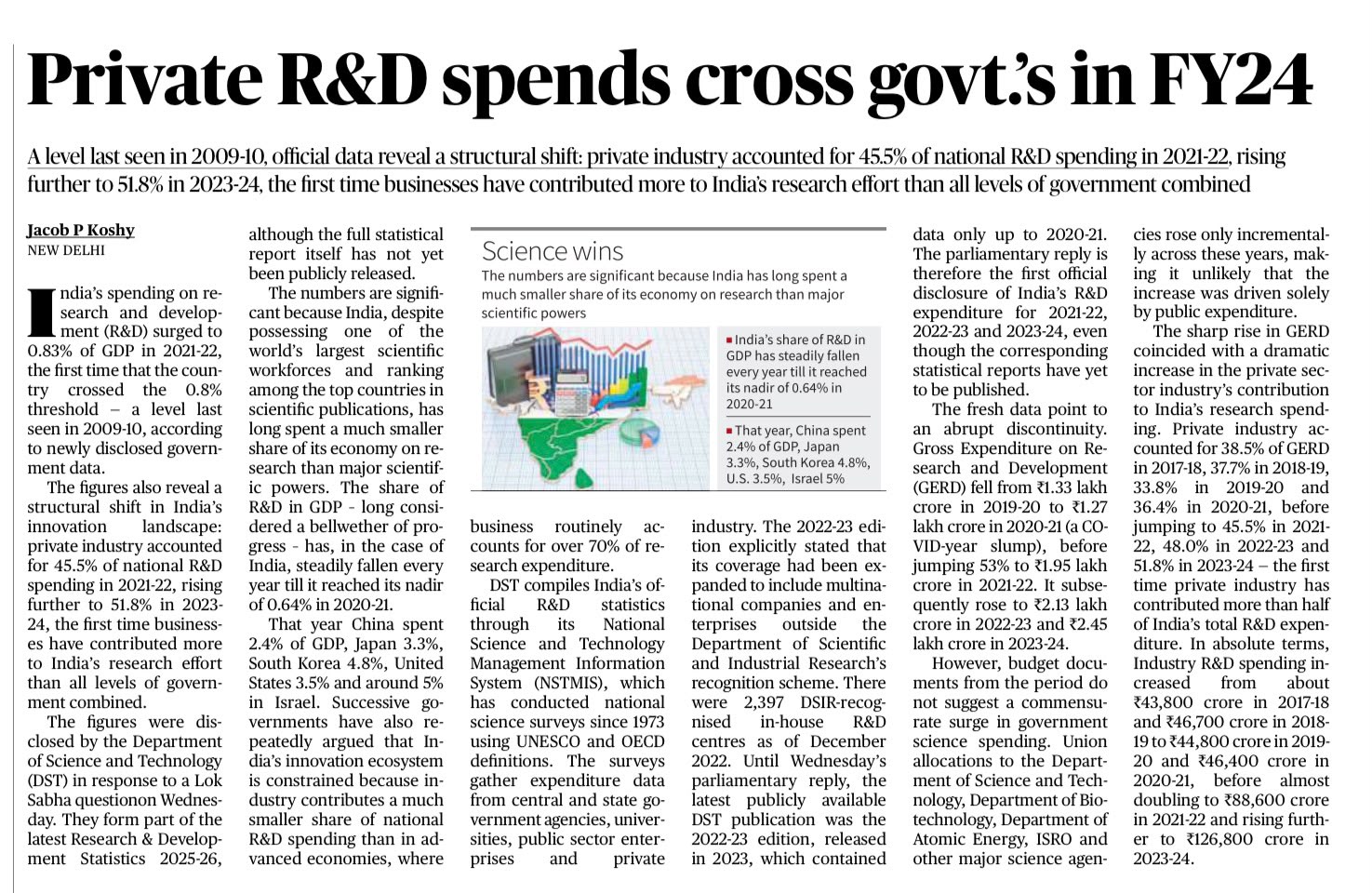
India Private R&D Expenditure FY24 Crosses Government

Context: India Private R&D Expenditure FY24
Government data released by the Department of Science and Technology shows that private industry contributed more than the combined government sector to India’s R&D expenditure for the first time in FY 2023–24.

This marks a major shift in India’s innovation ecosystem.

Gross Expenditure on Research and Development

Gross Expenditure on Research and Development, or GERD, measures total national spending on R&D.

It includes spending by government, higher education institutions, public sector enterprises and private industry.

Major Findings

India’s GERD reached 0.83% of GDP in 2021–22.

This crossed the 0.8% mark for the first time since 2009–10.

The private industry’s share in total R&D expenditure increased from:

  • 45.5% in 2021–22
  • 48.0% in 2022–23
  • 51.8% in 2023–24

This means private industry contributed more than all levels of government combined for the first time.

Surge in Private Investment

Private sector R&D spending increased from:

  • ₹46,400 crore in 2020–21
  • ₹88,600 crore in 2021–22
  • ₹1,26,800 crore in 2023–24

This shows that India’s innovation ecosystem is becoming more industry-driven.

Global Comparison

R&D expenditure as a percentage of GDP in 2021:

  • India: 0.64%
  • China: 2.4%
  • Japan: 3.3%
  • United States: 3.5%
  • South Korea: 4.8%
  • Israel: 5.0%

Despite improvement, India’s R&D intensity remains far below leading innovation economies.

Why This Matters

Higher private participation can improve commercialisation of research.

It can promote innovation-led growth and support Atmanirbhar Bharat.

It can also strengthen industry-academia linkages and technology development.

However, India still needs to increase overall R&D expenditure as a share of GDP.

Private participation alone is not enough if total R&D spending remains low.

Key Takeaway

India’s R&D ecosystem is becoming more industry-driven, but India must raise overall R&D intensity to compete with major scientific and technological powers.

India Private R&D Expenditure FY24

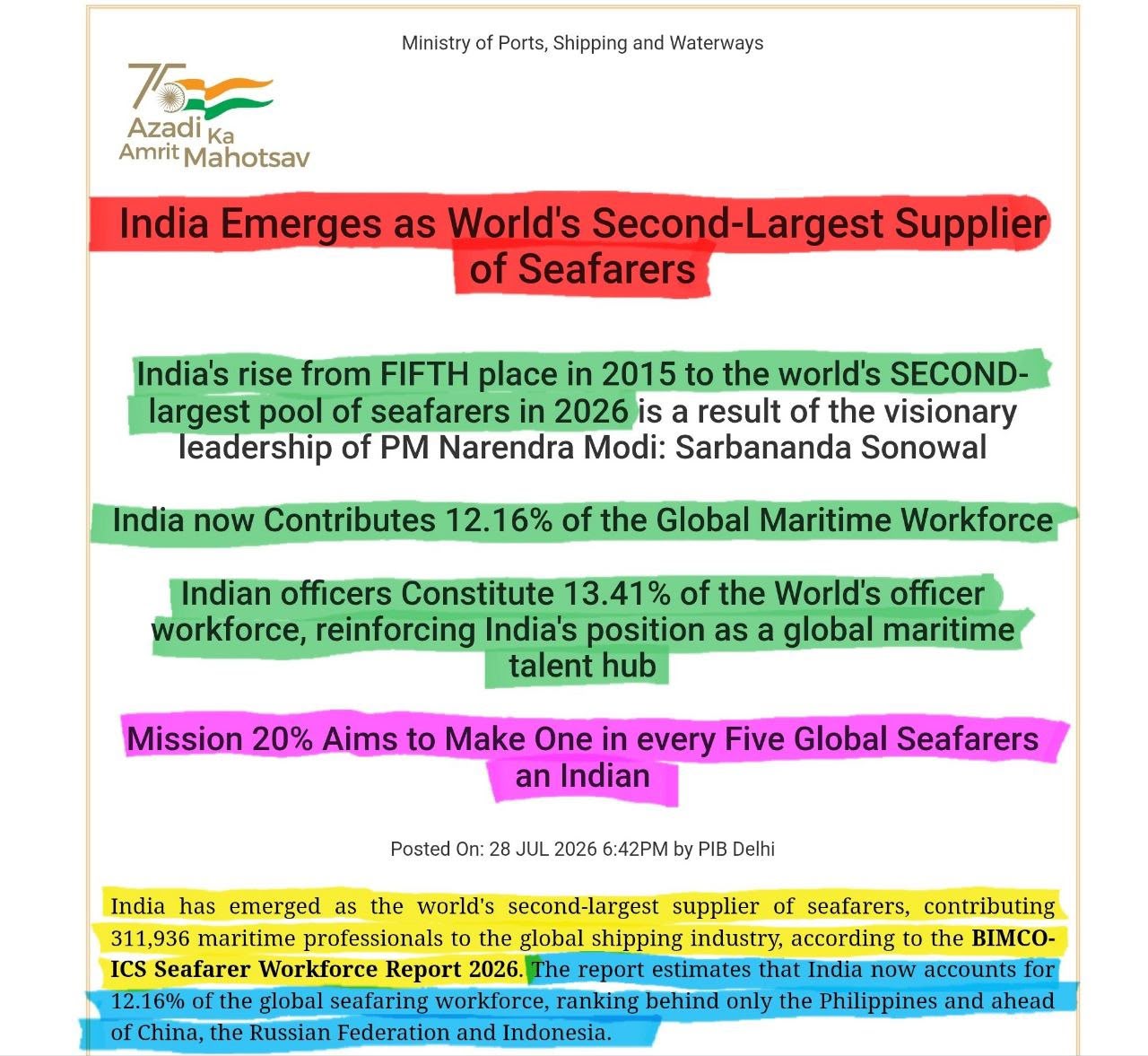
India Second Largest Seafarer Supplier in 2026

Context: India Second Largest Seafarer Supplier
According to the BIMCO–ICS Seafarer Workforce Report 2026, India has become the world’s second-largest supplier of seafarers.

This highlights India’s growing importance in the global maritime industry.

Major Highlights

India has improved from 5th place in 2015 to 2nd place in 2026 globally in supplying seafarers.

India now contributes 12.16% of the global seafaring workforce.

The goal of Mission 20% is to make one in every five global seafarers an Indian.

Who Is a Seafarer?

A seafarer is a trained person employed on a merchant ship.

Seafarers may be responsible for:

  • Navigation
  • Engineering
  • Cargo handling
  • Ship operations
  • Safety duties
  • Other onboard work

Why This Is Important for India

India’s rise as a major seafarer supplier strengthens its position as a global maritime talent hub.

It also supports India’s maritime economy and shipping ecosystem.

A larger trained maritime workforce can help India expand its role in global shipping and maritime services.

Recent Issues Faced by Indian Seafarers

Indian seafarers face risks due to conflicts and piracy.

Houthi attacks in the Red Sea and Gulf of Aden have exposed seafarers to security threats.

Piracy near the Gulf of Aden and Somali coast remains a concern.

Geopolitical conflicts have also led to:

  • Detentions
  • Delayed crew changes
  • Disruptions to shipping routes
  • Safety risks for Indian workers

Policy Significance

India needs better maritime training, welfare and protection systems.

As more Indians work on global vessels, consular support and emergency response become important.

India’s maritime policy must protect both ships and seafarers.

Key Takeaway

India’s rise as the world’s second-largest supplier of seafarers strengthens its maritime profile, but it also increases the responsibility to protect Indian seafarers in conflict-prone global waters.

India Second Largest Seafarer Supplier

RBI Polymer Banknotes Pilot for ₹10 and ₹20 Notes

Context: RBI Polymer Banknotes Pilot
The Reserve Bank of India has received approval from the Central Government to conduct field trials of ₹10 and ₹20 polymer banknotes.

The objective is to test whether polymer banknotes are more durable, secure and cost-effective than existing cotton-based paper notes. The RBI has clarified that these notes are only under trial and will not immediately replace paper currency.

What Are Polymer Banknotes?

Polymer banknotes are currency notes printed on a special plastic substrate.

They are different from conventional cotton-based paper notes.

The material is designed specifically for currency production.

Polymer banknotes generally offer better durability and improved security features.

Why RBI Is Testing Polymer Banknotes

Polymer notes may last longer than cotton-based paper notes.

They are more resistant to water and dirt.

They can carry advanced security features, making counterfeiting more difficult.

Even if the initial printing cost is higher, their longer lifespan may reduce long-term replacement cost.

Will Polymer Notes Replace Paper Notes?

No.

Polymer notes are currently being introduced only for field trials.

If the trial is successful, they may coexist with cotton-based paper notes.

At present, there is no proposal to replace all paper currency with polymer notes.

Scale of the Trial

The RBI trial will involve ₹10 and ₹20 notes.

The proposal includes introduction of polymer notes worth around ₹3,000 crore.

This includes 100 crore pieces each of ₹10 and ₹20 notes.

Prelims Angle

For UPSC, polymer banknotes are important because they connect:

  • RBI currency management
  • Counterfeit prevention
  • Currency durability
  • Cost efficiency
  • Banking technology
  • Material science

Key Takeaway

RBI’s polymer banknote pilot is a currency management experiment. The aim is not to replace paper money immediately, but to test whether plastic notes can be more durable, secure, and cost-effective.+

RBI Polymer Banknotes Pilot

About the UPSC Civil Services Examination (UPSC CSE)

The UPSC Civil Services Examination (CSE) is one of the most competitive and esteemed examinations in India, conducted by the Union Public Service Commission to recruit officers for services such as the Indian Administrative Service (IAS), Indian Police Service (IPS), Indian Foreign Service (IFS), and others. The exam comprises three stages — Prelims, Mains, and the Personality Test (Interview) — designed to test a candidate’s knowledge, aptitude, decision-making, and leadership skills.

How to Prepare Effectively for UPSC CSE

Cracking the UPSC CSE requires a deep understanding of the syllabus, consistent revision, structured answer writing, and smart test-taking strategies. The Prelims test analytical and conceptual clarity, the Mains focuses on critical thinking, articulation, and subject mastery, while the Interview assesses presence of mind, ethical judgment, and personality traits relevant to public service.

At UnderStand UPSC, we empower aspirants with a personalized and focused approach to each stage of the exam.

Why Choose UnderStand UPSC?

UnderStand UPSC is a mentorship-driven platform offering a clear, clutter-free strategy to tackle the Civil Services Examination. Our programs like Transform (for beginners and intermediate learners) and Conquer (for advanced mains preparation) provide structured study plans, syllabus-wise video content, interactive live sessions, and answer writing support.

We emphasize:

  • Concept clarity through topic-wise lectures

  • Test series designed around real UPSC standards

  • Personalized mentorship in small groups

  • Regular performance tracking and peer benchmarking

  • Doubt-clearing sessions, current affairs analysis, and monthly magazines

Join the UnderStand UPSC Learning Community

Our mission is to make UPSC preparation less overwhelming and more strategic. We combine mentorship, discipline, and academic rigor to help you clear CSE with confidence. Whether you’re preparing from Delhi, Mumbai, Bangalore, or a remote village — our online-first model ensures quality guidance reaches every corner of India.

Join the thousands of aspirants who trust UnderStand UPSC to guide their journey toward becoming civil servants.

Stay connected with us through our Telegram, YouTube, and Instagram channels for daily tips, strategies, and updates.

Copyright © 2026 USARAMBHA EDUCATION (UnderStand UPSC). All Rights Reserved.

Fill out the form