4 August 2026 | UPSC Daily Current Affairs

4 August 2026 | UPSC Daily Current Affairs

US–Japan Joint Action: How a Stronger Yen Affects Indian Markets

Context:
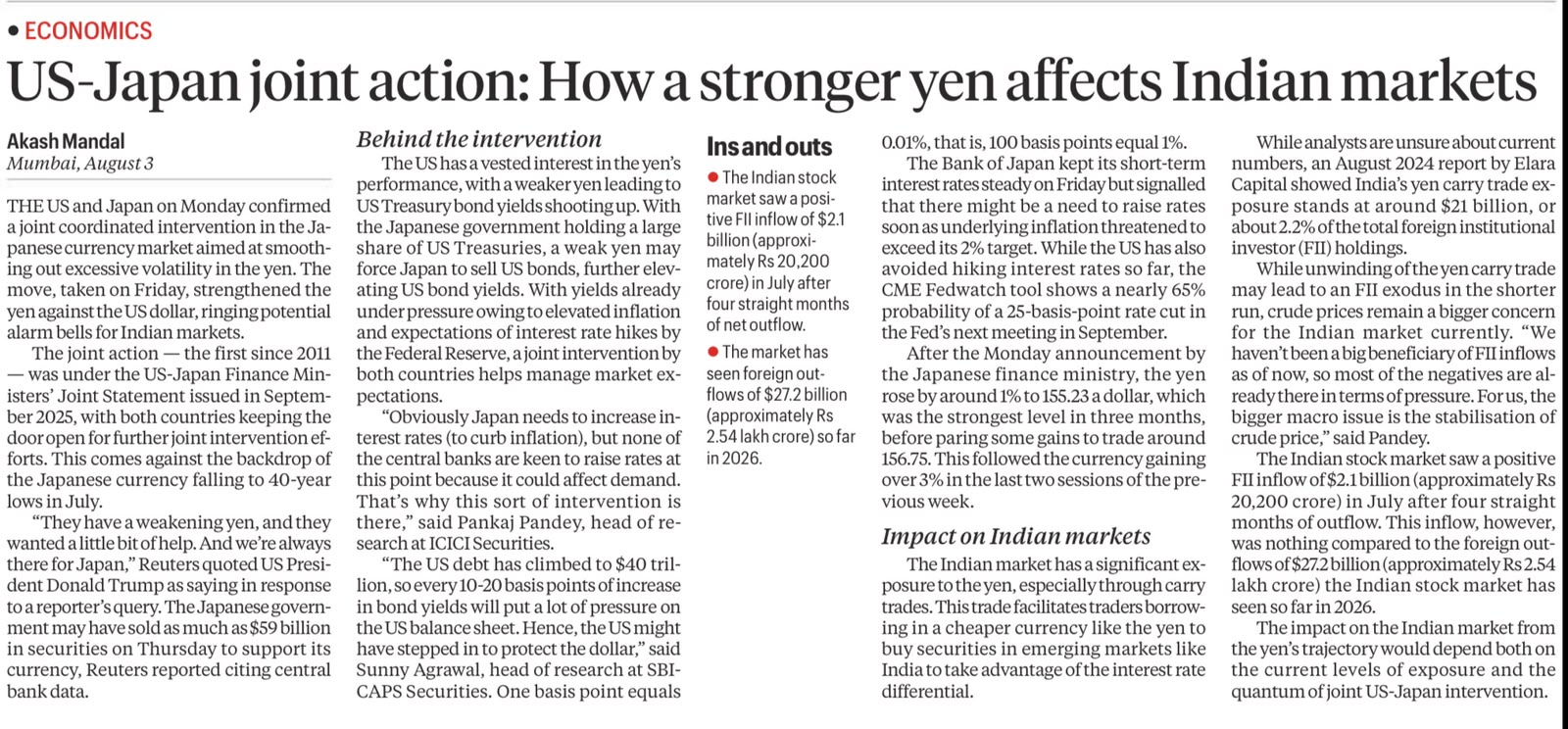
The United States and Japan jointly intervened in the foreign exchange market to stabilise the Japanese yen.

A stronger yen can influence global capital flows, especially Foreign Portfolio Investment into emerging markets like India. This makes the issue important for understanding exchange rates, carry trade and Indian financial markets.

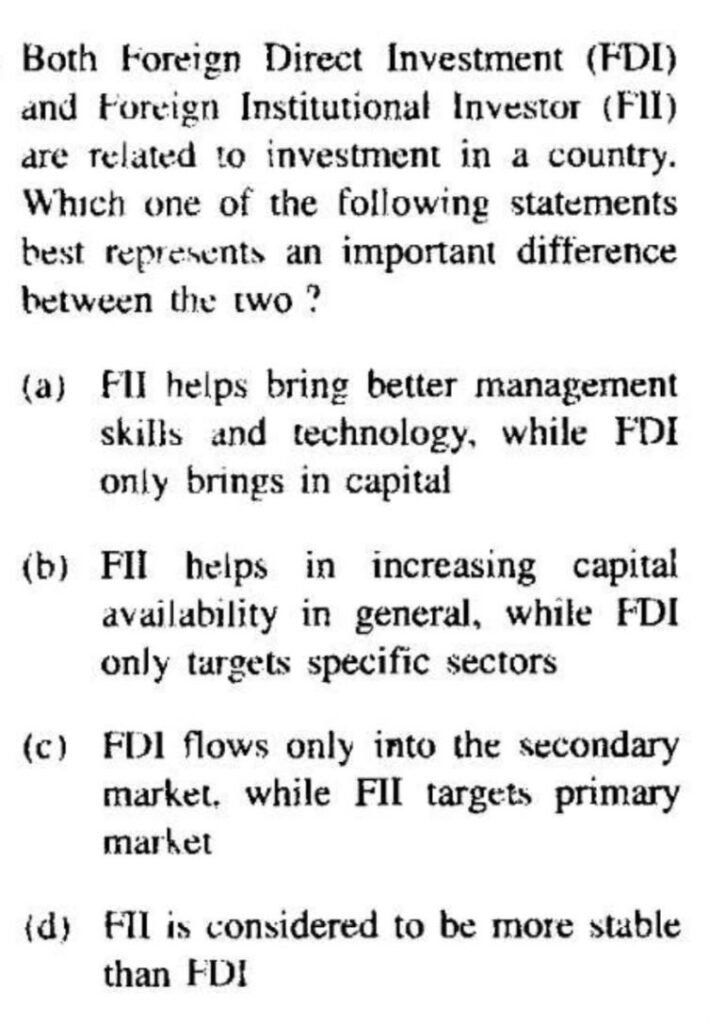
Foreign Portfolio Investment

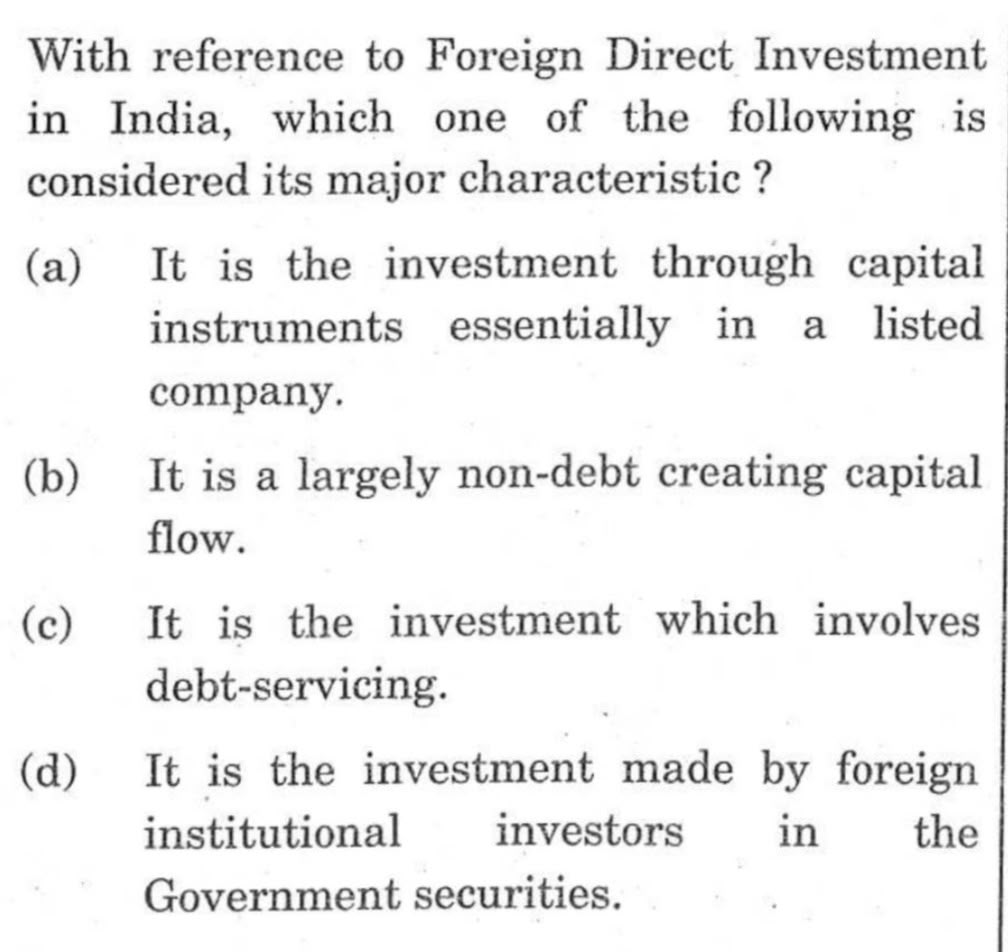
Foreign Portfolio Investment refers to investment in financial securities without management control.

Investment below 10% of a company’s voting equity is treated as FPI.

Investment of 10% or more is generally treated as Foreign Direct Investment.

FPI is more volatile than FDI because investors can quickly move funds in and out of financial markets.

Yen Carry Trade

Yen carry trade means investors borrow money cheaply in Japanese yen and invest it in higher-return markets.

Japan has historically had very low interest rates.

This encouraged investors to borrow in yen and invest in emerging markets where returns are higher.

Why a Stronger Yen Matters

When the yen strengthens, repayment becomes costlier for those who borrowed in yen.

This reduces the profitability of carry trade.

As a result, investors may withdraw money from emerging markets to reduce risk.

This can affect stock markets, bond markets and currency stability in countries like India.

Why the Intervention Took Place

Japan wanted to stabilise the yen and control imported inflation.

The United States wanted to avoid excessive volatility in currency and bond markets.

The intervention reflects coordinated action to maintain global financial stability.

Impact on India

India recorded Foreign Portfolio Investment outflows of around US$27.2 billion, despite US$2.1 billion inflows in July.

A stronger yen may reduce FPI inflows into India because carry trade becomes less attractive.

This can create short-term volatility in equity and debt markets.

It can also put pressure on the Indian rupee.

However, the overall impact is expected to remain limited because India’s domestic economic fundamentals remain relatively strong.

Key Takeaway

A stronger yen can disturb global carry trade and affect FPI flows into India, but India’s strong domestic fundamentals may limit the long-term damage.
The Problem with India’s Free Trade Agreement Strategy

Context:
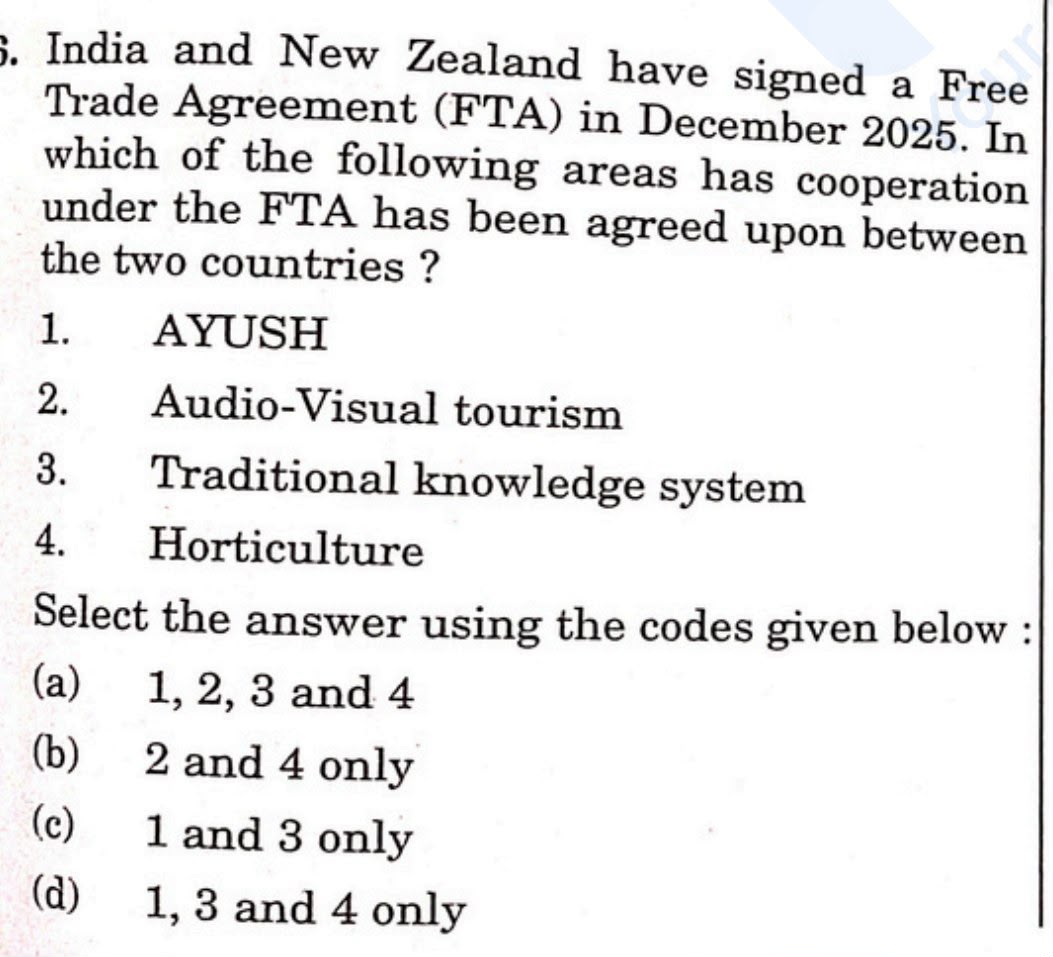
India has expanded its Free Trade Agreement network to improve exports and integrate with global markets.

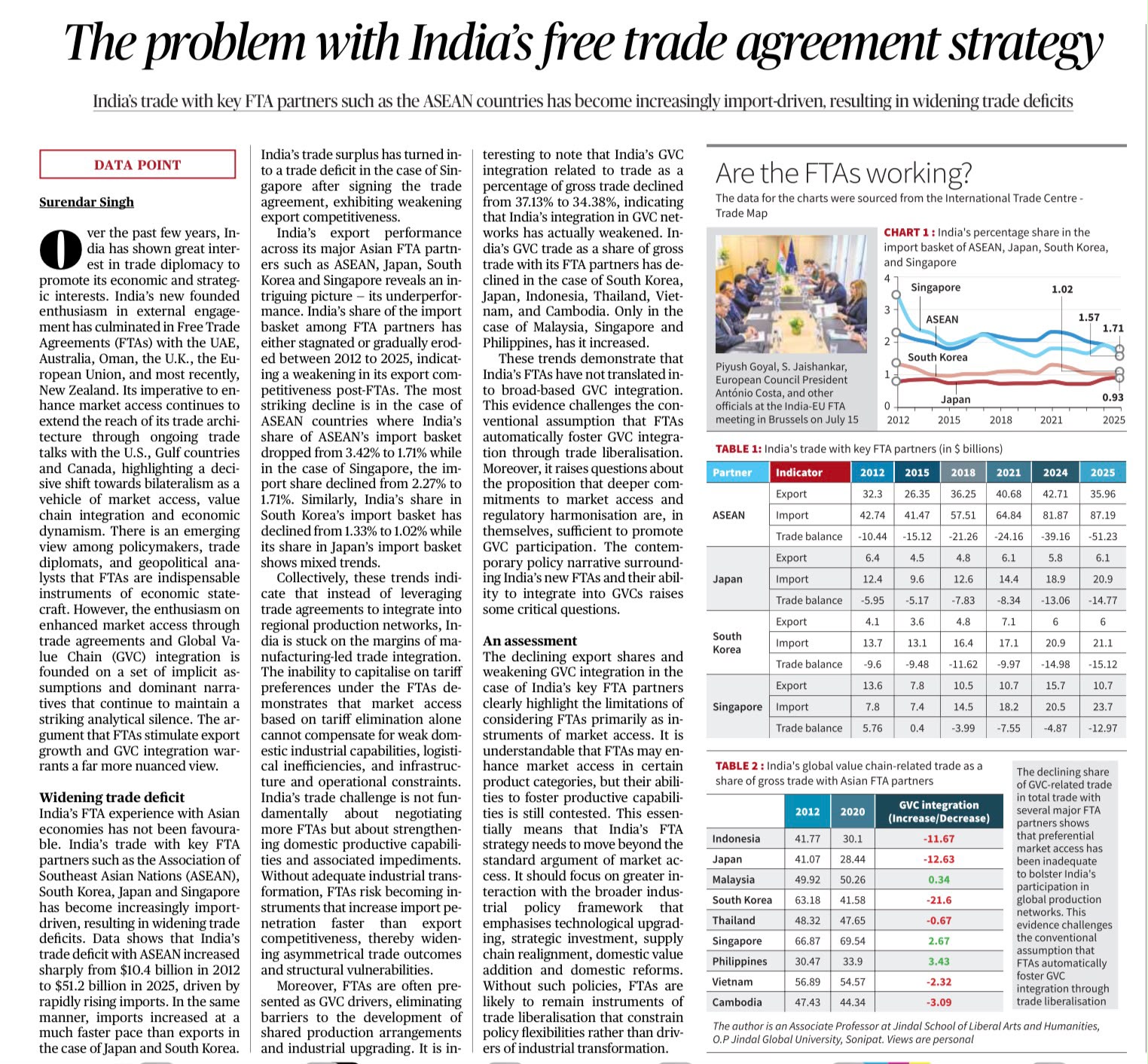
However, recent evidence suggests that many FTAs have become import-driven, widened trade deficits and delivered limited gains in Global Value Chain integration.

Free Trade Agreement

A Free Trade Agreement is an agreement between two or more countries to reduce or remove trade barriers such as tariffs, quotas and restrictions.

The aim is to promote trade, investment and market access.

Why India’s FTAs Are Being Questioned

India’s imports have grown faster than exports with several major FTA partners.

Market access has not automatically translated into export competitiveness.

India’s participation in Global Value Chains has also remained weak.

This means India has not gained enough from regional production networks despite tariff concessions.

Key Evidence

India’s trade deficit with ASEAN widened from US$10.4 billion in 2012 to US$51.2 billion in 2025.

India’s share in ASEAN’s import basket declined from 3.42% to 1.71%.

India’s GVC-related trade share declined from 37.1% to 34.4%.

This shows weaker integration into global production networks.

Why FTAs Alone Are Not Enough

FTA-led market access cannot compensate for weak domestic competitiveness.

Indian exports face challenges such as:

  • High logistics costs
  • Infrastructure gaps
  • Regulatory bottlenecks
  • Limited manufacturing scale
  • Low domestic value addition
  • Weak participation in production networks

If imports rise faster than exports, FTAs can widen trade deficits instead of strengthening the economy.

Global Value Chains

Global Value Chains refer to production systems where different stages of manufacturing are spread across countries.

For example, one country may produce components, another may assemble the product and another may provide design or marketing.

India’s weak GVC integration limits its ability to benefit from FTAs.

Way Forward

India should align future FTAs with industrial policy.

The focus should shift from tariff reduction alone to export competitiveness.

India must improve logistics, ports, infrastructure and ease of doing business.

FTAs should promote technology transfer, investment, domestic value addition and manufacturing depth.

India should periodically review FTAs based on export outcomes and sector-specific performance.

Key Takeaway

India’s FTA strategy needs a reset. Market access works only when domestic manufacturing, logistics and Global Value Chain integration are strong.

Critical Minerals: The Foundation of Strategic Power

Context:
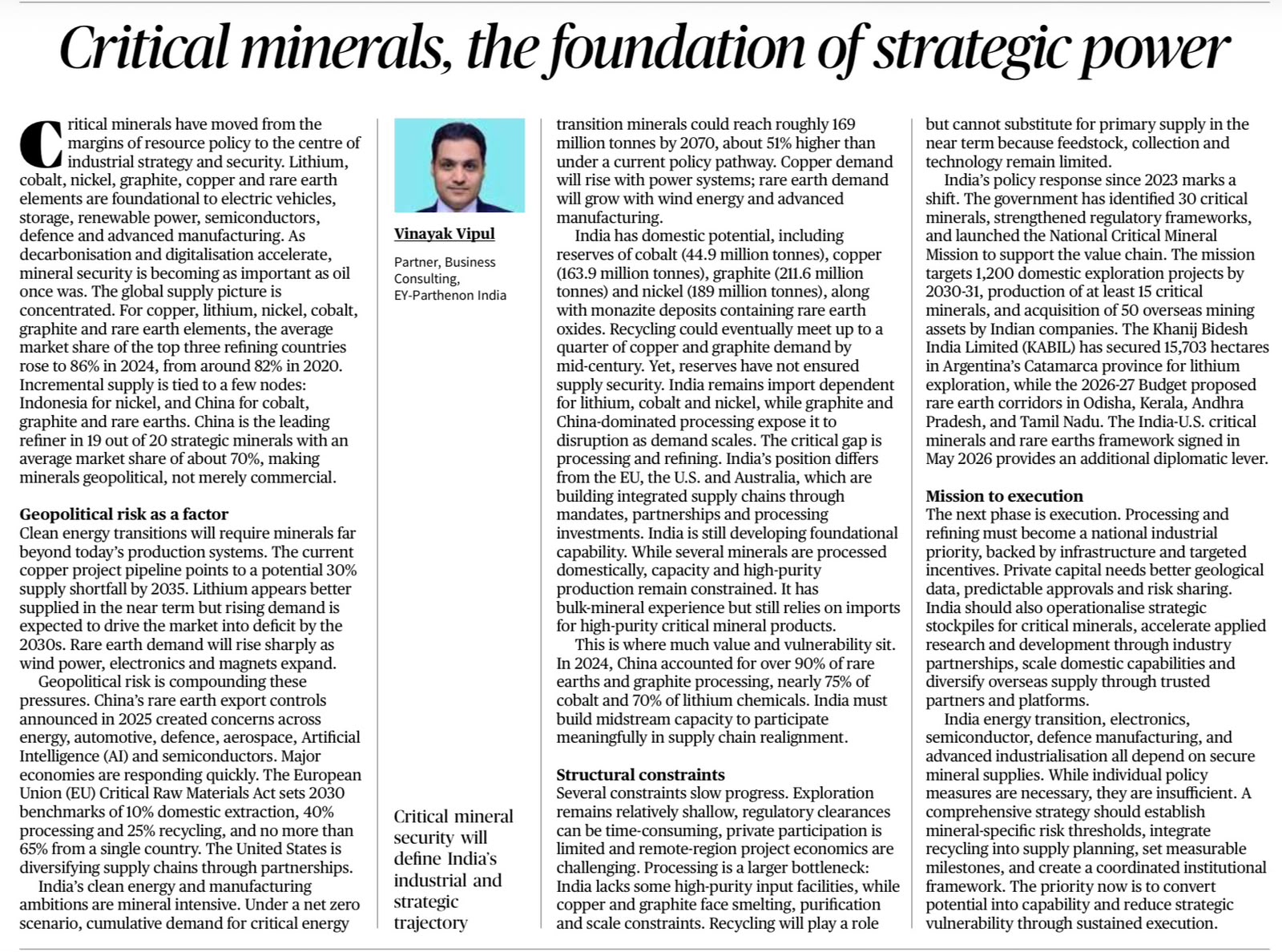
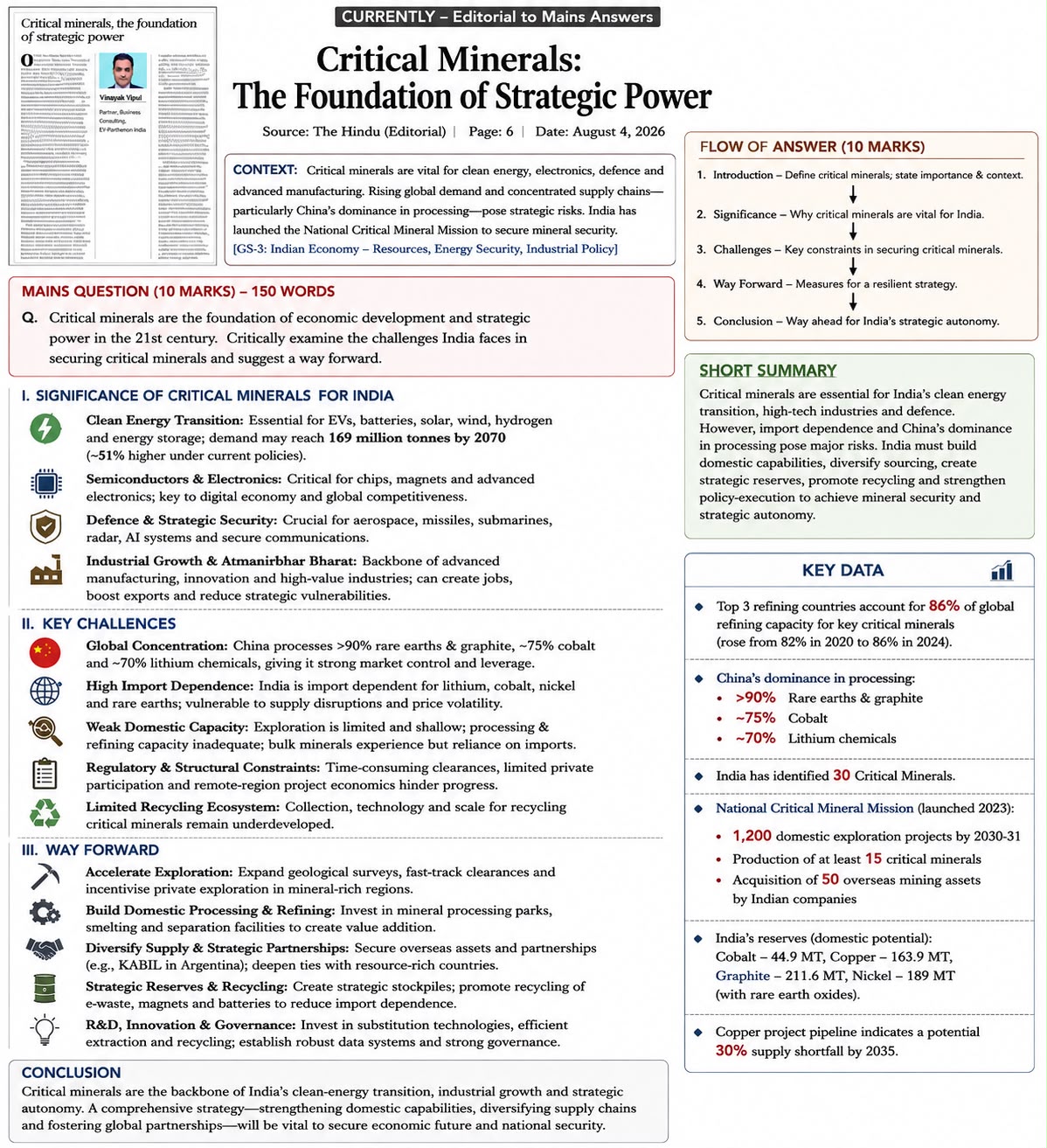
Critical minerals have become the foundation of clean energy, electronics, defence manufacturing and strategic technology.

The article argues that India must treat critical minerals not only as a commercial input but as a strategic requirement for national power, energy security and industrial competitiveness.

What Are Critical Minerals?

Critical minerals are minerals that are essential for modern technologies but face supply risks due to limited availability, geographical concentration or processing dependence.

They are important for:

  • Clean energy
  • Electric vehicles
  • Solar power
  • Wind energy
  • Batteries
  • Semiconductors
  • Defence systems
  • Space technology
  • Electronics manufacturing

Why Critical Minerals Matter

The global energy transition depends heavily on minerals such as lithium, cobalt, nickel, graphite, copper and rare earth elements.

Electric vehicles, battery storage, solar panels, wind turbines and advanced defence systems require these minerals.

Countries that control mining, processing and refining of critical minerals can gain strategic advantage.

Global Supply Challenge

Critical mineral supply chains are highly concentrated.

China dominates processing of many minerals such as graphite, rare earths, cobalt, lithium chemicals and nickel.

This makes countries like India vulnerable to supply disruptions, price shocks and geopolitical pressure.

India’s Vulnerability

India has identified critical minerals, but domestic exploration and processing capacity remain limited.

India depends significantly on imports for several strategic minerals.

India’s current weakness lies not only in mining but also in processing, refining, recycling and downstream manufacturing.

Without domestic capability, India risks remaining dependent on foreign-controlled supply chains.

India’s Policy Response

India has launched the National Critical Mineral Mission to secure mineral supply chains.

The mission focuses on:

  • Mineral exploration
  • Overseas acquisition
  • Domestic processing
  • Recycling
  • Strategic stockpiling
  • Research and development
  • Private sector participation

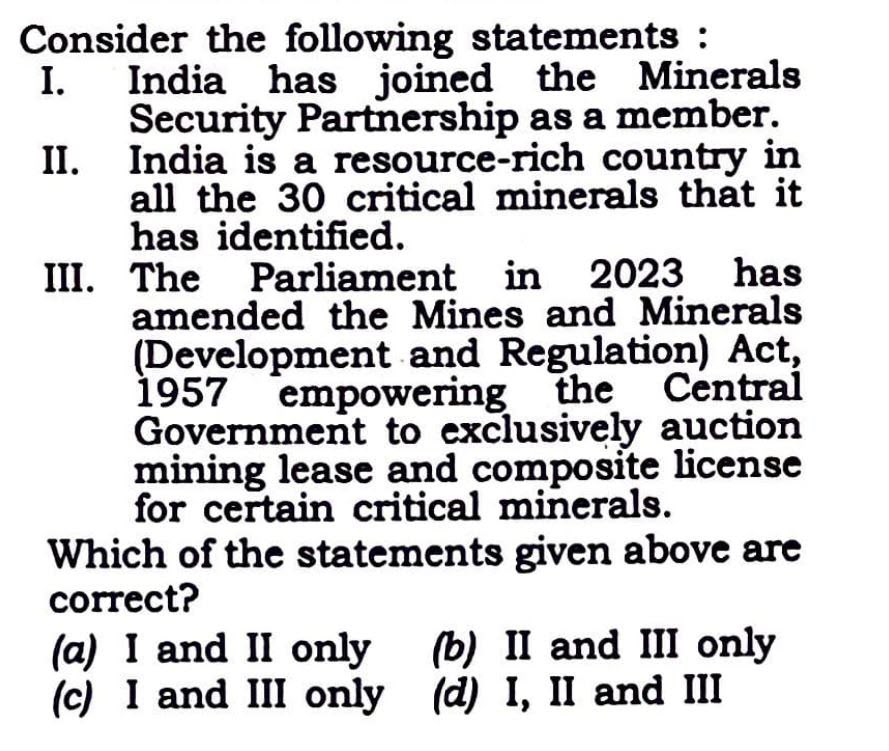
India has also amended mining laws to enable auctioning of certain critical mineral blocks.

Why It Is Strategically Important

Critical minerals are linked with India’s clean energy targets.

They are also vital for electric mobility, renewable energy storage, defence equipment, aerospace and electronics.

A secure mineral supply chain will support Atmanirbhar Bharat and reduce strategic dependence.

Way Forward

India should accelerate exploration and mapping of mineral reserves.

It should build processing and refining capacity.

Overseas mineral partnerships must be strengthened.

Recycling of batteries, electronics and solar waste should be promoted.

India also needs strategic reserves for key minerals.

Private sector participation, technology development and international cooperation must be expanded.

Key Takeaway

Critical minerals are the new foundation of strategic power. India’s clean energy transition and industrial future will depend on how quickly it secures mining, processing, recycling and global supply partnerships.

Why the Iran War Did Not Trigger a Fertiliser Crisis in India

Context:
The West Asia conflict and disruptions around the Strait of Hormuz raised concerns over global fertiliser supplies.

However, India avoided a fertiliser crisis because of proactive government intervention, diversified imports, higher domestic urea production and subdued domestic demand.

Why Fertiliser Security Matters

Fertilisers are essential for Indian agriculture.

Any disruption in fertiliser supply can affect:

  • Crop production
  • Farmer income
  • Food security
  • Input costs
  • Subsidy burden
  • Inflation

India depends on imports for several fertiliser inputs and raw materials, making fertiliser security strategically important.

Why India Avoided a Crisis

Diversified Imports

India reduced dependence on Qatar and the UAE by sourcing LNG and fertilisers from countries such as:

  • United States
  • Oman
  • Nigeria
  • Angola
  • Norway
  • Indonesia

This reduced exposure to West Asian disruptions.

Proactive Government Action

The government used timely import tenders, higher domestic urea production and supply-side management to ensure availability.

This helped prevent shortage despite global uncertainty.

Subdued Demand

Deficient monsoon and lower kharif acreage reduced fertiliser consumption.

This eased pressure on domestic fertiliser supply.

Key Data

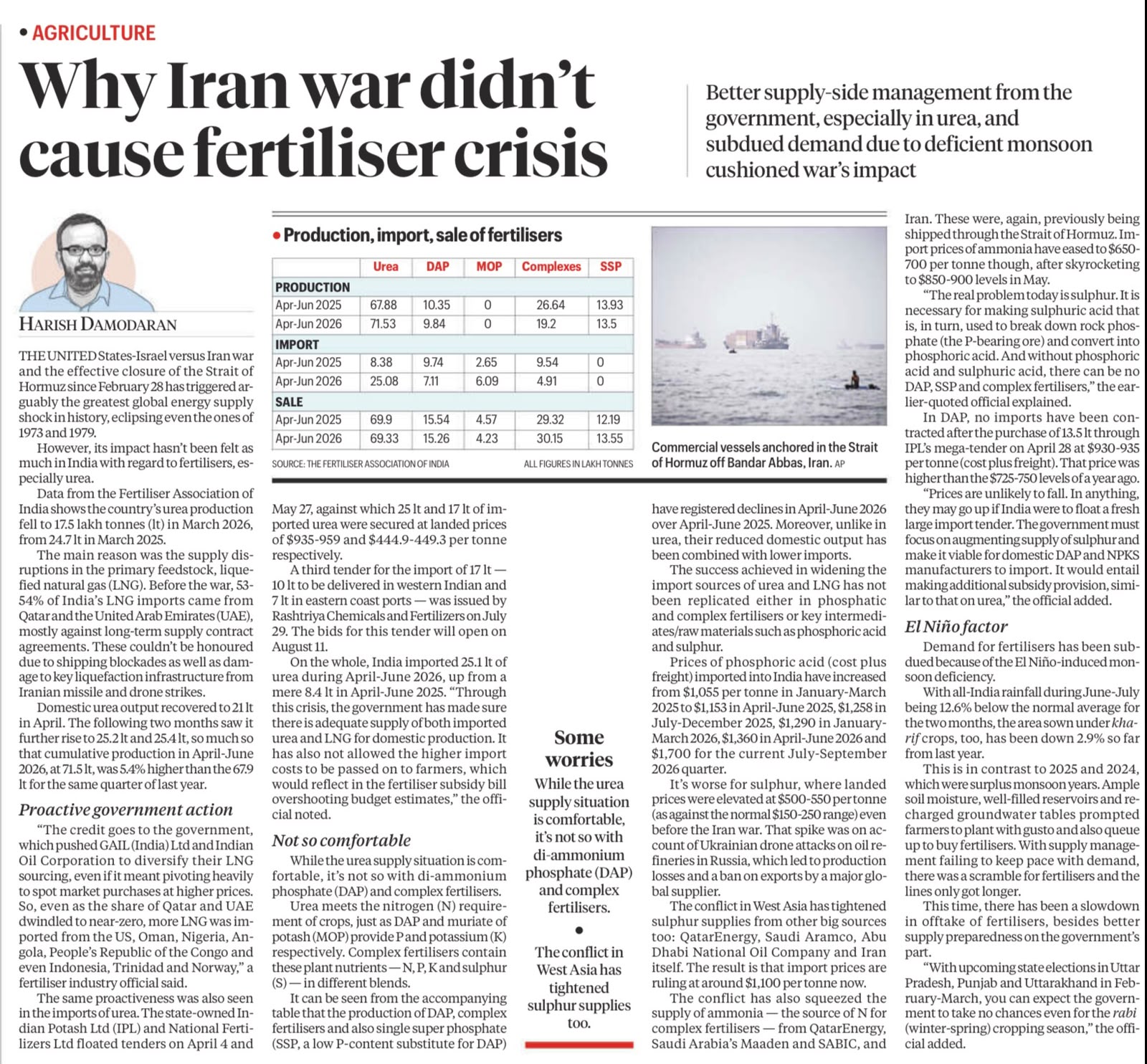
Domestic urea production increased from 67.9 lakh tonnes during April–June 2025 to 71.5 lakh tonnes during April–June 2026.

Urea imports increased from 8.4 lakh tonnes to 25.1 lakh tonnes.

Overall urea sales remained stable at around 69 lakh tonnes.

This shows that India managed supply without major disruption.

Vulnerability in Phosphatic Fertilisers

DAP and complex fertilisers remain more vulnerable than urea.

This is because India depends on imported raw materials such as:

  • Phosphoric acid
  • Sulphur
  • Ammonia

Sulphur prices rose to around US$1,100 per tonne, increasing production costs.

This can raise the fertiliser subsidy burden.

Way Forward

India should diversify fertiliser and raw material import sources.

Domestic production of DAP, NPK and phosphatic fertilisers must be strengthened.

India should secure long-term overseas supply agreements.

Strategic fertiliser reserves should be created.

Balanced fertilisation, nutrient-use efficiency and nano-fertilisers should be promoted.

Digital monitoring of fertiliser supply chains should continue.

Key Takeaway

India avoided a fertiliser crisis through diversified imports, timely intervention and better supply management, but dependence on imported phosphatic fertiliser inputs remains a strategic vulnerability.

Glaw Lake Becomes Arunachal Pradesh’s First Ramsar Site

Context:
India has designated Glaw Lake as its 101st Ramsar Site.

It is also the first Ramsar Site in Arunachal Pradesh, marking an important milestone for wetland conservation in the State.

Glaw Lake

Glaw Lake is located in Arunachal Pradesh.

Its designation as a Ramsar Site recognises its ecological value and importance for biodiversity, water security and climate resilience.

Ramsar Convention

The Ramsar Convention is an international treaty for the conservation and wise use of wetlands.

It was adopted in 1971 in Ramsar, Iran.

Wetlands recognised under the Convention are called Ramsar Sites.

India’s Ramsar Sites

With Glaw Lake’s inclusion, India now has 101 Ramsar Sites.

This shows India’s expanding commitment to wetland conservation.

Glaw Lake is the first Ramsar Site from Arunachal Pradesh.

Importance of Wetlands

Wetlands provide several ecological services.

They help in:

  • Water storage
  • Flood control
  • Groundwater recharge
  • Biodiversity conservation
  • Carbon storage
  • Livelihood support
  • Climate resilience
  • Migratory bird habitats

Significance of Glaw Lake

The site supports rich wetland biodiversity.

It provides habitat for migratory birds.

Its recognition can improve conservation planning, sustainable wetland management and local livelihood support.

It also strengthens India’s commitment under the Ramsar Convention.

Key Takeaway

Glaw Lake’s Ramsar recognition is important because it strengthens wetland conservation in Arunachal Pradesh and adds to India’s growing network of internationally recognised wetlands.

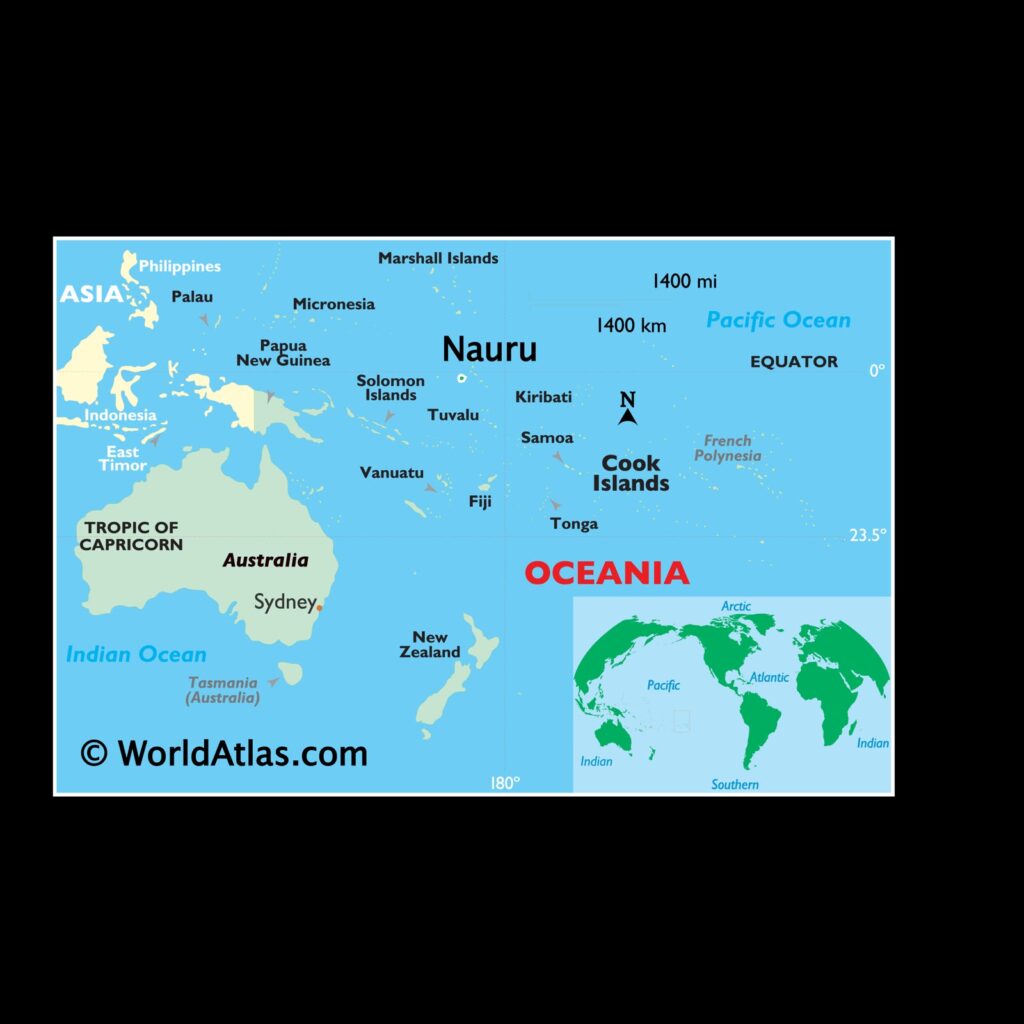
Nauru, the World’s Third Smallest Country, Changes Name to Naoero

Context:
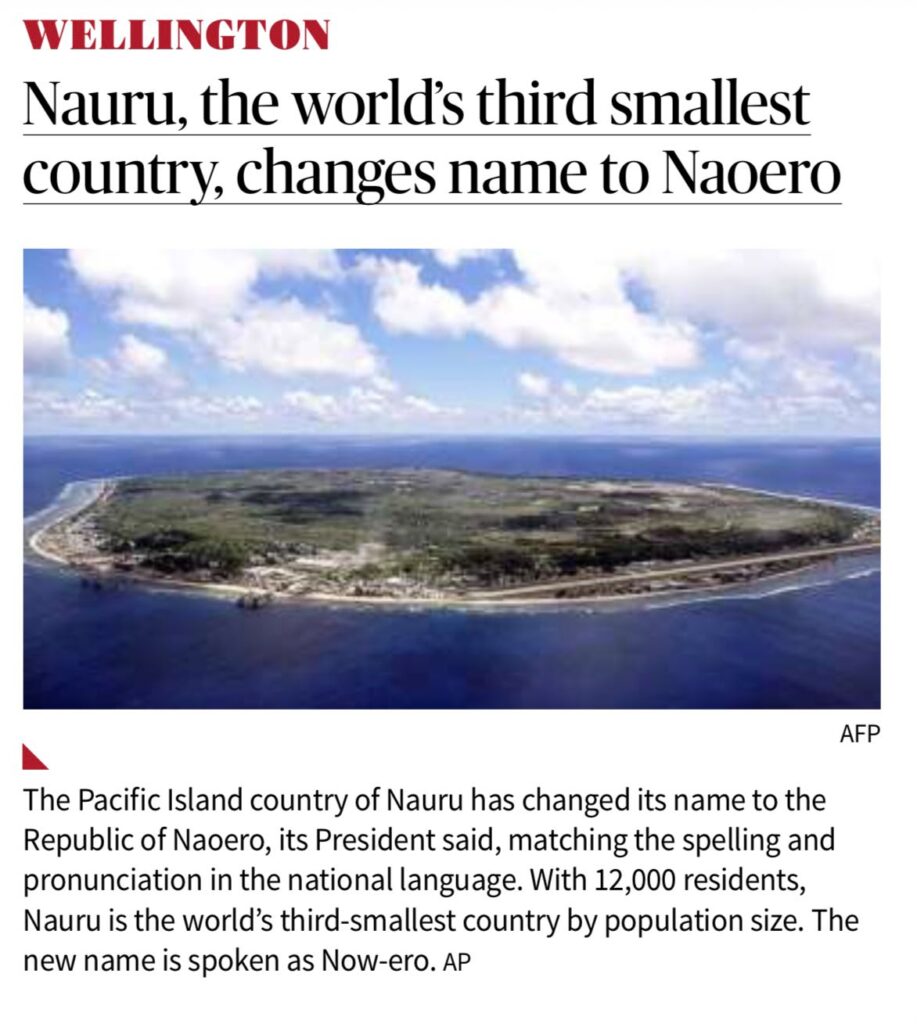
The Pacific island country of Nauru has changed its official name to the Republic of Naoero.

The change matches the spelling and pronunciation used in the national language. The new name is pronounced as “Now-ero.”

Nauru / Naoero

Nauru, now officially called Naoero, is a small island country in the Pacific Ocean.

It is one of the smallest countries in the world.

It has a population of around 12,000 people.

It is the world’s third smallest country by population size.

Location

Naoero is located in Oceania in the central Pacific region.

It lies near the Equator.

It is located northeast of Australia.

Important nearby island groups include:

  • Kiribati
  • Marshall Islands
  • Solomon Islands
  • Tuvalu
  • Micronesia

Why the Name Was Changed

The country changed its name to reflect the spelling and pronunciation in its national language.

This is linked with identity, cultural recognition and linguistic representation.

Geographical Importance

Naoero is important for map-based questions because it is a Pacific island nation.

Pacific island countries are often in news due to:

  • Climate change
  • Sea-level rise
  • Strategic competition
  • Maritime zones
  • Fisheries
  • Small island diplomacy

Key Takeaway

Nauru’s renaming to Naoero is a small but important development in world geography, reflecting national identity, language and the geopolitical significance of Pacific island states.

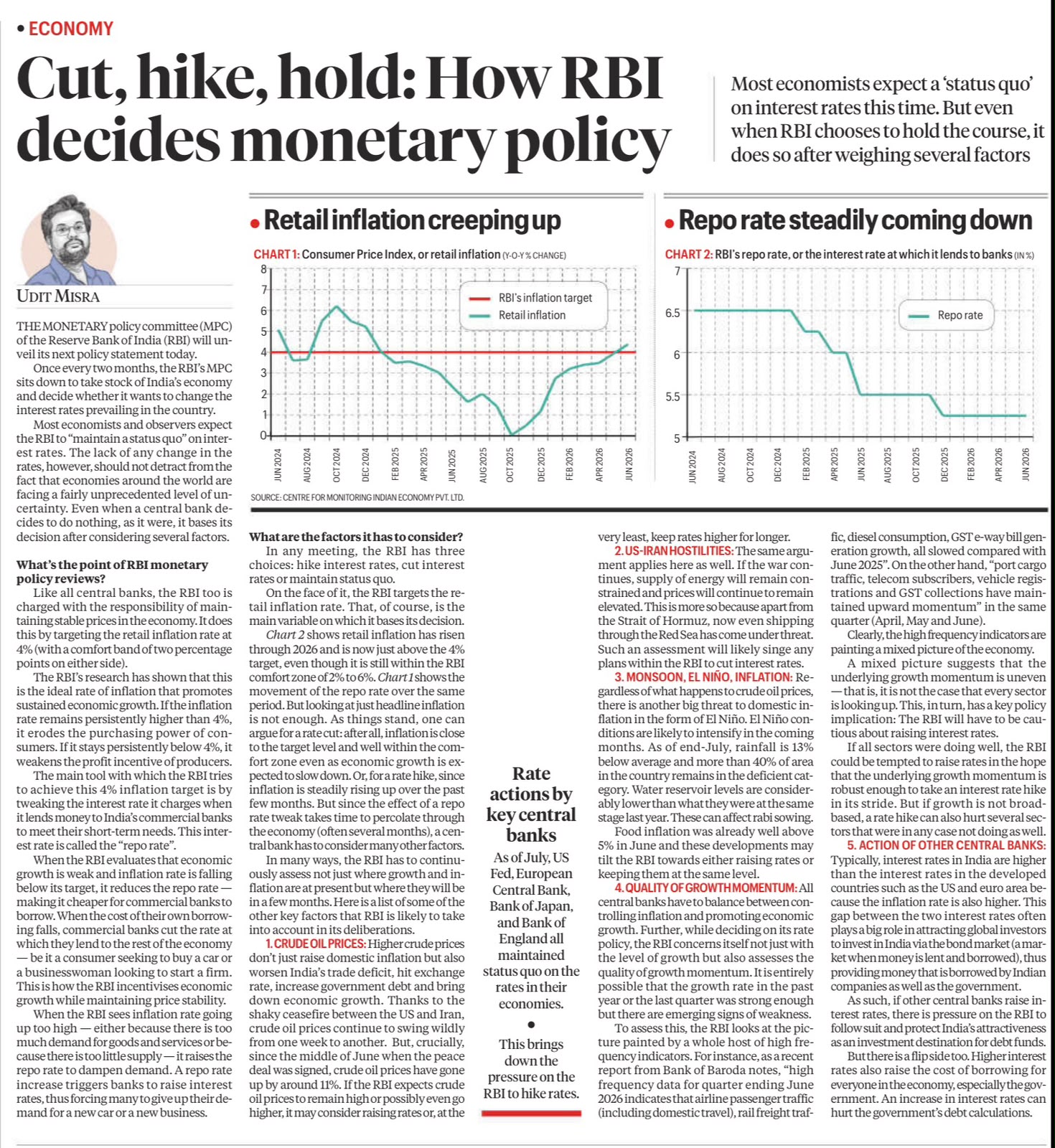
Cut, Hike, Hold: How RBI Decides Monetary Policy

Context:
The Reserve Bank of India’s Monetary Policy Committee is reviewing the policy repo rate amid inflationary pressure and global uncertainty.

The challenge is to balance price stability with economic growth.

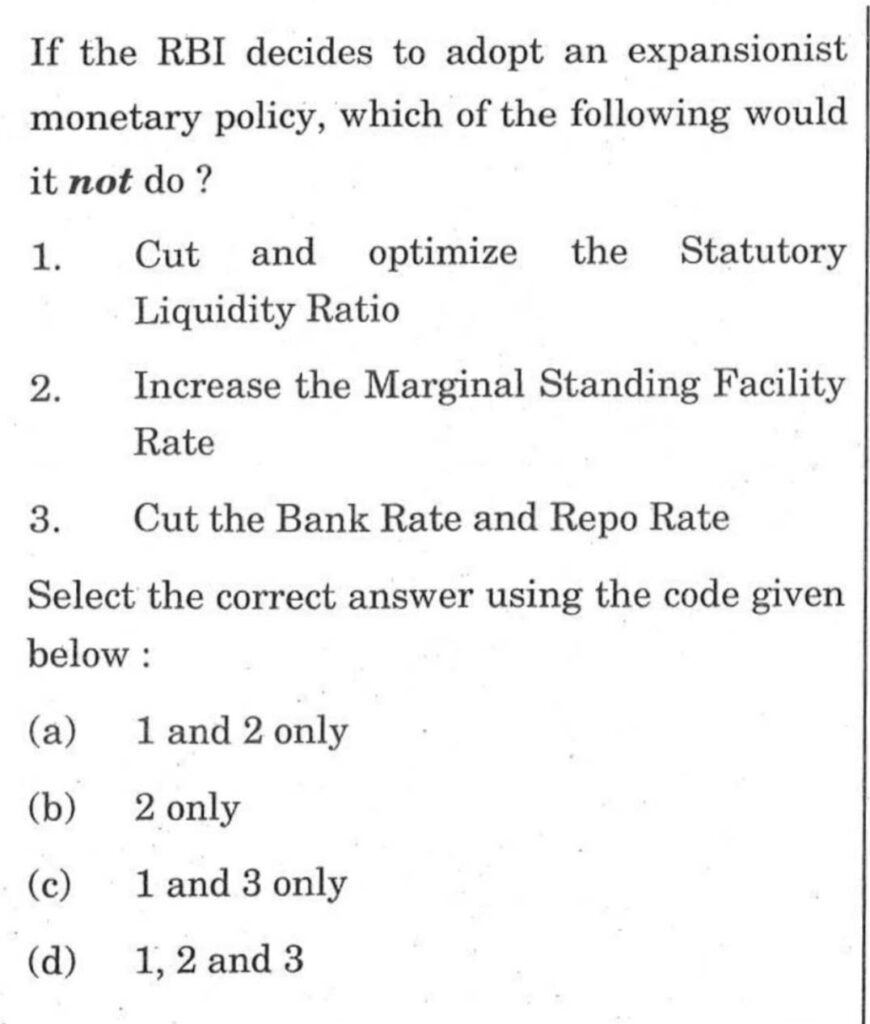
Monetary Policy

Monetary policy is the RBI’s policy to regulate:

  • Money supply
  • Liquidity
  • Interest rates

Its main objective is to maintain price stability while supporting economic growth.

Monetary Policy Committee

The Monetary Policy Committee, or MPC, is a six-member statutory body.

It was constituted under the RBI Act, 1934, after the 2016 amendment.

It was created on the recommendation of the Urjit Patel Committee, 2014.

Composition of MPC

The MPC consists of:

  • RBI Governor as Chairperson
  • Deputy Governor in charge of Monetary Policy
  • One RBI nominee
  • Three members nominated by the Central Government

Meetings

The MPC meets at least four times a year, generally once every two months.

Decision-Making

Decisions are taken by majority vote.

If there is a tie, the RBI Governor has a casting vote.

Inflation Target

India follows the Flexible Inflation Targeting framework.

The RBI is required to maintain CPI inflation at 4%, with a tolerance band of ±2%.

This means the acceptable inflation range is 2% to 6%.

Policy Tools

The RBI uses several instruments to manage liquidity and interest rates.

These include:

Cut, Hike and Hold

Rate Cut

A rate cut means the RBI reduces the repo rate.

This makes borrowing cheaper and can support growth.

It is generally used when inflation is under control and growth needs support.

Rate Hike

A rate hike means the RBI increases the repo rate.

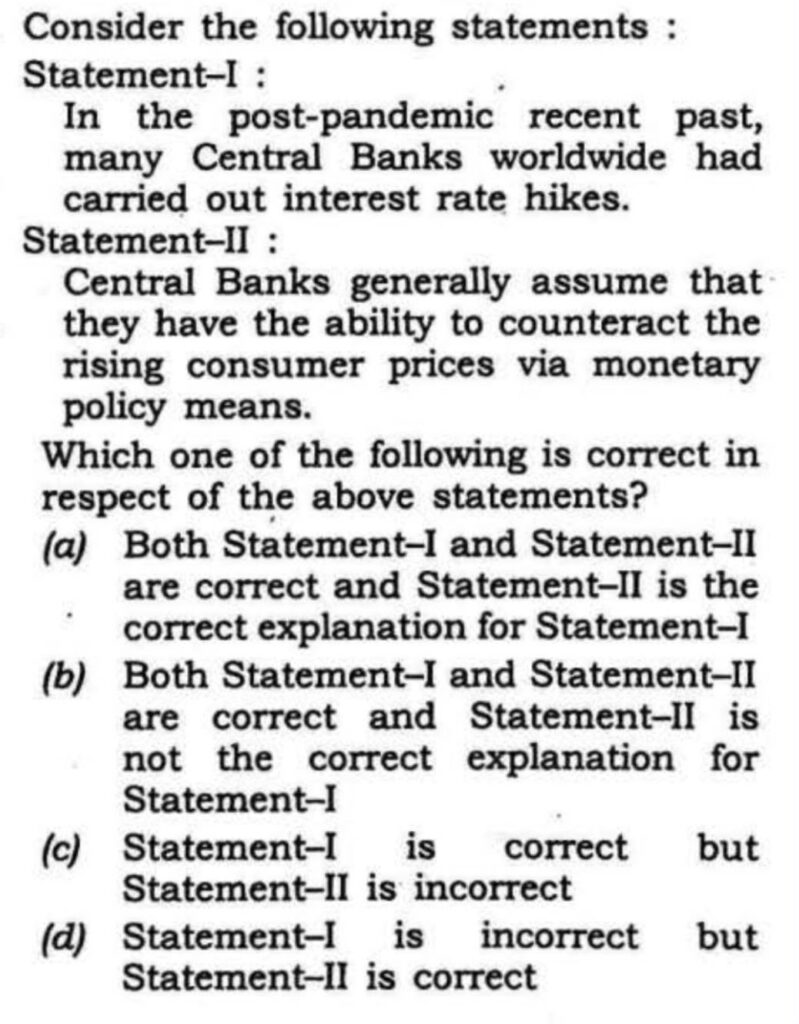
This makes borrowing costlier and helps control inflation.

It is generally used when inflationary pressure is high.

Rate Hold

A rate hold means the RBI keeps the policy rate unchanged.

This is done when the RBI wants to wait for more data before changing policy direction.

Key Takeaway

RBI’s monetary policy is a balancing act. It must control inflation without unnecessarily hurting growth, using interest rates and liquidity tools carefully.

Copyright © 2026 USARAMBHA EDUCATION (UnderStand UPSC). All Rights Reserved.

Inquiry form for Takshila Residential Program