Saudi Pakistan Turkey defence deal: UPSC GS2 Analysis
Context: Saudi Pakistan Turkey defence deal
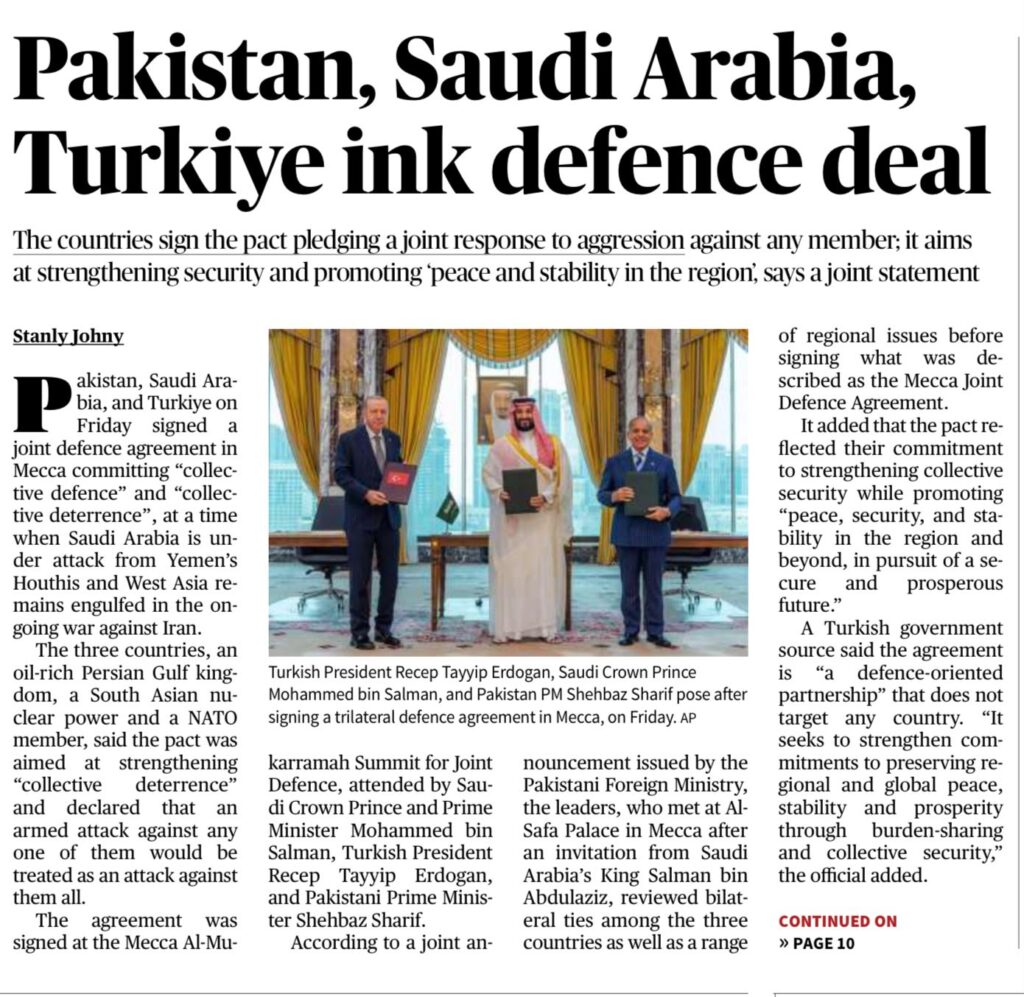
Saudi Arabia, Turkey and Pakistan have signed a joint defence agreement amid growing instability in West Asia.
The agreement comes at a time when Gulf states are facing security threats, existing security guarantees are being questioned and regional powers are looking for greater strategic autonomy.
Makkah Joint Defence Agreement
The agreement was signed in Makkah.
It is based on the principle of collective deterrence.
This means an armed attack on any one signatory will be treated as an attack on all three.
Key Features
Collective Deterrence
An attack on Saudi Arabia, Turkey or Pakistan will be treated as an attack on all three countries.
This is meant to strengthen deterrence against regional threats.
Defensive Character
The agreement is officially described as defensive.
It is not aimed at any specific country.
It is also not meant to create a sectarian or military bloc.
Strategic Convergence
The agreement brings together three different strengths:
- Saudi Arabia’s economic and energy power
- Turkey’s military and defence-industrial strength
- Pakistan’s military and nuclear capability
Broader Objective
The pact aims to strengthen:
- Defence coordination
- Regional deterrence
- Maritime security
- Protection of energy routes
- Strategic autonomy in West Asia
Core Strategic Interests
Saudi Arabia
Saudi Arabia wants to diversify its security partnerships.
It also wants to reduce excessive dependence on U.S. security guarantees.
The deal strengthens its deterrence against regional threats.
Pakistan
Pakistan gains strategic relevance in West Asia.
It also seeks to deepen energy, investment and employment linkages with Saudi Arabia.
This can increase Pakistan’s role in regional security architecture.
Turkey
Turkey wants to expand its influence in West Asia.
It is also trying to build an independent regional security role while remaining a NATO member.
Is It a “Muslim NATO”?
It resembles NATO’s collective-defence idea in a limited sense.
But it is not a Muslim NATO.
It lacks NATO-like:
- Institutional structure
- Automatic military intervention mechanism
- Unified command system
- Formal military alliance framework
Significance
The agreement reflects a shift towards a more multipolar and regionally driven West Asian security order.
It shows that regional powers are no longer depending only on traditional external security providers.
Instead, they are trying to build their own security arrangements.
Key Takeaway
The Saudi Arabia–Turkey–Pakistan defence deal is not a formal Islamic military alliance. It is a regional strategic partnership for deterrence, security coordination and greater strategic autonomy in West Asia.