
Admissions Open: MAD-X for UPSC Prelims 2027 · Batch starts 1st Nov 2026 Explore MAD-X
US
UnderStand UPSC Daily Current Affairs Practice
0.00Score / 14
0 / 7MCQs Attempted
0%Accuracy
4 November 2026 • UPSC CSE

Read the news. Test the concept. Write the Mains answer.

This interactive edition converts each current-affairs item into one Prelims-level MCQ, one Mains-level question, and a compact value-addition section for revision.

+2 correct −0.66 incorrect Explanation after attempt Image/PDF answer upload
NEWS 1 GS3 • Internal Security — Cybersecurity Source: The Hindu

Digital Pathogen: Why Cyber Hygiene Is No Longer Optional

Context: Rising data breaches and cyber frauds in India's fast-growing digital economy show that basic cyber hygiene is now the first line of defence for banks, businesses, regulators and citizens alike.
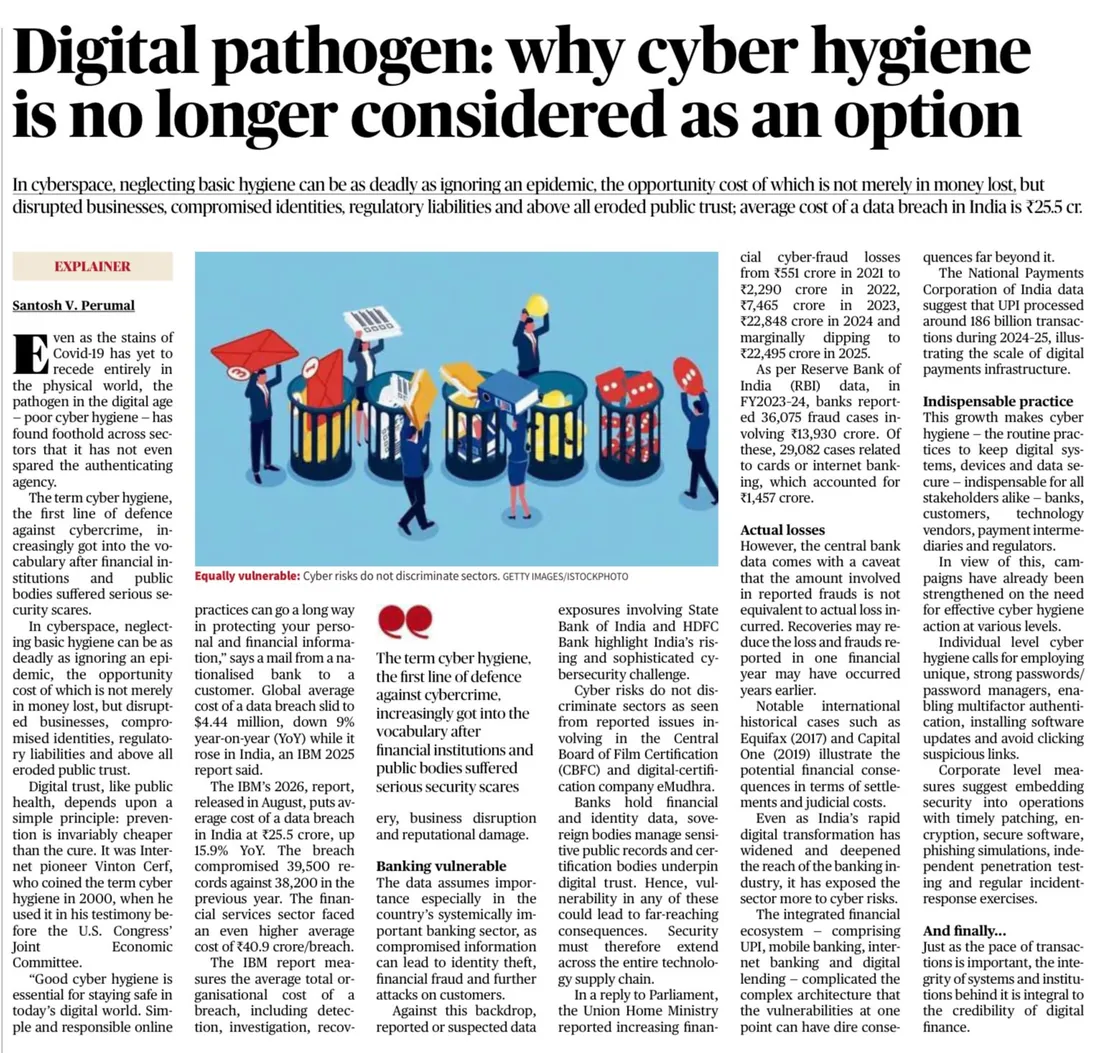
Digital pathogen – why cyber hygiene is no longer an option, data breach cost in India ₹25.5 crore (The Hindu explainer)
Cyber risks do not discriminate between sectors. Source: The Hindu

What Is Cyber Hygiene?

Meaning
Routine practices that keep devices, networks and data secure — the digital equivalent of personal hygiene.
Origin
Term coined by internet pioneer Vinton Cerf in 2000, in testimony before the U.S. Congress.
Logic
Like public health, prevention is cheaper than cure.

Key Data

Data breach cost
Average ₹25.5 crore per breach in India (IBM 2026), up 15.9%; financial sector ₹40.9 crore.
Bank frauds
RBI (2023-24): 36,075 cases involving ₹13,930 crore; 29,082 linked to cards/internet banking.
Cyber-fraud losses
From ₹551 crore (2021) to ₹22,848 crore (2024); ₹22,495 crore in 2025 (MHA).
Scale
UPI processed about 186 billion transactions in 2024-25 (NPCI).

Why the Risk Is Rising

Interconnected systems
UPI, mobile banking and digital lending are linked — a weak point in one can spread across the chain.
Supply chain
Vendors and payment intermediaries can become entry points; even CBFC and eMudhra faced issues.
Trust
Breaches cause identity theft, fraud, business disruption and loss of public trust.

Way Forward

Individuals
Strong unique passwords, password managers, multi-factor authentication, updates, no suspicious links.
Institutions
Timely patching, encryption, phishing simulations, penetration testing and incident-response drills.
System
Security across the whole technology supply chain; coordinated reporting with CERT-In and regulators.

Previous-Year Question

UPSC Mains 2017 — GS III
Discuss the potential threats of cyber attack and the security framework to prevent it.
Key Takeaway: As digital payments grow, a single weak password or unpatched system can hurt millions. Cyber hygiene is cheap, but its absence is expensive — so it must become a habit for citizens and a rule for institutions.

Prelims Practice MCQ

+2 correct • −0.66 wrong

With reference to cyber hygiene, consider the following statements:
1. The term 'cyber hygiene' was coined by Vinton Cerf.
2. Multi-factor authentication is an example of an individual-level cyber hygiene practice.
3. Penetration testing is used to deliberately disable an organisation's systems during a cyber attack.
Which of the statements given above are correct?

Explanation: Statements 1 and 2 are correct. Penetration testing is an authorised, simulated attack used to find and fix vulnerabilities before real attackers exploit them.

UPSC Mains Question

15 Marks • 250 Words

"In cyberspace, neglecting basic hygiene can be as deadly as ignoring an epidemic." Examine the cyber risks facing India's digital financial ecosystem and suggest measures to strengthen cyber hygiene.

Attempt before opening the value-addition tab.
Accepted: JPG, JPEG, PNG, WEBP or PDF. The standalone file previews your answer locally; connect the API hook for real server submission.
Use after attempting the Mains answer
  • Data — ₹25.5 crore average breach cost; 36,075 bank fraud cases (2023-24); 186 billion UPI transactions.
  • Risks — phishing, identity theft, ransomware, supply-chain attacks, loss of trust.
  • Framework — IT Act 2000, CERT-In, NCIIPC, National Cyber Security Policy 2013, DPDP Act 2023, I4C.
  • Measures — MFA, patching, encryption, audits, incident response, awareness.
  • Link — Digital India, financial inclusion, cooperative federalism in policing cybercrime.
NEWS 2 GS2 • India–Bangladesh Relations Source: The Hindu

Ganga Water Treaty Renewal: India Says Mechanism in Place

Context: With the 1996 Ganga Water Treaty expiring on 12 December 2026, the External Affairs Ministry said the Joint Rivers Commission is the structured mechanism to discuss shared rivers, though there is no update yet on renewal or on a visit by Bangladesh PM Tarique Rahman.

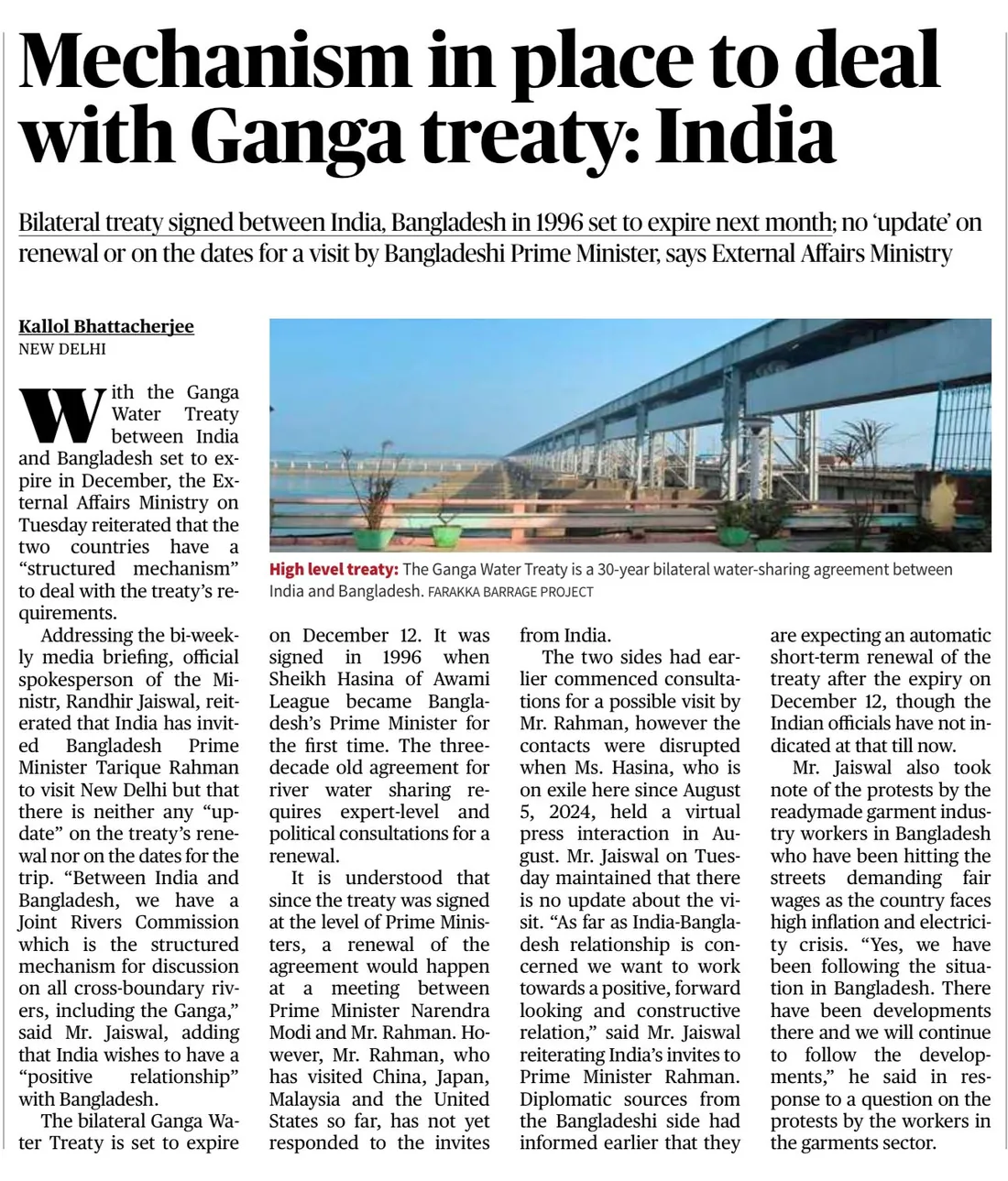
Mechanism in place to deal with Ganga treaty – Farakka Barrage, India–Bangladesh Ganga Water Treaty 1996 renewal (The Hindu)
Farakka Barrage: the Ganga Water Treaty is a 30-year water-sharing agreement. Source: The Hindu

Ganga Water Treaty, 1996

Signed
December 1996, when Sheikh Hasina became PM for the first time.
Duration
30 years; expires on 12 December 2026.
Purpose
Sharing Ganga waters at Farakka during the lean (dry) season.
Mechanism
Joint Rivers Commission (JRC) — the forum for all cross-boundary rivers.

Current Situation

Renewal
Needs expert-level and political consultations; likely at a PM-level meeting.
Visit
India has invited PM Tarique Rahman; no response yet, though he has visited China, Japan, Malaysia and the U.S.
Irritant
Sheikh Hasina in exile in India since 5 August 2024; contacts disrupted after her virtual press interaction.

Challenges

Water sharing
Lean-season flows and competing demands for agriculture and fisheries.
Politics
Leadership change in Dhaka and trust deficit slow negotiations.
Hydrology
Changing river flows, sediment and limited data sharing.

Way Forward

Institutions
Revive JRC talks and fast-track renewal.
Science
Joint basin studies and real-time hydrological data.
Diplomacy
Use shared rivers (54 common rivers) for trust-building; settle Teesta alongside.

Previous-Year Questions

UPSC Prelims 2017 — Teesta
Rangeet originates in Sikkim and is a tributary of Teesta. Answer: (b) 2 only.
UPSC Prelims 2020 — Trade
Textiles are an important item of India–Bangladesh trade. Answer: (b) 2 only.
Key Takeaway: A treaty that has kept the peace on water for 30 years now depends on political goodwill. Renewing it on time would signal that India–Bangladesh ties can survive a change of government in Dhaka.

Prelims Practice MCQ

+2 correct • −0.66 wrong

With reference to the Ganga Water Treaty between India and Bangladesh, consider the following statements:
1. It was signed in 1996 for a period of 30 years.
2. It governs the sharing of Ganga waters at the Farakka Barrage during the lean season.
3. It was negotiated under the framework of the Indus Waters Treaty.
Which of the statements given above are correct?

Explanation: Statements 1 and 2 are correct. The Indus Waters Treaty (1960) is between India and Pakistan; it has no link with the Ganga treaty.

UPSC Mains Question

10 Marks • 150 Words

Transboundary rivers can be a source of either conflict or cooperation in India's neighbourhood. Discuss with reference to the renewal of the Ganga Water Treaty.

Attempt before opening the value-addition tab.
Accepted: JPG, JPEG, PNG, WEBP or PDF. The standalone file previews your answer locally; connect the API hook for real server submission.
Use after attempting the Mains answer
  • Facts — signed Dec 1996; 30 years; expires 12 Dec 2026; Farakka; lean season (Jan–May).
  • Institutions — Joint Rivers Commission (1972); 54 shared rivers.
  • Issues — Teesta deal pending, political change in Dhaka, Hasina's stay in India, China factor.
  • Approach — basin-level management, data sharing, climate resilience.
  • Link — Neighbourhood First, Act East, BBIN connectivity.
NEWS 3 GS1 • Urbanisation | GS2 • Urban Local Bodies Source: The Hindu

Need for a Unified National Urbanisation Policy

Context: Census 2027 will still use the 2011 definitions of 'urban', even though the Economic Survey 2026 says India is far more urban in functional terms. Experts argue that a National Urbanisation Policy is needed to plan and finance the rural–urban continuum.

Need for a unified urbanisation plan – Census 2027 urban definition, census towns, DEGURBA and National Urbanisation Policy (The Hindu)
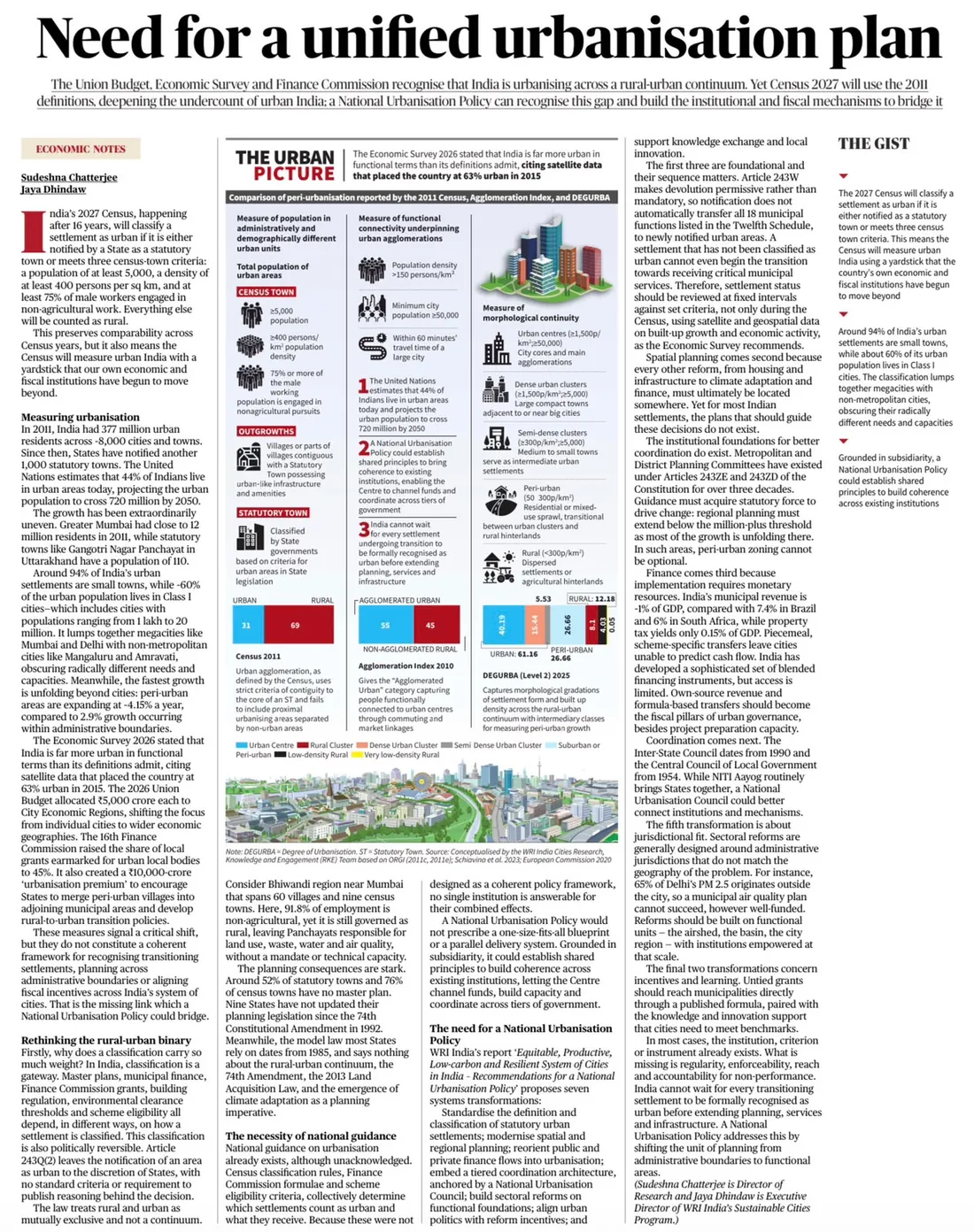
The urban picture: Census 2011 vs Agglomeration Index vs DEGURBA. Source: The Hindu

How 'Urban' Is Defined

Statutory town
Notified as urban by the State government (municipality, corporation, etc.).
Census town
Population ≥5,000, density ≥400 per sq km, ≥75% male workers in non-farm work.
Census 2027
Will continue with the 2011 definitions — preserving comparability but deepening the undercount.

The Urban Reality

2011
377 million urban residents in about 8,000 cities and towns (31%).
Functional urbanisation
Economic Survey 2026: satellite data placed India at 63% urban in 2015.
Future
UN: 44% urban today, 720 million urban residents by 2050.
Peri-urban growth
Expanding ~4.15% a year vs 2.9% inside city limits; e.g. Bhiwandi — 91.8% non-farm jobs but governed as rural.

Gaps

Planning
About 52% of statutory towns and 76% of census towns have no master plan.
Discretion
Article 243Q(2) leaves notification to States; 243W makes devolution of 18 functions permissive.
Finance
Municipal revenue only ~1% of GDP (Brazil 7.4%, South Africa 6%); property tax 0.15% of GDP.
Coordination
MPCs (Art. 243ZE) and DPCs (Art. 243ZD) exist but lack statutory force.

Recent Measures & Way Forward

Budget 2026
₹5,000 crore each for City Economic Regions.
16th Finance Commission
45% of local body grants for urban bodies; ₹10,000-crore urbanisation premium to merge peri-urban villages.
WRI's seven shifts
Standard classification, regional planning, finance reform, a National Urbanisation Council, functional units (airshed, basin), incentives, learning.

Previous-Year Questions

UPSC Mains 2015 — GS I
'Smart cities in India cannot sustain without smart villages.' Discuss in the backdrop of rural–urban integration.
UPSC Mains 2023 — GS I
Does urbanisation lead to more segregation and/or marginalisation of the poor in Indian metropolises?
Key Takeaway: India's cities have outgrown their legal boundaries. Until classification, planning and finance follow functional regions rather than old maps, the fastest-growing areas will remain unplanned and underfunded.

Prelims Practice MCQ

+2 correct • −0.66 wrong

For classification as a 'Census Town' in India, which of the following criteria must be satisfied?
1. A minimum population of 5,000
2. A population density of at least 400 persons per sq km
3. At least 75% of the male main working population engaged in non-agricultural pursuits
4. Notification as a municipality by the State government
Select the correct answer using the code given below:

Explanation: A census town must meet all three census criteria. Notification by the State makes a settlement a statutory town, not a census town.

UPSC Mains Question

15 Marks • 250 Words

India is urbanising across a rural–urban continuum, but its institutions still treat rural and urban as separate categories. Discuss the case for a National Urbanisation Policy.

Attempt before opening the value-addition tab.
Accepted: JPG, JPEG, PNG, WEBP or PDF. The standalone file previews your answer locally; connect the API hook for real server submission.
Use after attempting the Mains answer
  • Definitions — statutory vs census towns; 5,000 / 400 per sq km / 75% criteria.
  • Data — 377 million (2011); 63% functional urban (ES 2026); 720 million by 2050.
  • Constitution — 74th Amendment, Art. 243Q, 243W, 243ZD, 243ZE, 12th Schedule.
  • Finance — municipal revenue ~1% of GDP; 16th FC urbanisation premium; City Economic Regions.
  • Way forward — functional regions, MPC/DPC empowerment, own revenue, National Urbanisation Council.
NEWS 4 GS3 • Science & Technology — Genetics Source: The Hindu

In Snails, a Mother's Genes Decide Which Way Her Baby Spirals

Context: Scientists from the U.K. and Japan found that in Japanese Euhadra snails the coiling direction of the shell depends on variants of an unconventional myosin gene carried by the mother — a classic case of maternal effect inheritance (Current Biology, 16 October).

In snails, a mother's hidden genes decide which way her baby spirals – Euhadra shell coiling and myosin gene (The Hindu)
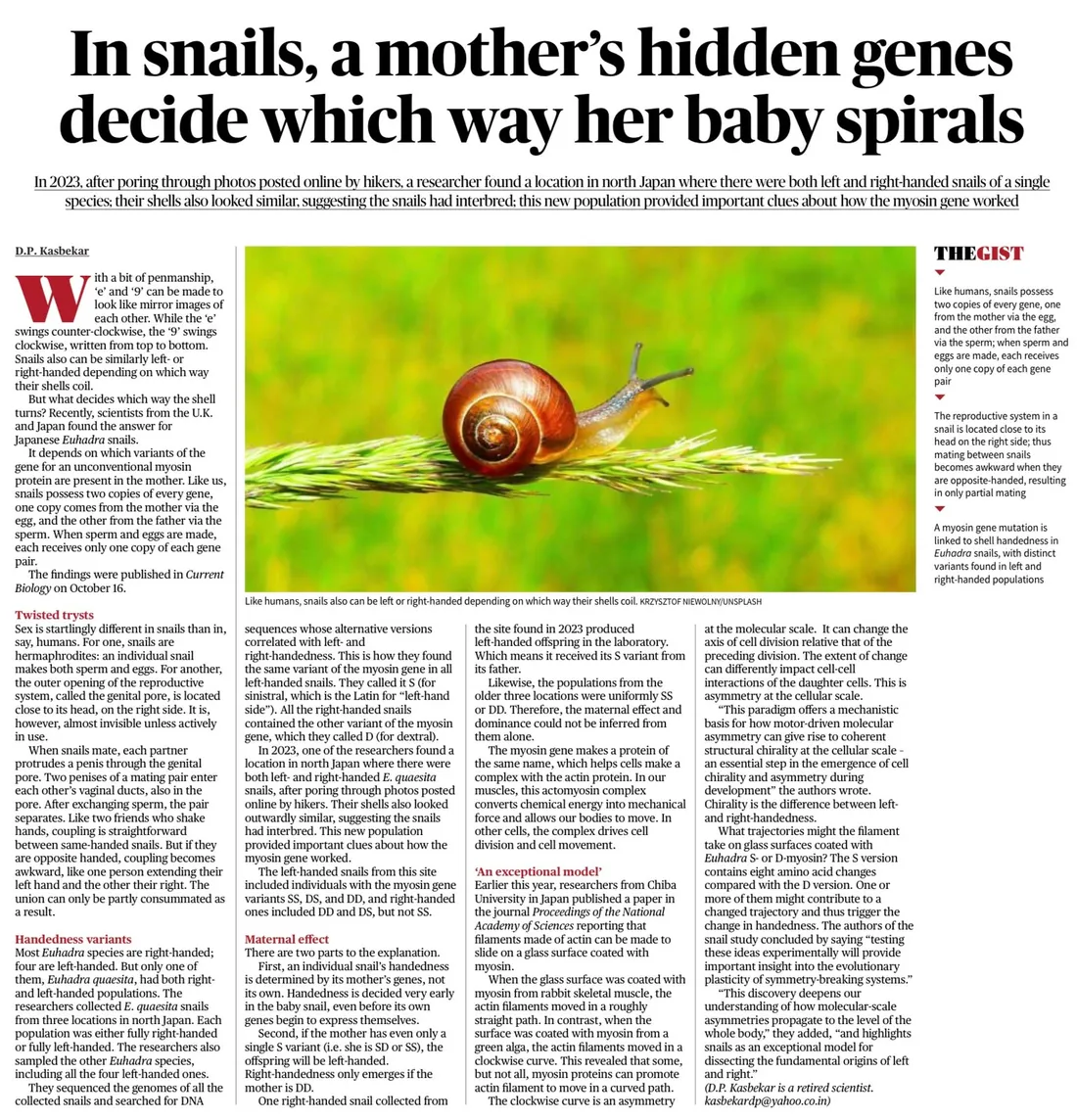
Snails can be left- or right-handed depending on how their shells coil. Source: The Hindu

Key Concepts

Handedness
Dextral = right-handed (clockwise) coil; Sinistral = left-handed coil.
Myosin variants
S (sinistral) and D (dextral) variants of an unconventional myosin gene.
Myosin's role
Works with actin (actomyosin) for muscle movement, cell division and cell movement.

The Findings

Maternal effect
A baby snail's handedness is set by its mother's genes, before its own genes act.
Dominance
If the mother has even one S (SD or SS), offspring are left-handed; right-handed only if she is DD.
Clue
A mixed population of E. quaesita in north Japan (found via hikers' photos, 2023) revealed the pattern.
Mechanism
S-myosin has eight amino-acid changes; myosin can make actin move in a curved path, creating asymmetry.

Why It Matters

Mating
Snails are hermaphrodites; opposite-handed snails mate awkwardly — handedness can drive speciation.
Biology
Shows how molecular asymmetry scales up to whole-body left–right asymmetry.

Previous-Year Question

UPSC Prelims 2021 — Mitochondrial diseases
A child inherits mitochondrial diseases entirely from the mother; MRT can prevent transfer. Answer: (c) Both 1 and 2. Note: maternal inheritance (mitochondria) differs from maternal effect (snail coiling).
Key Takeaway: In these snails, the shell's direction is written in the mother's genes, not the baby's. It is a neat example of how one protein's tiny twist at the molecular level can shape the entire body.

Prelims Practice MCQ

+2 correct • −0.66 wrong

With reference to the recent study on Euhadra snails, consider the following statements:
1. The direction of shell coiling is determined by the genotype of the offspring itself.
2. A mother carrying even one 'S' variant of the myosin gene produces left-handed offspring.
3. Myosin works together with actin to generate mechanical force in cells.
Which of the statements given above are correct?

Explanation: Statements 2 and 3 are correct. Coiling is a maternal effect — it depends on the mother's genotype, not the offspring's own genes.

UPSC Mains Question

10 Marks • 150 Words

Distinguish between maternal inheritance and maternal effect, with examples. How can studies on model organisms improve our understanding of human development?

Attempt before opening the value-addition tab.
Accepted: JPG, JPEG, PNG, WEBP or PDF. The standalone file previews your answer locally; connect the API hook for real server submission.
Use after attempting the Mains answer
  • Terms — dextral/sinistral; chirality; maternal effect vs mitochondrial (maternal) inheritance.
  • Finding — S variant dominant in mothers; DD mothers give right-handed young.
  • Mechanism — actomyosin; curved actin movement; cell-division axis.
  • Relevance — origin of left–right asymmetry (e.g. heart on the left in humans).
  • Link — Genome editing, GenomeIndia, basic research funding (ANRF).
NEWS 5 GS2 • Judiciary & Criminal Justice | GS4 • Ethics Source: The Hindu

How the Supreme Court Shaped Due Process in Death Penalty Cases

Context: Writing after the World Day Against the Death Penalty (10 October), a former SC judge reviews four decades of safeguards from Bachan Singh (1980) to Dupare (2025), and shows that trial courts still often ignore them.

How the Supreme Court shaped due process in death penalty cases – Bachan Singh, Manoj v. State of MP, Dupare (The Hindu op-ed)
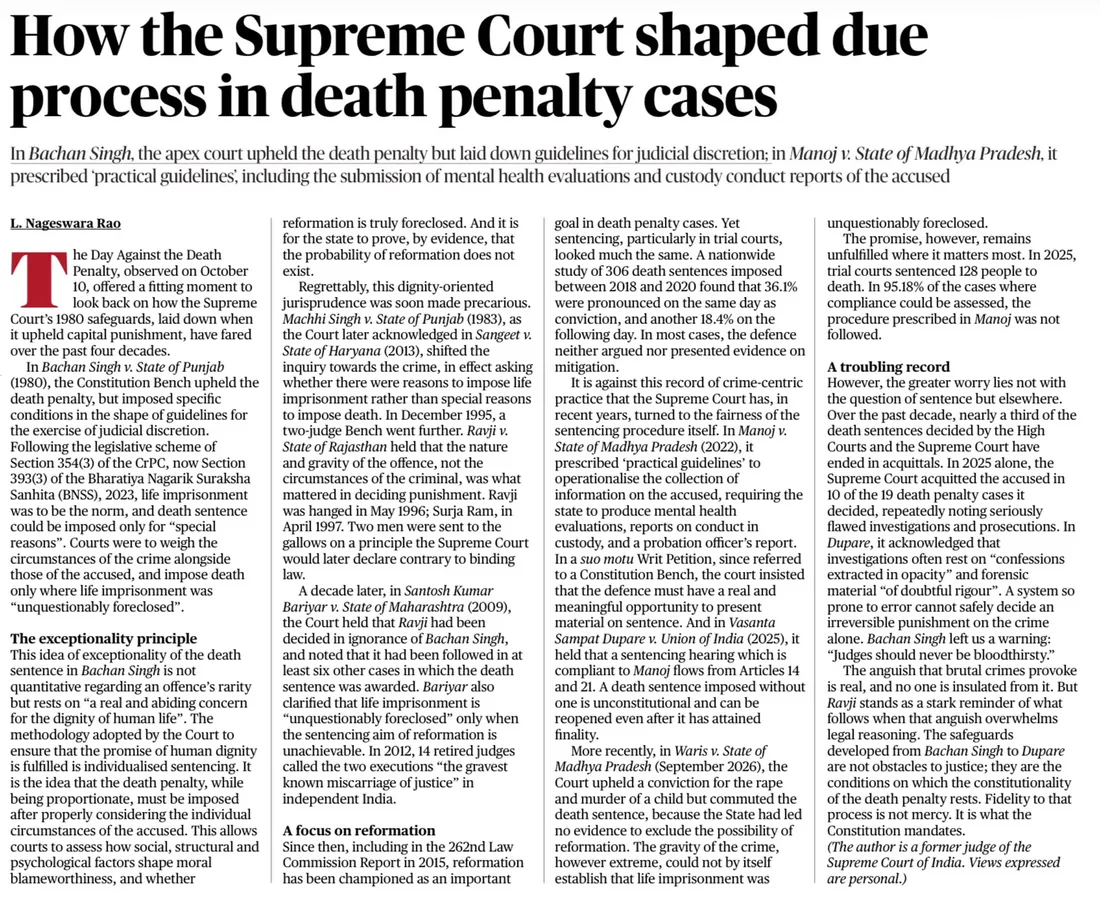
From Bachan Singh to Dupare: safeguards in capital sentencing. Source: The Hindu

Legal Framework

Rule
Life imprisonment is the rule; death only for 'special reasons' — Sec. 354(3) CrPC, now Sec. 393(3) BNSS, 2023.
Articles 14 & 21
Fair, non-arbitrary procedure is a constitutional requirement.

Evolution of Jurisprudence

Bachan Singh (1980)
Upheld death penalty; rarest of rare; only when life imprisonment is 'unquestionably foreclosed'.
Machhi Singh (1983)
Shifted focus towards the crime (acknowledged in Sangeet, 2013).
Ravji (1995)
Held only the crime mattered — later declared per incuriam in Bariyar (2009).
Manoj v. State of MP (2022)
Mental-health evaluation, jail conduct report and probation officer's report before sentencing.
Dupare (2025)
A sentencing hearing compliant with Manoj flows from Articles 14 and 21; a death sentence without it can be reopened.

The Ground Reality

Same-day sentencing
Study of 306 death sentences (2018-20): 36.1% given on the day of conviction.
Non-compliance
128 death sentences by trial courts in 2025; Manoj not followed in 95.18% of assessable cases.
Acquittals
In 2025, SC acquitted in 10 of 19 death penalty cases it decided; flawed investigations.

Ethical Dimension

Dignity
Exceptionality rests on 'concern for the dignity of human life', not just the rarity of the crime.
Reformation
262nd Law Commission (2015) favoured abolition except for terrorism; reform is a key goal.
Irreversibility
An error-prone system cannot safely impose an irreversible punishment.
Key Takeaway: The safeguards are not leniency; they are the conditions that make the death penalty constitutional. Without individualised sentencing and fair investigation, 'rarest of rare' becomes arbitrary.

Prelims Practice MCQ

+2 correct • −0.66 wrong

With reference to death penalty jurisprudence in India, consider the following statements:
1. The 'rarest of rare' doctrine was laid down in Bachan Singh v. State of Punjab.
2. In Manoj v. State of Madhya Pradesh, the Supreme Court required mental-health evaluations of the accused before sentencing.
3. Under the BNSS, 2023, death is the normal punishment for murder and life imprisonment is the exception.
Which of the statements given above are correct?

Explanation: Statements 1 and 2 are correct. Section 393(3) of the BNSS retains the rule that life imprisonment is the norm and death requires 'special reasons'.

UPSC Mains Question

15 Marks • 250 Words

"Fidelity to due process in death penalty cases is not mercy; it is what the Constitution mandates." Discuss with reference to the evolution of Supreme Court jurisprudence.

Attempt before opening the value-addition tab.
Accepted: JPG, JPEG, PNG, WEBP or PDF. The standalone file previews your answer locally; connect the API hook for real server submission.
Use after attempting the Mains answer
  • Cases — Bachan Singh 1980, Machhi Singh 1983, Bariyar 2009, Sangeet 2013, Manoj 2022, Dupare 2025.
  • Law — Sec. 354(3) CrPC → Sec. 393(3) BNSS; Art. 14, 21, 72, 161 (pardon).
  • Data — 36.1% same-day sentences; 95.18% non-compliance; 10 of 19 SC acquittals (2025).
  • Reports — 262nd Law Commission (2015): abolish except terror cases.
  • Ethics — dignity, reformative justice, irreversibility, judicial restraint ('never bloodthirsty').
NEWS 6 GS3 • Climate Change & Negotiations Source: The Hindu

India to Push for Predictable Climate Finance and Equitable Transition at COP31

Context: At COP31 in Antalya, Türkiye (9–20 November), India will seek predictable climate finance, technology transfer and nationally determined approaches, and will resist top-down mitigation targets and fossil-fuel phase-out language.

India to push for predictable climate finance and equitable transition at COP31 Antalya, Türkiye (The Hindu)
India will seek a Climate Finance Work Programme at COP31. Source: The Hindu

India's Key Demands

Climate finance
Under Article 9.1 of the Paris Agreement, finance must be predictable, largely public and concessional.
Work programme
A decision to start a Climate Finance Work Programme.
Just Transition
Continue the Just Transition Work Programme; oppose top-down mitigation targets.
Adaptation
Global Goal on Adaptation indicators must stay voluntary; cut from ~1,000 to 59.

India's Stand

Fossil fuels
Against language on fossil-fuel phase-out; India is raising renewables, forest cover and efficiency.
Equity
Developed countries must meet obligations; finance should not add to debt burden.

Prelims Facts

COP31
31st Conference of Parties to the UNFCCC; Antalya, Türkiye.
Paris Agreement
Article 7 — Global Goal on Adaptation; Article 9 — finance; NDCs are country-set targets.
NCQG
COP29 (Baku) set a goal of at least $300 billion a year by 2035 for developing countries.

Previous-Year Questions

UPSC Prelims 2016 — Paris Agreement
Aims to keep warming well below 2°C, pursuing 1.5°C. Answer: (b) 2 only.
UPSC Prelims 2018
'Momentum for Change: Climate Neutral Now' was launched by the UNFCCC Secretariat.
UPSC Mains 2021 — GS III
Describe the major outcomes of COP26. What commitments did India make at this conference?
Key Takeaway: India's message is consistent: climate action must be fair. Without predictable public finance from developed countries, ambitious targets for developing nations become unfunded mandates.

Prelims Practice MCQ

+2 correct • −0.66 wrong

With reference to the Paris Agreement, consider the following statements:
1. Article 9 deals with the provision of financial resources by developed countries to developing countries.
2. The Global Goal on Adaptation is established under Article 7.
3. Nationally Determined Contributions are targets assigned to each country by the UNFCCC Secretariat.
Which of the statements given above are correct?

Explanation: Statements 1 and 2 are correct. NDCs are set by each country itself (bottom-up), not assigned by the UNFCCC Secretariat.

UPSC Mains Question

15 Marks • 250 Words

Climate finance remains the weakest link in global climate negotiations. Discuss India's position at COP31 in the light of the principle of Common But Differentiated Responsibilities.

Attempt before opening the value-addition tab.
Accepted: JPG, JPEG, PNG, WEBP or PDF. The standalone file previews your answer locally; connect the API hook for real server submission.
Use after attempting the Mains answer
  • COP31 — Antalya, Türkiye, 9–20 Nov 2026.
  • India's asks — Art. 9.1 finance, Climate Finance Work Programme, JTWP, voluntary GGA indicators (59).
  • Principles — CBDR-RC, equity, climate justice, carbon budget.
  • India's record — 50%+ non-fossil capacity, updated NDC 2022, net zero 2070, LiFE.
  • Issues — $100 bn shortfall, NCQG $300 bn, loans vs grants, CBAM.
NEWS 7 GS2 • State Legislature & Federalism Source: The Hindu

What Is the Role of State Legislative Councils?

Context: Elections to 28 Legislative Council seats in Uttar Pradesh, Bihar, Maharashtra and Karnataka have revived the debate on the relevance, powers and reform of second chambers in States.

What is the role of Legislative Councils – constitutional basis, composition and Second ARC reforms (The Hindu explainer)
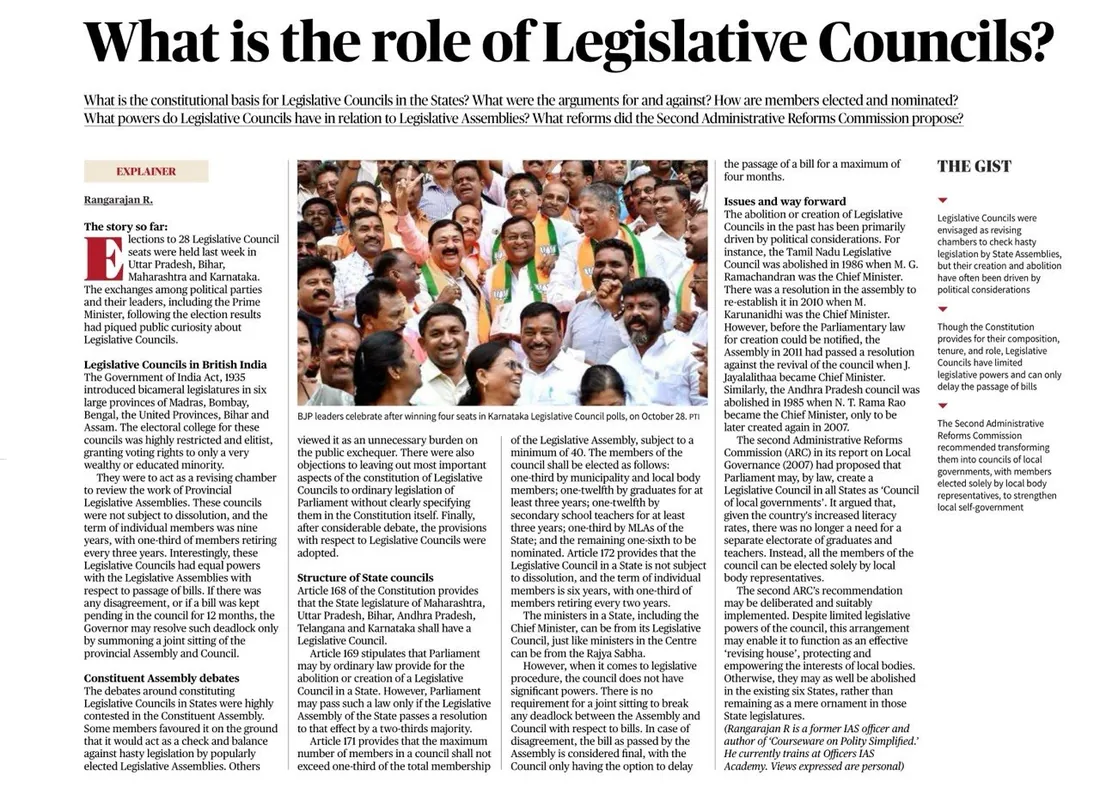
Leaders celebrate after winning Karnataka Legislative Council polls. Source: The Hindu

Constitutional Basis

Article 168
Six States have Councils: Maharashtra, UP, Bihar, Andhra Pradesh, Telangana, Karnataka.
Article 169
Parliament creates/abolishes by ordinary law after an Assembly resolution by special majority.
Article 171
Maximum one-third of the Assembly's strength; minimum 40.
Article 172
Permanent House; six-year term; one-third retire every two years.

Composition (Article 171)

Elected
1/3 by local bodies · 1/3 by MLAs · 1/12 by graduates · 1/12 by teachers.
Nominated
1/6 by the Governor — literature, science, art, cooperative movement, social service.

Powers & History

Ordinary Bills
Can delay for a maximum of four months; no joint sitting — Assembly prevails.
Money Bills
Can hold for only 14 days.
History
GoI Act 1935 created Councils in six provinces; debated in the Constituent Assembly.
Politics
Tamil Nadu abolished (1986); Andhra abolished (1985) and recreated (2007).

Reforms

2nd ARC (2007)
Convert into 'Councils of local governments' elected solely by local body representatives.
Others
Rational creation, real expert nominations, stronger committees.

Previous-Year Questions

UPSC Prelims 2015
Council cannot exceed one-third of the Assembly; its Chairman is elected by members. Answer: (d) Neither 1 nor 2.
UPSC Mains 2021 — GS II
Explain the constitutional provisions for Legislative Councils and review their working and current status.
Key Takeaway: Councils were meant to be a revising chamber, but with weak powers and politically driven creation they often add little. Reform, as the Second ARC suggested, could make them a voice for local governments.

Prelims Practice MCQ

+2 correct • −0.66 wrong

With reference to State Legislative Councils, consider the following statements:
1. A law of Parliament creating a Legislative Council is deemed to be an amendment of the Constitution under Article 368.
2. One-sixth of the members are nominated by the Governor.
3. There is no provision for a joint sitting of the two Houses of a State Legislature.
Which of the statements given above are correct?

Explanation: Statements 2 and 3 are correct. Article 169(3) says such a law is NOT deemed an amendment of the Constitution for the purposes of Article 368.

UPSC Mains Question

10 Marks • 150 Words

"State Legislative Councils have limited legislative powers but can still play a meaningful role." Examine their relevance and suggest reforms.

Attempt before opening the value-addition tab.
Accepted: JPG, JPEG, PNG, WEBP or PDF. The standalone file previews your answer locally; connect the API hook for real server submission.
Use after attempting the Mains answer
  • Articles — 168, 169, 171, 172, 197, 198; 6 States.
  • Composition — 1/3 local bodies, 1/3 MLAs, 1/12 graduates, 1/12 teachers, 1/6 nominated.
  • Powers — 4-month delay, 14 days for Money Bills, no joint sitting.
  • Arguments — revising chamber vs cost, patronage, duplication.
  • Reform — 2nd ARC: councils of local governments; link with 73rd/74th Amendments.

Copyright © 2026 USARAMBHA EDUCATION (UnderStand UPSC). All Rights Reserved.

MAD-X Orientation

Talk to Our Counsellor

Share your details and our counselling team will call you back in 10 minutes.

Please enter your name.
+91
Please enter a valid 10-digit mobile number.
When do you plan to enroll in MAD-X?
Please select an option.

Thank you, !

Our counselling team will call you within 10 minutes.
Please keep your phone handy.