Context: Fiscal Federalism in India
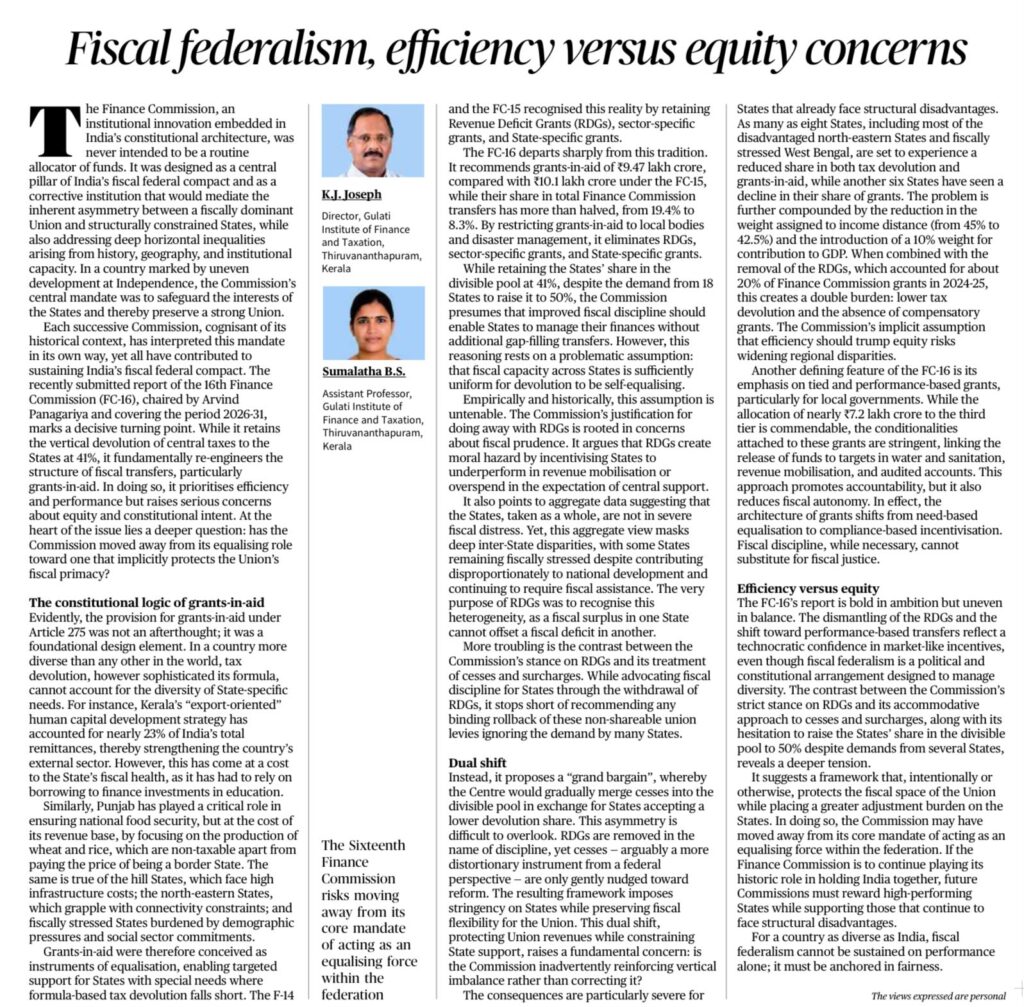
The recommendations of the 16th Finance Commission for 2026–31 have revived the debate over whether India’s fiscal transfer system should prioritise efficiency or continue its constitutional role of reducing regional disparities.
Constitutional Role of the Finance Commission
The Finance Commission is established under Article 280.
Its role is to maintain fiscal balance between the Union and the States through tax devolution and grants-in-aid.
Article 275 provides for grants-in-aid to support States with special needs and reduce horizontal fiscal inequalities.
Fiscal federalism is meant to strengthen cooperative federalism by balancing fiscal capacity across States.
Major Changes in the 16th Finance Commission
The Commission has retained the States’ share in the divisible pool at 41% under Article 270.
However, it has significantly restructured transfers.
It recommends ₹9.47 lakh crore as grants-in-aid, compared with ₹10.1 lakh crore under the 15th Finance Commission.
The share of grants in total Finance Commission transfers has declined from 19.4% to 8.3%.
Revenue Deficit Grants, sector-specific grants and State-specific grants have largely been discontinued.
There is greater emphasis on local body grants and disaster management grants.
Efficiency versus Equity
The recommendations assume that stronger fiscal discipline will improve State finances by reducing dependence on Central transfers.
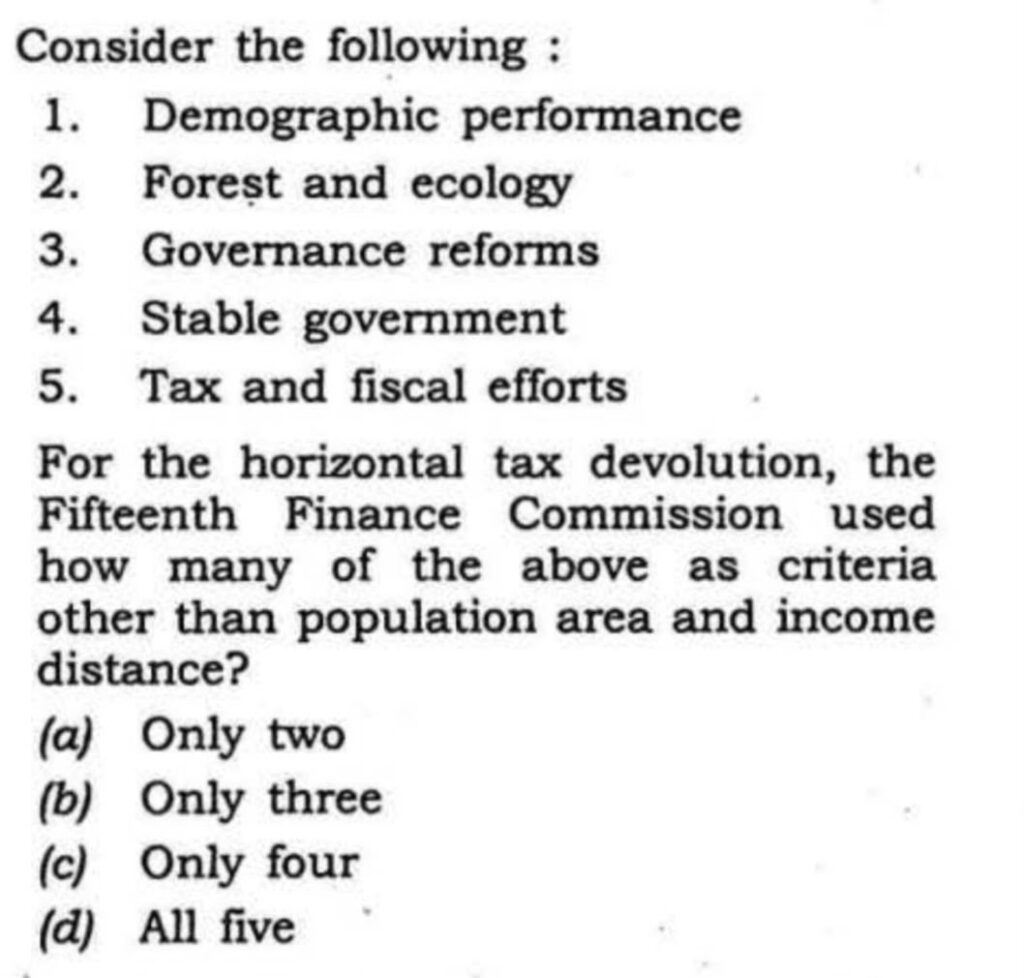
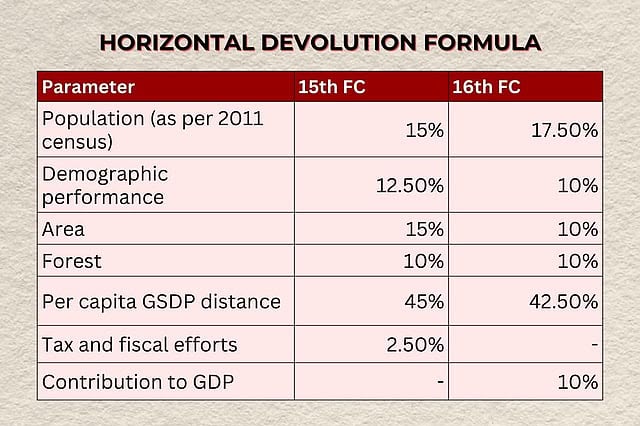
The weight assigned to income distance has been reduced from 45% to 42.5%.
A new 10% weight for contribution to GDP has been introduced.
This favours relatively stronger economies.
States with structural disadvantages, especially several North-Eastern States and fiscally stressed States such as West Bengal, may receive relatively lower support.
Concerns for Fiscal Federalism
The withdrawal of Revenue Deficit Grants weakens an important equalisation tool for fiscally weaker States.
Continued reliance on cesses and surcharges, which remain outside the divisible pool, limits the effectiveness of tax devolution.
Greater reliance on performance-based grants may improve accountability, but it can also reduce fiscal autonomy and ignore differences in State capacity.
Way Forward
India must preserve the constitutional objective of equalisation while promoting fiscal responsibility.
Cesses and surcharges should be rationalised by increasing their inclusion in the divisible pool.
Finance Commission criteria should recognise:
- Regional diversity
- Historical disadvantages
- Differential fiscal capacity
- Need-based support
Performance incentives should be balanced with adequate need-based grants.
Key Takeaway
Fiscal federalism cannot be sustained only through performance incentives. India needs a balance between efficiency and equity so that weaker States are not left behind.