15 August 2026 | UPSC Daily Current Affairs

15 August 2026 | UPSC Daily Current Affairs

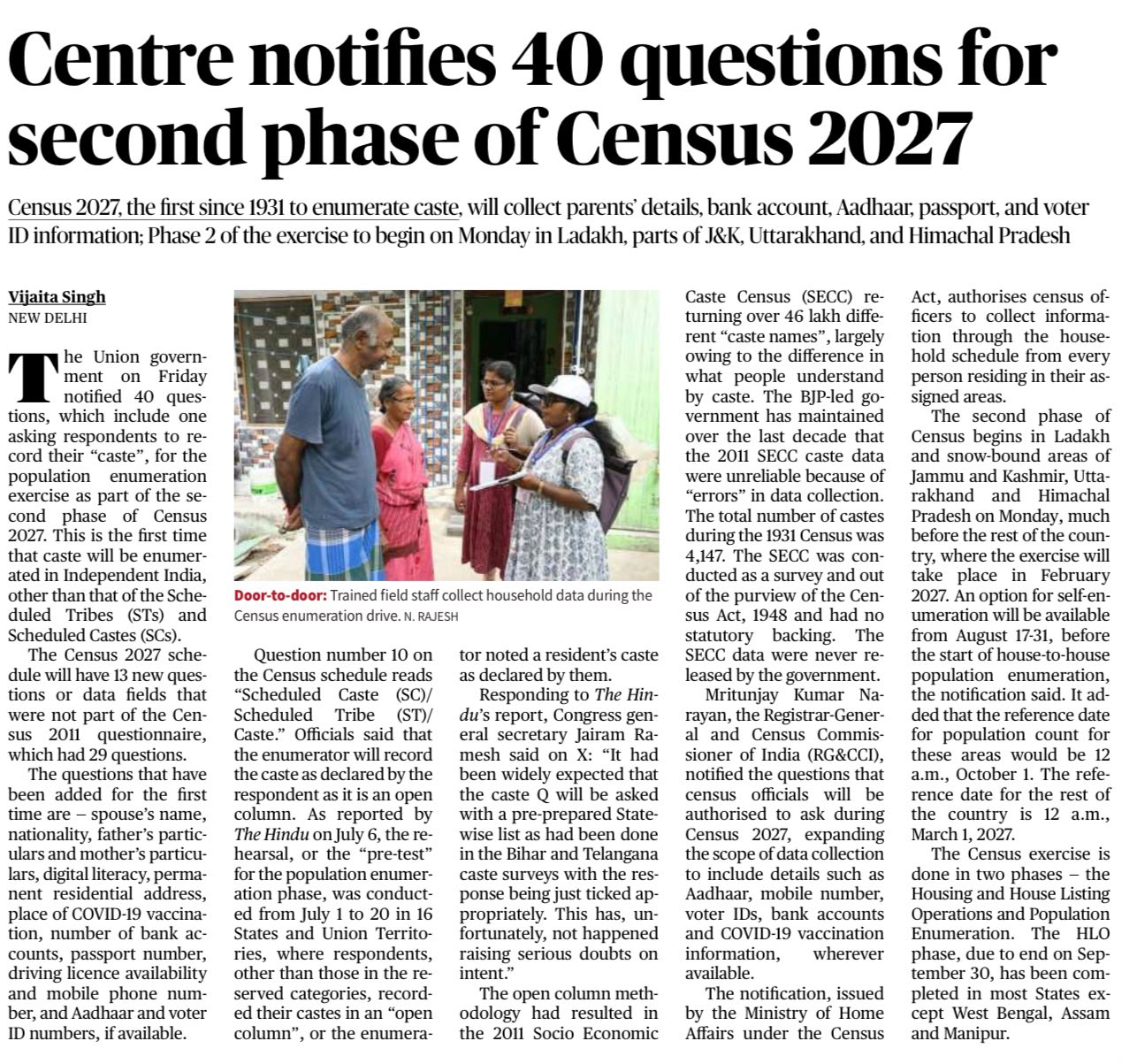
Census 2027 caste enumeration: 40 questions notified

Context: Census 2027 caste enumeration
The Centre has notified 40 questions for the second phase of Census 2027. This includes caste enumeration for the first time in independent India beyond Scheduled Castes and Scheduled Tribes. The exercise will also collect selected socio-economic and identity-related information.

Census 2027: Key Changes

First Census since 1931 to enumerate caste

Respondents will be asked to record their caste as declared by them in an open column.

This is different from the enumeration of SCs and STs, which has been undertaken in earlier Censuses.

40 Questions

The second-phase questionnaire will now have 40 questions.

This includes 13 new questions added to the earlier 2011 Census questionnaire.

New Information to be Collected

The new questions include information such as:

  • Spouse’s name
  • Nationality
  • Parents’ particulars
  • Digital literacy
  • Permanent residential address
  • Bank-account details
  • Passport details
  • Driving licence details
  • Mobile number
  • Aadhaar details
  • Voter-ID details

These will be collected where applicable.

Why Caste Enumeration Matters

Caste enumeration can provide updated empirical data on India’s caste composition.

This may help inform policies related to:

  • Social justice
  • Affirmative action
  • Targeted welfare
  • Representation
  • Socio-economic planning

SECC 2011 Experience

The 2011 Socio-Economic and Caste Census collected caste information.

However, its caste data was not officially released due to concerns over data quality and the very large number of caste names reported.

Standardisation Challenge

The 1931 Census recorded 4,147 castes.

The 2011 SECC reportedly produced around 46 lakh different caste names.

This highlights the challenge of standardisation and classification.

Self-Declared Caste

The Census approach now relies on the respondent’s self-declared caste.

This makes accurate enumeration and later classification especially important.

Governance Significance

The Census is the foundation for demographic and socio-economic planning.

Updated caste data can influence welfare design, resource allocation and social-justice policy.

However, data quality, classification, privacy and political sensitivity will be major governance challenges.

Key Takeaway

Census 2027 is significant because it will include caste enumeration beyond SCs and STs for the first time in independent India. The exercise can support evidence-based social-justice policy, but its success will depend on accurate data collection, classification and safeguards.
Census 2027 caste enumeration

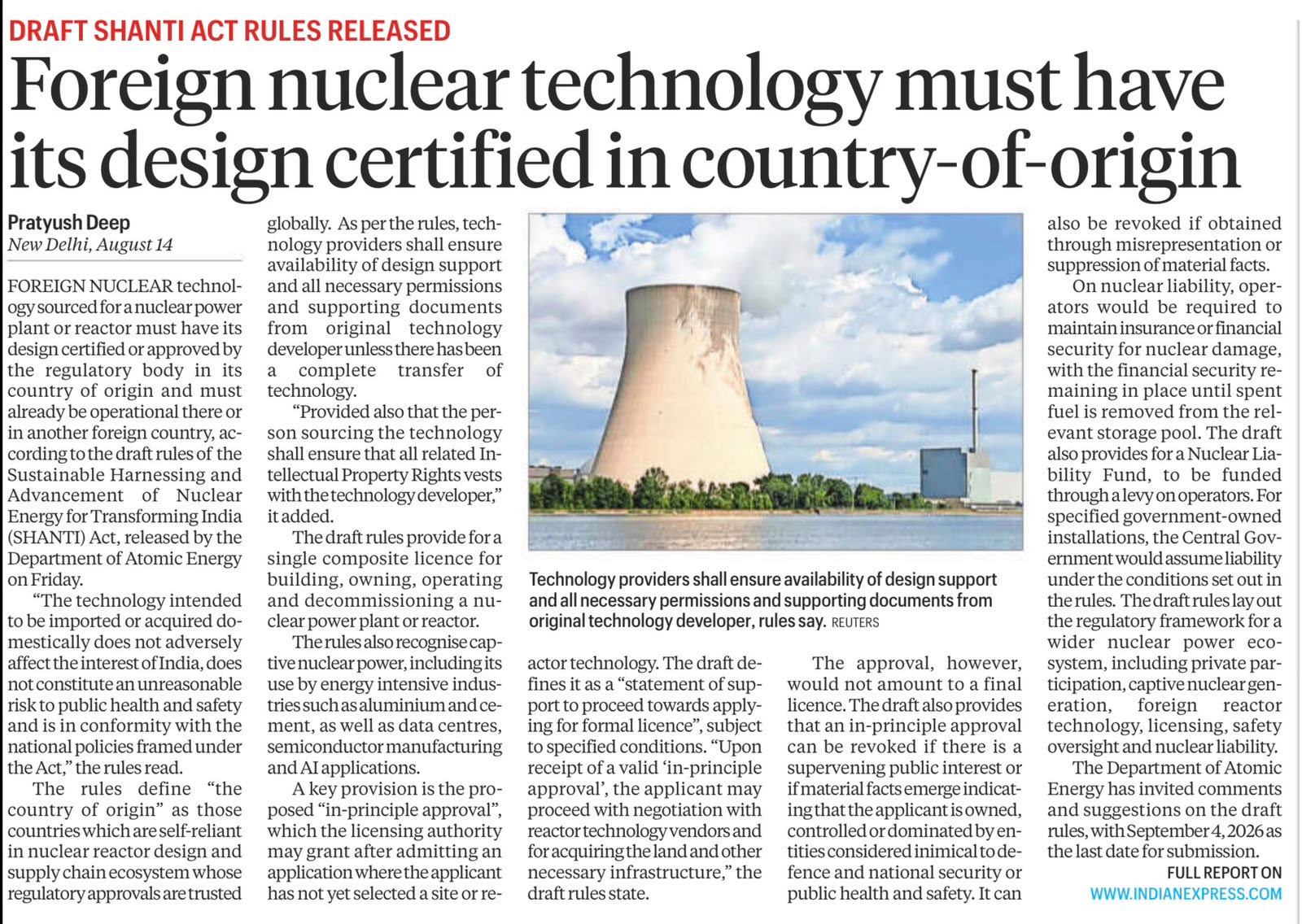
SHANTI Act 2025: Draft Rules for Nuclear Energy

Context: SHANTI Act 2025
The Department of Atomic Energy has released draft SHANTI Rules, 2026 to operationalise the SHANTI Act, 2025. The SHANTI Act replaced the Atomic Energy Act, 1962 and the Civil Liability for Nuclear Damage Act, 2010. The reform aims to expand nuclear power through greater private participation while retaining strong regulatory and strategic safeguards.

SHANTI Act, 2025

SHANTI stands for Sustainable Harnessing and Advancement of Nuclear Energy for Transforming India.

Private Participation

Indian private companies and joint ventures can seek licences to:

  • Build nuclear power plants/reactors
  • Own nuclear power plants/reactors
  • Operate nuclear power plants/reactors
  • Decommission nuclear power plants/reactors

This will be subject to government permission and safety regulation.

Regulation

The Atomic Energy Regulatory Board, or AERB, receives statutory recognition.

It is responsible for:

  • Nuclear safety
  • Radiation safety
  • Licensing
  • Inspections
  • Enforcement

Strategic Control

Opening nuclear power to private players does not mean opening the entire nuclear fuel cycle.

Sensitive strategic activities remain under Central Government control.

Nuclear Liability

The Act replaces the earlier liability framework with a graded operator-liability system.

Liability is linked to the category or capacity of the nuclear installation.

Operators must maintain insurance or financial security.

The Act also provides for a Nuclear Damage Claims Commission for adjudication of claims.

What the Draft SHANTI Rules, 2026 add

Foreign Reactor Technology

Foreign reactor technology must have its design certified or approved by the regulatory authority in the country of origin.

It must already be operational in that country or another foreign country.

Technology Assurance

Foreign technology providers must provide necessary:

  • Design support
  • Permissions
  • Technical documentation

These must come from the original technology developer unless technology transfer is complete.

Single Composite Licence

The draft rules propose a single composite licence for:

  • Construction
  • Ownership
  • Operation
  • Decommissioning

This applies to a nuclear plant or reactor.

In-Principle Approval

An initial approval can allow an applicant to proceed with negotiations for:

  • Technology
  • Land
  • Infrastructure

However, it does not amount to a final operating licence.

It can also be revoked under specified circumstances.

Safety and Financial Protection

Operators must maintain adequate financial security for nuclear damage.

The rules also provide for a Nuclear Liability Fund financed through a levy on operators.

Why it matters

The framework enables private capital, foreign technology and domestic expertise to participate in India’s nuclear expansion.

It supports India’s ambition of 100 GW nuclear capacity by 2047.

Nuclear power can become an important source of reliable, low-carbon electricity.

The framework attempts to balance:

  • Investment
  • Faster deployment
  • Nuclear safety
  • Public compensation
  • Regulatory oversight
  • Strategic autonomy

Key Takeaway

The SHANTI framework seeks to open nuclear power to private and foreign technology participation while keeping safety, liability, regulatory oversight and strategic control at the centre.

SHANTI Act 2025
SHANTI Act 2025

Sangeet Natak Akademi Award honours Odissi exponent

Context: Sangeet Natak Akademi Award
Renowned Odissi exponent Shubhada Varadkar received the Sangeet Natak Akademi Award from the President of India for her contribution to Odissi, one of India’s classical dance traditions.

Sangeet Natak Akademi

The Sangeet Natak Akademi is India’s National Academy of Music, Dance and Drama.

It was established by a Government of India resolution in 1952.

It was inaugurated in 1953.

It is an autonomous organisation under the Ministry of Culture.

Mandate

The Akademi works for the preservation, promotion and development of India’s performing arts.

Its mandate covers:

  • Music
  • Dance
  • Drama
  • Classical performing arts
  • Folk performing arts
  • Tribal performing arts
  • Other traditional performing arts

Sangeet Natak Akademi Award

The Sangeet Natak Akademi Award, also called Akademi Puraskar, was instituted in 1952.

It is regarded as the highest national recognition given to practising artists, gurus and scholars in the performing arts.

Fields Covered

The award is given for distinguished contribution in:

  • Music
  • Dance
  • Theatre
  • Traditional/Folk/Tribal Music
  • Dance-Theatre
  • Puppetry
  • Overall Contribution/Scholarship

Number of Awards

Under the current framework, up to 46 Akademi Awards may be given annually across these fields.

Selection and Conferment

Awardees are selected by the General Council of the Sangeet Natak Akademi.

The awards are conferred by the President of India.

Award Components

The award carries:

  • Cash prize of ₹1 lakh
  • Tamrapatra
  • Angavastram

Significance

The recognition of Shubhada Varadkar highlights the importance of preserving and promoting Indian classical dance traditions.

Odissi is one of India’s important classical dance forms.

Awards like the Sangeet Natak Akademi Award help recognise artists who have contributed to the continuity, teaching, performance and evolution of traditional arts.

Key Takeaway

The award to Shubhada Varadkar is important from the perspective of Indian classical dance, cultural preservation and national recognition of performing artists.

Sangeet Natak Akademi Award

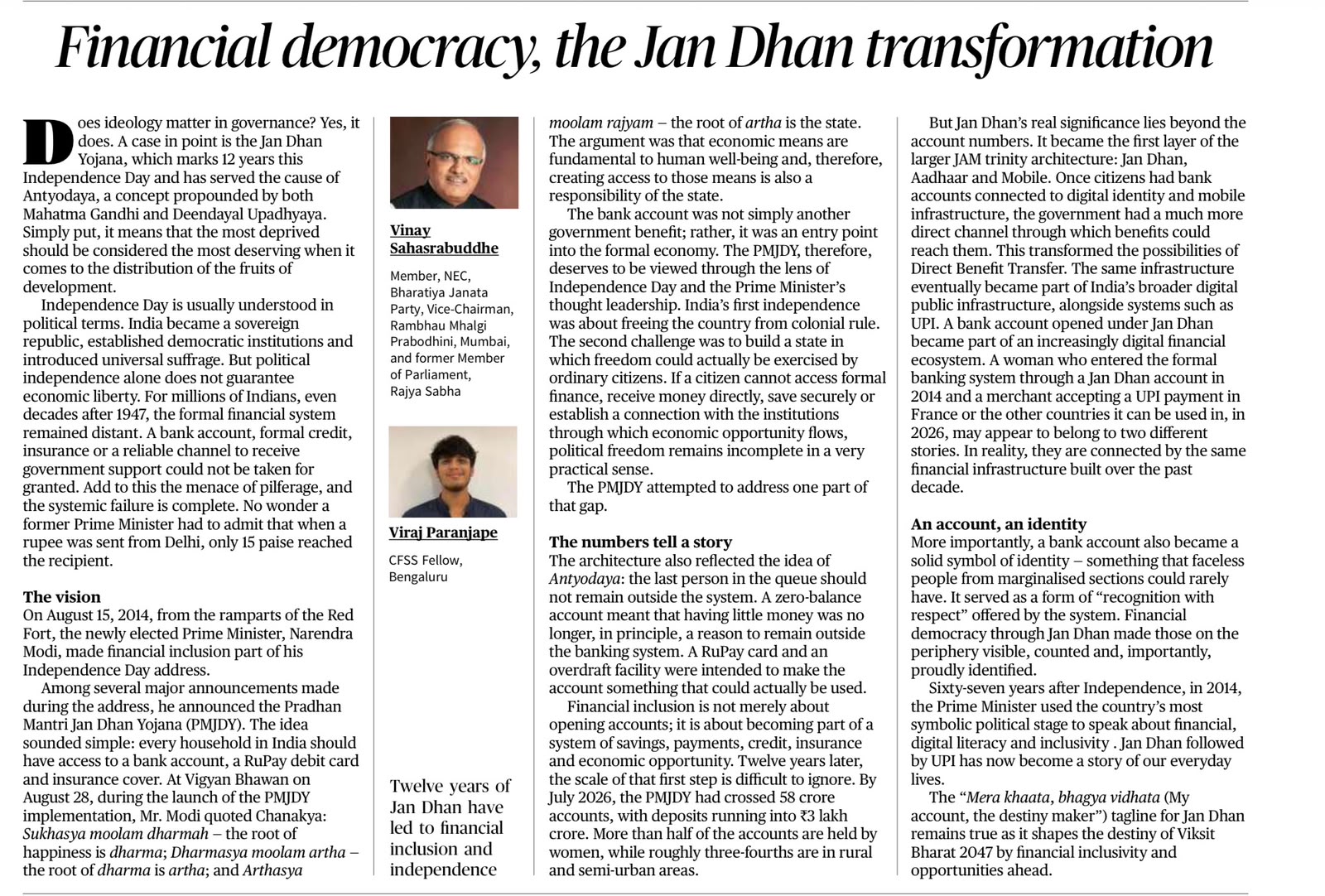
PM Jan Dhan Yojana: Financial Inclusion Milestone

Context: PM Jan Dhan Yojana
Twelve years of Pradhan Mantri Jan-Dhan Yojana show how financial inclusion has evolved from simply opening bank accounts to creating an economic and digital infrastructure for the poor. The broader objective is to make citizens active participants in the formal economy.

Pradhan Mantri Jan-Dhan Yojana

Launch

The scheme was launched on 28 August 2014.

It was announced on 15 August 2014 as the National Mission for Financial Inclusion.

Aim

The aim is to provide affordable access to:

  • Banking
  • Savings
  • Remittances
  • Credit
  • Insurance
  • Pension

It targets financially excluded households.

Key Features

PMJDY provides:

  • Zero-minimum-balance Basic Savings Bank Deposit Account
  • RuPay debit card
  • Overdraft facility for eligible account holders
  • Linkage with social-security schemes
  • Direct Benefit Transfer support

Transformation: From Account to Economic Participation

Scale

As of 22 July 2026, PMJDY has:

  • 58.84 crore accounts
  • ₹3.11 lakh crore deposits
  • 32.79 crore women beneficiaries
  • 45.77 crore rural/semi-urban accounts
  • 41.01 crore RuPay cards issued

JAM Architecture

Jan Dhan + Aadhaar + Mobile created the basic infrastructure for targeted and direct delivery of government benefits.

This became the foundation for direct welfare transfer and digital financial inclusion.

Digital Financial Inclusion

Bank accounts became gateways to:

  • Direct Benefit Transfer
  • UPI
  • Digital payments
  • Other digital financial services

This links welfare delivery with India’s Digital Public Infrastructure.

Financial Democracy

Access to formal banking gives poorer households the ability to:

  • Save securely
  • Receive benefits directly
  • Transact digitally
  • Access credit gradually
  • Access insurance
  • Access pension products

Challenges Ahead

Account ownership is not equal to financial inclusion

Opening a bank account is only the first step.

The focus must now shift from account ownership to regular and meaningful usage.

Financial and Digital Literacy

Beneficiaries need greater awareness of:

  • Digital payments
  • Credit
  • Insurance
  • Pensions
  • Cyber-fraud risks

Last-Mile Access

Remote areas still face constraints related to:

  • Connectivity
  • Banking infrastructure
  • Business Correspondents
  • Service availability

Quality of Inclusion

Greater access to productive and affordable credit, insurance and pensions is needed.

This is necessary to convert financial access into real economic mobility.

Way Forward

India should move from universal account ownership to universal financial usage.

Financial literacy, digital infrastructure and consumer protection must be strengthened, especially for vulnerable groups.

Access to formal credit, insurance and pension products should be expanded responsibly.

The JAM–DBT–digital payments ecosystem should be used to deepen inclusion while ensuring:

  • Privacy
  • Cybersecurity
  • Grievance redressal
  • Consumer protection

Key Takeaway

PMJDY has transformed financial inclusion from mere bank-account access to a broader digital and economic participation framework. The next challenge is meaningful usage, financial literacy, last-mile access and quality inclusion.

PM Jan Dhan Yojana
PM Jan Dhan Yojana

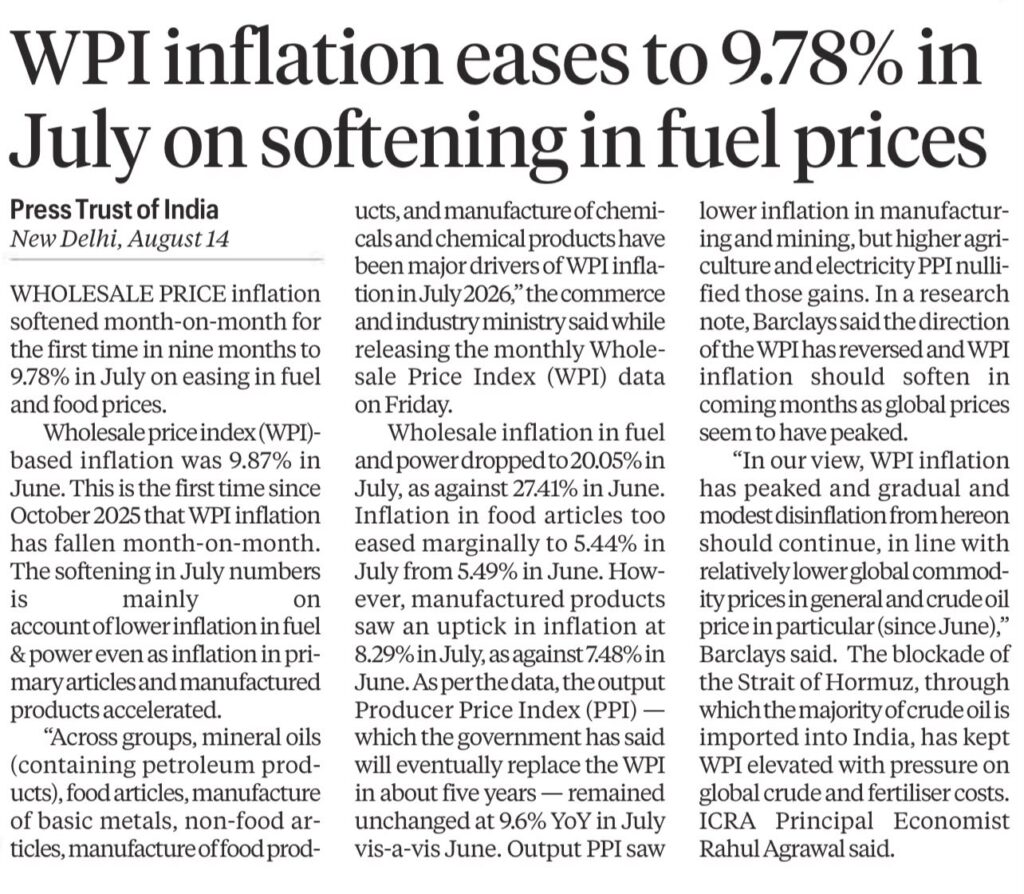
WPI inflation July 2026 eases to 9.78%

Context: WPI inflation July 2026
India’s Wholesale Price Index-based inflation moderated marginally from 9.87% in June to 9.78% in July 2026. The easing was mainly due to slower inflation in Fuel & Power, although price pressure remained elevated in manufactured products.

What drove July inflation?

Fuel & Power

Inflation in Fuel & Power fell sharply from 27.41% to 20.05%.

This does not mean fuel prices became cheaper.

It means fuel prices increased more slowly than they had a year earlier.

This is known as disinflation.

Food Articles

Inflation in food articles eased slightly from 5.49% to 5.44%.

This shows some moderation in food-related wholesale price pressure.

Manufactured Products

Inflation in manufactured products increased from 7.48% to 8.29%.

This indicates continued price pressure in the production and manufacturing sector.

WPI: Basic Understanding

Wholesale Price Index

The Wholesale Price Index, or WPI, measures changes in prices of goods at the wholesale level before they reach consumers.

It is different from CPI, which measures retail-level prices paid by households.

Major Groups in WPI

WPI mainly includes:

  • Primary Articles
  • Fuel & Power
  • Manufactured Products

Compiling Authority

WPI is compiled by the Office of the Economic Adviser, under the Department for Promotion of Industry and Internal Trade, Ministry of Commerce and Industry.

Base Year

The new WPI series uses 2022–23 as the base year.

It replaces the earlier 2011–12 base year.

New WPI–PPI System

India has introduced Producer Price Indices, or PPI, alongside the revised WPI series.

Output Producer Price Index

The Output PPI measures the prices producers receive for their output.

Input Producer Price Index

The Input PPI tracks the prices producers pay for inputs.

It is currently a trial index.

Service PPI

The Service PPI measures producer prices in selected services.

Transition Period

The Government will continue publishing WPI alongside PPI for five years.

This will allow users to gradually shift towards the PPI system.

Why move towards PPI?

WPI captures wholesale price movements.

PPI gives a more direct picture of the prices received by producers.

It also helps track how input costs are transmitted into output prices.

Key Takeaway

The fall in WPI inflation reflects slower fuel-price inflation, but rising manufactured-product inflation shows that production-side cost pressures remain important. The move towards PPI will make India’s price-measurement system more producer-focused and globally aligned.

WPI inflation July 2026

Copyright © 2026 USARAMBHA EDUCATION (UnderStand UPSC). All Rights Reserved.

Inquiry form for
Takshila Residential Program