28 May 2026 | Daily Current Affairs

Gynacantha khasiaca Rediscovered in Arunachal Pradesh After 110 Years

Context: Gynacantha khasiaca
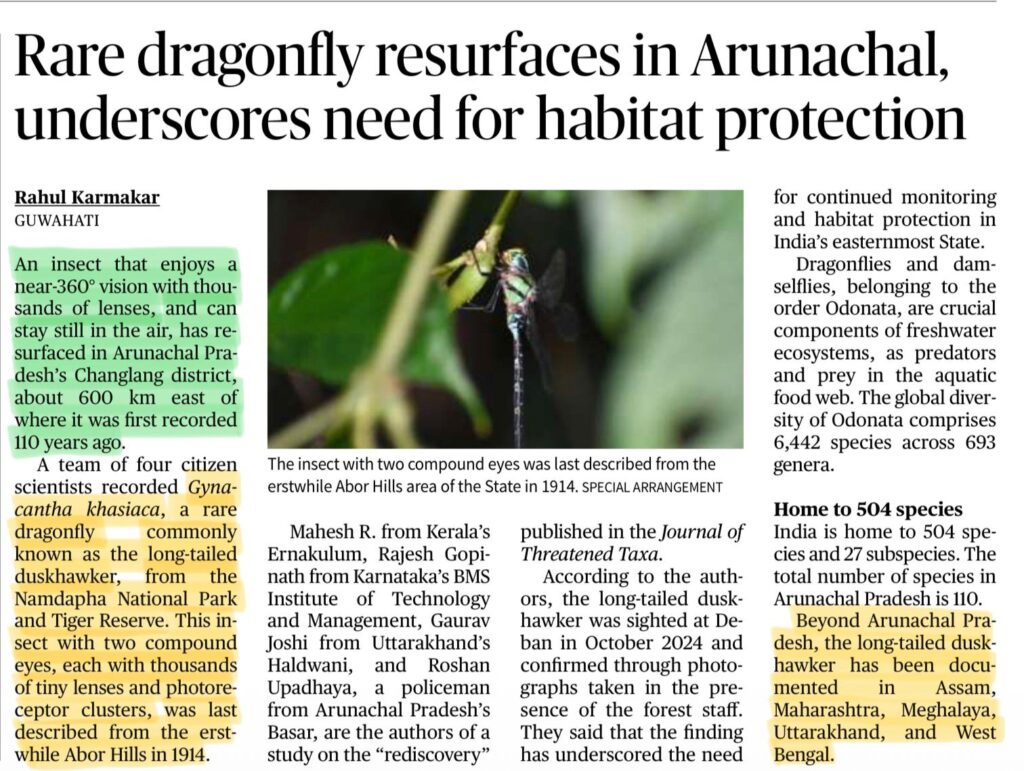
Rare dragonfly Gynacantha khasiaca, also known as Long-tailed Duskhawker, was rediscovered in Arunachal Pradesh’s Namdapha landscape after about 110 years, highlighting the importance of habitat conservation in the Eastern Himalayas.

Species Basics

  • Gynacantha khasiaca is a rare dragonfly known as Long-tailed Duskhawker.
  • Order: Odonata, which includes dragonflies and damselflies.
  • Features: Near-360° vision, two compound eyes with thousands of lenses, and ability to hover or stay still in air.
  • Dragonflies are important indicators of freshwater ecosystem health.

Namdapha National Park and Tiger Reserve

  • Located in Changlang district, Arunachal Pradesh, near the India-Myanmar border.
  • One of India’s largest protected areas and a biodiversity hotspot.
  • Declared National Park in 1983.
  • Tiger Reserve under Project Tiger.
  • Important river: Noa-Dihing River flows through the park.
  • Unique for presence of tropical rainforest to alpine vegetation in one landscape.
  • Known for four major big cats: Tiger, Leopard, Snow Leopard and Clouded Leopard.

Protected Areas of Arunachal Pradesh

Tiger Reserves

  • Namdapha Tiger Reserve
  • Kamlang Tiger Reserve

National Parks

  • Namdapha National Park
  • Mouling National Park

Important Wildlife Sanctuaries

  • Pakke / Pakhui Wildlife Sanctuary
  • Eaglenest Wildlife Sanctuary
  • Dibang Wildlife Sanctuary
  • Mehao Wildlife Sanctuary
  • Sessa Orchid Sanctuary

Important Facts

  • India has about 504 species of Odonata; Arunachal Pradesh alone has around 110 species.
  • Long-tailed Duskhawker has also been recorded from Assam, Meghalaya, Uttarakhand, Maharashtra and West Bengal.
  • Rediscovery highlights the ecological importance of the Eastern Himalayan biodiversity hotspot.
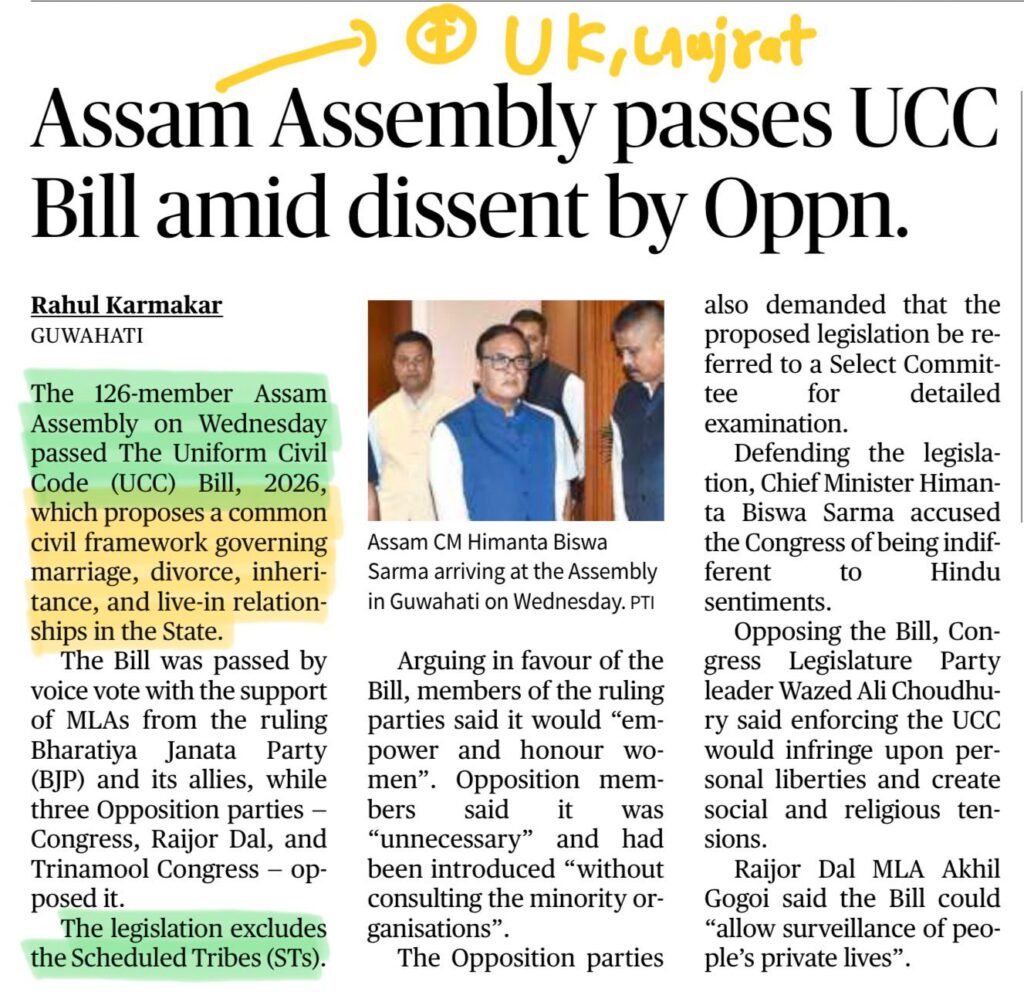
Uniform Civil Code: Assam Assembly Passes UCC Bill 2026 Amid Opposition Protest

Context: Uniform Civil Code
Assam Assembly passed the Uniform Civil Code Bill, 2026 proposing a common civil framework for marriage, divorce, inheritance and live-in relationships; Scheduled Tribes are kept outside its ambit.

Uniform Civil Code

  • Common set of civil laws applicable to all citizens irrespective of religion.
  • Covers marriage, divorce, adoption, guardianship, succession and inheritance.
  • Aim: Ensure equality before law and uniformity in personal laws.
  • Personal laws currently differ across religious communities.
  • Goa Civil Code is often cited as an example of a form of UCC in India.

Constitutional Basis

  • Article 44: Directive Principle of State Policy asking the State to endeavour to secure Uniform Civil Code for citizens.
  • Article 14: Equality before law.
  • Article 15: Prohibition of discrimination on religious grounds.
  • Article 25: Freedom of religion subject to public order, morality and health.
  • Debate: Balance between religious freedom and gender justice or equality.

Key Features of Assam UCC Bill

  • Common civil framework for marriage, divorce, inheritance and live-in relationships.
  • Scheduled Tribes excluded from ambit of Bill.
  • Government argues UCC promotes gender justice and uniformity.
  • Critics argue it may affect cultural autonomy and personal liberty.

Important Supreme Court Judgments

  • Shah Bano Case, 1985: Favoured common civil framework for gender justice.
  • Sarla Mudgal vs Union of India, 1995: Highlighted misuse of personal laws and supported UCC idea.
  • John Vallamattom vs Union of India, 2003: Observed need for uniform civil laws.
  • Shayara Bano Case, 2017: Triple talaq declared unconstitutional; reinforced constitutional morality and gender equality.

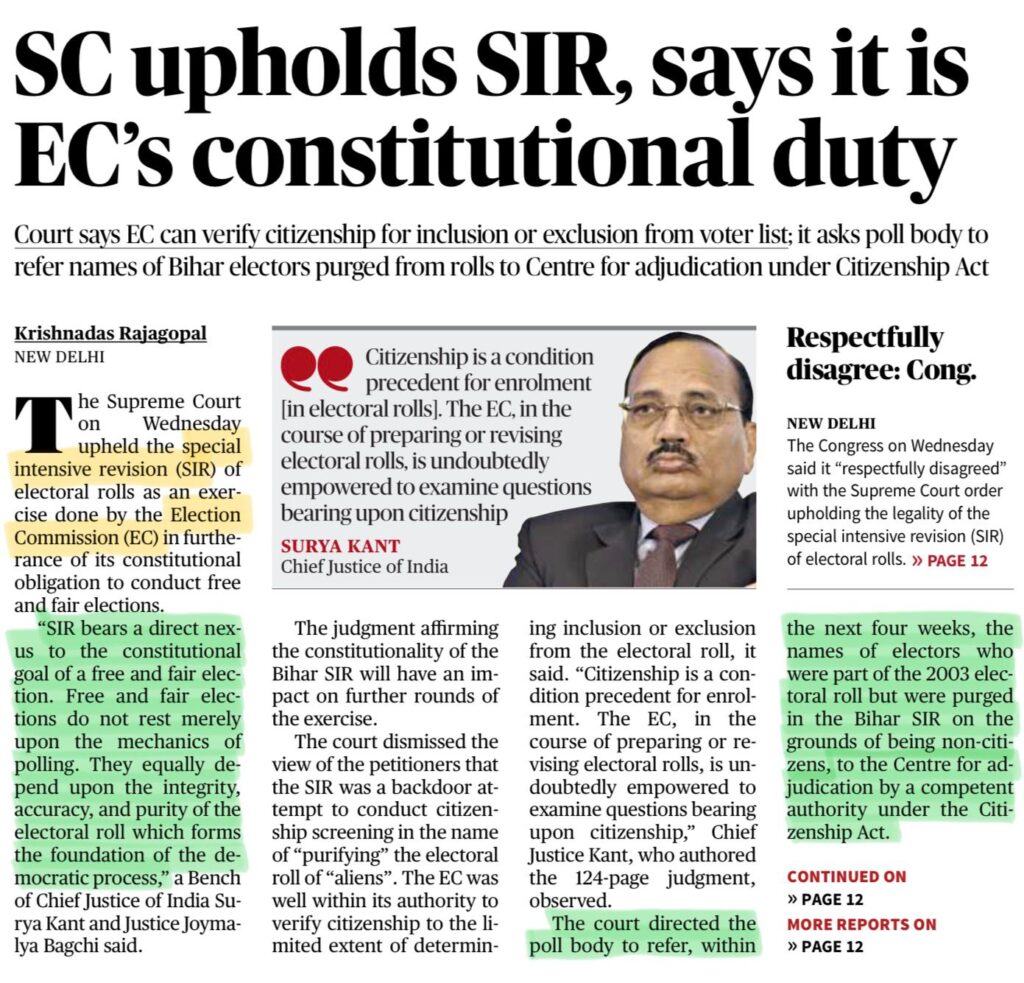
Special Intensive Revision: Supreme Court Upholds EC’s Power to Revise Electoral Rolls

Context: Special Intensive Revision
Supreme Court upheld the Special Intensive Revision (SIR) of electoral rolls in Bihar, holding that the Election Commission has constitutional authority to verify citizenship for maintaining pure and accurate electoral rolls.

Special Intensive Revision

  • Detailed verification and revision of electoral rolls conducted by Election Commission.
  • Objective: Remove duplicate, deceased, shifted and ineligible voters; ensure purity and accuracy of electoral rolls.
  • Citizenship is mandatory for inclusion in electoral rolls.
  • Bihar SIR linked to verification of voters added after 2003 electoral rolls.
  • Names removed on citizenship grounds are to be referred under Citizenship Act for adjudication by competent authority.

Important Constitutional and Legal Basis

  • Article 324: Election Commission has superintendence, direction and control over elections.
  • Article 326: Only Indian citizens aged 18+ are eligible to vote.
  • RPA, 1950 — Section 16: Disqualification from electoral rolls, including non-citizens.
  • RPA, 1950 — Section 19: Conditions for voter registration.
  • RPA, 1950 — Section 21: Empowers Election Commission to prepare and revise electoral rolls, including special revision.
  • Registration of Electors Rules, 1960: Procedure for claims, objections and correction of electoral rolls.

Supreme Court’s Key Observations

  • SIR has direct nexus with constitutional goal of free and fair elections.
  • Integrity and purity of electoral rolls form the foundation of democratic process.
  • Election Commission can examine citizenship issues during electoral roll revision.

Important Judgments

  • Indira Nehru Gandhi vs Raj Narain, 1975: Free and fair elections are part of the Basic Structure.
  • Mohinder Singh Gill vs CEC, 1978: Election Commission has wide powers under Article 324.
  • PUCL vs Union of India, 2003: Strengthened electoral transparency and voter rights.

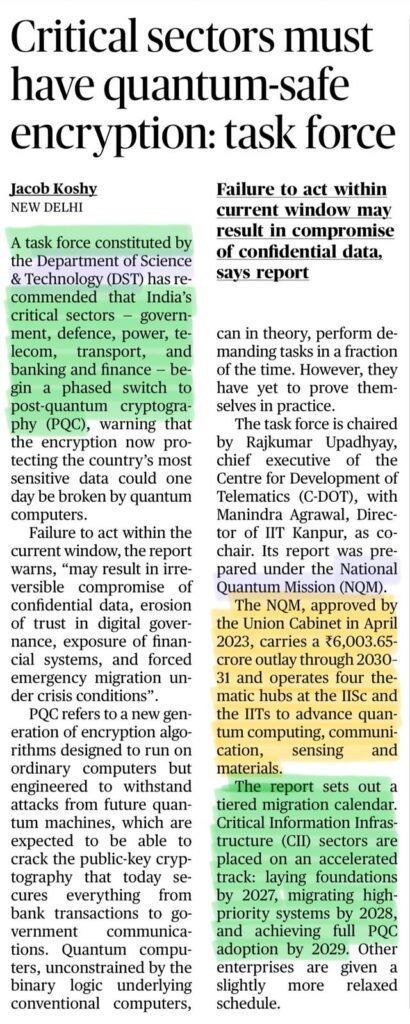
Post-Quantum Cryptography: DST Pushes Quantum-Safe Encryption for Critical Sectors

Context: Post-Quantum Cryptography
DST task force recommended phased shift to Post-Quantum Cryptography (PQC) for critical sectors as future quantum computers may break current encryption systems.

Post-Quantum Cryptography

  • Encryption algorithms designed to resist attacks from quantum computers.
  • Protects banking, telecom, defence and governance data from future quantum threats.

Quantum Computing Basics

  • Classical computers use bits; quantum computers use qubits.
  • Qubits use superposition and entanglement, enabling very high-speed computation.

Quantum-Safe Encryption Concepts

  • Current public-key encryption systems like RSA and ECC may become vulnerable to quantum attacks.
  • “Harvest now, decrypt later” risk means data stolen today may be decrypted in future using quantum computers.
  • Quantum-safe encryption uses algorithms resistant to quantum attacks.

National Quantum Mission

  • Approved in 2023 with outlay of ₹6,003.65 crore till 2030-31.
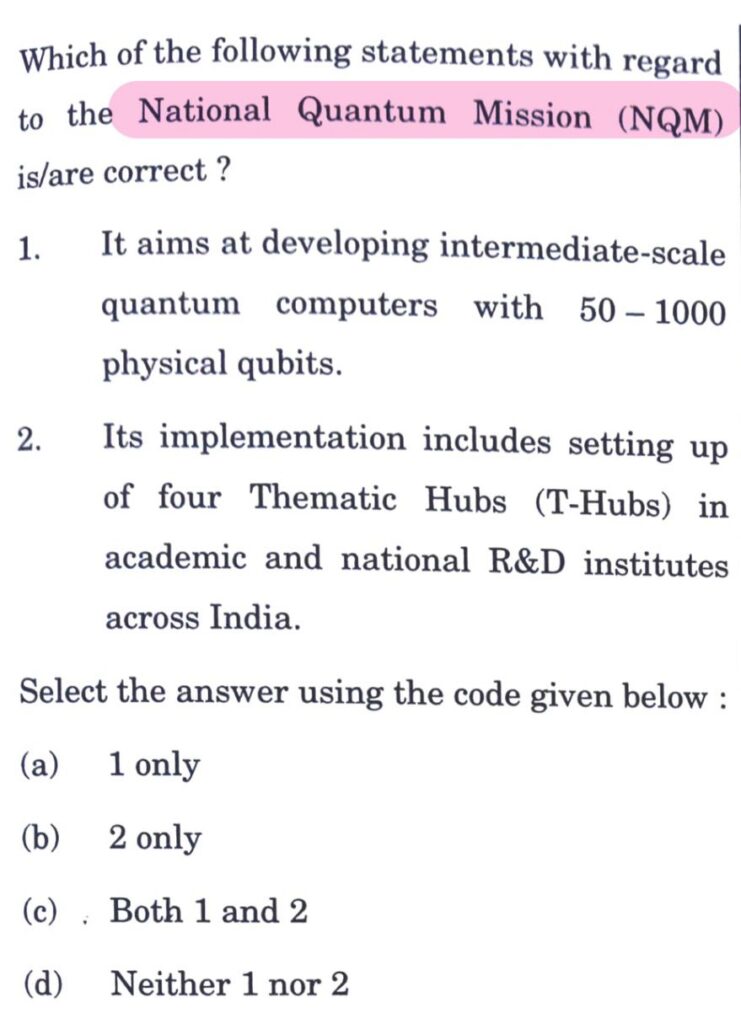
  • Aim: Develop quantum computers with 50–1000 physical qubits.
  • Includes four Thematic Hubs in academic and R&D institutions.
  • Focus areas: Quantum computing, communication, sensing, and materials.
PYQ – 2026, Ans – C

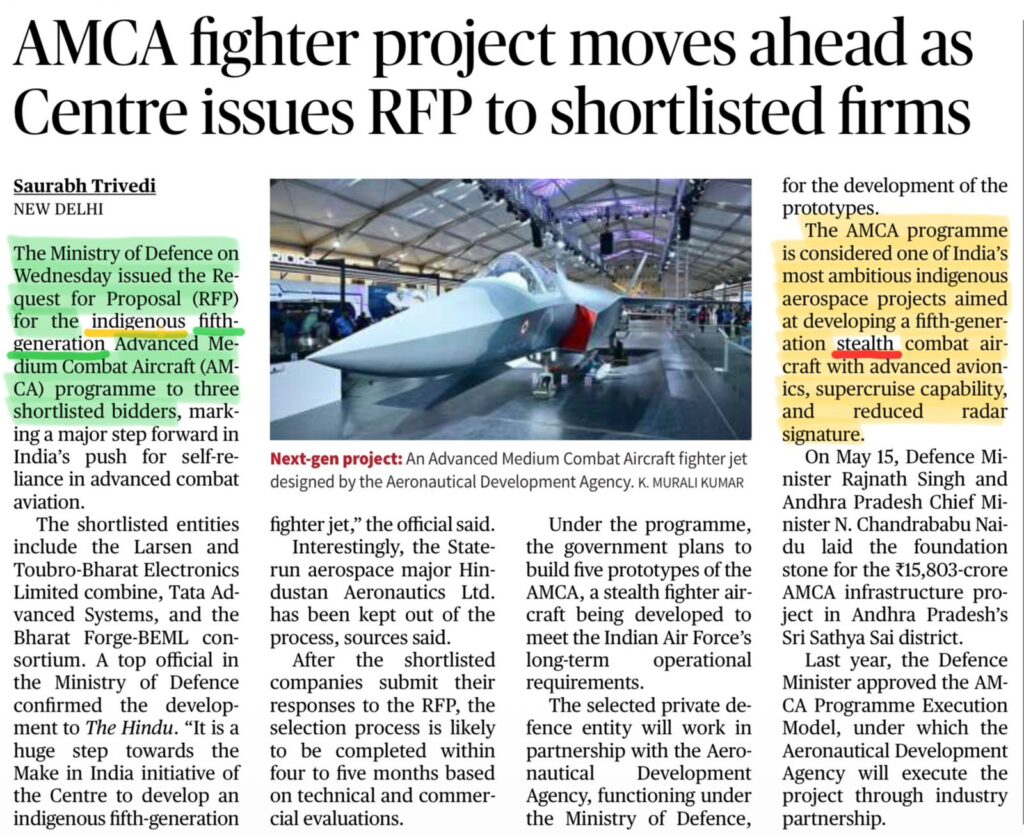
AMCA fighter project: India’s Indigenous Fifth-Generation Stealth Fighter Programme

Context: AMCA fighter project
Ministry of Defence issued Request for Proposal (RFP) for AMCA — India’s indigenous fifth-generation stealth fighter aircraft programme aimed at strengthening self-reliance in advanced combat aviation.

AMCA — Advanced Medium Combat Aircraft

  • Indigenous fifth-generation stealth multirole fighter aircraft being developed by Aeronautical Development Agency (ADA).
  • Features: Stealth technology, supercruise capability, advanced avionics, internal weapon bays, and reduced radar signature.
  • Aim: Meet long-term Indian Air Force operational requirements and reduce dependence on foreign fighter aircraft.

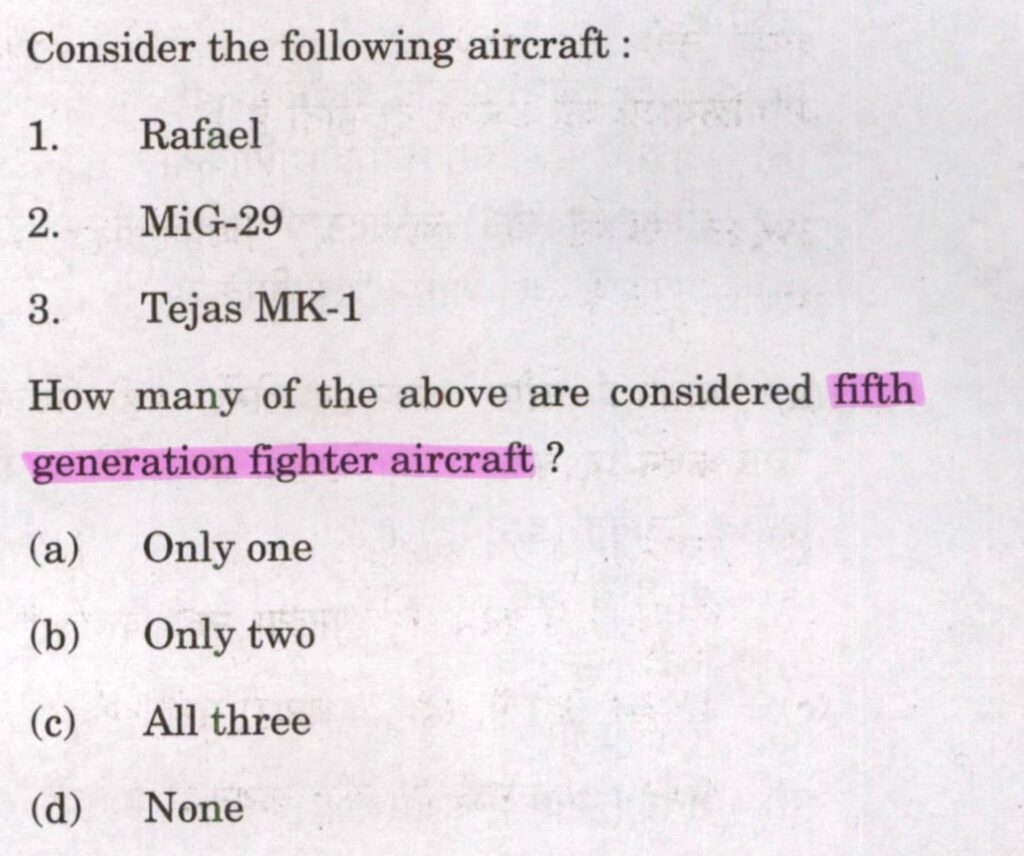
Fifth-Generation Fighter Aircraft

  • Fifth-generation fighter aircraft combine stealth with advanced combat networking and avionics.
  • Important features include stealth capability, sensor fusion, supercruise, AI-enabled avionics, and network-centric warfare.
  • Rafale, MiG-29 and Tejas Mk-1 are not fifth-generation fighter aircraft.
  • Examples: F-35 of USA, J-20 of China, Su-57 of Russia, and AMCA of India, which is under development.

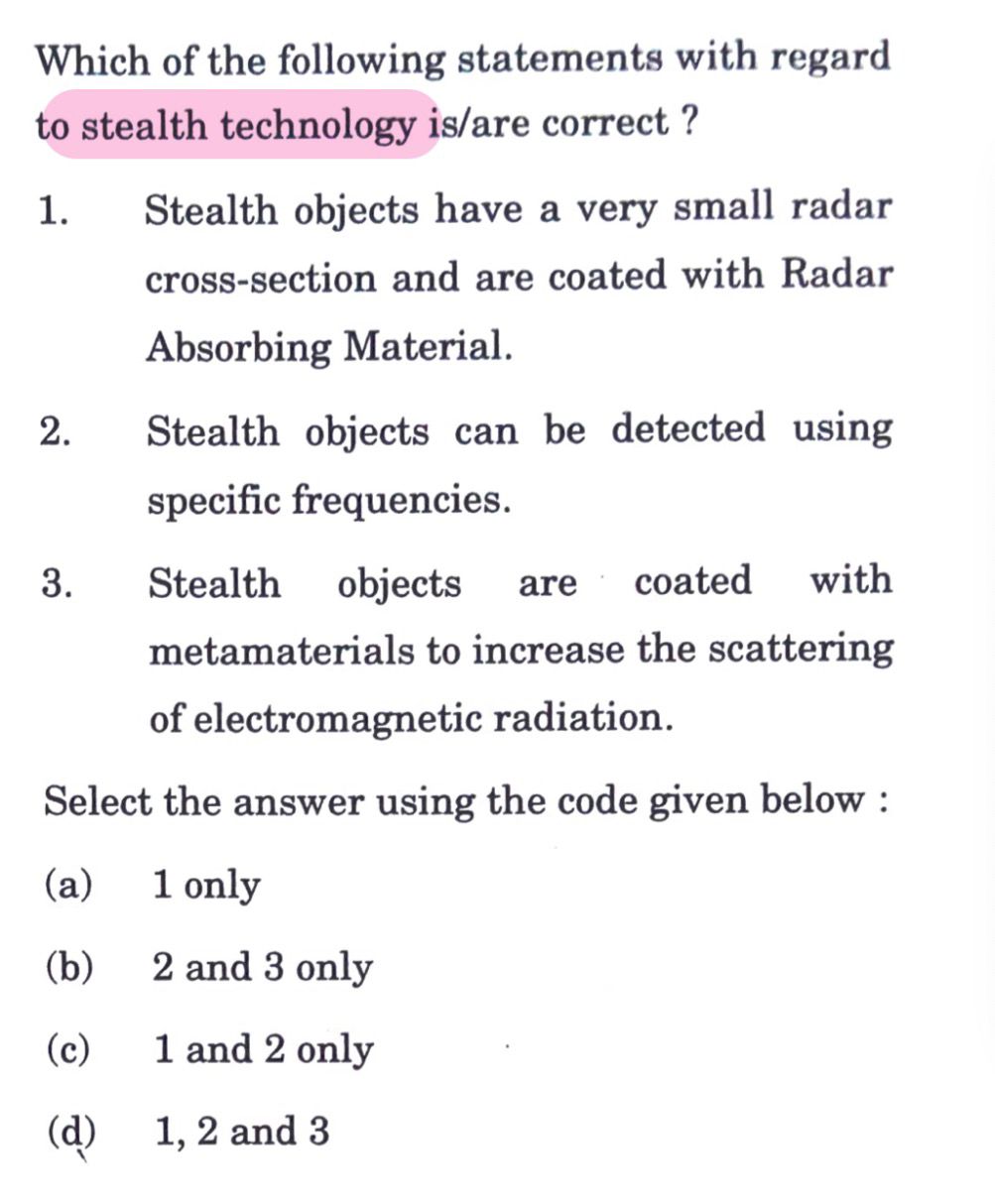
Stealth Technology

  • Radar Cross-Section (RCS): Measure of how detectable an object is by radar; stealth aircraft have very small RCS.
  • Radar Absorbing Material (RAM): Special coating or material used to absorb radar waves and reduce radar reflection.
  • Internal weapon carriage: Weapons are kept inside the aircraft body to avoid radar reflection from external payloads.
  • Reduced infrared signature: Engine heat and noise are reduced to avoid infrared detection.
  • Stealth aircraft can still be detected by certain radar frequencies and advanced tracking systems.
  • Metamaterials help reduce electromagnetic scattering, improving stealth characteristics.

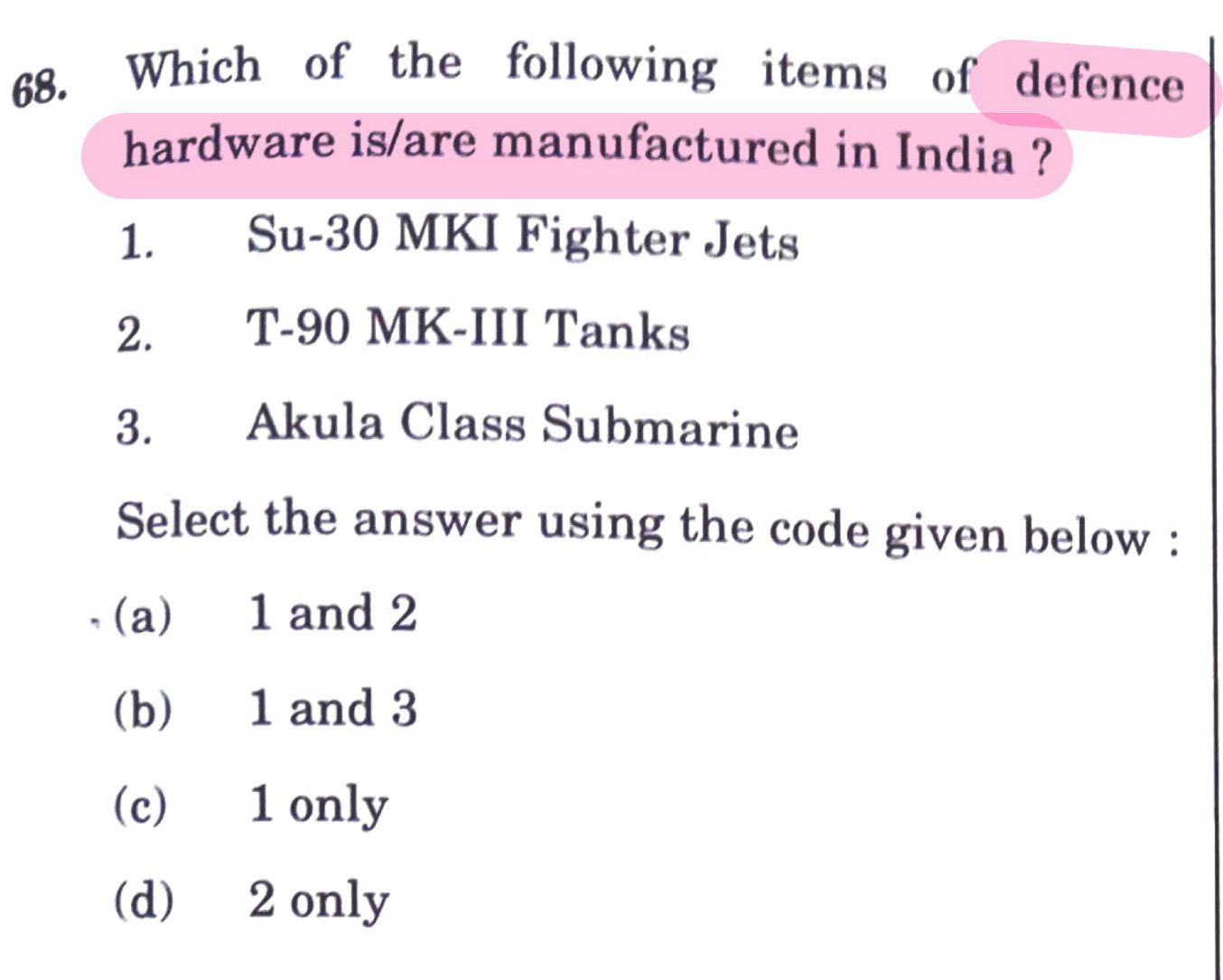
Indigenous Defence Hardware

  • Su-30 MKI fighter jets and T-90 tanks are manufactured in India under licensed production.
  • Akula-class submarine is Russian-origin and not manufactured in India.
  • Important indigenous or India-manufactured systems include Tejas LCA, Arjun MBT, Akash Missile System, Pinaka Rocket System, and AMCA.
  • Importance: Strategic autonomy, reduced import dependence, defence exports growth, and indigenous technology ecosystem.
AMCA fighter project
PYQ – 2024, Ans – D
PYQ – 2026, Ans – C
PYQ – 2026, Ans – A
About the UPSC Civil Services Examination (UPSC CSE)

The UPSC Civil Services Examination (CSE) is one of the most competitive and esteemed examinations in India, conducted by the Union Public Service Commission to recruit officers for services such as the Indian Administrative Service (IAS), Indian Police Service (IPS), Indian Foreign Service (IFS), and others. The exam comprises three stages — Prelims, Mains, and the Personality Test (Interview) — designed to test a candidate’s knowledge, aptitude, decision-making, and leadership skills.


How to Prepare Effectively for UPSC CSE

Cracking the UPSC CSE requires a deep understanding of the syllabus, consistent revision, structured answer writing, and smart test-taking strategies. The Prelims test analytical and conceptual clarity, the Mains focuses on critical thinking, articulation, and subject mastery, while the Interview assesses presence of mind, ethical judgment, and personality traits relevant to public service.

At UnderStand UPSC, we empower aspirants with a personalized and focused approach to each stage of the exam.


Why Choose UnderStand UPSC?

UnderStand UPSC is a mentorship-driven platform offering a clear, clutter-free strategy to tackle the Civil Services Examination. Our programs like Transform (for beginners and intermediate learners) and Conquer (for advanced mains preparation) provide structured study plans, syllabus-wise video content, interactive live sessions, and answer writing support.

We emphasize:

  • Concept clarity through topic-wise lectures

  • Test series designed around real UPSC standards

  • Personalized mentorship in small groups

  • Regular performance tracking and peer benchmarking

  • Doubt-clearing sessions, current affairs analysis, and monthly magazines


Join the UnderStand UPSC Learning Community

Our mission is to make UPSC preparation less overwhelming and more strategic. We combine mentorship, discipline, and academic rigor to help you clear CSE with confidence. Whether you’re preparing from Delhi, Mumbai, Bangalore, or a remote village — our online-first model ensures quality guidance reaches every corner of India.

Join the thousands of aspirants who trust UnderStand UPSC to guide their journey toward becoming civil servants.

Stay connected with us through our Telegram, YouTube, and Instagram channels for daily tips, strategies, and updates.

Copyright © 2026 USARAMBHA EDUCATION (UnderStand UPSC). All Rights Reserved.

Fill the form

Our team will reach out to you soon