27 April 2026 | Daily Current Affairs

Mattala Airport Sri Lanka: Country Seeks Investors for Loss-Making Project

Context: Mattala Airport Sri Lanka

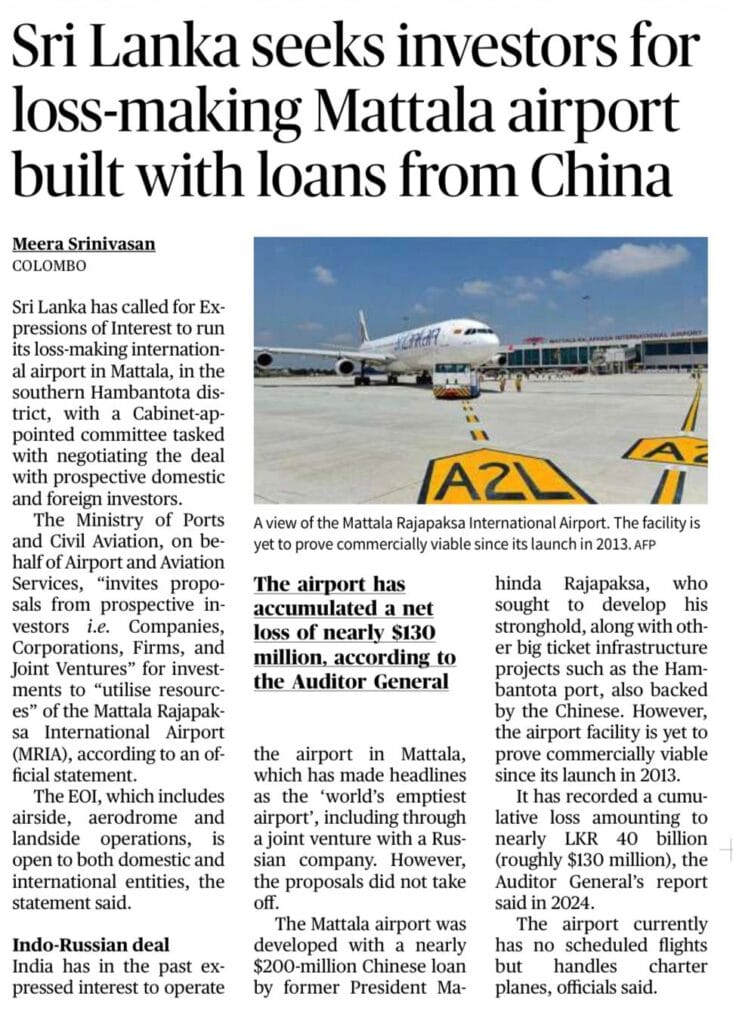
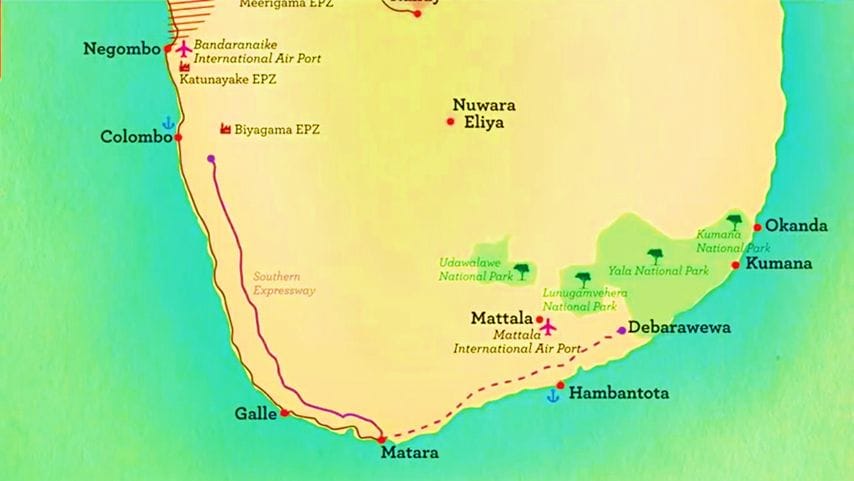
Sri Lanka has invited investors to run the loss-making Mattala airport, built with Chinese loans, after it failed to generate traffic or revenue.
Summary

  1. Immediate Issue:
  • Mattala airport, built with $200 million Chinese loan, has remained largely unused, with heavy losses ($130 million) and minimal operations.
  • Sri Lanka is now exploring private/foreign participation to make it viable.
  1. Underlying Problem:
  • The project suffered from poor demand assessment and overinvestment, making it commercially unviable from the start.
  1. Debt Trap Diplomacy – Core Idea:
  • Large-scale infrastructure loans, especially from China, can lead to repayment stress when projects fail, increasing economic dependence.
  1. Hambantota as a Precedent:
  • A nearby Chinese-funded project where debt pressure led to a 99-year lease of Hambantota Port to China.
  • Demonstrates how financial distress can translate into strategic leverage.
  1. What Mattala Reflects:
  • A second example of underperforming, debt-funded infrastructure, but now Sri Lanka is trying to diversify partners instead of ceding control.
  1. Larger Significance:
  • Highlights risks of unsustainable borrowing and low-return projects.
  • Important for India due to strategic implications in the Indian Ocean region and China’s expanding presence.
Vikram-1 Rocket: India’s First Private Orbital Launch by Skyroot Aerospace

Context: Vikram-1 Rocket

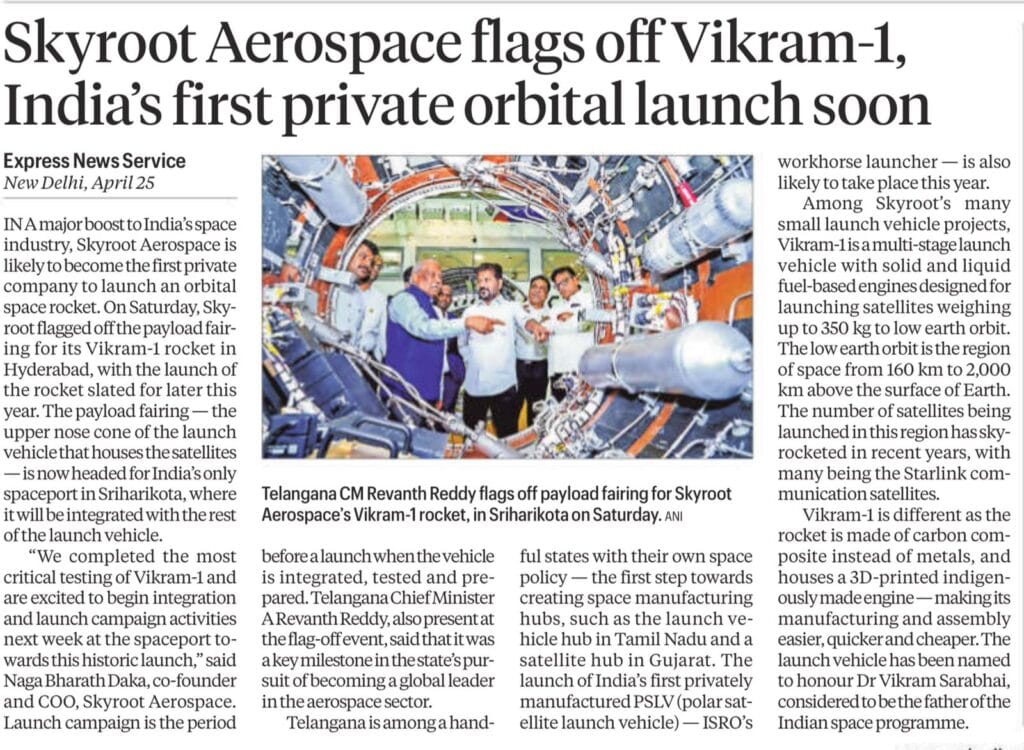
Skyroot Aerospace has begun final integration of its Vikram-1 rocket, which is expected to become India’s first privately developed orbital launch vehicle.

Key Facts

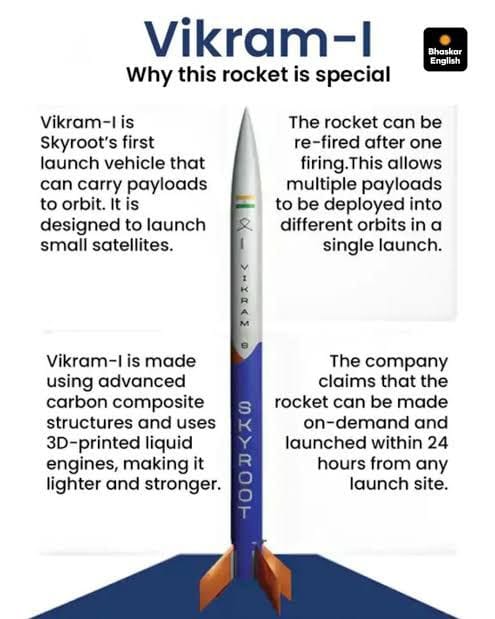
  • Vikram-1: Multi-stage launch vehicle (solid + liquid propulsion)
  • Payload capacity: ~350 kg to Low Earth Orbit (160–2000 km)
  • Payload fairing flagged off from Hyderabad, integration at Sriharikota
  • Built using carbon composites and 3D-printed indigenous engine
  • Designed for small satellite launches
  • Named after Vikram Sarabhai

Summary

  1. What is happening?
  • A private Indian company is preparing to launch an orbital rocket, something earlier done only by ISRO.
  1. Why is it important?
  • It marks a shift to private participation in India’s space sector after recent reforms.
  • Opens India to the global small-satellite launch market, which is growing rapidly.
  1. What makes Vikram-1 special?
  • Uses advanced materials and manufacturing (carbon composites, 3D printing).
  • Designed to be cost-effective, faster to build, and efficient.
  1. What is the objective?
  • To provide dedicated launch services for small satellites into Low Earth Orbit.
  • To build a reliable, indigenous private launch capability.
  1. Why does it matter for India?
  • Strengthens self-reliance in space technology.
  • Helps create a space startup ecosystem and manufacturing hubs.
  • Improves India’s competitiveness in the global space economy.

India UAE Relations: Ajit Doval Meets UAE President to Boost Gulf Outreach

Context: India UAE Relations

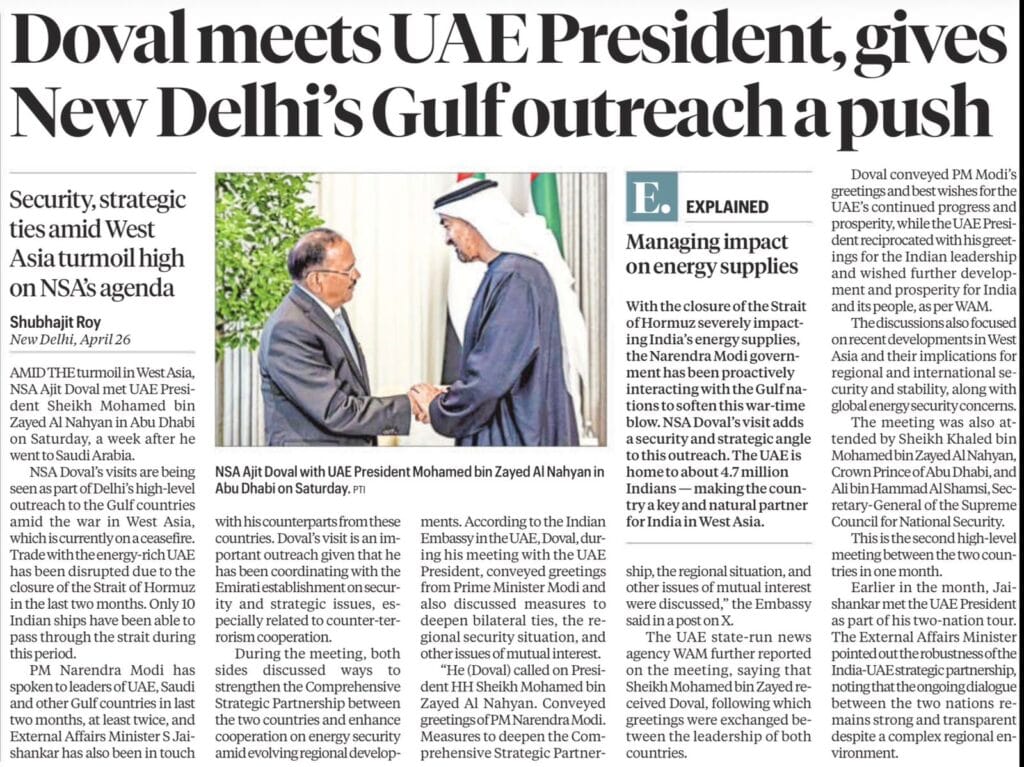
Amid rising instability in West Asia and concerns over disruption of energy routes, NSA Ajit Doval met the UAE President to deepen strategic engagement and reinforce India’s Gulf outreach.

Key points

  1. Geopolitical Context:
  • Meeting takes place against West Asia tensions and Strait of Hormuz disruptions, directly affecting India’s energy security.
  1. Energy and Economic Interests:
  • Focus on securing reliable oil supplies, trade flows, and economic stability with a key partner.
  1. Security Cooperation:
  • Emphasis on counter-terrorism, regional stability, and strategic coordination, reflecting converging interests.
  1. Strengthening Bilateral Ties:
  • Reinforces the India–UAE Comprehensive Strategic Partnership, with expanding cooperation in energy, defence, and regional affairs.
  1. GCC Dimension:
  • The UAE is part of the Gulf Cooperation Council, a regional bloc formed in 1981 comprising Saudi Arabia, United Arab Emirates, Qatar, Kuwait, Oman, and Bahrain.
  • The GCC is central to global oil and gas supply, and works toward economic integration, policy coordination, and regional security cooperation.
  • For India, GCC countries are crucial for energy imports, trade, remittances, and diaspora welfare, making engagement with UAE part of a larger strategic outreach to the Gulf region.
  1. Overall Significance:
  • Reflects India’s proactive and sustained Gulf diplomacy, positioning it as a reliable partner in a volatile region while safeguarding its core strategic and economic interests.

Right to Life: Supreme Court Links Safe Travel on Highways to Article 21

Context: Right to Life

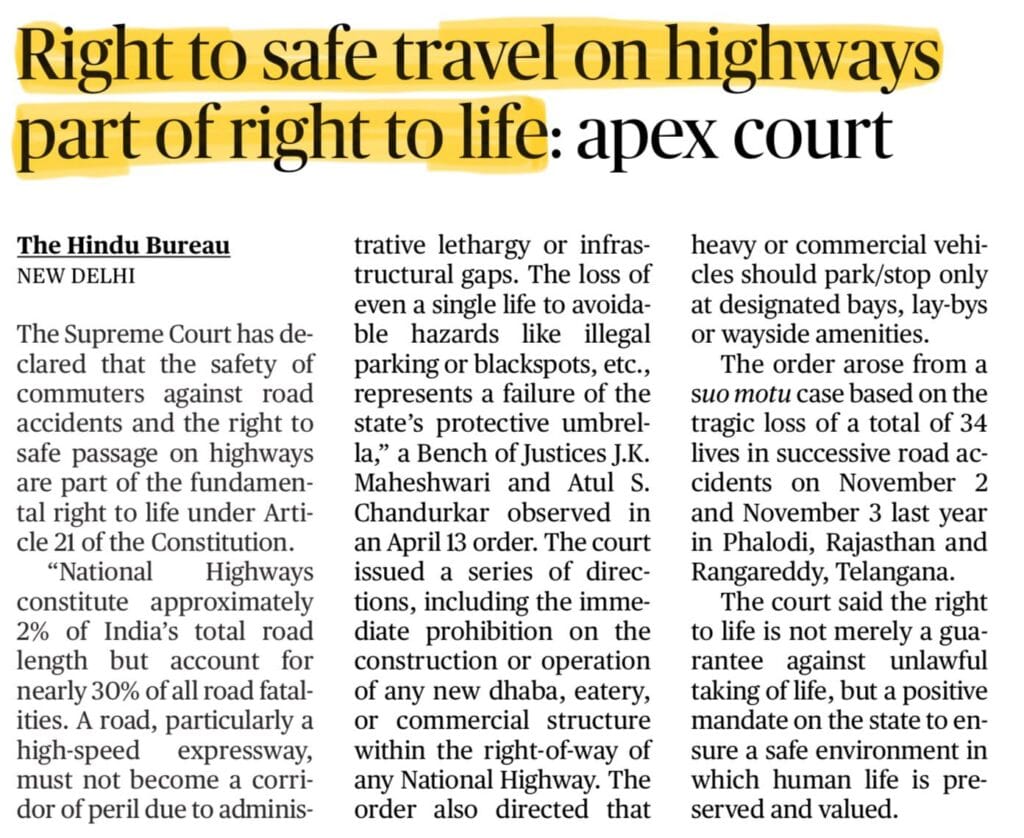
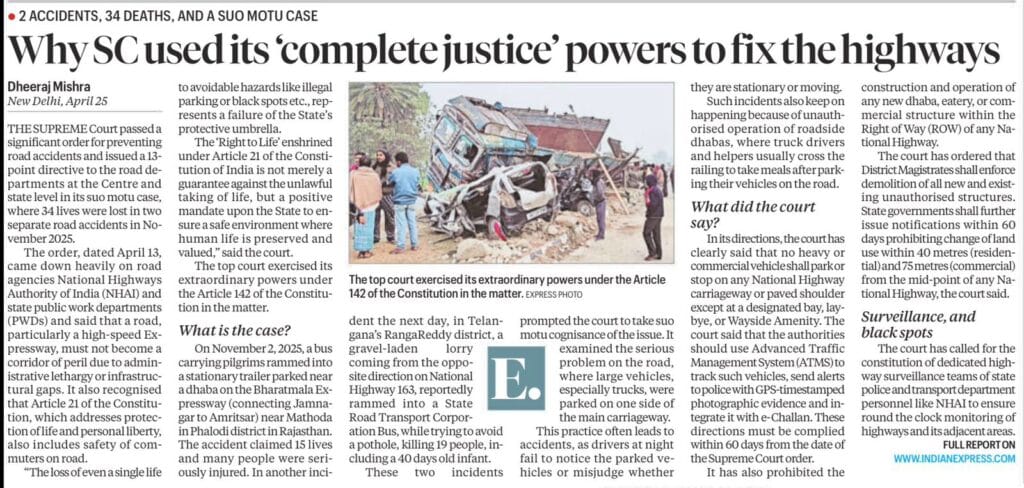
In a suo motu case after two highway accidents causing 34 deaths, the Supreme Court held that safe travel is part of the Right to Life and called for systemic road safety reforms.

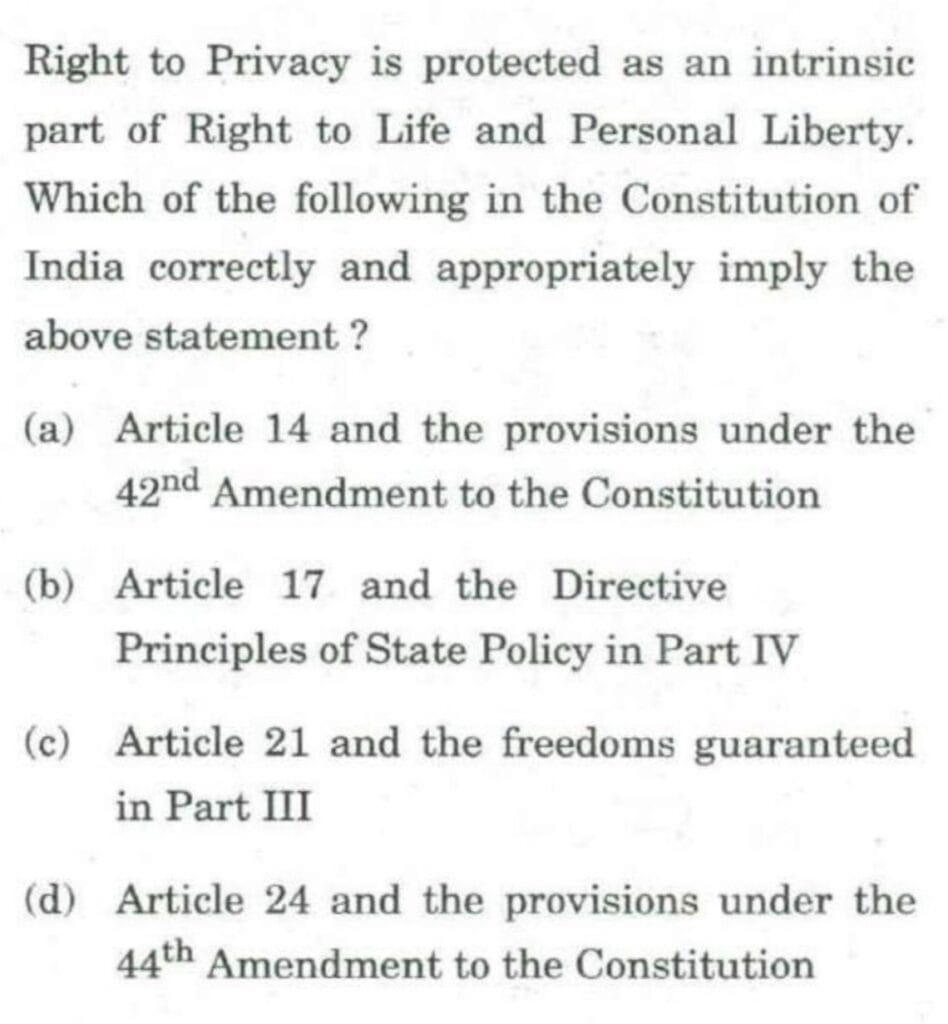
PYQ – 2018, Ans – C

Key Points

  1. Article 21 – Right to Life and Personal Liberty:
  • “No person shall be deprived of his life or personal liberty except according to procedure established by law.”
  • Expanded to include safe, secure, and dignified travel, making road safety a fundamental right.
  1. Article 142 – Complete Justice:
  • Empowers the Court to pass orders necessary for complete justice.
  • Used to issue binding directions for structural road safety reforms.
  1. Articles 38 & 47 – Welfare and Public Health:
  • State is duty-bound to ensure welfare and public health, which includes preventing road accidents and ensuring safe infrastructure.
  1. Judicial Observation:
  • Deaths due to encroachments, illegal parking, blackspots, and weak enforcement are preventable and indicate failure of governance.
  1. State Responsibility:
  • Imposes a positive obligation on authorities to create and maintain a safe road environment.
  1. Key Directions:
  • Removal of encroachments and unauthorised activities on highways.
  • Designated parking for heavy vehicles.
  • Use of technology and stricter enforcement.
  • Identification and correction of accident-prone areas.
  1. Significance:
  • Transforms road safety into a constitutionally enforceable right.
  • Strengthens accountability of State agencies and governance standards.

India New Zealand FTA: Tariffs Eliminated to Boost Bilateral Trade

Context: India New Zealand FTA

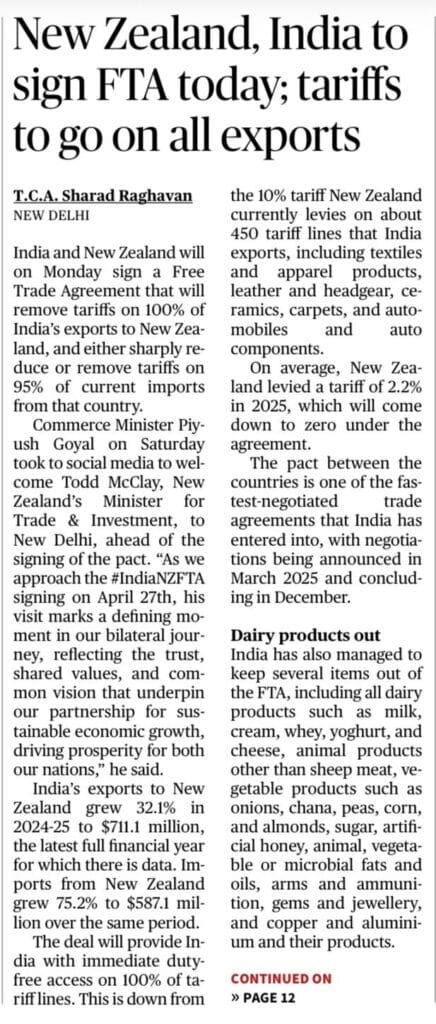
India and New Zealand will sign a Free Trade Agreement aimed at eliminating tariffs, expanding market access, and strengthening bilateral trade relations.

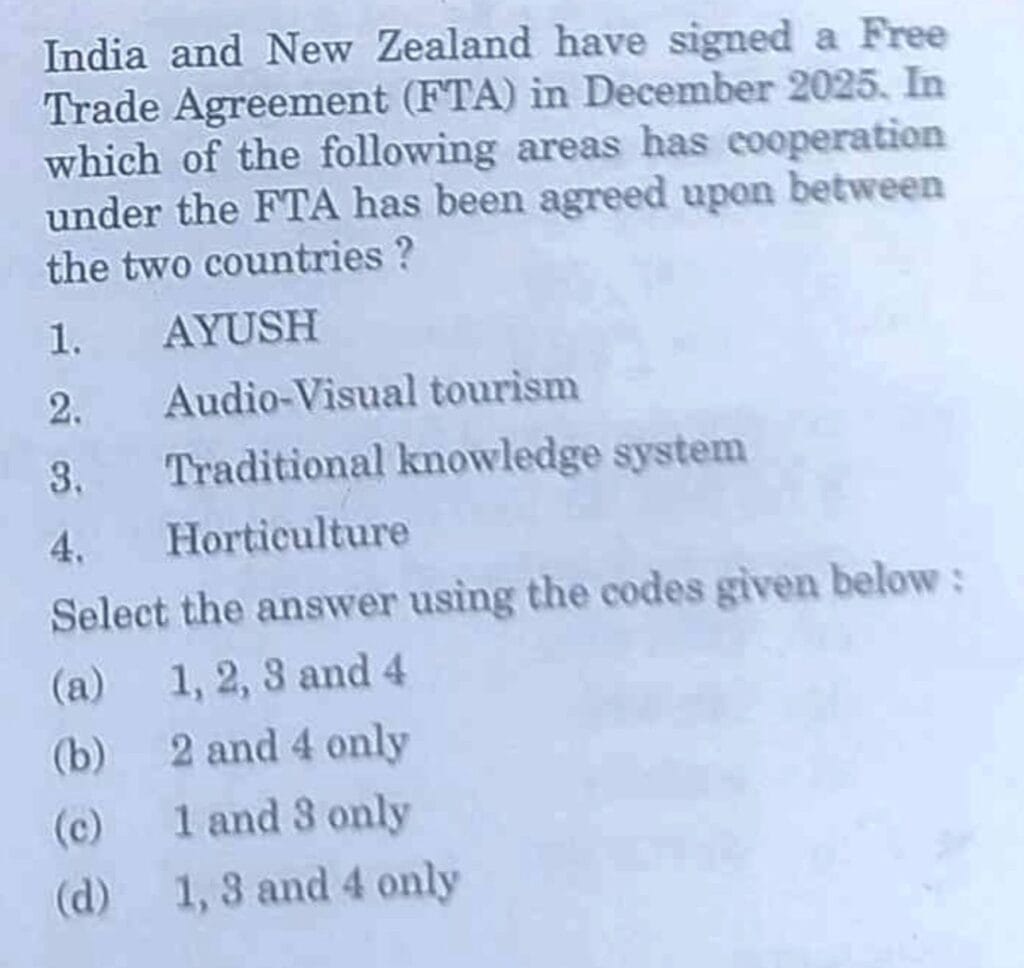
PYQ – CDS 2026, Ans – A

Key Points

  1. Extent of Tariff Removal:
  • India will get duty-free access on 100% of its exports to New Zealand.
  • India will reduce or eliminate tariffs on about 95% of imports from New Zealand.
  • New Zealand’s tariffs (around 2.2% on average) will fall to zero, including ~10% duties on several Indian export items.
  1. Sectors Benefiting (India’s Exports):
  • Textiles, apparel, leather, carpets, ceramics
  • Automobiles and auto components
  • These sectors gain full market access and improved competitiveness.
  1. Sensitive/Excluded Items (Protected by India):
  • Dairy products (milk, butter, cheese, etc.)
  • Key agricultural products (onions, pulses, corn, almonds)
  • Sugar, fats and oils
  • Gems & jewellery, metals (copper, aluminium), arms
  • Reflects protection of domestic farmers and sensitive industries.
  1. Trade Trends & Impact:
  • India’s exports: $711.1 million (+32.1%)
  • Imports: $587.1 million (+75.2%)
  • FTA expected to boost trade volume, diversify markets, and deepen economic integration.
  1. Strategic Significance:
  • Among the fastest negotiated FTAs, indicating urgency in trade diplomacy.
  • Strengthens India’s trade outreach in the Indo-Pacific.
  • Balances market access with domestic protection, especially in agriculture and dairy.
About the UPSC Civil Services Examination (UPSC CSE)

The UPSC Civil Services Examination (CSE) is one of the most competitive and esteemed examinations in India, conducted by the Union Public Service Commission to recruit officers for services such as the Indian Administrative Service (IAS), Indian Police Service (IPS), Indian Foreign Service (IFS), and others. The exam comprises three stages — Prelims, Mains, and the Personality Test (Interview) — designed to test a candidate’s knowledge, aptitude, decision-making, and leadership skills.


How to Prepare Effectively for UPSC CSE

Cracking the UPSC CSE requires a deep understanding of the syllabus, consistent revision, structured answer writing, and smart test-taking strategies. The Prelims test analytical and conceptual clarity, the Mains focuses on critical thinking, articulation, and subject mastery, while the Interview assesses presence of mind, ethical judgment, and personality traits relevant to public service.

At UnderStand UPSC, we empower aspirants with a personalized and focused approach to each stage of the exam.


Why Choose UnderStand UPSC?

UnderStand UPSC is a mentorship-driven platform offering a clear, clutter-free strategy to tackle the Civil Services Examination. Our programs like Transform (for beginners and intermediate learners) and Conquer (for advanced mains preparation) provide structured study plans, syllabus-wise video content, interactive live sessions, and answer writing support.

We emphasize:

  • Concept clarity through topic-wise lectures

  • Test series designed around real UPSC standards

  • Personalized mentorship in small groups

  • Regular performance tracking and peer benchmarking

  • Doubt-clearing sessions, current affairs analysis, and monthly magazines


Join the UnderStand UPSC Learning Community

Our mission is to make UPSC preparation less overwhelming and more strategic. We combine mentorship, discipline, and academic rigor to help you clear CSE with confidence. Whether you’re preparing from Delhi, Mumbai, Bangalore, or a remote village — our online-first model ensures quality guidance reaches every corner of India.

Join the thousands of aspirants who trust UnderStand UPSC to guide their journey toward becoming civil servants.

Stay connected with us through our Telegram, YouTube, and Instagram channels for daily tips, strategies, and updates.

Copyright © 2026 USARAMBHA EDUCATION (UnderStand UPSC). All Rights Reserved.

Join the Success Journey!