29 May 2026 | Daily Current Affairs

India China Border Dispute: Talks Focus on Delimitation and Border Management

Context: India China Border Dispute
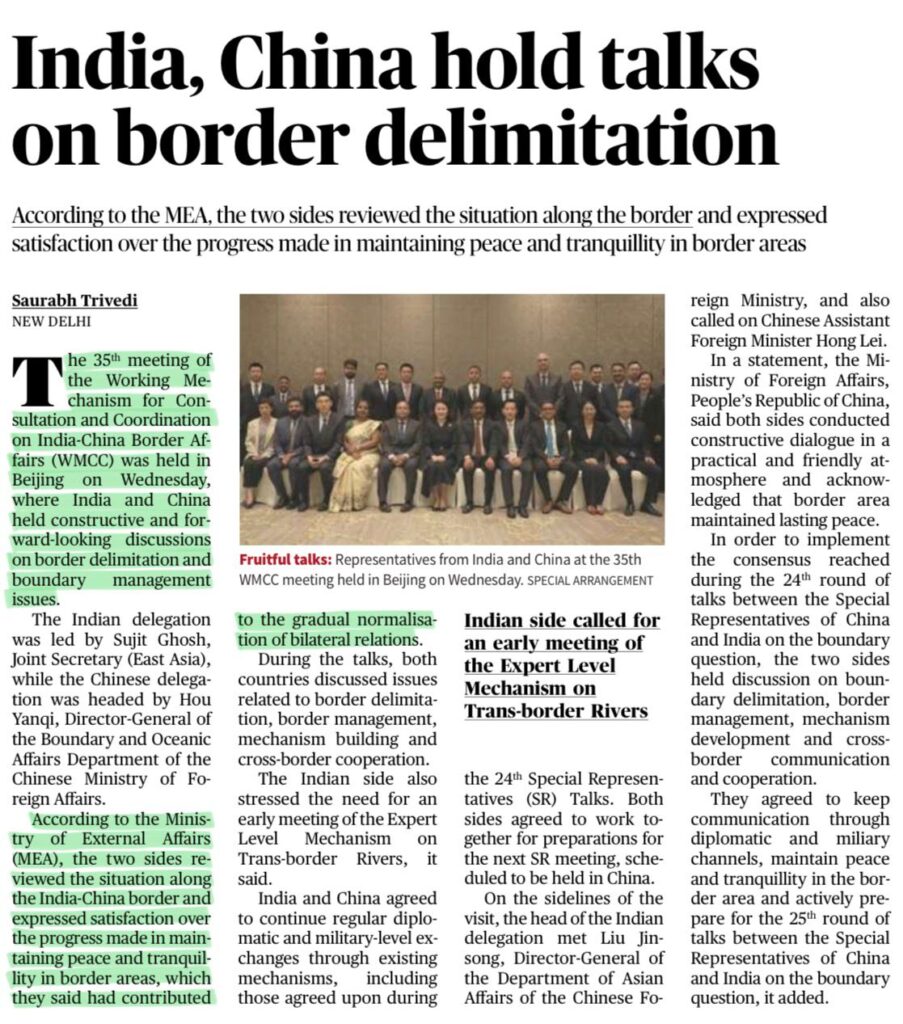
At the 35th Working Mechanism for Consultation and Coordination on India-China Border Affairs meeting in Beijing, India and China reviewed the border situation, discussed border delimitation, border management and cross-border cooperation, and agreed to maintain peace and tranquillity along the border.

Key Outcomes

  • Reviewed progress in maintaining peace along border areas.
  • Discussed border delimitation and boundary-management issues.
  • Agreed to continue diplomatic and military-level communication.
  • India called for an early meeting of the Expert Level Mechanism on Trans-Border Rivers.
  • Preparations initiated for the 25th Special Representatives Talks.

India–China Boundary Dispute — Basics

  • Total disputed boundary: about 3,488 km, according to Indian estimate.
  • China does not formally accept this figure.
  • Boundary is divided into Western, Middle and Eastern Sectors.

Boundary Sectors

Western Sector

  • Ladakh–Aksai Chin
  • Largest dispute

Middle Sector

  • Himachal Pradesh–Uttarakhand
  • Least disputed

Eastern Sector

  • Arunachal Pradesh
  • Claimed by China as “South Tibet”

Line of Actual Control

  • De facto military boundary between India and China.
  • Not a mutually agreed international boundary.
  • Emerged after the 1962 India-China War.
  • Differing perceptions of the LAC are the primary cause of face-offs and patrol clashes.

Important Agreements

  • 1993: Agreement on Maintenance of Peace and Tranquillity along the LAC
  • 1996: Confidence Building Measures Agreement
  • 2005: Political Parameters and Guiding Principles Agreement
  • 2013: Border Defence Cooperation Agreement

Border Management Mechanisms

Special Representatives Talks, 2003

  • Political-level mechanism for boundary settlement.

Working Mechanism for Consultation and Coordination, 2012

  • Diplomatic mechanism for managing border issues and communication.

Military Commander-level talks

  • Used for disengagement and de-escalation.

Prelims Pointers

  • Aksai Chin is controlled by China and claimed by India as part of Ladakh.
  • Arunachal Pradesh is claimed by China as “South Tibet”.
  • Major friction points include Depsang, Demchok, Galwan, Hot Springs and Pangong Tso.
Lunar South Pole: Chandrayaan-2 Detects Possible Presence of Water Ice

Context: Lunar South Pole
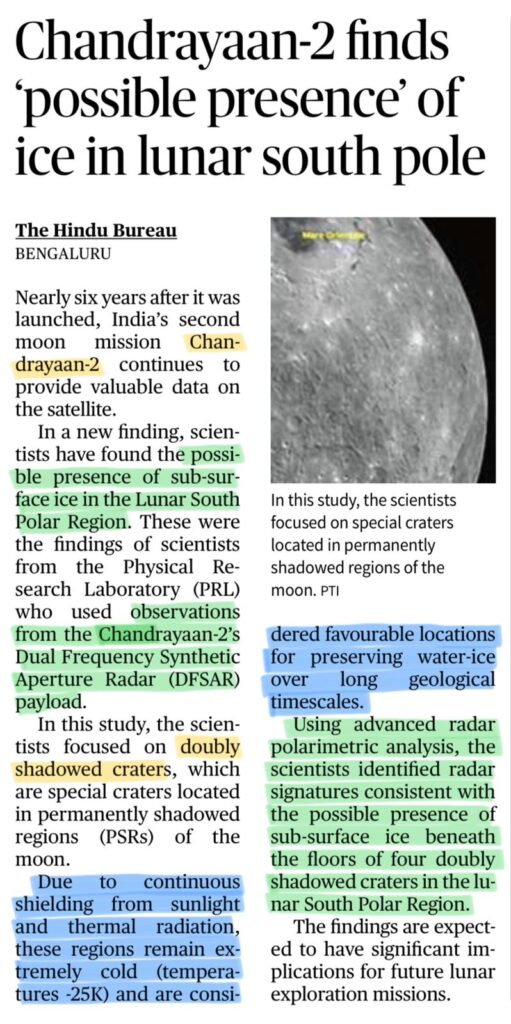
Scientists from the Physical Research Laboratory, using data from Chandrayaan-2’s Dual Frequency Synthetic Aperture Radar, have reported evidence suggesting the possible presence of subsurface water-ice in the Lunar South Polar Region.

Key Findings

  • Study focused on Doubly Shadowed Craters located within Permanently Shadowed Regions of the Moon.
  • Radar signatures indicate the possible presence of subsurface ice beneath four crater floors in the Lunar South Pole.
  • These regions remain extremely cold, around 25 Kelvin, due to the absence of sunlight and thermal radiation.
  • Such conditions favour the preservation of water-ice over geological timescales.

Why Lunar South Pole Matters?

  • Contains numerous Permanently Shadowed Regions.
  • Considered the most promising location for water-ice deposits on the Moon.
  • Water can support human habitation, oxygen production and rocket fuel generation for future lunar missions.

Chandrayaan-2 — Basics

  • Launched in 2019 by the Indian Space Research Organisation.
  • Components: Orbiter, Vikram Lander and Pragyan Rover.
  • Orbiter remains operational and continues to generate scientific data.
  • Dual Frequency Synthetic Aperture Radar is designed to detect water-ice beneath the lunar surface.

Prelims Pointers

Permanently Shadowed Region:
Areas near lunar poles that never receive direct sunlight.

Doubly Shadowed Crater:
Crater within a Permanently Shadowed Region receiving even lesser solar exposure, making it a potential ice trap.

Chandrayaan-3:
India’s Chandrayaan-3 successfully landed near the lunar south polar region in 2023.

Supreme Court Pendency: Will Increasing Judges Reduce Case Backlog?

Context: Supreme Court Pendency
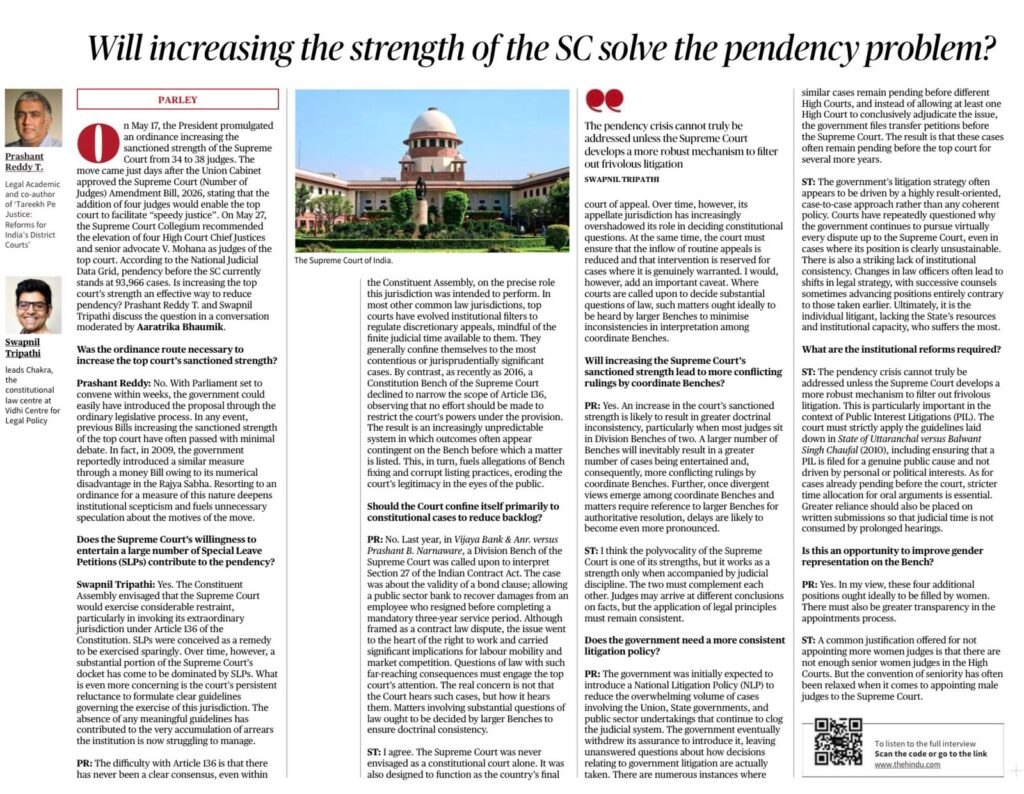
The sanctioned strength of the Supreme Court of India has been increased from 34 to 38 judges to address mounting pendency. However, concerns remain that backlog is driven more by excessive appeals, government litigation and weak case-management systems than by judicial vacancies alone.

Constitutional Basis

  • Article 124(1): Parliament may increase the number of Supreme Court judges.
  • Article 136: Special Leave Petition jurisdiction.
  • Article 32: Right to Constitutional Remedies.
  • Article 141: Supreme Court decisions are binding on all courts.
  • Article 142: Power to do complete justice.

Potential Benefits

  • Higher disposal capacity
  • More Division Benches and Constitution Benches
  • Faster hearing of pending cases
  • Better access to justice
  • Opportunity to improve women’s representation on the Bench

Key Concerns

  • Pendency is not merely a judge-strength issue.
  • Excessive use of Special Leave Petitions overloads the Court.
  • Growing government litigation contributes significantly to backlog.
  • Supreme Court increasingly functions as a regular appellate court rather than focusing on constitutional questions.
  • Larger number of coordinate benches may increase inconsistent rulings.

Way Forward

  • Filter frivolous litigation and unnecessary Special Leave Petitions.
  • Focus on substantial constitutional questions.
  • Implement a robust National Litigation Policy.
  • Strengthen case-management and written-submission mechanisms.
  • Increase use of Constitution Benches for issues of national importance.

Coastal Security: CISF to Monitor Nearly 1,200 Fishing Harbours in India

Context: Coastal Security
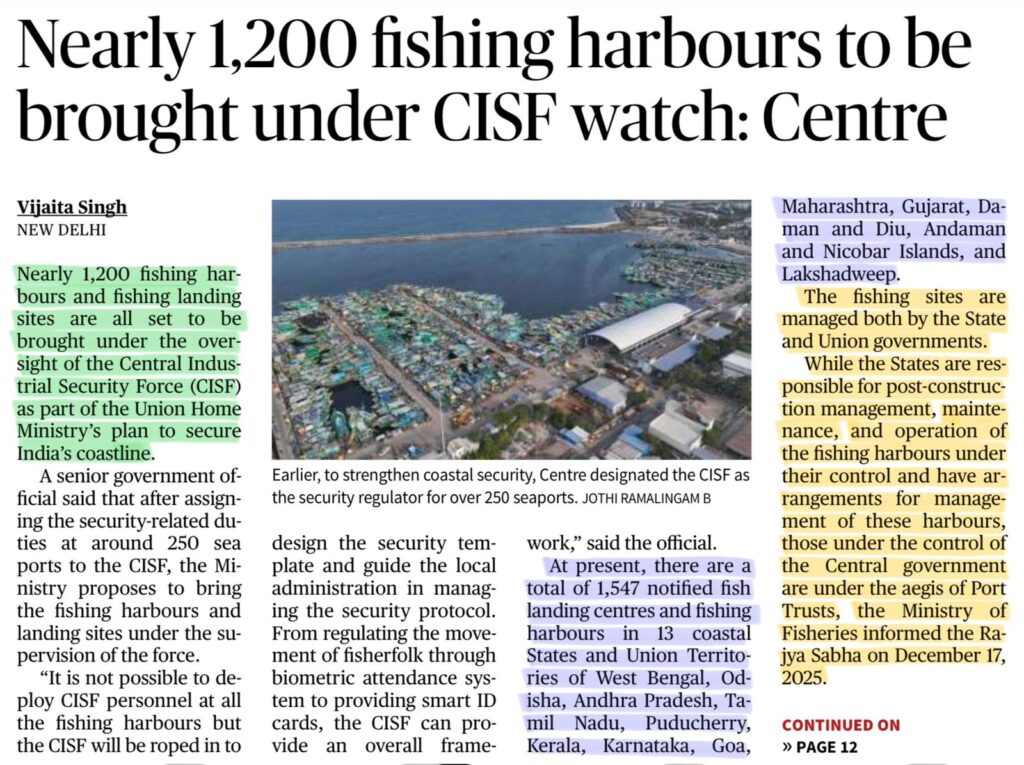
The Union Government has decided to bring nearly 1,200 fishing harbours and fish landing centres under the security oversight of the Central Industrial Security Force to strengthen India’s coastal security and maritime surveillance framework.

Key Highlights

  • CISF has already been designated the security regulator for 250+ seaports.
  • The framework will now be extended to fishing harbours and landing centres.
  • CISF will develop security protocols, biometric identification systems, Smart Identity Cards and access-control mechanisms.
  • Day-to-day administration will continue with State Governments and Union Territory administrations.

Objective

  • Prevent infiltration
  • Prevent smuggling
  • Prevent trafficking
  • Prevent illegal fishing
  • Strengthen maritime security

Central Industrial Security Force — Basics

  • Established: 1969
  • Statutory basis: Central Industrial Security Force Act, 1968
  • Ministry: Ministry of Home Affairs
  • One of the Central Armed Police Forces

Functions of CISF

CISF provides security to:

  • Airports
  • Seaports
  • Delhi Metro Rail Corporation
  • Nuclear installations
  • Space establishments
  • Public Sector Undertakings
  • Other critical infrastructure

It also undertakes security audits and consultancy services.

Coastal Security and Fisheries Facts

  • Total coastline of India: around 7,516.6 km
  • Coastal States: 9
  • Coastal Union Territories: 4
  • Longest coastline among States: Gujarat, around 1,600 km
  • Shortest coastline among States: Goa
  • Longest coastline among Union Territories: Andaman and Nicobar Islands
  • India’s Exclusive Economic Zone: around 2.37 million sq km
  • Fishing vessels and fishermen are considered the first line of maritime surveillance.

Prelims PYQ Linkage

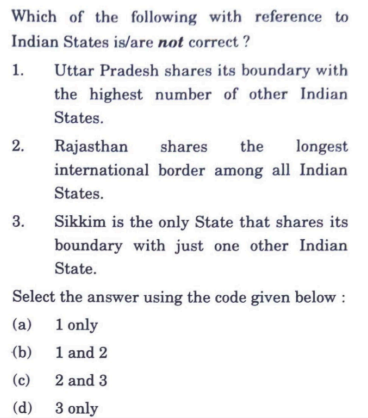
  • UPSC CSE Prelims 2023: Rajasthan shares the longest international border among Indian States; Uttar Pradesh shares boundaries with the highest number of States.
  • Similar map-based questions can be asked on coastal States, longest coastline, island groups, fishing harbours and maritime security institutions.
PYQ – 2026, Ans – C

Ebola Virus Disease: WHO Warns of Rising Risk Amid Conflict in DRC

Context: Ebola Virus Disease
WHO warned that the ongoing conflict in Ituri Province, Democratic Republic of Congo is hampering efforts to contain a fresh Ebola outbreak, with insecurity, displacement and weak healthcare infrastructure increasing the risk of transmission.

Ebola Virus Disease

  • Type: Viral Haemorrhagic Fever
  • Family: Filoviridae
  • First identified: 1976 near Ebola River, Democratic Republic of Congo
  • Reservoir host: Fruit bats

Transmission

  • Infected animals
  • Blood / body fluids
  • Contaminated objects
  • Infected corpses

Symptoms

  • Fever
  • Headache
  • Muscle pain
  • Vomiting
  • Diarrhoea
  • Bleeding
  • Multi-organ failure

Case Fatality Rate

  • 25–90%

Important Prelims Facts

  • Current strain: Bundibugyo Ebola Virus
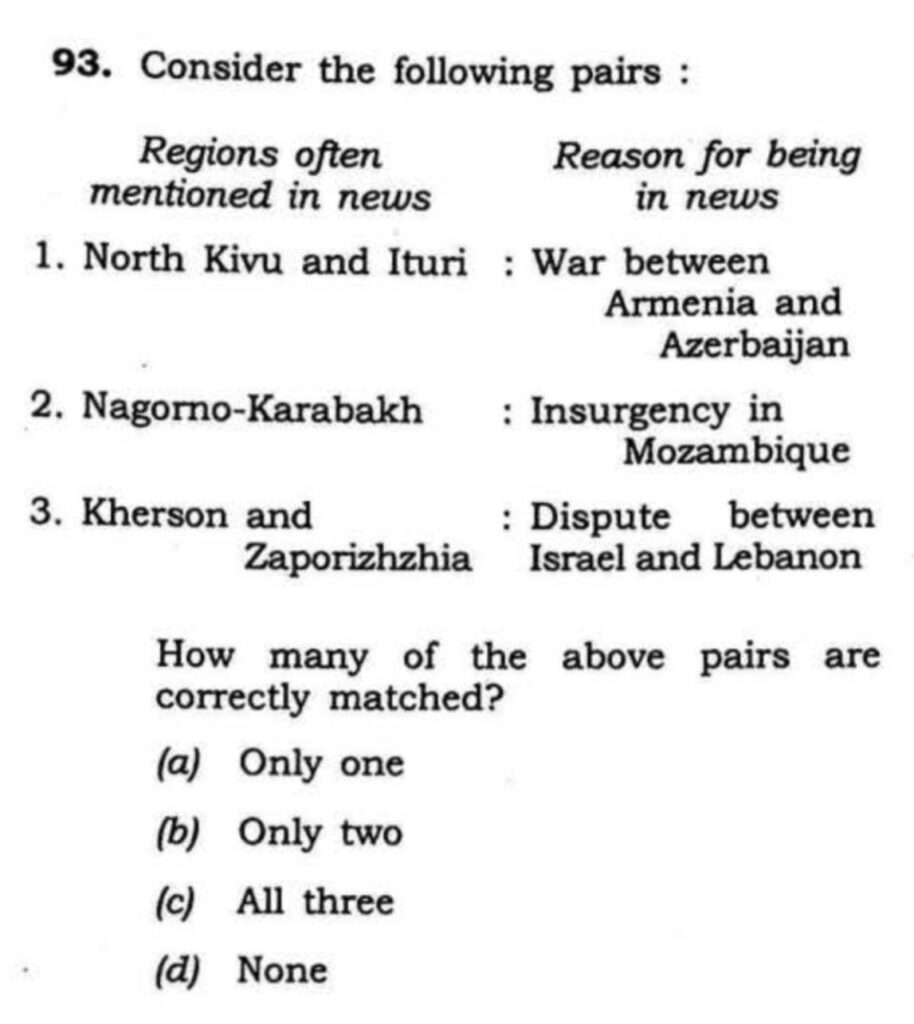
  • Ituri and North Kivu are provinces of eastern DRC.
  • These regions are recurrent hotspots of armed conflict and Ebola outbreaks.

Control Measures

  • Isolation
  • Contact tracing
  • Safe burial practices
  • PPE
  • Vaccination for certain strains

WHO Headquarters

  • Geneva, Switzerland

PYQ Linkage

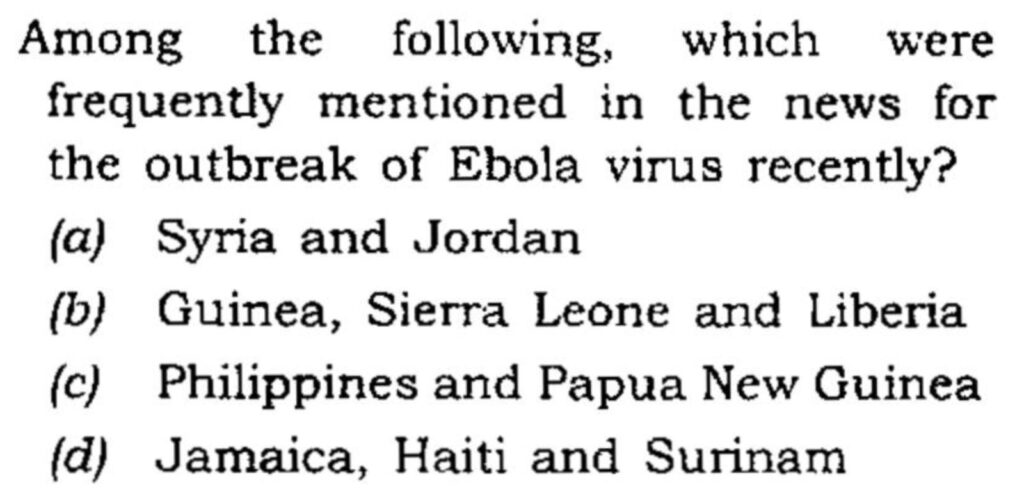
  • UPSC Prelims 2023: North Kivu and Ituri were in news due to conflict and Ebola outbreaks in DRC.
  • UPSC Prelims 2015: Ebola epidemic was associated with Guinea, Sierra Leone and Liberia.
PYQ – 2015, Ans – B
PYQ – 2023, Ans – D
About the UPSC Civil Services Examination (UPSC CSE)

The UPSC Civil Services Examination (CSE) is one of the most competitive and esteemed examinations in India, conducted by the Union Public Service Commission to recruit officers for services such as the Indian Administrative Service (IAS), Indian Police Service (IPS), Indian Foreign Service (IFS), and others. The exam comprises three stages — Prelims, Mains, and the Personality Test (Interview) — designed to test a candidate’s knowledge, aptitude, decision-making, and leadership skills.


How to Prepare Effectively for UPSC CSE

Cracking the UPSC CSE requires a deep understanding of the syllabus, consistent revision, structured answer writing, and smart test-taking strategies. The Prelims test analytical and conceptual clarity, the Mains focuses on critical thinking, articulation, and subject mastery, while the Interview assesses presence of mind, ethical judgment, and personality traits relevant to public service.

At UnderStand UPSC, we empower aspirants with a personalized and focused approach to each stage of the exam.


Why Choose UnderStand UPSC?

UnderStand UPSC is a mentorship-driven platform offering a clear, clutter-free strategy to tackle the Civil Services Examination. Our programs like Transform (for beginners and intermediate learners) and Conquer (for advanced mains preparation) provide structured study plans, syllabus-wise video content, interactive live sessions, and answer writing support.

We emphasize:

  • Concept clarity through topic-wise lectures

  • Test series designed around real UPSC standards

  • Personalized mentorship in small groups

  • Regular performance tracking and peer benchmarking

  • Doubt-clearing sessions, current affairs analysis, and monthly magazines


Join the UnderStand UPSC Learning Community

Our mission is to make UPSC preparation less overwhelming and more strategic. We combine mentorship, discipline, and academic rigor to help you clear CSE with confidence. Whether you’re preparing from Delhi, Mumbai, Bangalore, or a remote village — our online-first model ensures quality guidance reaches every corner of India.

Join the thousands of aspirants who trust UnderStand UPSC to guide their journey toward becoming civil servants.

Stay connected with us through our Telegram, YouTube, and Instagram channels for daily tips, strategies, and updates.

Copyright © 2026 USARAMBHA EDUCATION (UnderStand UPSC). All Rights Reserved.

Fill the form

Our team will reach out to you soon