2 June 2026 | Daily Current Affairs

India-Middle East-Europe Economic Corridor: Geopolitical Challenges and Strategic Significance for India

Context: India-Middle East-Europe Economic Corridor
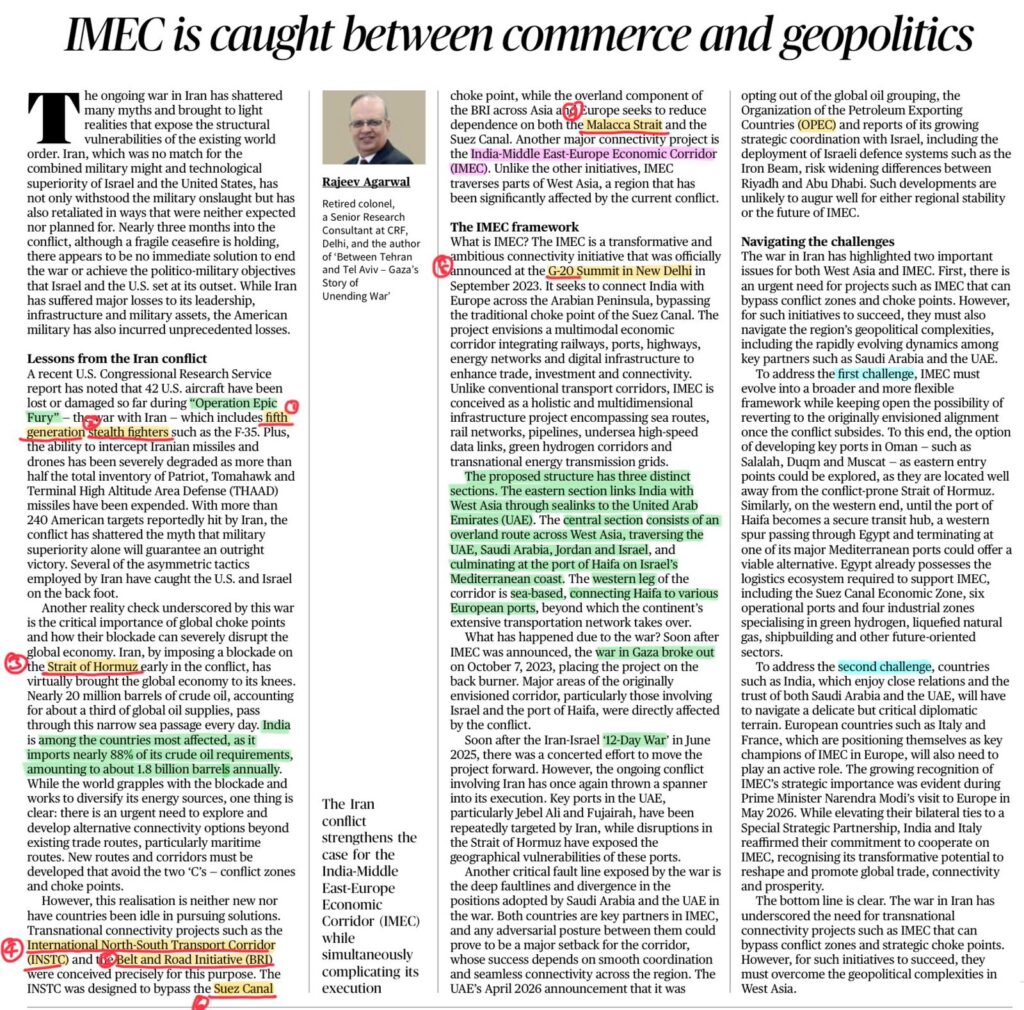
Iran-Israel conflict and tensions in the Strait of Hormuz have revived interest in the India-Middle East-Europe Economic Corridor while highlighting how geopolitical instability can disrupt major connectivity projects.

India-Middle East-Europe Economic Corridor

Launch:
G20 New Delhi Summit, 2023

Route:

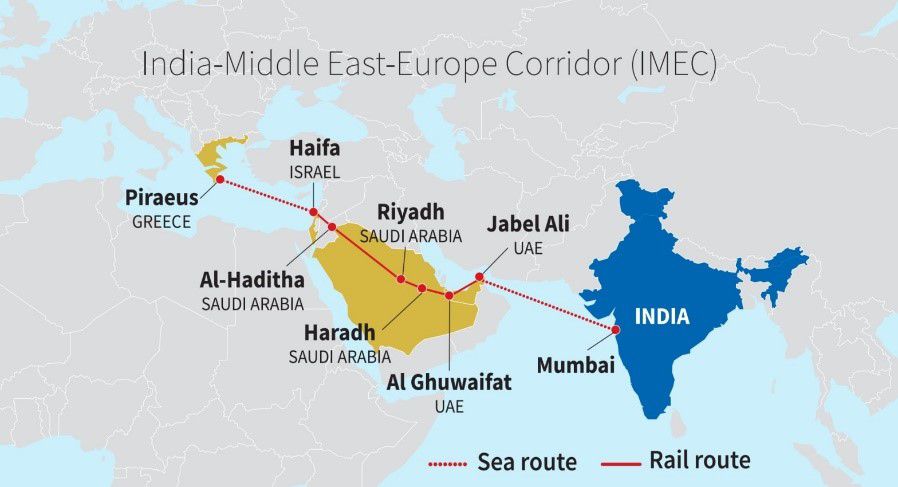
  • Eastern: India → United Arab Emirates, by sea
  • Central: United Arab Emirates → Saudi Arabia → Jordan → Israel, by rail
  • Western: Haifa → Europe, by sea

Components:

  • Railways
  • Ports
  • Energy pipelines
  • Electricity grid
  • Digital connectivity
  • Green hydrogen corridor

Significance:

  • Faster India-Europe trade
  • Reduced Suez Canal dependence
  • Supply-chain resilience
  • Energy and digital connectivity

Challenges

  • Regional conflicts: Israel-Gaza and Iran-Israel tensions threaten corridor viability.
  • Chokepoint risks: Dependence on Strait of Hormuz, Suez Canal, Bab-el-Mandeb and Malacca Strait.
  • Political coordination: Sustained cooperation among United Arab Emirates, Saudi Arabia, Jordan and Israel remains uncertain.
  • Haifa dependency: European leg of IMEC depends on stability around Haifa Port.
  • Energy security risks: Hormuz disruptions can affect India’s crude oil imports, freight costs and inflation.

Solutions Suggested

  • Flexible corridor design: Develop multiple routes instead of a single rigid corridor.
  • Alternative maritime hubs: Strengthen Duqm, Salalah and Muscat ports.
  • Strategic diplomacy: Deepen India-Gulf-Europe engagement.
  • Connectivity diversification: Pursue IMEC alongside the International North-South Transport Corridor.
  • Long-term investment: Continue infrastructure development despite temporary geopolitical disruptions.

PYQ Themes Quick Revision

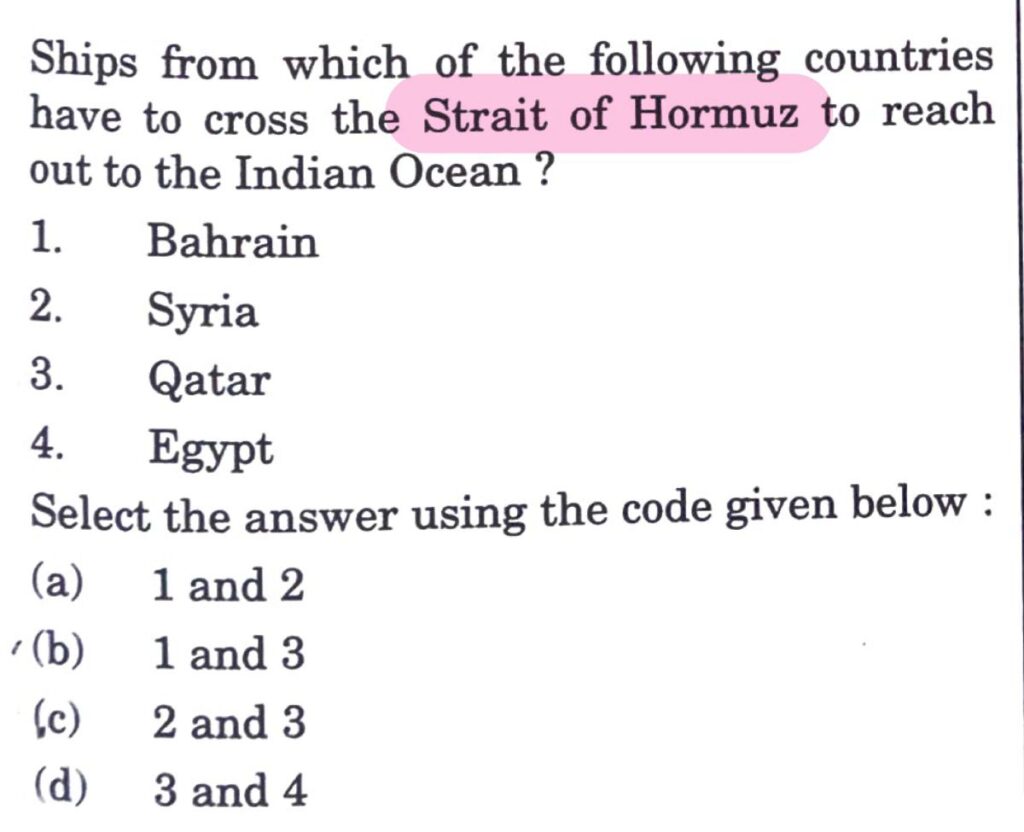
Strait of Hormuz

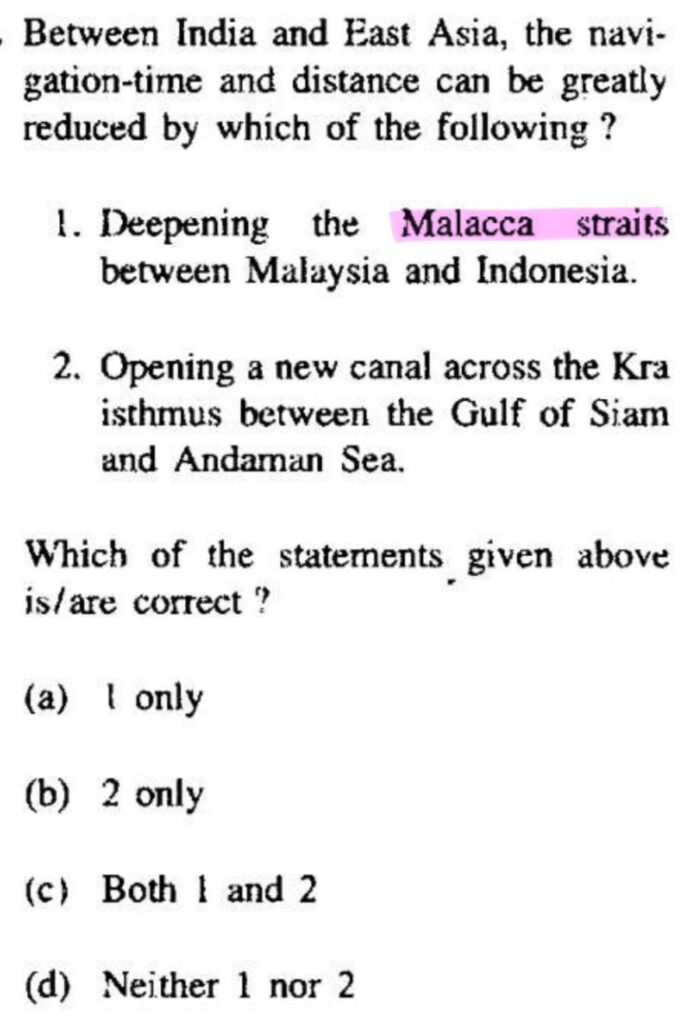
Malacca Strait

  • Indonesia-Malaysia-Singapore
  • Connects Indian Ocean and South China Sea
  • One of the busiest maritime trade routes
  • Key for Indo-Pacific commerce

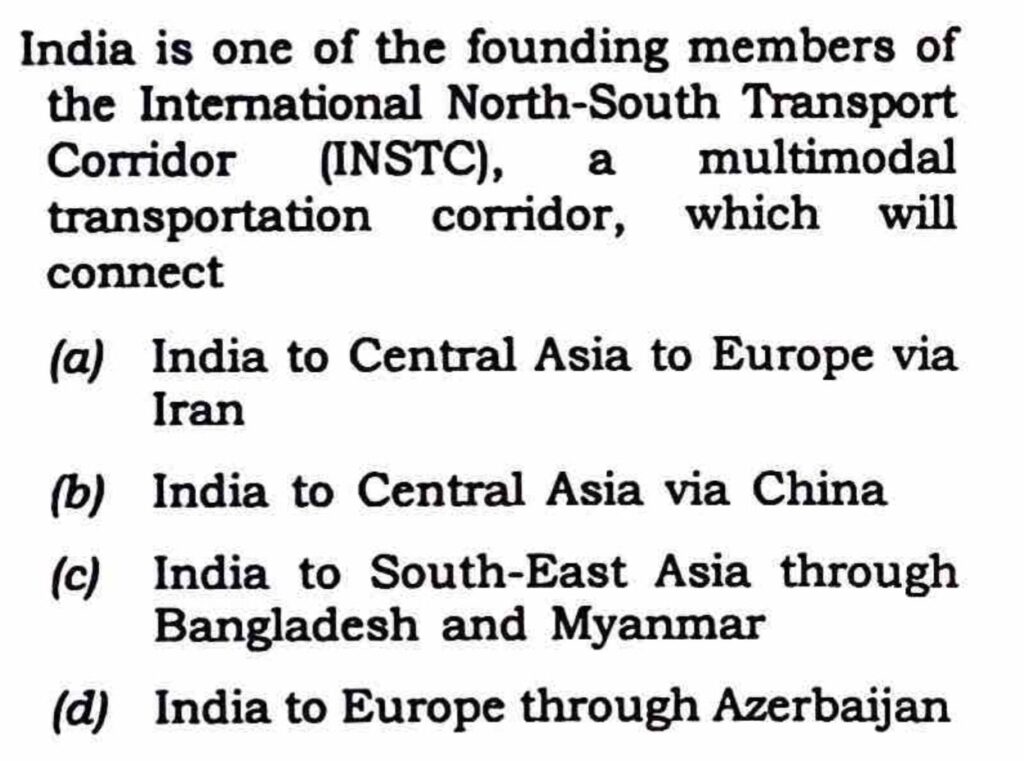
International North-South Transport Corridor

  • India-Iran-Russia initiative
  • Key node: Chabahar Port
  • Connects India with Central Asia, Russia and Europe
  • Alternative to Suez route

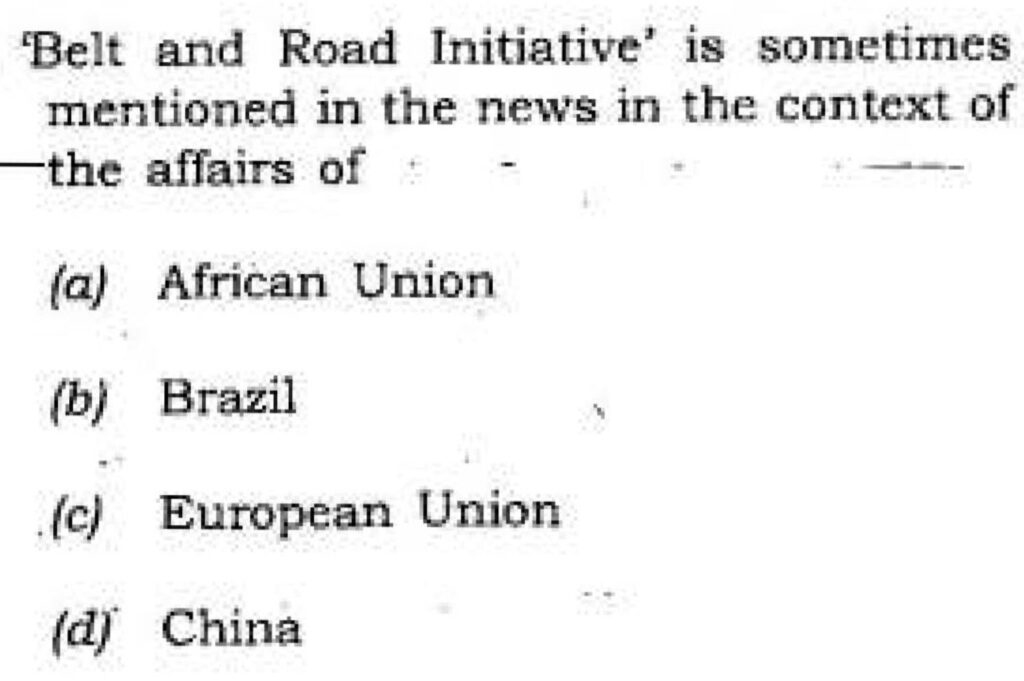
Belt and Road Initiative

  • China, 2013
  • Silk Road Economic Belt + 21st Century Maritime Silk Road
  • India opposes it due to China-Pakistan Economic Corridor passing through Pakistan-occupied Kashmir.

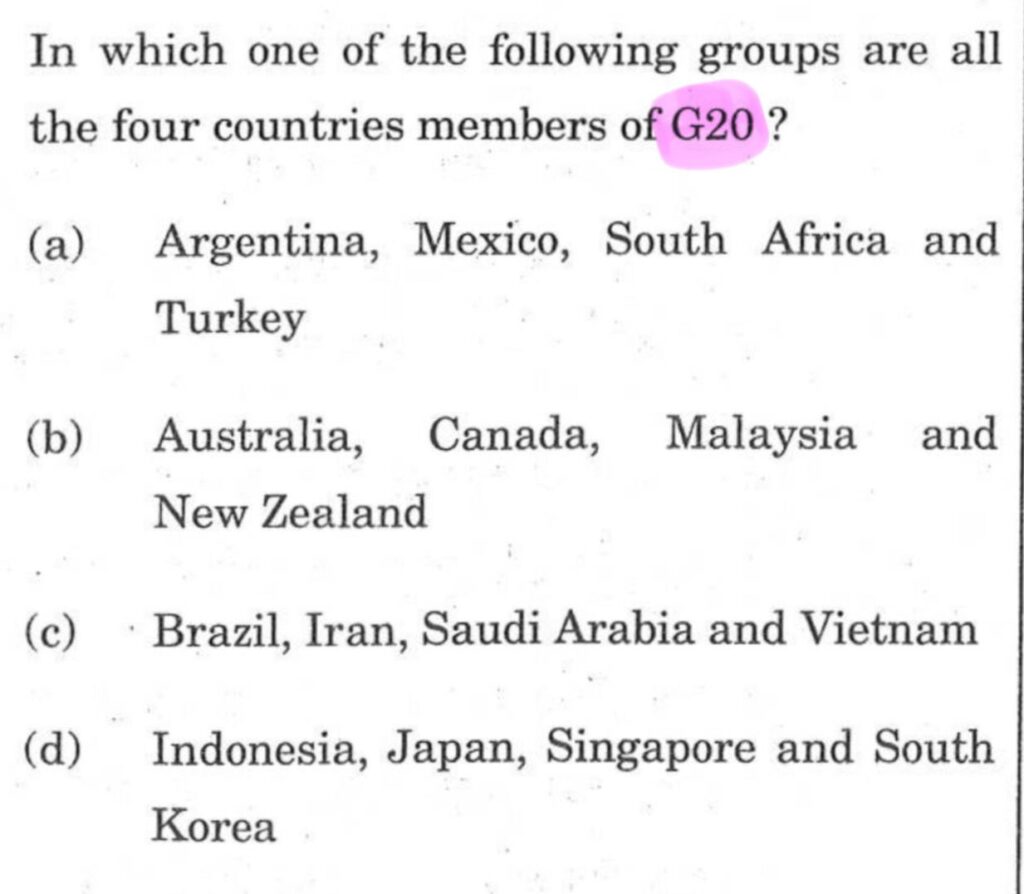
Group of Twenty

  • Established in 1999
  • Leaders’ Summit since 2008
  • 19 countries + European Union + African Union
  • No permanent secretariat
  • Troika system
  • Represents around 85% of global GDP

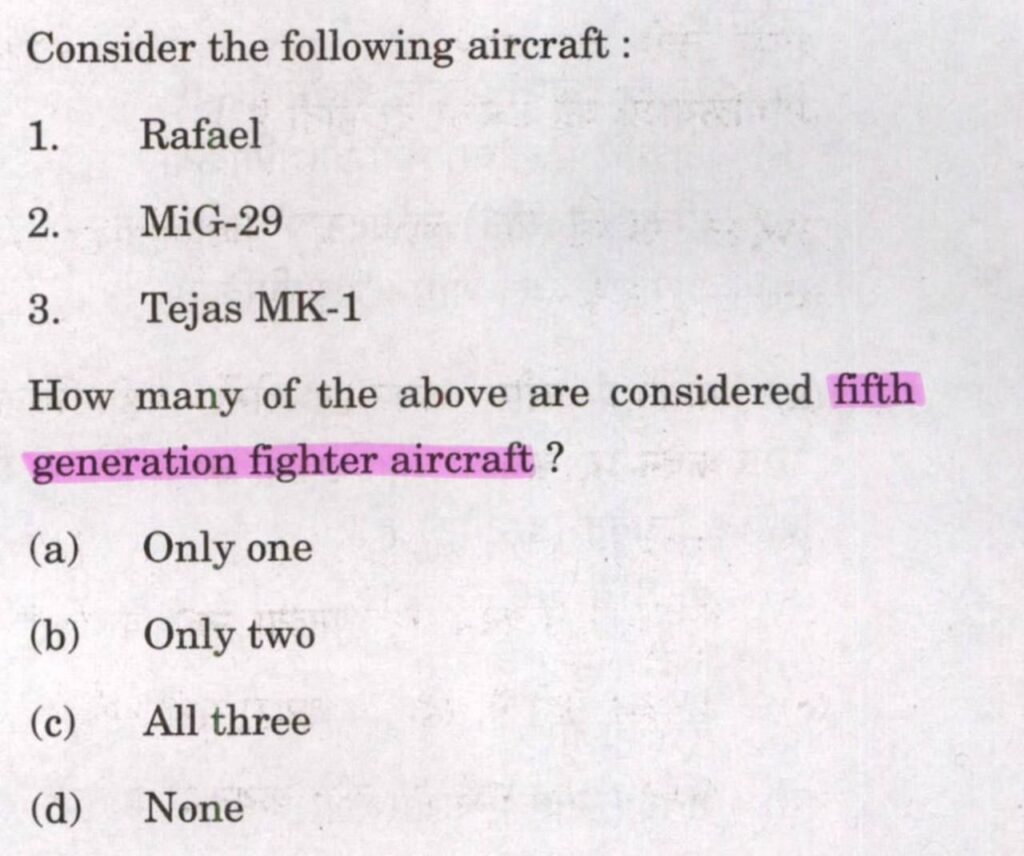
Fifth-Generation Fighter Aircraft

  • Features: Stealth, sensor fusion, supercruise, internal weapon bays
  • Examples: F-22 Raptor, F-35 Lightning II, J-20 and Su-57

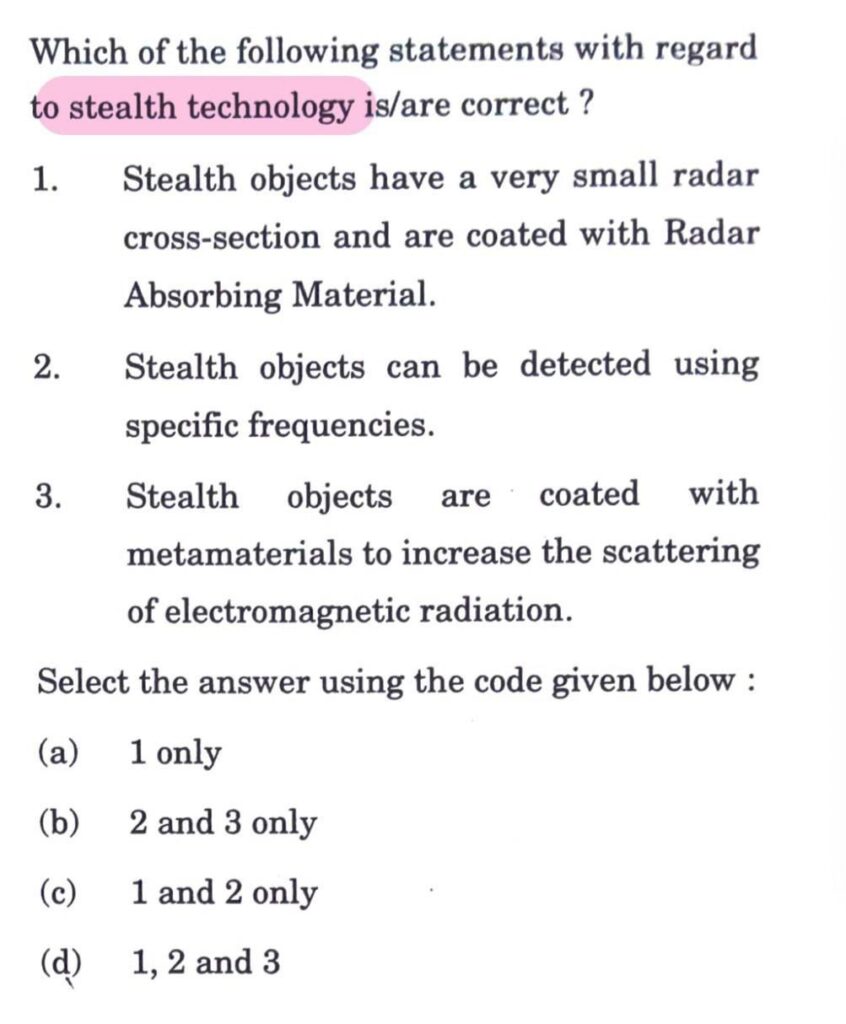
Stealth Technology

  • Low Radar Cross Section
  • Radar Absorbing Material
  • Reduces radar detection probability
  • Difficult to detect, not invisible
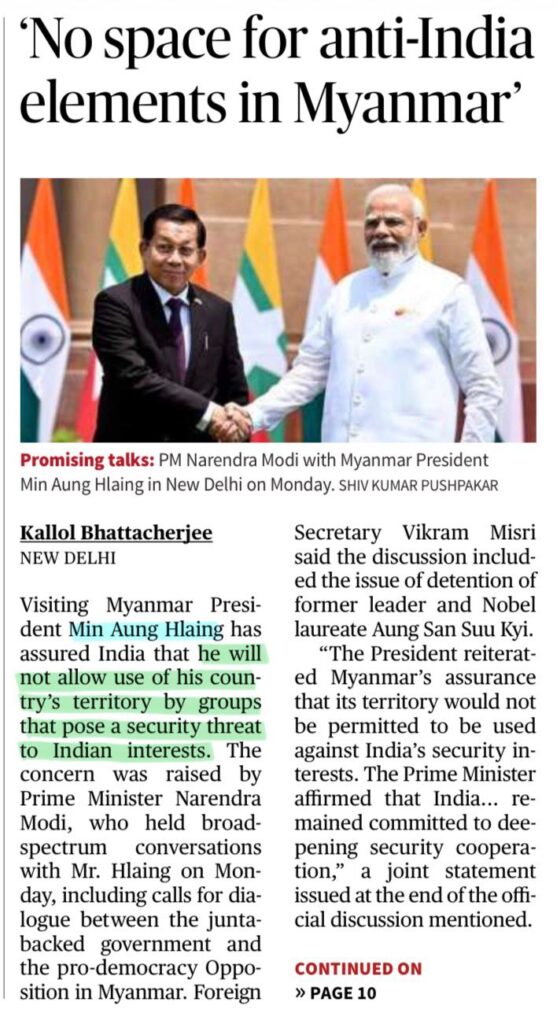
India-Myanmar Relations: Myanmar Assures Action Against Anti-India Insurgent Groups

Context: India-Myanmar Relations
Myanmar assured India that its territory will not be used by anti-India insurgent groups, highlighting the importance of border security, connectivity and strategic cooperation.

Myanmar

Official Name:
Republic of the Union of Myanmar

Capital:
Nay Pyi Taw

Border with India:
1,643 km

Indian States sharing border with Myanmar:

  • Arunachal Pradesh
  • Nagaland
  • Manipur
  • Mizoram

Importance for India

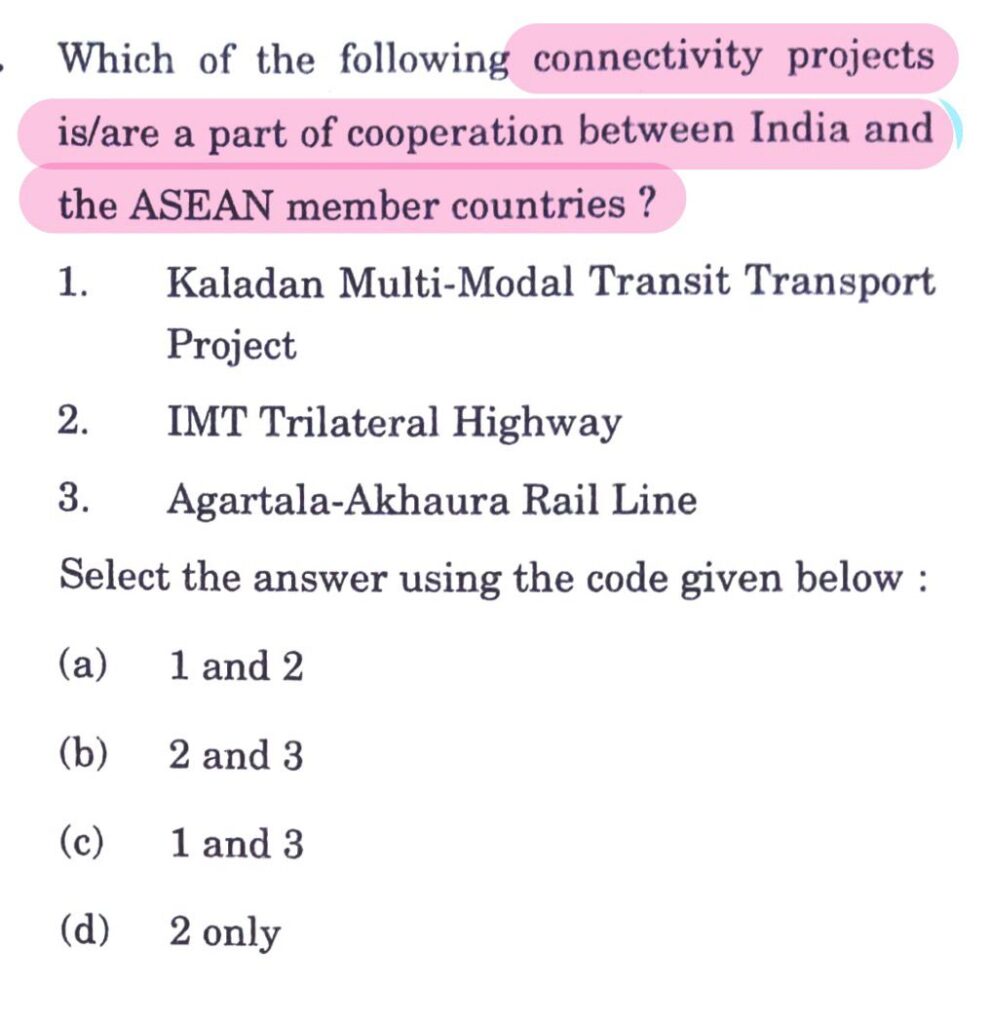
ASEAN

  • Myanmar has been a member since 1997.
  • ASEAN was established through the Bangkok Declaration, 1967.
  • Headquarters: Jakarta
  • Members: 11

Free Movement Regime

  • It allowed people living along the India-Myanmar border to travel up to 16 km across the border without visa or passport.
  • India has decided to phase out or replace the Free Movement Regime and strengthen border fencing due to security concerns.

PYQ Quick Revision

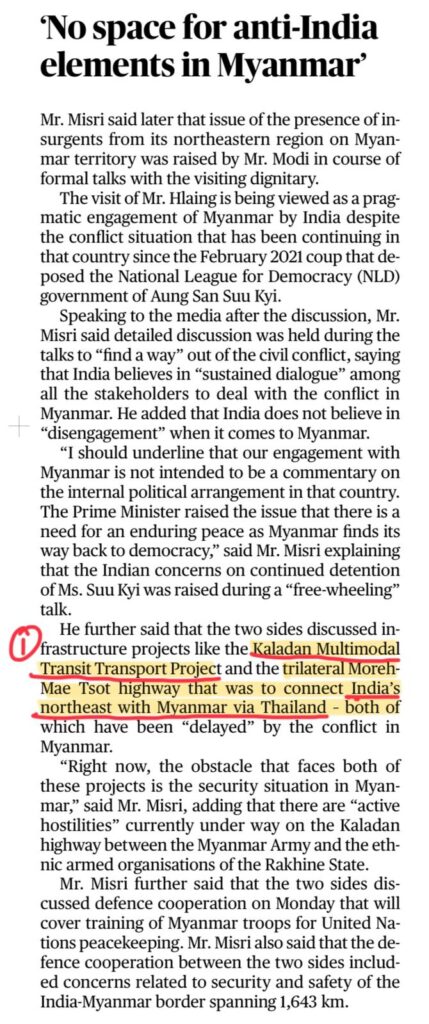
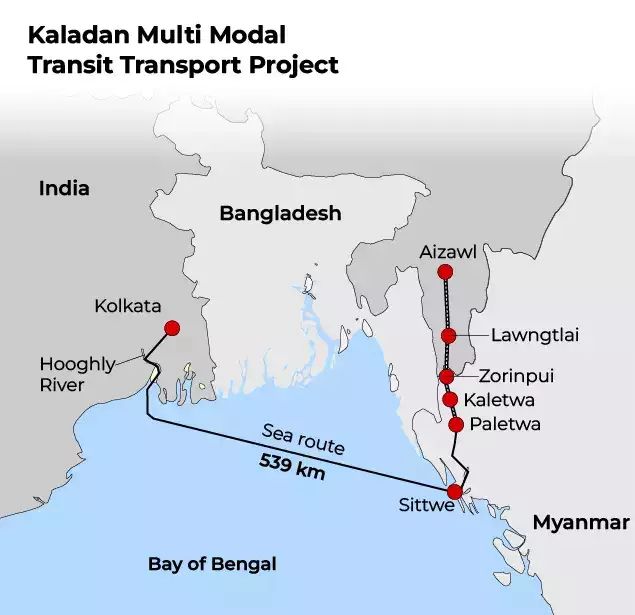
Kaladan Multi-Modal Transit Transport Project

  • Kolkata → Sittwe Port → Kaladan River → Mizoram
  • Provides alternative access to Northeast India, bypassing the Siliguri Corridor.

India-Myanmar-Thailand Trilateral Highway

  • Moreh, Manipur → Myanmar → Mae Sot, Thailand
  • Key Act East connectivity project
  • Not fully operational

Sittwe Port

  • Located in Rakhine State, Myanmar
  • Developed with Indian assistance
  • Operational
  • Maritime gateway of the Kaladan Project

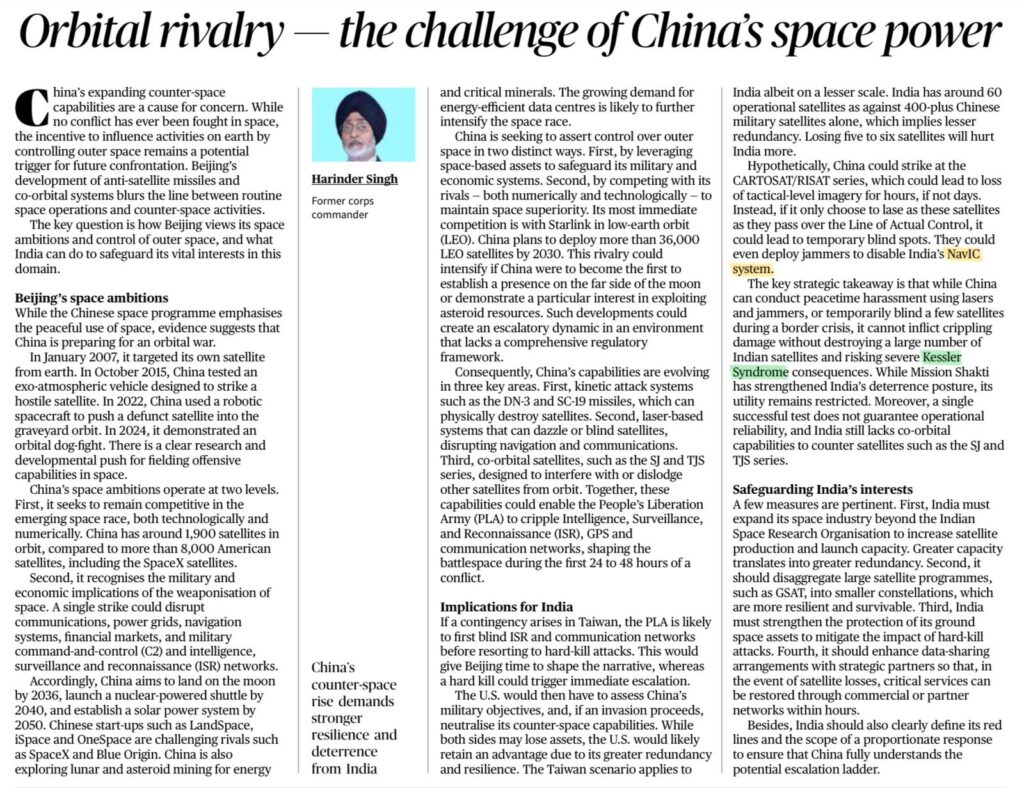
Counter-Space Weapons: China’s Growing Capabilities and India’s Space Security Concerns

Context: Counter-Space Weapons
China’s expanding counter-space capabilities have raised concerns about the security of India’s satellites, navigation systems and military communications.

Core Issue

Counter-Space Weapons

  • Anti-Satellite missiles
  • Lasers
  • Jammers
  • Co-orbital satellites

These can disrupt or destroy satellites.

Strategic Concern

Modern warfare depends on:

  • Navigation
  • Communication
  • Intelligence
  • Surveillance and Reconnaissance satellites

Indian Challenge

  • India has fewer satellites and lower redundancy compared to China.

Way Forward

  • Increase satellite constellations.
  • Strengthen indigenous space industry.
  • Improve satellite resilience and backup systems.
  • Enhance cooperation with strategic partners.

PYQ Quick Revision

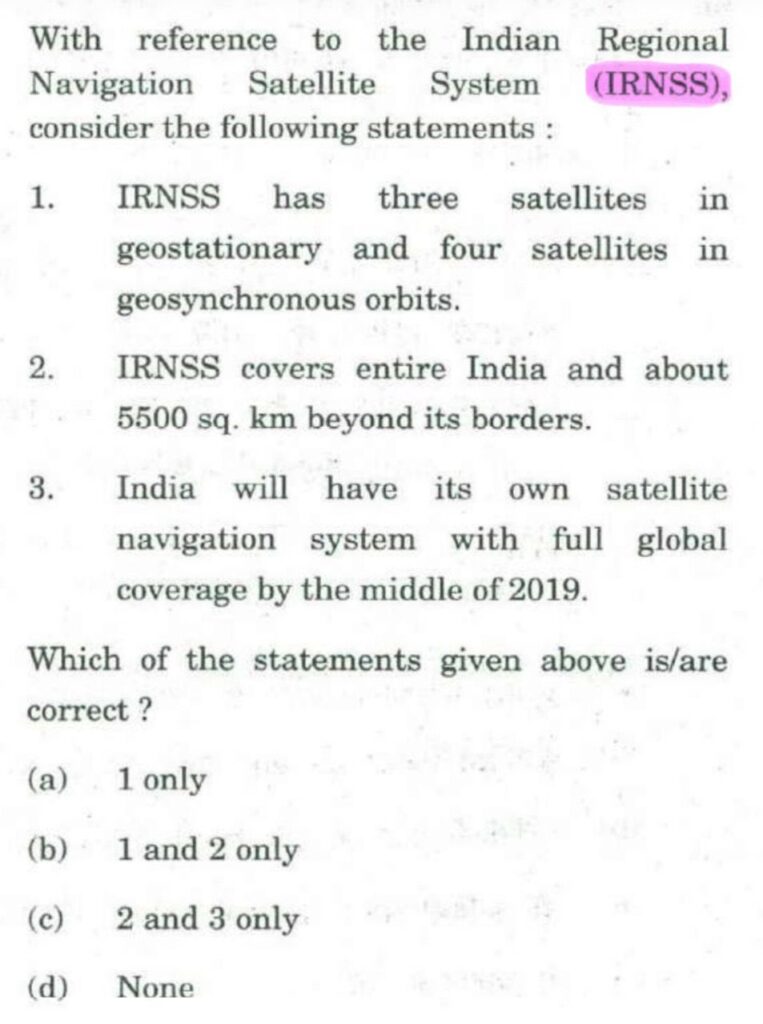
NavIC

Constellation

  • 7 satellites
  • 3 in Geostationary Orbit
  • 4 in Geosynchronous Orbit

Coverage

  • India + about 1,500 km beyond its borders

Mission Shakti, 2019

  • India’s Anti-Satellite missile test.
  • India became the 4th country to demonstrate ASAT capability.

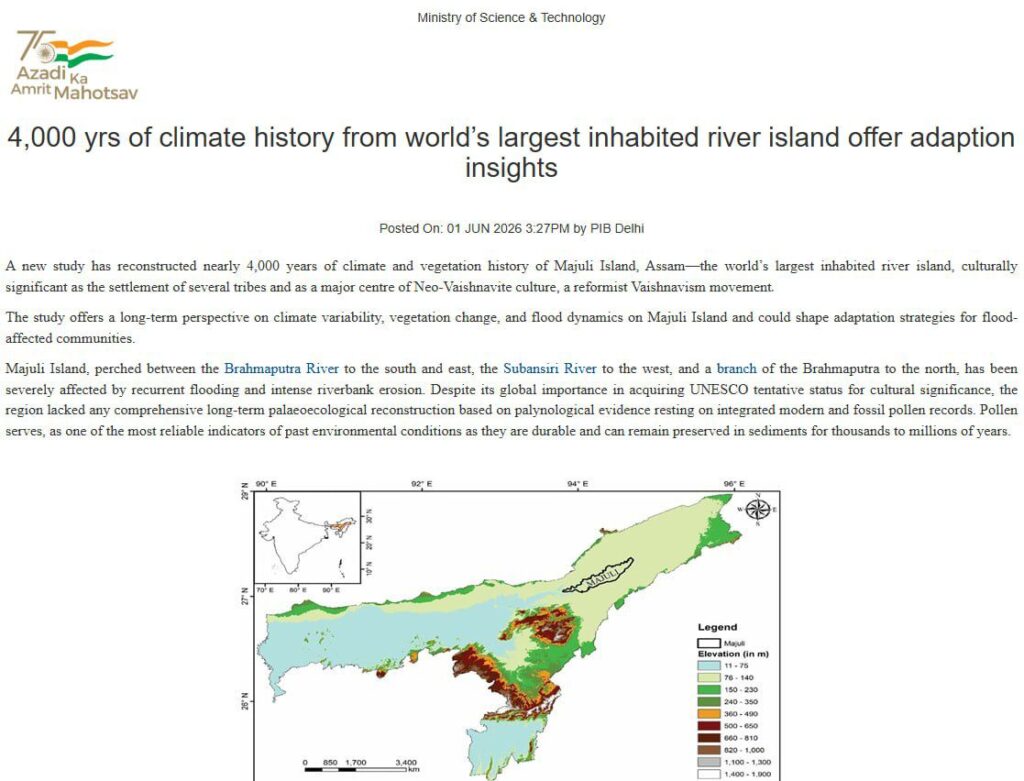
Majuli Climate History: 4,000 Years of Climate Change and Adaptation Insights

Context: Majuli Climate History
A new study reconstructed nearly 4,000 years of climate history of Majuli, Assam, offering insights into floods, erosion and climate adaptation in the Brahmaputra basin.

Majuli: Basics

  • World’s largest inhabited river island
  • Located in Assam
  • Centre of Neo-Vaishnavite culture
  • Located between Brahmaputra and Subansiri river systems
  • Major threats: floods, erosion and channel migration

PYQ Quick Revision

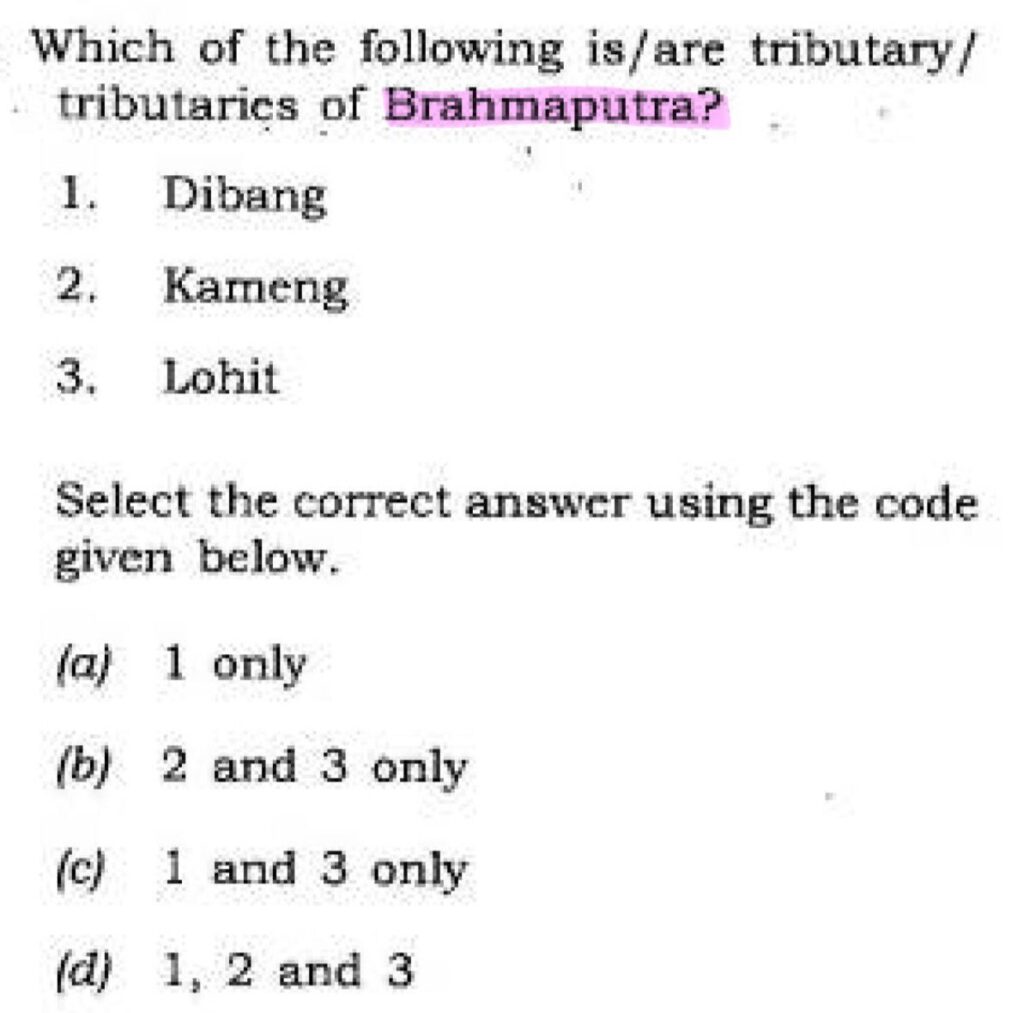
Brahmaputra River

  • Origin: Angsi Glacier, Tibet
  • Flows through China, India and Bangladesh
  • Known as Yarlung Tsangpo in China
  • Known as Siang / Dihang in India
  • Known as Jamuna in Bangladesh

Tributaries

  • Dibang
  • Kameng
  • Lohit

All three are tributaries of the Brahmaputra.

Other important tributaries:

  • Subansiri
  • Manas
  • Sankosh
  • Dhansiri
  • Kopili

Subansiri River

  • Largest tributary of Brahmaputra
  • Origin: Tibet

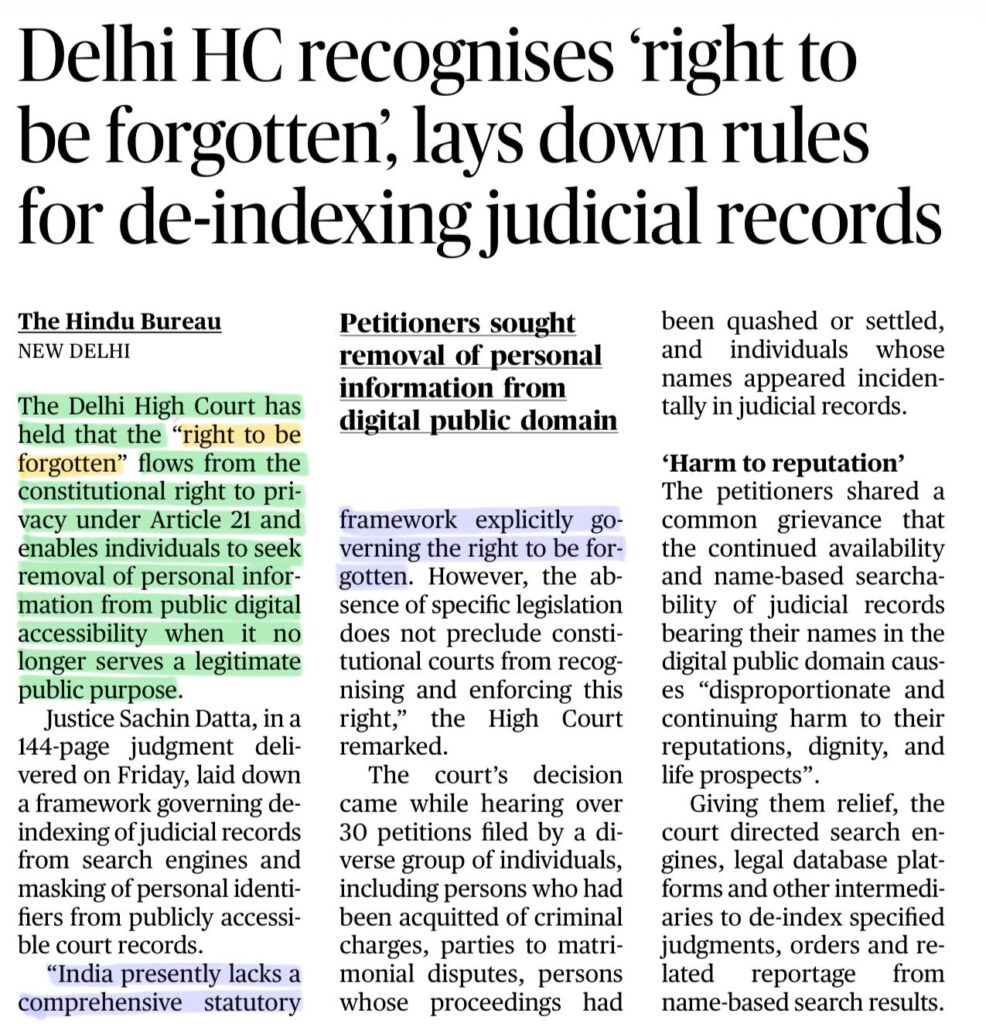
Right to be Forgotten under Article 21 Recognised by Delhi High Court

Context: Right to be Forgotten
The Delhi High Court held that the Right to be Forgotten is a part of the Right to Privacy under Article 21, allowing individuals to seek de-indexing of judicial records from search-engine results when continued disclosure causes disproportionate harm and no longer serves a legitimate public interest.

Core Discussion

Right to be Forgotten

  • Right of an individual to have outdated, irrelevant or prejudicial personal information removed from easy public access in the digital domain.

Court’s View

  • Privacy, dignity and reputation cannot be permanently compromised merely because information remains available online.

Balancing Test

Right to be Forgotten is not absolute and must be balanced against:

  • Freedom of Speech
  • Right to Information
  • Transparency
  • Open Justice

Constitutional Basis

Article 21

  • Right to Life and Personal Liberty

Justice K.S. Puttaswamy v. Union of India, 2017

  • Right to Privacy recognised as a Fundamental Right under Article 21.

Global Practice

European Union

  • Recognised under the General Data Protection Regulation.
  • Allows individuals to seek erasure of personal data under specified conditions.
About the UPSC Civil Services Examination (UPSC CSE)

The UPSC Civil Services Examination (CSE) is one of the most competitive and esteemed examinations in India, conducted by the Union Public Service Commission to recruit officers for services such as the Indian Administrative Service (IAS), Indian Police Service (IPS), Indian Foreign Service (IFS), and others. The exam comprises three stages — Prelims, Mains, and the Personality Test (Interview) — designed to test a candidate’s knowledge, aptitude, decision-making, and leadership skills.


How to Prepare Effectively for UPSC CSE

Cracking the UPSC CSE requires a deep understanding of the syllabus, consistent revision, structured answer writing, and smart test-taking strategies. The Prelims test analytical and conceptual clarity, the Mains focuses on critical thinking, articulation, and subject mastery, while the Interview assesses presence of mind, ethical judgment, and personality traits relevant to public service.

At UnderStand UPSC, we empower aspirants with a personalized and focused approach to each stage of the exam.


Why Choose UnderStand UPSC?

UnderStand UPSC is a mentorship-driven platform offering a clear, clutter-free strategy to tackle the Civil Services Examination. Our programs like Transform (for beginners and intermediate learners) and Conquer (for advanced mains preparation) provide structured study plans, syllabus-wise video content, interactive live sessions, and answer writing support.

We emphasize:

  • Concept clarity through topic-wise lectures

  • Test series designed around real UPSC standards

  • Personalized mentorship in small groups

  • Regular performance tracking and peer benchmarking

  • Doubt-clearing sessions, current affairs analysis, and monthly magazines


Join the UnderStand UPSC Learning Community

Our mission is to make UPSC preparation less overwhelming and more strategic. We combine mentorship, discipline, and academic rigor to help you clear CSE with confidence. Whether you’re preparing from Delhi, Mumbai, Bangalore, or a remote village — our online-first model ensures quality guidance reaches every corner of India.

Join the thousands of aspirants who trust UnderStand UPSC to guide their journey toward becoming civil servants.

Stay connected with us through our Telegram, YouTube, and Instagram channels for daily tips, strategies, and updates.

Copyright © 2026 USARAMBHA EDUCATION (UnderStand UPSC). All Rights Reserved.

Fill the form

Our team will reach out to you soon