5 June 2026 | Daily Current Affairs

North Eastern Council: Role in Northeast India’s Development and Connectivity

Context: Govt. has turned Northeast from region of conflict to hub of opportunities
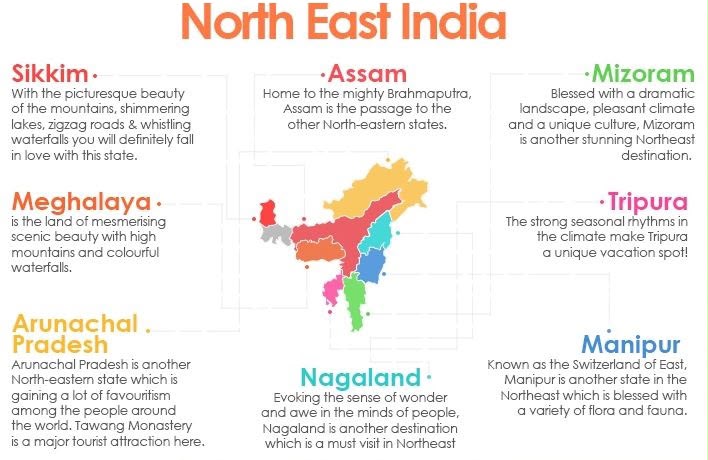
At the 73rd Plenary Session of the North Eastern Council in Shillong, the focus was on Northeast India’s transition from insurgency and security concerns to development, connectivity, technology and economic growth.

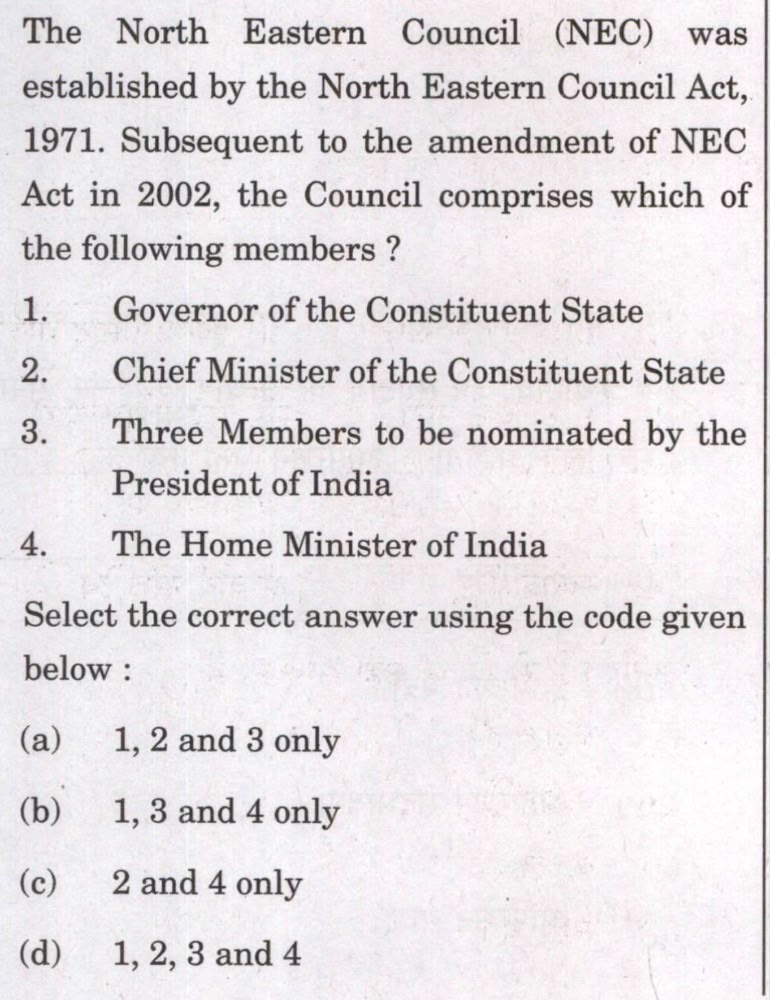
North Eastern Council

  • Established under the North Eastern Council Act, 1971.
  • Operational since 1972.
  • It is a statutory body.
  • Ministry: Ministry of Development of North Eastern Region.
  • Headquarters: Shillong, Meghalaya.
  • 2002 Amendment: NEC became the Regional Planning Body for Northeast India and Sikkim was included.

Structure

Chairman

  • Union Home Minister

Vice-Chairman

  • Minister for Development of North Eastern Region

Members

  • Governors of the 8 Northeastern States
  • Chief Ministers of the 8 Northeastern States
  • 3 members nominated by the President

Northeastern States

  • Arunachal Pradesh
  • Assam
  • Manipur
  • Meghalaya
  • Mizoram
  • Nagaland
  • Sikkim
  • Tripura

Role

  • Regional planning
  • Connectivity
  • Infrastructure
  • Socio-economic development

Key Focus Areas

  • Village Resource Mapping
  • Wetland, Forest and River Monitoring
  • Geospatial and Space Technology Start-ups
  • NER-Shield for Disaster Resilience and Early Warning
  • Green Wealth and Natural Capital Accounting
  • Artificial Intelligence, Machine Learning and Blockchain Infrastructure
  • Agarwood, Health Tourism and Foreign Trade Promotion

Eighth Schedule

Constitutional Basis

  • Article 344(1)
  • Article 351

Recognised Languages

  • 22 languages

Important Amendments

  • 21st Constitutional Amendment Act, 1967: Sindhi
  • 71st Constitutional Amendment Act, 1992: Konkani, Manipuri, Nepali
  • 92nd Constitutional Amendment Act, 2003: Bodo, Dogri, Maithili, Santali
  • 96th Constitutional Amendment Act, 2011: Oriya renamed as Odia
US DCA 5 June 2026

Ecosystem-Based Adaptation: How Mangroves Strengthen Coastal Climate Resilience

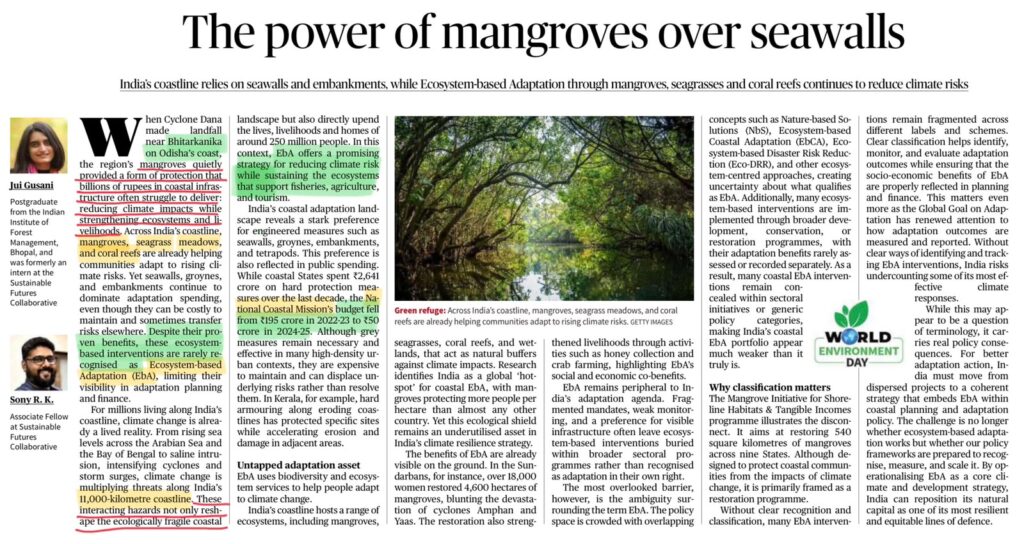
Context: The power of mangroves over seawalls
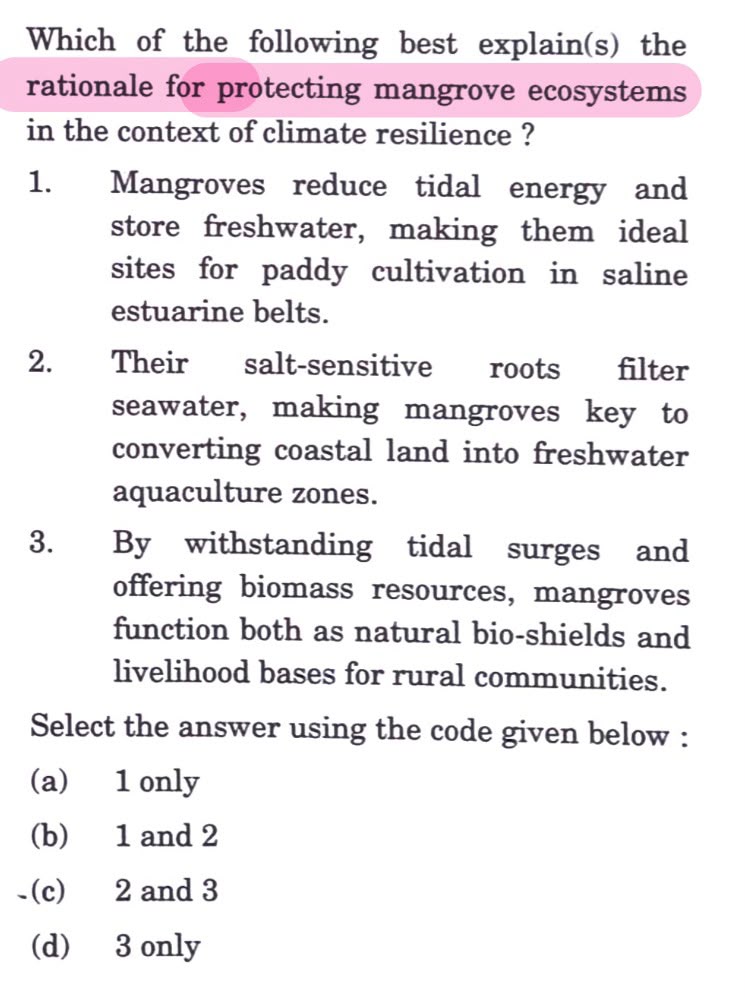
The article argues that Ecosystem-Based Adaptation through mangroves, seagrass meadows and coral reefs can provide sustainable climate resilience and coastal protection while supporting biodiversity and livelihoods.

Mangroves: Basics

  • Salt-tolerant vegetation found in inter-tidal coastal areas, estuaries and deltas.
  • Act as natural barriers against cyclones, storm surges, tsunamis and coastal erosion.
  • Important Blue Carbon Ecosystem with high carbon sequestration potential.
  • Support fisheries, biodiversity and coastal livelihoods.

Major Mangrove Areas

  • Sundarbans, West Bengal
  • Bhitarkanika, Odisha
  • Godavari–Krishna Delta, Andhra Pradesh
  • Pichavaram, Tamil Nadu
  • Andaman and Nicobar Islands

Ecosystem-Based Adaptation

Meaning

  • Use of ecosystems and biodiversity to help communities adapt to climate change.

How Adaptation Happens

Mangroves

  • Reduce cyclone impact, storm surges and coastal erosion.

Coral Reefs

  • Absorb wave energy and protect coastlines.

Seagrass Meadows

  • Stabilise seabed and store carbon.

Wetlands

  • Absorb floodwaters and regulate water flow.

Benefits

  • Coastal protection
  • Flood control
  • Carbon sequestration
  • Biodiversity conservation
  • Livelihood support
  • Cost-effective adaptation

National Coastal Mission

  • Launched: 2014
  • Under: National Action Plan on Climate Change
  • Ministry: Ministry of Environment, Forest and Climate Change

Objective

  • Climate-resilient coastal management through conservation of mangroves, coral reefs and other coastal ecosystems while protecting coastal communities and livelihoods.

Climate Finance: Challenges and Investment Needs for India’s Climate Goals

Context: Funding India’s climate future, a trillion-dollar question
India’s climate challenge is not a shortage of capital but the absence of a strong climate-finance architecture. The article advocates climate taxonomy, green-finance reforms, State-level financing mechanisms and deeper capital markets to mobilise climate investments at scale.

Important Data for Mains

What India Needs

  • ₹162.5 lakh crore, around $2.5 trillion, by 2030 for climate targets.
  • $10.1 trillion for Net Zero by 2070.
  • Additional investment of 2.5% of GDP annually till 2030.
  • $467 billion needed for steel, cement, power and transport decarbonisation.

What India Has Done

  • $55.9 billion Green, Social, Sustainability and Sustainability-Linked debt issued till 2024.
  • 83% of sustainable debt issuance is green debt.
  • ₹477 billion Sovereign Green Bonds issued.
  • RBI Climate Finance and Climate Risk Management Framework introduced.

New Collective Quantified Goal

  • Adopted at COP29, Baku, 2024.
  • Replaces $100 billion per year goal from COP15, Copenhagen, 2009.
  • Developed countries to mobilise $300 billion annually by 2035.

Priority Sector Lending

  • RBI-mandated lending to priority sectors.

Suggestion

  • Expand PSL coverage for climate adaptation, renewable energy and other green investments.

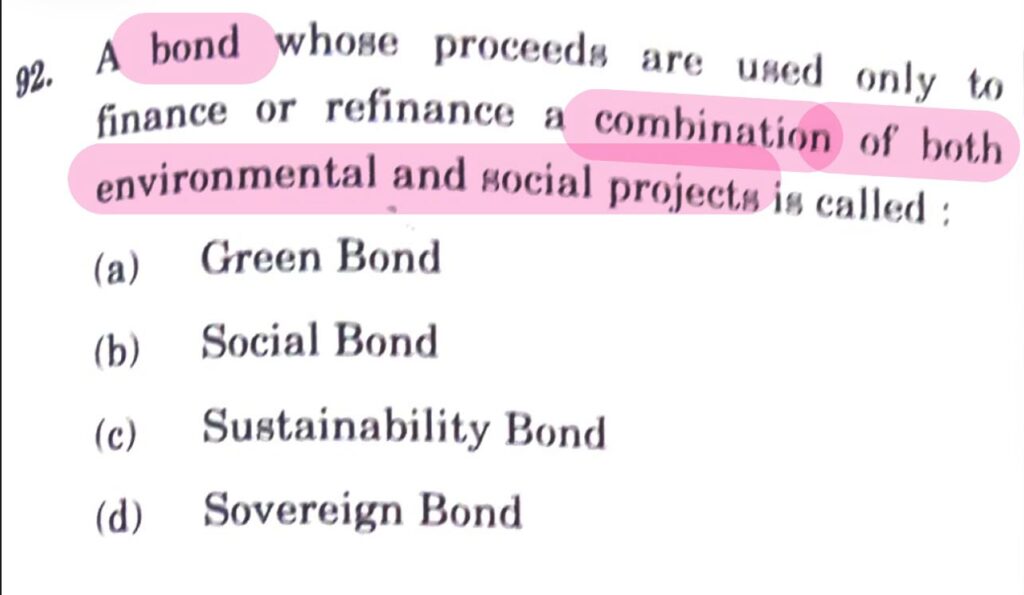
Green, Social and Sustainability Bonds

Green Bond

  • Used for environmental projects.

Social Bond

  • Used for social projects.

Sustainability Bond

  • Used for environmental and social projects.

Sustainability-Linked Bond

  • Linked to sustainability targets.

Nationally Determined Contributions

Meaning

  • National climate commitments under the Paris Agreement.

India’s Updated NDC: 2031–35

Emissions Intensity

  • Reduce GDP emissions intensity by 47% from 2005 levels by 2035.

Non-Fossil Capacity

  • Achieve 60% of installed electric power capacity from non-fossil fuel sources by 2035.

Carbon Sink

  • Create an additional 3.5–4 billion tonnes of CO₂ equivalent carbon sink through forests and tree cover by 2035.

Compassion: Turning Personal Loss into Educational Support for Students

Context: Man turns tragic loss into mission to help students live their dreams
After losing his son in 2022, Odisha-based contractor Anil Mahalik sold part of his land, established the Biswa Bhusan Memorial Trust, and has supported 20 MBBS students from economically weaker backgrounds, initially 10, transforming personal grief into a mission of educational empowerment.

Mains Enrichment: GS4 Ethics

Compassion

  • Supporting disadvantaged students by responding to human suffering with action.

Altruism

  • Using personal resources for the welfare of others without any expectation of reward.

Emotional Intelligence and Resilience

  • Channeling grief into a constructive social mission and creating positive outcomes from adversity.

Critical Minerals: India-UK Observatory for Secure Supply Chains

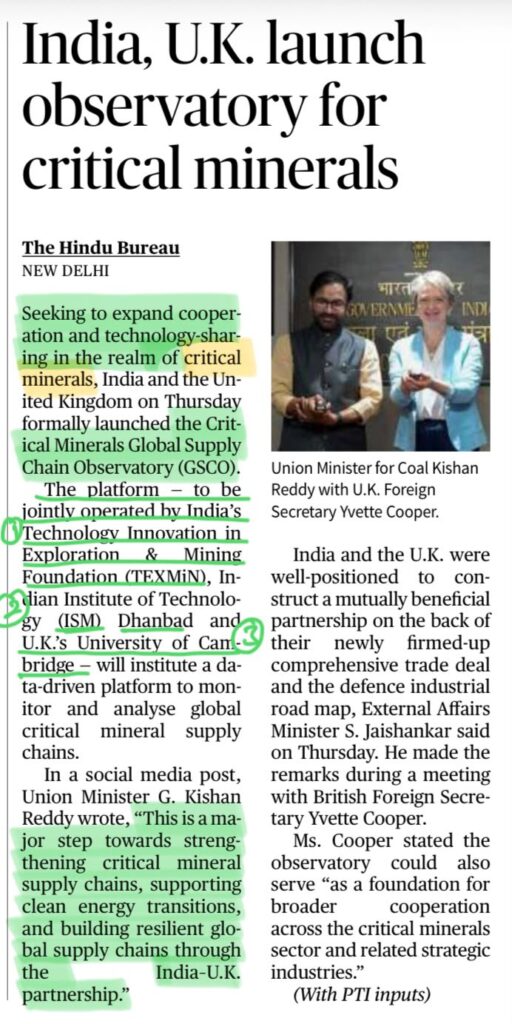
Context: India, U.K. launch observatory for critical minerals
India and the United Kingdom launched the Critical Minerals Global Supply Chain Observatory to strengthen critical mineral supply chains, improve supply-chain resilience and support clean energy and advanced technology sectors.

Critical Minerals Global Supply Chain Observatory

Partners

  • Technology Innovation in Exploration and Mining Foundation, IIT (ISM) Dhanbad, India
  • University of Cambridge, United Kingdom

Functions

  • Supply-chain monitoring
  • Risk assessment
  • Data analytics
  • Technology cooperation
  • Strategic policy support

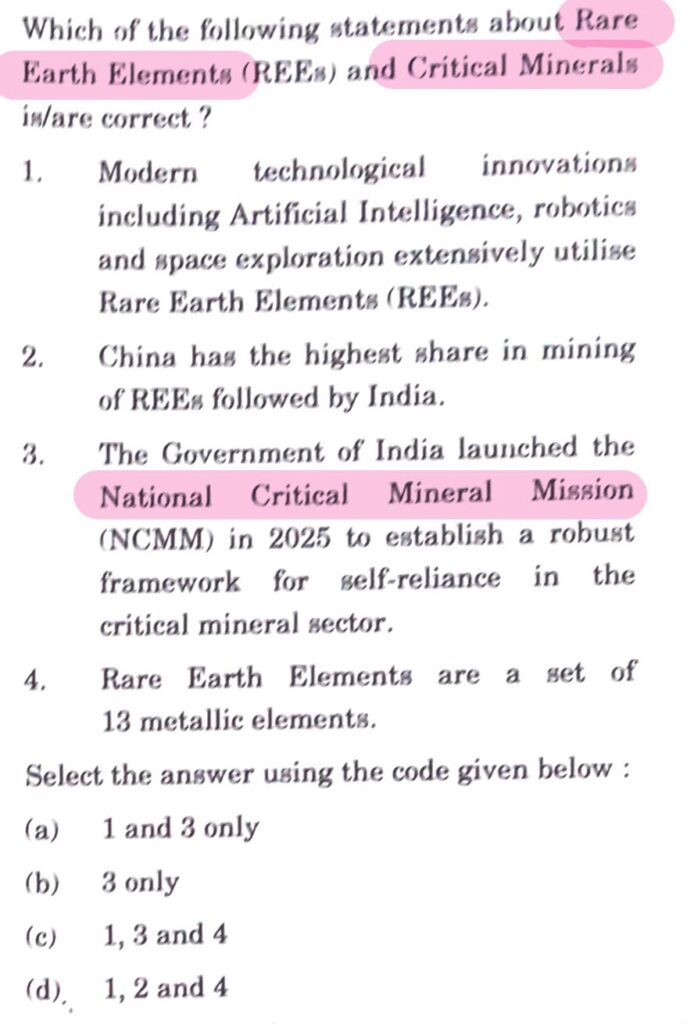
Critical Minerals and Rare Earth Elements

Critical Minerals

  • Strategic minerals essential for economic and national security.
  • Used in Electric Vehicles, batteries, semiconductors, solar panels, wind turbines, energy storage and telecommunications.
  • India has identified 30 Critical Minerals.

Rare Earth Elements

  • Group of 17 elements.
  • Includes 15 Lanthanides, Scandium and Yttrium.
  • Used in permanent magnets, electric motors, robotics, missiles, radars, fighter aircraft, satellites and advanced electronics.

National Critical Mineral Mission

  • Launched: 2025
  • Ministry: Ministry of Mines

Objective

  • Secure critical mineral supply chains and achieve mineral self-reliance.

Focus Areas

  • Exploration
  • Mining
  • Overseas acquisitions
  • Processing and refining
  • Recycling
  • Strategic stockpiles
  • Research and technology
About the UPSC Civil Services Examination (UPSC CSE)

The UPSC Civil Services Examination (CSE) is one of the most competitive and esteemed examinations in India, conducted by the Union Public Service Commission to recruit officers for services such as the Indian Administrative Service (IAS), Indian Police Service (IPS), Indian Foreign Service (IFS), and others. The exam comprises three stages — Prelims, Mains, and the Personality Test (Interview) — designed to test a candidate’s knowledge, aptitude, decision-making, and leadership skills.


How to Prepare Effectively for UPSC CSE

Cracking the UPSC CSE requires a deep understanding of the syllabus, consistent revision, structured answer writing, and smart test-taking strategies. The Prelims test analytical and conceptual clarity, the Mains focuses on critical thinking, articulation, and subject mastery, while the Interview assesses presence of mind, ethical judgment, and personality traits relevant to public service.

At UnderStand UPSC, we empower aspirants with a personalized and focused approach to each stage of the exam.


Why Choose UnderStand UPSC?

UnderStand UPSC is a mentorship-driven platform offering a clear, clutter-free strategy to tackle the Civil Services Examination. Our programs like Transform (for beginners and intermediate learners) and Conquer (for advanced mains preparation) provide structured study plans, syllabus-wise video content, interactive live sessions, and answer writing support.

We emphasize:

  • Concept clarity through topic-wise lectures

  • Test series designed around real UPSC standards

  • Personalized mentorship in small groups

  • Regular performance tracking and peer benchmarking

  • Doubt-clearing sessions, current affairs analysis, and monthly magazines


Join the UnderStand UPSC Learning Community

Our mission is to make UPSC preparation less overwhelming and more strategic. We combine mentorship, discipline, and academic rigor to help you clear CSE with confidence. Whether you’re preparing from Delhi, Mumbai, Bangalore, or a remote village — our online-first model ensures quality guidance reaches every corner of India.

Join the thousands of aspirants who trust UnderStand UPSC to guide their journey toward becoming civil servants.

Stay connected with us through our Telegram, YouTube, and Instagram channels for daily tips, strategies, and updates.

Copyright © 2026 USARAMBHA EDUCATION (UnderStand UPSC). All Rights Reserved.

Fill the form

Our team will reach out to you soon