11 June 2026 | Daily Current Affairs

Floating Solar Photovoltaic Potential in India: 102 GW Capacity Report

Context: Floating Solar Capacity in India
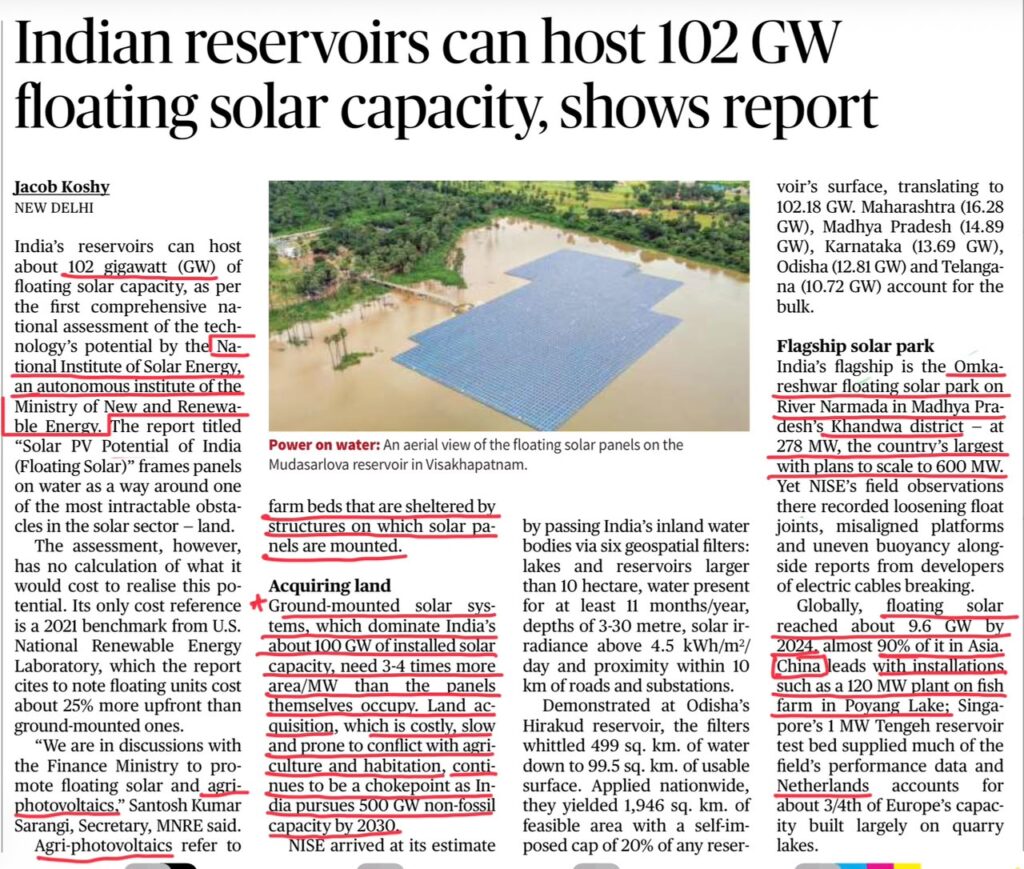
A National Institute of Solar Energy report estimates that India’s reservoirs can support 102.18 GW of Floating Solar Photovoltaic capacity.

Floating Solar and NISE

Floating Solar Photovoltaic

  • Solar panels installed on floating structures over reservoirs and lakes.

Importance

  • Reduces land requirement.
  • Ground-mounted solar faces land constraints.
  • Ground-mounted solar requires 3–4 times more land per MW than the panel area.
  • Utilises unused water surfaces.
  • Reduces evaporation losses.

National Institute of Solar Energy

Status

  • Autonomous institution under the Ministry of New and Renewable Energy

Role

  • Apex body for solar energy research, testing and certification.

Important Point

  • It is not a statutory body.

Value Addition

India’s largest floating solar project

  • Omkareshwar Floating Solar Park, Madhya Pradesh
  • Capacity: 278 MW
  • Planned expansion: 600 MW

Global floating solar capacity

  • 9.6 GW in 2024
  • China leads globally
  • Asia accounts for nearly 90% of installed capacity

India’s renewable energy rank

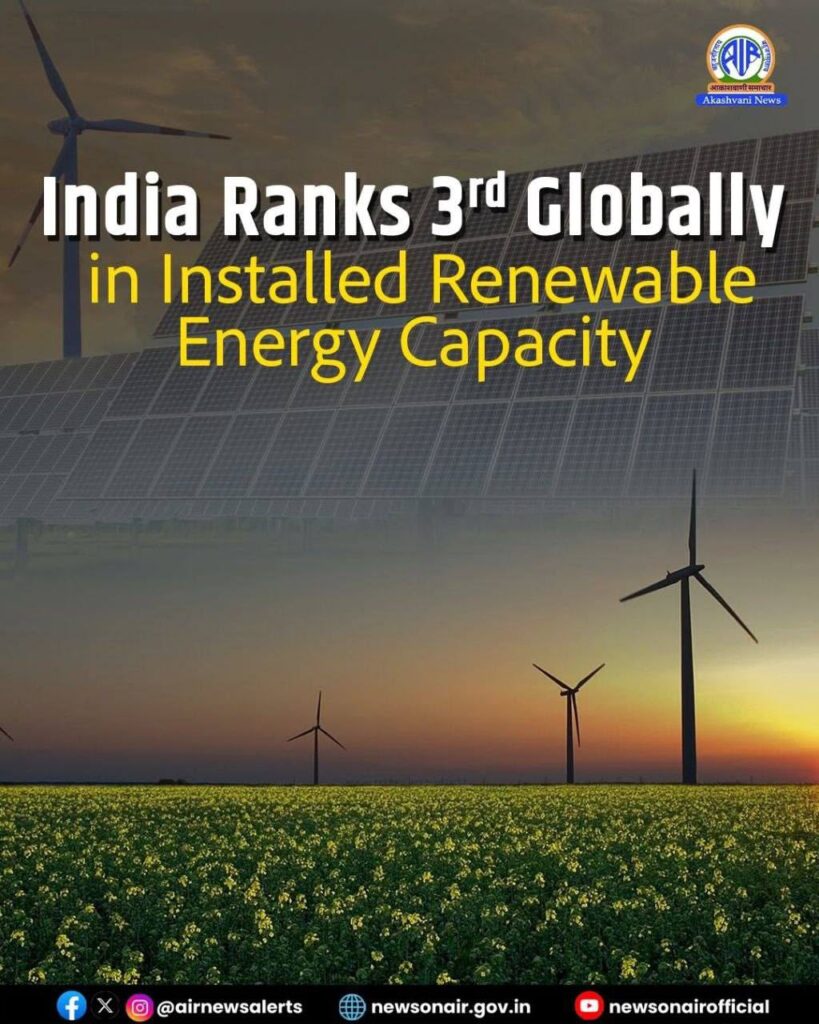
  • India ranks 3rd globally in installed Renewable Energy capacity.
  • China ranks 1st.
  • USA ranks 2nd.

India’s Renewable Energy Mix

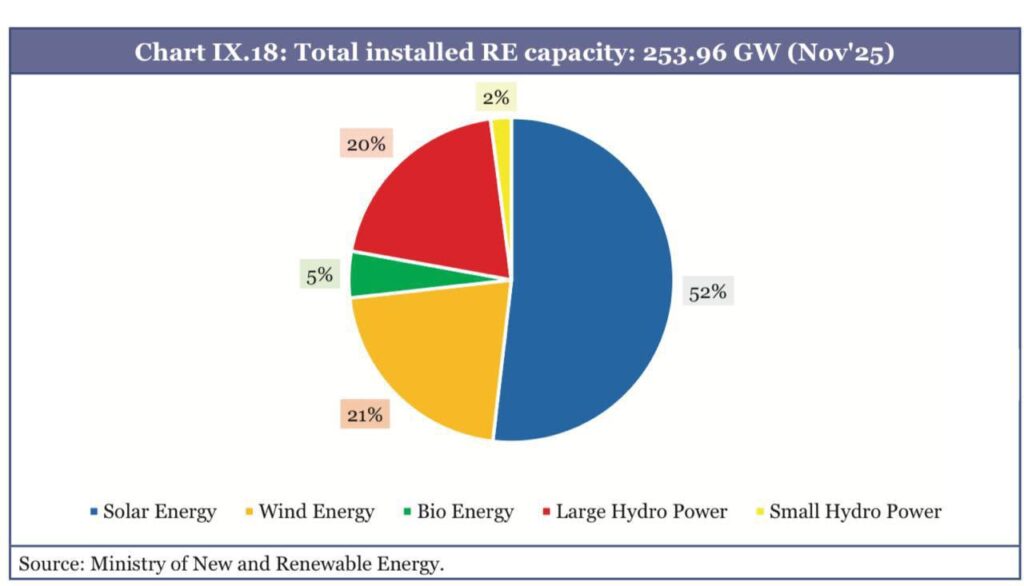
Total installed Renewable Energy capacity: 253.96 GW, November 2025

  • Solar Energy — 52%
  • Wind Energy — 21%
  • Large Hydro Power — 20%
  • Bio-Energy — 5%
  • Small Hydro Power — 2%

Agrivoltaics

Agrivoltaics means cultivation of crops beneath or alongside elevated solar panels.

Benefits

  • Dual use of land — agriculture and solar power.
  • Additional income for farmers.
  • Reduces land acquisition conflicts.
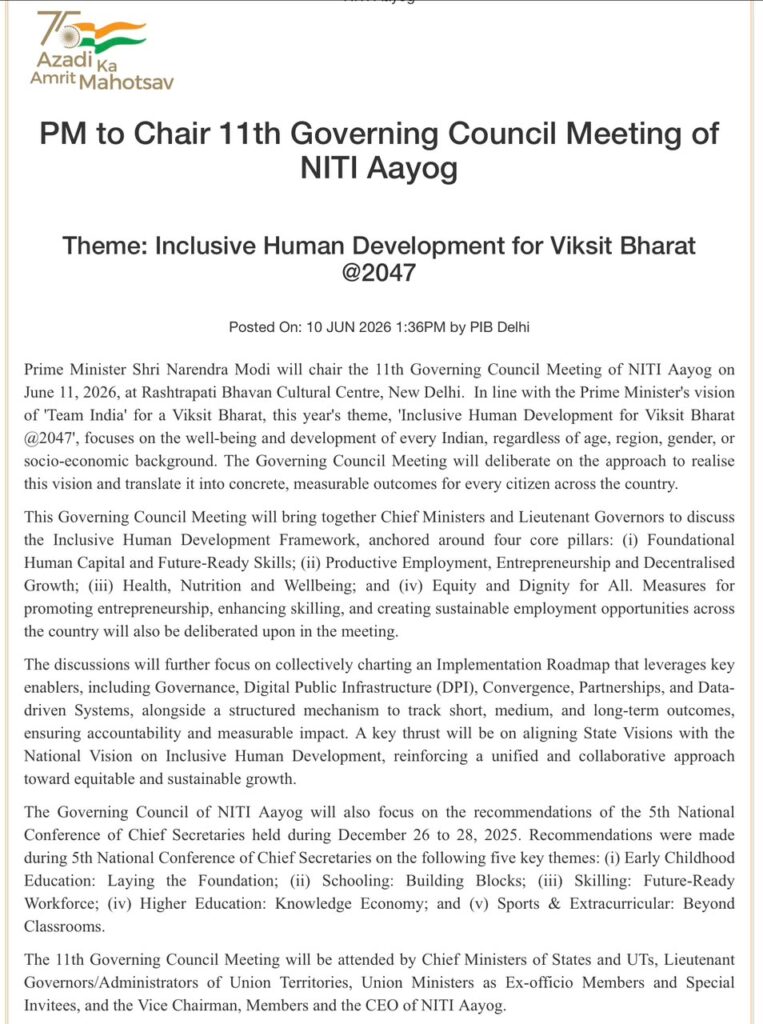
NITI Aayog Governing Council: 11th Meeting and Key Functions Explained

Context: NITI Aayog Governing Council
Prime Minister will chair the 11th Governing Council Meeting of NITI Aayog on 11 June 2026. The theme is “Inclusive Human Development for Viksit Bharat @2047.”

National Institution for Transforming India

Established

  • 1 January 2015

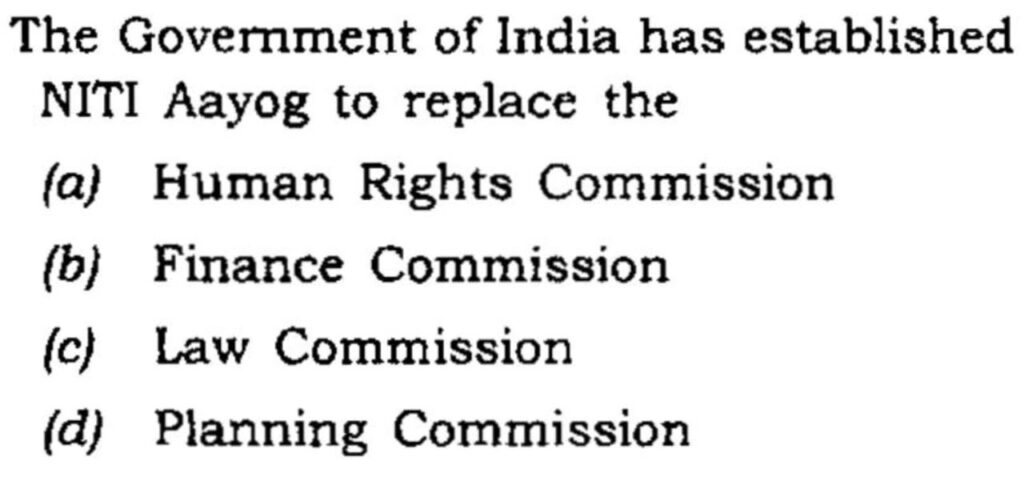
Replaced

Nature

  • Non-Constitutional body
  • Non-Statutory body
  • Executive body

Objective

  • Policy think tank promoting Cooperative and Competitive Federalism.

Composition

Chairperson

  • Prime Minister

Vice-Chairperson

  • Appointed by Prime Minister

Members

  • Full-time members
  • Ex-officio Union Ministers

CEO

  • Appointed by Prime Minister

Special Invitees

  • Domain experts

Governing Council

Status

  • Highest body of NITI Aayog

Members

  • Prime Minister
  • Chief Ministers of States
  • Lieutenant Governors / Administrators of Union Territories

Functions

  • Centre-State coordination
  • National development priorities
  • Policy consensus building

Meetings

  • No fixed interval
  • Generally held once a year

11th Governing Council Meeting, 2026

Theme

  • Inclusive Human Development for Viksit Bharat @2047

Total Fertility Rate Decline Across the World: Causes and Implications

Context: Global Decline in Fertility Rates
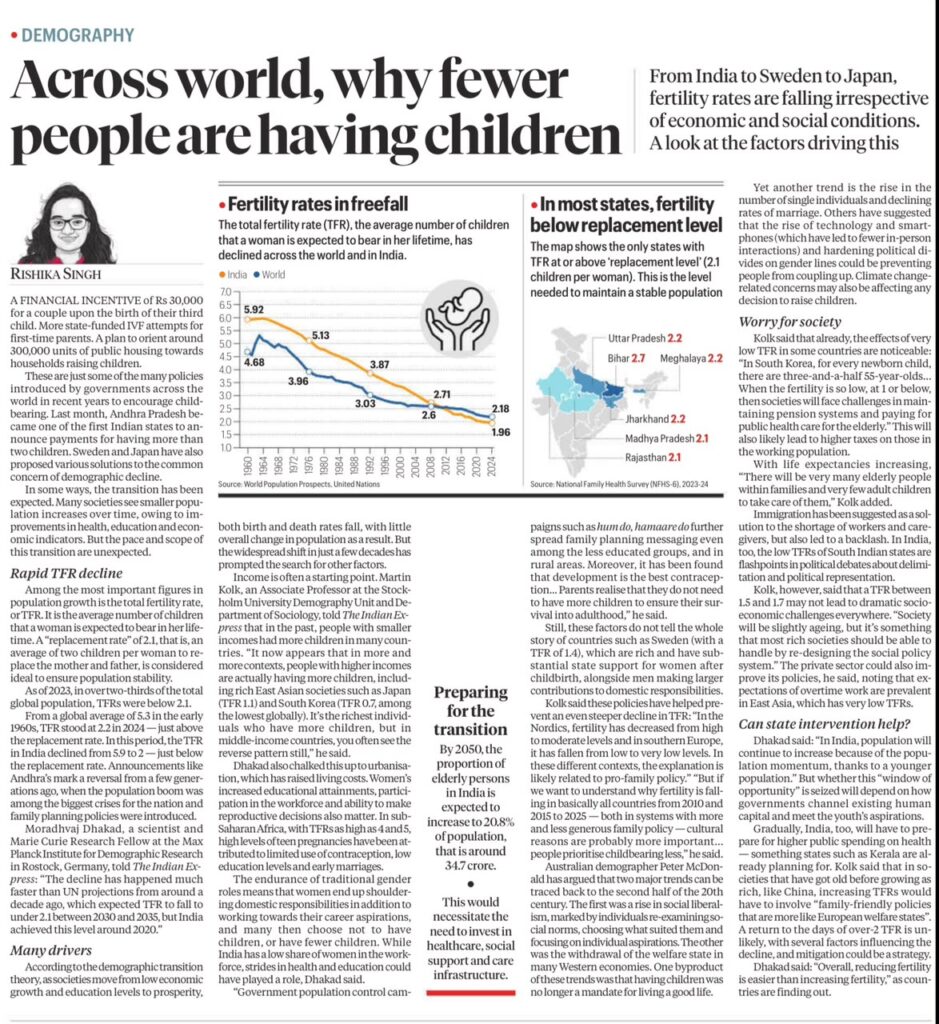
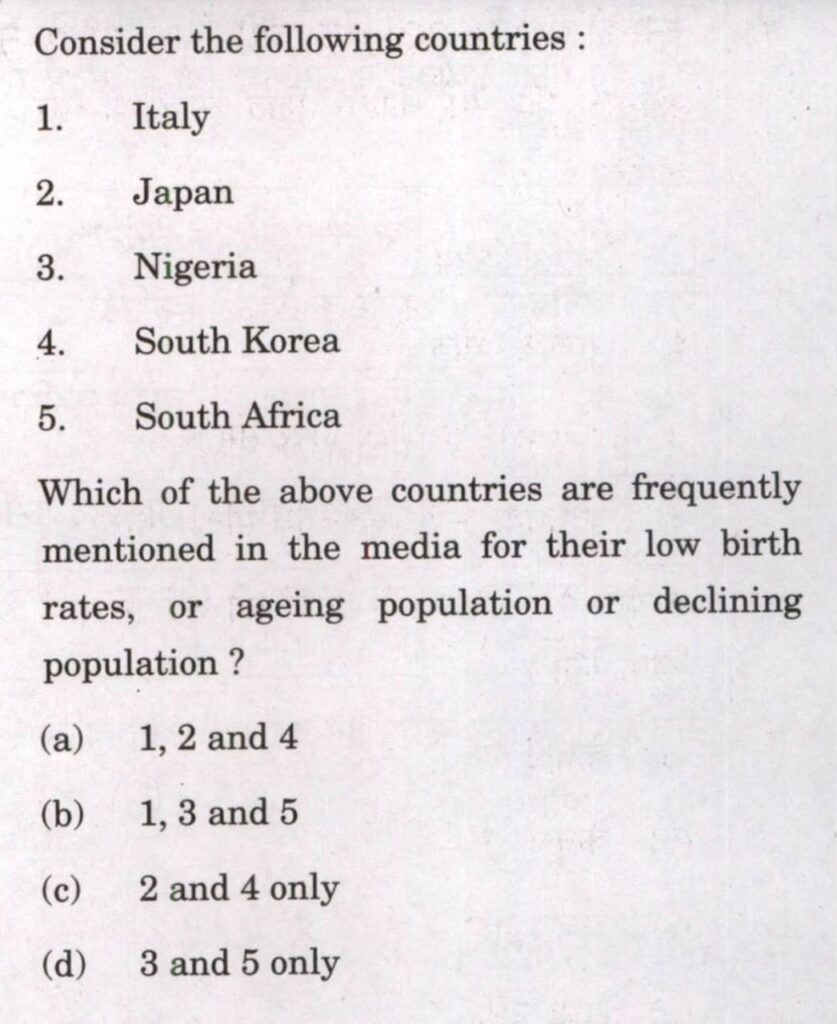
Fertility rates are declining across the world, including India, pushing many countries below the replacement level required for long-term population stability.

Key Terms

Total Fertility Rate

  • Average number of children a woman is expected to have during her reproductive years.

Replacement Level Fertility

  • Average number of children needed per woman to replace parents and maintain a stable population.
  • Usually taken as 2.1 children per woman.

Global Scenario

World TFR

  • 4.68 in 1960
  • 2.18 in 2024

Major Drivers

  • Urbanisation
  • Higher female education
  • Workforce participation
  • Delayed marriages
  • Contraception access
  • Rising cost of living

Concerns

  • Ageing population
  • Labour shortages
  • Rising pension burden
  • Rising healthcare burden

Indian Scenario

India’s TFR

  • 5.9 in 1960
  • 2.0 in 2024
  • This is below replacement level.

NFHS-6, 2023–24

Only six States remain at or above replacement level:

  • Bihar — 2.7
  • Uttar Pradesh — 2.2
  • Meghalaya — 2.2
  • Jharkhand — 2.2
  • Madhya Pradesh — 2.1
  • Rajasthan — 2.1

Elderly Population Projection

By 2050, India’s elderly population is projected at:

  • 20.8%
  • Around 34.7 crore

Birsa Munda and the Evolution of Adivasi Identity and Rights | UPSC

Context: Birsa Munda and Adivasi Identity
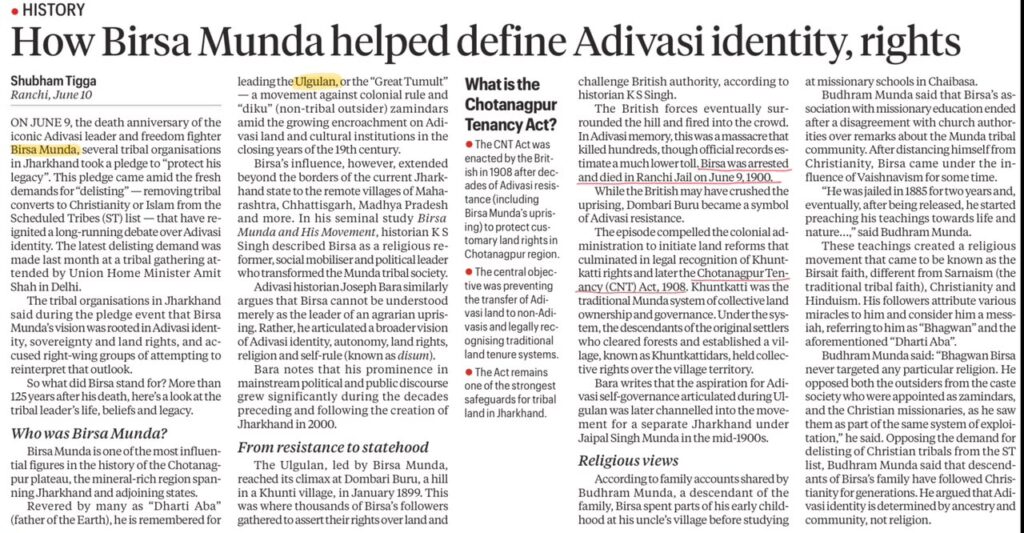
Birsa Munda’s legacy is remembered not merely for a tribal revolt but for shaping the modern idea of Adivasi identity, land rights and self-governance.

Birsa Munda, 1875–1900

  • Revered as Dharti Aba, meaning Father of the Earth.
  • Tribal leader, social reformer and anti-colonial freedom fighter.
  • Advocated Adivasi identity, autonomy, land rights and self-rule.
  • His idea of autonomy was expressed through Abua Disum.

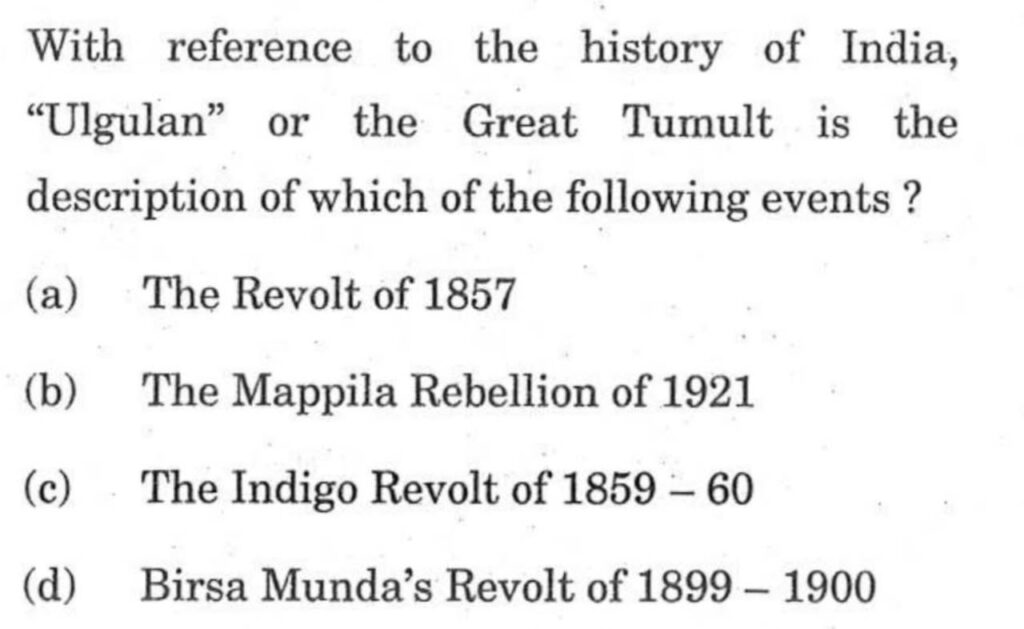
Ulgulan — The Great Tumult, 1899–1900

  • Ulgulan means Great Tumult or Great Upheaval.
  • Movement against British rule, zamindars and Dikus, meaning outsiders.
  • Triggered by tribal land alienation and exploitation.
  • Major centre: Dombari Buru.

How Ulgulan Shaped Adivasi Identity

  • Linked land rights with tribal identity.
  • Asserted Adivasi autonomy, culture and customary rights.
  • Mobilised tribes around a shared identity rather than only economic grievances.
  • Transformed tribal resistance into a broader movement for dignity, recognition and self-governance.

Impact

  • Led to colonial land reforms.
  • Resulted in the Chotanagpur Tenancy Act, 1908.
  • Inspired the later Jharkhand movement and tribal rights discourse.
  • Made Birsa Munda a lasting symbol of Adivasi identity and land rights.

Net Foreign Direct Investment in India: Reasons for Decline Explained for UPSC

Context: Falling Net Foreign Direct Investment
India’s Net Foreign Direct Investment has declined despite healthy Gross Foreign Direct Investment inflows because foreign investors are taking out larger amounts through dividends, profits, royalties and investor exits.

Balance of Payments

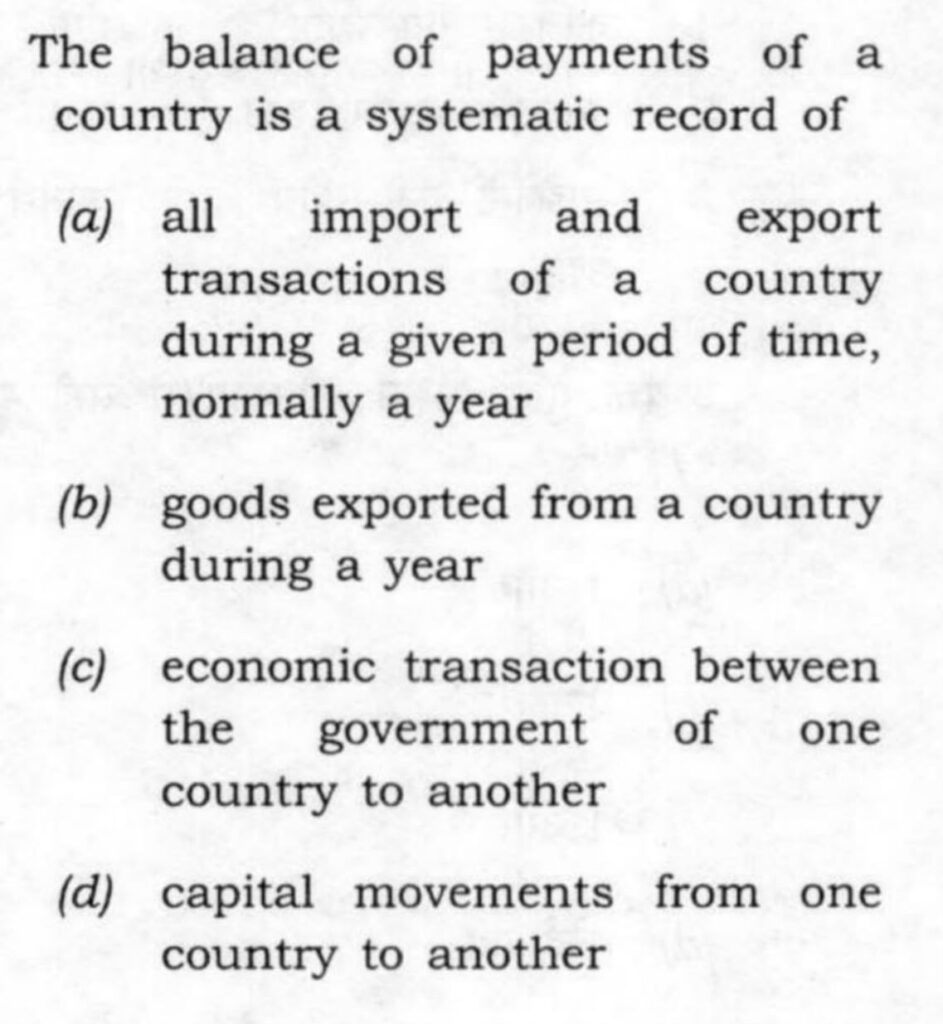
Balance of Payments is the record of all economic transactions between residents of India and the rest of the world during a specific period.

Current Account

Records transactions related to current income and expenditure. It does not create assets or liabilities.

Components

  • Goods — exports and imports
  • Services — Information Technology, tourism, banking, shipping
  • Income — interest, dividend, royalty, profits
  • Transfers — remittances, gifts, grants

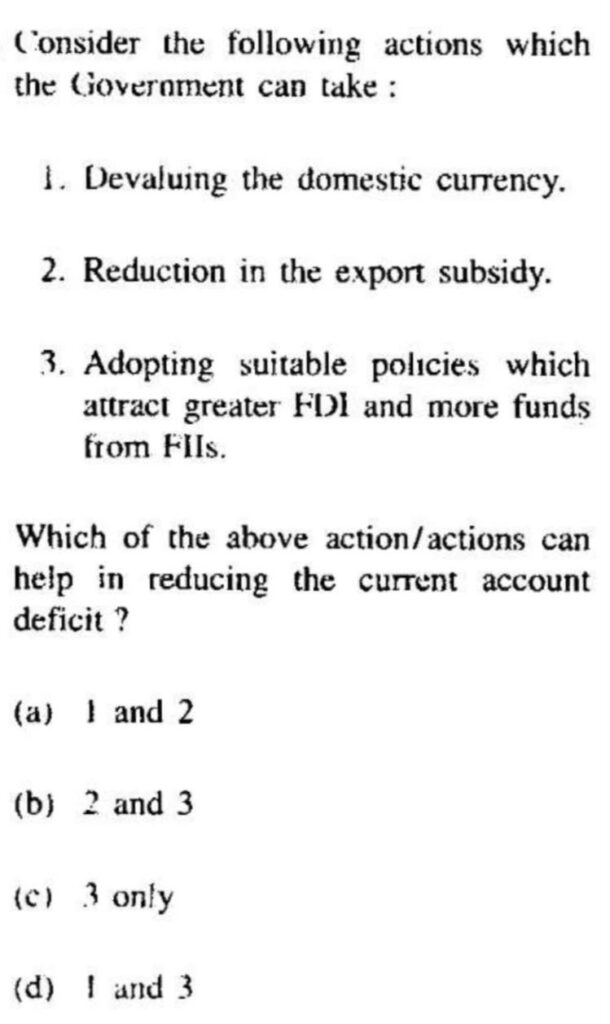
Current Account Deficit

Current Account Deficit occurs when Current Account payments exceed Current Account receipts.

Capital Account

Records transactions that create assets or liabilities between India and the rest of the world.

Components

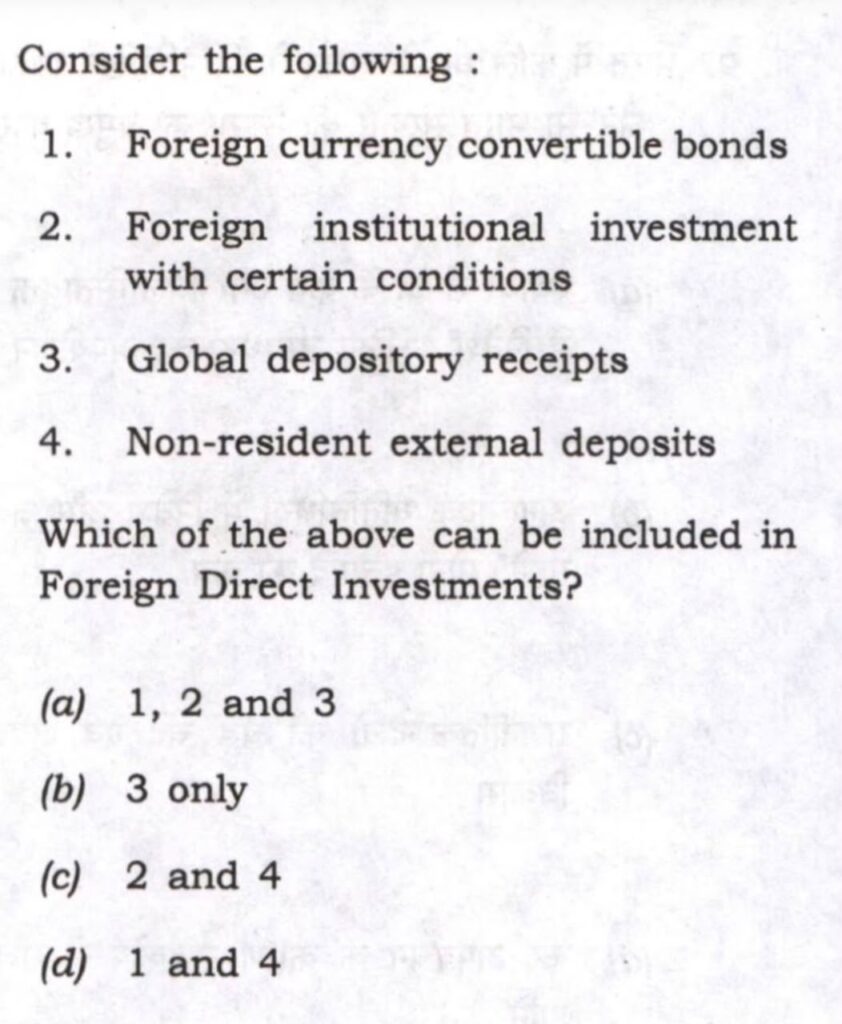
  • Foreign Direct Investment
  • Foreign Portfolio Investment / Foreign Institutional Investment
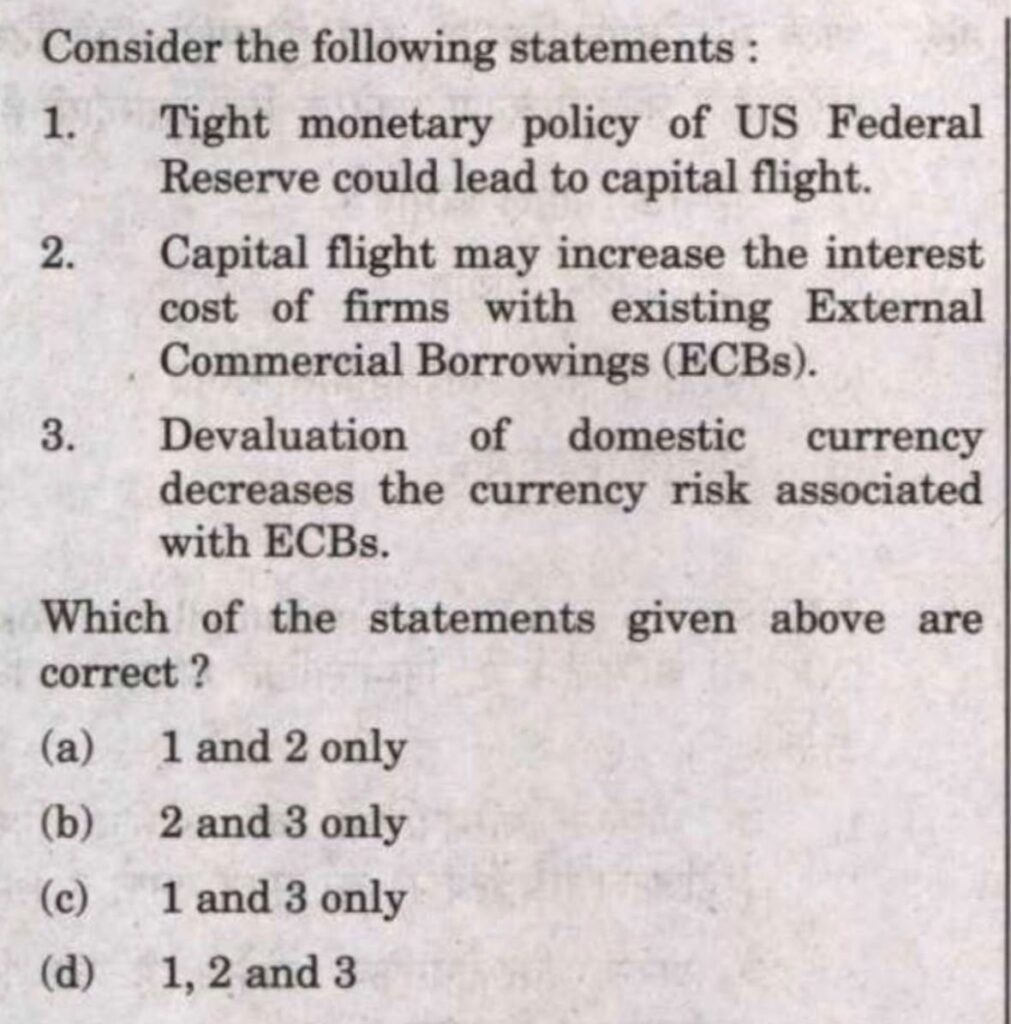
  • External Commercial Borrowings
  • Foreign loans
  • Non-Resident Indian deposits

Important Concepts

Foreign Direct Investment

  • Long-term foreign investment involving ownership, management participation or control in a business.

External Commercial Borrowings

  • Loans raised by Indian companies from foreign banks, international financial institutions or overseas markets for expansion and capital investment.

Remittances

  • Money sent by Indians working abroad to families in India.
  • Recorded under Current Account Transfers.
  • India is the world’s largest recipient of remittances, about $130 billion annually.

Disinvestment

  • Sale of an existing investment or stake by an investor.
  • When a foreign investor sells shares and takes money abroad, it results in capital outflows.

Why is Net FDI Falling?

Net FDI = Gross FDI Inflows − FDI Outflows

Major Outflows

Dividend Remittances

  • Indian subsidiaries distribute profits to foreign shareholders abroad.

Profit Repatriation

  • Foreign companies transfer profits earned in India back to their parent company.

Royalty Payments

  • Payments made for use of foreign technology, patents, trademarks and brand names.

Technical Service Fees

  • Payments for management, consultancy and technical support provided by foreign parent companies.

Disinvestment / Investor Exit

  • Foreign investors sell their stakes in Indian companies and withdraw money.
About the UPSC Civil Services Examination (UPSC CSE)

The UPSC Civil Services Examination (CSE) is one of the most competitive and esteemed examinations in India, conducted by the Union Public Service Commission to recruit officers for services such as the Indian Administrative Service (IAS), Indian Police Service (IPS), Indian Foreign Service (IFS), and others. The exam comprises three stages — Prelims, Mains, and the Personality Test (Interview) — designed to test a candidate’s knowledge, aptitude, decision-making, and leadership skills.


How to Prepare Effectively for UPSC CSE

Cracking the UPSC CSE requires a deep understanding of the syllabus, consistent revision, structured answer writing, and smart test-taking strategies. The Prelims test analytical and conceptual clarity, the Mains focuses on critical thinking, articulation, and subject mastery, while the Interview assesses presence of mind, ethical judgment, and personality traits relevant to public service.

At UnderStand UPSC, we empower aspirants with a personalized and focused approach to each stage of the exam.


Why Choose UnderStand UPSC?

UnderStand UPSC is a mentorship-driven platform offering a clear, clutter-free strategy to tackle the Civil Services Examination. Our programs like Transform (for beginners and intermediate learners) and Conquer (for advanced mains preparation) provide structured study plans, syllabus-wise video content, interactive live sessions, and answer writing support.

We emphasize:

  • Concept clarity through topic-wise lectures

  • Test series designed around real UPSC standards

  • Personalized mentorship in small groups

  • Regular performance tracking and peer benchmarking

  • Doubt-clearing sessions, current affairs analysis, and monthly magazines


Join the UnderStand UPSC Learning Community

Our mission is to make UPSC preparation less overwhelming and more strategic. We combine mentorship, discipline, and academic rigor to help you clear CSE with confidence. Whether you’re preparing from Delhi, Mumbai, Bangalore, or a remote village — our online-first model ensures quality guidance reaches every corner of India.

Join the thousands of aspirants who trust UnderStand UPSC to guide their journey toward becoming civil servants.

Stay connected with us through our Telegram, YouTube, and Instagram channels for daily tips, strategies, and updates.

Copyright © 2026 USARAMBHA EDUCATION (UnderStand UPSC). All Rights Reserved.

Start Your
UPSC Journey

Our team will reach out to you soon