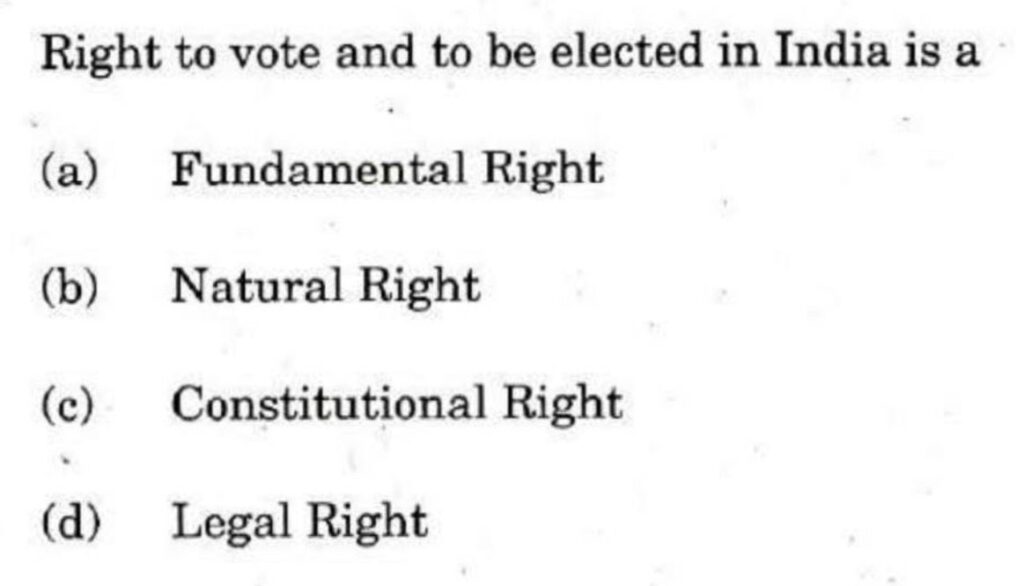
Right to Vote Fundamental Right: Constitutional Debate

Context: Right to Vote Fundamental Right
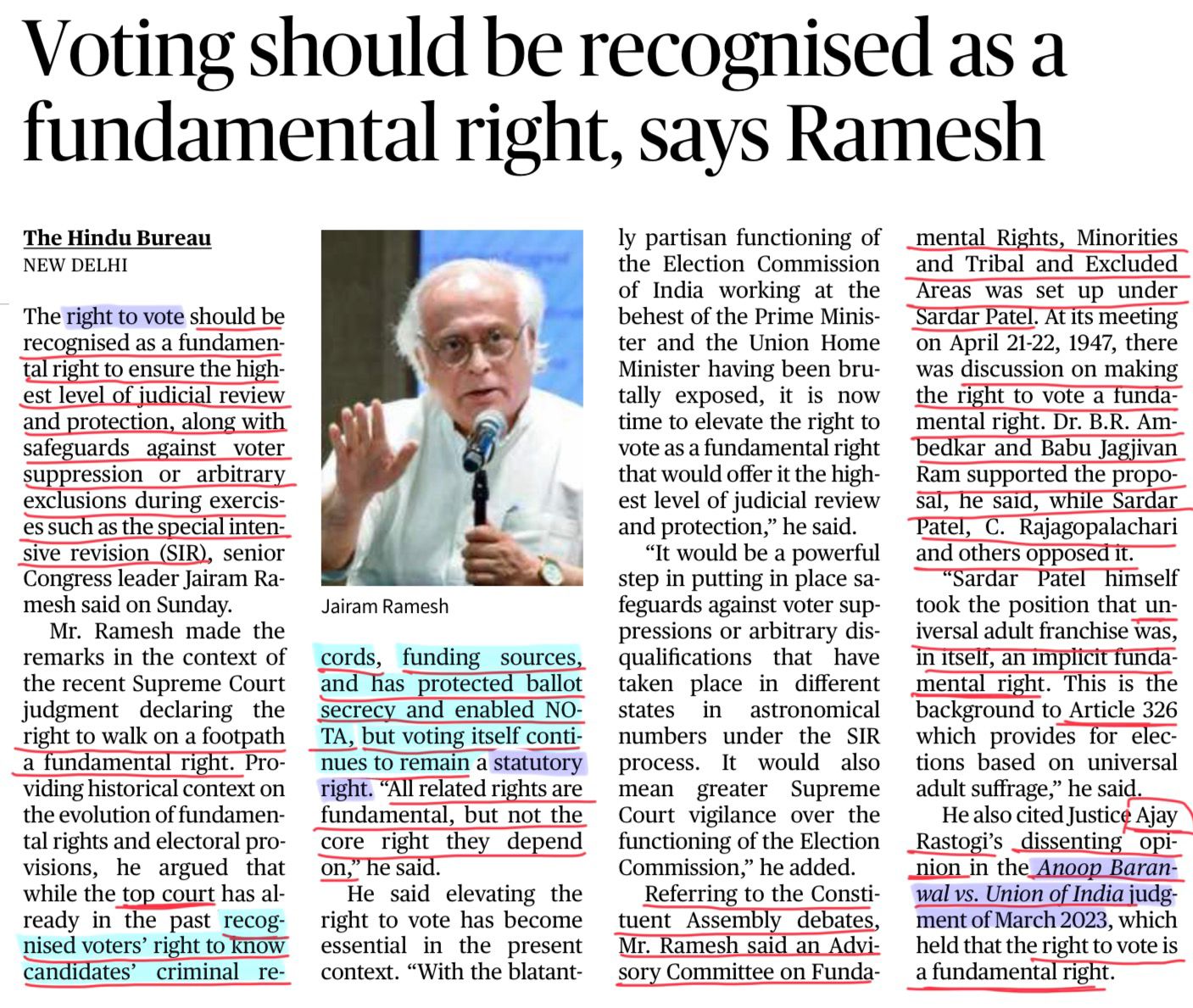
Congress leader Jairam Ramesh demanded that the Right to Vote be recognised as a Fundamental Right, arguing that stronger constitutional protection is needed against voter exclusion and arbitrary electoral processes.

Core Constitutional Provisions

Article 324

  • Gives the Election Commission of India superintendence, direction and control over elections.

Article 326

Article 327

  • Empowers Parliament to make laws relating to elections.

Laws Made Under Article 327

Representation of the People Act, 1950

  • Deals with electoral rolls and voter registration.

Representation of the People Act, 1951

  • Deals with conduct of elections, qualifications, disqualifications and election disputes.

Nature of Voting Rights in India

Article 326

  • Constitutional foundation of voting.

RPA 1950 and RPA 1951

  • Statutory mechanism for voting and elections.

Article 19(1)(a)

  • Basis for Right to Know candidate information and None of the Above.

Election Commissioner Appointment

Anoop Baranwal v. Union of India, 2023

Chief Election Commissioner and Other Election Commissioners Act, 2023

  • Appointment committee now consists of:
    • Prime Minister
    • Leader of Opposition
    • Union Cabinet Minister nominated by Prime Minister

Constituent Assembly Debate on Right to Vote

Supported by

  • Dr. B.R. Ambedkar
  • Babu Jagjivan Ram

Opposed by

Patel’s View

Universal Adult Franchise itself was considered a sufficient democratic safeguard, so a separate Fundamental Right was seen as unnecessary.

As a result, voting was placed under Article 326, not under Part III of the Constitution.

Supreme Court-led Electoral Reforms

Indira Nehru Gandhi v. Raj Narain, 1975

Association for Democratic Reforms Case, 2002

  • Candidate disclosure of criminal cases, assets and educational qualifications.

PUCL, 2003

  • Right to Know recognised under Article 19(1)(a).

PUCL, 2013

  • NOTA and ballot secrecy.

Lily Thomas v. Union of India, 2013

  • Immediate disqualification upon conviction.

Public Interest Foundation v. Union of India, 2018

  • Wider disclosure of criminal antecedents.

Anoop Baranwal v. Union of India, 2023

  • Independent appointment process for Election Commissioners.

Final Supreme Court Position

The Supreme Court position through cases such as N.P. Ponnuswami, 1952, Jyoti Basu, 1982 and Kuldip Nayar, 2006 is that the Right to Vote is not a Fundamental Right.

It is a Statutory Right, though rooted in Article 326.
Right to Vote Fundamental Right
Subscribe
Notify of
guest
0 Comments
Oldest
Newest Most Voted

Right to Vote Fundamental Right: Constitutional Debate

About the UPSC Civil Services Examination (UPSC CSE)

The UPSC Civil Services Examination (CSE) is one of the most competitive and esteemed examinations in India, conducted by the Union Public Service Commission to recruit officers for services such as the Indian Administrative Service (IAS), Indian Police Service (IPS), Indian Foreign Service (IFS), and others. The exam comprises three stages — Prelims, Mains, and the Personality Test (Interview) — designed to test a candidate’s knowledge, aptitude, decision-making, and leadership skills.


How to Prepare Effectively for UPSC CSE

Cracking the UPSC CSE requires a deep understanding of the syllabus, consistent revision, structured answer writing, and smart test-taking strategies. The Prelims test analytical and conceptual clarity, the Mains focuses on critical thinking, articulation, and subject mastery, while the Interview assesses presence of mind, ethical judgment, and personality traits relevant to public service.

At UnderStand UPSC, we empower aspirants with a personalized and focused approach to each stage of the exam.


Why Choose UnderStand UPSC?

UnderStand UPSC is a mentorship-driven platform offering a clear, clutter-free strategy to tackle the Civil Services Examination. Our programs like Transform (for beginners and intermediate learners) and Conquer (for advanced mains preparation) provide structured study plans, syllabus-wise video content, interactive live sessions, and answer writing support.

We emphasize:

  • Concept clarity through topic-wise lectures

  • Test series designed around real UPSC standards

  • Personalized mentorship in small groups

  • Regular performance tracking and peer benchmarking

  • Doubt-clearing sessions, current affairs analysis, and monthly magazines


Join the UnderStand UPSC Learning Community

Our mission is to make UPSC preparation less overwhelming and more strategic. We combine mentorship, discipline, and academic rigor to help you clear CSE with confidence. Whether you’re preparing from Delhi, Mumbai, Bangalore, or a remote village — our online-first model ensures quality guidance reaches every corner of India.

Join the thousands of aspirants who trust UnderStand UPSC to guide their journey toward becoming civil servants.

Stay connected with us through our Telegram, YouTube, and Instagram channels for daily tips, strategies, and updates.

Copyright © 2026 USARAMBHA EDUCATION (UnderStand UPSC). All Rights Reserved.

Fill out the form for

Downloading the free Agriculture Short Notes


Fill out the form

If you have any queries related to
Our Programs We Offer


0
Would love your thoughts, please comment.x
()
x