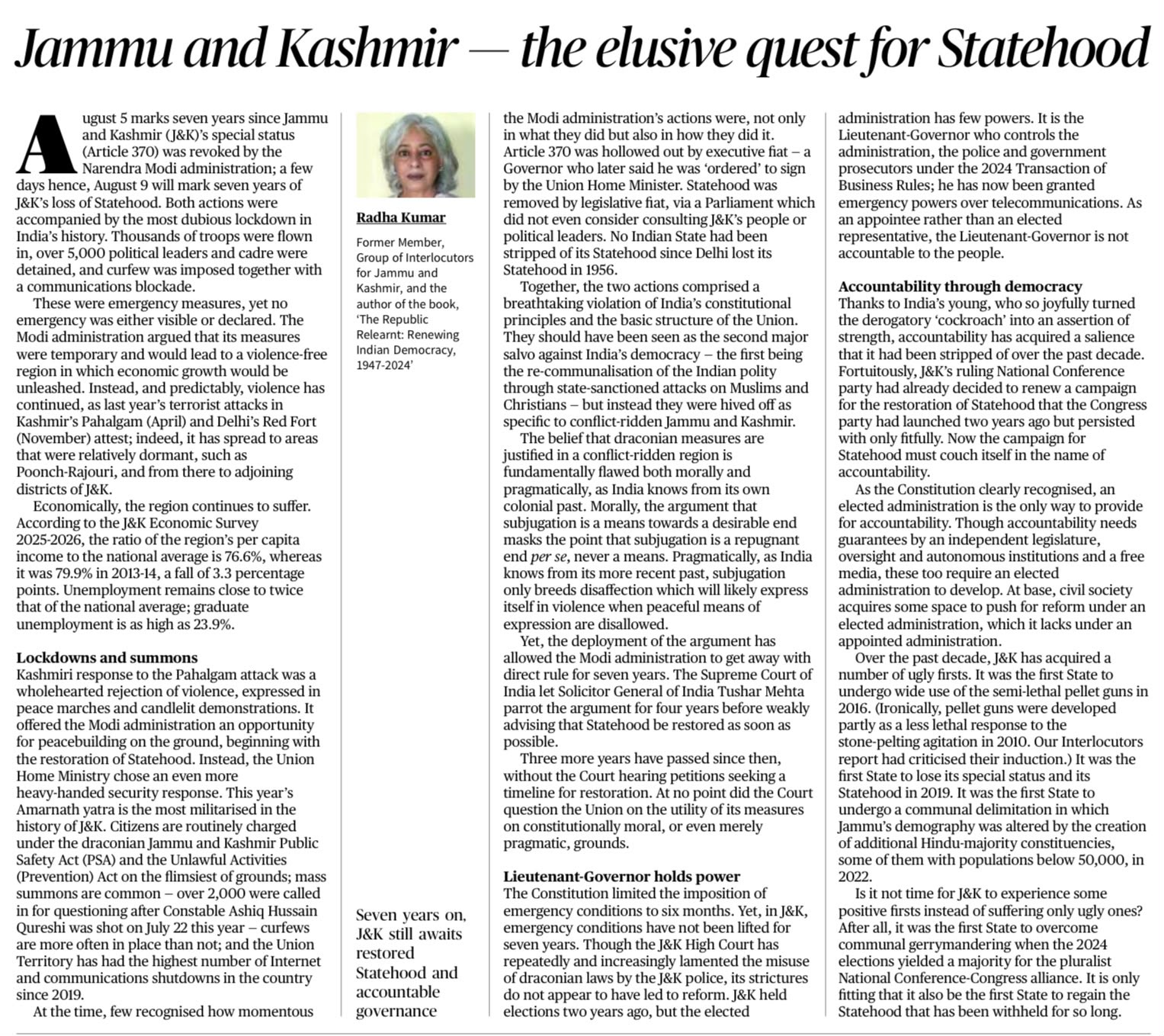
Context: The Elusive Quest for Statehood
Seven years after the abrogation of Article 370 and the reorganisation of Jammu and Kashmir, the debate over restoration of statehood has resurfaced.
The issue raises concerns around constitutional federalism, democratic accountability and sustainable peace.
Background
Jammu and Kashmir was reorganised in 2019 after the abrogation of Article 370.
It was converted from a State into a Union Territory.
The question now is whether statehood should be restored and how soon that should happen.
Federalism and Democratic Governance
Continued Union Territory status raises concerns over cooperative federalism and representative democracy.
The Supreme Court, while upholding the 2019 constitutional changes, observed that statehood should be restored at the earliest.
Democratic Accountability
Even after the 2024 Assembly elections, significant executive powers remain with the Lieutenant Governor under the Transaction of Business Rules, 2024.
This limits the power of the elected government.
It also weakens legislative oversight and political accountability.
Constitutional Perspective
This issue can be linked with:
- Article 3 — Parliament’s power to reorganise States
- Article 14 — Equality and non-arbitrary governance
- Article 21 — Due process and protection of liberty
- Basic Structure Doctrine — Federalism, democracy and rule of law
The S.R. Bommai v. Union of India case is relevant because it recognised federalism, democracy and rule of law as part of constitutional principles.
Key Issues
Security Challenges
Major incidents such as the Pahalgam attack in April 2025 and the Red Fort attack in November 2025 show that security concerns continue.
The spread of militancy into Rajouri and Poonch also suggests that security measures alone cannot ensure durable peace.
Economic Concerns
Jammu and Kashmir’s per capita income was 76.6% of the national average according to the J&K Economic Survey 2025–26.
Graduate unemployment stood at 23.9%.
Overall unemployment remains nearly twice the national average.
This shows that economic benefits have remained limited.
Governance Deficit
Continued reliance on the Public Safety Act, preventive detentions and internet restrictions reflects a security-centric governance model.
This has contributed to a trust deficit between citizens and public institutions.
Way Forward
Restore Statehood
Full statehood should be restored to strengthen representative institutions and democratic legitimacy.
Balance Security with Constitutional Values
Security measures should remain proportionate and must protect civil liberties and rule of law.
Strengthen Cooperative Federalism
Regular Centre–State dialogue is needed.
Elected institutions should be empowered for responsive governance.
Promote Inclusive Development
Employment generation, tourism, infrastructure and private investment should be prioritised.
Key Takeaway
Jammu and Kashmir’s long-term stability cannot depend only on security management. Restoring statehood, strengthening elected institutions and promoting inclusive development are central to democratic peace.