19 August 2026 | UPSC Daily Current Affairs

19 August 2026 | UPSC Daily Current Affairs

West Asia security architecture: Regional Security Shift

Context: West Asia security architecture
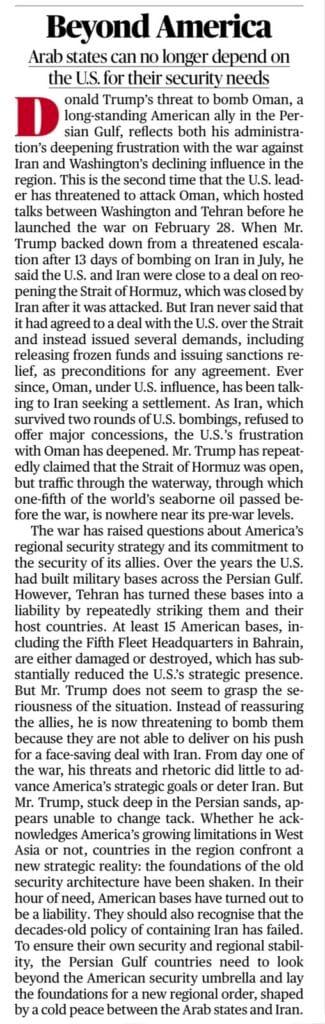
The Iran–U.S. conflict has exposed the strain in the traditional U.S.-centred security architecture of West Asia. Gulf States are now being forced to reconsider whether they can continue depending mainly on the United States as their external security guarantor.

Changing Security Architecture of West Asia

Strain in the U.S.-centred model:
The old model of U.S. military presence, bilateral security guarantees and forward bases has come under pressure.

Regional conflict has shown that external protection has limits.

Limits of Iran containment:
Decades of attempts to contain Iran have not created a durable regional security order.

Regional ownership:
The editorial argues that Persian Gulf States need to take greater responsibility for their own security instead of relying primarily on an external guarantor.

Diversification of partnerships:
Gulf States are widening their security partnerships.

The Makkah Joint Defence Agreement between Saudi Arabia, Türkiye and Pakistan, signed on August 7, 2026, reflects this trend towards diversified and regionally connected security arrangements.

Arab–Iran “cold peace”:
The proposed organising principle is not complete reconciliation or alliance.

It is a pragmatic cold peace based on coexistence, dialogue and management of differences.

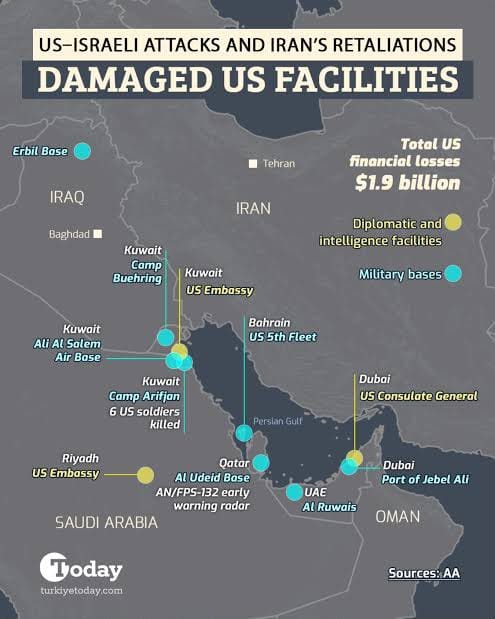
Key U.S. Military Facilities Targeted

Al Udeid Air Base — Qatar
Forward headquarters of U.S. Central Command and a major regional air-operations hub.

Naval Support Activity Bahrain / U.S. Fifth Fleet Headquarters — Bahrain
Principal U.S. naval command presence in the Gulf.

Al Dhafra Air Base — UAE
Important U.S. air and surveillance facility.

Ali Al Salem Air Base — Kuwait
Major U.S. air-support and logistics facility.

Significance

The attacks show that the forward-deployed U.S. security network can itself become vulnerable during regional conflict.

This raises questions about the sustainability of the existing West Asian security model.

Key Takeaway

West Asia is moving towards a new security reality where Gulf States may increasingly diversify partnerships and seek regional arrangements rather than depending only on U.S. protection.
West Asia security architecture

BRICS opposition to EU CBAM: India’s Climate Trade Challenge

Context: BRICS opposition to EU CBAM
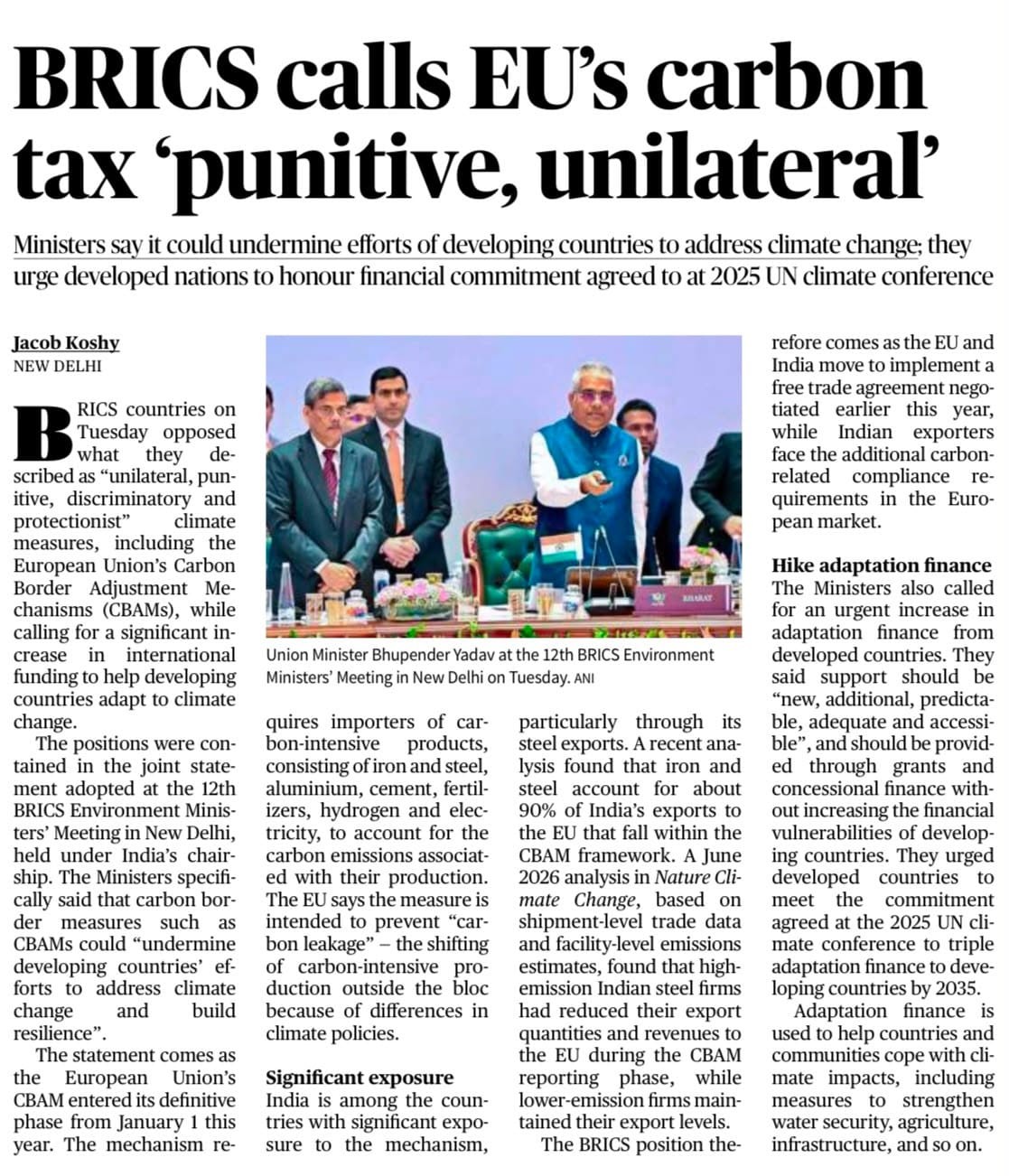
The 12th BRICS Environment Ministers’ Meeting, held in New Delhi under India’s 2026 BRICS Chairship, opposed unilateral carbon-border measures, especially the European Union’s Carbon Border Adjustment Mechanism.

BRICS Environment Ministers’ Meeting

India is the BRICS Chair for 2026 and host of the 18th BRICS Summit.

The meeting focused on:

  • Climate action
  • Environmental sustainability
  • Climate resilience
  • International cooperation

BRICS opposed carbon-border measures that could become discriminatory or protectionist trade barriers.

The ministers emphasised:

European Union’s Carbon Border Adjustment Mechanism

Meaning:
The Carbon Border Adjustment Mechanism, or CBAM, is a carbon cost imposed by the European Union on embedded emissions in specified imported goods.

Objective:
Its stated goal is to prevent carbon leakage.

Carbon leakage happens when carbon-intensive production shifts to countries with weaker climate regulations.

Timeline:

  • October 2023 — Transitional reporting phase
  • January 2026 — Definitive regime

Sectors covered:

  • Iron and steel
  • Aluminium
  • Cement
  • Fertilisers
  • Electricity
  • Hydrogen

Why India and BRICS Oppose CBAM

Export competitiveness:
CBAM raises the effective cost of carbon-intensive exports to the European Union.

Climate equity:
Developing countries have different historical responsibilities, capabilities and development needs.

Protectionism concern:
There is a risk that environmental measures may become disguised trade barriers.

Capacity constraints:
Developing economies need greater finance, technology and capacity-building for decarbonisation.

Way Forward

India should accelerate industrial decarbonisation in CBAM-exposed sectors.

Domestic carbon measurement, reporting and verification systems should be strengthened.

India and BRICS should use platforms such as:

These platforms can be used to push for equitable implementation.

Developing economies should also seek technology transfer and climate finance.

Key Takeaway

BRICS sees CBAM as a climate-linked trade measure that may hurt developing countries. India’s response should combine international negotiation with faster domestic industrial decarbonisation.

BRICS opposition to EU CBAM

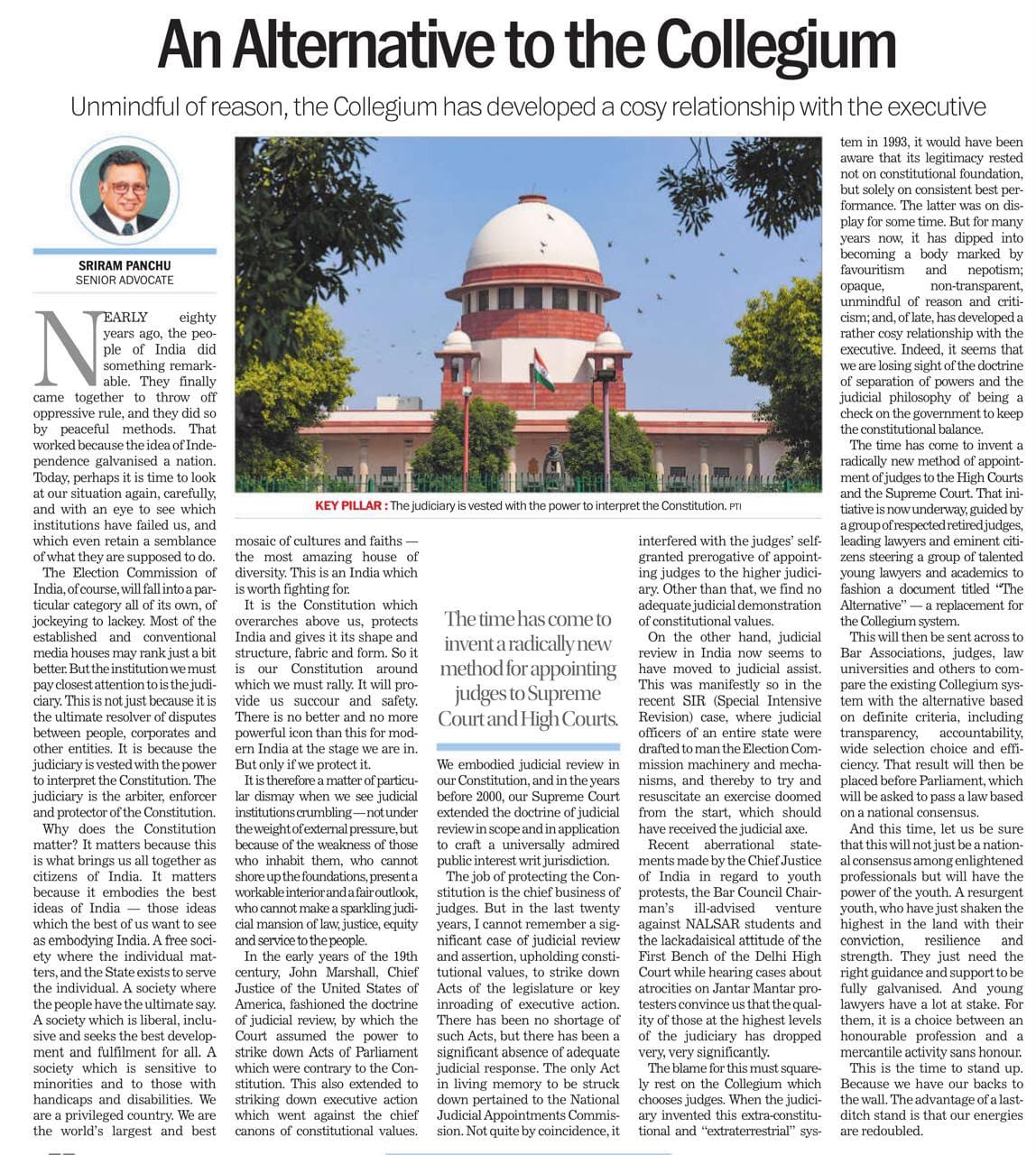
Collegium reform in judicial appointments: Key Reforms

Context: Collegium reform in judicial appointments
The debate over judicial appointments is about how to preserve judicial independence while ensuring transparency, merit and accountability in the selection of judges.

Constitutional Basis — Article 124

Article 124(2) provides that Supreme Court judges are formally appointed by the President after consultation with constitutionally specified judges.

The Collegium system is not directly mentioned in the Constitution.

Judicial primacy in appointments emerged through the Second Judges Case and Third Judges Case.

Evolution of the Collegium

First Judges Case, 1981:
Executive primacy.

Second Judges Case, 1993:
Judicial primacy emerged and the Collegium system evolved.

Third Judges Case, 1998:
The composition and functioning of the Collegium were clarified.

NJAC Case, 2015:
The National Judicial Appointments Commission was struck down.

The Collegium was restored to protect judicial independence and the basic structure.

Why the Collegium is Criticised

Opacity:
The basis for choosing one candidate over another is not always sufficiently explained.

Justice Ujjal Bhuyan in 2026 called for greater transparency, noting that withholding reasons can harm deserving candidates.

Accountability deficit:
Since judges themselves recommend judges, there is limited independent scrutiny of the selection process.

Vacancies and delays:
As of March 2026, 312 of 1,122 sanctioned High Court posts were vacant.

132 appointment proposals were being processed.

Recommendations for 180 vacancies were still awaited from High Court Collegiums.

Diversity concerns:
There is no reservation in higher judicial appointments.

As of February 2026, only 1 of 33 working Supreme Court judges was a woman.

High Courts had 116 women judges out of 814.

Narrow talent networks:
A largely internal process can make it difficult to systematically identify strong candidates from the wider Bar and legal academia.

What Should the Alternative Look Like?

The alternative should retain judicial independence while making appointments more transparent, professional and accountable.

Independent search mechanism:
A professional secretariat should identify, screen and assess candidates beyond existing judicial networks.

Objective criteria:
Selection should be based on:

  • Legal competence
  • Integrity
  • Experience
  • Judicial temperament
  • Constitutional values

Wider consultation:
Structured inputs from the judiciary, Bar and legal academia can broaden the talent pool.

Reasoned recommendations:
The broad basis for selection should be recorded, while protecting confidential personal information.

Balanced participation:
Neither the Executive nor the judiciary should have unchecked control over appointments.

Supporting Reforms

Time-bound process:
Adopt a fixed vacancy calendar and begin recommendations well before vacancies arise.

Diversity with merit:
The pool should be widened to include qualified women, regions and under-represented professional backgrounds.

Only 130 women were appointed to High Courts between 2018 and February 2026.

Digital transparency:
Build on the Supreme Court’s practice of publishing Collegium resolutions by progressively disclosing selection criteria and broad reasons.

Conflict-of-interest safeguards:
Require disclosure and recusal where selectors have significant personal or professional links with candidates.

Editorial to Mains Answer | Day 11

10 Marker | 150 Words

What are the main problems with the Collegium system of judicial appointments in India? Suggest suitable reforms.

भारत में न्यायाधीशों की नियुक्ति की कॉलेजियम प्रणाली की प्रमुख समस्याएँ क्या हैं? उपयुक्त सुधार सुझाइए।

Key Takeaway

Judicial appointments need independence from executive capture, but also greater transparency, diversity, accountability and professional evaluation.

Collegium reform in judicial appointments

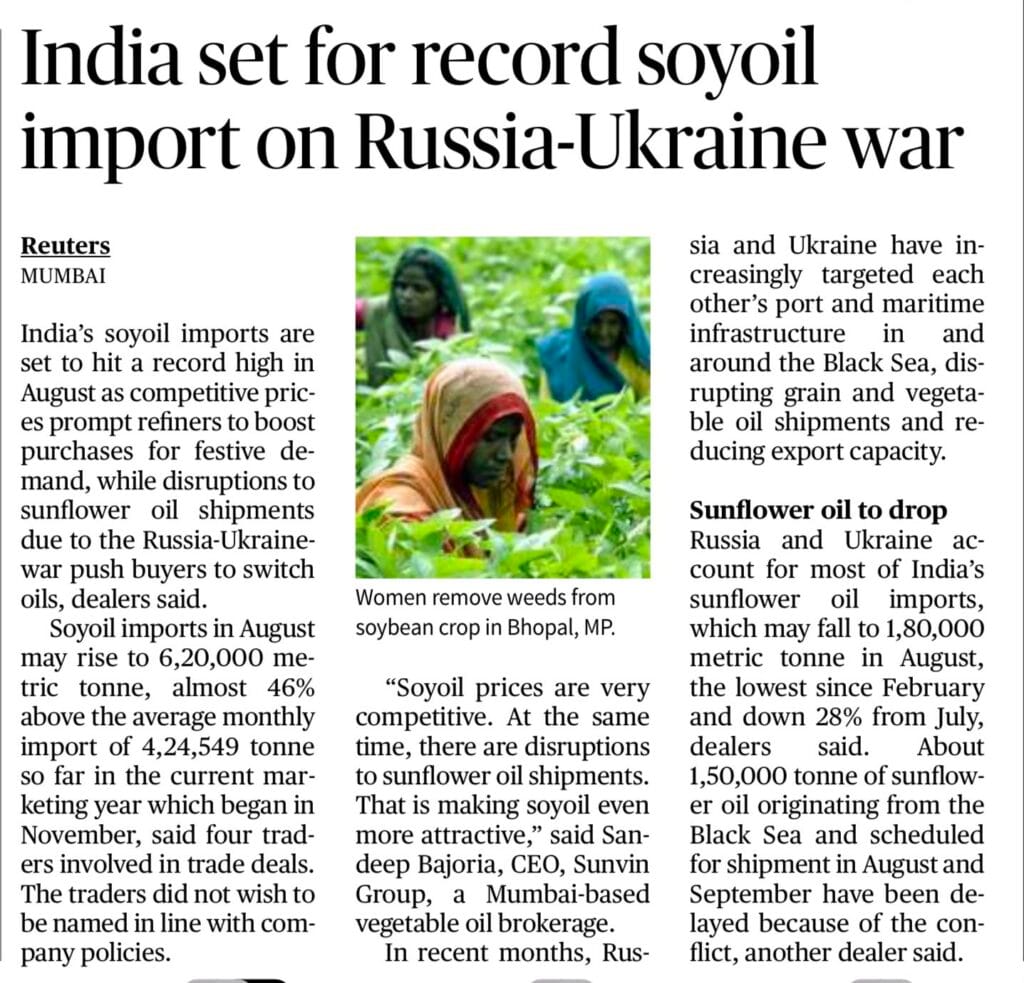
India soyoil imports record as sunflower oil supplies fall

Context: India soyoil imports record
Disruption of sunflower-oil supplies due to the Russia–Ukraine conflict is pushing Indian refiners towards soybean oil. This is expected to take India’s soyoil imports to a record level.

India’s Soybean-Oil Imports Rise

India’s soyoil imports are expected to reach 6.2 lakh tonnes in August 2026.

This is around 46% higher than the current marketing-year monthly average of 4,24,549 tonnes.

India has already secured around 1.4 million tonnes of soyoil for September–December.

This indicates continued strong demand.

The increase is driven by:

  • Competitive soyoil prices
  • Reduced availability of sunflower oil
  • Higher demand ahead of the festive season

Russia–Ukraine War Disrupts Sunflower Oil

Russia and Ukraine are major suppliers of sunflower oil to India.

However, attacks on Black Sea ports and maritime infrastructure have disrupted shipments.

Around 1.5 lakh tonnes of sunflower oil scheduled for August–September delivery have been delayed.

As a result, India’s sunflower-oil imports are expected to fall to 1.8 lakh tonnes in August.

This is:

  • 28% lower than July
  • The lowest level since February

This shows a clear substitution effect:

Disruption in sunflower oil → increased demand for soybean oil

Global Soybean and Sunflower Oil Position

Soybean oil:
China is the largest producer.

India is the largest importer.

Sunflower oil:
Russia is the largest producer.

India is the largest importer.

Significance for India

The issue highlights India’s dependence on imported edible oils.

It also shows how geopolitical conflicts can affect domestic food and cooking-oil security.

Global price movements and disruptions in shipping routes can directly influence Indian household consumption costs.

Key Takeaway

India’s record soyoil imports show the vulnerability of edible-oil security to global supply disruptions, especially the Russia–Ukraine conflict and Black Sea shipping risks.

India soyoil imports record

Elderly heat stress in India: Rising Climate Risks for All

Context: Elderly heat stress in India
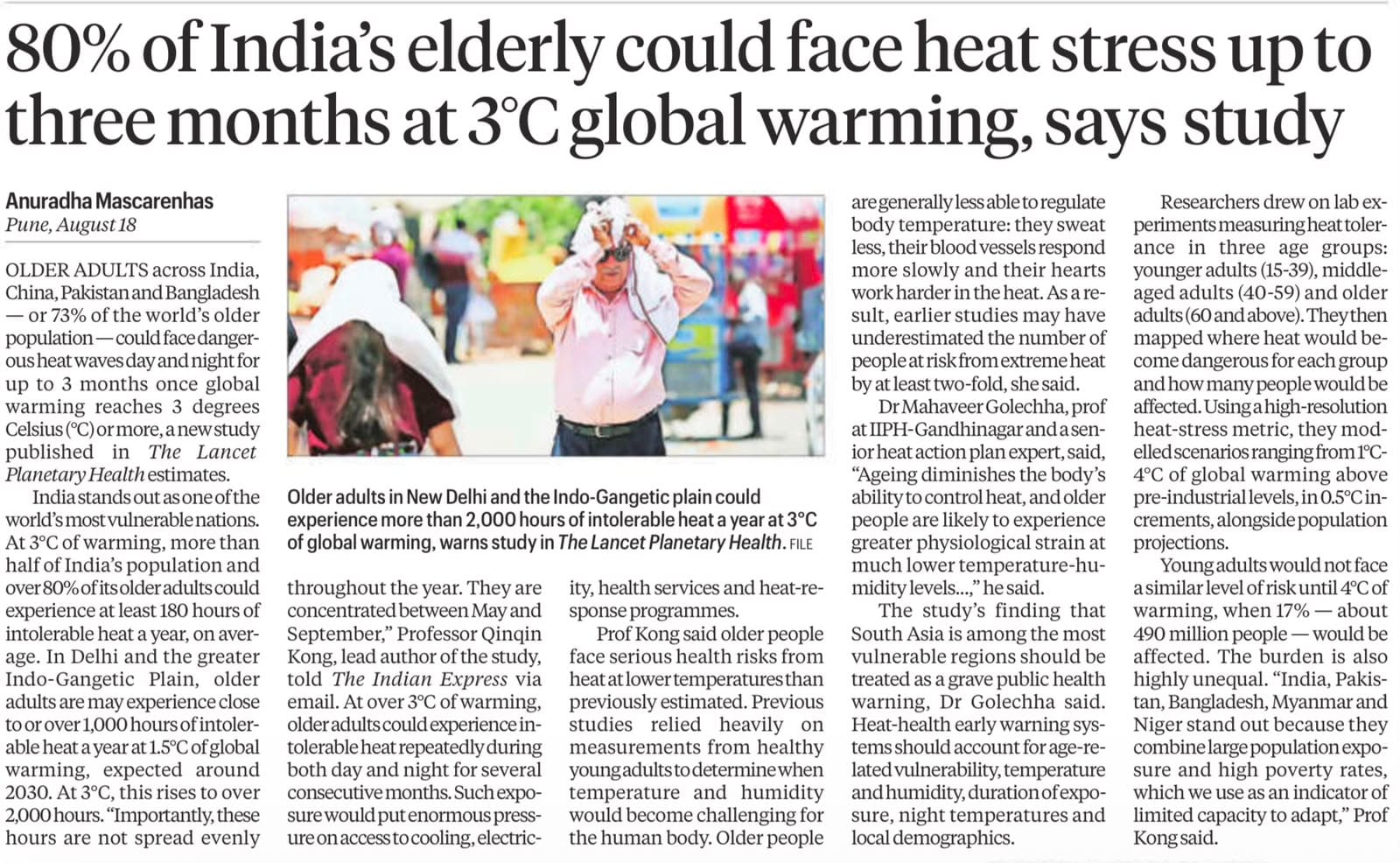
A Lancet Planetary Health study highlights the disproportionate heat vulnerability of the elderly as global warming intensifies. India’s Indo-Gangetic region is emerging as a major heat-stress hotspot.

What the Study Shows

At 3°C global warming, over 80% of India’s elderly population could face at least 180 hours of intolerable heat annually.

This could potentially extend over three months.

Delhi and the Indo-Gangetic Plain face particularly severe exposure.

Elderly people in these regions could experience over 2,000 hours of intolerable heat annually at 3°C warming.

Even at 1.5°C warming, elderly people in the region could face around 1,000 hours of intolerable heat annually.

The study indicates that previous assessments may have underestimated heat vulnerability by at least two-fold.

This is because older adults have lower physiological capacity to cope with heat.

What This Means for India

Public health:
Greater exposure will increase the risk of heat-related illness and mortality among the elderly.

Heat Action Plans:
Heat warnings need to become age-sensitive.

They should incorporate:

  • Humidity
  • Duration of exposure
  • Night-time heat

Warnings should not rely only on maximum temperature.

Urban adaptation:
High-risk regions such as Delhi and the Indo-Gangetic Plain need stronger adaptation measures.

These include:

  • Cooling infrastructure
  • Heat shelters
  • Water access
  • Healthcare preparedness

Targeted climate adaptation:
The elderly should be treated as a specific vulnerable group in India’s climate and disaster-management planning.

Key Takeaway

Heat stress is becoming a serious public-health and climate-adaptation challenge for India. Elderly citizens need special protection through age-sensitive heat warnings, cooling infrastructure and targeted health preparedness.

Elderly heat stress in India

Copyright © 2026 USARAMBHA EDUCATION (UnderStand UPSC). All Rights Reserved.

Inquiry form for
Takshila Residential Program