
New Batch Starts 30 Nov: UPSC GS Foundation 2028/29 Enroll Now
US
UnderStand UPSC Daily Current Affairs Practice
0.00Score / 12
0 / 6MCQs Attempted
0%Accuracy
25 November 2026 • UPSC CSE

Read the news. Test the concept. Write the Mains answer.

This interactive edition converts each current-affairs item into one Prelims-level MCQ, one Mains-level question, and a compact value-addition section for revision.

+2 correct −0.66 incorrect Explanation after attempt Image/PDF answer upload
NEWS 1 GS2 • India–US Relations | GS3 • International Trade and WTO Source: Reuters

US Section 301 Probe: Trump Plans New Tariffs on India and Other Countries

Context: The US is preparing additional tariffs on 16 trading partners, including India, China and the EU, after a Section 301 investigation into alleged excess industrial capacity.
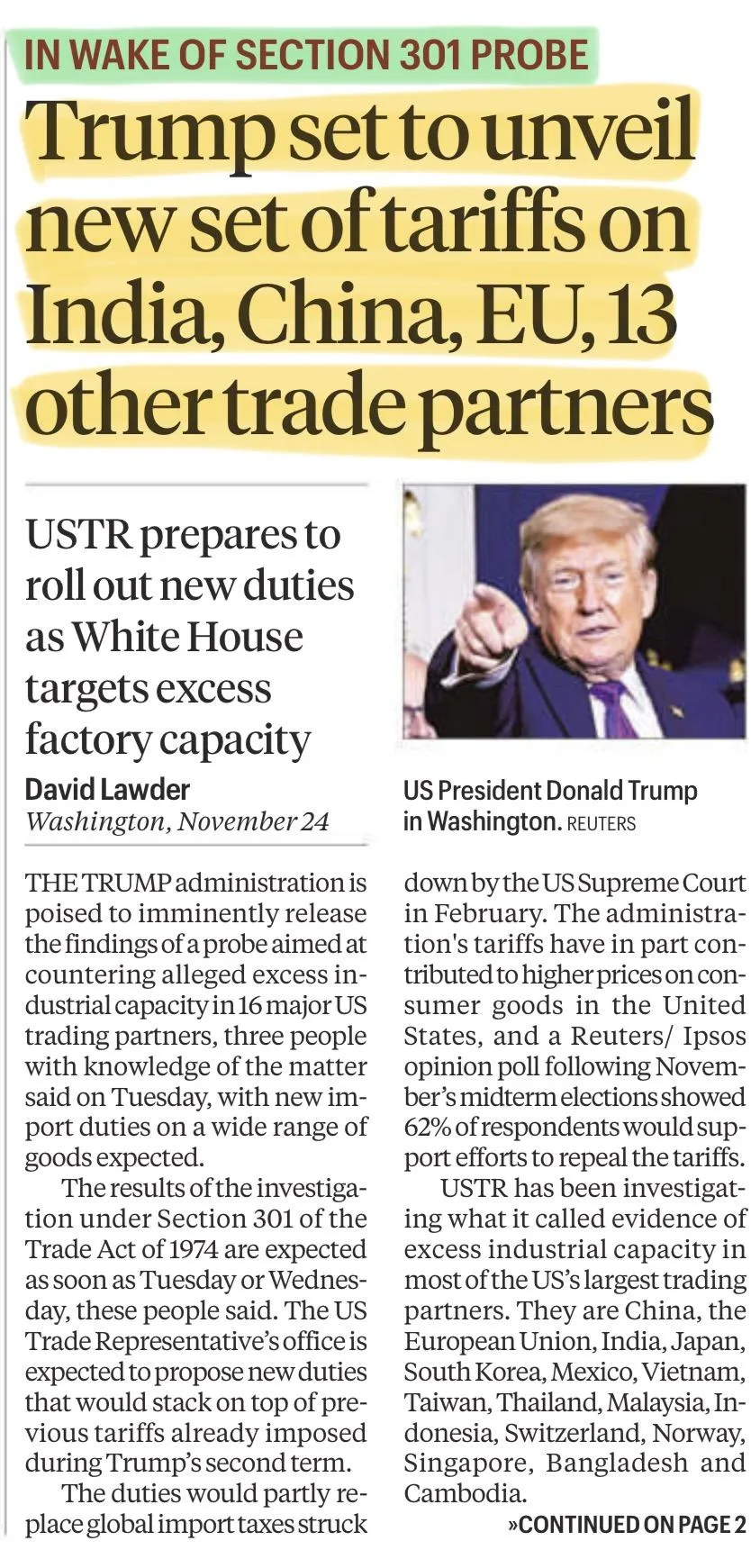
Trump set to unveil new set of tariffs on India, China, EU and 13 other trade partners (Reuters)
Trump set to unveil new tariffs on India, China, EU and 13 other trade partners. Source: Reuters
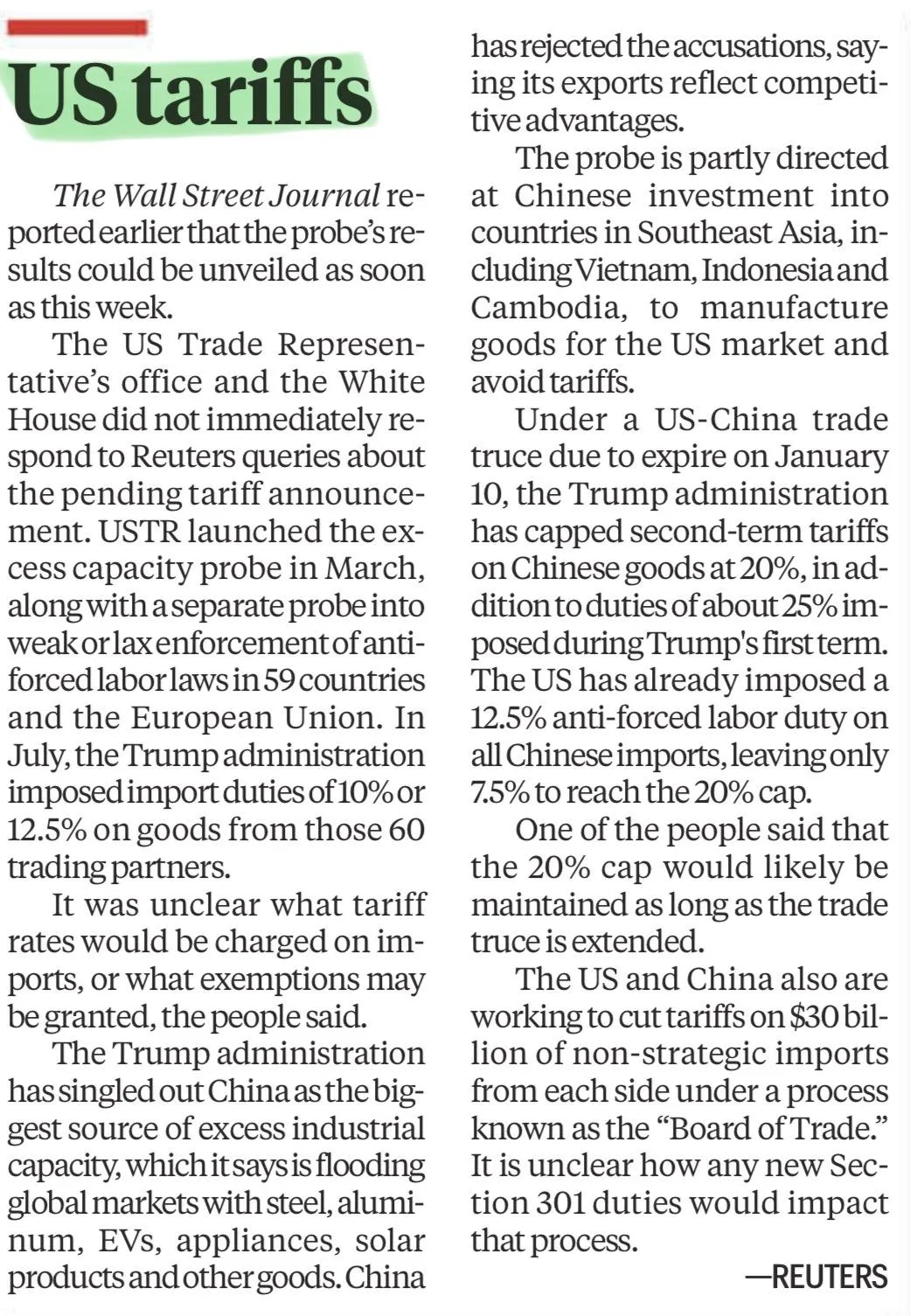
US tariffs: Section 301 probe, China trade truce and anti-forced labour duties (Reuters)
US tariffs: excess-capacity probe and the US–China trade truce. Source: Reuters

Section 301: Basic Understanding

What it is
A provision of the US Trade Act, 1974 to investigate allegedly unfair foreign trade practices.
Administered by
The United States Trade Representative (USTR).
Powers
Allows unilateral trade measures, including additional import tariffs and restrictions.

Reasons Behind the Investigation

Excess industrial capacity
Alleged overproduction, particularly in China.
Unfair competition
Surplus goods may distort global markets and hurt domestic industries.
Trade diversion
Chinese firms shifting production to third countries (Vietnam, Indonesia, Cambodia) to avoid US tariffs.
Targeted sectors
Steel, aluminium, EVs, appliances and solar products.

WTO Angle

Most-Favoured-Nation (MFN)
Generally requires equal trade treatment among WTO members.
Legality
Unilateral tariffs may violate WTO obligations if inconsistent with its agreements.
Remedy
Affected countries can challenge them through the WTO dispute settlement mechanism.

Implications for India

Exports
Extra US tariffs may reduce the competitiveness of Indian goods in the US market.
Manufacturing
Steel, aluminium, automobile and solar-product exporters may face higher barriers.
Supply chains
India could attract firms shifting manufacturing away from China.
Trade relations
May complicate India–US trade negotiations and add uncertainty.
Key Takeaway: Section 301 lets the US act unilaterally outside the WTO; India must protect exporters while using supply-chain shifts away from China to its advantage.

Prelims Practice MCQ

+2 correct • −0.66 wrong

With reference to Section 301 of the US Trade Act, 1974, consider the following statements:
1. It is administered by the United States Trade Representative (USTR).
2. It is a provision of the WTO’s General Agreement on Tariffs and Trade (GATT).
3. It allows the US to impose additional tariffs on countries found to follow unfair trade practices.
Which of the statements given above are correct?

Explanation: Section 301 is a US domestic law administered by the USTR that permits unilateral measures such as extra tariffs. It is not a WTO/GATT provision – such unilateral action can in fact be challenged at the WTO.

UPSC Mains Question

GS2/GS3 • 15 Marks • 250 Words

Unilateral trade measures like Section 301 tariffs weaken the rules-based multilateral trading system. Examine the implications for India and suggest a response strategy.

Attempt before opening the value-addition tab.
Accepted: JPG, JPEG, PNG, WEBP or PDF. The standalone file previews your answer locally; connect the API hook for real server submission.
Use after attempting the Mains answer
  • Concepts — MFN, national treatment, excess capacity, trade diversion, tariff stacking.
  • Institutions — USTR, WTO Dispute Settlement Body (Appellate Body non-functional since 2019).
  • India’s tools — FTAs, PLI schemes, China+1 strategy, export diversification.
  • Keywords — protectionism, supply-chain resilience, strategic autonomy in trade.
NEWS 2 GS2 • Health, Nutrition and Social Justice Source: The Hindu

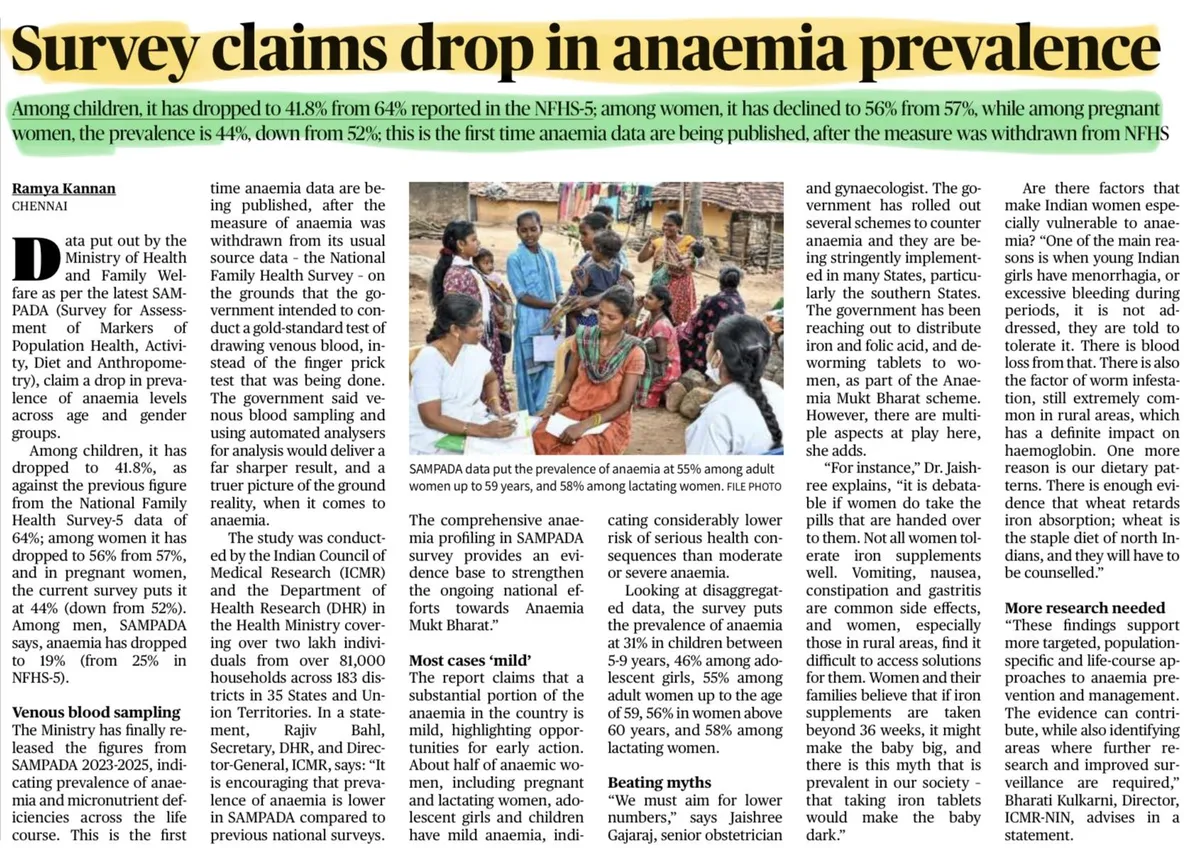
Survey Claims Decline in Anaemia Prevalence in India

Context: The SAMPADA Survey (2023–25) reports a decline in anaemia among children, women, pregnant women and men compared with NFHS-5 – the first anaemia data published after the measure was withdrawn from the NFHS.

Survey claims drop in anaemia prevalence – SAMPADA 2023-25 (The Hindu)
Survey claims drop in anaemia prevalence. Source: The Hindu

SAMPADA Survey: Key Findings (NFHS-5 → SAMPADA)

Conducted by
ICMR and the Department of Health Research.
Children
64% → 41.8%
Women
57% → 56%
Pregnant women
52% → 44%
Men
25% → 19%
Other groups
Children 5–9 years 31%; adolescent girls 46%; lactating women 58%.

Survey Methodology

Coverage
Over 2 lakh individuals, 81,000 households, 183 districts, 35 States/UTs.
Sampling
Venous blood sampling instead of the finger-prick method.
Analysis
Automated analysers give more reliable haemoglobin readings.
Scope
Evidence on anaemia and micronutrient deficiencies across the life course.

Causes and Challenges

Nutritional deficiency
Inadequate iron intake and poor dietary diversity.
Menstrual blood loss
Heavy bleeding (menorrhagia) among adolescent girls and women.
Worm infestation
Intestinal parasites cause blood loss.
Poor iron absorption
Phytates in wheat reduce iron absorption.
Treatment barriers
Side effects of iron tablets, myths and low awareness hurt adherence.

Government Initiatives

Anaemia Mukt Bharat (2018)
6×6×6 strategy: IFA supplementation, deworming, behaviour change, testing & treatment, delayed cord clamping, non-nutritional causes.
POSHAN Abhiyaan
Better nutrition through inter-sectoral convergence.
National Health Mission
Strengthens maternal and child healthcare.
IFA supplementation
Targets children, adolescents and women.
Key Takeaway: Better measurement (venous blood) shows anaemia falling, yet over half of women remain anaemic – targeted, life-course interventions must continue.

Prelims Practice MCQ

+2 correct • −0.66 wrong

UPSC Prelims PYQ 2023: Consider the following statements in the context of interventions being undertaken under the Anaemia Mukt Bharat Strategy:
1. It provides prophylactic calcium supplementation for pre-school children, adolescents and pregnant women.
2. It runs a campaign for delayed cord clamping at the time of childbirth.
3. It provides for periodic deworming to children and adolescents.
4. It addresses non-nutritional causes of anaemia in endemic pockets with special focus on malaria, haemoglobinopathies and fluorosis.
How many of the statements given above are correct?

Explanation: Anaemia Mukt Bharat provides prophylactic iron-folic acid (not calcium) supplementation. Delayed cord clamping, periodic deworming and addressing non-nutritional causes are all part of the strategy – so three statements are correct.

UPSC Mains Question

GS2 • 15 Marks • 250 Words

Despite several programmes, anaemia remains a major public-health challenge among Indian women. Analyse the causes and suggest measures for a life-course approach.

Attempt before opening the value-addition tab.
Accepted: JPG, JPEG, PNG, WEBP or PDF. The standalone file previews your answer locally; connect the API hook for real server submission.
Use after attempting the Mains answer
  • Surveys — SAMPADA (ICMR-DHR), NFHS-5 (2019–21), Comprehensive National Nutrition Survey.
  • Schemes — Anaemia Mukt Bharat, POSHAN 2.0, National Deworming Day, rice fortification.
  • Concepts — venous vs capillary sampling, haemoglobin threshold, hidden hunger.
  • PYQ link — Prelims 2023 (Anaemia Mukt Bharat).
NEWS 3 GS2 • Health Governance & Consumer Protection | GS3 • Environmental Pollution Source: The Hindu

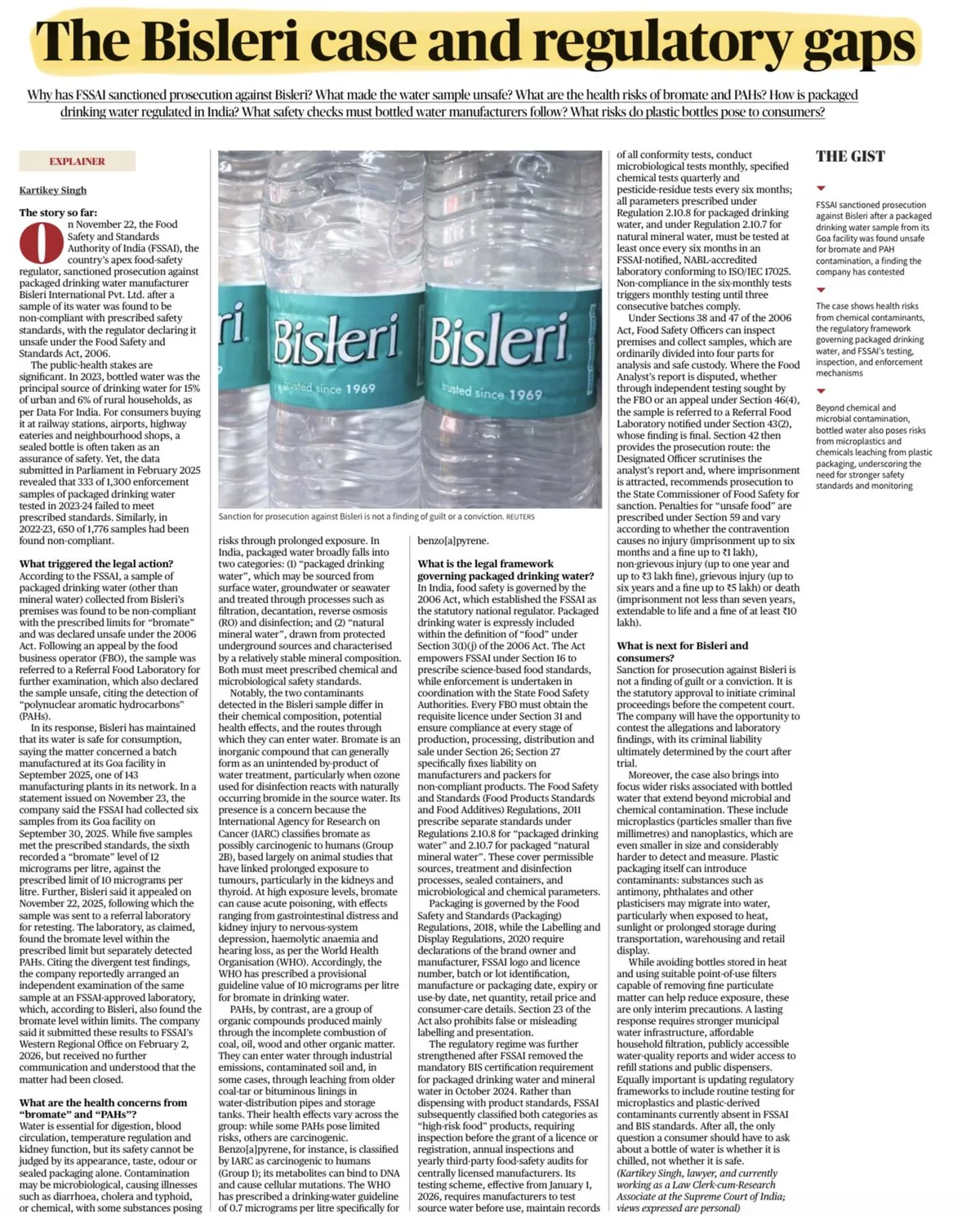
The Bisleri Case and Regulatory Gaps in Packaged Drinking Water

Context: On 22 November, FSSAI sanctioned prosecution against Bisleri International after a packaged drinking water sample from its Goa facility was found non-compliant with prescribed safety standards, raising concerns about chemical contamination and enforcement.

The Bisleri case and regulatory gaps in packaged drinking water – FSSAI, bromate and PAHs (The Hindu)
The Bisleri case and regulatory gaps. Source: The Hindu

The Bisleri Case

Sample
One of six samples collected from the Goa facility (batch of September 2025) was found non-compliant.
Bromate
12 µg/L against the permissible limit of 10 µg/L.
Referral laboratory
Found bromate within limit but detected Polycyclic Aromatic Hydrocarbons (PAHs); the sample was declared unsafe.
Company’s stand
Bisleri disputed the findings, citing an independent FSSAI-approved lab test.
Legal status
Sanction for prosecution is not a conviction; the court will decide liability.

Health Risks of Contaminants

Bromate
Forms during ozonation of bromide-containing water; IARC Group 2B (possibly carcinogenic); kidney damage.
PAHs
From incomplete combustion of coal, oil, wood; benzo[a]pyrene is IARC Group 1 carcinogen.
Microplastics
Plastic particles below 5 mm; potential health and environmental risks.
Nanoplastics
Extremely small particles (generally below 1 µm); long-term impacts still being studied.
WHO guideline
Bromate in drinking water – 10 µg/L.

Regulatory Framework in India

FSS Act, 2006
Establishes FSSAI and the legal framework for food safety; packaged water is ‘food’.
FSS (Food Products Standards & Food Additives) Regulations, 2011
Standards for packaged drinking water (2.10.8) and natural mineral water (2.10.7).
Testing requirements
Microbiological tests monthly, chemical tests quarterly, pesticide residues six-monthly at NABL labs.
Enforcement
FSSAI sets standards; State Food Safety Authorities enforce.
Section 59
Penalties for unsafe food – up to life imprisonment if it causes death.

Regulatory Challenges and Way Forward

Testing & monitoring
Strengthen independent laboratory testing and regular inspections.
Emerging contaminants
Monitor microplastics and plastic-derived chemicals.
Packaging safety
Stronger checks on plastic bottles and food-contact materials.
Accountability
Transparent disclosure of test results and effective enforcement.
Consumer protection
Better access to safe drinking water and reliable quality information.
Key Takeaway: A sealed bottle is not a guarantee of safety – India needs stricter testing, transparency and standards for emerging contaminants like microplastics.

Prelims Practice MCQ

+2 correct • −0.66 wrong

UPSC Prelims PYQ 2022: Consider the following statements:
1. Other than those made by humans, nanoparticles do not exist in nature.
2. Nanoparticles of some metallic oxides are used in the manufacture of some cosmetics.
3. Nanoparticles of some commercial products which enter the environment are unsafe for humans.
Which of the statements given above is/are correct?

Explanation: Nanoparticles also occur naturally (volcanic ash, sea spray, forest fires), so statement 1 is wrong. Metallic oxide nanoparticles (e.g., zinc oxide, titanium dioxide) are used in cosmetics and sunscreens, and some nanoparticles entering the environment can be unsafe for humans.

UPSC Mains Question

GS2 • 15 Marks • 250 Words

The Bisleri case highlights gaps in India’s food-safety enforcement. Discuss the regulatory framework for packaged drinking water and suggest reforms to address emerging contaminants.

Attempt before opening the value-addition tab.
Accepted: JPG, JPEG, PNG, WEBP or PDF. The standalone file previews your answer locally; connect the API hook for real server submission.
Use after attempting the Mains answer
  • Law — FSS Act 2006 (Sections 16, 26, 27, 42, 46, 59), FSS Packaging Regulations 2018.
  • Bodies — FSSAI, State Food Safety Authorities, Referral Food Laboratories, NABL.
  • Contaminants — bromate, PAHs, microplastics, antimony, phthalates.
  • PYQ link — Prelims 2019 (microbeads are harmful to marine ecosystems).
NEWS 4 GS2 • International Relations | GS1 • World History Source: The Indian Express – Raja Mandala

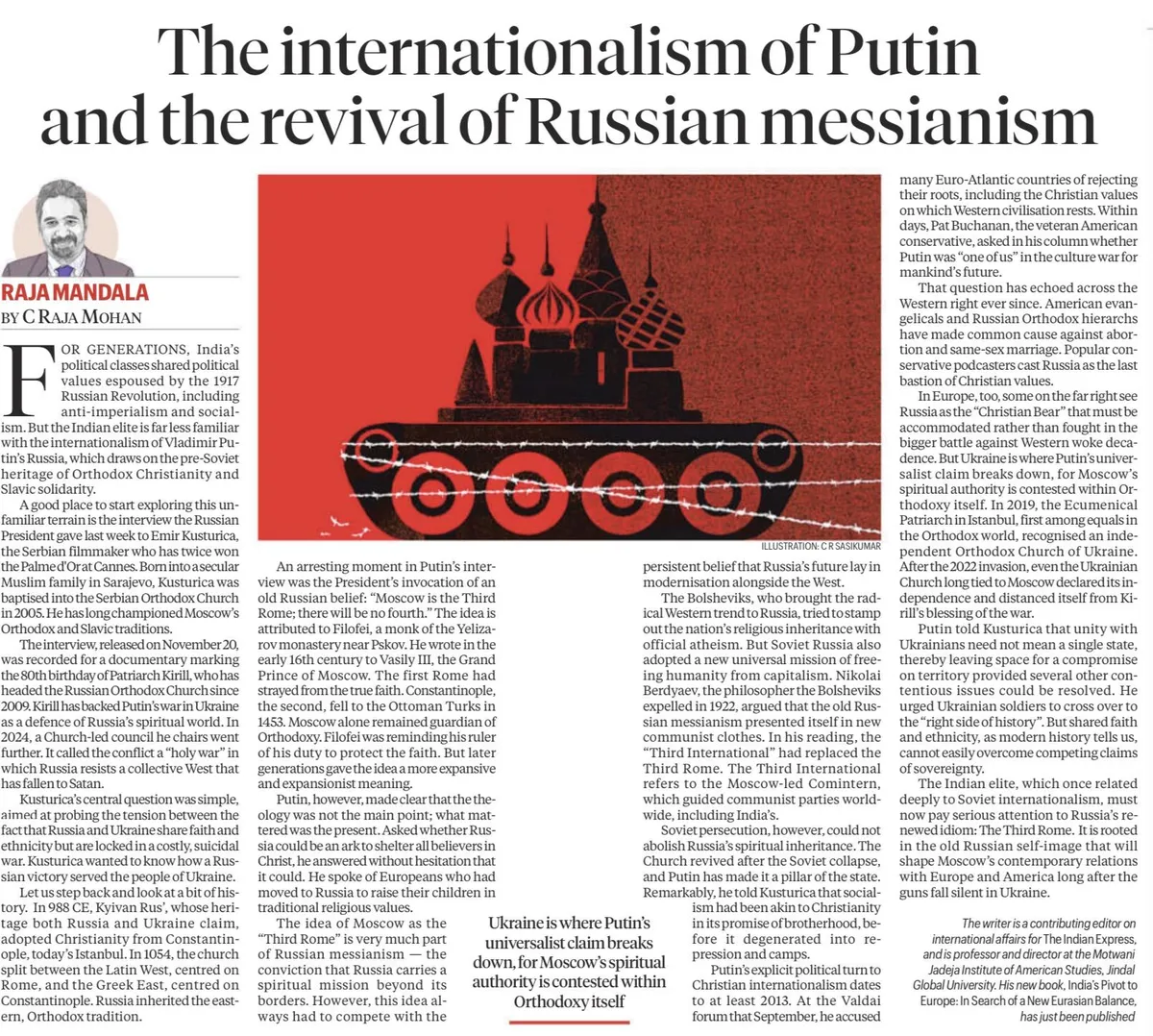
The Internationalism of Putin and the Revival of Russian Messianism

Context: Vladimir Putin is reviving Russia’s historical and religious identity, especially the idea of Moscow as the ‘Third Rome’, to justify a distinct civilisational identity and global role.

The internationalism of Putin and the revival of Russian messianism – C Raja Mohan (The Indian Express)
The internationalism of Putin and the revival of Russian messianism. Source: The Indian Express

Understanding Russian Messianism

Meaning
Belief that Russia has a special historical and spiritual mission to protect and guide civilisation.
Third Rome concept
Moscow as successor to Rome and Constantinople – guardian of Orthodox Christianity.
Origin
Monk Filofei (early 16th century), writing to Grand Prince Vasily III.
Russian identity
Blends Orthodox Christianity, Slavic traditions and national identity.
Modern revival
Putin uses it to build national unity and an independent geopolitical role.

Historical Evolution

988 CE
Kievan Rus’ adopted Christianity from Constantinople.
1054
Great Schism – Roman Catholic (West) and Eastern Orthodox (East).
1453
Fall of Constantinople to the Ottoman Turks strengthened Moscow’s claim.
1917 Revolution
Bolsheviks promoted atheism and communist internationalism (Comintern).
Post-Soviet period
The Russian Orthodox Church regained influence under Putin.

Putin’s Political and Geopolitical Strategy

Religious nationalism
Orthodox Christianity and traditional values as pillars of the state.
Anti-Western narrative
Russia as defender of tradition against Western liberalism.
Geopolitical influence
Restore Russia’s status as a major global power.
Ukraine
Civilisational claims break down – Ukraine asserts an independent national and religious identity.
Orthodox Church
Patriarch Kirill backs the war as a defence of Russia’s spiritual world.

Significance for International Relations

Russia–West
Civilisational differences deepen ideological tensions.
Ukraine
Faith and ethnicity cannot easily override competing claims of sovereignty.
Global order
Russia’s worldview challenges Western ideological influence.
India
Understand Russia’s evolving identity while keeping strategic autonomy.
Key Takeaway: Putin’s ‘Third Rome’ narrative will shape Russia’s ties with Europe and the US long after the Ukraine war – India must read it carefully while keeping strategic autonomy.

Prelims Practice MCQ

+2 correct • −0.66 wrong

With reference to the history of Christianity in Europe, consider the following statements:
1. Kievan Rus’ adopted Christianity from Constantinople in 988 CE.
2. The Great Schism of 1054 divided Christianity into the Roman Catholic and Eastern Orthodox traditions.
3. Constantinople fell to the Mongols in 1453.
Which of the statements given above are correct?

Explanation: Kievan Rus’ adopted Christianity from Constantinople in 988 CE, and the Great Schism of 1054 split the Latin West and Greek East. Constantinople fell to the Ottoman Turks, not the Mongols, in 1453.

UPSC Mains Question

GS2 • 15 Marks • 250 Words

Civilisational narratives are increasingly shaping the foreign policies of major powers. Examine with reference to Russia and discuss implications for India–Russia relations.

Attempt before opening the value-addition tab.
Accepted: JPG, JPEG, PNG, WEBP or PDF. The standalone file previews your answer locally; connect the API hook for real server submission.
Use after attempting the Mains answer
  • Concepts — Third Rome, Russian messianism, civilisational state, Eurasianism.
  • History — 988 CE baptism of Rus’, 1054 Great Schism, 1453 fall of Constantinople, 1917 Revolution.
  • Current — Russia–Ukraine war, Orthodox Church of Ukraine’s independence (2019).
  • Keywords — strategic autonomy, multipolarity, India–Russia special and privileged strategic partnership.
NEWS 5 GS3 • Science & Technology | Space Technology and Space Economy Source: The Hindu

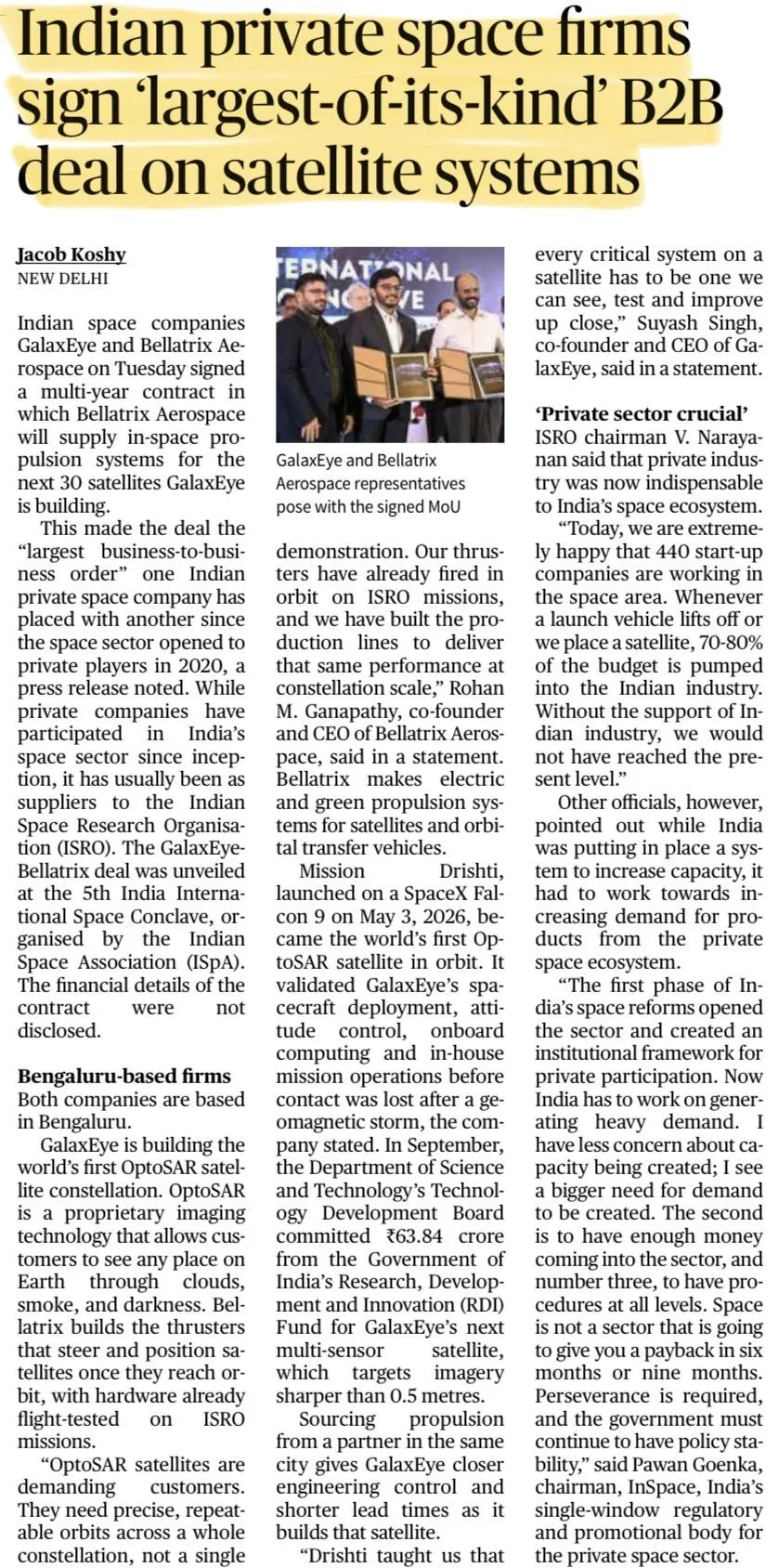
Indian Private Space Firms Sign Major Deal on Satellite Systems

Context: Bengaluru-based GalaxEye and Bellatrix Aerospace signed a multi-year contract under which Bellatrix will supply in-space propulsion systems for GalaxEye’s next 30 satellites – the largest B2B order between Indian private space firms since 2020.

Indian private space firms GalaxEye and Bellatrix sign largest-of-its-kind B2B deal on satellite systems (The Hindu)
Indian private space firms sign ‘largest-of-its-kind’ B2B deal. Source: The Hindu

About the Agreement

GalaxEye
Building the world’s first OptoSAR satellite constellation.
Bellatrix Aerospace
Will supply in-space propulsion systems for 30 satellites.
Propulsion systems
Help satellites manoeuvre, maintain or change orbits.
Significance
Largest business-to-business order between Indian private space firms.

Important Technologies

OptoSAR
Combines optical imaging and Synthetic Aperture Radar – sees through clouds, smoke and darkness.
Mission Drishti
Launched on SpaceX Falcon 9 (3 May 2026); first OptoSAR satellite in orbit.
Electric propulsion
Uses electrical energy to accelerate propellant.
RDI Fund support
₹63.84 crore for GalaxEye’s next multi-sensor satellite.

India’s Private Space Ecosystem

Space reforms (2020)
Opened the space sector to private participation.
IN-SPACe
Single-window body to authorise and promote private space activities.
NSIL
Commercial arm of ISRO – commercialises ISRO technologies.
ISRO
Core R&D and missions; ~70–80% of budget flows to Indian industry.

Significance and Challenges

Self-reliance
Less dependence on foreign space technologies.
Commercialisation
Expands India’s space economy and global market share.
Innovation
Indigenous satellite manufacturing and advanced propulsion.
Challenges
High investment, limited demand, long payback and need for stable policy.
Key Takeaway: Private firms now buy from each other, not just supply ISRO – India’s next challenge is creating demand and patient capital for its space start-ups.

Prelims Practice MCQ

+2 correct • −0.66 wrong

UPSC Prelims PYQ 2026: Consider the following statements with regard to involvement of private entities in India’s space programme:
1. The Indian National Space Promotion and Authorisation Centre (IN-SPACe) is an autonomous agency formed to facilitate participation of private entities.
2. Agnikul Cosmos launched the world’s first flight using a 3D-printed rocket engine.
3. Skyroot Aerospace has developed liquid fuel for GSLV.
Which of the statements given above is/are correct?

Explanation: IN-SPACe facilitates private participation, and Agnikul achieved the first flight using a single-piece, fully 3D-printed rocket engine. Skyroot develops its own launch vehicles (Vikram series) and engines, not liquid fuel for GSLV.

UPSC Mains Question

GS3 • 15 Marks • 250 Words

India’s space sector reforms have created capacity, but demand generation remains the key challenge. Discuss the role of the private sector in building India’s space economy.

Attempt before opening the value-addition tab.
Accepted: JPG, JPEG, PNG, WEBP or PDF. The standalone file previews your answer locally; connect the API hook for real server submission.
Use after attempting the Mains answer
  • Institutions — IN-SPACe, NSIL, ISRO, Indian Space Association (ISpA).
  • Policies — Indian Space Policy 2023, Space reforms 2020, FDI liberalisation in space.
  • Technologies — OptoSAR, SAR, electric and green propulsion, orbital transfer vehicles.
  • Keywords — space start-ups, B2B ecosystem, Atmanirbhar Bharat, patient capital.
NEWS 6 GS3 • Indian Economy | Employment and Labour Market Source: The Hindu

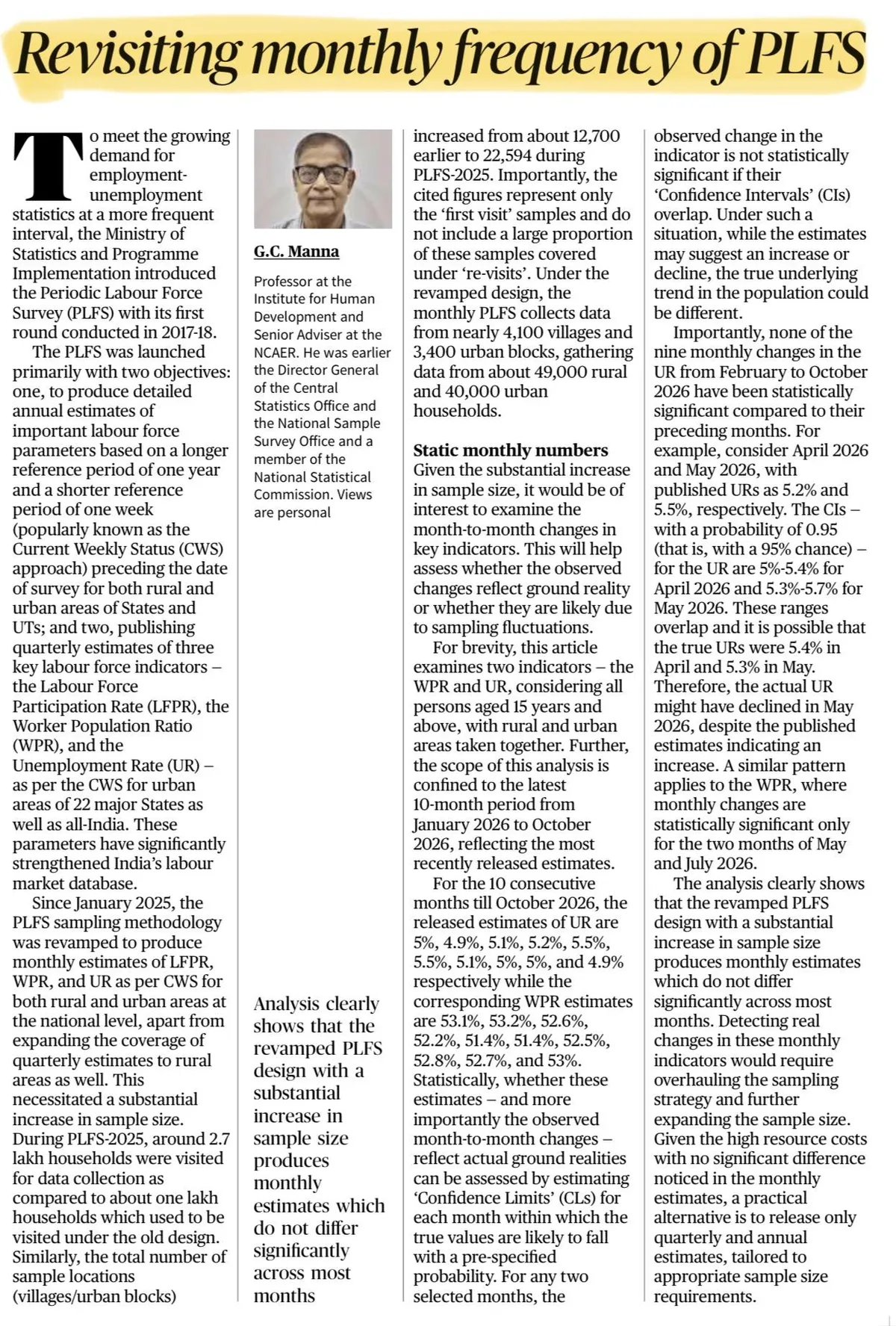
Revisiting Monthly Frequency of Periodic Labour Force Survey (PLFS)

Context: Since January 2025, PLFS publishes monthly employment estimates with a much larger sample, but most month-to-month changes are not statistically significant, raising questions about the value of monthly data.

Revisiting monthly frequency of PLFS – G.C. Manna (The Hindu)
Revisiting monthly frequency of PLFS. Source: The Hindu

About PLFS

Purpose
Estimates of employment and unemployment across India.
Key indicators
LFPR, WPR and Unemployment Rate (UR).
Earlier design
Annual estimates + quarterly urban estimates by Current Weekly Status (CWS).

Major Changes Since January 2025

Monthly estimates
LFPR, WPR and UR for rural and urban India.
Rural coverage
Quarterly estimates extended to rural areas.
Sample size
From about 1 lakh to 2.7 lakh households; sample locations ~12,700 → 22,594.
Frequency
Better geographic coverage and frequency of labour data.

Key Findings and Analytical Concerns

Unemployment Rate
Monthly estimates ranged 4.9%–5.5% (Jan–Oct 2026).
Worker Population Ratio
Ranged 51.4%–53.2%.
Limited variation
Most month-to-month changes were not statistically significant.
Confidence intervals
Overlapping intervals mean apparent changes may be sampling noise.
Policy implication
More frequent data ≠ better insight without statistical reliability.

Way Forward

Methodology
Strengthen sampling design and reliability.
Transparency
Publish confidence intervals with monthly estimates.
Caution
Avoid policy conclusions from insignificant fluctuations.
Focus
Use well-designed quarterly and annual estimates for trends.
Key Takeaway: Data frequency is useful only if changes are statistically meaningful – quarterly and annual PLFS estimates may serve policy better at lower cost.

Prelims Practice MCQ

+2 correct • −0.66 wrong

With reference to the Periodic Labour Force Survey (PLFS), consider the following statements:
1. It is conducted by the Ministry of Statistics and Programme Implementation.
2. Under the Current Weekly Status (CWS) approach, the reference period is one year.
3. Since January 2025, it releases monthly estimates of the unemployment rate for both rural and urban areas.
Which of the statements given above are correct?

Explanation: PLFS is conducted by MoSPI and, since January 2025, gives monthly LFPR, WPR and UR for rural and urban India. Under CWS the reference period is the one week preceding the survey; the one-year reference period is the Usual Status approach.

UPSC Mains Question

GS3 • 15 Marks • 250 Words

Reliable labour-market data are essential for evidence-based policymaking. Critically evaluate the revamped PLFS design and its usefulness for employment policy in India.

Attempt before opening the value-addition tab.
Accepted: JPG, JPEG, PNG, WEBP or PDF. The standalone file previews your answer locally; connect the API hook for real server submission.
Use after attempting the Mains answer
  • Concepts — LFPR, WPR, UR, Usual Status vs Current Weekly Status, confidence interval.
  • Institutions — MoSPI, National Statistics Office (NSO), National Statistical Commission.
  • Related data — EPFO payroll, ASUSE, e-Shram, KLEMS database.
  • Keywords — evidence-based policy, statistical reliability, jobless growth.

Copyright © 2026 USARAMBHA EDUCATION (UnderStand UPSC). All Rights Reserved.

MAD-X for UPSC Prelims 2027 – Batch 3 starts 7th December 2026
Batch 3 · Starts 7th Dec 2026

MAD-X for UPSC Prelims 2027

Online & Offline · Fee details + free counselling

Preferred Medium

🔒 Your details are kept confidential.

Call Now · 83770 72252