MAD-X Webinar on 14th Nov | Limited Seats! Book Now
US
UnderStand UPSC Daily Current Affairs Practice
0.00Score / 14
0 / 7MCQs Attempted
0%Accuracy
11 November 2026 • UPSC CSE

Read the news. Test the concept. Write the Mains answer.

This interactive edition converts each current-affairs item into one Prelims-level MCQ, one Mains-level question, and a compact value-addition section for revision.

+2 correct −0.66 incorrect Explanation after attempt Image/PDF answer upload
NEWS 1 GS1 • Art & Culture (Literature) Source: The Hindu

M. John Harrison Wins the 2026 Booker Prize

Context: British writer M. John Harrison, 81, won the 2026 Booker Prize for fiction for The End of Everything — the first work of science fiction to win the prize.

John Harrison's The End of Everything wins the 2026 Booker Prize for fiction (The Hindu)
M. John Harrison with the Booker trophy at Old Billingsgate, London. Source: The Hindu / AP

2026 Booker Prize: Key Highlights

Winner
M. John Harrison (United Kingdom), aged 81.
Novel
The End of Everything — a satirical dystopian novel.
First
The first science-fiction work to win the Booker.
Theme
A near-future England after an unexplained calamity, with mysterious alien entities.
Prize money
£50,000 (about US$67,000).

About the Booker Prize

Established
1969; first winner P. H. Newby (Something to Answer For).
Eligibility
Fiction written in English and published in the UK or Ireland.
Open to
Authors of any nationality.

Indian and Indian-Origin Winners

1971
V. S. Naipaul — In a Free State.
1981
Salman Rushdie — Midnight's Children.
1997
Arundhati Roy — The God of Small Things.
2006
Kiran Desai — The Inheritance of Loss.
2008
Aravind Adiga — The White Tiger.

Booker vs International Booker

Language
Booker: written in English | International: translated into English.
Prize goes to
Booker: author | International: author and translator jointly.
Indian example
Booker: The White Tiger | International: Tomb of Sand (Geetanjali Shree, 2022).
Key Takeaway: Booker = original English fiction; International Booker = fiction translated into English. Mixing these up is a common Prelims trap.

Prelims Practice MCQ

+2 correct • −0.66 wrong

With reference to the Booker Prize and the International Booker Prize, consider the following statements:
1. The Booker Prize is open only to authors who are citizens of the UK, Ireland or the Commonwealth.
2. The International Booker Prize is shared equally between the author and the translator.
3. Geetanjali Shree's 'Tomb of Sand' won the International Booker Prize.
Which of the statements given above are correct?

Explanation: Since 2014 the Booker Prize is open to authors of any nationality writing in English, so Statement 1 is wrong. The International Booker is shared between author and translator, and Tomb of Sand (translated by Daisy Rockwell) won it in 2022.

UPSC Mains Question

10 Marks • 150 Words

Literature is a powerful instrument of a nation's soft power. Discuss with reference to the global recognition of Indian writers in recent decades.

Attempt before opening the value-addition tab.
Accepted: JPG, JPEG, PNG, WEBP or PDF. The standalone file previews your answer locally; connect the API hook for real server submission.
Use after attempting the Mains answer
  • Other awards — Nobel Prize in Literature (Tagore, 1913), Jnanpith (highest Indian literary award), Sahitya Akademi Awards.
  • International Booker — Tomb of Sand (Hindi, 2022); Heart Lamp by Banu Mushtaq (Kannada, 2025).
  • Genre point — the 2026 win shows the Booker opening to speculative fiction.
  • Soft power link — literature, translation and cultural diplomacy (ICCR).
  • Keywords — translation, global readership, cultural capital.
NEWS 2 GS2 • Social Sector (Sports) Source: The Indian Express

India Reaches 100 Chess Grandmasters: The Real Test Begins After the Title

Context: India now has 100 chess Grandmasters, 38 years after Viswanathan Anand became the country's first GM in 1988. But players say the title alone does not guarantee sponsors or elite invitations.

100 grandmasters for India but for most, real test of wits begins after the title (The Indian Express)
India crossed 100 Grandmasters on 9 November 2026. Source: The Indian Express

India's 100th Grandmaster

Player
Ashok Shrivatri, 22, from Madhya Pradesh.
Milestone
India crossed 100 GMs on 9 November 2026.
First GM
Viswanathan Anand (1988).
Super GMs (2,700+)
Praggnanandhaa, Arjun Erigaisi, D. Gukesh, Nihal Sarin and Anand.

The Grandmaster Title

Awarded by
FIDE (International Chess Federation).
Status
The highest lifetime title in chess.
Requirement
Usually a rating of 2,500 and three GM norms.
Super GM
Rating above 2,700 — invited to elite events like Norway Chess and Tata Steel.

Challenges After the Title

Money
Travel, stay and entry fees for tournaments are expensive.
Sponsors
The title does not automatically bring sponsorship.
Competition
Ratings must keep rising to get elite invitations.
Access
Opportunities remain unequal across players.
Key Takeaway: Numbers show depth; support decides peaks. India now needs a system that turns 100 Grandmasters into many world-class players.

Prelims Practice MCQ

+2 correct • −0.66 wrong

With reference to chess, consider the following statements:
1. The Grandmaster title is awarded by FIDE and is held for life.
2. Viswanathan Anand became India's first Grandmaster in 1988.
3. A player becomes a Grandmaster automatically on crossing an Elo rating of 2,700.
Which of the statements given above are correct?

Explanation: The GM title is a lifetime FIDE title, and Anand became India's first GM in 1988. The title needs a 2,500 rating plus GM norms; 2,700+ is the informal 'super GM' level, so Statement 3 is wrong.

UPSC Mains Question

10 Marks • 150 Words

India's rise in chess shows the potential of non-traditional sports. What steps are needed to convert such talent into sustained global success?

Attempt before opening the value-addition tab.
Accepted: JPG, JPEG, PNG, WEBP or PDF. The standalone file previews your answer locally; connect the API hook for real server submission.
Use after attempting the Mains answer
  • Schemes — Khelo India, TOPS (Target Olympic Podium Scheme), National Sports Policy.
  • Chess wins — D. Gukesh World Champion (2024); India's double gold at the 2024 Chess Olympiad (Budapest).
  • Hub — Chennai (Tamil Nadu) as India's chess capital; 44th Chess Olympiad, Mamallapuram (2022).
  • Issues — sponsorship gap, travel costs, coaching access beyond metros.
  • Keywords — sports ecosystem, grassroots talent, soft power.
NEWS 3 GS2 • International Relations Source: The Indian Express

Russia–Ukraine War: Abu Dhabi Talks and India's Position

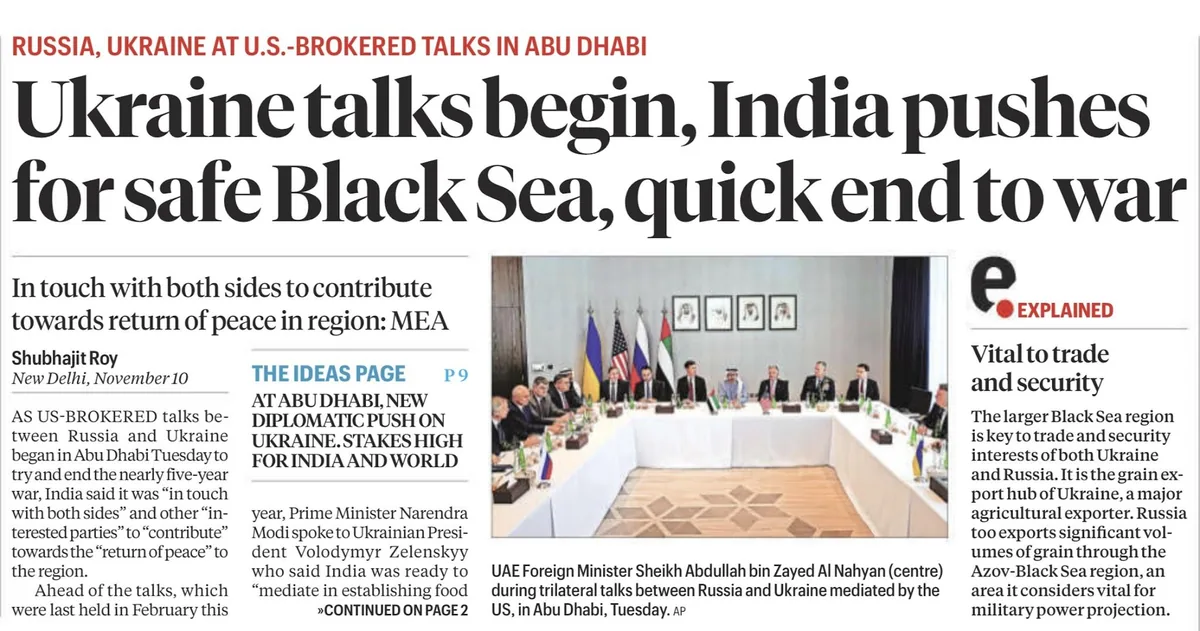
Context: U.S.-brokered talks between Russia and Ukraine resumed in Abu Dhabi on 10–11 November 2026. India said it is in touch with both sides and pushed for a safe Black Sea and a quick end to the war.

Ukraine talks begin, India pushes for safe Black Sea, quick end to war (The Indian Express)
Trilateral Russia–Ukraine talks mediated by the U.S. in Abu Dhabi. Source: The Indian Express / AP

Background

2014
Russia annexed Crimea; conflict began in the Donbas.
Feb 2022
Russia launched a full-scale invasion of Ukraine.
Control
Russia holds about one-fifth of Ukraine, incl. Crimea and parts of the east and south.
Annexation claims
Donetsk, Luhansk, Zaporizhzhia, Kherson (2022) — not internationally recognised.

Key Places on the Map

Crimea
Russian naval base at Sevastopol on the Black Sea.
Donbas
Industrial region; main conflict zone.
Mariupol
Port on the Sea of Azov.
Odesa
Key port for Ukraine's grain exports.
Zaporizhzhia
Europe's largest nuclear power plant.
Dnipro River
Natural military barrier.

Why the Black Sea Matters

Food security
Ukraine exports wheat, maize and sunflower oil through its ports.
Trade
Disruption raises shipping and insurance costs.
Military
Crimea gives Russia a strategic position in the Black Sea.

Talks & India's Stand

Sticking points
Territory, security guarantees, NATO ties and ceasefire terms.
Status
Talks resumed; no final peace deal yet.
India
Dialogue and diplomacy; respect for sovereignty and territorial integrity.
Priorities
Safe navigation, protection of energy and civilian infrastructure, food and energy security.
Strategic autonomy
Engaging both Russia and Ukraine.
Key Takeaway: For India, the war is not distant: it shows up in fertiliser, edible oil and fuel prices. That is why safe sea lanes sit at the centre of India's message.

Prelims Practice MCQ

+2 correct • −0.66 wrong

Consider the following pairs:
1. Odesa — Port on the Sea of Azov
2. Zaporizhzhia — Europe's largest nuclear power plant
3. Sevastopol — Naval base in Crimea
How many of the pairs given above are correctly matched?

Explanation: Odesa is on the Black Sea, not the Sea of Azov (Mariupol and Berdyansk are Azov ports). Zaporizhzhia hosts Europe's largest nuclear plant and Sevastopol is the Black Sea Fleet's base in Crimea.

UPSC Mains Question

15 Marks • 250 Words

India's position on the Russia–Ukraine conflict reflects its pursuit of strategic autonomy. Examine, with reference to India's interests in food, energy and maritime security.

Attempt before opening the value-addition tab.
Accepted: JPG, JPEG, PNG, WEBP or PDF. The standalone file previews your answer locally; connect the API hook for real server submission.
Use after attempting the Mains answer
  • Map — countries bordering the Black Sea: Ukraine, Russia, Georgia, Turkey, Bulgaria, Romania.
  • Straits — Bosporus and Dardanelles (Montreux Convention, 1936); Kerch Strait links Azov and Black Sea.
  • Black Sea Grain Initiative (2022–23) — brokered by UN and Türkiye.
  • India's line — 'This is not an era of war'; abstentions at UN; humanitarian aid to Ukraine.
  • Keywords — strategic autonomy, multi-alignment, freedom of navigation.
NEWS 5 GS1 • Society | GS3 • Economy Source: The Hindu (Data Point)

Women's Employment: Rising Participation, Persistent Inequality

Context: ICRIER's report 'The Participation Paradox' (2026), based on PLFS and the Time Use Survey, shows that more women are working, but mostly in informal, low-paid farm work while still carrying most unpaid care.

More women work but in informal and less secure jobs – ICRIER Participation Paradox data (The Hindu)
Sector share, weekly hours and monthly earnings of men and women, 2017 vs 2025. Source: The Hindu / ICRIER

More Women at Work

Numbers
Working women nearly doubled: 104 million → 201 million (2017–18 to 2025).
Female WPR
22% → 38%.
Agriculture
Women's share in the primary sector rose 70.7% → 73.3%; men's fell 54.1% → 47.2%.
Type of work
Mostly own-account and unpaid family work, not regular salaried jobs.

Quality of Work

Hours
Weekly hours fell; rural women work about six hours less per week.
Wages
A rural woman earns about 45% of a rural man's earnings (down from 53%).
Salaried jobs
Share among rural women slipped 10.5% → 9.3%.
Segregation
Concentrated in home-based, piece-rate work.

Unpaid Care: The Hidden Barrier

Time gap
Women spend 3.7 hours more a day on domestic work and ~1 hour more on care (Time Use Survey 2024).
Reason for not working
60% of women outside the labour force cite childcare and household work.
Double burden
Paid work is added to, not substituted for, unpaid work.

Way Forward

Care
Affordable childcare, creches, shared parental leave.
Jobs
Secure, formal work with social protection.
MSMEs
Credit, skills and tech for women entrepreneurs; hostels and transport near industry.
Rural
Non-farm jobs, women-led producer organisations.
Key Takeaway: Counting women's work was step one. The real goal is better work — more productive, better paid and secure — without adding to the unpaid load at home.

Prelims Practice MCQ

+2 correct • −0.66 wrong

Which of the following official surveys in India captures the time spent by individuals on unpaid domestic and caregiving activities?

Explanation: The Time Use Survey by NSO (MoSPI) measures time spent on paid work, unpaid domestic services and caregiving. PLFS measures employment and unemployment, ASI covers factories and NFHS covers health and family welfare.

UPSC Mains Question

15 Marks • 250 Words

Rising female workforce participation in India has not translated into better-quality employment. Analyse the reasons and suggest measures to make women's work more productive and secure.

Attempt before opening the value-addition tab.
Accepted: JPG, JPEG, PNG, WEBP or PDF. The standalone file previews your answer locally; connect the API hook for real server submission.
Use after attempting the Mains answer
  • Concepts — LFPR vs WPR; 'feminisation of agriculture'; U-shaped female labour curve.
  • Schemes — DAY-NRLM (Lakhpati Didi), PM Vishwakarma, Stand-Up India, Mission Shakti (Palna creches).
  • Laws — Maternity Benefit (Amendment) Act 2017 (26 weeks; creche for 50+ employees), Code on Wages 2019.
  • Global — ILO Convention 156 (workers with family responsibilities); SDG 5.4 (value unpaid care).
  • Keywords — care economy, double burden, participation paradox.
NEWS 6 GS2 • Polity (Federalism) Source: The Hindu (Editorial)

Justice Kurian Joseph Committee: Rebalancing Centre–State Relations

Context: Tamil Nadu's new government discontinued the Justice Kurian Joseph Committee on Union–State Relations on 6 November 2026, after Part I of its report, and gave its work to the State Law Commission.

Without rationale: India's federal structure could have benefited from the Kurian Committee (The Hindu editorial)
Editorial on the disbanding of the Justice Kurian Joseph Committee. Source: The Hindu

Background

Constituted
By Tamil Nadu on 15 April 2025.
Report
Part I submitted in February 2026.
Discontinued
6 November 2026; records moved to the State Law Commission.
Reason given
'Non-statutory body' and overlap with the Commission.

Areas of Centre–State Tension

Legislative
Concurrent List overlaps.
Administrative
Governor's role; use of central agencies.
Financial
Dependence on transfers; GST autonomy.
Political
Delimitation and representation.

Constitutional Framework

Art. 246 + 7th Schedule
Division of legislative powers.
Art. 254
Repugnancy between Union and State laws.
Art. 263
Inter-State Council.
Art. 280 | 279A
Finance Commission | GST Council.
Cases
S.R. Bommai (1994) — federalism is basic structure; Mohit Minerals (2022) — GST Council advice is persuasive, not binding.

Key Proposals (Part I)

Governor
Act on Bills in 15 days; appointment from a panel approved by the Assembly; fixed 5-year term.
Education
Move education (incl. medical) back to the State List.
Amendments
Wider State ratification for amendments affecting federalism.
Delimitation
Extend the seat freeze to 2126 or till fertility rates converge.
Fiscal
Rebalance GST Council voting; more State flexibility on SGST.
Note
These are proposals, not law.

Earlier Commissions

Rajamannar (1969–71)
Tamil Nadu panel for State autonomy.
Sarkaria (1983–88)
Cooperative federalism; restrained use of Art. 356.
Punchhi (2007–10)
Governor's role, emergency provisions.
Key Takeaway: A strong Union and empowered States are not rivals. Federalism works through trust and consultation — and expert work should not be dropped just because governments change.

Prelims Practice MCQ

+2 correct • −0.66 wrong

With reference to the Inter-State Council, the National Security Council and the Zonal Councils, how many of them were established under the provisions of the Constitution of India?

Explanation: Only the Inter-State Council is constitutional (Article 263; set up in 1990 by Presidential order). Zonal Councils are statutory (States Reorganisation Act, 1956) and the National Security Council is executive (1998).

UPSC Mains Question

15 Marks • 250 Words

UPSC CSE Mains 2024 (GS2): What changes has the Union Government recently introduced in the domain of Centre–State relations? Suggest measures to be adopted to build the trust between the Centre and the States and for strengthening federalism.

Attempt before opening the value-addition tab.
Accepted: JPG, JPEG, PNG, WEBP or PDF. The standalone file previews your answer locally; connect the API hook for real server submission.
Use after attempting the Mains answer
  • Mains PYQ 2013 — 'Federalism under the Indian Constitution leans in favour of a strong Centre.' Discuss.
  • Parliament on State List — Art. 249 (Rajya Sabha resolution, 2/3), Art. 250 (Emergency), Art. 252 (consent of 2+ States), Art. 253 (treaties).
  • Governor & Bills — State of Tamil Nadu v. Governor (2025); Presidential Reference opinion (2025) on timelines.
  • Delimitation — seat freeze till first Census after 2026 (84th Amendment, 2001).
  • Keywords — cooperative vs competitive federalism, asymmetric federalism, fiscal federalism.
NEWS 7 GS2 • Governance | Civil Society Source: The Hindu (Op-ed)

FCRA Amendments: Transparency, Accountability and Minority Rights

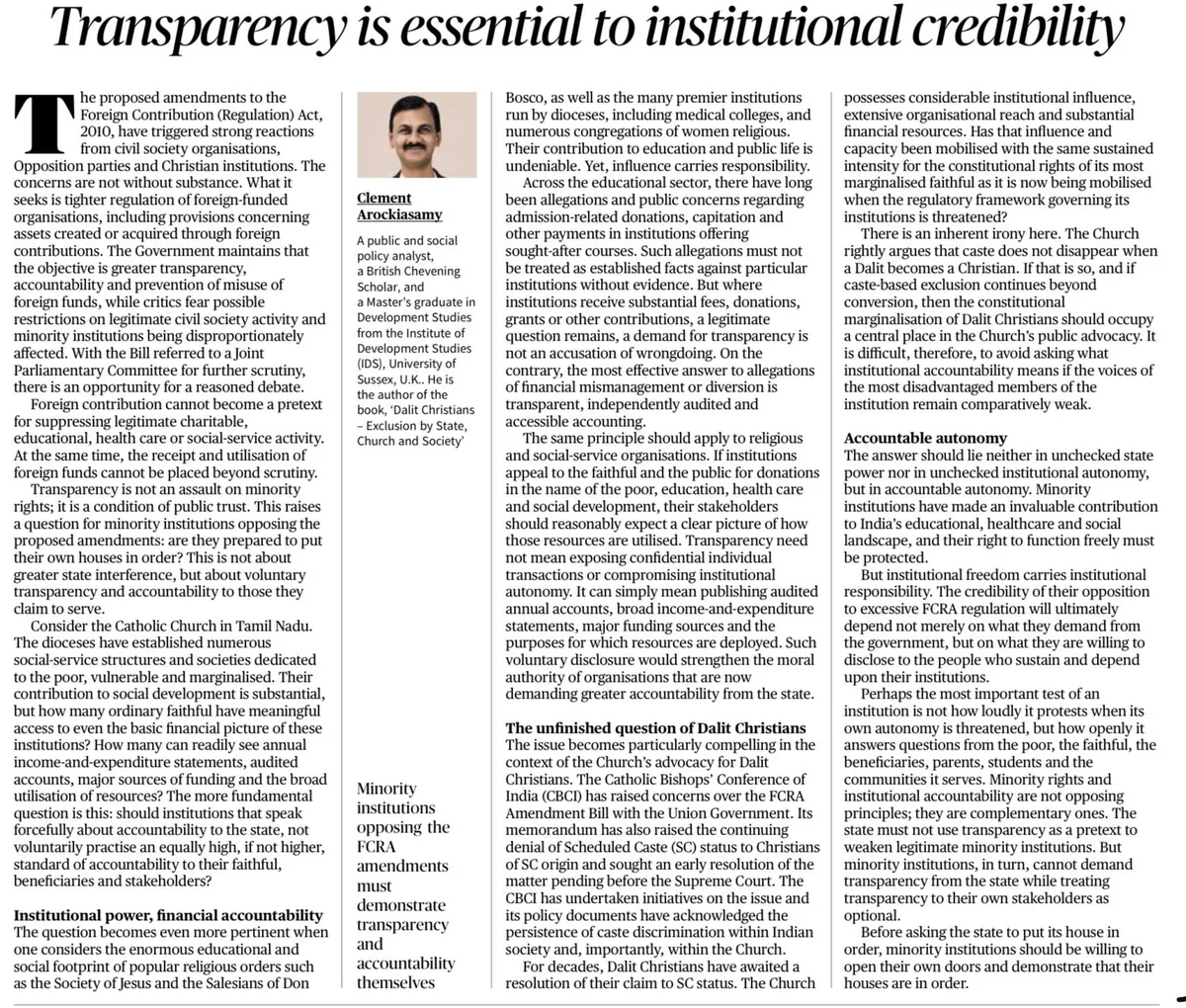
Context: Proposed amendments to the Foreign Contribution (Regulation) Act, 2010 have sparked debate on balancing transparency over foreign funds with the autonomy of minority and civil-society institutions. The Bill is with a Joint Parliamentary Committee.

Transparency is essential to institutional credibility – FCRA amendments and minority institutions (The Hindu)
Op-ed by Clement Arockiasamy on FCRA amendments. Source: The Hindu

FCRA and the Proposed Changes

FCRA 2010
Regulates acceptance and use of foreign contributions.
Administered by
Ministry of Home Affairs.
Govt's aim
Transparency, accountability, preventing misuse of foreign funds.
Concerns
May restrict legitimate charity, education and health work.
Status
Referred to a Joint Parliamentary Committee.

The Accountability Argument

Public trust
Transparency is a condition of trust, not an attack on rights.
Voluntary disclosure
Publish audited accounts, funding sources and use of funds.
Due process
Allegations need evidence and independent audits.

Minority Rights & Dalit Christians

Articles 25–30
Religious freedom and minority educational rights.
SC status
Constitution (SC) Order 1950 limits SC status to Hindus, Sikhs and Buddhists.
Debate
Dalit Christians' claim to SC status is pending before the Supreme Court.

Way Forward: Accountable Autonomy

Proportionate rules
Compliance without choking legitimate work.
Transparency
Clear, public financial reporting.
Fairness
Evidence-based oversight, not blanket suspicion.
Balance
Protect rights and prevent misuse.
Key Takeaway: Minority rights and accountability are not opposites. The state must not use transparency as a weapon, and institutions must not treat it as optional.

Prelims Practice MCQ

+2 correct • −0.66 wrong

With reference to the Foreign Contribution (Regulation) Act, 2010, consider the following statements:
1. It is administered by the Ministry of Home Affairs.
2. The 2020 amendment barred the transfer of foreign contribution received by a registered organisation to any other person or organisation.
3. Registration under FCRA, once granted, is valid for life.
Which of the statements given above are correct?

Explanation: FCRA is administered by the MHA, and the 2020 amendment barred onward transfer of foreign contributions. Registration is valid for five years and must be renewed, so Statement 3 is wrong.

UPSC Mains Question

15 Marks • 250 Words

Regulation of foreign contributions must balance national security with the freedom of civil society. Critically examine in the context of the proposed FCRA amendments.

Attempt before opening the value-addition tab.
Accepted: JPG, JPEG, PNG, WEBP or PDF. The standalone file previews your answer locally; connect the API hook for real server submission.
Use after attempting the Mains answer
  • FCRA 2020 amendment — Aadhaar for office-bearers, SBI New Delhi FCRA account, admin expense cap cut to 20%.
  • Case — Noel Harper v. Union of India (2022): SC upheld the 2020 amendments.
  • Dalit Christians — Justice K.G. Balakrishnan Commission (2022) examining SC status for converts.
  • Minority institutions — Art. 30; T.M.A. Pai Foundation (2002).
  • Keywords — accountable autonomy, civil society space, foreign funding.

Copyright © 2026 USARAMBHA EDUCATION (UnderStand UPSC). All Rights Reserved.

Antim Pag 6.0 – UPSC Interview Guidance Program 2026 by UnderStand UPSC