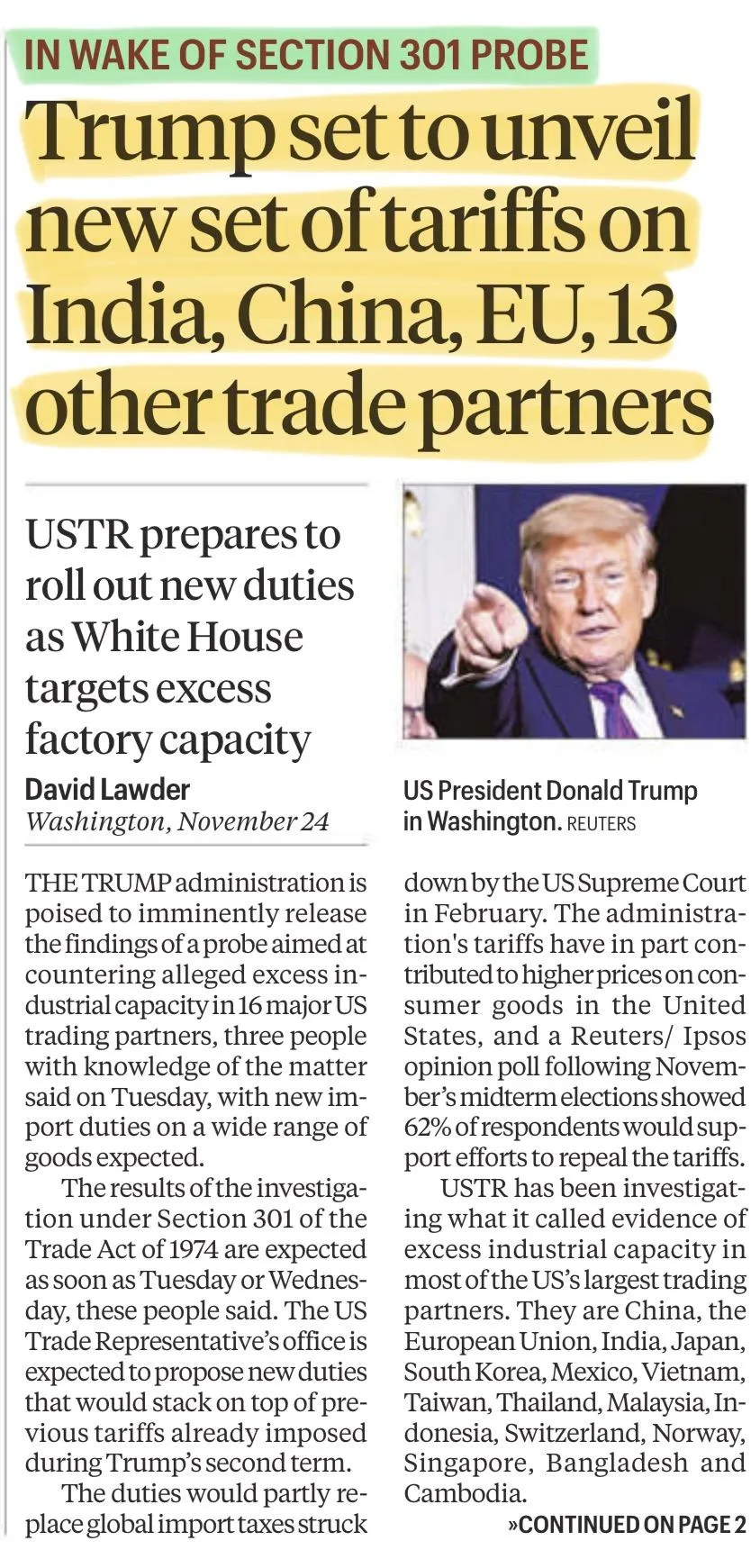
US Section 301 Probe: Trump Plans New Tariffs on India and Other Countries
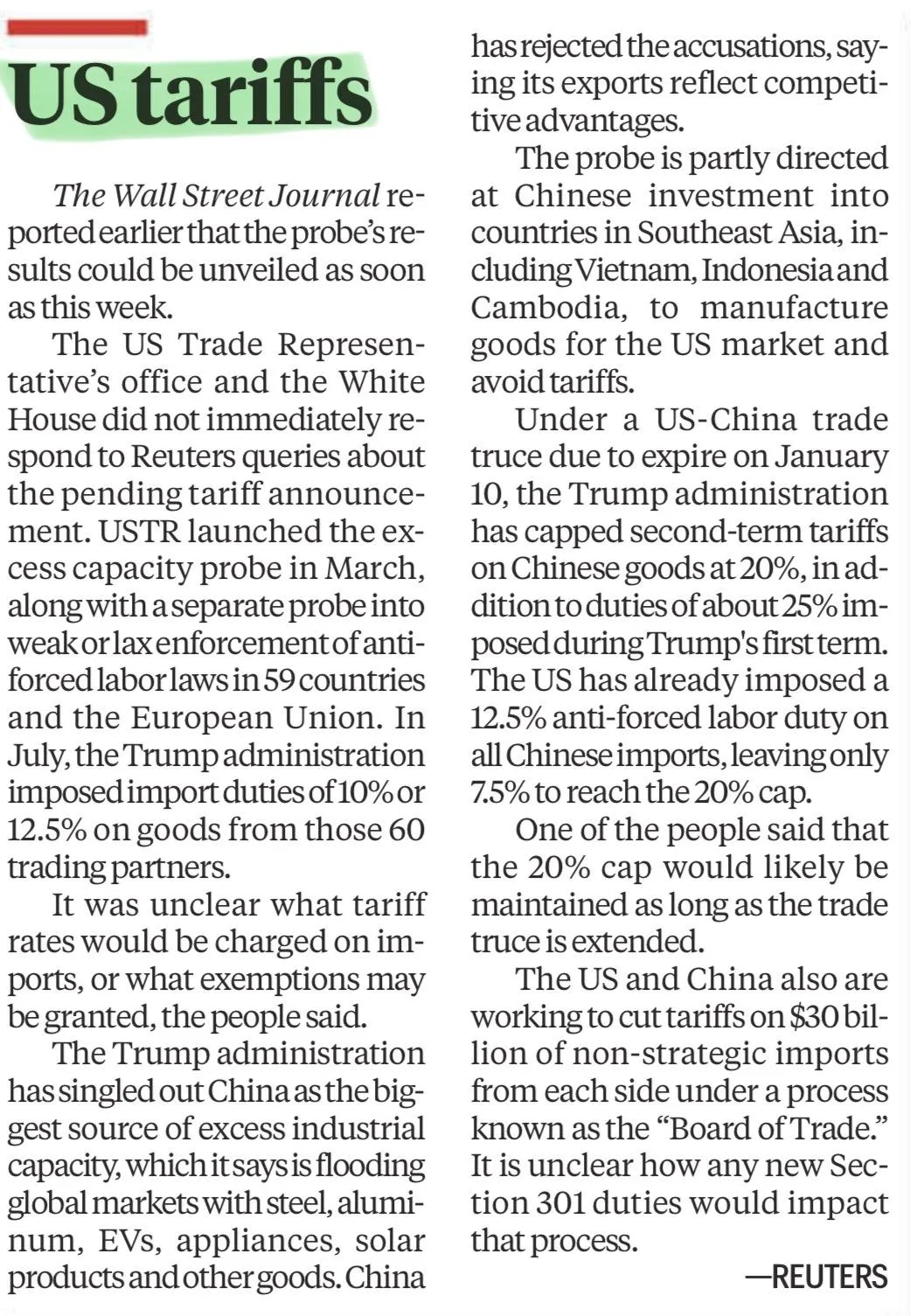
Context: The US is preparing additional tariffs on 16 trading partners, including India, China and the EU, after a Section 301 investigation into alleged excess industrial capacity.
Section 301: Basic Understanding
What it is
A provision of the US Trade Act, 1974 to investigate allegedly unfair foreign trade practices.
Administered by
The United States Trade Representative (USTR).
Powers
Allows unilateral trade measures, including additional import tariffs and restrictions.
Reasons Behind the Investigation
Excess industrial capacity
Alleged overproduction, particularly in China.
Unfair competition
Surplus goods may distort global markets and hurt domestic industries.
Trade diversion
Chinese firms shifting production to third countries (Vietnam, Indonesia, Cambodia) to avoid US tariffs.
Targeted sectors
Steel, aluminium, EVs, appliances and solar products.
WTO Angle
Most-Favoured-Nation (MFN)
Generally requires equal trade treatment among WTO members.
Legality
Unilateral tariffs may violate WTO obligations if inconsistent with its agreements.
Remedy
Affected countries can challenge them through the WTO dispute settlement mechanism.
Implications for India
Exports
Extra US tariffs may reduce the competitiveness of Indian goods in the US market.
Manufacturing
Steel, aluminium, automobile and solar-product exporters may face higher barriers.
Supply chains
India could attract firms shifting manufacturing away from China.
Trade relations
May complicate India–US trade negotiations and add uncertainty.
Key Takeaway: Section 301 lets the US act unilaterally outside the WTO; India must protect exporters while using supply-chain shifts away from China to its advantage.
Prelims Practice MCQ
+2 correct • −0.66 wrongWith reference to Section 301 of the US Trade Act, 1974, consider the following statements:
1. It is administered by the United States Trade Representative (USTR).
2. It is a provision of the WTO’s General Agreement on Tariffs and Trade (GATT).
3. It allows the US to impose additional tariffs on countries found to follow unfair trade practices.
Which of the statements given above are correct?
Explanation: Section 301 is a US domestic law administered by the USTR that permits unilateral measures such as extra tariffs. It is not a WTO/GATT provision – such unilateral action can in fact be challenged at the WTO.
UPSC Mains Question
GS2/GS3 • 15 Marks • 250 WordsUnilateral trade measures like Section 301 tariffs weaken the rules-based multilateral trading system. Examine the implications for India and suggest a response strategy.
Accepted: JPG, JPEG, PNG, WEBP or PDF. The standalone file previews your answer locally; connect the API hook for real server submission.
Use after attempting the Mains answer
- Concepts — MFN, national treatment, excess capacity, trade diversion, tariff stacking.
- Institutions — USTR, WTO Dispute Settlement Body (Appellate Body non-functional since 2019).
- India’s tools — FTAs, PLI schemes, China+1 strategy, export diversification.
- Keywords — protectionism, supply-chain resilience, strategic autonomy in trade.