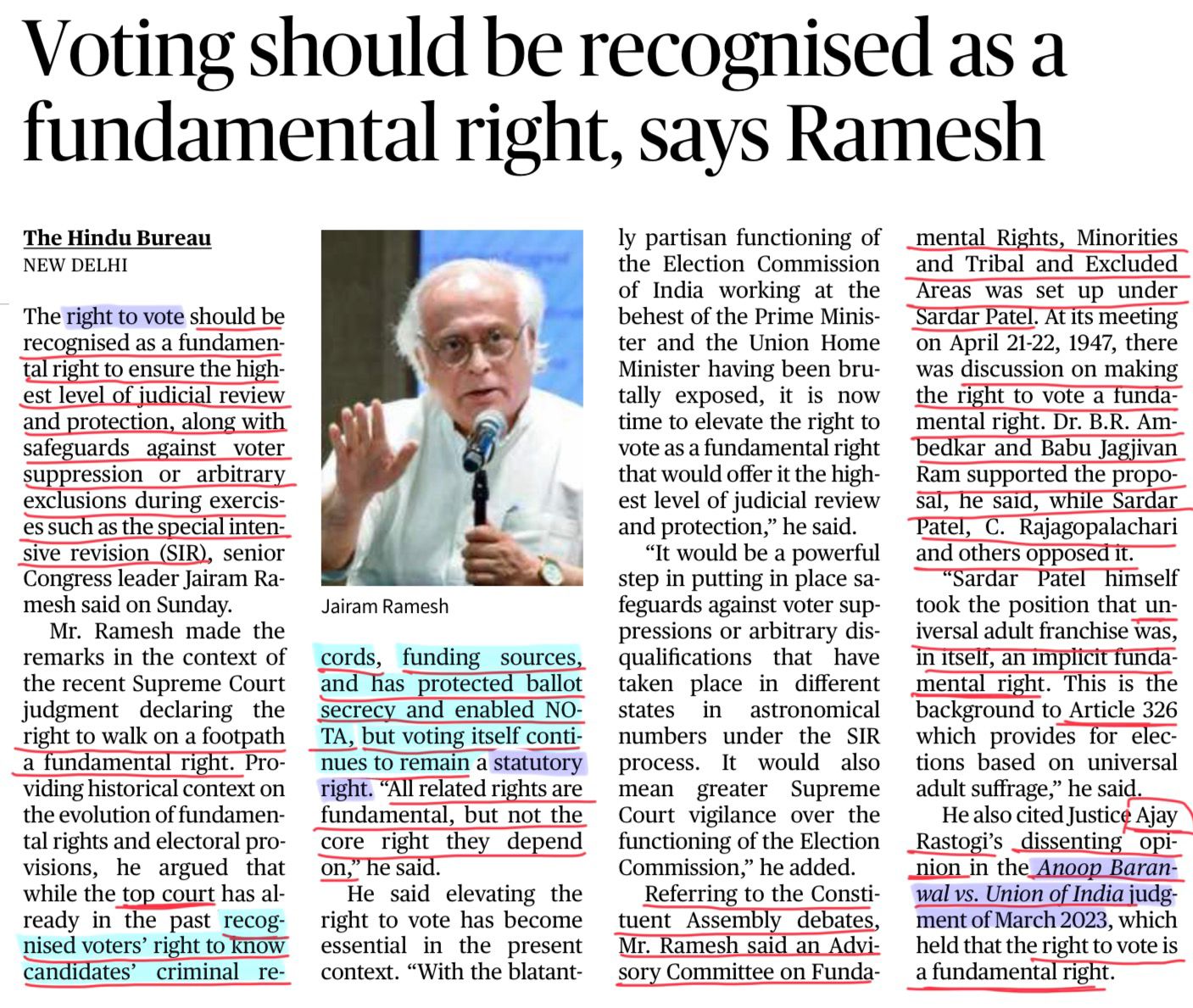
Context: Right to Vote Fundamental Right
Congress leader Jairam Ramesh demanded that the Right to Vote be recognised as a Fundamental Right, arguing that stronger constitutional protection is needed against voter exclusion and arbitrary electoral processes.
Core Constitutional Provisions
- Gives the Election Commission of India superintendence, direction and control over elections.
- Provides the constitutional basis of Universal Adult Suffrage.
- Empowers Parliament to make laws relating to elections.
Laws Made Under Article 327
Representation of the People Act, 1950
- Deals with electoral rolls and voter registration.
Representation of the People Act, 1951
- Deals with conduct of elections, qualifications, disqualifications and election disputes.
Nature of Voting Rights in India
Article 326
- Constitutional foundation of voting.
RPA 1950 and RPA 1951
- Statutory mechanism for voting and elections.
Article 19(1)(a)
- Basis for Right to Know candidate information and None of the Above.
Election Commissioner Appointment
Anoop Baranwal v. Union of India, 2023
- Supreme Court suggested appointment by a committee consisting of:
- Prime Minister
- Leader of Opposition
- Chief Justice of India
Chief Election Commissioner and Other Election Commissioners Act, 2023
- Appointment committee now consists of:
- Prime Minister
- Leader of Opposition
- Union Cabinet Minister nominated by Prime Minister
Constituent Assembly Debate on Right to Vote
Supported by
- Dr. B.R. Ambedkar
- Babu Jagjivan Ram
Opposed by
- Sardar Vallabhbhai Patel
- C. Rajagopalachari
Patel’s View
Universal Adult Franchise itself was considered a sufficient democratic safeguard, so a separate Fundamental Right was seen as unnecessary.
As a result, voting was placed under Article 326, not under Part III of the Constitution.
Supreme Court-led Electoral Reforms
Indira Nehru Gandhi v. Raj Narain, 1975
- Free and fair elections linked to Basic Structure.
Association for Democratic Reforms Case, 2002
- Candidate disclosure of criminal cases, assets and educational qualifications.
PUCL, 2003
- Right to Know recognised under Article 19(1)(a).
PUCL, 2013
- NOTA and ballot secrecy.
Lily Thomas v. Union of India, 2013
- Immediate disqualification upon conviction.
Public Interest Foundation v. Union of India, 2018
- Wider disclosure of criminal antecedents.
Anoop Baranwal v. Union of India, 2023
- Independent appointment process for Election Commissioners.
Final Supreme Court Position
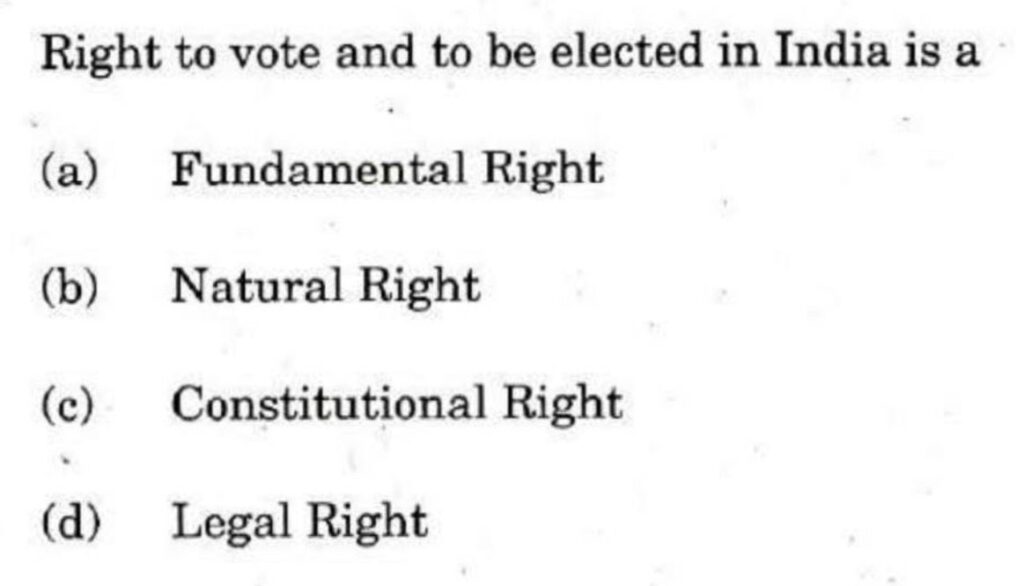
The Supreme Court position through cases such as N.P. Ponnuswami, 1952, Jyoti Basu, 1982 and Kuldip Nayar, 2006 is that the Right to Vote is not a Fundamental Right.
It is a Statutory Right, though rooted in Article 326.