11 August 2026 | UPSC Daily Current Affairs

11 August 2026 | UPSC Daily Current Affairs

Indian Handloom Sector: Economy and Cultural Heritage

Context: Indian handloom sector
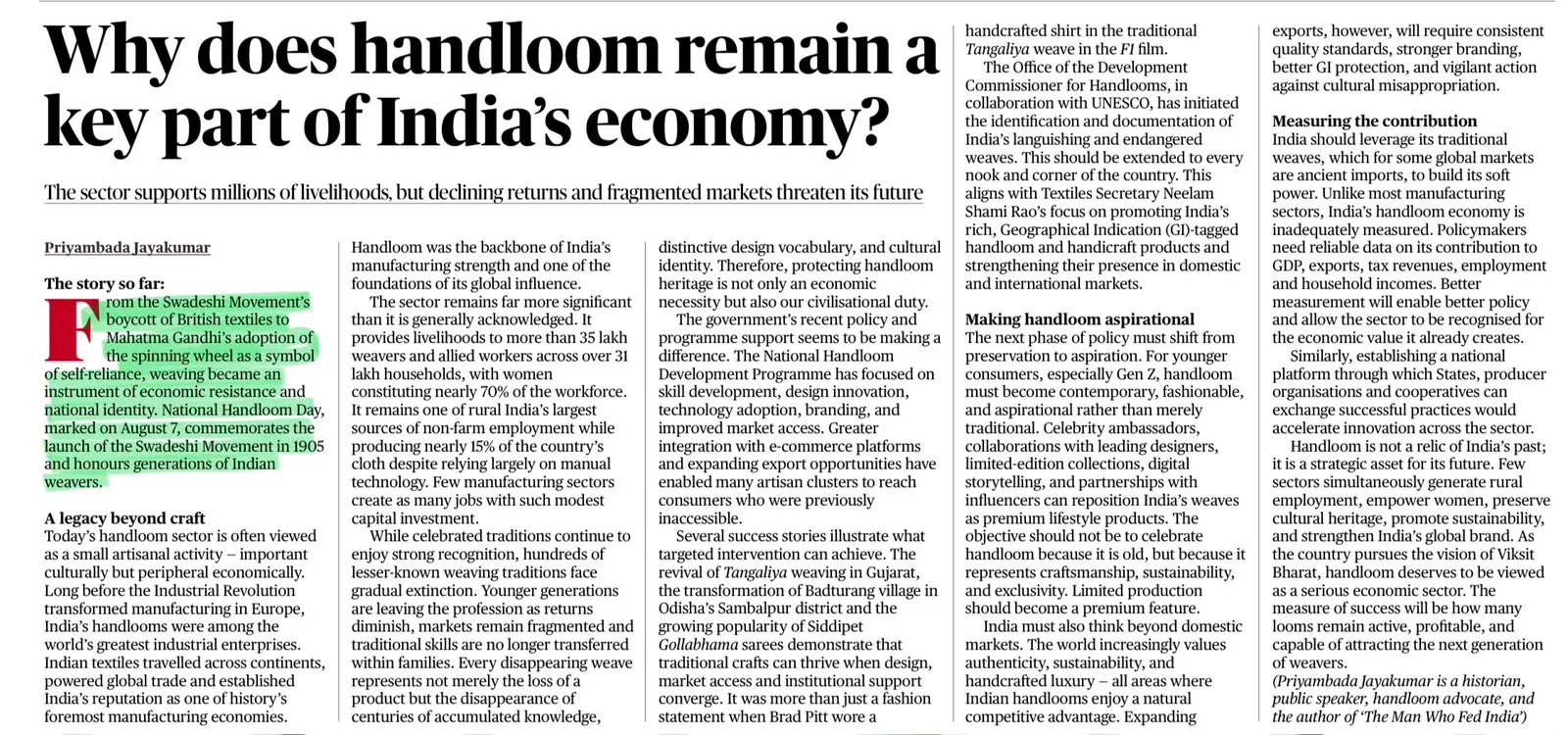
National Handloom Day is observed on 7 August to commemorate the Swadeshi Movement of 1905. The topic highlights handloom as both a source of rural employment and an important part of India’s cultural and economic heritage.

Handloom Sector in India

Handloom has been one of India’s oldest manufacturing traditions.

It is not only an economic activity, but also a carrier of regional identity, traditional knowledge and cultural heritage.

The sector supports millions of livelihoods, especially in rural areas.

Economic Significance

The handloom sector supports more than 35 lakh weavers and over 31 lakh allied workers across around 31 lakh households.

Nearly 70% of the workforce is women, making it important for women’s employment and rural household income.

Despite being largely manual and low-capital intensive, handloom produces nearly 15% of India’s cloth.

It is also a major source of non-farm rural employment.

Cultural and Heritage Value

Handloom preserves:

  • Indigenous designs
  • Traditional skills
  • Regional identities
  • Local weaving knowledge
  • Community-based craftsmanship

Important examples include:

  • Tangaliya from Gujarat
  • Sambalpuri from Odisha
  • Siddipet / Gollabhama tradition

These traditions show that handloom is not just cloth production, but cultural documentation through craft.

Need for GI Protection

Geographical Indication recognition can help protect traditional weaves from cultural misappropriation.

GI tagging, documentation and branding can also improve market recognition and support artisans.

Key Challenges

The sector faces declining returns and fragmented markets.

Younger generations are leaving the profession because income is uncertain.

Traditional skills are not being transferred properly to the next generation.

Many weavers face limited access to:

  • Technology
  • Branding
  • Finance
  • Design support
  • E-commerce
  • Export markets

Another major problem is lack of reliable data on GDP contribution, exports, employment and household income.

Without proper data, policy planning becomes weak.

Policy Link

The National Handloom Development Programme focuses on:

  • Skill development
  • Design innovation
  • Technology adoption
  • Market access

However, the sector needs stronger implementation and better integration with modern markets.

Way Forward

Handloom should be connected with e-commerce and export platforms.

GI protection and branding must be strengthened.

Designer collaborations, limited editions and digital storytelling can make handloom aspirational for younger consumers.

A national handloom data platform should be created to track employment, income, exports and productivity.

States should also share best practices to improve innovation and market access.

Key Takeaway

Handloom remains important because it combines employment, women’s participation, cultural heritage and rural economy. The next step is to make handloom commercially viable, aspirational and globally competitive.
Indian handloom sector

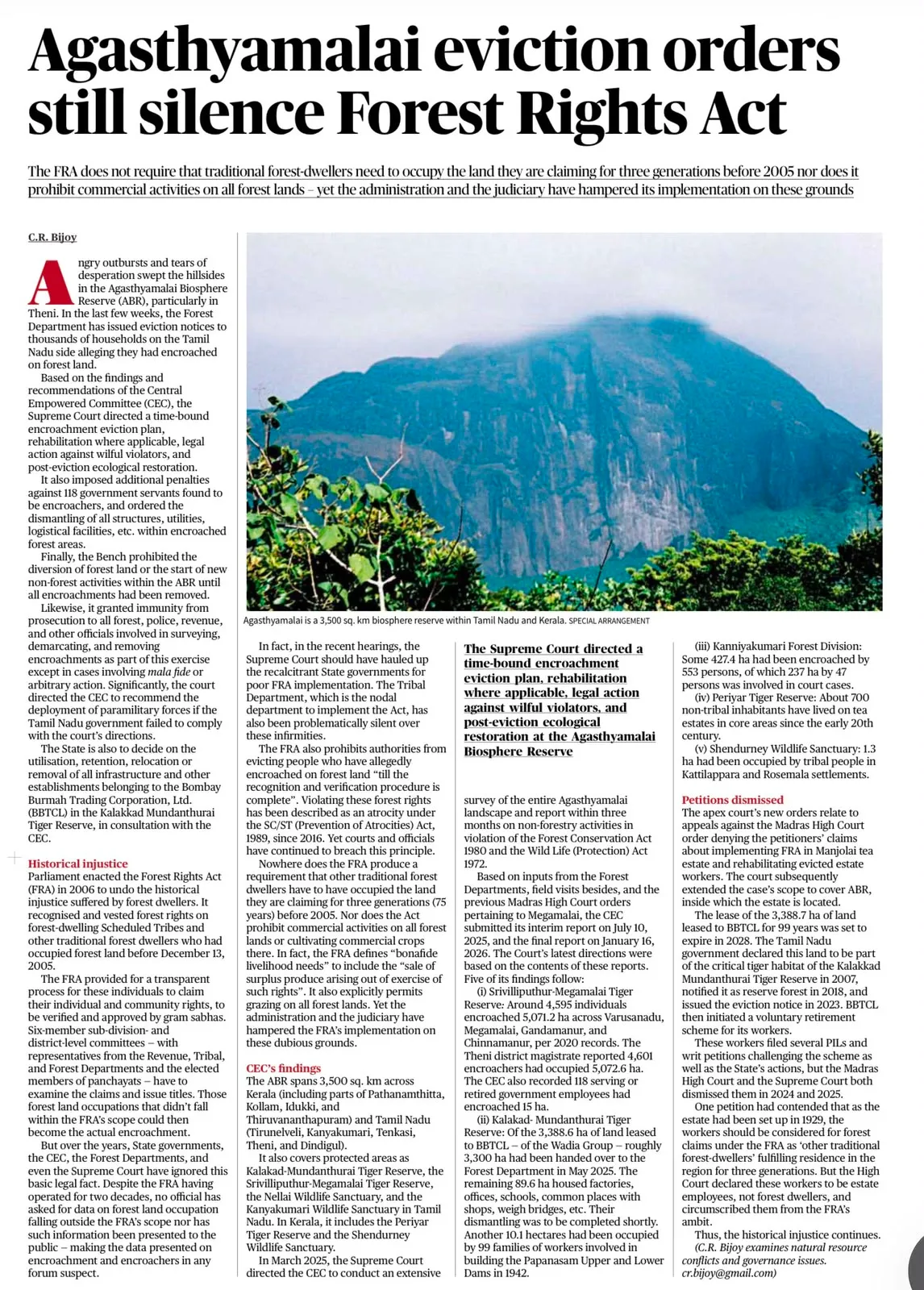
Forest Rights Act Agasthyamalai: Rights and Conservation

Context: Forest Rights Act Agasthyamalai
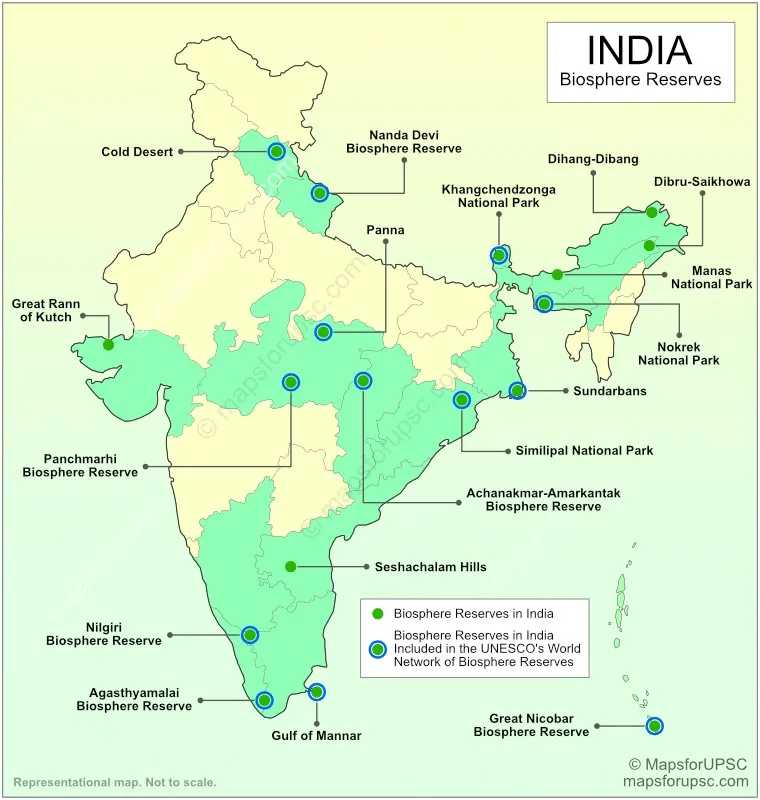
Eviction notices in the Agasthyamalai Biosphere Reserve have brought attention to the conflict between forest conservation and the legally recognised rights of forest-dwelling communities.

The core question is whether affected households are eligible rights-holders under the Forest Rights Act, 2006, or illegal encroachers.

Forest Rights Act, 2006

The Forest Rights Act recognises the rights of forest-dwelling Scheduled Tribes and Other Traditional Forest Dwellers.

It recognises both:

  • Individual Forest Rights
  • Community Forest Rights

Other Traditional Forest Dwellers

Other Traditional Forest Dwellers must have primarily and genuinely resided in and depended on forest land for livelihood for at least three generations, meaning 75 years, before 13 December 2005.

This cut-off is important because rights recognised under the Act must be distinguished from post-cut-off illegal encroachments.

Role of Gram Sabha

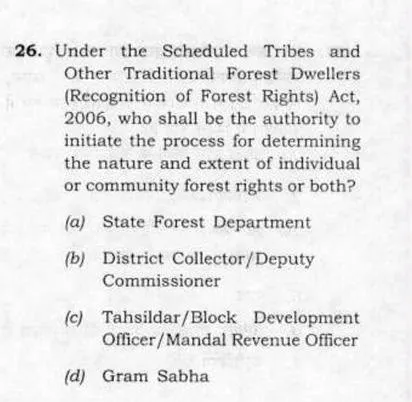
The Gram Sabha initiates and verifies forest-rights claims.

This makes local community participation central to the implementation of the Forest Rights Act.

Nodal Ministry

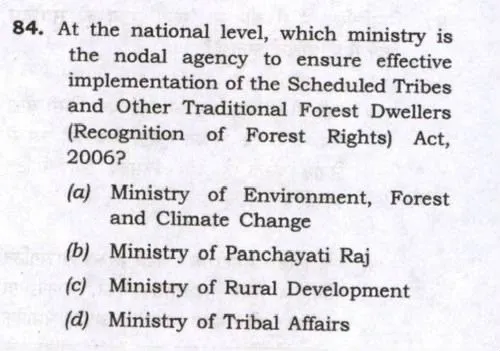
The Ministry of Tribal Affairs is the nodal ministry for implementation of the Forest Rights Act.

Agasthyamalai Biosphere Reserve

Agasthyamalai Biosphere Reserve is located in the southern Western Ghats across Kerala and Tamil Nadu.

It covers around 3,500 sq km.

It is part of UNESCO’s Man and the Biosphere Programme since 2016.

Important Protected Areas

Major protected areas include:

  • Neyyar Wildlife Sanctuary
  • Peppara Wildlife Sanctuary
  • Shendurney Wildlife Sanctuary
  • Kalakad–Mundanthurai Tiger Reserve

The region is important for Western Ghats biodiversity, high endemism and tribal communities, including the Kani.

Conservation-Rights Balance

Forest conservation requires prevention of illegal encroachment and protection of biodiversity and wildlife habitats.

But legitimate forest-rights claims must be recognised before eviction.

The Supreme Court’s directions on time-bound eviction of illegal encroachments, rehabilitation where applicable and ecological restoration make proper identification of genuine rights-holders especially important.

Key Issue

The concern is not whether illegal encroachment should be allowed.

The real issue is whether the Forest Rights Act process is being properly followed before eviction.

If genuine rights-holders are removed without recognition of their claims, it weakens both tribal justice and legal governance.

Key Takeaway

Agasthyamalai highlights the need to balance conservation with forest rights. Illegal encroachments must be removed, but genuine FRA claims must be verified and recognised before eviction.

Forest Rights Act Agasthyamalai

Self Help Groups Financial Inclusion: UPSC Key Lessons

Context: Self Help Groups financial inclusion
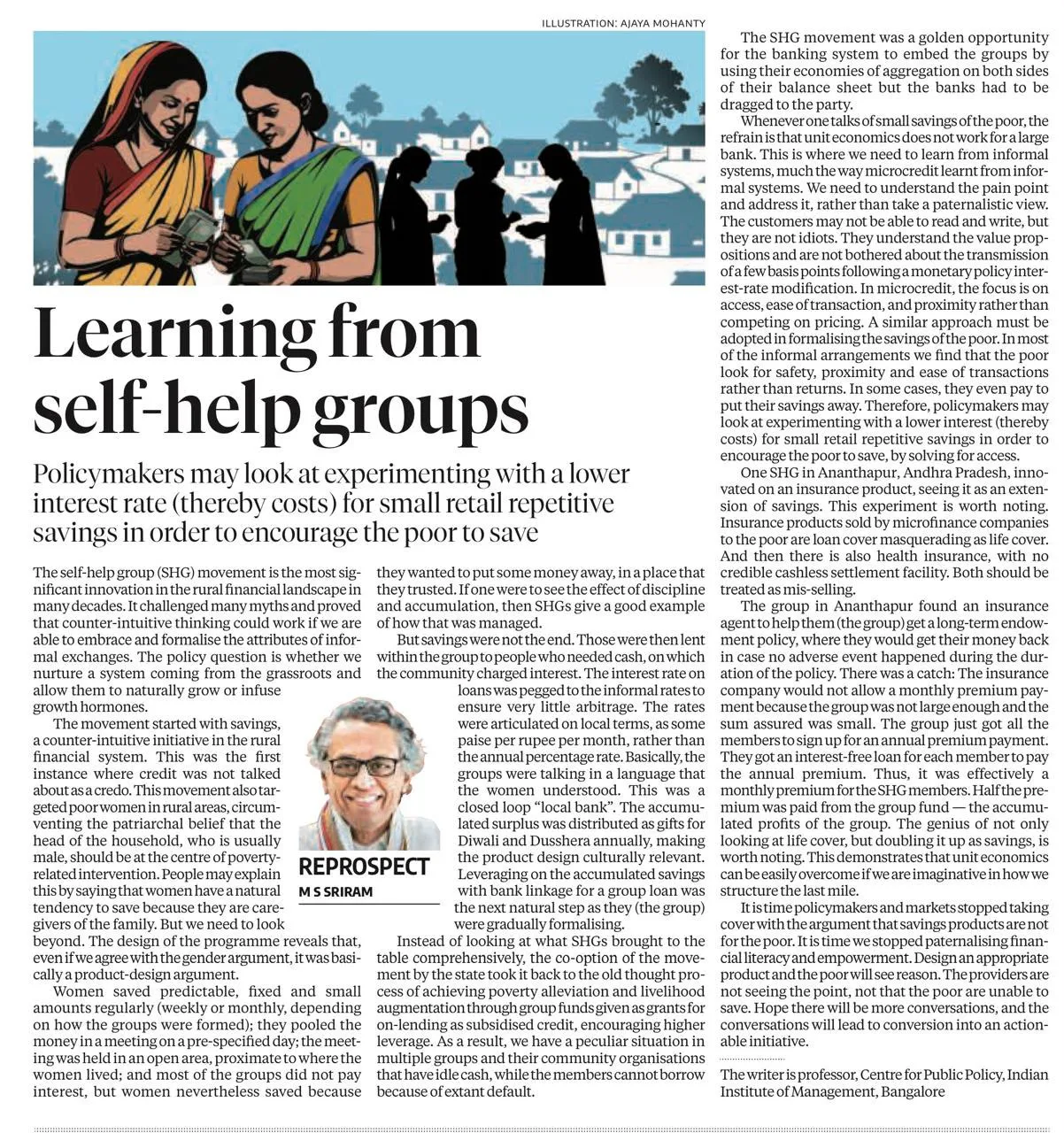
The Self-Help Group movement shows how collective savings, social trust and need-based finance can strengthen the financial resilience of poor households.

It also offers lessons for making formal banking more inclusive and more suited to the needs of low-income communities.

What Is a Self-Help Group?

A Self-Help Group is a voluntary group, usually of 10–20 members.

Members pool small regular savings, provide small internal loans and collectively access formal financial services.

SHGs as a Financial Inclusion Model

Savings-Led Inclusion

Small and regular savings build financial discipline.

They reduce dependence on informal moneylenders.

They also help poor households manage emergencies and recurring expenses.

Social Collateral

SHGs use peer monitoring and collective responsibility.

This reduces information asymmetry and lending risk for banks.

It allows banks to lend to groups that may not have conventional collateral.

Last-Mile Banking

Under Deendayal Antyodaya Yojana–National Rural Livelihoods Mission, or DAY-NRLM, 90.91 lakh SHGs covering 10.05 crore rural households had been mobilised by December 2025.

This shows the scale of SHGs as a last-mile financial delivery system.

SHGs as Women-Led Development

Financial Autonomy

Access to savings and credit strengthens women’s control over money and household decisions.

Collective Empowerment

Group-based action improves women’s bargaining power, confidence and participation in community institutions.

Financial Protection

SHGs can provide access not only to credit but also to:

  • Insurance
  • Pensions
  • Risk-management products
  • Livelihood support

Institutional Credit

Since 2013–14, SHGs have accessed ₹12.18 lakh crore of bank credit.

This shows their growing integration with formal finance.

Core Lesson for Formal Banking

Banks should adapt products to the poor’s financial reality.

Poor households often have small savings, irregular incomes and frequent transaction needs.

Formal banking should not impose conventional products that do not match their lives.

Financial inclusion should combine:

  • Savings
  • Credit
  • Insurance
  • Pensions
  • Livelihood support

Credit should be linked with skills, technology, market linkages and infrastructure.

SHG networks can reduce the cost and difficulty of last-mile financial service delivery.

Key Takeaway

SHGs show that financial inclusion works best when it is built on trust, savings, collective responsibility and products designed around the real needs of poor households.

Self Help Groups financial inclusion

Unconditional Cash Transfers: Fiscal Impact and Welfare

Context: Unconditional cash transfers
Unconditional cash transfers by States can provide immediate income support.

However, rapid expansion of such schemes can create large recurring expenditure commitments and may crowd out spending on education, health and infrastructure.

What Are Unconditional Cash Transfers?

Unconditional Cash Transfers, or UCTs, are direct cash payments given without requiring recipients to meet specific conditions.

They are usually used for welfare support, income support or social protection.

Why UCTs Matter

Income Support

UCTs provide immediate money for food, health, household expenses and basic needs.

Women’s Empowerment

Direct transfers can increase women’s financial autonomy.

They can improve women’s role in household decision-making.

Social Protection

Cash transfers help households cope with economic distress, livelihood shocks and rising costs.

Fiscal Concern

The main concern is not cash transfer itself, but the scale and sustainability of recurring commitments.

Regular transfers create a continuous revenue expenditure burden.

If poorly targeted, they can reduce fiscal space for long-term public investment.

Crowding-Out Risk

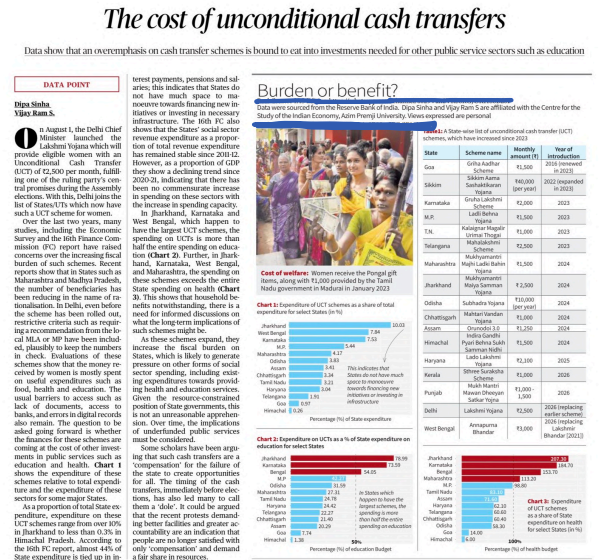
In some States, UCTs are becoming a large share of total expenditure.

The document gives examples:

  • Jharkhand: UCT spending is 10.03% of total State expenditure
  • West Bengal: 7.84%
  • Karnataka: 7.53%

Education Trade-Off

UCT spending equals:

  • 79% of the education budget in Jharkhand
  • 74% in Karnataka
  • 54% in West Bengal

This shows that large cash-transfer commitments can compete with human-capital spending.

Health Trade-Off

UCT spending equals:

  • 207% of the health budget in Jharkhand
  • 185% in Karnataka
  • 154% in West Bengal

This makes the fiscal trade-off even sharper.

Deeper Issue

States already have large committed expenditure towards salaries, pensions and interest payments.

This limits resources available for new investments.

Excessive revenue expenditure can constrain capital expenditure, infrastructure creation and productive public spending.

The concern is not anti-welfare.

The concern is poorly targeted and fiscally unsustainable welfare.

Way Forward

Cash transfers should prioritise genuine vulnerability instead of becoming blanket schemes.

Education, health, nutrition and infrastructure spending must be protected.

Cash support should be combined with skills, livelihoods and employment opportunities.

States should conduct cost-benefit and outcome-based evaluation before expanding schemes.

Key Takeaway

Unconditional cash transfers can help vulnerable households, but if they expand without targeting and fiscal discipline, they can weaken long-term spending on health, education and infrastructure.

Unconditional cash transfers

Nursing Registration Tracking System: Key UPSC Issues

Context: Nursing Registration Tracking System
India lacks an accurate live national database of nurses.

This weakens workforce planning, professional mobility, patient safety and emergency response. The Nurses Registration and Tracking System, or NRTS, was launched over seven years ago, but coverage remains incomplete.

Nurses Registration and Tracking System

The NRTS was created to build a national live registry of nursing personnel.

It aims to provide updated data on nurses across the country.

Current Status

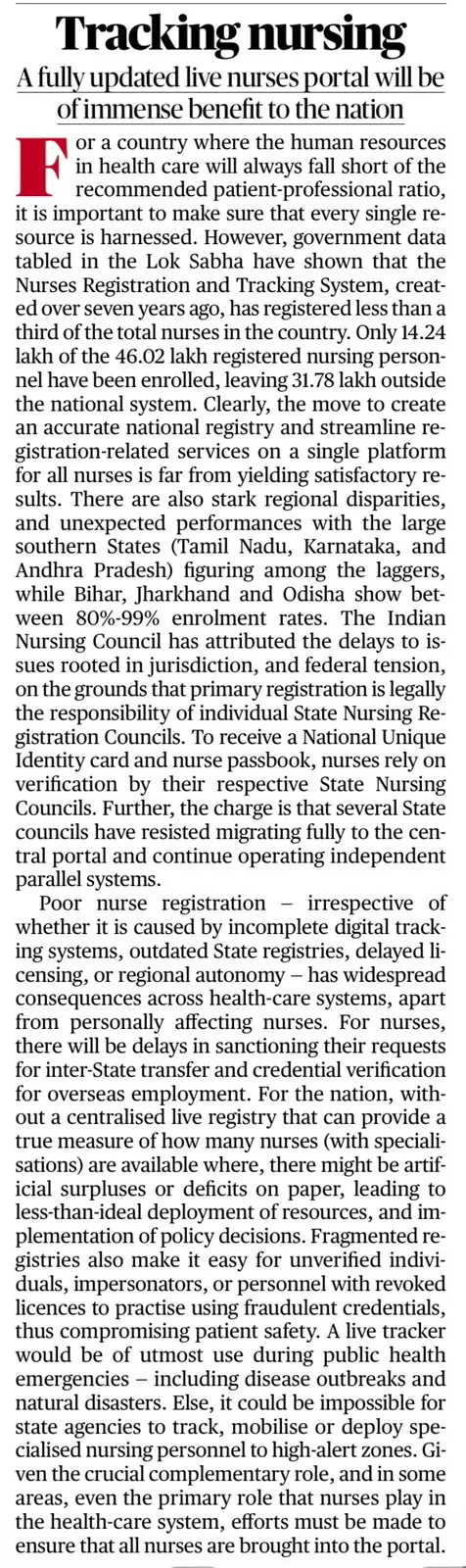
India has 46.02 lakh registered nursing personnel.

Only 14.24 lakh are enrolled on the NRTS.

This means around 31.78 lakh nurses remain outside the national system.

In percentage terms, only about 31% nurses are on NRTS, while around 69% remain outside it.

Why a Live Nursing Registry Matters

Workforce Mapping

Real-time data on number, location, qualification and specialisation can help identify actual shortages and surpluses.

This can improve nurse deployment across regions.

Patient Safety

Centralised verification can prevent fake credentials, impersonation and practice by nurses with revoked licences.

This protects patients and improves trust in the health system.

Emergency Response

A live database can help rapidly mobilise specialised nurses during disease outbreaks, pandemics and natural disasters.

Professional Mobility

Unified registration can make inter-State transfers easier.

It can also speed up credential verification for overseas employment.

Gaps in the Present System

Low Coverage

Only 14.24 lakh out of 46.02 lakh nurses are on NRTS.

This leaves a large majority outside the system.

Regional Disparity

Bihar, Jharkhand and Odisha reportedly show 80–99% enrolment.

Tamil Nadu, Karnataka and Andhra Pradesh are among the lagging States.

Fragmented Registries

Primary registration remains with State Nursing Councils.

Several councils continue parallel systems instead of fully migrating to the central portal.

Federal and Jurisdictional Issues

Verification for the National Unique Identity Card and nurse passbook depends on State Nursing Councils.

This creates delays and coordination problems.

Way Forward

India needs one interoperable nursing registry.

State Nursing Council databases should be integrated with NRTS.

Parallel records should be eliminated.

The database must be updated regularly for:

  • Registration
  • Renewal
  • Qualifications
  • Specialisation
  • Employment status
  • Licence status

The registry should be used for data-driven deployment according to regional health needs.

Centre-State coordination should improve through common standards and interoperable technology.

Key Takeaway

A live nursing registry is essential for patient safety, workforce planning and emergency response. India needs updated, interoperable and nationally integrated nursing data.

Nursing Registration Tracking System

Russian Oil Imports India: Energy Security and Sanctions

Context: Russian oil imports India
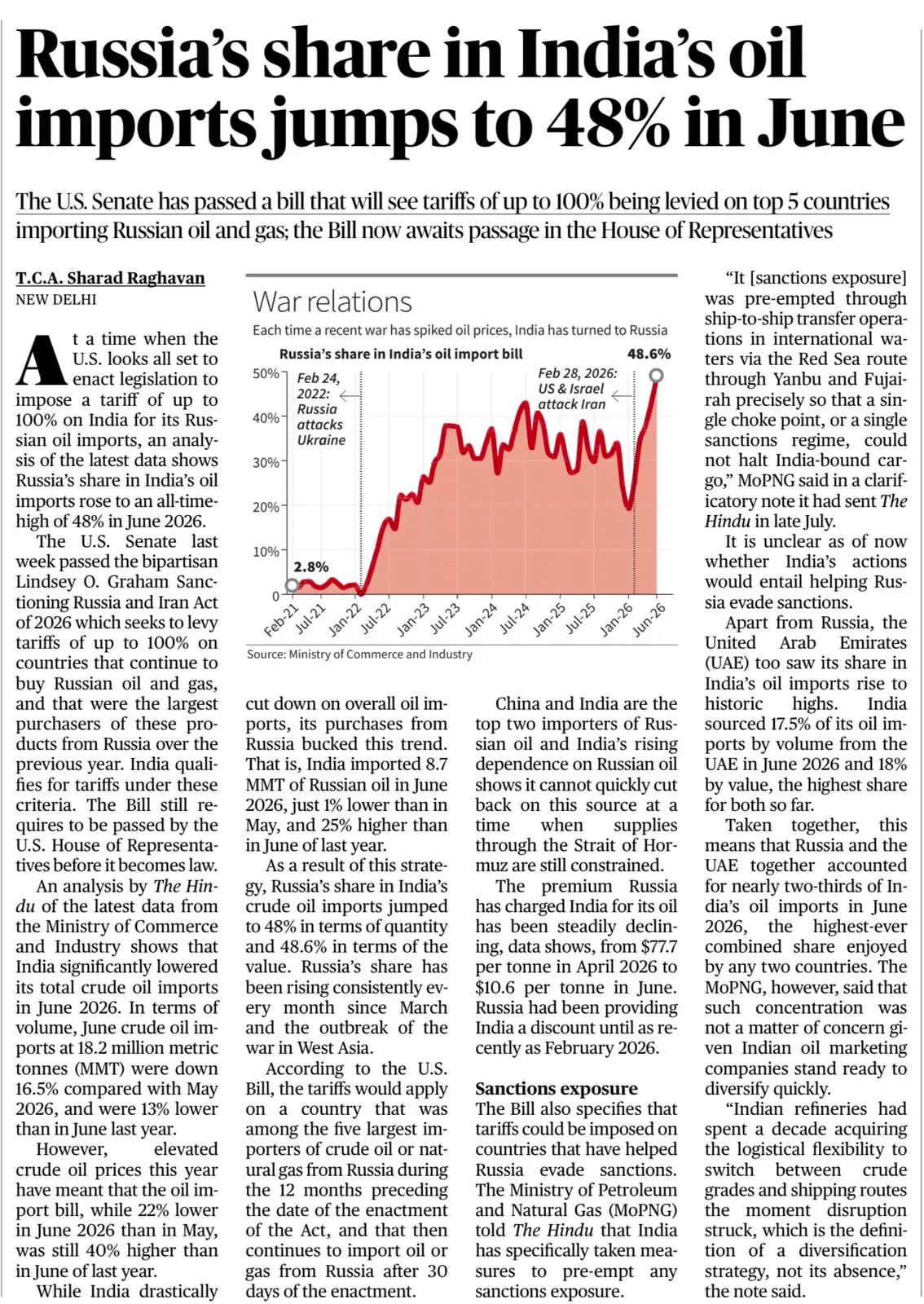
Russia’s share in India’s crude-oil imports rose to a record 48.6% by value in June 2026.

This comes as the United States moves towards stronger secondary sanctions on countries purchasing Russian energy.

Key Data

Russia accounted for 48.6% of India’s oil import bill in June 2026.

This is a sharp rise from around 2.8% in February 2022.

India imported 18.2 million metric tonnes of crude in June 2026.

This was 16.5% lower than May and 13% lower year-on-year.

India imported 8.7 MMT from Russia.

This was only 1% below May, but 25% higher than June 2025.

Russian Crude Discount

Russia’s price discount reportedly narrowed from $77.7 per tonne in April 2026 to $10.6 per tonne in June 2026.

This reduces one of the earlier economic advantages of buying Russian crude.

UAE Share

The United Arab Emirates supplied 17.5% of India’s oil imports by volume and 18% by value in June 2026.

Core Issue: Energy Security vs Sanctions

Russia remains a major crude supplier for India.

This allows Indian refiners to maintain diversified sourcing and flexible crude grades and shipping routes.

However, a 48.6% share also creates strategic vulnerability.

If geopolitical tensions disrupt Russian supplies or sanctions restrict payments and transactions, India could face supply and financial risks.

Strait of Hormuz Factor

With supplies through the Strait of Hormuz constrained, India’s dependence on alternative suppliers such as Russia has increased.

This shows why India’s energy-import strategy is shaped by both economics and geopolitics.

U.S. Sanctions Pressure

The U.S. Senate passed the Lindsey O. Graham Sanctioning Russia and Iran Act of 2026.

The Bill could allow tariffs of up to 100% on countries among the top five importers of Russian oil and gas.

However, the Bill still requires action in the U.S. House of Representatives.

India’s Dilemma

If India reduces Russian imports too quickly, energy costs and supply risks may rise.

If India continues large-scale Russian imports, trade and sanctions exposure with the United States may increase.

Key Takeaway

India’s Russian oil imports show the tension between energy security and sanctions risk. The challenge is to preserve affordable and diversified crude supplies while avoiding excessive strategic dependence on any one supplier.

Russian oil imports India

Copyright © 2026 USARAMBHA EDUCATION (UnderStand UPSC). All Rights Reserved.

Inquiry form for
Takshila Residential Program