25 July 2026 | UPSC Daily Current Affairs

25 July 2026 | UPSC Daily Current Affairs

BHAVYA Scheme for Chemical Parks: Key UPSC Notes

Context: BHAVYA Scheme for Chemical Parks
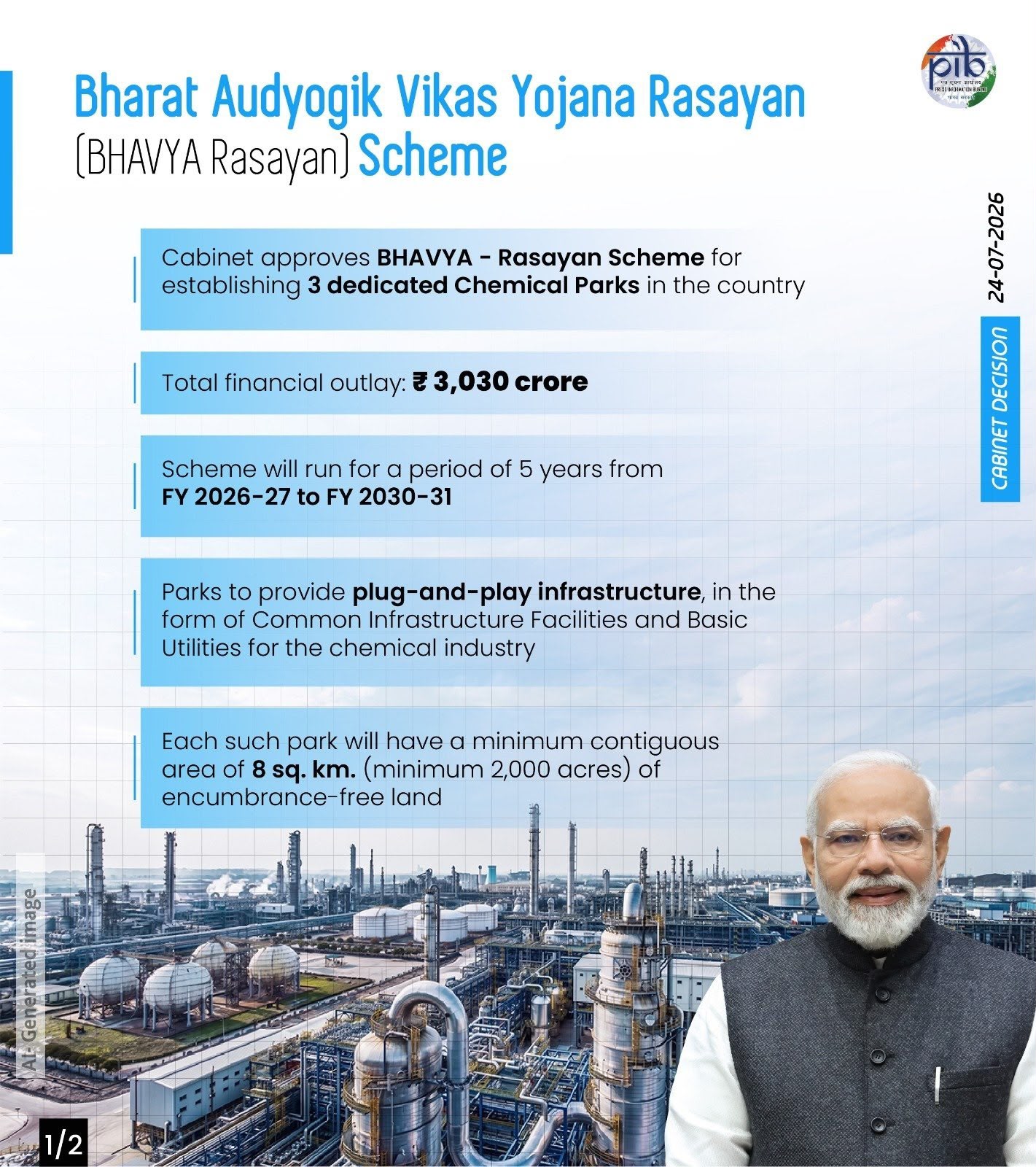
The Union Cabinet has approved the BHAVYA Scheme, or Bharat Audyogik Vikas Yojana Rasayan, to establish 3 dedicated Chemical Parks in India.

The scheme aims to create world-class common infrastructure for the chemical industry and promote manufacturing, exports, Global Value Chain integration, import substitution and employment.

BHAVYA Scheme

BHAVYA stands for Bharat Audyogik Vikas Yojana Rasayan.

It is a scheme for developing integrated chemical parks with common infrastructure and plug-and-play facilities.

Ministry

The scheme comes under the Ministry of Chemicals and Fertilizers.

Duration

The scheme will run for 5 years, from FY 2026–27 to FY 2030–31.

Financial Outlay

The total financial outlay is ₹3,030 crore.

This includes:

  • ₹3,000 crore for infrastructure
  • ₹30 crore for administrative expenditure

Funding Pattern

The Centre will provide a grant of up to ₹1,000 crore per park.

The concerned State Government will provide a minimum contribution of ₹500 crore.

Selection Method

States will be selected through a competitive Challenge Route, based on project readiness.

Eligibility

Each chemical park must have at least 8 sq. km., or around 2,000 acres, of contiguous and encumbrance-free land.

Infrastructure Facilities

The parks will provide plug-and-play infrastructure such as:

  • Common Effluent Treatment Plant
  • Treatment, Storage and Disposal Facility
  • Water supply and distribution systems
  • Steam generation and distribution network
  • Solvent recovery and distillation facilities
  • Interconnected pipeline network
  • Logistics and warehousing facilities

Significance

The scheme will help reduce logistics costs and improve competitiveness of the chemical sector.

It will also promote sustainable manufacturing by providing common environmental infrastructure like CETP and hazardous waste management facilities.

The scheme is expected to support domestic and foreign investment, exports, employment generation, Atmanirbhar Bharat and Viksit Bharat 2047.

Key Takeaway

BHAVYA is important because it aims to build integrated chemical manufacturing ecosystems with common infrastructure, lower costs and stronger global competitiveness.

BHAVYA Scheme for Chemical Parks

India Seaward Foreign Policy: Maritime Strategy UPSC

Context: India Seaward Foreign Policy
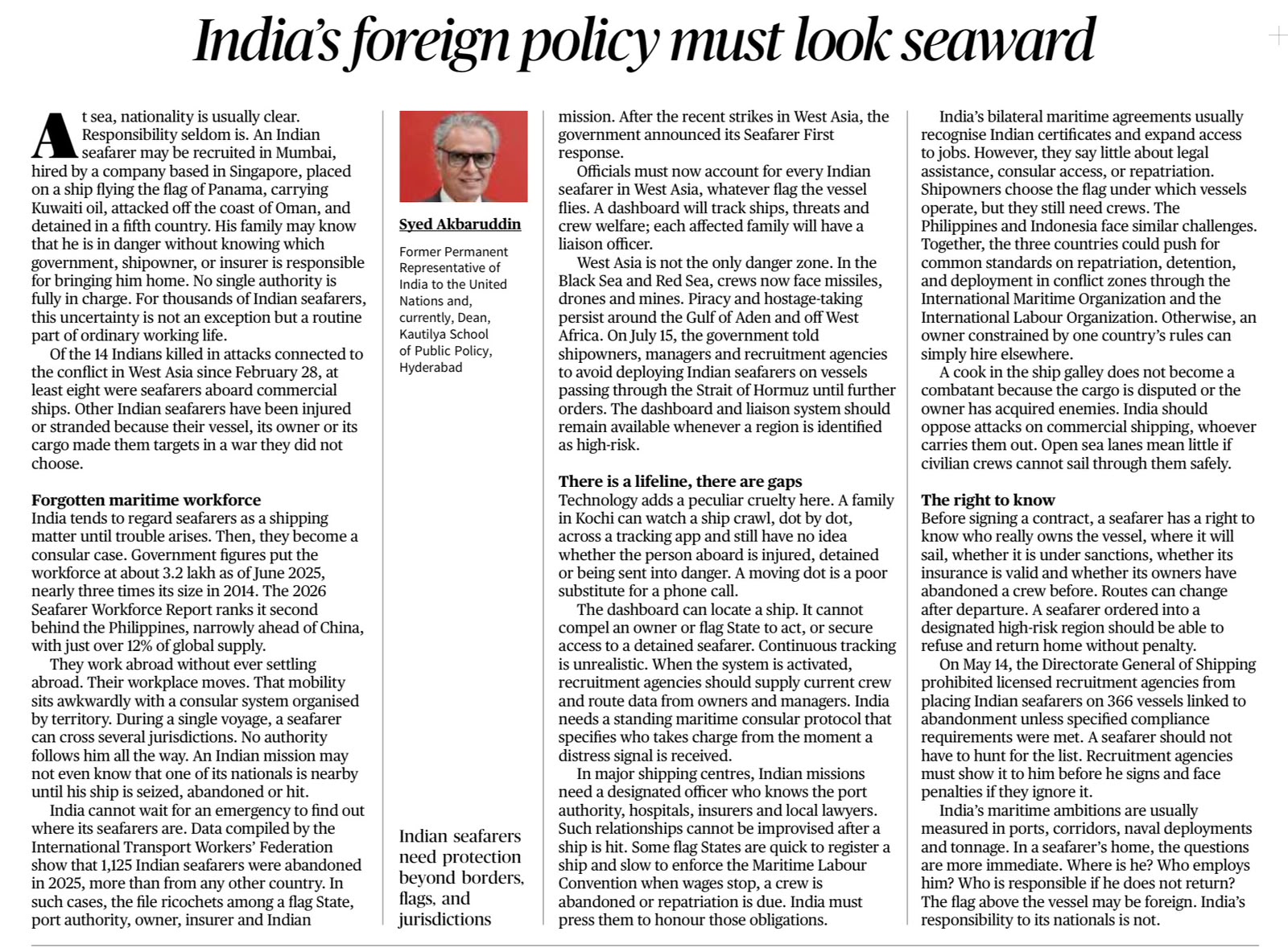
The editorial argues that India’s maritime diplomacy should go beyond securing sea lanes.

It must also protect Indian seafarers, many of whom work on foreign-flagged vessels and remain vulnerable during conflicts, piracy incidents and jurisdictional disputes.

Core Issue

Indian seafarers often work on ships registered under foreign flags.

This creates uncertainty over:

  • Legal jurisdiction
  • Consular protection
  • Emergency assistance
  • Repatriation
  • Responsibility during conflict or piracy incidents

Why This Matters

Recent conflicts in West Asia, the Red Sea, the Black Sea and piracy around the Gulf of Aden have exposed gaps in India’s institutional response.

When a ship is foreign-flagged, Indian authorities may face practical difficulties in ensuring quick protection, legal help or evacuation for Indian crew members.

Gaps in Current Maritime Agreements

India’s maritime agreements generally focus on:

  • Recognition of certificates
  • Employment facilitation
  • Shipping cooperation

But they provide limited safeguards for:

  • Legal assistance
  • Detention-related support
  • Evacuation
  • Repatriation
  • Conflict-zone protection

Maritime Labour Convention, 2006

Ships are governed mainly by Flag State jurisdiction.

The Maritime Labour Convention, 2006 protects seafarers’ rights, but enforcement remains uneven.

As a result, seafarers can remain vulnerable in crisis situations.

Right to Know

A major concern is that seafarers may not have enough information about:

  • Vessel ownership
  • Insurance status
  • Sanctions risk
  • Voyage routes
  • Conflict-zone risks

Without this information, they cannot make fully informed decisions before joining a vessel.

Way Forward

India should institutionalise a Seafarer First approach.

This requires a permanent maritime consular mechanism with dedicated liaison officers.

There should be clear protocols among:

  • Indian Missions
  • Shipowners
  • Insurers
  • Recruitment agencies
  • Port authorities

India should also strengthen cooperation through the International Maritime Organization and the International Labour Organization to develop common standards on detention, conflict-zone deployment and crew repatriation.

Key Takeaway

India’s maritime policy must protect not only trade routes but also Indian seafarers. Maritime security is incomplete without legal, consular and emergency protection for Indian citizens at sea.

India Seaward Foreign Policy

Women Employment and Economic Growth for UPSC

Context: Women Employment and Economic Growth
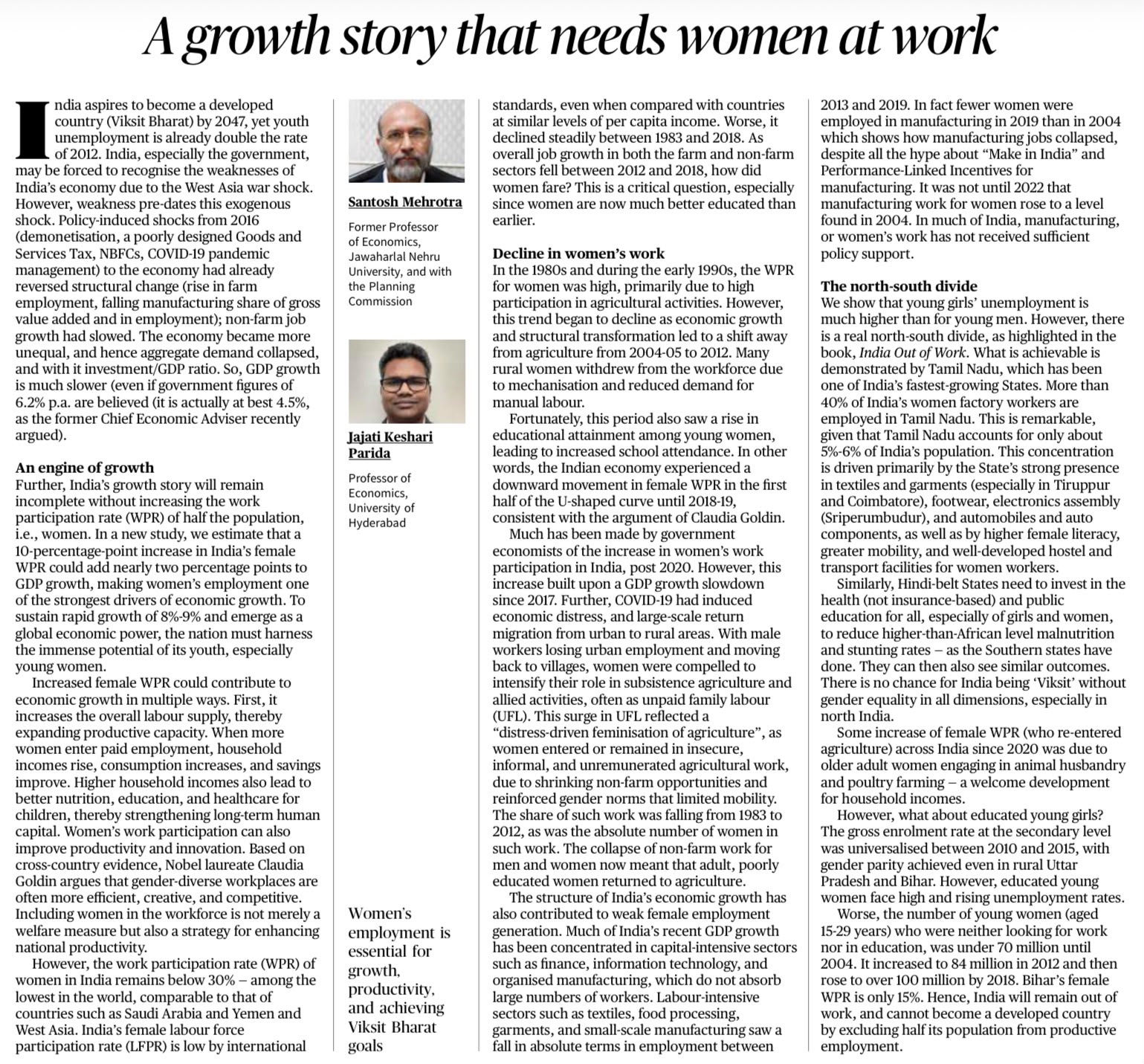
The article argues that India’s growth story cannot become complete without higher women’s participation in the workforce.

India aspires to become Viksit Bharat by 2047, but women’s employment remains low, limiting growth, productivity and inclusive development.

Core Argument

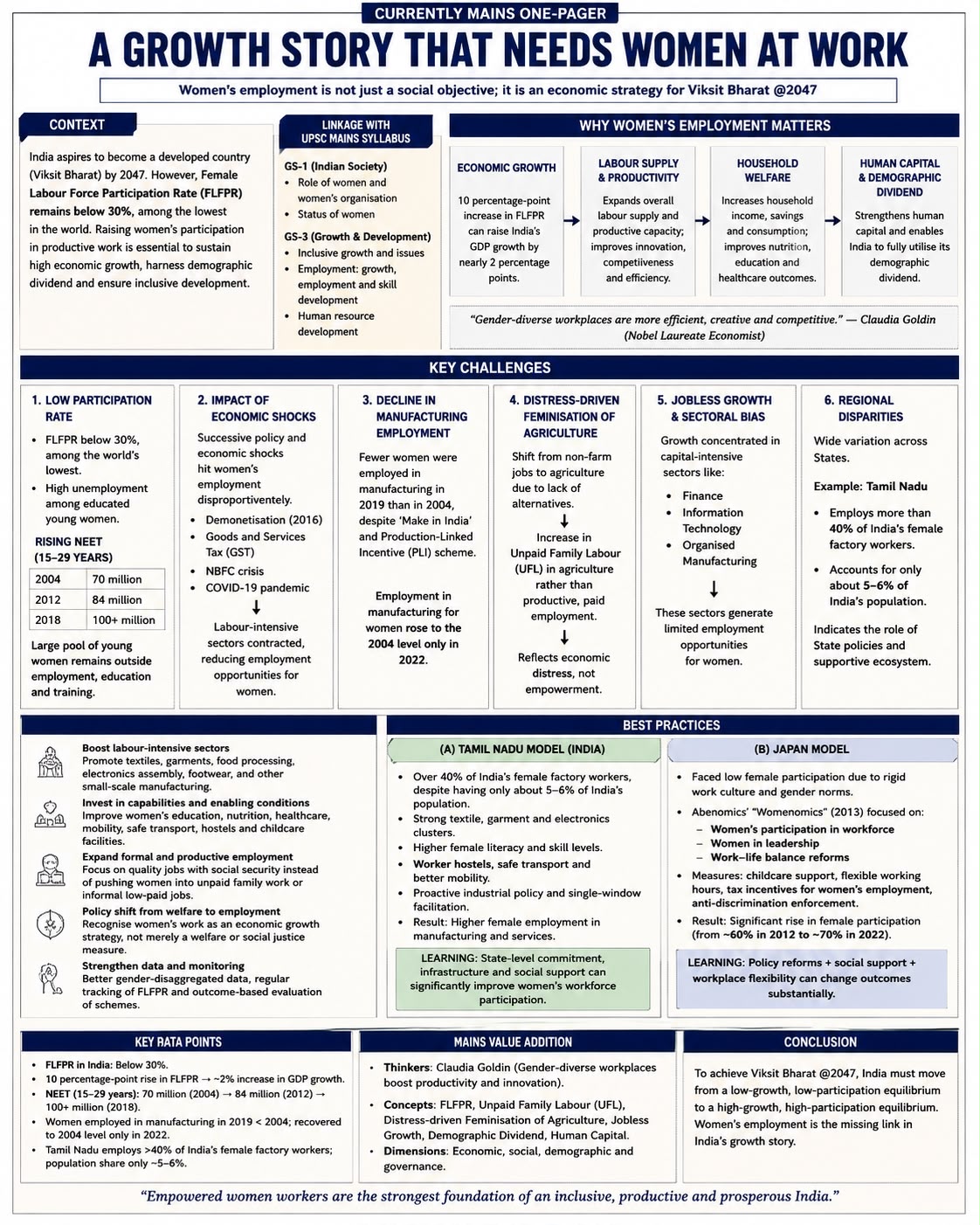
Women’s employment is not only a social objective.

It is an economic strategy for India’s long-term growth.

Higher women’s participation can expand labour supply, increase household income, improve human capital and help India use its demographic dividend better.

Female Labour Force Participation

India’s Female Labour Force Participation Rate remains below 30%, among the lowest globally.

This means a large share of working-age women are outside paid employment.

Why Women’s Employment Matters

A 10 percentage-point increase in female labour force participation can raise GDP growth by nearly 2 percentage points.

Women’s employment also improves:

  • Household income
  • Savings
  • Consumption
  • Nutrition
  • Education outcomes
  • Healthcare access
  • Children’s human capital

Key Challenges

1. Low Participation Rate

Women’s participation in productive work remains low despite improvement in education.

Educated young women also face high unemployment.

2. Impact of Economic Shocks

Successive shocks such as demonetisation, GST, NBFC crisis and COVID-19 affected women’s employment disproportionately.

Labour-intensive sectors that employed women were hit badly.

3. Decline in Manufacturing Employment

Fewer women were employed in manufacturing in 2019 than in 2004.

This shows that manufacturing did not absorb women workers at the required scale.

4. Distress-Driven Feminisation of Agriculture

Some women entered agriculture not because of better opportunities but because of lack of alternatives.

This increase in unpaid family labour reflects economic distress rather than real empowerment.

5. Jobless Growth in Services

Growth has been concentrated in capital-intensive and formal service sectors like finance, information technology and organised manufacturing.

These sectors generate fewer employment opportunities for women at scale.

6. Regional Disparities

There are major regional differences.

Tamil Nadu is a positive example because it employs more than 40% of India’s female factory workers, despite having only around 5–6% of India’s population.

Its textile, garment, electronics and manufacturing ecosystem has helped women enter the workforce.

Best Practices

Tamil Nadu Model

Tamil Nadu shows that State-level policy support, industrial clusters, worker hostels, safe transport and better mobility can improve women’s workforce participation.

Japan Model

Japan improved female participation through policy reforms, childcare support, flexible working hours, tax incentives and anti-discrimination measures.

Way Forward

India must promote labour-intensive sectors such as textiles, garments, food processing, electronics assembly and footwear.

It must invest in women’s education, nutrition, healthcare, safe transport, childcare and hostels.

Policy must shift from welfare-only thinking to employment-led empowerment.

Better gender-disaggregated data and regular monitoring of female labour force participation are also needed.

Key Takeaway

Women’s employment is the missing link in India’s growth story. Without bringing more women into productive and paid work, India’s demographic dividend will remain underused.

Women Employment and Economic Growth

India US Trade Tariffs: UPSC Current Affairs

Context: India US Trade Tariffs
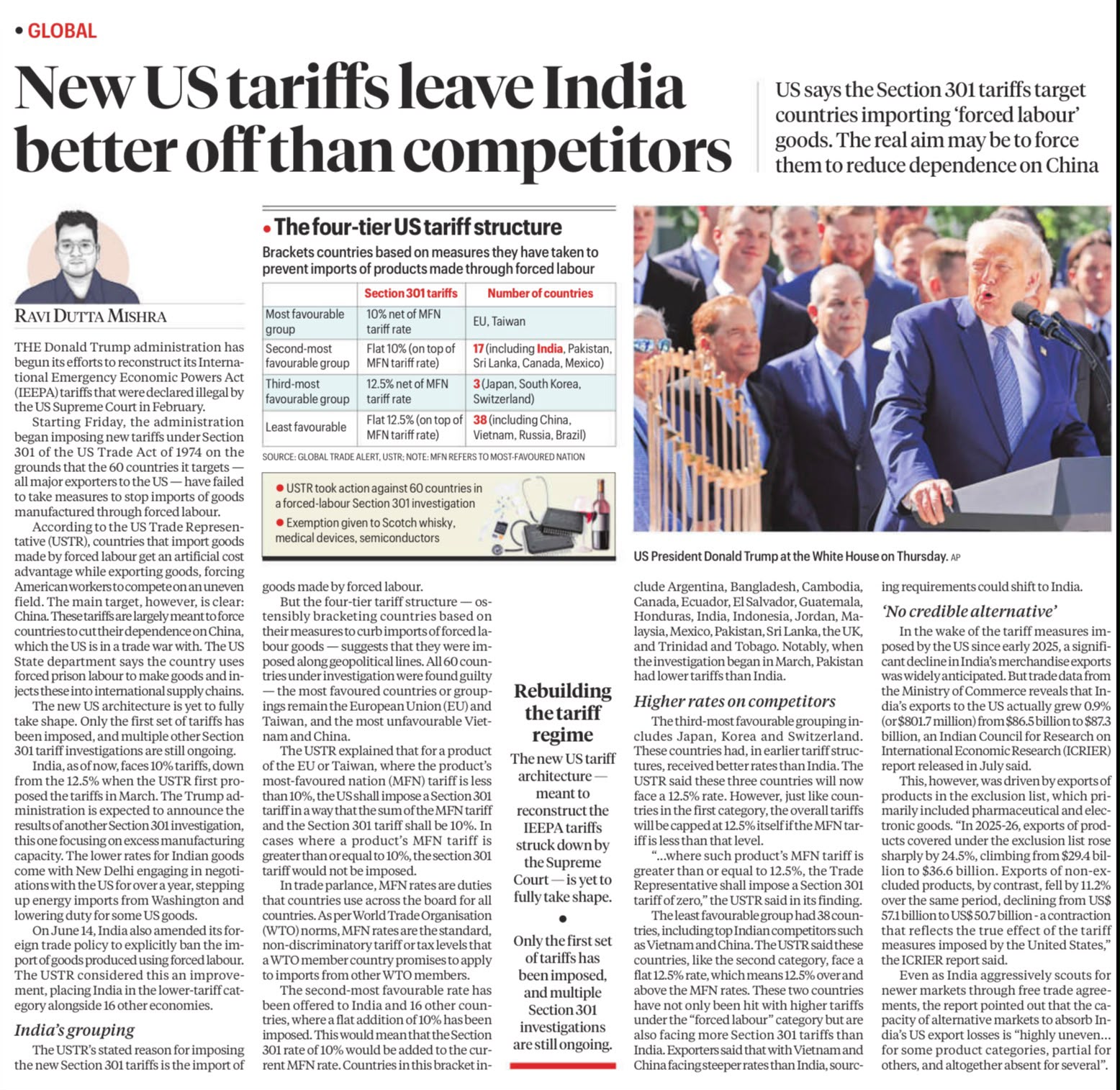
The United States has introduced a new tariff regime under Section 301 of the US Trade Act, 1974, restructuring import tariffs on nearly 60 countries.

India has been placed in a relatively favourable tariff category compared to competitors like China and Vietnam, improving the competitiveness of Indian exports in the US market.

Section 301 Tariffs

Section 301 of the US Trade Act, 1974 allows the US to take trade action against countries whose trade practices are considered unfair or harmful to US commerce.

The new tariff system replaces earlier tariffs imposed under the International Emergency Economic Powers Act, after those tariffs were invalidated by the US Supreme Court.

Purpose of the Tariff Regime

Officially, the tariffs aim to curb imports linked to forced labour.

However, the policy also reflects the US strategy of:

  • Reducing dependence on China
  • De-risking supply chains
  • Promoting domestic manufacturing
  • Diversifying sourcing towards trusted partners

Four-Tier Tariff Structure

Countries have been classified into four tariff categories.

India faces lower additional tariffs than major competitors such as China and Vietnam.

This creates a relative trade advantage for India, though not an absolute advantage.

Why India May Benefit

Lower tariffs can make Indian exports more competitive in the US market.

This gives India an opportunity to:

  • Expand market share in the US
  • Attract supply-chain relocation
  • Strengthen its role in Global Value Chains
  • Improve export competitiveness

Limits of the Advantage

Tariff advantage alone cannot guarantee export growth.

India must improve:

  • Manufacturing competitiveness
  • Logistics efficiency
  • Infrastructure
  • Ease of doing business
  • Production scale
  • Quality standards

Key Takeaway

The new US tariff regime gives India a relative advantage over some competitors, but India can benefit only if it strengthens manufacturing capacity, logistics and export competitiveness.

India US Trade Tariffs

India Education Expenditure Decline: UPSC Analysis

Context: India Education Expenditure Decline
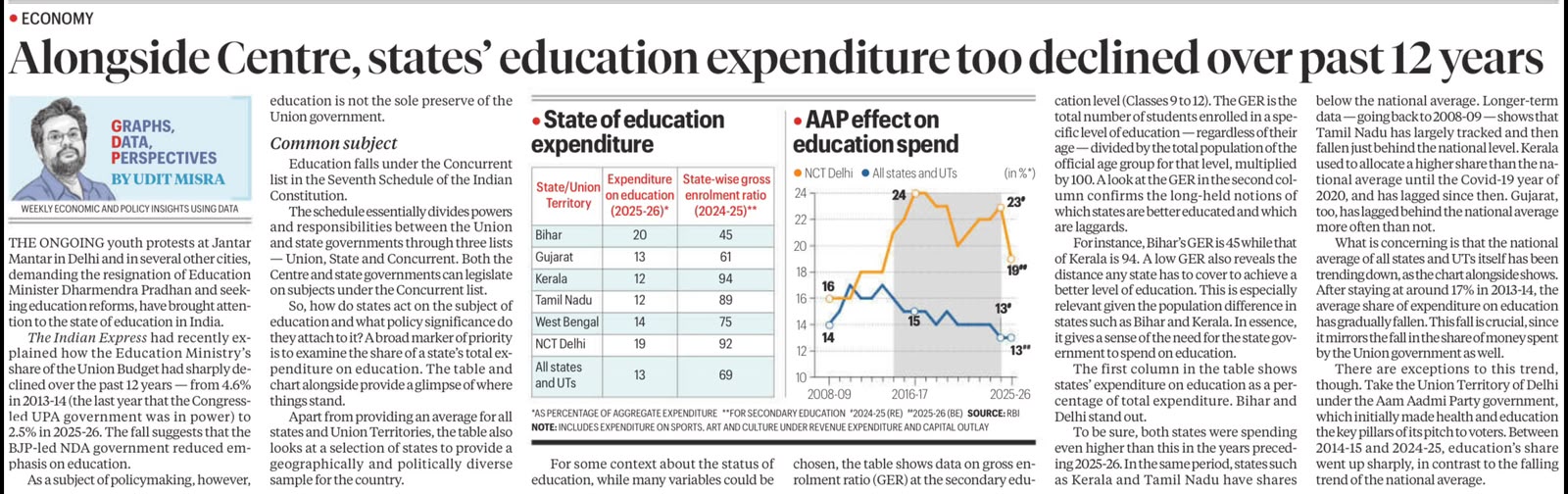
India’s education spending has declined at both the Union and State levels over the past decade.

This raises concerns about the implementation of National Education Policy 2020, quality of education, learning outcomes and human capital development.

Declining Public Investment

The Union Government’s expenditure on education declined from 4.6% of the Union Budget in 2013–14 to 2.5% in the 2025–26 Budget Estimates.

The average share of education expenditure by States and Union Territories also declined from nearly 17% in 2013–14 to 13% in 2025–26.

This shows that the decline is not limited to the Centre.

Education and Federalism

Education is a Concurrent List subject under the Seventh Schedule.

This means both the Union and State governments have responsibility for the sector.

If both levels reduce budgetary priority, overall investment in education weakens.

Key Findings

There are major interstate differences.

Bihar allocates the highest share of its expenditure to education, around 20%, but records a Secondary Gross Enrolment Ratio of only 45.

Kerala and Tamil Nadu allocate around 12% of their expenditure to education, but achieve much better outcomes.

Kerala has a Secondary GER of 94, while Tamil Nadu has a GER of 89.

This shows that higher spending alone does not automatically guarantee better outcomes.

Delhi Exception

Delhi remains a notable exception.

Its education expenditure increased substantially between 2014–15 and 2024–25, showing the impact of sustained policy prioritisation.

Implications

Declining public investment can slow the implementation of NEP 2020.

It may affect:

  • School education
  • Skill development
  • Learning outcomes
  • Teacher capacity
  • Digital infrastructure
  • Human capital formation

Persistent regional disparities can widen inequality in labour productivity and economic growth.

Way Forward

India should progressively increase public investment towards the 6% of GDP target envisaged under NEP 2020.

It should also improve efficiency and outcome-orientation of education spending.

Better governance, teacher training, digital infrastructure and accountability are essential.

Centre-State fiscal coordination must be strengthened to reduce interstate disparities and ensure equitable access to quality education.

Key Takeaway

India’s education challenge is not only about spending more. It is also about spending better, sustaining policy priority and reducing regional inequalities in learning outcomes.

India Education Expenditure Decline

About the UPSC Civil Services Examination (UPSC CSE)

The UPSC Civil Services Examination (CSE) is one of the most competitive and esteemed examinations in India, conducted by the Union Public Service Commission to recruit officers for services such as the Indian Administrative Service (IAS), Indian Police Service (IPS), Indian Foreign Service (IFS), and others. The exam comprises three stages — Prelims, Mains, and the Personality Test (Interview) — designed to test a candidate’s knowledge, aptitude, decision-making, and leadership skills.

How to Prepare Effectively for UPSC CSE

Cracking the UPSC CSE requires a deep understanding of the syllabus, consistent revision, structured answer writing, and smart test-taking strategies. The Prelims test analytical and conceptual clarity, the Mains focuses on critical thinking, articulation, and subject mastery, while the Interview assesses presence of mind, ethical judgment, and personality traits relevant to public service.

At UnderStand UPSC, we empower aspirants with a personalized and focused approach to each stage of the exam.

Why Choose UnderStand UPSC?

UnderStand UPSC is a mentorship-driven platform offering a clear, clutter-free strategy to tackle the Civil Services Examination. Our programs like Transform (for beginners and intermediate learners) and Conquer (for advanced mains preparation) provide structured study plans, syllabus-wise video content, interactive live sessions, and answer writing support.

We emphasize:

  • Concept clarity through topic-wise lectures

  • Test series designed around real UPSC standards

  • Personalized mentorship in small groups

  • Regular performance tracking and peer benchmarking

  • Doubt-clearing sessions, current affairs analysis, and monthly magazines

Join the UnderStand UPSC Learning Community

Our mission is to make UPSC preparation less overwhelming and more strategic. We combine mentorship, discipline, and academic rigor to help you clear CSE with confidence. Whether you’re preparing from Delhi, Mumbai, Bangalore, or a remote village — our online-first model ensures quality guidance reaches every corner of India.

Join the thousands of aspirants who trust UnderStand UPSC to guide their journey toward becoming civil servants.

Stay connected with us through our Telegram, YouTube, and Instagram channels for daily tips, strategies, and updates.

Copyright © 2026 USARAMBHA EDUCATION (UnderStand UPSC). All Rights Reserved.

Fill out the form

Fill out the form for

Downloading the free Agriculture Short Notes