27 May 2026 | Daily Current Affairs

India US Rare Earth Deal: Quad Critical Minerals Initiative Explained for UPSC

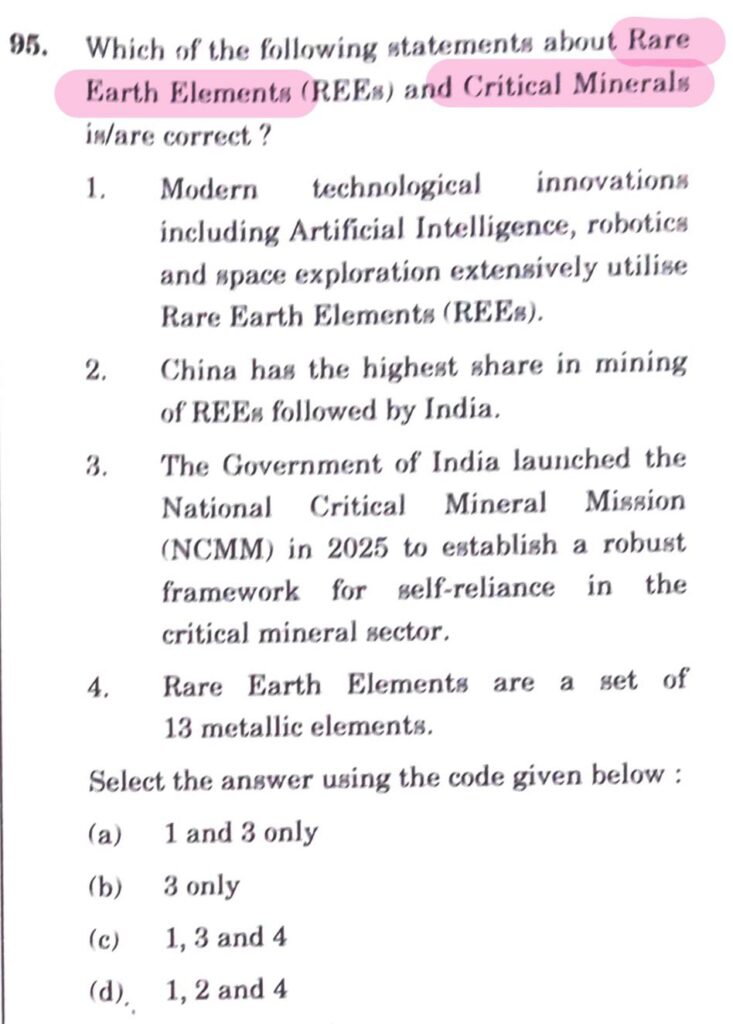
Context: India US Rare Earth Deal
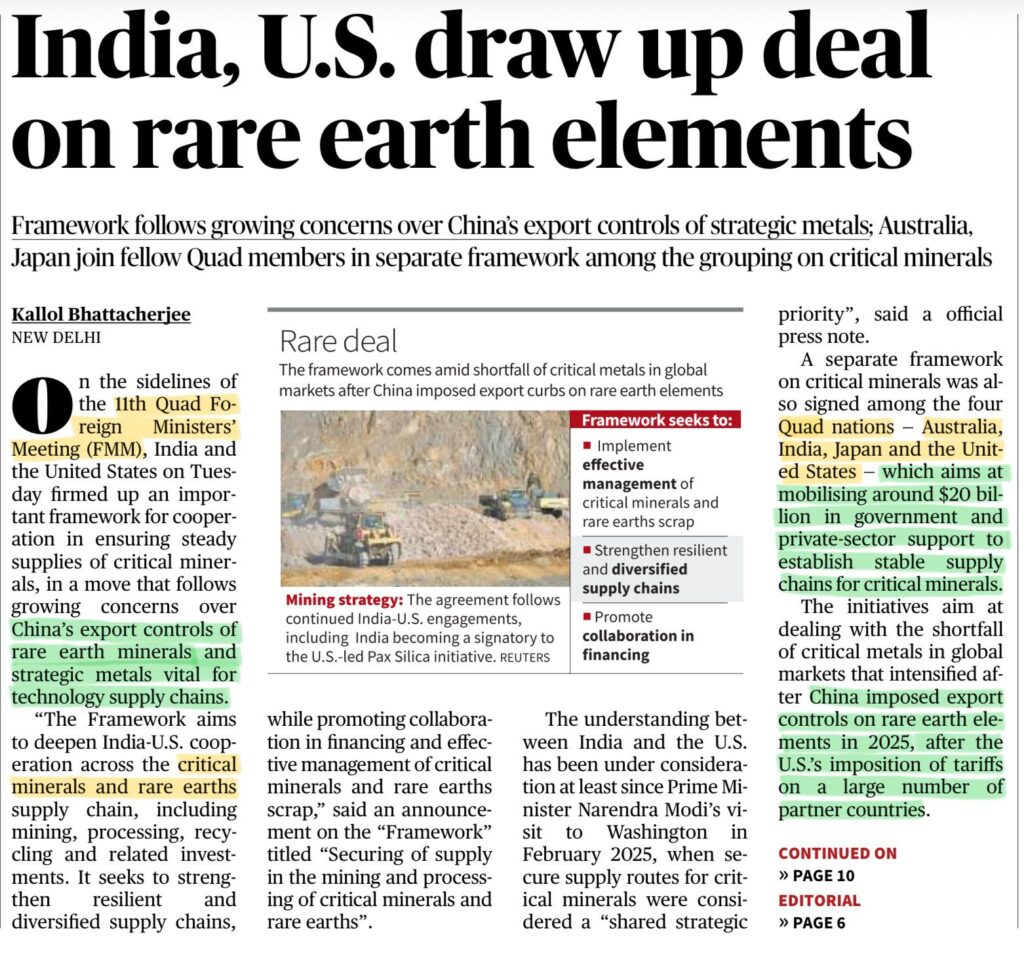
At the 11th Quad Foreign Ministers’ Meeting, India and the U.S. signed a new framework on critical minerals and rare earth supply chains amid global concerns over China’s export controls on strategic metals and rare earth elements.

Basics

Rare Earth Elements (REEs):

  • Group of 17 strategic metals used in:
    • EVs and batteries
    • Semiconductors and electronics
    • Defence systems and missiles
    • Wind turbines and magnets

Critical minerals:

  • Lithium
  • Cobalt
  • Nickel
  • Graphite
  • Copper
  • Rare earths

These are essential for clean energy, high-tech manufacturing and strategic industries.

Key Initiatives Announced

India–U.S. Critical Minerals Framework

  • Cooperation in mining, processing, recycling, rare earth scrap management and financing.
  • Aim: secure and diversified supply chains.

Quad Critical Minerals Initiative

  • India, U.S., Japan and Australia launched a separate framework.
  • Seeks nearly $20 billion public-private investment in stable critical mineral supply chains.

Pax Silica Initiative

  • India joined the U.S.-led initiative focused on secure semiconductor and mineral supply chains.

Why This Became Important?

  • China dominates global rare earth processing and supply chains.
  • China imposed export controls on several rare earth elements and strategic metals in 2025.
  • This increased fears of supply disruptions in technology, defence and clean energy sectors.

India’s Position

  • China has the largest rare earth reserves globally.
  • Brazil has the second-largest reserves.
  • India has the third-largest rare earth reserves.
India US Rare Earth Deal
PYQ – 2026, Ans – A

Quad Maritime Initiatives Amid Strait of Hormuz Crisis Explained for UPSC

Context: Quad Maritime Initiatives
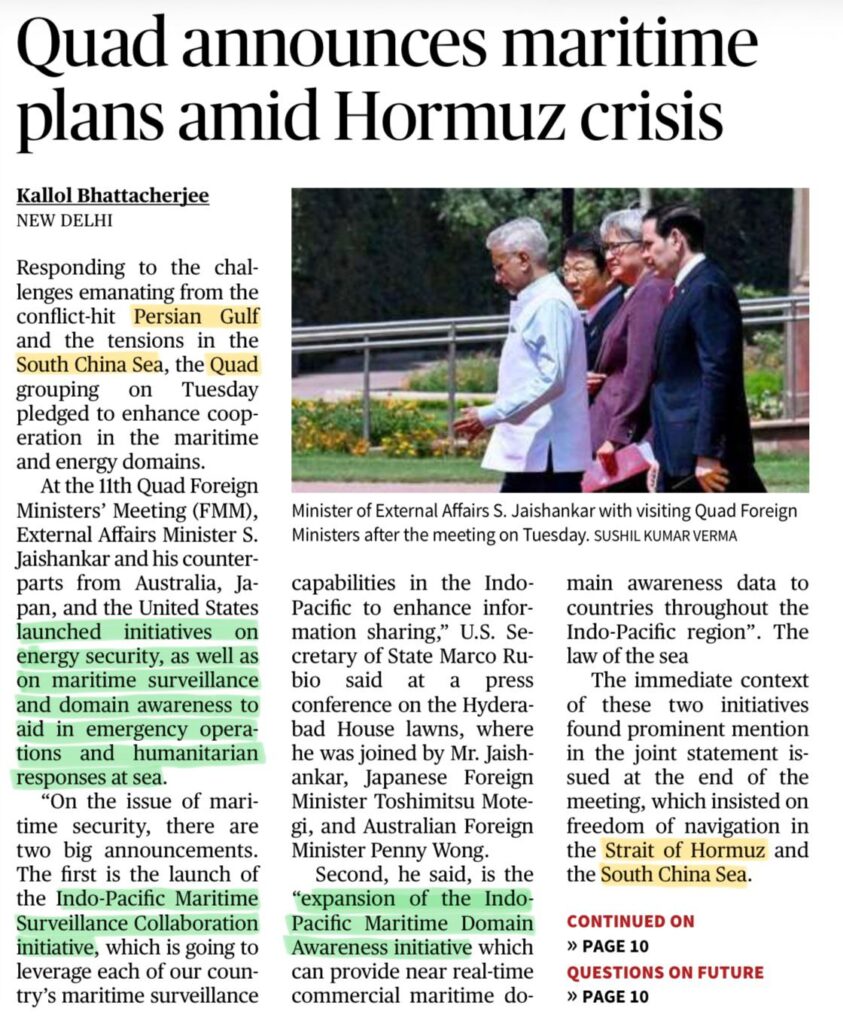
At the 11th Quad Foreign Ministers’ Meeting, India, U.S., Japan and Australia announced new maritime and energy-security initiatives amid tensions in the Persian Gulf, Strait of Hormuz and South China Sea.

Key Quad Maritime Initiatives

Indo-Pacific Maritime Surveillance Collaboration

  • Integration of Quad surveillance capabilities for better maritime monitoring and information-sharing.

Expansion of Indo-Pacific Maritime Domain Awareness (IPMDA)

Energy Security Cooperation

  • Focus on secure sea lanes and stable energy supply chains.

Why These Initiatives?

Rising geopolitical tensions in:

  • Strait of Hormuz
  • South China Sea

Concerns:

  • Disruption of global trade and energy flows.

Quad reiterated:

  • Freedom of navigation
  • Respect for UNCLOS and international maritime law

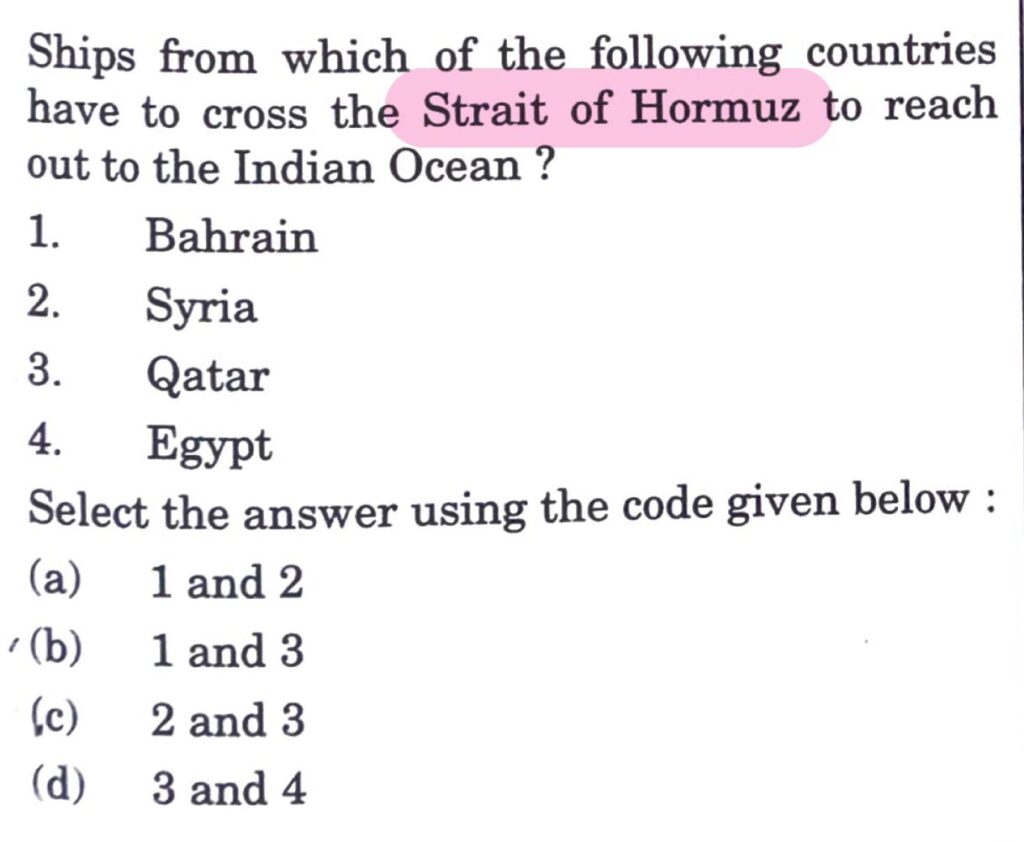
Strait of Hormuz — Basics

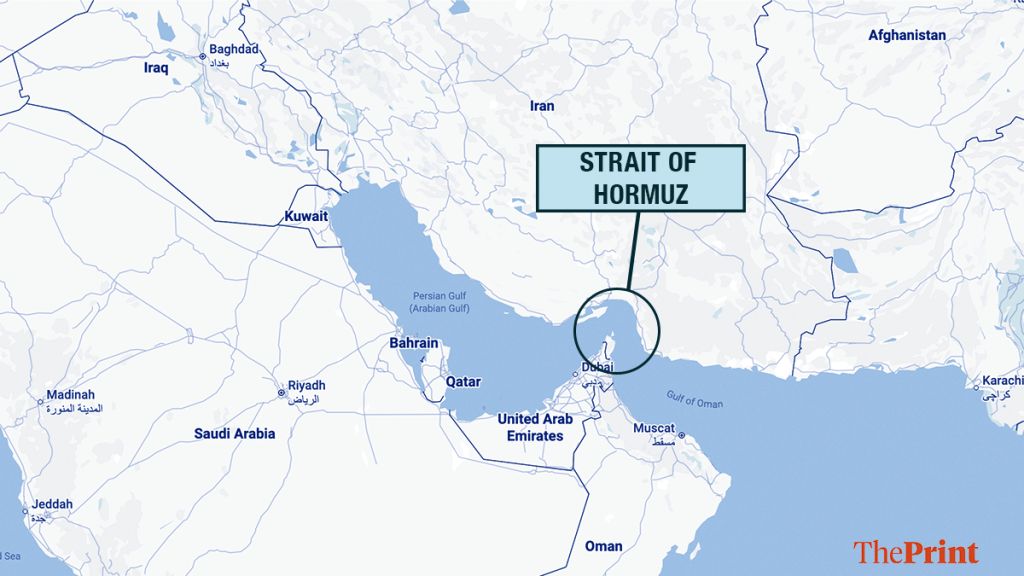
  • Narrow strategic chokepoint linking Persian Gulf → Gulf of OmanArabian Sea.
  • Nearly 20% of global oil trade passes through it.
  • One of the world’s most critical energy transit routes.

Bordering Countries

  • Iran — North
  • Oman — South, through Musandam Peninsula
  • UAE lies close to the southern maritime side.
Quad Maritime Initiatives
Quad Maritime Initiatives (2)
PYQ – 2026, Ans – B
Quad Maritime Initiatives (3)

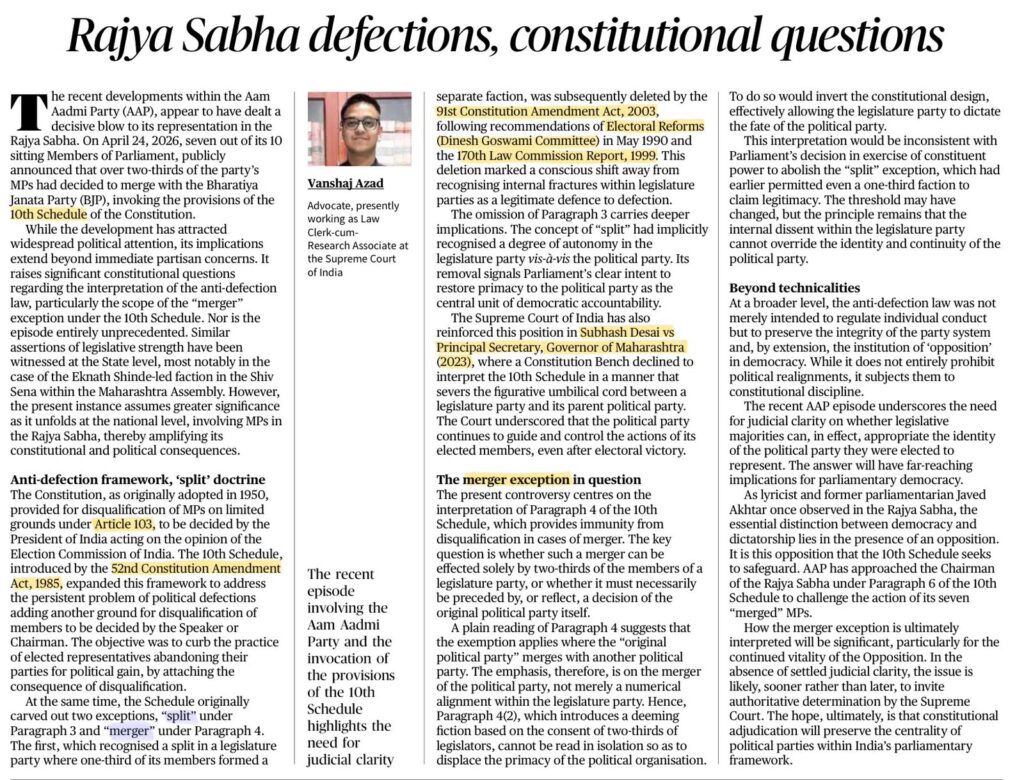
Anti Defection Law and Rajya Sabha Merger Provision Explained for UPSC

Context:Anti Defection Law
The article discusses constitutional issues after some AAP Rajya Sabha MPs invoked the “merger” provision of the Tenth Schedule while joining another party.

Anti-Defection Law

Grounds of Disqualification

  • Leaving party voluntarily.
  • Voting against whip.
  • Independent member joining party after election.
  • Nominated member joining party after 6 months.

Split vs Merger

Originally:

  • Split under Para 3: One-third members splitting got protection.
  • Merger under Para 4: Protection if two-thirds members support merger.

91st Constitutional Amendment Act, 2003

  • Deleted split provision.
  • Retained only merger exception to curb misuse.

Committees Mentioned

Both recommended removing the split exception.

Core Constitutional Issue

  • Can two-thirds MPs alone claim merger?
  • Or must original political party also formally merge?

Article stresses:

  • Legislature party ≠ original political party.
  • Mere numerical strength may not qualify as valid merger.

Supreme Court Judgment

Subhash Desai vs Principal Secretary, Governor of Maharashtra, 2023

  • Supreme Court upheld primacy of original political party under Tenth Schedule.

Importance

  • Impacts anti-defection law, party discipline, opposition politics and parliamentary stability.
Anti Defection Law
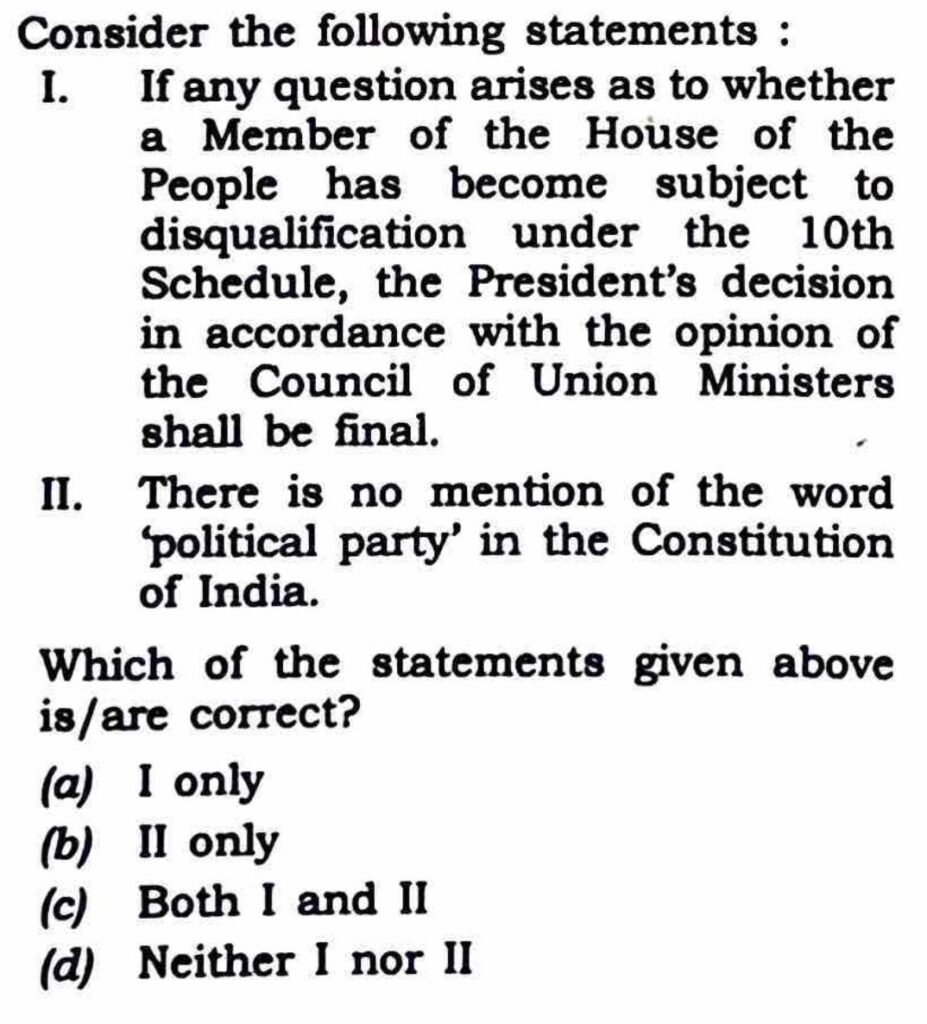
PYQ – 2025, Ans – A

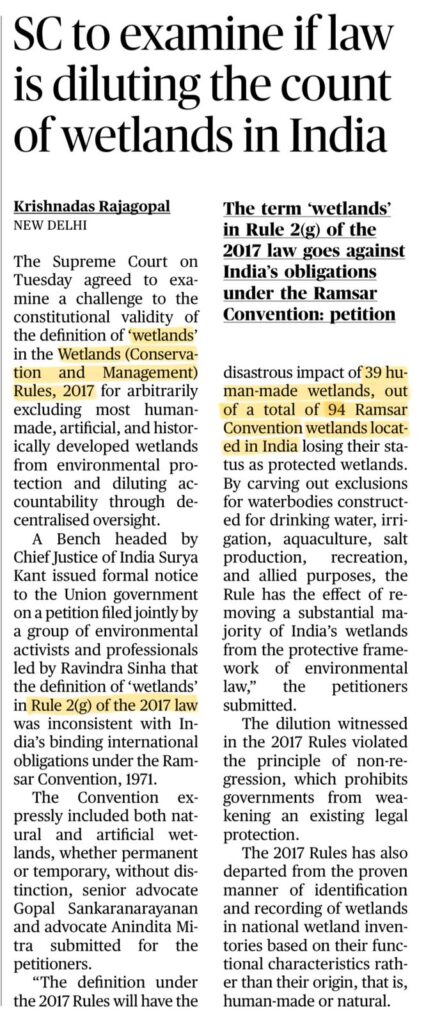
Wetlands Rules 2017 Under Supreme Court Review Explained for UPSC

Context: Wetlands Rules 2017
Supreme Court agreed to examine the constitutional validity of the Wetlands (Conservation and Management) Rules, 2017 over claims that Rule 2(g) narrows the definition of wetlands and weakens protection contrary to the Ramsar Convention, 1971.

Core Issue

  • Rule 2(g) allegedly excludes artificial, human-made and historically developed wetlands from protection.
  • Petition argues this dilutes environmental safeguards and accountability.

Ramsar Convention vs 2017 Rules

Ramsar Convention includes:

  • Natural and artificial wetlands
  • Permanent and temporary wetlands

Petition claims the 2017 Rules violate India’s international obligations.

Major Concerns

Exempted categories:

  • Irrigation tanks
  • Drinking water bodies
  • Aquaculture ponds
  • Salt pans
  • Recreational water bodies

Impact:

  • Many wetlands may fall outside legal protection framework.

Important Data

  • India has 94 Ramsar Sites.
  • Petition says nearly 39 human-made wetlands may lose protected status.

Principle Mentioned

Non-regression principle

  • Existing environmental protections should not be weakened.

Importance of Wetlands

  • Flood control
  • Groundwater recharge
  • Biodiversity conservation
  • Carbon sink
  • Climate regulation
Wetlands Rules 2017
Wetlands Rules 2017

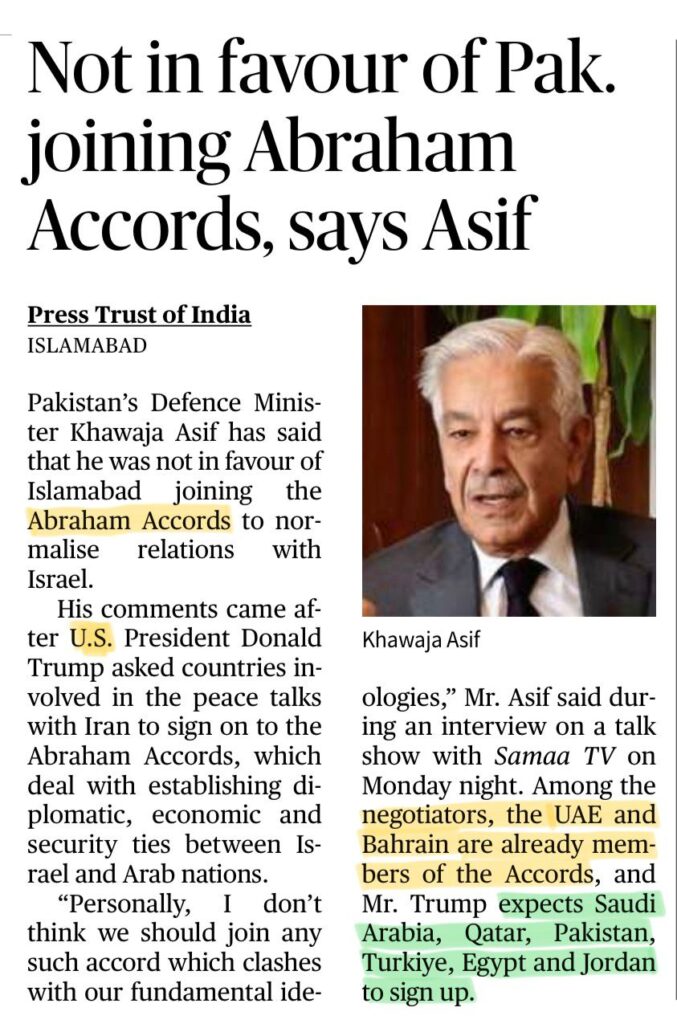
Abraham Accords and Pakistan’s Stand Explained for UPSC

Context: Abraham Accords
Pakistan opposed joining the Abraham Accords amid renewed U.S. efforts to expand Israel–Arab normalisation.

Abraham Accords, 2020

  • U.S.-brokered normalisation agreements between Israel and Arab nations.
  • Focus: diplomatic, economic and security ties.

Members:

  • UAE
  • Bahrain
  • Morocco
  • Sudan

Importance

  • Marked shift from traditional Arab policy of “No recognition without Palestinian statehood”.
  • Strengthened Israel–Gulf strategic cooperation, especially against Iran.

Arab Peace Initiative, 2002 — UPSC PYQ

  • Proposed by Saudi Arabia.
  • Adopted by Arab League.

Offered full Arab recognition of Israel if:

  • Israel withdraws from occupied territories based on 1967 borders.
  • Israel accepts Palestinian state with East Jerusalem as capital.
  • Refugee issue is resolved.
Abraham Accords
Abraham Accords
About the UPSC Civil Services Examination (UPSC CSE)

The UPSC Civil Services Examination (CSE) is one of the most competitive and esteemed examinations in India, conducted by the Union Public Service Commission to recruit officers for services such as the Indian Administrative Service (IAS), Indian Police Service (IPS), Indian Foreign Service (IFS), and others. The exam comprises three stages — Prelims, Mains, and the Personality Test (Interview) — designed to test a candidate’s knowledge, aptitude, decision-making, and leadership skills.


How to Prepare Effectively for UPSC CSE

Cracking the UPSC CSE requires a deep understanding of the syllabus, consistent revision, structured answer writing, and smart test-taking strategies. The Prelims test analytical and conceptual clarity, the Mains focuses on critical thinking, articulation, and subject mastery, while the Interview assesses presence of mind, ethical judgment, and personality traits relevant to public service.

At UnderStand UPSC, we empower aspirants with a personalized and focused approach to each stage of the exam.


Why Choose UnderStand UPSC?

UnderStand UPSC is a mentorship-driven platform offering a clear, clutter-free strategy to tackle the Civil Services Examination. Our programs like Transform (for beginners and intermediate learners) and Conquer (for advanced mains preparation) provide structured study plans, syllabus-wise video content, interactive live sessions, and answer writing support.

We emphasize:

  • Concept clarity through topic-wise lectures

  • Test series designed around real UPSC standards

  • Personalized mentorship in small groups

  • Regular performance tracking and peer benchmarking

  • Doubt-clearing sessions, current affairs analysis, and monthly magazines


Join the UnderStand UPSC Learning Community

Our mission is to make UPSC preparation less overwhelming and more strategic. We combine mentorship, discipline, and academic rigor to help you clear CSE with confidence. Whether you’re preparing from Delhi, Mumbai, Bangalore, or a remote village — our online-first model ensures quality guidance reaches every corner of India.

Join the thousands of aspirants who trust UnderStand UPSC to guide their journey toward becoming civil servants.

Stay connected with us through our Telegram, YouTube, and Instagram channels for daily tips, strategies, and updates.

Copyright © 2026 USARAMBHA EDUCATION (UnderStand UPSC). All Rights Reserved.

Fill the form

Our team will reach out to you soon