3 July 2026 | Daily Current Affairs

I-2SEA submarine cable project for UPSC Notes

Context: I-2SEA submarine cable project
A consortium led by Tata Communications, Microsoft, Singtel and Lightstorm has unveiled the I-2SEA submarine cable project to enhance digital connectivity between India, Malaysia and Singapore.

The project will support the region’s growing AI and data-centre ecosystem.
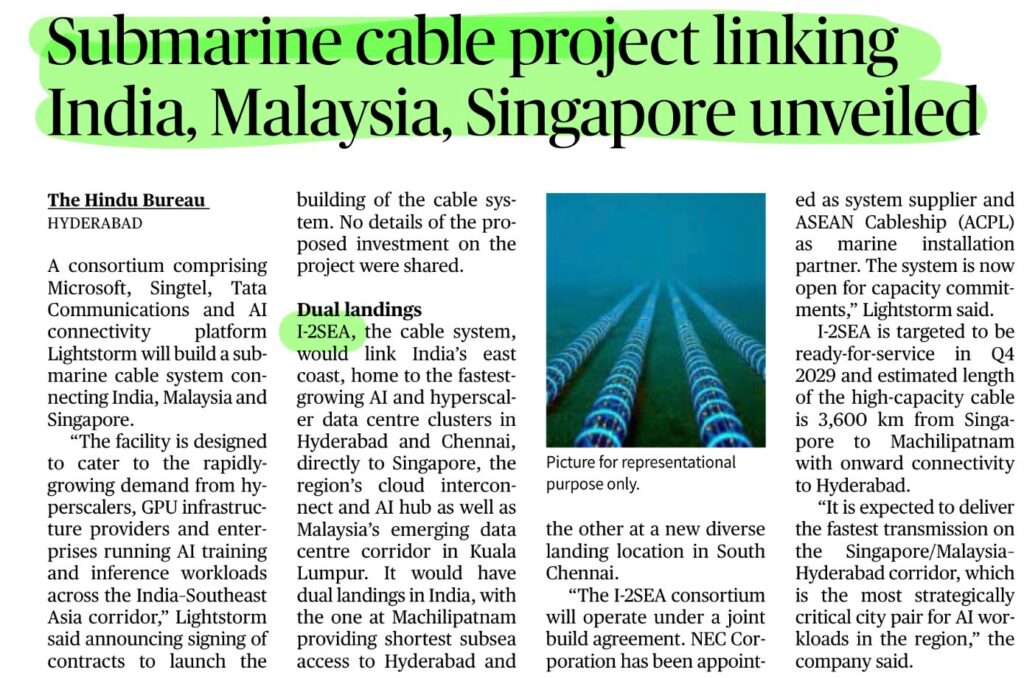
I-2SEA

Full Form

  • India–Singapore–Malaysia

Type

  • High-capacity submarine fibre-optic cable

Length

  • Around 3,600 km

Route

  • Machilipatnam to Singapore via Malaysia

Dual Landing Stations in India

  • Machilipatnam
  • South Chennai

Purpose of Dual Landing

Dual landing improves:

  • Network resilience
  • Redundancy
  • Continuity of data flow
  • Protection against outages

Expected Operational Timeline

  • Q4 2029

Significance

1. Faster Data Transmission

Supports faster and more secure international data movement.

2. AI and Cloud Infrastructure

Supports:

3. India–Southeast Asia Connectivity

Strengthens India’s digital connectivity with Southeast Asia.

4. Act East Policy

The project supports India’s broader Act East Policy by improving digital infrastructure links with ASEAN economies.

5. Strategic Digital Infrastructure

Submarine cables are critical infrastructure for:

  • Internet connectivity
  • Financial transactions
  • Cloud services
  • Defence communications
  • Global data flows

Challenges

  • Cybersecurity risks
  • Physical vulnerability of undersea cables
  • High project cost
  • Geopolitical risks
  • Need for redundancy and repair capacity

Key Takeaway

I-2SEA will strengthen India’s digital infrastructure, improve connectivity with Southeast Asia and support the future growth of AI, cloud computing and data-centre ecosystems.
UN AI preliminary report: UPSC Current Affairs

Context: UN AI preliminary report
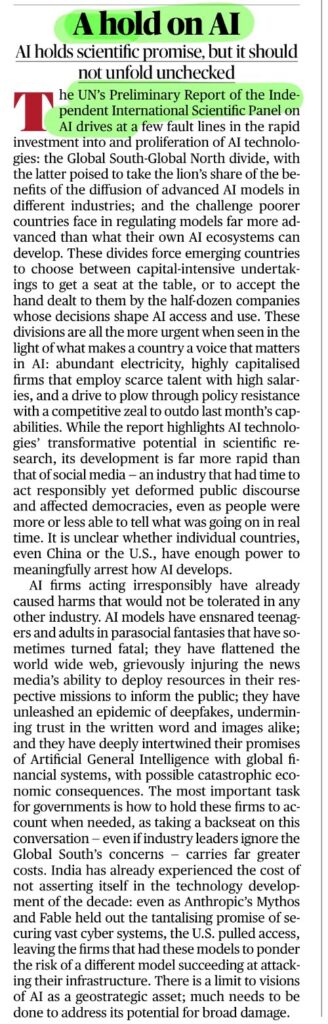
The United Nations released the Preliminary Report of the Independent International Scientific Panel on Artificial Intelligence, calling for globally coordinated governance to maximise AI benefits while managing risks.

UN AI Panel

Full Name

  • Independent International Scientific Panel on Artificial Intelligence

Constituted Under

  • United Nations General Assembly

Mandate

To provide independent, evidence-based scientific advice on:

  • AI opportunities
  • AI risks
  • Global AI governance

Key Findings

1. AI Has Major Potential

AI can support:

  • Science
  • Healthcare
  • Education
  • Economic growth
  • Climate modelling
  • Public service delivery
  • Disaster prediction

2. Global North–South AI Divide

Rapid AI expansion may widen inequality between developed and developing countries.

Developing countries may fall behind due to unequal access to:

  • Computing power
  • Quality data
  • Finance
  • Skilled talent
  • Research infrastructure

3. AI Risks

Unregulated AI can increase risks such as:

  • Deepfakes
  • Misinformation
  • Bias
  • Discrimination
  • Cybersecurity threats
  • Job displacement
  • Concentration of technological power

Key Recommendations

1. Inclusive Global AI Governance

Develop a global AI governance framework based on:

  • Safety
  • Transparency
  • Accountability
  • Human rights
  • Equity

2. Participation of Developing Countries

Developing countries must have greater participation in:

  • AI rule-making
  • Standard-setting
  • Governance institutions

3. International Cooperation

Promote responsible AI development through:

  • Shared research
  • Capacity building
  • Technology access
  • Safety standards
  • Global coordination

Why This Matters for India

India needs to balance:

  • AI innovation
  • Digital public infrastructure
  • Data protection
  • Jobs and skilling
  • Cybersecurity
  • Ethical AI
  • Global South representation

Mains Significance

This topic can be used in answers on:

  • AI governance
  • Global digital inequality
  • Technology diplomacy
  • Responsible innovation
  • Cybersecurity
  • Ethical AI
  • Global South and emerging technologies

Key Takeaway

AI can transform development, but without inclusive governance it may deepen global inequality and create new risks. India’s role is important in pushing for safe, transparent and development-oriented AI governance.

Mandsaur HPV vaccination model: UPSC Editorial Notes

Context: Mandsaur HPV vaccination model
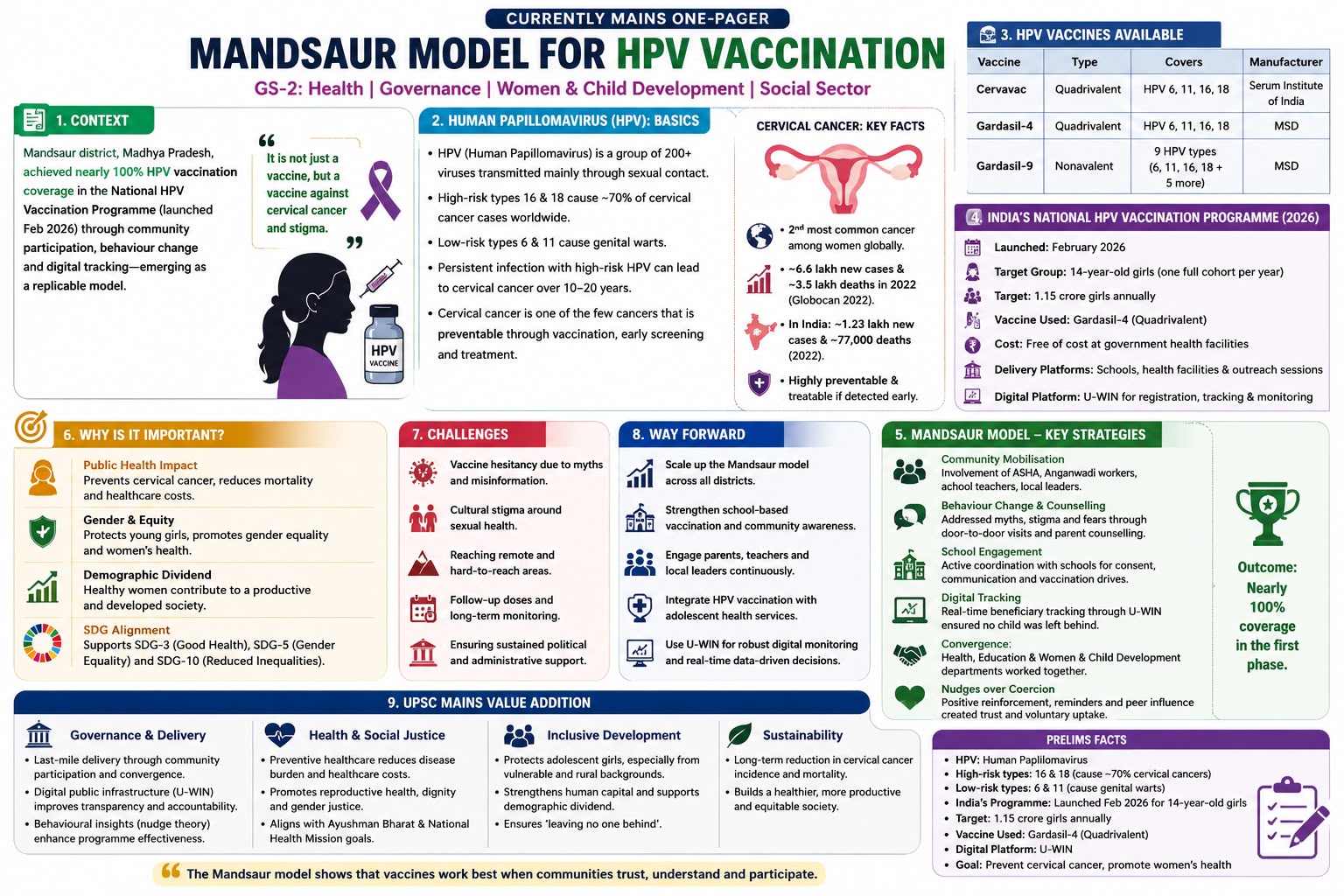
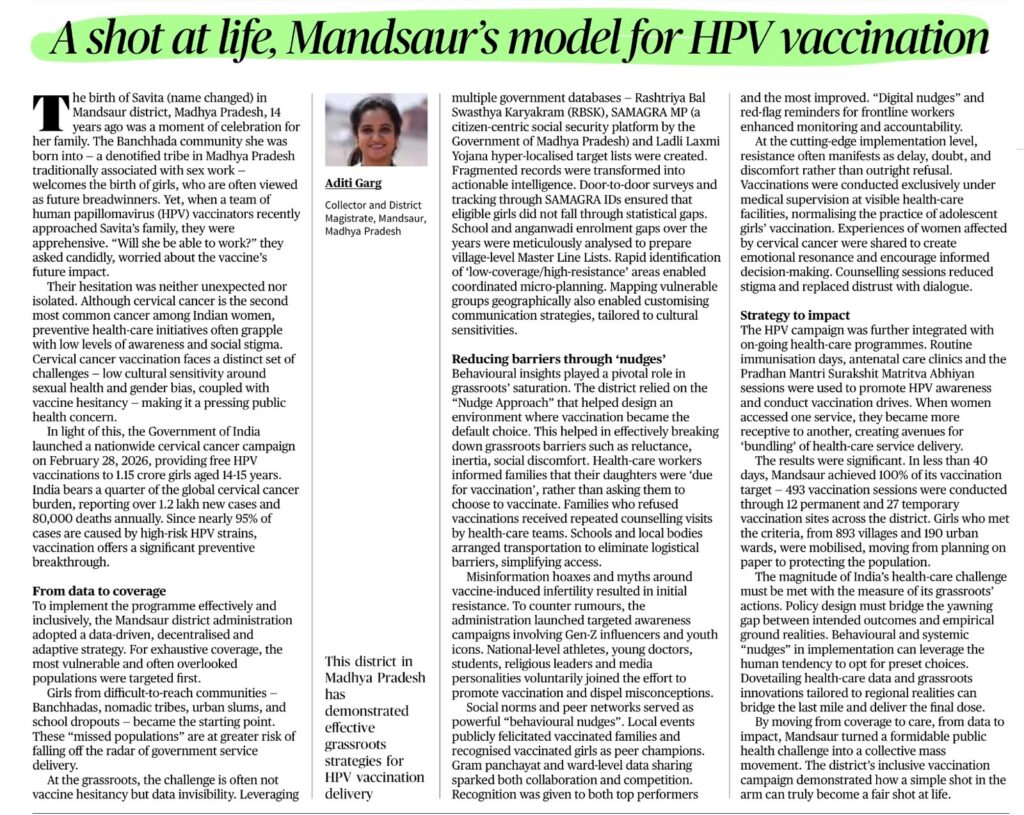
The Mandsaur district in Madhya Pradesh achieved nearly 100% HPV vaccination coverage in the first phase through community participation, school-based outreach and digital tracking.

The editorial presents it as a replicable model for cervical cancer prevention.

Human Papillomavirus

HPV is a group of viruses transmitted mainly through sexual contact.

High-risk HPV types can cause cervical cancer.

Cervical Cancer

Cervical cancer is one of the most common cancers among women in India.

It is preventable through:

  • HPV vaccination
  • Regular screening
  • Early diagnosis
  • Timely treatment

HPV Vaccination

HPV vaccine protects against high-risk HPV strains that can cause cervical cancer.

Target Group

The vaccination is generally focused on adolescent girls before exposure to HPV infection.

Mandsaur Model: Key Features

1. Community Mobilisation

Local administration, health workers, teachers, parents and community leaders worked together to build trust.

2. School-Based Campaign

Schools became the main delivery platform for reaching adolescent girls.

3. Digital Tracking

Digital tools were used to:

  • Track eligible girls
  • Monitor vaccination coverage
  • Identify missed beneficiaries
  • Ensure follow-up

4. Counselling and Awareness

Awareness campaigns helped address:

  • Vaccine hesitancy
  • Myths around HPV
  • Cultural concerns
  • Safety doubts

5. Convergence Approach

The model involved coordination among:

  • Health department
  • Education department
  • District administration
  • Schools
  • Community networks

Why This Model Matters

  • Prevents cervical cancer.
  • Reduces future mortality and health burden.
  • Promotes gender-sensitive public health.
  • Supports adolescent health.
  • Shows how district-level governance can improve vaccination coverage.
  • Builds trust through community participation.

Challenges in HPV Vaccination

  • Vaccine hesitancy
  • Cultural stigma
  • Misinformation
  • Lack of awareness
  • School dropouts
  • Follow-up gaps
  • Limited access in rural areas

Way Forward

  • Scale up the Mandsaur model across districts.
  • Strengthen school-based vaccination.
  • Use ASHA and Anganwadi workers for mobilisation.
  • Run awareness campaigns for parents.
  • Use digital dashboards for real-time tracking.
  • Integrate HPV vaccination with adolescent health programmes.
  • Ensure vaccine availability and cold-chain readiness.

Mains Value Addition

This example can be used in answers on:

  • Preventive healthcare
  • Women’s health
  • Cervical cancer prevention
  • Public health governance
  • Vaccine hesitancy
  • Community participation
  • District-level innovation
  • Social sector delivery

NIMHANS Sleep Disorders Database for UPSC Notes

Context: NIMHANS sleep disorders database
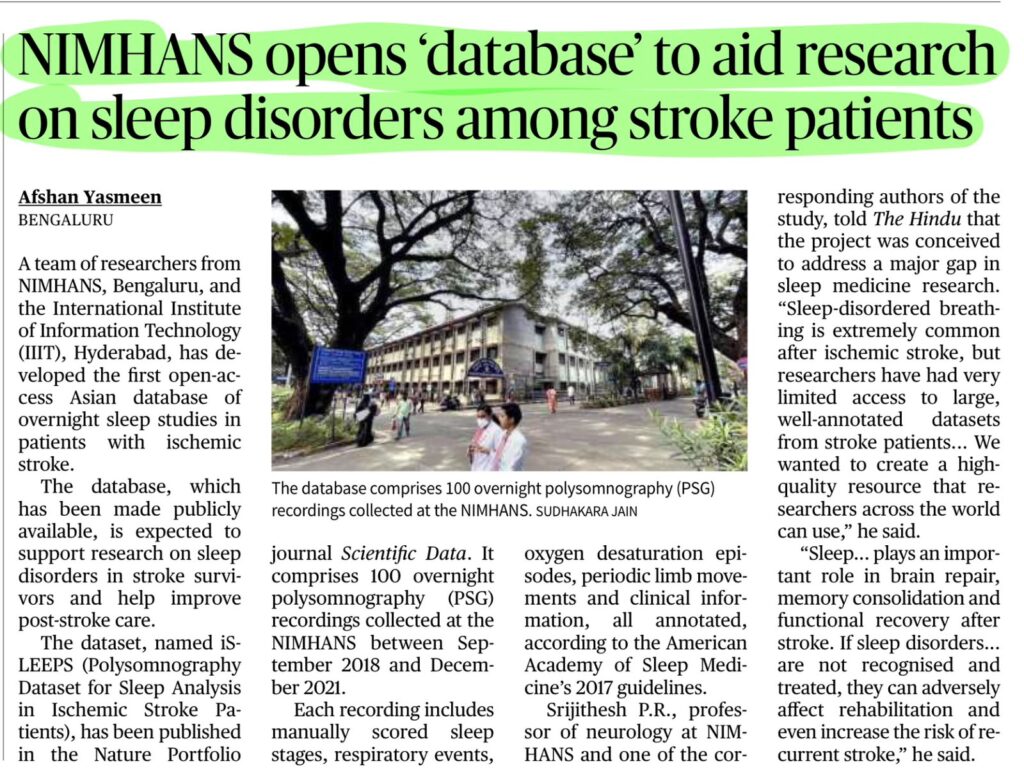
NIMHANS and IIIT Hyderabad have launched iSLEEPS, Asia’s first open-access sleep database for ischemic stroke patients.

The aim is to strengthen research and improve post-stroke care.

Institutions Involved

NIMHANS

  • National Institute of Mental Health and Neuro Sciences

IIIT Hyderabad

  • International Institute of Information Technology, Hyderabad

iSLEEPS Database

Full Form

  • Polysomnography Dataset for Sleep Analysis in Ischemic Stroke Patients

Key Features

  • Asia’s first open-access sleep database for ischemic stroke patients.
  • Contains 100 overnight polysomnography recordings.
  • Data collected between 2018 and 2021.
  • Published in Scientific Data, Nature Portfolio.

What Does It Record?

The database records:

  • Sleep stages
  • Breathing disorders
  • Oxygen desaturation
  • Limb movements
  • Clinical data

Why Is It Important?

  • Addresses lack of high-quality sleep datasets in Asia.
  • Supports AI-based diagnosis.
  • Helps global sleep and stroke research.
  • Improves post-stroke rehabilitation.
  • Helps detect sleep-disordered breathing early.
  • May reduce risk of recurrent stroke.

Polysomnography

Polysomnography is the gold-standard overnight sleep test used to diagnose sleep disorders.

It records parameters such as:

  • Brain activity
  • Breathing
  • Oxygen levels
  • Heart rate
  • Limb movement
  • Sleep stages

Ischemic Stroke

Ischemic stroke occurs due to blockage of blood supply to the brain.

It accounts for around 85% of all strokes.

Significance

This topic connects:

  • Health technology
  • AI in medicine
  • Open-access research data
  • Stroke rehabilitation
  • Precision diagnosis
  • Digital health innovation

Vikram-1 private orbital rocket: UPSC Current Affairs

Context: Vikram-1 private orbital rocket
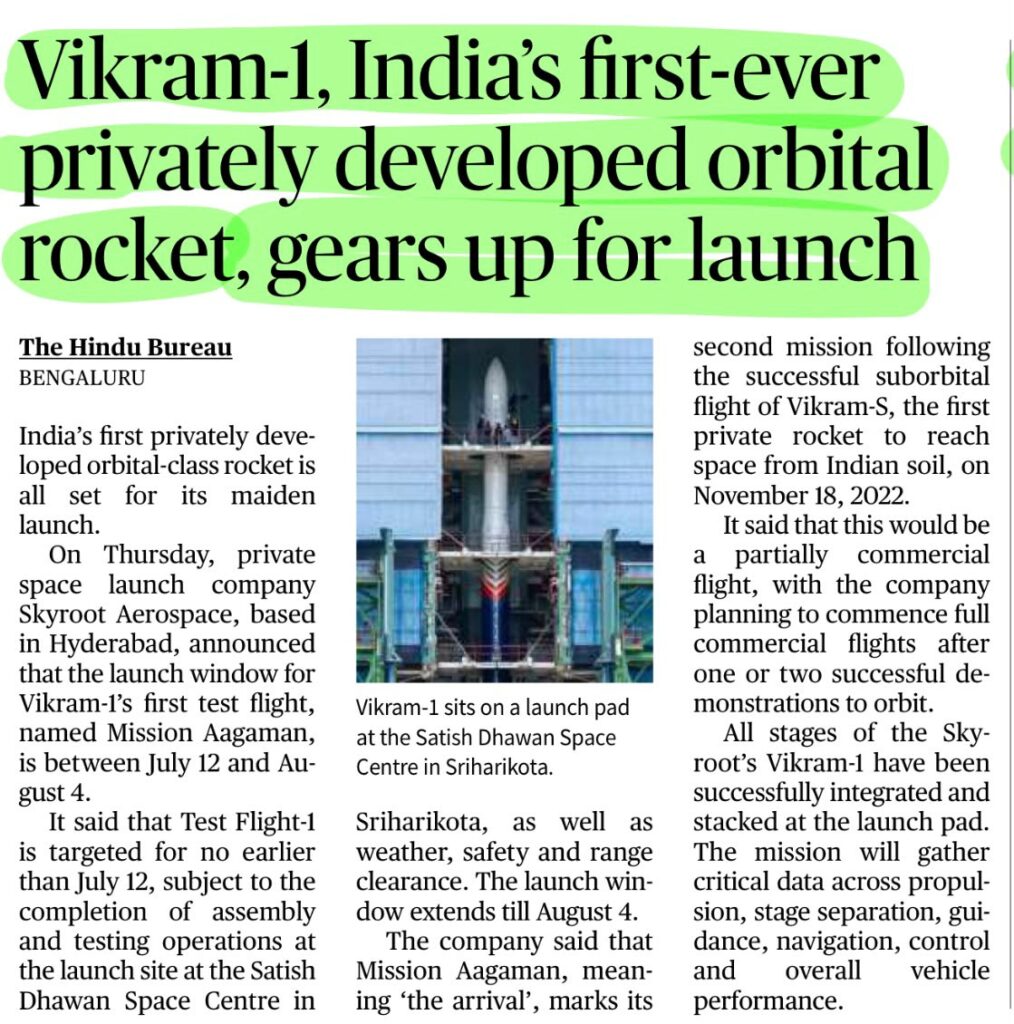
Skyroot Aerospace has announced the launch window of 12 July to 4 August 2026 for Mission Aagaman, the maiden flight of Vikram-1, India’s first privately developed orbital launch vehicle.

Vikram-1

Developed By

  • Skyroot Aerospace

Mission Aagaman

  • Maiden flight of Vikram-1.
  • Launch site: Satish Dhawan Space Centre, Sriharikota.

Purpose

Vikram-1 is designed to place small satellites into Low Earth Orbit.

Low Earth Orbit

Low Earth Orbit generally refers to an orbit between:

  • 160 km and 2,000 km above Earth

Orbital Rocket

An orbital rocket is a launch vehicle capable of achieving orbital velocity and placing satellites into orbit.

Orbital Velocity

  • Around 7.8 km per second

Orbital vs Suborbital Rocket

Orbital Rocket

  • Reaches space and places payload into orbit.

Suborbital Rocket

  • Reaches space but does not enter orbit.

Vikram-S vs Vikram-1

Vikram-S, 2022

  • Suborbital rocket

Vikram-1

  • Orbital launch vehicle

Significance

  • Reflects success of India’s space sector reforms of 2020.
  • Strengthens India’s private space ecosystem.
  • Supports commercial launch capability.
  • Helps India enter the global small-satellite launch market.
  • Reduces dependence only on public-sector space infrastructure.
  • Encourages start-ups and private innovation in space technology.

Key Institutions

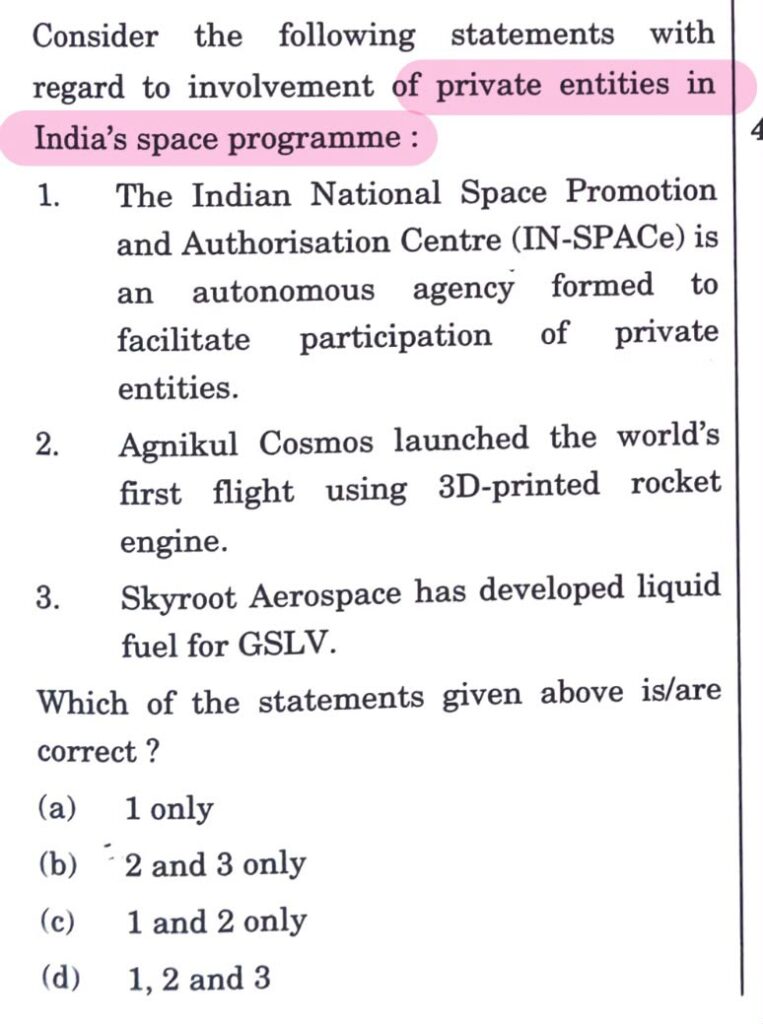
IN-SPACe

Indian National Space Promotion and Authorisation Centre

  • Regulates and promotes private space activities.

NSIL

NewSpace India Limited

  • Commercial arm of ISRO.

UPSC Value Addition

Private sector participation in space can help India in:

  • Small satellite launches
  • Commercial space services
  • Space manufacturing
  • Innovation ecosystem
  • Global launch market competitiveness
  • Strategic autonomy in space technology
About the UPSC Civil Services Examination (UPSC CSE)

The UPSC Civil Services Examination (CSE) is one of the most competitive and esteemed examinations in India, conducted by the Union Public Service Commission to recruit officers for services such as the Indian Administrative Service (IAS), Indian Police Service (IPS), Indian Foreign Service (IFS), and others. The exam comprises three stages — Prelims, Mains, and the Personality Test (Interview) — designed to test a candidate’s knowledge, aptitude, decision-making, and leadership skills.


How to Prepare Effectively for UPSC CSE

Cracking the UPSC CSE requires a deep understanding of the syllabus, consistent revision, structured answer writing, and smart test-taking strategies. The Prelims test analytical and conceptual clarity, the Mains focuses on critical thinking, articulation, and subject mastery, while the Interview assesses presence of mind, ethical judgment, and personality traits relevant to public service.

At UnderStand UPSC, we empower aspirants with a personalized and focused approach to each stage of the exam.


Why Choose UnderStand UPSC?

UnderStand UPSC is a mentorship-driven platform offering a clear, clutter-free strategy to tackle the Civil Services Examination. Our programs like Transform (for beginners and intermediate learners) and Conquer (for advanced mains preparation) provide structured study plans, syllabus-wise video content, interactive live sessions, and answer writing support.

We emphasize:

  • Concept clarity through topic-wise lectures

  • Test series designed around real UPSC standards

  • Personalized mentorship in small groups

  • Regular performance tracking and peer benchmarking

  • Doubt-clearing sessions, current affairs analysis, and monthly magazines


Join the UnderStand UPSC Learning Community

Our mission is to make UPSC preparation less overwhelming and more strategic. We combine mentorship, discipline, and academic rigor to help you clear CSE with confidence. Whether you’re preparing from Delhi, Mumbai, Bangalore, or a remote village — our online-first model ensures quality guidance reaches every corner of India.

Join the thousands of aspirants who trust UnderStand UPSC to guide their journey toward becoming civil servants.

Stay connected with us through our Telegram, YouTube, and Instagram channels for daily tips, strategies, and updates.

Copyright © 2026 USARAMBHA EDUCATION (UnderStand UPSC). All Rights Reserved.

Fill out the form

If you have any queries...

Fill out the form for

Downloading the free Agriculture Short Notes