4 July 2026 | Daily Current Affairs

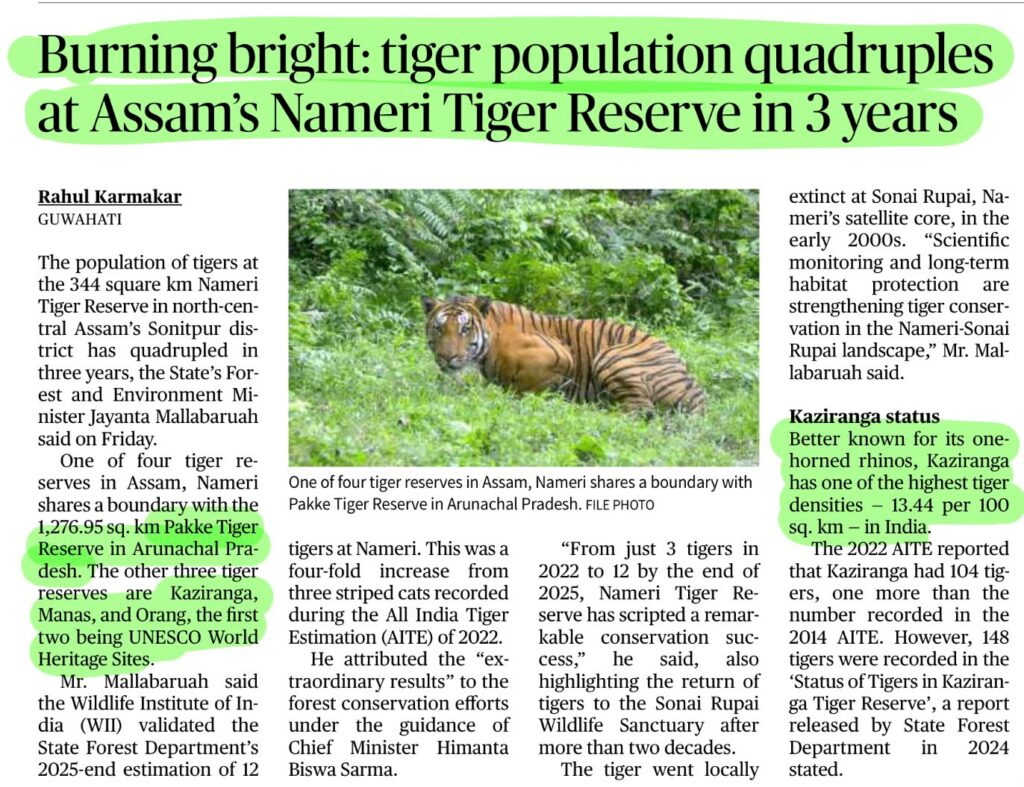
Nameri Tiger Reserve Population Increase: Key UPSC Notes

Context: Nameri Tiger Reserve Population Increase
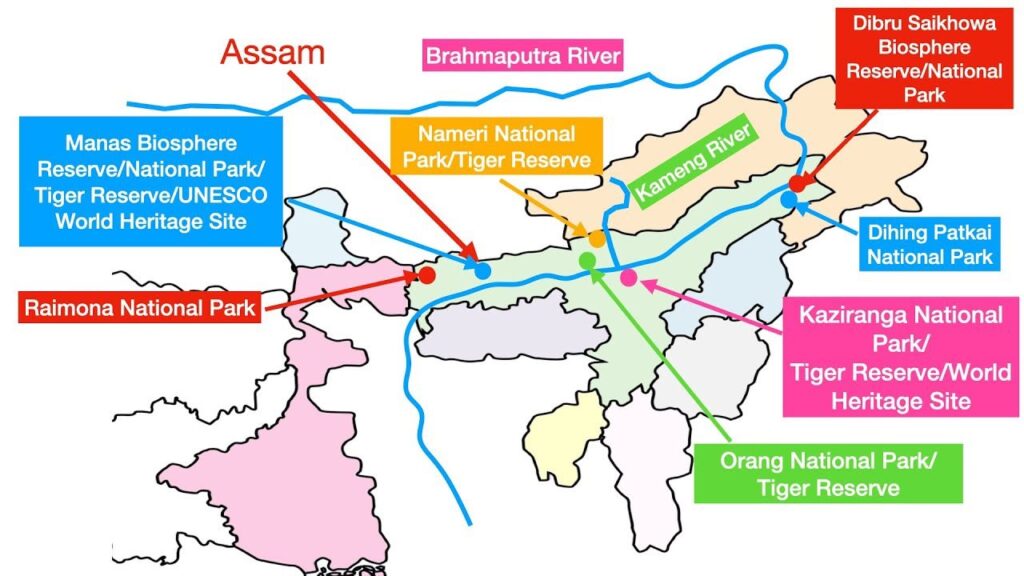
The Wildlife Institute of India validated the Assam Forest Department’s 2025 tiger estimation, which recorded 12 tigers in Nameri Tiger Reserve, up from 3 tigers in All India Tiger Estimation 2022.

This indicates a four-fold increase due to improved conservation.

Tiger

Scientific Name

  • Panthera tigris tigris

Common Name

  • Royal Bengal Tiger

India’s Share

India harbours around 75% of the world’s wild tiger population.

Conservation Status

IUCN

  • Endangered

CITES

  • Appendix I

Wildlife Protection Act, 1972

  • Schedule I

Nameri Tiger Reserve

Location

  • Assam

Tiger Population

  • AITE 2022: 3 tigers
  • 2025 WII validation: 12 tigers

Reasons for Increase

  • Habitat restoration
  • Scientific monitoring
  • Anti-poaching measures
  • Landscape-level conservation
  • Better prey base and habitat protection

Important Update

Tigers have recolonised Sonai-Rupai Wildlife Sanctuary in Assam after more than two decades.

Tiger Reserves of Assam

1. Kaziranga Tiger Reserve

  • UNESCO World Heritage Site.
  • Famous for the one-horned rhinoceros.
  • Has one of India’s highest tiger densities.

2. Manas Tiger Reserve

  • UNESCO World Heritage Site.
  • Biosphere Reserve.
  • Famous for Golden Langur and Pygmy Hog.

3. Nameri Tiger Reserve

  • Shares landscape with Pakke Tiger Reserve in Arunachal Pradesh.
  • Important transboundary tiger corridor.

4. Orang Tiger Reserve

  • Known as “Mini Kaziranga.”
  • Famous for one-horned rhinoceros.

Significance

  • Shows success of landscape-based conservation.
  • Highlights Assam’s role in tiger conservation.
  • Strengthens biodiversity protection in the Brahmaputra landscape.
  • Shows importance of monitoring, habitat recovery and anti-poaching systems.
  • Supports ecological connectivity between Assam and Arunachal Pradesh.
Cancer Nationally Notifiable Disease: UPSC Editorial Notes

Context: Cancer Nationally Notifiable Disease
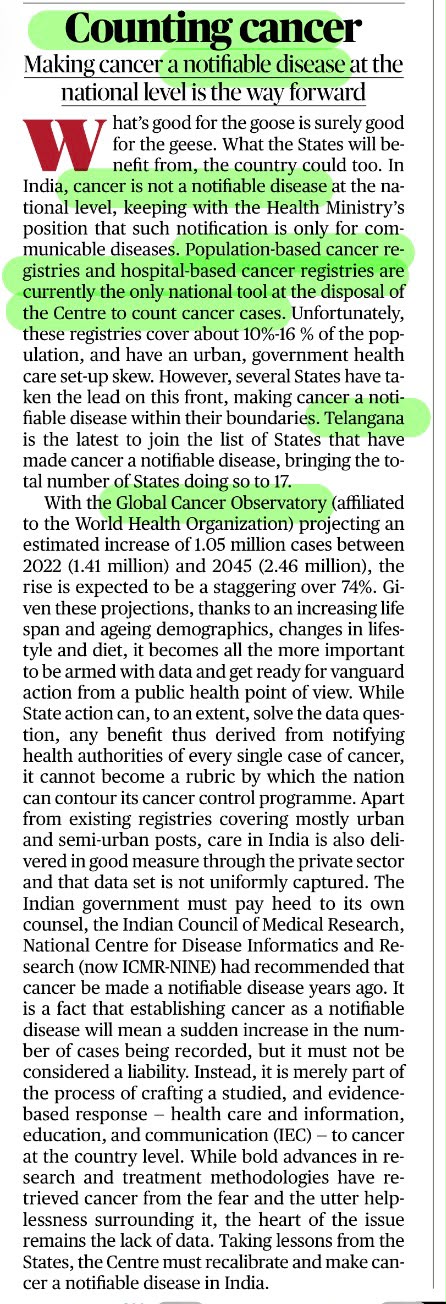
Cancer cases are projected to rise from 1.41 million in 2022 to 2.46 million in 2045, an increase of around 74%, according to the Global Cancer Observatory.

There is growing demand to make cancer a nationally notifiable disease to strengthen surveillance and evidence-based policymaking.

Present Situation

India has not yet declared cancer as a nationally notifiable disease.

However, 17 States, including Telangana, have already notified cancer under their respective public health laws.

Existing Cancer Data System in India

India currently relies on the National Cancer Registry Programme of the Indian Council of Medical Research.

Types of Registries

Population-Based Cancer Registries

  • Track cancer cases in defined populations.

Hospital-Based Cancer Registries

  • Track cancer cases reported in hospitals.

Limitation

These registries cover only around 10–16% of India’s population, leading to incomplete national data.

What Is a Notifiable Disease?

A notifiable disease is a disease that must be reported by:

  • Hospitals
  • Laboratories
  • Registered medical practitioners

to the designated public health authority.

Purpose

  • Surveillance
  • Early detection of trends
  • Public health action
  • Resource planning
  • Disease control

Who Can Notify a Disease?

State Governments

States can notify diseases under their respective State Public Health Acts.

This is why States like Telangana have already notified cancer.

Union Government

The Union Government can declare a disease nationally notifiable, making reporting mandatory across all States and Union Territories through a uniform framework.

Advantages of Making Cancer Nationally Notifiable

  • Creates a comprehensive nationwide cancer database.
  • Ensures uniform reporting from public and private healthcare facilities.
  • Helps identify regional cancer hotspots.
  • Enables better policy formulation.
  • Improves resource allocation.
  • Strengthens cancer control programmes.
  • Supports research and surveillance.
  • Helps plan screening, diagnosis and treatment infrastructure.

Why It Matters

Cancer care requires strong data because different regions may show different cancer patterns due to:

  • Lifestyle
  • Pollution
  • Tobacco use
  • Occupational exposure
  • Genetics
  • Diet
  • Healthcare access

Way Forward

  • Make cancer nationally notifiable.
  • Strengthen cancer registries.
  • Ensure mandatory reporting from private hospitals.
  • Integrate cancer data with digital health systems.
  • Protect patient privacy.
  • Improve screening programmes.
  • Use data for targeted prevention and treatment strategies.

Water Security in India: Challenges & UPSC Editorial Notes

Context: Water Security in India
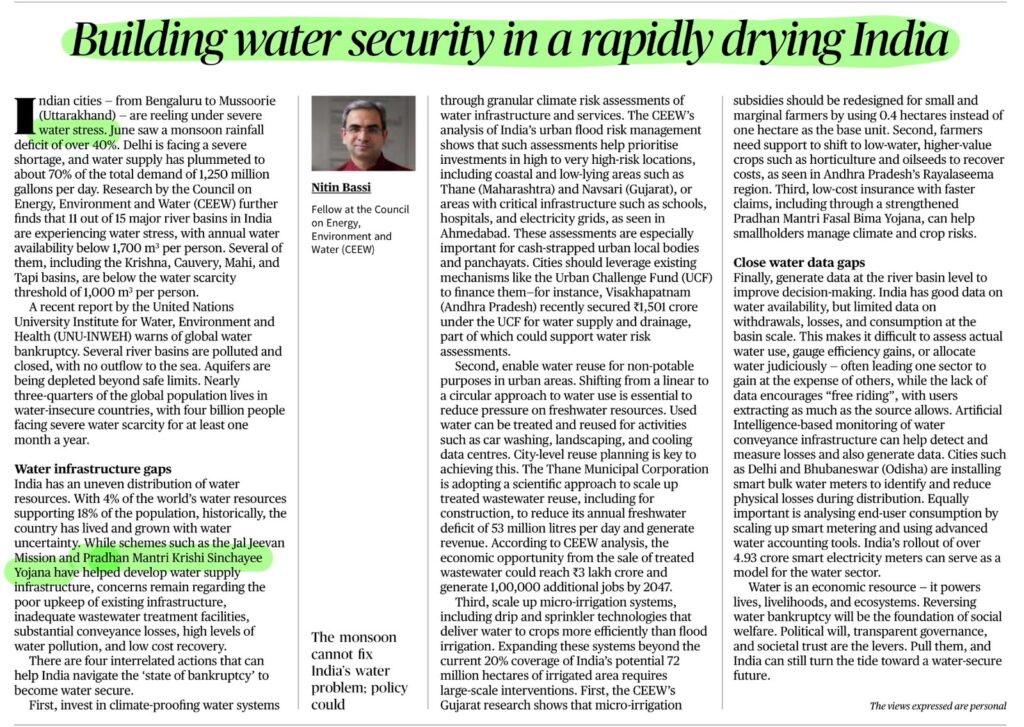
Increasing water stress, declining per capita water availability and climate variability have highlighted the need for climate-resilient water governance.

India has only 4% of the world’s freshwater resources but supports nearly 18% of the global population.

Also, 11 of India’s 15 major river basins are already water-stressed.

Water Security

Water security means reliable access to adequate quantity and quality of water for:

  • Drinking
  • Agriculture
  • Industry
  • Ecosystems
  • Livelihoods
  • Disaster resilience

Key Challenges

1. Rising Water Stress

Several river basins have annual per capita water availability below 1,700 cubic metres, making them water-stressed.

Some basins have already crossed the water scarcity threshold of below 1,000 cubic metres per person per year.

2. Groundwater Depletion

Over-extraction of groundwater for irrigation, urban use and industry is worsening water insecurity.

3. Pollution

Industrial waste, sewage discharge and agricultural runoff reduce usable water availability.

4. Erratic Rainfall

Climate change has made rainfall more unpredictable, increasing both drought and flood risks.

5. Infrastructure Gaps

India faces issues such as:

  • High transmission losses
  • Poor maintenance of water infrastructure
  • Inadequate wastewater treatment
  • Weak storage and distribution systems

6. Governance Gaps

Limited river-basin level data on water use, withdrawals and losses leads to inefficient allocation.

Way Forward

1. Build Climate-Resilient Water Infrastructure

  • Conduct climate-risk assessment of water projects.
  • Strengthen urban water systems.
  • Improve drainage and flood-water management.
  • Build resilient storage and distribution networks.

2. Improve Water-Use Efficiency

Scale up:

  • Drip irrigation
  • Sprinkler irrigation
  • Treated wastewater reuse
  • Low water-intensive crops
  • Efficient industrial water use

3. Strengthen Water Governance

Use:

  • AI-enabled monitoring
  • Smart water metering
  • River-basin water accounting
  • Real-time data systems
  • Evidence-based planning

4. Strengthen Flagship Schemes

Improve implementation of:

5. Promote Crop Diversification

Shift from water-intensive crops to climate-suitable and less water-intensive crops.

6. Reuse and Recycle Wastewater

Treated wastewater can be used for:

  • Industry
  • Construction
  • Landscaping
  • Agriculture where safe

Significance

  • Supports drinking water security.
  • Reduces agricultural vulnerability.
  • Helps climate adaptation.
  • Protects groundwater.
  • Improves urban resilience.
  • Strengthens food and livelihood security.

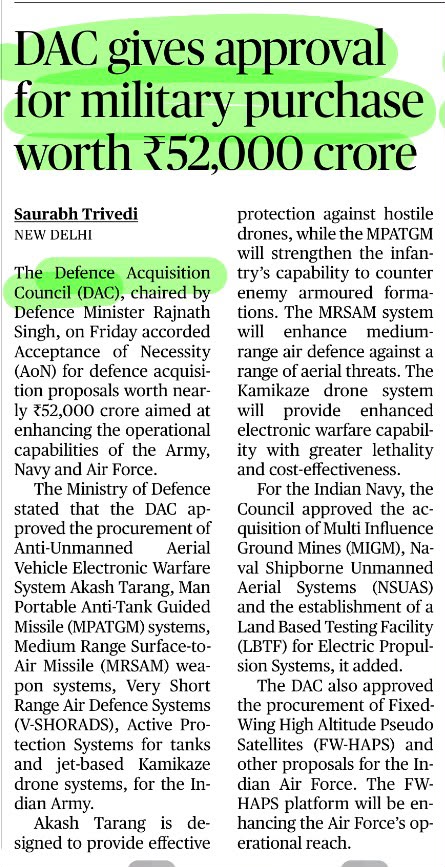
DAC Defence Procurement Approval: ₹52,000 Crore UPSC Notes

Context: DAC Defence Procurement Approval
The Defence Acquisition Council approved Acceptance of Necessity for capital acquisition proposals worth around ₹52,000 crore.

The proposals aim to enhance operational capabilities of the Army, Navy and Air Force, with focus on indigenisation and next-generation defence technologies.

Defence Acquisition Council

The Defence Acquisition Council is the highest decision-making body for capital defence procurement.

Chairperson

  • Defence Minister

Acceptance of Necessity

Acceptance of Necessity is the first stage of the defence procurement process.

It means the broad requirement for a defence purchase has been accepted.

Important Defence Systems Approved

1. Akash Tarang

Type

  • Indigenous Anti-UAV Electronic Warfare System

Purpose

Used for:

  • Detecting hostile drones
  • Tracking hostile drones
  • Neutralising hostile drones

2. MPATGM

Full Form

  • Man-Portable Anti-Tank Guided Missile

Developed By

  • DRDO

Type

  • Fire-and-forget missile

Purpose

Used to destroy:

  • Enemy tanks
  • Armoured vehicles

3. MRSAM

Full Form

  • Medium-Range Surface-to-Air Missile

Developed By

  • DRDO and Israel Aerospace Industries

Purpose

Air defence against:

  • Aircraft
  • Helicopters
  • Drones
  • Missiles

4. V-SHORADS

Full Form

  • Very Short-Range Air Defence System

Developed By

  • DRDO

Type

  • Man-portable air defence missile

Purpose

Counters:

  • Low-flying aerial threats
  • Enemy aircraft
  • Helicopters
  • Drones

5. FW-HAPS

Full Form

  • Fixed-Wing High Altitude Pseudo Satellite

Type

  • Solar-powered high-altitude unmanned platform

Purpose

Used for:

  • Persistent Intelligence, Surveillance and Reconnaissance
  • Communication
  • Border surveillance

Significance

  • Strengthens indigenous defence manufacturing.
  • Supports Aatmanirbhar Bharat.
  • Improves drone defence capability.
  • Enhances air defence systems.
  • Strengthens border surveillance.
  • Supports next-generation warfare preparedness.
  • Reduces dependence on imports.

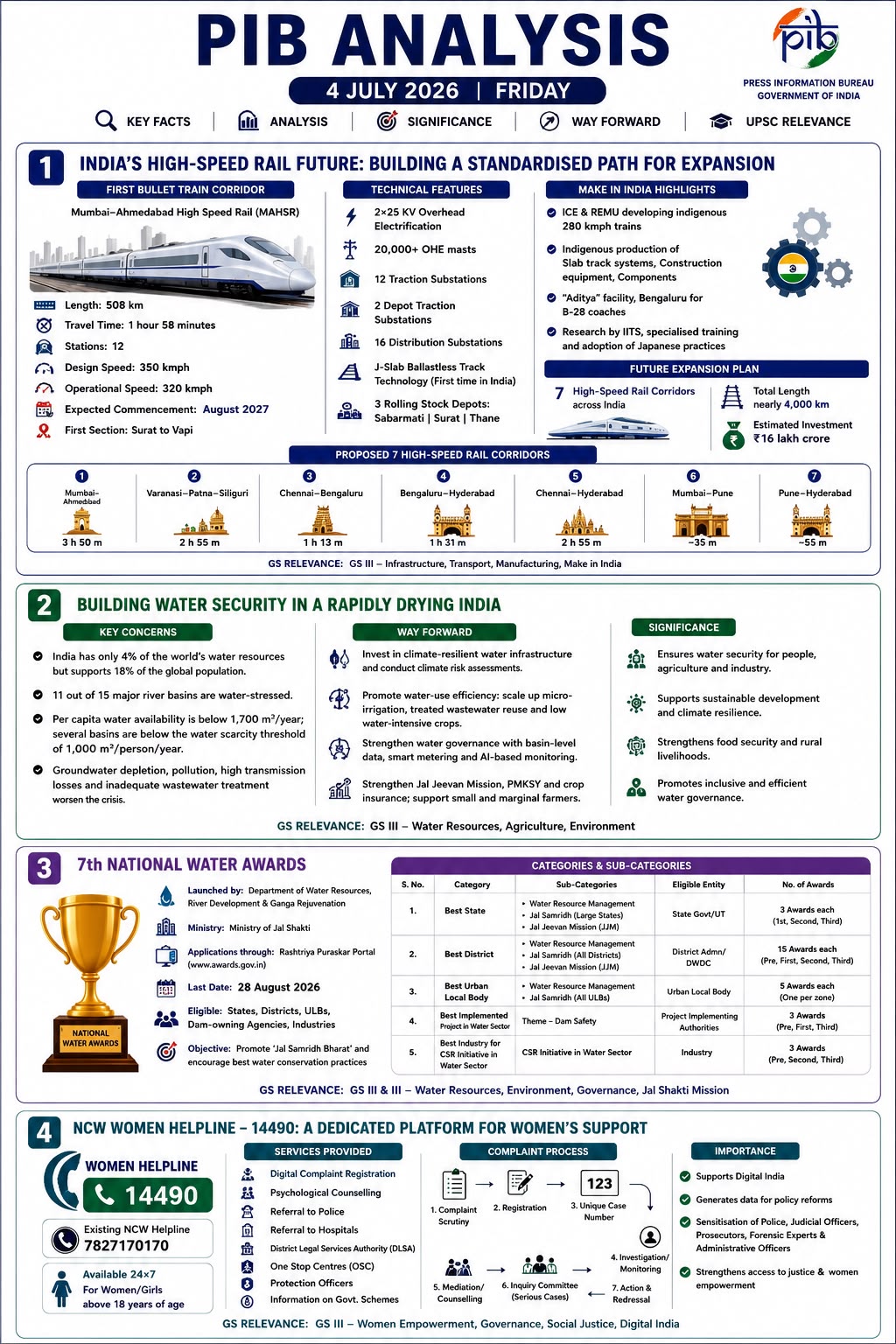
India High-Speed Rail Expansion: PIB UPSC Key Points

Context: India High-Speed Rail Expansion
India is planning a standardised approach for future high-speed rail corridors to enable faster expansion, lower costs, domestic manufacturing and better interoperability.

High-Speed Rail

High-speed rail refers to passenger railway systems designed for significantly higher speeds than conventional rail.

India’s First Bullet Train Corridor

Mumbai–Ahmedabad High-Speed Rail Corridor

Key Features

  • India’s first bullet train corridor.
  • Uses Japanese Shinkansen technology.
  • Designed for high-speed passenger movement.
  • Expected to reduce travel time between Mumbai and Ahmedabad.

Why Standardisation Matters

A standardised high-speed rail framework helps in:

  • Reducing project delays
  • Lowering construction costs
  • Improving interoperability
  • Promoting domestic manufacturing
  • Simplifying operations and maintenance
  • Creating common technical standards
  • Supporting Make in India

Areas of Standardisation

  • Track design
  • Signalling systems
  • Rolling stock
  • Safety protocols
  • Station design
  • Construction methods
  • Training systems
  • Maintenance protocols

Significance

  • Supports expansion of high-speed rail corridors.
  • Improves passenger mobility.
  • Reduces travel time.
  • Promotes regional economic integration.
  • Supports industrial development.
  • Generates jobs in manufacturing and construction.
  • Strengthens transport infrastructure.
  • Reduces pressure on roads and airports.

Challenges

  • High capital cost
  • Land acquisition
  • Technology transfer
  • Financing
  • Environmental clearance
  • Skilled workforce requirement
  • Integration with existing transport networks

Way Forward

  • Develop indigenous standards.
  • Promote domestic manufacturing of components.
  • Strengthen technology transfer.
  • Build specialised training centres.
  • Ensure multimodal connectivity at stations.
  • Use phased expansion.
  • Ensure financial viability and safety.

Water Security in India: PIB Insights for UPSC Exam

Context: Water Security in India
The PIB analysis reinforces the need for climate-resilient water security, given rising water stress, groundwater depletion and increasing climate variability.

Key Facts

  • India has only 4% of the world’s freshwater resources.
  • India supports nearly 18% of the global population.
  • 11 out of 15 major river basins are water-stressed.
  • Water availability is declining due to climate change, pollution and overuse.

Major Concerns

  • Falling groundwater levels
  • Urban water stress
  • Poor wastewater treatment
  • High transmission losses
  • Irrigation inefficiency
  • Climate-induced rainfall variability
  • River-basin level data gaps

Water Security Strategy

1. Demand Management

Reduce excessive water use through:

  • Efficient irrigation
  • Water pricing reforms
  • Smart metering
  • Public awareness

2. Supply Augmentation

Improve:

  • Rainwater harvesting
  • Watershed development
  • Aquifer recharge
  • Storage systems
  • Local water bodies

3. Wastewater Reuse

Promote treated wastewater use in:

  • Industry
  • Agriculture
  • Urban landscaping
  • Construction

4. Climate-Resilient Agriculture

Promote:

  • Crop diversification
  • Drought-resistant crops
  • Micro-irrigation
  • Soil moisture conservation

5. Technology Use

Use:

  • AI-based water monitoring
  • GIS mapping
  • Remote sensing
  • Smart water grids
  • Digital water accounting

Government Schemes

Jal Jeevan Mission

Provides functional household tap connections.

Pradhan Mantri Krishi Sinchayee Yojana

Promotes irrigation efficiency and “Har Khet Ko Pani.”

Atal Bhujal Yojana

Focuses on community-led groundwater management.

Jal Shakti Abhiyan

Promotes water conservation and rainwater harvesting.

Key Takeaway

India’s water crisis is not only about scarcity. It is also about governance, efficiency, infrastructure and climate resilience.

7th National Water Awards: PIB Highlights for UPSC

Context: 7th National Water Awards
The 7th National Water Awards recognise outstanding work in water conservation, water governance and sustainable water management.

Ministry

Purpose

The awards aim to encourage:

  • Water conservation
  • Rainwater harvesting
  • Groundwater recharge
  • Efficient water use
  • Community participation
  • Innovation in water management

Categories

Awards are given to:

  • States
  • Districts
  • Urban local bodies
  • Gram Panchayats
  • Schools
  • Industries
  • Water user associations
  • Institutions
  • NGOs
  • Individuals

Significance

  • Promotes cooperative and competitive federalism.
  • Encourages local innovation.
  • Recognises community-led conservation.
  • Strengthens awareness about water security.
  • Supports sustainable water governance.
  • Encourages replication of best practices.

Link with National Goals

The awards support:

Mains Usage

This topic can be used in answers on:

  • Water governance
  • Community participation
  • Behavioural change
  • Cooperative federalism
  • Sustainable development
  • Climate adaptation

NCW Women Helpline 14490: PIB UPSC Key Facts

Context: NCW Women Helpline 14490
The National Commission for Women has launched / highlighted the Women Helpline 14490 as a dedicated support platform for women.

NCW Women Helpline

Number

  • 14490

Purpose

To provide support to women facing distress, violence, harassment or legal and social issues.

Services Provided

  • Legal guidance
  • Counselling
  • Psychological support
  • Referral to police
  • Referral to One Stop Centres
  • Referral to District Legal Services Authorities
  • Information on government schemes
  • Support for complaint registration

National Commission for Women

Established

  • 1992

Legal Basis

  • National Commission for Women Act, 1990

Nature

  • Statutory body

Functions of NCW

  • Review constitutional and legal safeguards for women.
  • Recommend legislative measures.
  • Take up complaints of women’s rights violations.
  • Advise government on policy matters.
  • Support awareness and legal literacy.
  • Monitor issues affecting women.

Complaint Process

A woman can seek help through:

  • Calling 14490
  • Online complaint registration
  • Referral support
  • Follow-up with concerned authorities

Importance

  • Supports digital and phone-based grievance redressal.
  • Helps women access legal and counselling support.
  • Strengthens response to domestic violence and harassment.
  • Improves access for women in distress.
  • Promotes women’s safety and empowerment.

Significance for Governance

  • Citizen-centric service delivery.
  • Gender-sensitive governance.
  • Social justice.
  • Faster support mechanism.
  • Better coordination among agencies.
  • Strengthens trust in institutions.
About the UPSC Civil Services Examination (UPSC CSE)

The UPSC Civil Services Examination (CSE) is one of the most competitive and esteemed examinations in India, conducted by the Union Public Service Commission to recruit officers for services such as the Indian Administrative Service (IAS), Indian Police Service (IPS), Indian Foreign Service (IFS), and others. The exam comprises three stages — Prelims, Mains, and the Personality Test (Interview) — designed to test a candidate’s knowledge, aptitude, decision-making, and leadership skills.


How to Prepare Effectively for UPSC CSE

Cracking the UPSC CSE requires a deep understanding of the syllabus, consistent revision, structured answer writing, and smart test-taking strategies. The Prelims test analytical and conceptual clarity, the Mains focuses on critical thinking, articulation, and subject mastery, while the Interview assesses presence of mind, ethical judgment, and personality traits relevant to public service.

At UnderStand UPSC, we empower aspirants with a personalized and focused approach to each stage of the exam.


Why Choose UnderStand UPSC?

UnderStand UPSC is a mentorship-driven platform offering a clear, clutter-free strategy to tackle the Civil Services Examination. Our programs like Transform (for beginners and intermediate learners) and Conquer (for advanced mains preparation) provide structured study plans, syllabus-wise video content, interactive live sessions, and answer writing support.

We emphasize:

  • Concept clarity through topic-wise lectures

  • Test series designed around real UPSC standards

  • Personalized mentorship in small groups

  • Regular performance tracking and peer benchmarking

  • Doubt-clearing sessions, current affairs analysis, and monthly magazines


Join the UnderStand UPSC Learning Community

Our mission is to make UPSC preparation less overwhelming and more strategic. We combine mentorship, discipline, and academic rigor to help you clear CSE with confidence. Whether you’re preparing from Delhi, Mumbai, Bangalore, or a remote village — our online-first model ensures quality guidance reaches every corner of India.

Join the thousands of aspirants who trust UnderStand UPSC to guide their journey toward becoming civil servants.

Stay connected with us through our Telegram, YouTube, and Instagram channels for daily tips, strategies, and updates.

Copyright © 2026 USARAMBHA EDUCATION (UnderStand UPSC). All Rights Reserved.

Fill out the form

Fill out the form for

Downloading the free Agriculture Short Notes