6 July 2026 | Daily Current Affairs

Asiatic Lion Second Habitat: Need for Long-Term Conservation

Context: Asiatic lion second habitat
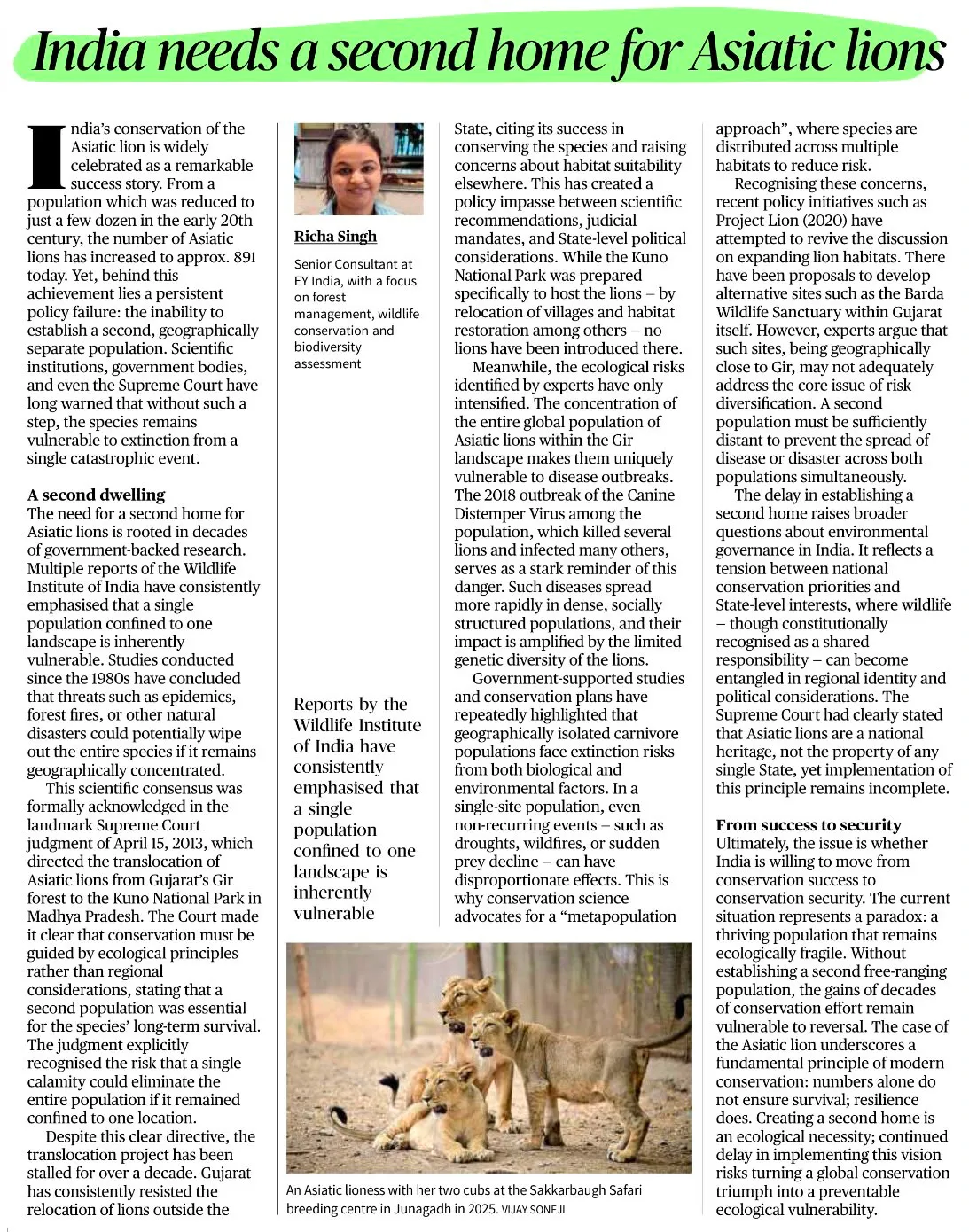
India’s successful conservation of the Asiatic lion has revived the need to establish a second free-ranging population outside Gujarat to ensure long-term species survival.
Current Status

2025 Lion Census

  • 891 Asiatic lions

Present Habitat

Asiatic lions are confined to the Greater Gir Landscape in Saurashtra, Gujarat.

This includes:

Why a Second Habitat Is Needed

A single confined population is vulnerable to:

  • Disease outbreaks
  • Natural disasters
  • Climate change
  • Habitat pressure
  • Genetic bottlenecks
  • Inbreeding risk

Metapopulation Conservation

Metapopulation conservation means maintaining geographically separated but ecologically connected populations of a species.

For Asiatic lions, a second habitat can:

  • Reduce extinction risk
  • Improve genetic diversity
  • Ensure long-term survival
  • Prevent dependence on a single landscape

Conservation Initiatives

Supreme Court, 2013

The Supreme Court directed translocation of Asiatic lions to Kuno National Park, Madhya Pradesh.

Project Lion, 2020

Focuses on:

  • Habitat expansion
  • Corridor management
  • Long-term conservation
  • Disease surveillance
  • Human-wildlife coexistence

UPSC Value Addition

Scientific Name

  • Panthera leo persica

IUCN Status

  • Endangered

Wildlife Protection Act, 1972

  • Schedule I

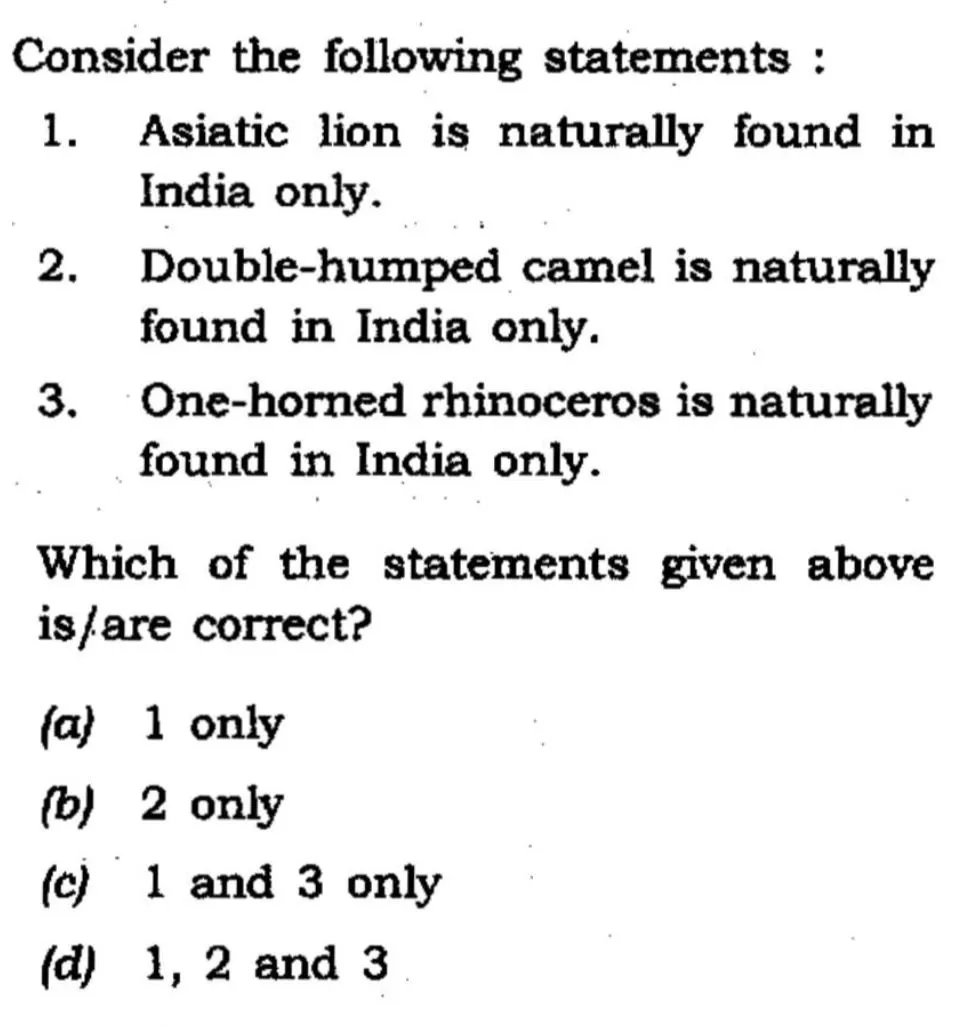
PYQ Link

Asiatic lion is naturally found in India only.

Double-humped camel and one-horned rhinoceros are not naturally found only in India.

Key Takeaway

Asiatic lion conservation cannot depend on one landscape alone. A second free-ranging population is essential for ecological security, genetic resilience and long-term species survival.
Right to Belong Citizenship: Constitutional Perspective for UPSC

Context: Right to belong citizenship
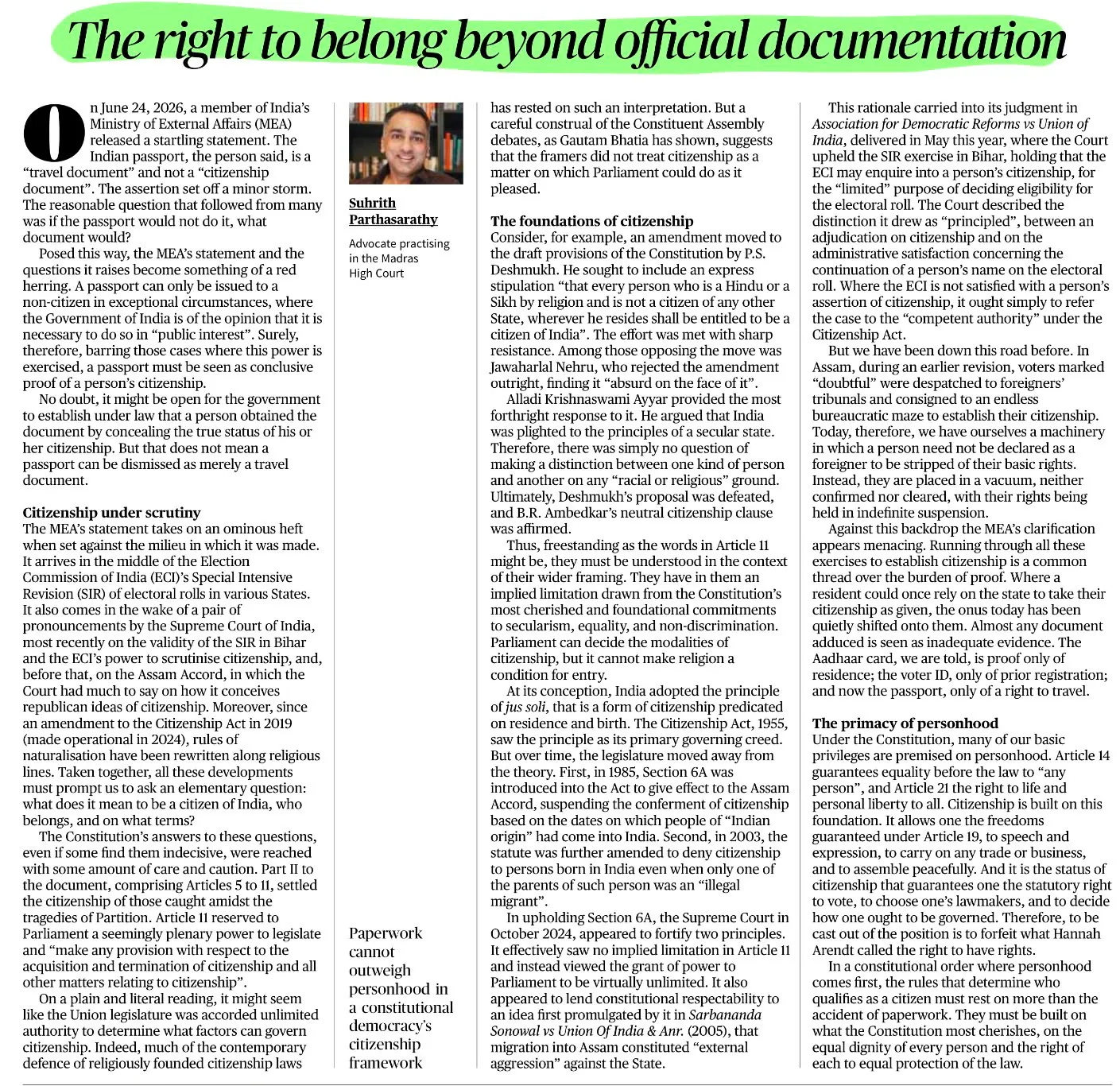
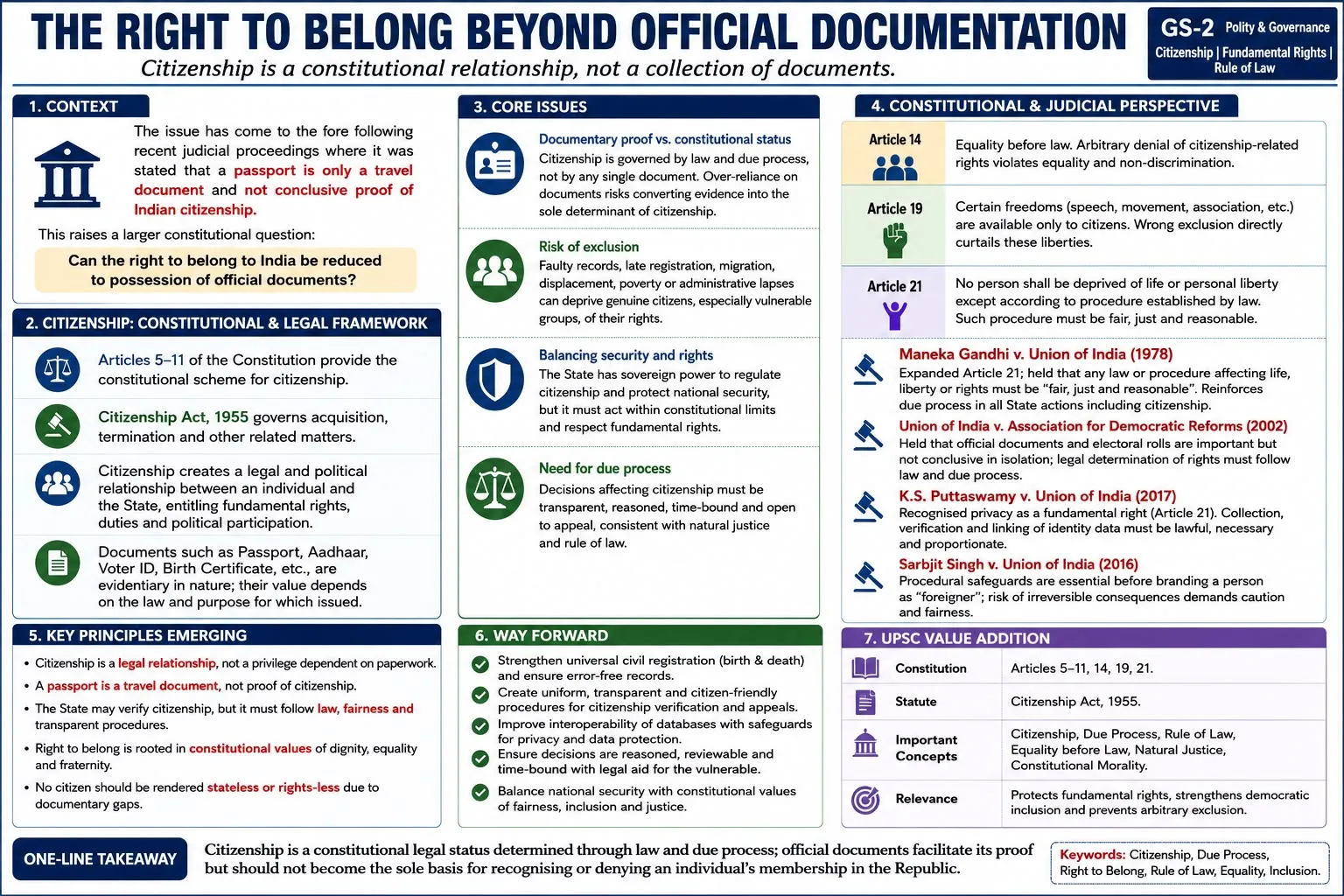
The article argues that citizenship is a constitutional relationship, not merely a collection of documents.

It raises the larger question of whether the right to belong can be reduced to the possession of official documentation.

Core Issue

Documentation is important for administration, but citizenship cannot depend only on papers.

Overdependence on documents can exclude vulnerable people such as:

  • Migrants
  • Poor households
  • Displaced persons
  • Women
  • Elderly persons
  • Marginalised communities

Citizenship: Constitutional and Legal Framework

Articles 5–11

Provide the constitutional scheme of citizenship.

Citizenship Act, 1955

Governs:

  • Acquisition of citizenship
  • Termination of citizenship
  • Registration
  • Naturalisation

Core Principle

Citizenship creates a legal and political relationship between an individual and the State.

It provides:

  • Fundamental rights
  • Duties
  • Political participation
  • Protection under law

Documents and Citizenship

Documents such as:

  • Passport
  • Aadhaar
  • Voter ID
  • PAN
  • Birth certificate

may serve as evidence.

But they are not the source of citizenship.

Key Concerns

1. Documentary Proof vs Constitutional Status

Citizenship is created by law and due process, not by a single document.

2. Risk of Exclusion

People may lack documents due to:

  • Poverty
  • Migration
  • Displacement
  • Illiteracy
  • Gender discrimination
  • Administrative failure

3. Due Process

Decisions affecting citizenship must be:

  • Fair
  • Transparent
  • Reasoned
  • Time-bound
  • Open to appeal
  • Consistent with natural justice

4. Balancing Security and Rights

The State may regulate citizenship for national security, but it must not use documentation in a way that violates dignity, equality and due process.

Constitutional and Judicial Perspective

Article 14

Provides equality before law and protection against arbitrary State action.

Article 19

Certain freedoms are available only to citizens.

Wrong exclusion from citizenship directly affects these liberties.

Article 21

No person shall be deprived of life or personal liberty except according to procedure established by law.

Procedure must be fair, just and reasonable.

Important Cases

Maneka Gandhi v. Union of India, 1978

Expanded Article 21 and held that procedure must be fair, just and reasonable.

Union of India v. Association for Democratic Reforms, 2002

Held that official documents and electoral information must be linked to transparency and democratic rights.

K.S. Puttaswamy v. Union of India, 2017

Recognised privacy as part of Article 21.

Sarbananda Sonowal Case

Discussed illegal migration and national security concerns in Assam.

Key Principles Emerging

  • Citizenship is a legal relationship, not a privilege dependent on paperwork.
  • A passport is a travel document, not proof of citizenship.
  • The State may verify citizenship, but it must follow fairness and transparency.
  • Right to belong is rooted in constitutional values of dignity, equality and fraternity.
  • No citizen should be rendered stateless or rightless due to documentary gaps.

Way Forward

  • Strengthen universal civil registration.
  • Ensure birth and death records are accessible.
  • Create citizen-friendly procedures for correcting records.
  • Protect vulnerable groups from exclusion.
  • Provide legal aid and appeal mechanisms.
  • Balance national security with constitutional values.
  • Avoid overdependence on a single document.
  • Ensure due process in citizenship verification.

Key Takeaway

Citizenship flows from law and constitutional status, not merely from documents. Official papers may support proof, but they cannot replace due process, dignity and the right to belong.

India Fisheries Crisis: Challenges and Solutions for UPSC

Context: India fisheries crisis
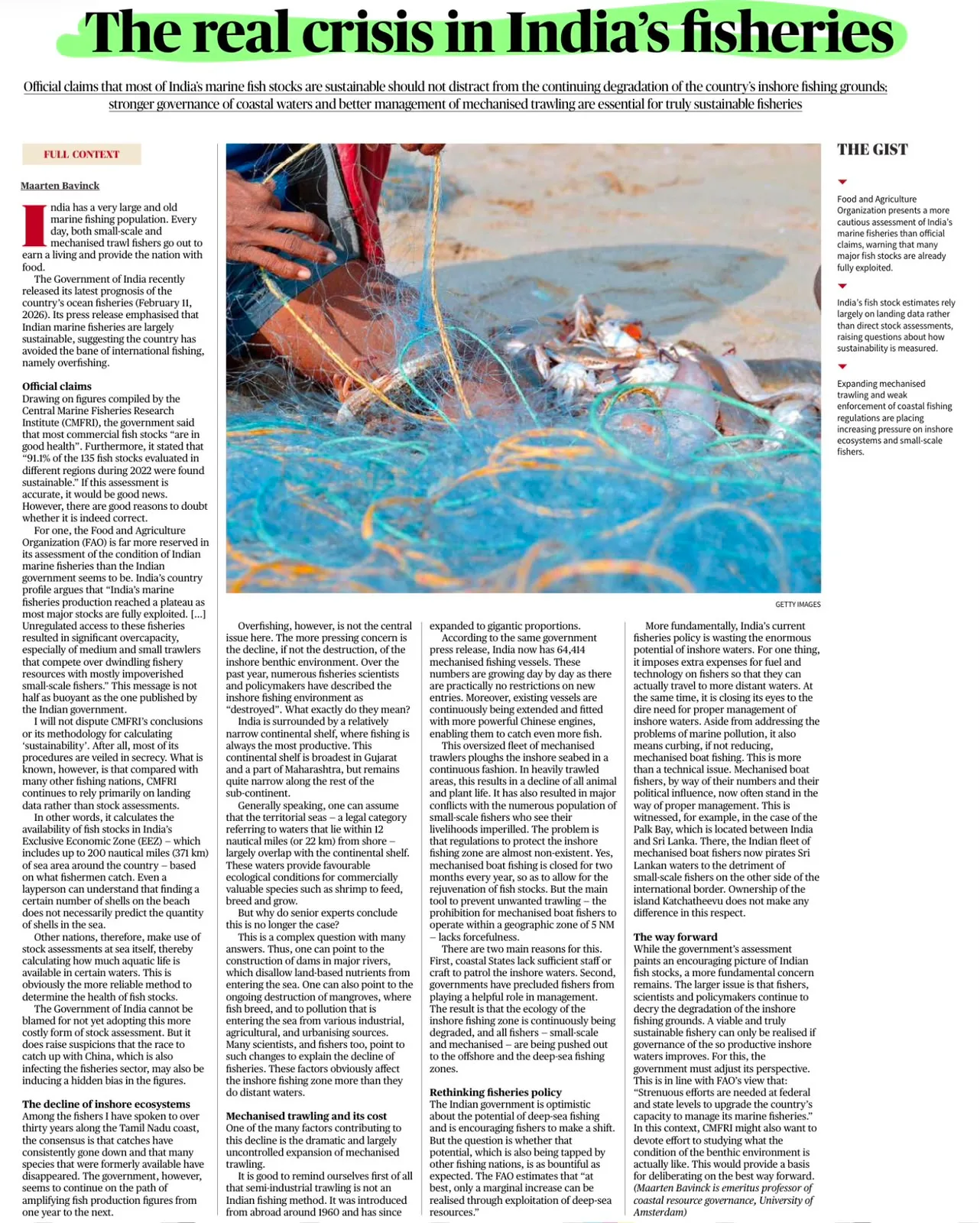
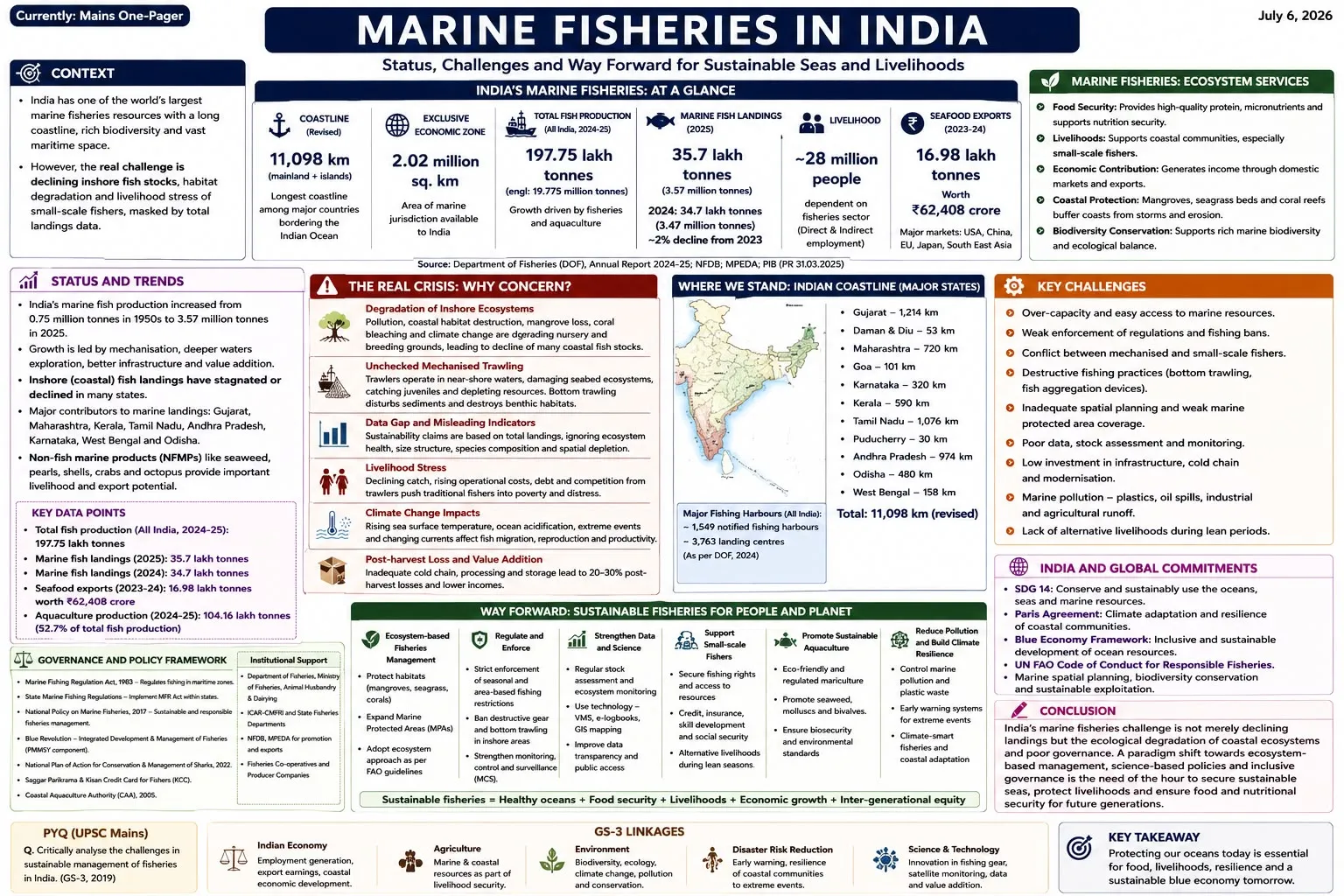
The article argues that India’s real fisheries crisis is not only about lower catches, but about ecological degradation, livelihood insecurity, poor regulation, overcapacity and weak governance of marine resources.

Importance of Fisheries in India

Fisheries support:

  • Coastal livelihoods
  • Food security
  • Nutrition
  • Exports
  • Blue Economy
  • Employment
  • Marine ecosystem services

Core Crisis

India’s marine fish sector faces stress due to:

  • Overfishing
  • Climate change
  • Coastal pollution
  • Habitat degradation
  • Declining fish stocks
  • Weak regulation
  • Livelihood vulnerability of small fishers

Key Challenges

1. Overcapacity and Overfishing

Too many fishing vessels and excessive fishing effort reduce fish stocks.

Mechanised fishing often creates pressure on near-shore waters.

2. Decline of Traditional Fishers

Small and traditional fishing communities face competition from:

  • Mechanised trawlers
  • Large fishing fleets
  • Export-oriented fishing
  • Market intermediaries

3. Climate Change

Rising sea temperatures and changing ocean conditions affect:

  • Fish migration
  • Breeding cycles
  • Catch availability
  • Coastal livelihoods

4. Habitat Degradation

Marine habitats are affected by:

  • Coastal development
  • Pollution
  • Mangrove loss
  • Coral reef degradation
  • Destructive fishing practices

5. Weak Data and Governance

Poor data on fish stocks, catches and fishing effort makes sustainable management difficult.

6. Post-Harvest Losses

Poor cold-chain infrastructure, lack of storage and weak processing facilities reduce fisher income.

7. Livelihood Insecurity

Fishers face:

  • Low incomes
  • Seasonal unemployment
  • Debt dependence
  • Lack of social security
  • Climate-related risks

Marine Fisheries and Ecosystem Services

Healthy marine fisheries provide:

  • Nutrition
  • Livelihoods
  • Biodiversity conservation
  • Carbon cycling
  • Coastal resilience
  • Cultural and social value

Way Forward

1. Scientific Fisheries Management

Use stock assessment, catch limits and seasonal fishing restrictions.

2. Protect Small Fishers

Provide social security, insurance, credit and market access.

3. Regulate Mechanised Fishing

Control destructive fishing gear and prevent overcapacity.

4. Strengthen Marine Data Systems

Improve real-time catch data, vessel tracking and fish-stock monitoring.

5. Improve Cold Chain and Processing

Invest in:

  • Storage
  • Ice plants
  • Processing units
  • Transport infrastructure

6. Promote Sustainable Aquaculture

Ensure aquaculture does not cause pollution, disease spread or habitat damage.

7. Community-Based Governance

Involve fisher communities in conservation and resource management.

8. Climate-Resilient Fisheries

Develop early warning systems, climate insurance and livelihood diversification.

Key Takeaway

India’s fisheries crisis is a governance and ecological crisis. Sustainable fisheries require protecting marine ecosystems while securing the livelihoods of small and traditional fishers.

Gaganyaan SOLVE Test: ISRO Validates Crew Safety System

Context: Gaganyaan SOLVE test
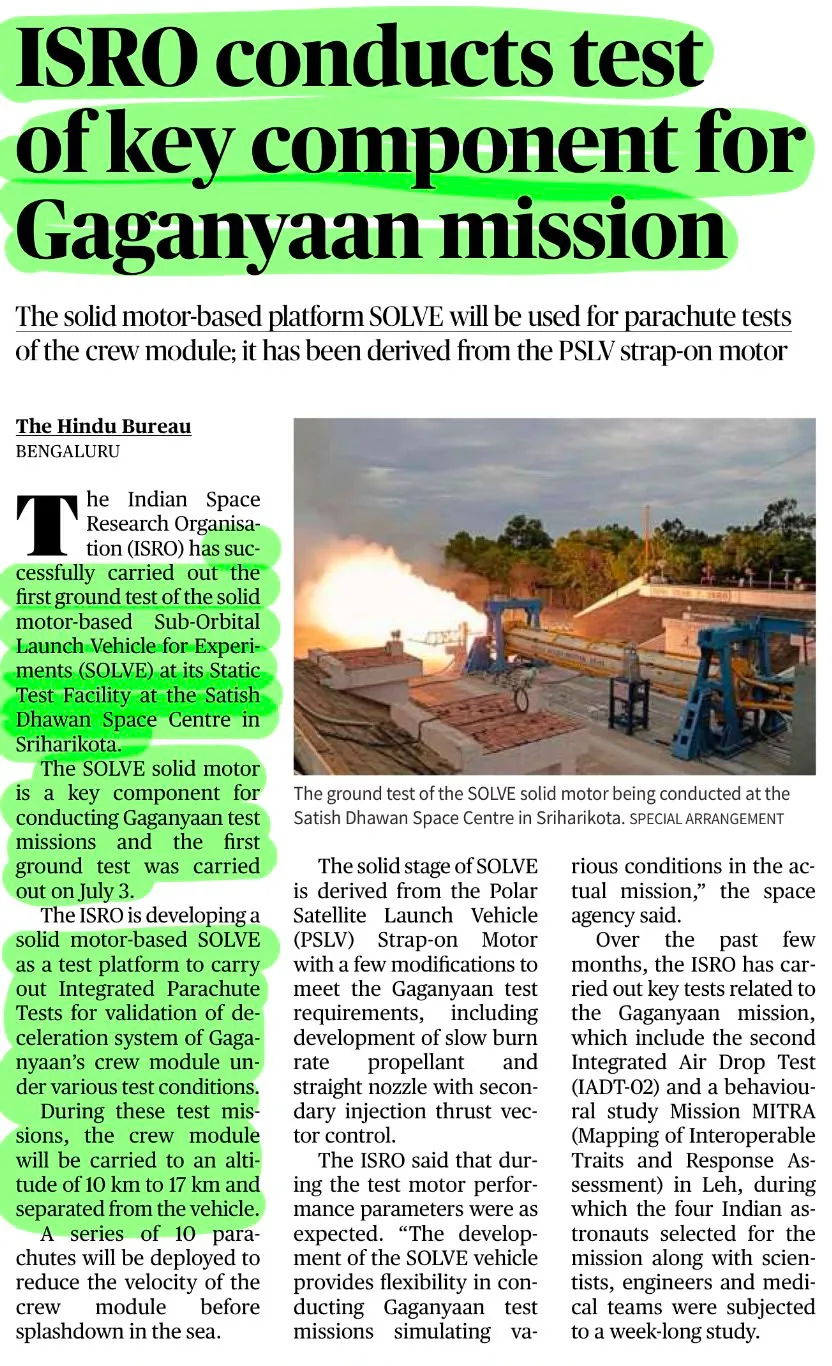
ISRO successfully tested SOLVE, a dedicated test platform developed to validate the crew module’s parachute recovery system for the Gaganyaan mission.

Gaganyaan Mission

Gaganyaan is India’s first indigenous human spaceflight mission.

Launch Vehicle

  • LVM3

Mission Objective

To send Indian astronauts to Low Earth Orbit at around 400 km for about 3 days and ensure safe sea splashdown.

Broader Objective

To develop indigenous human spaceflight capability and critical crew-safety technologies.

SOLVE

Full Form

  • Sub-Orbital Launch Vehicle for Experiments

What Is SOLVE?

SOLVE is a sub-orbital solid-motor test vehicle derived from the PSLV strap-on motor.

Purpose

It is used to test the crew module’s parachute recovery system.

How It Works

  • Carries the crew module to 10–17 km altitude.
  • Releases the crew module.
  • Tests the 10-parachute recovery sequence.
  • Validates safe landing and splashdown systems.

Why Is SOLVE Important?

SOLVE allows repeated testing of the landing system without launching the full Gaganyaan mission.

This improves:

  • Crew safety
  • Mission reliability
  • Parachute validation
  • Recovery system performance
  • Human spaceflight readiness

Significance

  • Strengthens India’s human spaceflight capability.
  • Builds confidence in crew safety systems.
  • Supports indigenous space technology.
  • Reduces mission risk.
  • Helps validate critical systems before human flight.

MY Bharat Initiative: Empowering India’s Youth for UPSC

Context: MY Bharat initiative
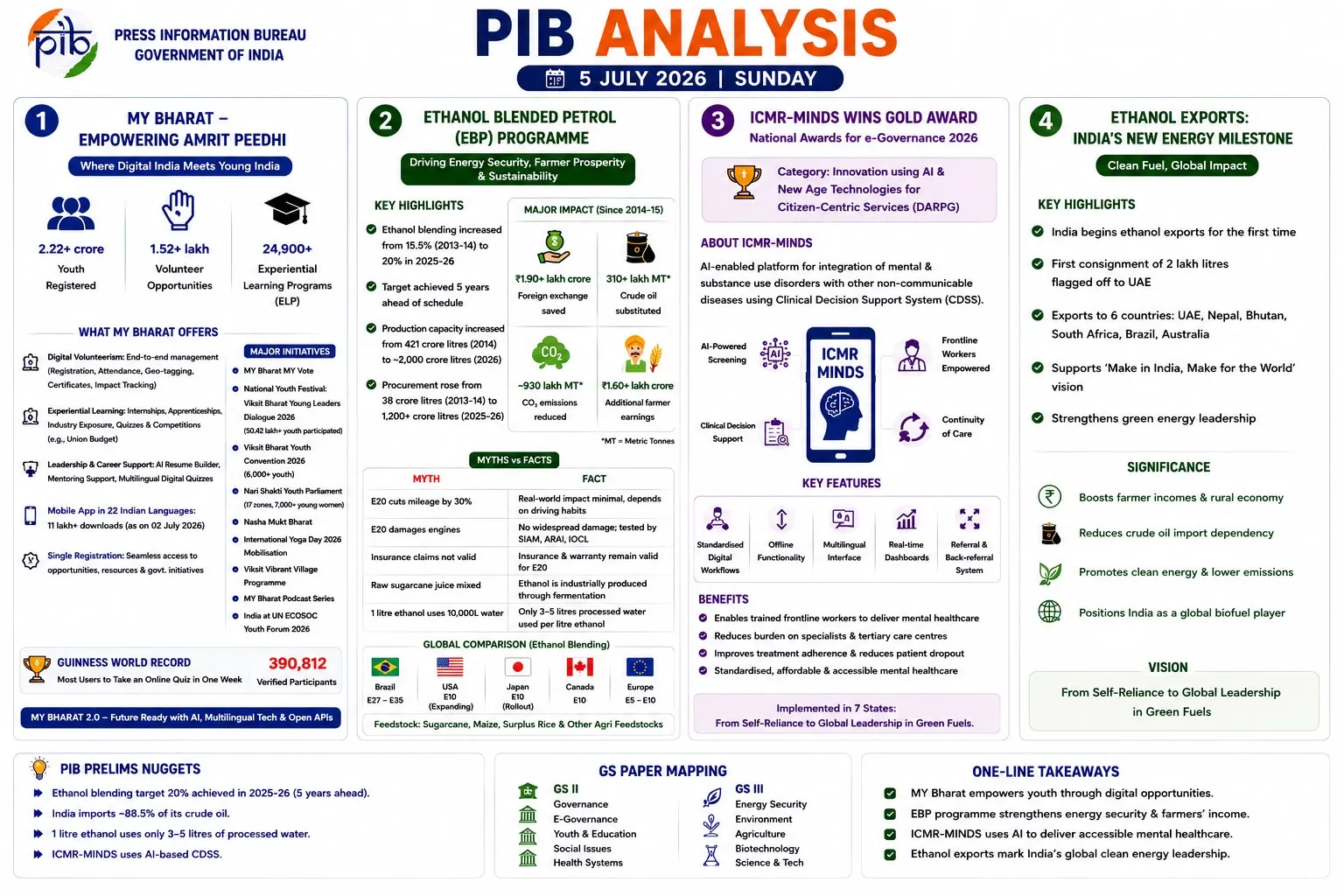
MY Bharat is a youth-focused platform aimed at empowering India’s young population through volunteering, experiential learning, leadership and nation-building opportunities.

MY Bharat

Full Form

  • Mera Yuva Bharat

Purpose

To provide young citizens opportunities for:

  • Volunteering
  • Skill development
  • Leadership
  • Experiential learning
  • Community participation
  • Nation-building

Key Features

  • Youth registration
  • Volunteer opportunities
  • Skill-building programmes
  • Experiential learning
  • Leadership development
  • Community service
  • Digital engagement

Significance

  • Channels youth energy towards productive civic participation.
  • Builds leadership and life skills.
  • Promotes social responsibility.
  • Supports youth-led development.
  • Creates a bridge between youth and governance.
  • Strengthens the idea of Amrit Peedhi.

Governance Relevance

MY Bharat supports:

  • Citizen participation
  • Youth empowerment
  • Participatory governance
  • Social capital formation
  • Community-led development

Key Takeaway

MY Bharat is a platform to convert India’s demographic dividend into civic leadership, skills and nation-building capacity.

Ethanol Blended Petrol Programme: E20 and Energy Security

Context: Ethanol Blended Petrol Programme
The Ethanol Blended Petrol Programme is a major initiative to reduce import dependence, promote clean energy and support farmers through ethanol blending in petrol.

Ethanol Blended Petrol Programme

The programme promotes blending ethanol with petrol.

Objective

  • Reduce crude oil imports
  • Reduce carbon emissions
  • Support farmers
  • Promote domestic biofuel production
  • Improve energy security

Ethanol

Ethanol is a biofuel produced from:

  • Sugarcane molasses
  • Sugarcane juice
  • Broken rice
  • Maize
  • Other biomass feedstock

Key Blends

E10

  • 10% ethanol
  • 90% petrol

E20

  • 20% ethanol
  • 80% petrol

Significance of E20

India achieved the E20 blending target ahead of schedule.

Benefits

  • Reduces oil import bill.
  • Lowers greenhouse gas emissions.
  • Provides additional income to farmers.
  • Supports sugarcane and grain-based ethanol industry.
  • Helps manage surplus sugar and grain stocks.
  • Supports rural economy.
  • Promotes cleaner fuel use.

Challenges

  • Feedstock availability
  • Food vs fuel concerns
  • Water-intensive sugarcane cultivation
  • Vehicle compatibility
  • Lower mileage due to lower energy density of ethanol
  • Need for storage and distribution infrastructure

Way Forward

  • Diversify ethanol feedstock.
  • Promote maize-based ethanol.
  • Develop second-generation ethanol from agricultural waste.
  • Improve vehicle compatibility.
  • Promote flex-fuel vehicles.
  • Ensure water-efficient crop planning.
  • Balance energy security with food security.

ICMR MINDS Platform Wins e-Governance Award 2026

Context: ICMR MINDS platform
ICMR-MINDS won the National Award for e-Governance 2026 for using digital tools to improve mental health services and research.

ICMR-MINDS

ICMR-MINDS is an e-health platform focused on mental health.

Purpose

It supports:

  • Mental health screening
  • Digital data collection
  • Research
  • Clinical decision support
  • Monitoring of mental health conditions
  • Public health planning

Why It Matters

Mental health has become a major public health priority.

Digital platforms can help by:

  • Improving access to care
  • Supporting early identification
  • Enabling tele-mental health support
  • Generating evidence for policymaking
  • Reducing service gaps in underserved areas

National Award for e-Governance

The award recognises innovative use of digital governance for better service delivery.

Significance

  • Promotes digital health innovation.
  • Improves mental health surveillance.
  • Supports evidence-based policymaking.
  • Strengthens public health systems.
  • Helps integrate technology with healthcare delivery.

Mains Usage

This can be used in answers on:

  • Digital health
  • Mental health governance
  • e-governance
  • Public health innovation
  • Inclusive healthcare
  • Technology for service delivery

India Ethanol Exports: New Milestone in Clean Energy

Context: India ethanol exports
India has begun ethanol exports as part of its growing biofuel and clean energy ecosystem, marking a new milestone in the country’s energy economy.

Why Ethanol Exports Matter

Ethanol exports indicate that India is moving from domestic blending success towards global biofuel participation.

Significance

1. Energy Economy

Ethanol exports strengthen India’s position in the clean fuel market.

2. Farmer Income

A strong ethanol ecosystem supports farmers by creating demand for:

  • Sugarcane
  • Maize
  • Broken rice
  • Biomass

3. Rural Industry

Ethanol production supports:

  • Distilleries
  • Biofuel units
  • Logistics
  • Rural jobs

4. Global Biofuel Leadership

India can become a major player in the global biofuel supply chain.

5. Climate Goals

Ethanol supports lower-carbon fuel systems and clean energy transition.

Link with Make in India

Domestic ethanol production strengthens:

  • Local manufacturing
  • Rural processing
  • Bio-economy
  • Energy self-reliance

Challenges

  • Maintaining domestic blending supply
  • Feedstock sustainability
  • Food security concerns
  • Water use
  • Export competitiveness
  • Quality standards
  • Long-term price stability

Way Forward

  • Ensure domestic EBP targets are protected.
  • Promote second-generation ethanol.
  • Diversify feedstock.
  • Build export-quality standards.
  • Strengthen biofuel logistics.
  • Encourage innovation in clean fuels.
  • Balance export growth with domestic energy security.

Key Takeaway

Ethanol exports show India’s growing strength in clean fuels, but long-term success will depend on sustainable feedstock, domestic energy needs and balanced biofuel policy.

About the UPSC Civil Services Examination (UPSC CSE)

The UPSC Civil Services Examination (CSE) is one of the most competitive and esteemed examinations in India, conducted by the Union Public Service Commission to recruit officers for services such as the Indian Administrative Service (IAS), Indian Police Service (IPS), Indian Foreign Service (IFS), and others. The exam comprises three stages — Prelims, Mains, and the Personality Test (Interview) — designed to test a candidate’s knowledge, aptitude, decision-making, and leadership skills.


How to Prepare Effectively for UPSC CSE

Cracking the UPSC CSE requires a deep understanding of the syllabus, consistent revision, structured answer writing, and smart test-taking strategies. The Prelims test analytical and conceptual clarity, the Mains focuses on critical thinking, articulation, and subject mastery, while the Interview assesses presence of mind, ethical judgment, and personality traits relevant to public service.

At UnderStand UPSC, we empower aspirants with a personalized and focused approach to each stage of the exam.


Why Choose UnderStand UPSC?

UnderStand UPSC is a mentorship-driven platform offering a clear, clutter-free strategy to tackle the Civil Services Examination. Our programs like Transform (for beginners and intermediate learners) and Conquer (for advanced mains preparation) provide structured study plans, syllabus-wise video content, interactive live sessions, and answer writing support.

We emphasize:

  • Concept clarity through topic-wise lectures

  • Test series designed around real UPSC standards

  • Personalized mentorship in small groups

  • Regular performance tracking and peer benchmarking

  • Doubt-clearing sessions, current affairs analysis, and monthly magazines


Join the UnderStand UPSC Learning Community

Our mission is to make UPSC preparation less overwhelming and more strategic. We combine mentorship, discipline, and academic rigor to help you clear CSE with confidence. Whether you’re preparing from Delhi, Mumbai, Bangalore, or a remote village — our online-first model ensures quality guidance reaches every corner of India.

Join the thousands of aspirants who trust UnderStand UPSC to guide their journey toward becoming civil servants.

Stay connected with us through our Telegram, YouTube, and Instagram channels for daily tips, strategies, and updates.

Copyright © 2026 USARAMBHA EDUCATION (UnderStand UPSC). All Rights Reserved.

Fill out the form

Fill out the form for

Downloading the free Agriculture Short Notes