
7 August 2026 | UPSC Daily Current Affairs

7 August 2026 | UPSC Daily Current Affairs

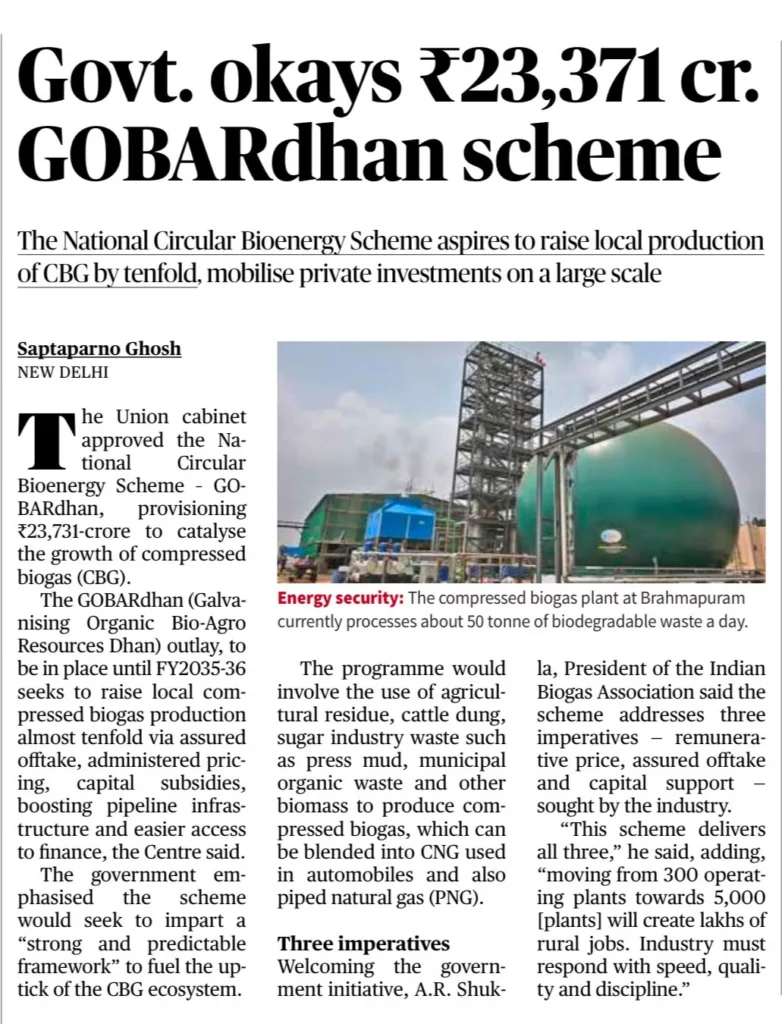
GOBARdhan Scheme 2026: Cabinet Approves ₹23,731 Cr Plan

Context: GOBARdhan Scheme 2026
The Union Cabinet has approved the National Circular Bioenergy Scheme, also called GOBARdhan — Galvanising Organic Bio-Agro Resources Dhan, with an outlay of ₹23,731 crore.

The scheme will run from FY 2026–27 to FY 2035–36 and aims to expand Compressed Biogas production while promoting a circular bioeconomy.

GOBARdhan Scheme

GOBARdhan is a national unified scheme for the Compressed Biogas ecosystem.

It brings different forms of Central Government support for CBG under one framework.

Nodal Ministry

The scheme is coordinated by the Ministry of Jal Shakti, with the commercial bioenergy rollout administered by the Ministry of Petroleum and Natural Gas.

Key Features

Umbrella Scheme

The scheme integrates Central Government support for the CBG ecosystem under a single framework.

This helps create a more predictable policy environment for investors and producers.

Feedstock Diversification

The scheme will use different types of biodegradable waste for CBG production, including:

  • Cattle dung
  • Crop residue
  • Press mud
  • Sewage
  • Municipal organic waste
  • Other biodegradable waste

Assured Offtake Mechanism

CBG producers will get assured market access through guaranteed procurement.

This is important because one of the biggest problems in the CBG sector is uncertainty over demand and offtake.

Administered Pricing Mechanism

The scheme provides price certainty.

This improves project viability and makes private investment more attractive.

Viability Gap Funding

Viability Gap Funding will support CBG projects that may be socially and environmentally useful but commercially less viable.

Private Sector Participation

The scheme encourages private investment and public-private partnerships across the CBG value chain.

Objectives

The scheme aims to increase domestic CBG production nearly tenfold.

It seeks to reduce dependence on imported natural gas.

It promotes the Waste-to-Wealth approach by converting organic waste into clean fuel and bio-manure.

It can also generate rural employment and provide additional income opportunities for farmers.

Significance

GOBARdhan supports circular economy and scientific waste management.

It can reduce stubble burning, landfill pressure and greenhouse gas emissions.

It also supports India’s Net Zero 2070 target and long-term energy security.

Key Takeaway

GOBARdhan is not only a waste-management scheme. It links clean energy, rural income, circular economy, private investment and India’s energy-security goals.


GOBARdhan Scheme 2026

Supreme Court Ramsar Wetlands Judgment on Mining Buffer

Context: Supreme Court Ramsar Wetlands Judgment
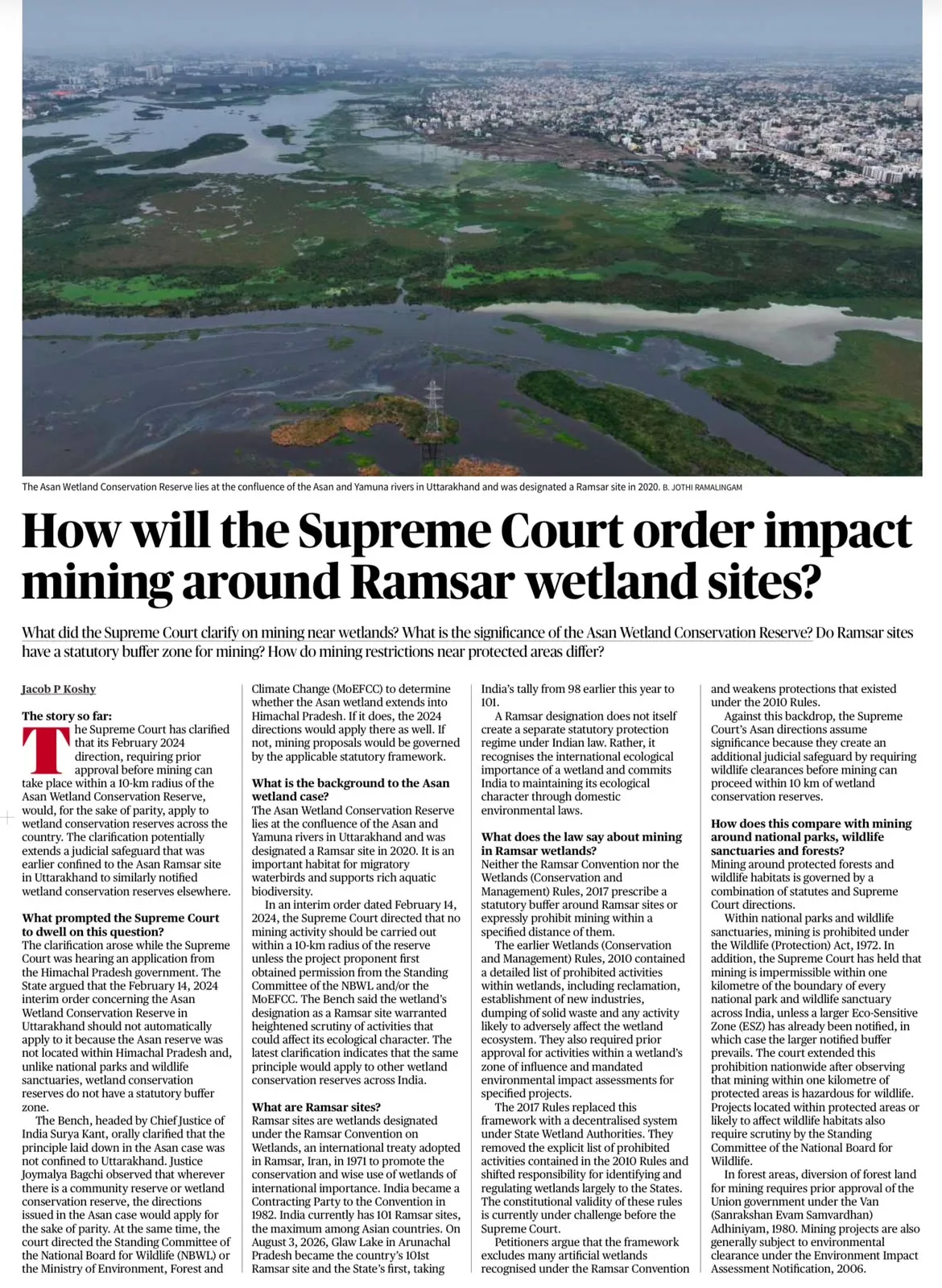
In T.N. Godavarman Thirumulpad v. Union of India, the Supreme Court clarified that its 10-km mining restriction around the Asan Wetland Conservation Reserve should, on the principle of parity, extend to Wetland Conservation Reserves across India.

This is important because Ramsar wetlands do not have a statutory 10-km buffer under the Wetlands Rules, 2017.

Supreme Court Judgment

Key Highlights

Mining within 10 km of the Asan Wetland Conservation Reserve requires prior approval of the Standing Committee of the National Board for Wildlife and/or the Ministry of Environment, Forest and Climate Change.

The Court said that the same judicial safeguard should apply to Wetland Conservation Reserves across India.

Where wetland boundaries extend across States, boundary verification will be needed.

Unlike Eco-Sensitive Zones around National Parks and Wildlife Sanctuaries, Ramsar wetlands do not automatically have a statutory 10-km buffer under the Wetlands Rules, 2017.

Therefore, the judgment creates an additional judicial safeguard based on the Precautionary Principle.

Asan Wetland Conservation Reserve

Location: Confluence of the Asan and Yamuna rivers, Uttarakhand.

Status: Conservation Reserve under the Wildlife Protection Act, 1972 and Ramsar Site since 2020.

Importance: It is a critical habitat for migratory birds along the Central Asian Flyway.

Why in News: It is the first Ramsar Site in India to receive a 10-km judicial safeguard against mining.

Ramsar Sites

Ramsar Sites are wetlands of international importance recognised under the Ramsar Convention.

The Convention was adopted in 1971 in Ramsar, Iran.

It promotes the conservation and wise use of wetlands.

India has 101 Ramsar Sites.

Why Wetlands Matter

Wetlands provide several ecological services:

  • Water purification
  • Flood control
  • Groundwater recharge
  • Carbon storage
  • Habitat for migratory birds
  • Biodiversity conservation
  • Livelihood support

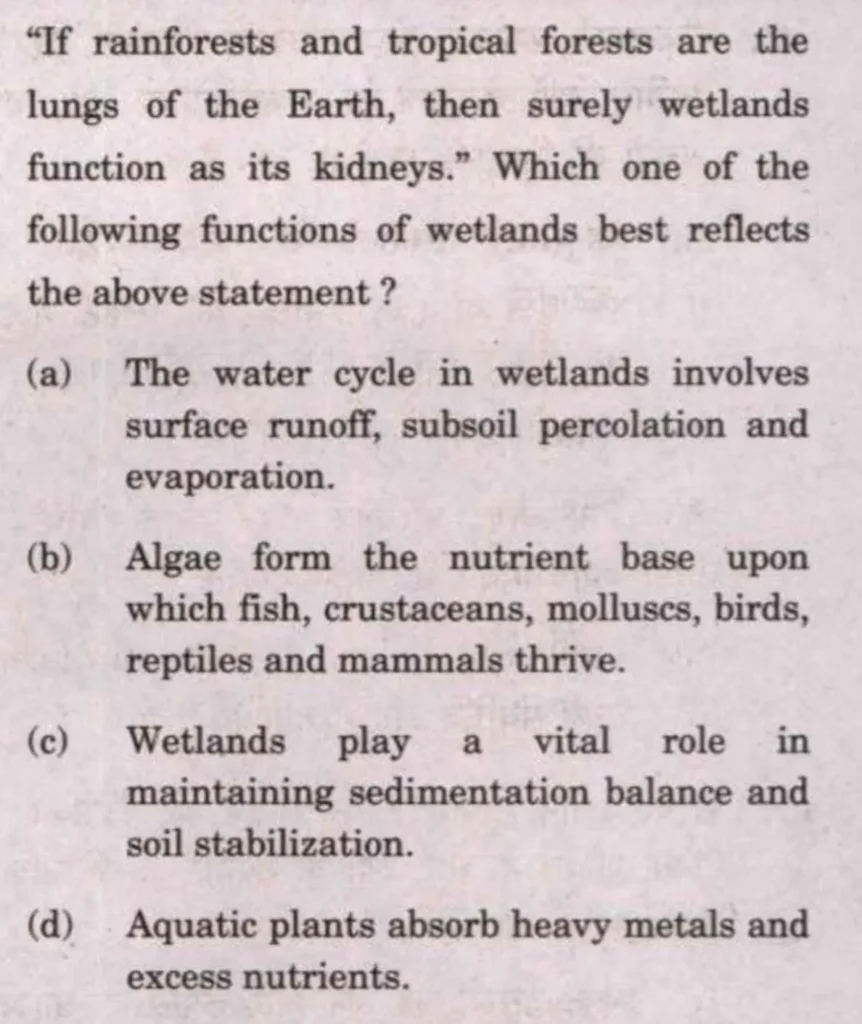
They are often called the “kidneys” of the Earth because they absorb pollutants, excess nutrients and heavy metals.

Significance of the Judgment

The order strengthens wetland protection even in the absence of a statutory buffer zone.

It can prevent damaging mining activities near ecologically sensitive wetland areas.

It also gives stronger importance to the Precautionary Principle in environmental governance.

Key Takeaway

The Supreme Court’s order gives Ramsar-linked Wetland Conservation Reserves stronger protection against mining. It fills a legal gap by creating a precaution-based judicial safeguard.

Supreme Court Ramsar Wetlands Judgment

Digital Arrest Scam Supreme Court Directions Explained

Context: Digital Arrest Scam Supreme Court
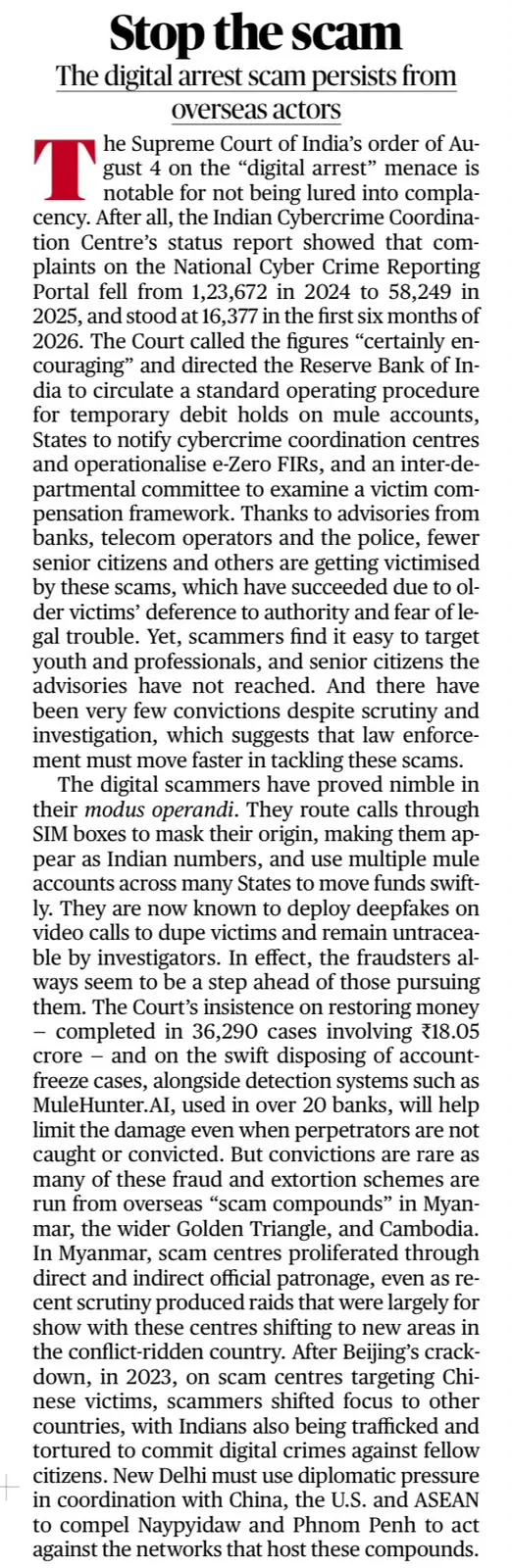
In In Re: Victims of Digital Arrest Related to Forged Documents, the Supreme Court directed the Union and States to create a coordinated institutional framework against digital arrest scams.

The focus is on preventive regulation, faster freezing of funds, victim protection and better inter-agency coordination.

Digital Arrest Scam

A digital arrest scam is a cyber fraud in which scammers impersonate police, investigation agencies or government officials.

They falsely accuse victims of crimes and keep them under pressure through video calls or phone calls.

Victims are then forced to transfer money to so-called “safe accounts” or “verification accounts”.

Why the Issue Is Serious

These scams often target senior citizens, professionals and vulnerable individuals.

Scammers use fear, fake legal documents, forged IDs and fake official language.

Many fraud networks operate through mule accounts, SIM boxes and cross-border scam compounds.

Supreme Court Directions

Financial Safeguards

The Court directed the Reserve Bank of India to frame a Standard Operating Procedure for immediate freezing of suspected mule accounts.

It also called for a mechanism for speedy recovery and restitution of money lost by victims.

Institutional Coordination

States were directed to operationalise electronic Zero FIRs for quick registration of cyber fraud cases.

The Court also called for stronger coordination among:

  • Ministry of Home Affairs
  • Indian Cyber Crime Coordination Centre
  • Department of Telecommunications
  • Reserve Bank of India
  • Banks
  • Law-enforcement agencies

Significance of the Judgment

Preventive Governance

The judgment shifts cyber fraud response from a purely reactive investigation model to a preventive management framework.

The idea is to intervene before the money is fully siphoned off.

Victim-Centric Justice

The judgment gives importance to recovery of victims’ money and compensation.

It does not limit the response only to criminal prosecution.

Institutional Accountability

The Court recognises cyber fraud as a whole-of-government challenge.

It clearly assigns responsibility to regulators, banks, telecom operators and enforcement agencies.

Way Forward

India should deploy AI-based fraud detection systems.

Real-time transaction monitoring must be strengthened.

KYC verification should be improved.

Cross-border cooperation is needed because several scam networks operate from outside India.

Conviction rates must improve.

Cyber awareness campaigns should be expanded, especially for senior citizens and first-time digital users.

Key Takeaway

Digital arrest scams show that cybercrime is no longer only a policing issue. India needs preventive regulation, faster fund freezing, coordinated institutions and victim-centric justice.

Digital Arrest Scam Supreme Court

Section 85 BNS Live-in Relationships: SC Expands Protection

Context: Section 85 BNS Live-in Relationships
In X v. State of Karnataka, 2026, the Supreme Court held that the offence of cruelty by husband or his relatives under Section 85 of the Bharatiya Nyaya Sanhita, 2023 can extend to women in live-in relationships that are in the nature of marriage.

However, this protection applies only when the relationship satisfies judicial tests laid down by the Court.

Earlier Legal Position

Section 85 of the Bharatiya Nyaya Sanhita, 2023 is the successor to Section 498A of the Indian Penal Code.

Traditionally, this provision was invoked in legally recognised marriages.

Women in live-in relationships mainly relied on the Protection of Women from Domestic Violence Act, 2005, which provides civil remedies.

What Did the Supreme Court Hold?

The Court said Section 85 must receive a purposive interpretation.

The purpose of the law is to punish domestic cruelty, not merely to protect formally valid marriages.

A person cannot escape criminal liability by claiming that the marriage was void, voidable or never legally solemnised after inducing a woman into a marriage-like relationship.

However, criminal protection is not available to all live-in relationships.

It applies only to relationships in the nature of marriage.

Conditions for Protection

The relationship must show:

  • Relationship in the nature of marriage
  • Intent to marry
  • Long-term cohabitation
  • Shared domestic life

This ensures that genuine marriage-like relationships are protected while preventing misuse.

Protection of Women from Domestic Violence Act, 2005

The Domestic Violence Act is a civil legislation.

It protects women from domestic violence in both marital and marriage-like relationships.

It provides:

  • Protection orders
  • Residence rights
  • Monetary relief
  • Custody-related relief
  • Compensation

What Is New in This Judgment?

The judgment clarifies that relief under the Domestic Violence Act cannot replace criminal prosecution under Section 85 of the BNS.

It extends criminal-law protection against domestic cruelty to eligible live-in relationships.

It bridges the gap between civil remedies and criminal liability.

It also aligns criminal law with changing family structures while limiting protection to genuine marriage-like relationships.

Key Takeaway

The judgment expands protection for women facing domestic cruelty in genuine marriage-like live-in relationships, while carefully restricting it to relationships that satisfy judicial tests.

School Consolidation Policy India: Access and Quality Balance

Context: School Consolidation Policy India
With declining fertility, changing demographics and falling student enrolment, several States are consolidating under-enrolled government schools into larger, better-equipped institutions.

The challenge is to improve education quality and public resource efficiency without reducing access for rural, tribal and disadvantaged children.

What Is School Consolidation?

School consolidation means merging or rationalising under-enrolled schools into larger and better-equipped schools.

The aim is to improve the use of:

  • Teachers
  • Infrastructure
  • Financial resources
  • Learning facilities

It seeks to improve quality of education by giving students access to better academic and physical resources.

Need for School Consolidation

Declining Enrolment

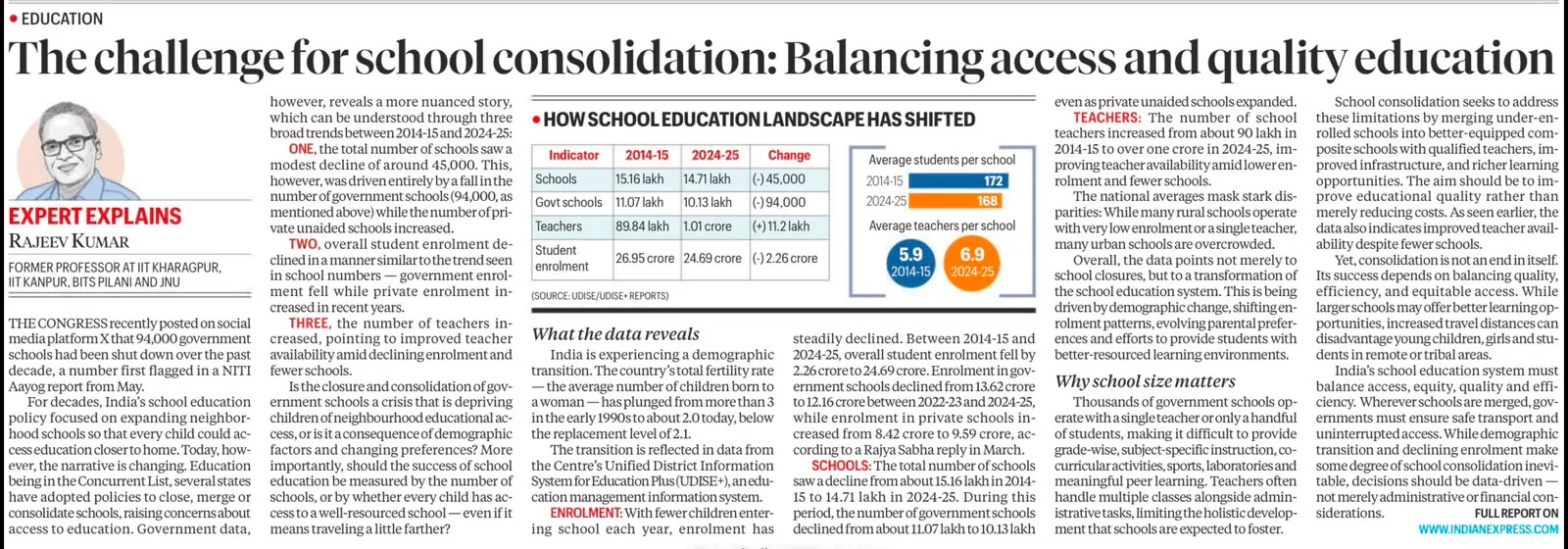
Student enrolment declined from 26.95 crore in 2014–15 to 24.69 crore in 2024–25.

This reflects demographic transition and falling fertility.

Under-Utilised Government Schools

Government schools declined from 11.07 lakh to 10.13 lakh.

The average number of students per school fell from 172 to 168.

Teacher Deployment

Teachers increased from 89.84 lakh to 1.01 crore.

This means better teacher deployment and infrastructure use have become important policy questions.

The data comes from UDISE+ 2024–25, Department of School Education and Literacy, Ministry of Education.

Benefits

School consolidation can improve learning outcomes by giving students better access to:

  • Subject teachers
  • Laboratories
  • Libraries
  • ICT facilities
  • Better infrastructure

It can optimise public expenditure and reduce duplication of infrastructure.

It also supports the National Education Policy, 2020, which promotes multidisciplinary and holistic education.

Challenges

Accessibility

Longer travel distances may affect girls, tribal children and students in remote areas.

This raises concerns under Article 14 and Article 21A.

Dropout Risk

Poor transport can increase absenteeism and dropout.

This can affect progress towards Sustainable Development Goal 4, which focuses on quality education.

Regional Disparities

Uniform consolidation may not work in geographically difficult or sparsely populated regions.

Mountain, tribal, desert and remote regions may require special treatment.

Way Forward

School consolidation must be done through careful local mapping.

States should ensure transport, hostels or residential support where needed.

No child should lose access because a nearby school was merged.

Consolidation should focus on quality, not just cost-cutting.

Local communities, parents and teachers should be consulted.

Key Takeaway

School consolidation can improve education quality, but only if access is protected. Efficiency must not come at the cost of equity.

Beijing Model of Innovation and India’s Deep-Tech Lessons

Context: Beijing Model of Innovation
China’s Beijing Model of Innovation integrates universities, industry, start-ups and the State to bridge the Valley of Death between research and commercialisation.

This model has helped China make rapid progress in Artificial Intelligence, robotics and other frontier technologies.

What Is the Valley of Death?

The Valley of Death refers to the gap between laboratory research and commercial use.

Many research ideas remain stuck in universities because they do not receive funding, industry support, technology transfer or market access.

The Beijing Model tries to solve this problem through coordinated innovation ecosystems.

Beijing Model of Innovation

Innovation Clusters

Research universities, incubators, industries and technology parks function together as an integrated ecosystem.

Important examples include:

  • Zhongguancun
  • Yizhuang

These clusters connect researchers, start-ups, investors and manufacturing networks.

Technology Commercialisation

Dedicated technology managers and incubators help convert laboratory research into market-ready products.

This reduces the gap between academic research and industrial application.

State-Backed Patient Capital

The government provides long-term funding, industrial infrastructure, tax incentives and support that complements venture capital.

This is especially important for deep-tech sectors where returns take longer.

Mission-Oriented Strategy

China focuses on strategic sectors such as:

  • Artificial Intelligence
  • Semiconductors
  • Humanoid robotics
  • Frontier technologies

This makes innovation closely linked with industrial policy and national strategy.

Outcomes

Beijing’s technology transfer platform executed 1.04 lakh technology contracts in 2025.

China entered the top 10 of the Global Innovation Index 2025, ranking 10th globally.

The model has helped China scale Artificial Intelligence and humanoid robotics through integrated domestic supply chains.

Lessons for India

India should strengthen industry-academia collaboration through Technology Transfer Offices and research parks.

Public investment in Research and Development should be increased.

India needs patient capital for deep-tech sectors.

Innovation clusters should be developed around institutions such as:

  • IITs
  • IISc
  • Major research universities
  • Start-up ecosystems

India should shift policy focus from only research publications to:

  • Commercialisation
  • Patents
  • Deep-tech manufacturing
  • Scalable innovation

Key Data

Global Innovation Index 2025:
China — 10th
India — 38th

Top innovation clusters:
China — 24
India — 4

Key Takeaway

The Beijing Model shows that innovation succeeds when universities, industry, start-ups and the State work together. For India, the next step is to move from research output to commercialisation and deep-tech manufacturing.

Copyright © 2026 USARAMBHA EDUCATION (UnderStand UPSC). All Rights Reserved.

Inquiry form for
Takshila Residential Program