19 June 2026 | Daily Current Affairs

Women Political Representation in India: ADR Data 2026

Context: Women Political Representation in India
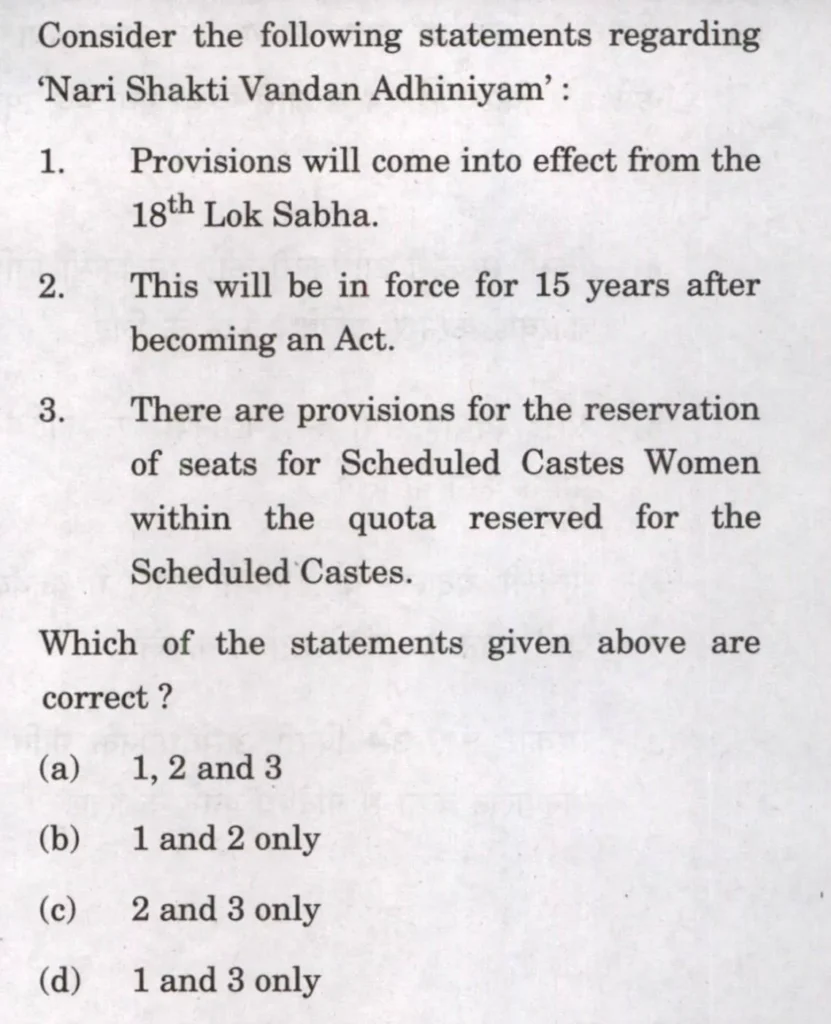
An analysis by the Association for Democratic Reforms found that women’s participation in electoral politics remains significantly low despite the enactment of the Nari Shakti Vandan Adhiniyam, 2023, highlighting the gap between constitutional commitment and actual political representation.

Nari Shakti Vandan Adhiniyam, 2023

Also known as the 106th Constitutional Amendment Act.

Key Provisions

Provides 33% reservation for women in:

  • Lok Sabha
  • State Legislative Assemblies
  • Delhi Legislative Assembly

Reservation Within Reservation

  • Includes reservation for SC/ST women within existing SC/ST reserved seats.

Important Articles Added

Article 330A

  • Reservation of seats for women in Lok Sabha.

Article 332A

  • Reservation of seats for women in State Legislative Assemblies.

Article 334A

  • Implementation, rotation and duration of reservation.

Implementation

  • Will be implemented after the first Census conducted after the Act.
  • Implementation will happen after the subsequent delimitation exercise.

Duration

  • Reservation will operate for 15 years.
  • It can be extended by Parliament.

Not Applicable To

Mains Value Addition

ADR Data

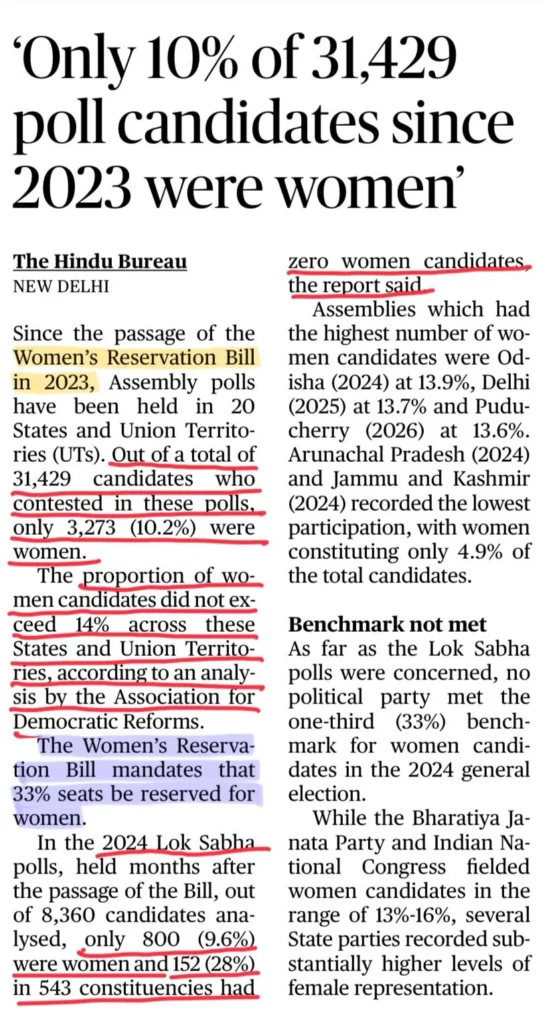
  • Women constituted only 10.2% of candidates, meaning 3,273 out of 31,429 candidates, in elections held after the enactment of the Act.
  • In the 2024 Lok Sabha election, women constituted only 9.6% of total candidates.
  • 152 Lok Sabha constituencies, around 28%, had no woman candidate.

Major Party Data

Major parties remained far below the 33% benchmark:

  • INC: around 14% women candidates
  • BJP: around 13% women candidates

Women in 18th Lok Sabha

  • 74 women MPs
  • 13.6% representation
  • Highest-ever in absolute numbers

Broader Concern

  • Women constitute nearly 50% of India’s population.
  • But parliamentary representation remains below 15%.

Global Gender Gap Report 2025

  • Overall Rank: 129 out of 146
  • Political Empowerment Rank: 48 out of 146

Grassroots Women’s Reservation

Women’s reservation already exists at the grassroots level.

Article 243D

  • Panchayats

Article 243T

Important Fact

  • Constitutional minimum is 33% reservation.
  • Many States provide 50% reservation.
  • More than 14 lakh elected women representatives serve in Panchayati Raj Institutions.
Section 69A IT Act: Content Blocking and Digital Rights

Context: Section 69A IT Act
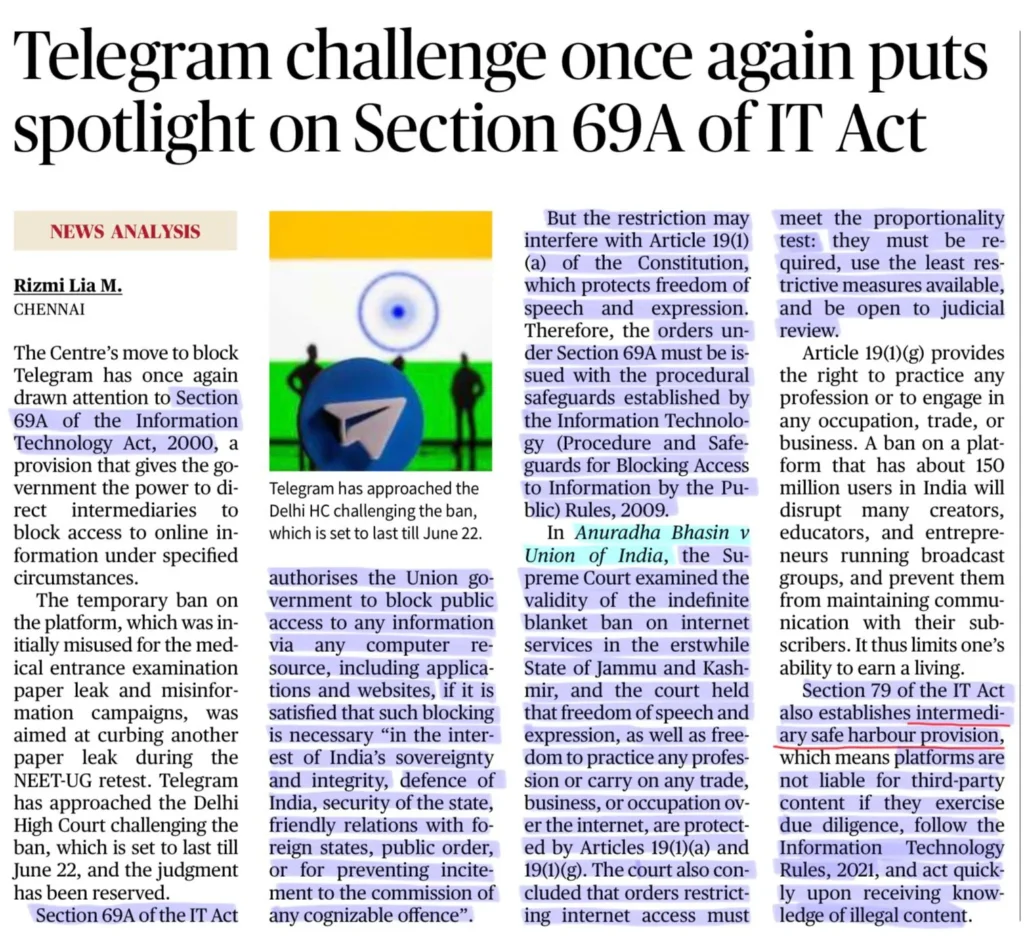
The Centre’s action against Telegram over the NEET paper leak and misinformation has revived the debate on balancing national security and public order with digital rights and freedom of expression.

Section 69A, Information Technology Act, 2000

Section 69A allows the Central Government to block online content on specific grounds.

Grounds for Blocking

  • Sovereignty and integrity of India
  • Defence of India
  • Security of the State
  • Friendly relations with foreign States
  • Public order
  • Incitement to cognizable offence

Rights Involved

Article 19(1)(a)

  • Freedom of speech and expression

Article 19(1)(g)

  • Freedom to practise any profession, occupation, trade or business

Section 79: Safe Harbour Protection

Section 79 provides safe harbour protection to intermediaries.

This means intermediaries are not liable for third-party content if they follow due diligence.

Due Diligence Includes

  • Appointment of grievance officer
  • Compliance with legal orders
  • Cooperation with law enforcement agencies
  • Following Information Technology Rules

Important Supreme Court Judgments

Shreya Singhal v. Union of India, 2015

  • Supreme Court upheld Section 69A.
  • Supreme Court struck down Section 66A.

Anuradha Bhasin v. Union of India, 2020

  • Restrictions on internet access must be:
    • Necessary
    • Proportionate
    • Least restrictive

Key Governance Issue

The core issue is how to regulate digital platforms without creating excessive censorship.

Mains Significance

This topic can be used in answers on:

  • Digital governance
  • Freedom of speech
  • Platform regulation
  • National security
  • Public order
  • Intermediary liability
  • Proportionality doctrine
  • Internet shutdowns and content blocking

NRE FCNR Deposit Rules: RBI Removes Interest Caps

Context: NRE FCNR Deposit Rules
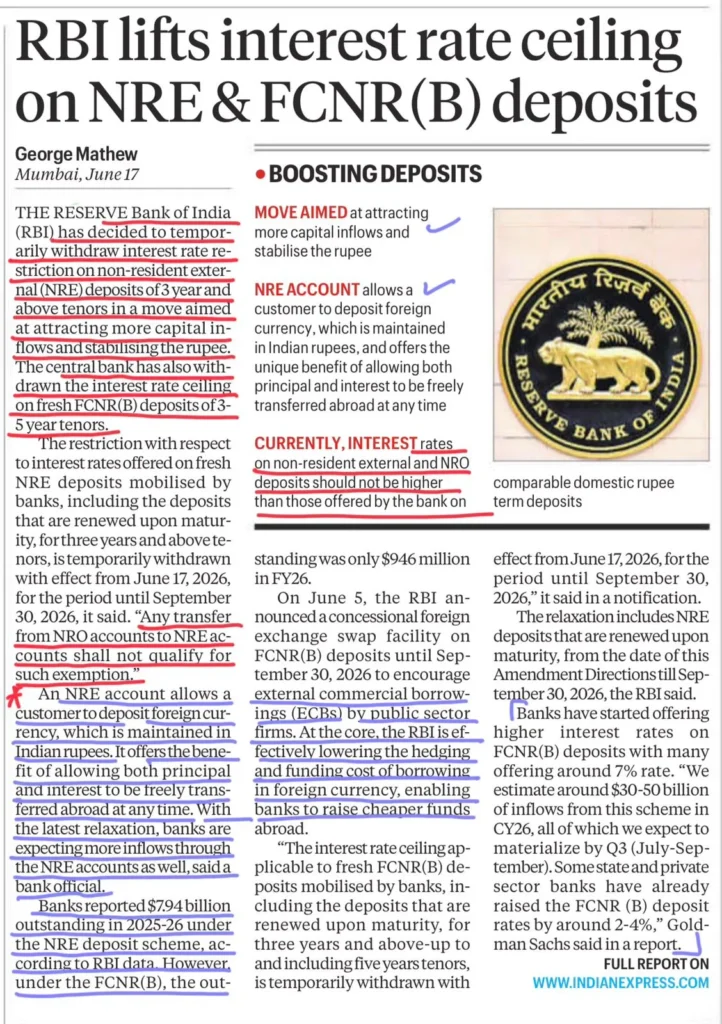
RBI has relaxed interest rate regulations on select NRI deposits to attract higher foreign currency inflows, strengthen forex reserves and improve external sector stability.

NRI Deposit Accounts

Non-Resident External Account

NRE Account

  • Foreign currency deposited by an NRI is converted into Indian Rupees.
  • Fully repatriable.
  • Exchange rate risk is borne by the depositor.

Foreign Currency Non-Resident Bank Account

FCNR(B) Account

  • Deposit is maintained in foreign currency itself.
  • Currencies include USD, Euro, GBP, Yen and others.
  • Fully repatriable.
  • No exchange rate risk for depositor.

Non-Resident Ordinary Account

NRO Account

  • Used for income earned in India.
  • Examples: rent, pension, dividend.
  • Maintained in Indian Rupees.
  • Repatriation is subject to prescribed conditions.

Prelims Fact

  • FCNR(A) was discontinued in 1993.
  • Only FCNR(B) is operational.

RBI Relaxation and BoP Linkage

Earlier

NRE Deposits

  • Interest rates were linked to comparable domestic term deposit rates.

FCNR(B) Deposits

  • Interest rates were capped with reference to international benchmark rates such as SOFR and related benchmarks plus a prescribed spread.

Now, Till 30 September 2026

  • Interest rate ceiling removed on NRE deposits of 3 years and above.
  • Interest rate ceiling removed on FCNR(B) deposits of 3–5 years.

Significance

  • Higher NRI deposit mobilisation.
  • Greater foreign exchange inflows.
  • Stronger forex reserves.
  • Improved external sector stability.
  • Helps manage Balance of Payments pressure.

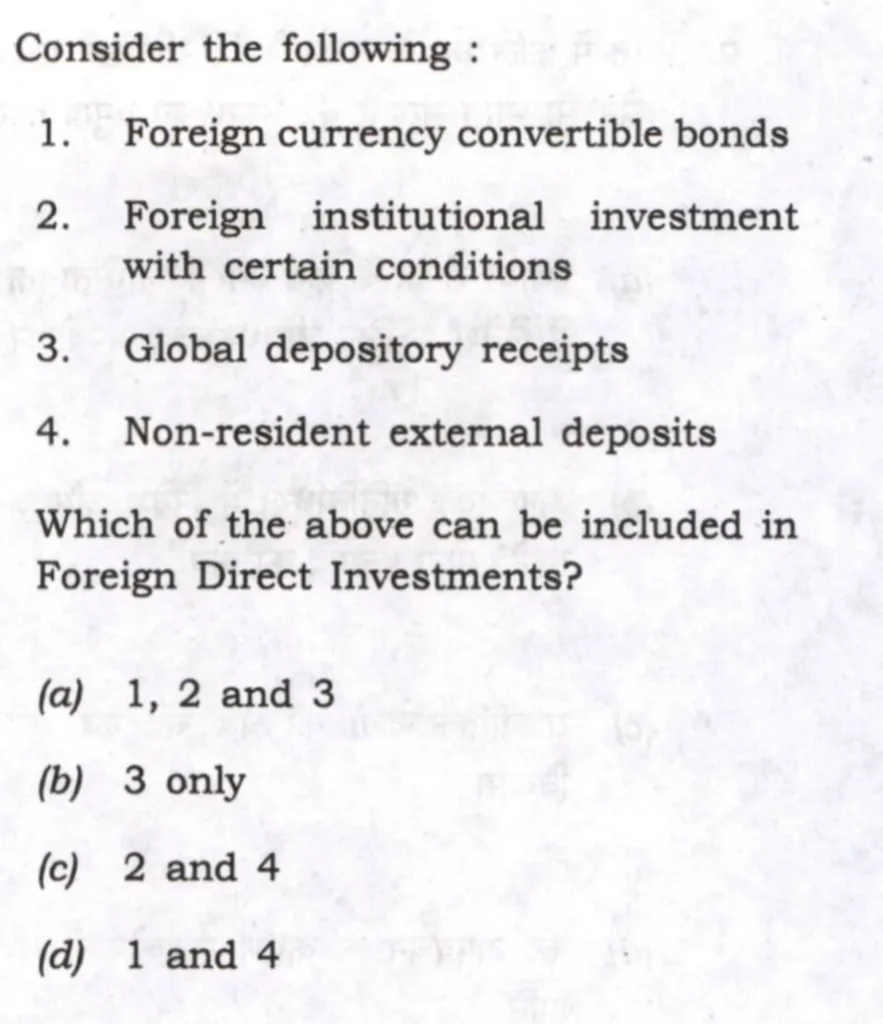
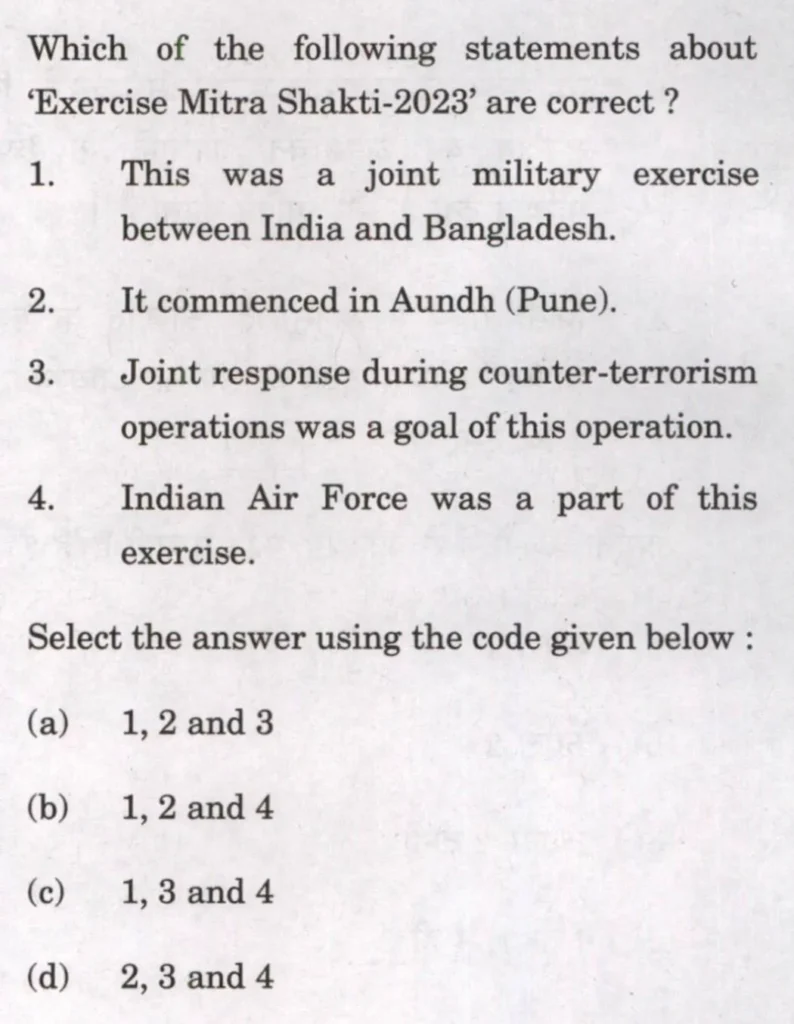
PYQ Link

Non-Resident External deposits are not Foreign Direct Investment.

Exercise KHAAN QUEST 2026: India Joins Mongolia Drill

Context: Exercise KHAAN QUEST 2026
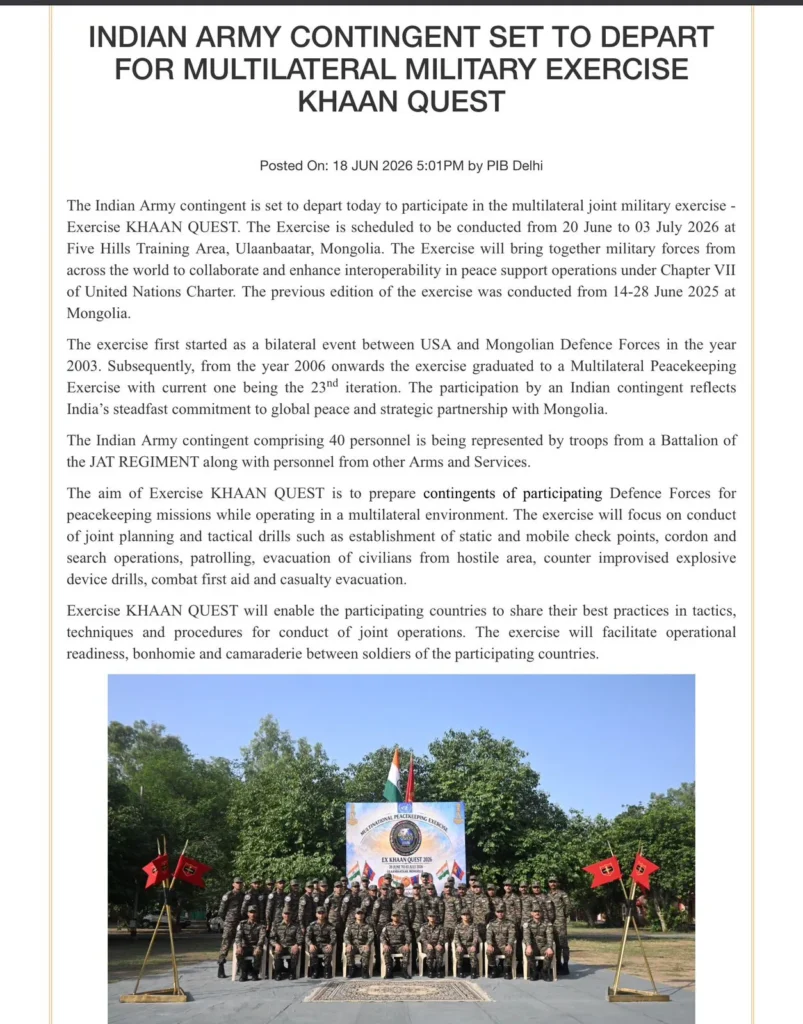
Indian Army contingent will participate in Exercise KHAAN QUEST 2026 from 20 June to 3 July 2026 at Five Hills Training Area, Ulaanbaatar, Mongolia.

KHAAN QUEST

Host

  • Mongolia

Location

  • Five Hills Training Area, Ulaanbaatar

Evolution

  • Started in 2003 as a USA–Mongolia bilateral exercise.
  • Became a multilateral exercise in 2006.
  • 2026 edition is the 23rd edition.

Nature

  • Multilateral military exercise.
  • Conducted under UN Peace Support Operations.
  • Linked to Chapter VII of the UN Charter.

India’s Participation

  • 40 Army personnel.
  • Primarily from the JAT Regiment.

Objective

The exercise aims to improve:

  • Peacekeeping skills
  • Interoperability
  • Tactical drills
  • Multinational coordination
  • UN peace support capabilities

Importance for India

  • Strengthens India’s role in UN peacekeeping.
  • Enhances military cooperation with Mongolia and other participating nations.
  • Improves operational readiness in multinational environments.
  • Supports India’s defence diplomacy.

Aqueous Zinc-Ion Batteries: New Electrolyte Innovation

Context: Aqueous Zinc-Ion Batteries
Scientists at the Institute of Nano Science and Technology, Mohali developed a new electrolyte additive, BDIM, that enhances the performance of Aqueous Zinc-Ion Batteries, making them safer, cheaper and more durable for large-scale energy storage.

Battery Basics

A battery consists of:

  • Anode
  • Cathode
  • Electrolyte

Anode

Cathode

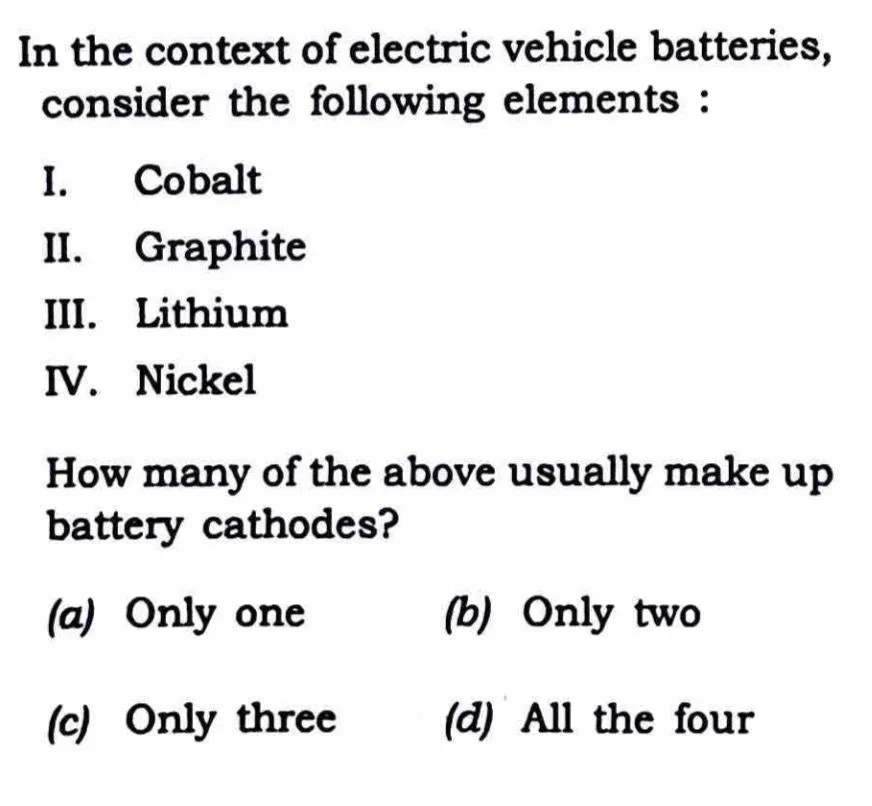
  • Positive electrode.
  • Receives electrons.
  • Commonly contains lithium, cobalt and nickel compounds.

Electrolyte

  • Medium through which ions move between electrodes.

Aqueous Zinc-Ion Battery

Aqueous Zinc-Ion Battery consists of:

  • Zinc anode
  • Water-based electrolyte

Why AZIBs Matter

They are:

  • Safer than conventional lithium-ion batteries.
  • Cheaper.
  • More suitable for large-scale energy storage.
  • Useful for renewable energy integration.

Main Challenge

Aqueous Zinc-Ion Batteries face problems such as:

  • Zinc dendrites
  • Corrosion
  • Hydrogen evolution

These reduce battery life and performance.

Innovation

BDIM additive forms a protective layer on zinc.

This helps suppress unwanted side reactions.

Significance

  • Longer battery life.
  • Improved safety.
  • Lower cost.
  • Renewable energy storage.
  • Grid-scale storage.
  • Supports clean energy transition.

PYQ Linkages

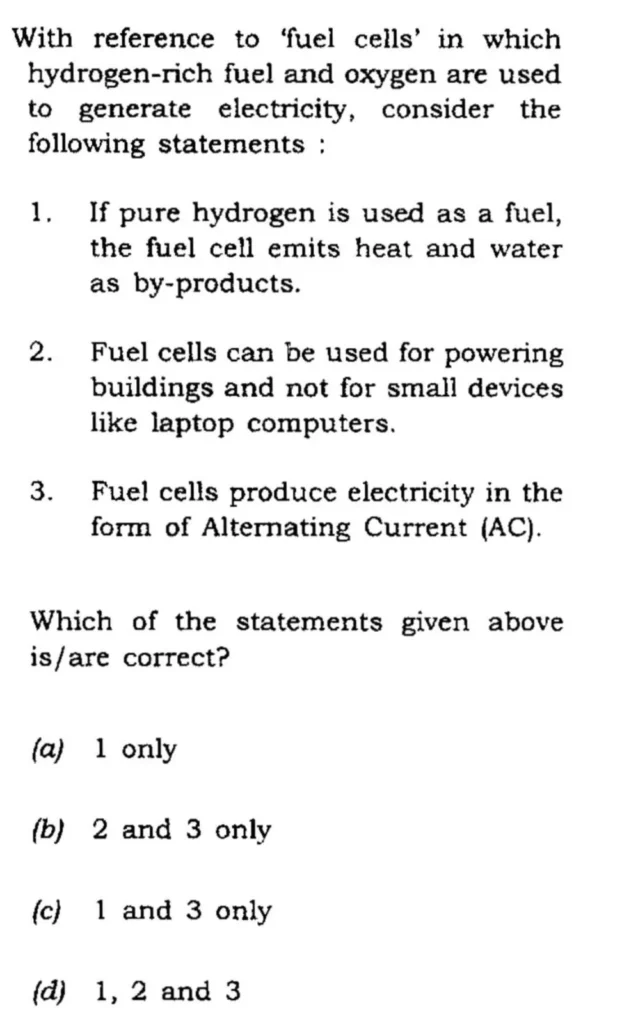
Fuel Cell vs Battery

Battery

  • Stores chemical energy internally.
  • Requires recharging or replacement after depletion.

Fuel Cell

  • Does not store energy.
  • Continuously generates electricity as long as fuel, such as hydrogen, is supplied.

Hydrogen Fuel Cell Output

  • Electricity
  • Water
  • Heat

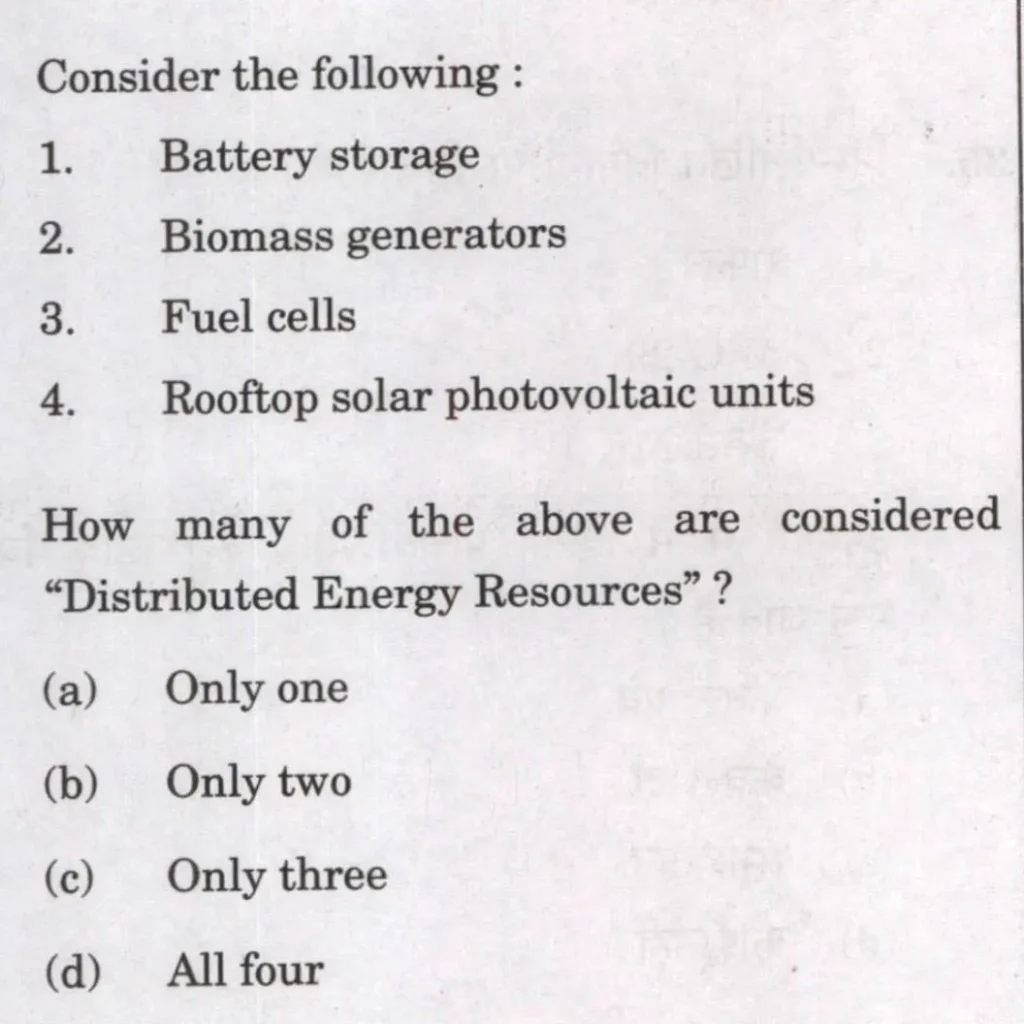
Distributed Energy Resources

Distributed Energy Resources are decentralised energy generation or storage systems located near consumers.

They reduce dependence on large centralised power plants.

Examples of DERs

  • Rooftop Solar PV
  • Battery Energy Storage Systems
  • Fuel Cells
  • Small Wind Turbines
  • Biomass Generators
About the UPSC Civil Services Examination (UPSC CSE)

The UPSC Civil Services Examination (CSE) is one of the most competitive and esteemed examinations in India, conducted by the Union Public Service Commission to recruit officers for services such as the Indian Administrative Service (IAS), Indian Police Service (IPS), Indian Foreign Service (IFS), and others. The exam comprises three stages — Prelims, Mains, and the Personality Test (Interview) — designed to test a candidate’s knowledge, aptitude, decision-making, and leadership skills.


How to Prepare Effectively for UPSC CSE

Cracking the UPSC CSE requires a deep understanding of the syllabus, consistent revision, structured answer writing, and smart test-taking strategies. The Prelims test analytical and conceptual clarity, the Mains focuses on critical thinking, articulation, and subject mastery, while the Interview assesses presence of mind, ethical judgment, and personality traits relevant to public service.

At UnderStand UPSC, we empower aspirants with a personalized and focused approach to each stage of the exam.


Why Choose UnderStand UPSC?

UnderStand UPSC is a mentorship-driven platform offering a clear, clutter-free strategy to tackle the Civil Services Examination. Our programs like Transform (for beginners and intermediate learners) and Conquer (for advanced mains preparation) provide structured study plans, syllabus-wise video content, interactive live sessions, and answer writing support.

We emphasize:

  • Concept clarity through topic-wise lectures

  • Test series designed around real UPSC standards

  • Personalized mentorship in small groups

  • Regular performance tracking and peer benchmarking

  • Doubt-clearing sessions, current affairs analysis, and monthly magazines


Join the UnderStand UPSC Learning Community

Our mission is to make UPSC preparation less overwhelming and more strategic. We combine mentorship, discipline, and academic rigor to help you clear CSE with confidence. Whether you’re preparing from Delhi, Mumbai, Bangalore, or a remote village — our online-first model ensures quality guidance reaches every corner of India.

Join the thousands of aspirants who trust UnderStand UPSC to guide their journey toward becoming civil servants.

Stay connected with us through our Telegram, YouTube, and Instagram channels for daily tips, strategies, and updates.

Copyright © 2026 USARAMBHA EDUCATION (UnderStand UPSC). All Rights Reserved.

Fill out the form

If you have any queries related to
Conquer 2026 & CAD 2026.