11 July 2026 | Daily Current Affairs

Ken Betwa River Linking Project: Tribal Protests Explained

Context: Ken Betwa River Linking Project
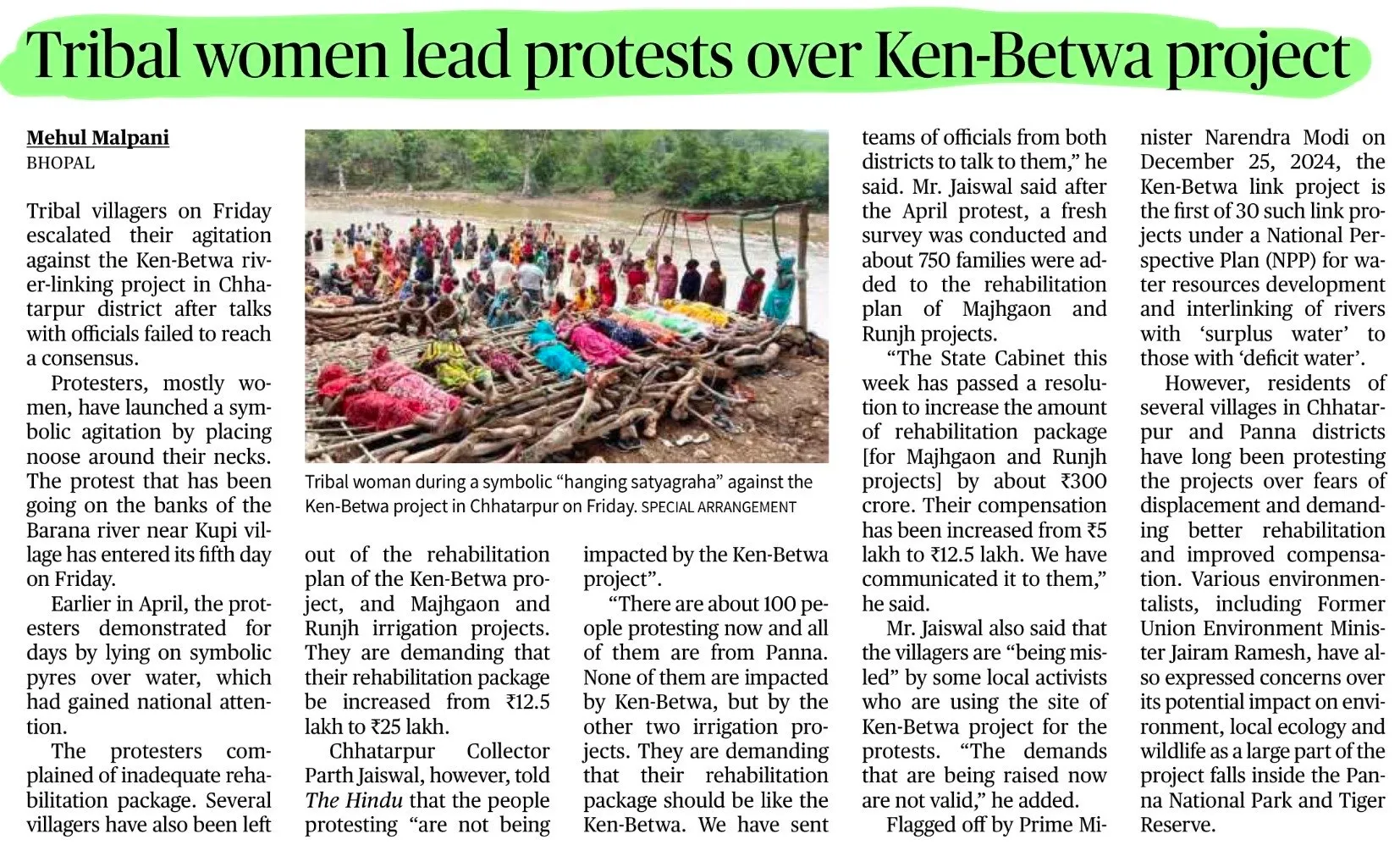
Tribal communities in Madhya Pradesh have renewed protests over the Ken–Betwa River Linking Project, demanding better rehabilitation and compensation for project-affected families.

Ken–Betwa River Linking Project

About

  • Approved by the Union Cabinet in 2021.
  • India’s first river interlinking project under the National Perspective Plan.
  • Implemented in Madhya Pradesh and Uttar Pradesh.

Objective

The project aims to transfer water from the Ken River to the Betwa River.

It is intended to improve:

  • Irrigation
  • Drinking water supply
  • Hydropower generation

especially in the drought-prone Bundelkhand region.

Key Components

  • Daudhan Dam on the Ken River.
  • Ken–Betwa Link Canal.
  • Associated irrigation infrastructure.

Key Concerns

1. Displacement

Affected tribal families are demanding better rehabilitation and compensation.

2. Rehabilitation

Local communities argue that rehabilitation should be fair, timely and adequate.

3. Environmental Impact

The project may affect:

  • Panna Tiger Reserve
  • Forest ecosystem
  • Wildlife habitats
  • River ecology

4. Governance Concern

Large infrastructure projects must balance development with:

  • Environmental protection
  • Tribal rights
  • Livelihood security
  • Social justice

Significance

This topic can be used in answers on:

  • River interlinking
  • Water security
  • Environmental governance
  • Tribal rights
  • Rehabilitation and resettlement
  • Sustainable development
  • Human-wildlife conflict

Key Takeaway

The Ken–Betwa project shows the classic development dilemma: water security and infrastructure benefits must be balanced with ecological protection and justice for displaced communities.
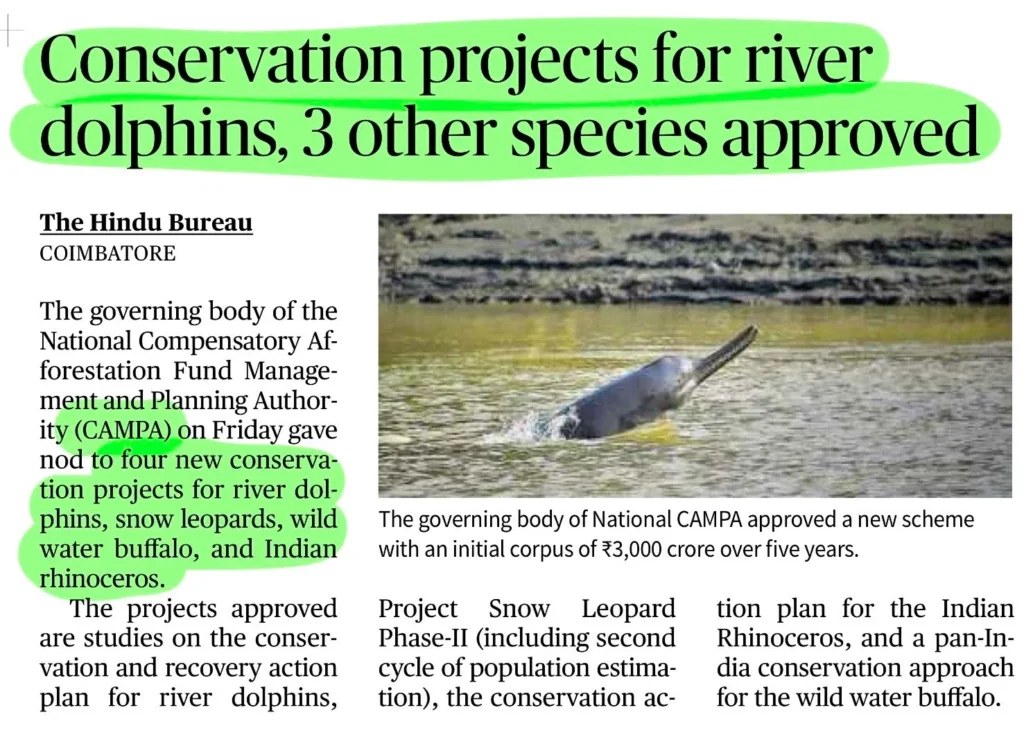
CAMPA Wildlife Conservation Projects for UPSC Notes

Context: CAMPA Wildlife Conservation Projects
The National Compensatory Afforestation Fund Management and Planning Authority approved ₹3,000 crore for 2025–30 for conservation of four species:

The focus will be on habitat restoration and species recovery.

CAMPA

Full Form

  • Compensatory Afforestation Fund Management and Planning Authority

Legal Basis

  • Compensatory Afforestation Fund Act, 2016

Ministry

  • Ministry of Environment, Forest and Climate Change

Function

CAMPA utilises funds collected for diversion of forest land towards:

  • Compensatory afforestation
  • Habitat restoration
  • Wildlife conservation
  • Forest ecosystem improvement

Species Covered

1. Ganges River Dolphin

Status

  • National Aquatic Animal

IUCN

  • Endangered

Wildlife Protection Act, 1972

  • Schedule I

Habitat

  • Ganga–Brahmaputra river system

2. Snow Leopard

IUCN

  • Vulnerable

Wildlife Protection Act, 1972

  • Schedule I

Habitat

Trans-Himalayan region including:

  • Ladakh
  • Jammu & Kashmir
  • Himachal Pradesh
  • Uttarakhand
  • Sikkim
  • Arunachal Pradesh

3. Greater One-horned Rhinoceros

IUCN

  • Vulnerable

Wildlife Protection Act, 1972

  • Schedule I

Habitat

Found mainly in:

  • Assam
  • West Bengal
  • Dudhwa National Park, Uttar Pradesh

4. Wild Water Buffalo

IUCN

  • Endangered

Wildlife Protection Act, 1972

  • Schedule I

Habitat

Mainly found in:

  • Assam

Smaller populations are also found in:

  • Chhattisgarh
  • Arunachal Pradesh

Significance

  • Supports species-specific conservation.
  • Improves habitat restoration.
  • Strengthens India’s biodiversity protection.
  • Uses compensatory afforestation funds for ecological recovery.
  • Supports endangered and vulnerable species.
  • Encourages landscape-level conservation.

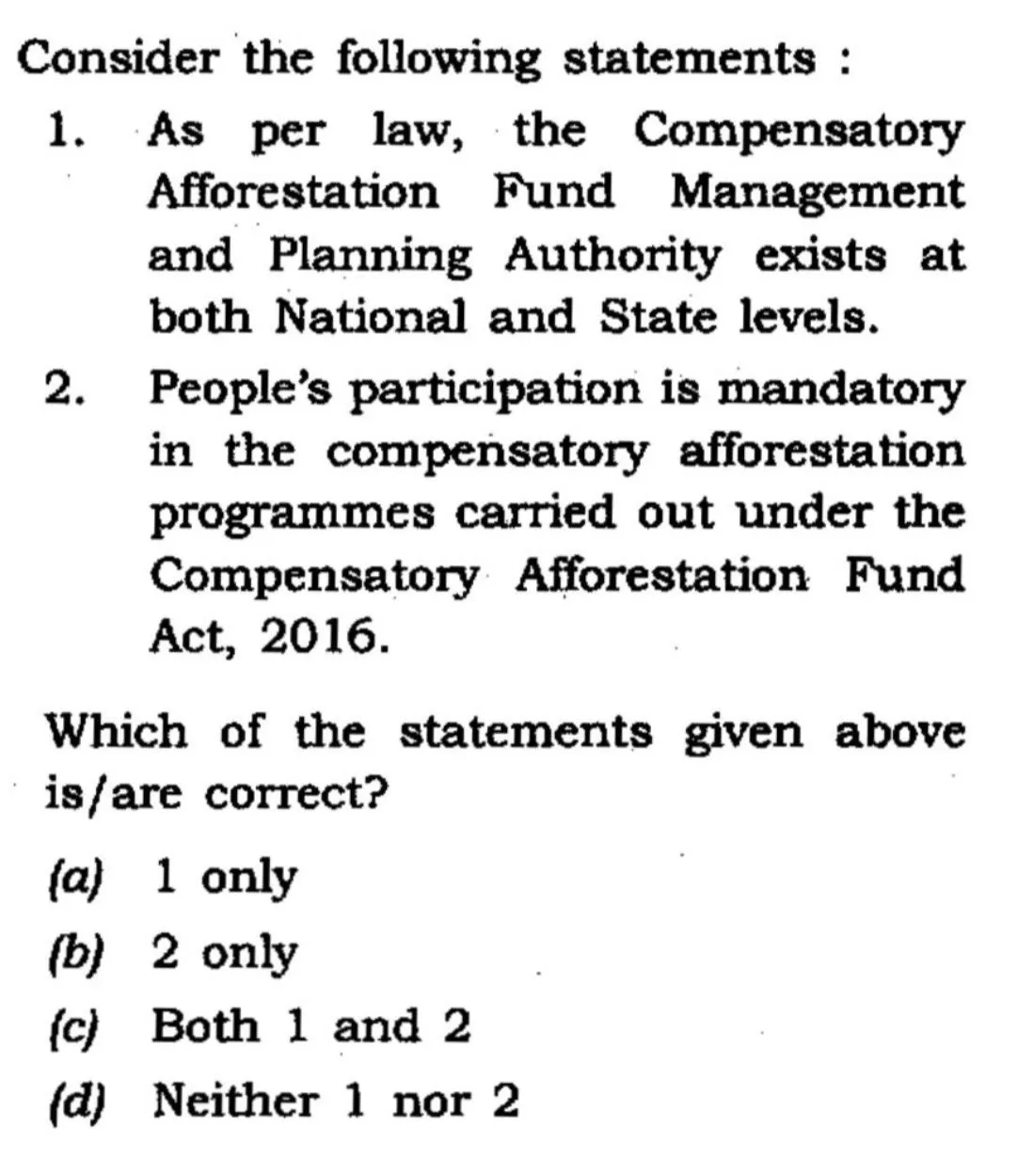
PYQ Link

CAMPA exists at both National and State levels under the CAF Act, 2016.

Emerging Global Terrorism Threats for UPSC Explained

Context: Emerging Global Terrorism Threats
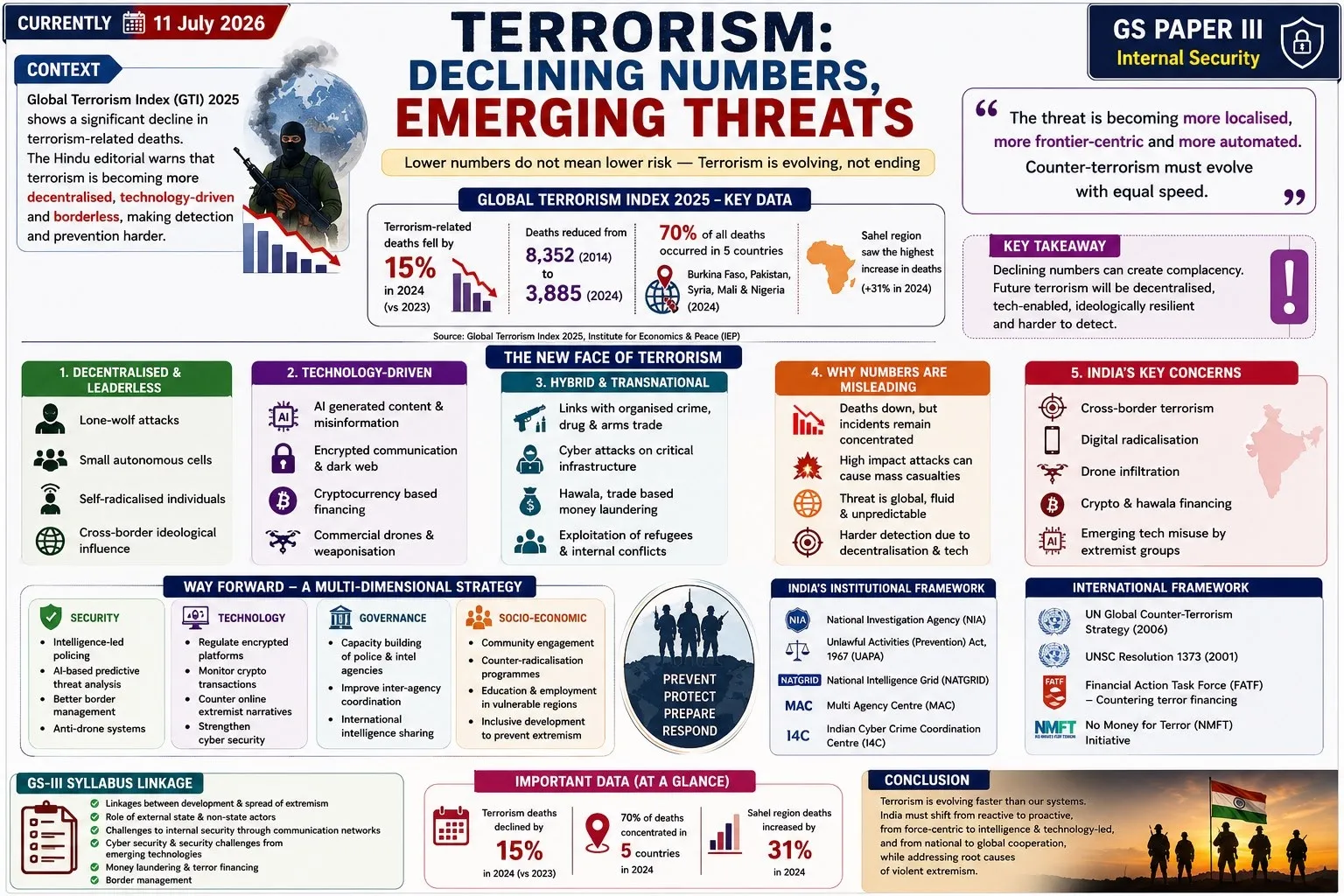
The article argues that although global terrorism-related deaths may be declining in official datasets, emerging threats are becoming harder to detect because terrorism is becoming more decentralised, technology-driven and borderless.

Core Issue

Lower terrorism numbers do not necessarily mean lower risk.

Terrorism is evolving into new forms that are:

  • Decentralised
  • Localised
  • Technology-enabled
  • Harder to track
  • More unpredictable

Emerging Trends in Terrorism

1. Decentralised Terror Networks

Terror groups increasingly rely on:

  • Lone-wolf attackers
  • Small autonomous cells
  • Local radicalisation
  • Online ideological networks

2. Technology-Driven Terrorism

Terrorists are using:

  • Encrypted communication
  • Drones
  • AI-generated propaganda
  • Cryptocurrency
  • Dark web platforms
  • Cyber tools

3. Online Radicalisation

Social media and encrypted platforms can accelerate:

  • Recruitment
  • Propaganda
  • Ideological indoctrination
  • Fundraising

4. Grey-Zone Threats

Terrorism is increasingly linked with:

  • Organised crime
  • Drug trafficking
  • Cybercrime
  • Money laundering
  • Cross-border networks

5. Data Blind Spots

Traditional terrorism databases may miss:

  • Small attacks
  • Online radicalisation
  • Failed plots
  • Cyber-linked terrorism
  • Lone-wolf mobilisation

Why Numbers Can Be Misleading

Deaths may fall, but terrorism risk can remain high because:

  • Attack methods are changing.
  • Radicalisation is harder to detect.
  • Digital recruitment is increasing.
  • Financing networks are becoming hidden.
  • Small attacks may not appear in global databases.
  • Threats may be geographically dispersed.

India’s Concerns

India faces risks from:

  • Cross-border terrorism
  • Digital radicalisation
  • Drone infiltration
  • Crypto-based terror financing
  • Emerging tech misuse by extremist groups
  • Hybrid warfare

Way Forward

1. Intelligence Modernisation

Use AI-enabled analysis while ensuring legal safeguards.

2. Cyber Monitoring

Strengthen tracking of dark web, encrypted platforms and online propaganda.

3. Financial Surveillance

Monitor:

  • Cryptocurrency channels
  • Hawala networks
  • Shell organisations
  • Suspicious digital transactions

4. Counter-Radicalisation

Promote:

  • Community engagement
  • Youth outreach
  • Education
  • Online counter-narratives

5. International Cooperation

Strengthen cooperation through:

  • FATF
  • UN counter-terror frameworks
  • Intelligence sharing
  • Regional security platforms

Key Takeaway

Terrorism is not disappearing. It is changing form. Counter-terrorism must evolve from only tracking deaths and attacks to detecting networks, digital footprints, financing and radicalisation pathways.

National CAMPA Governing Body Meeting UPSC Notes

Context: National CAMPA Governing Body Meeting
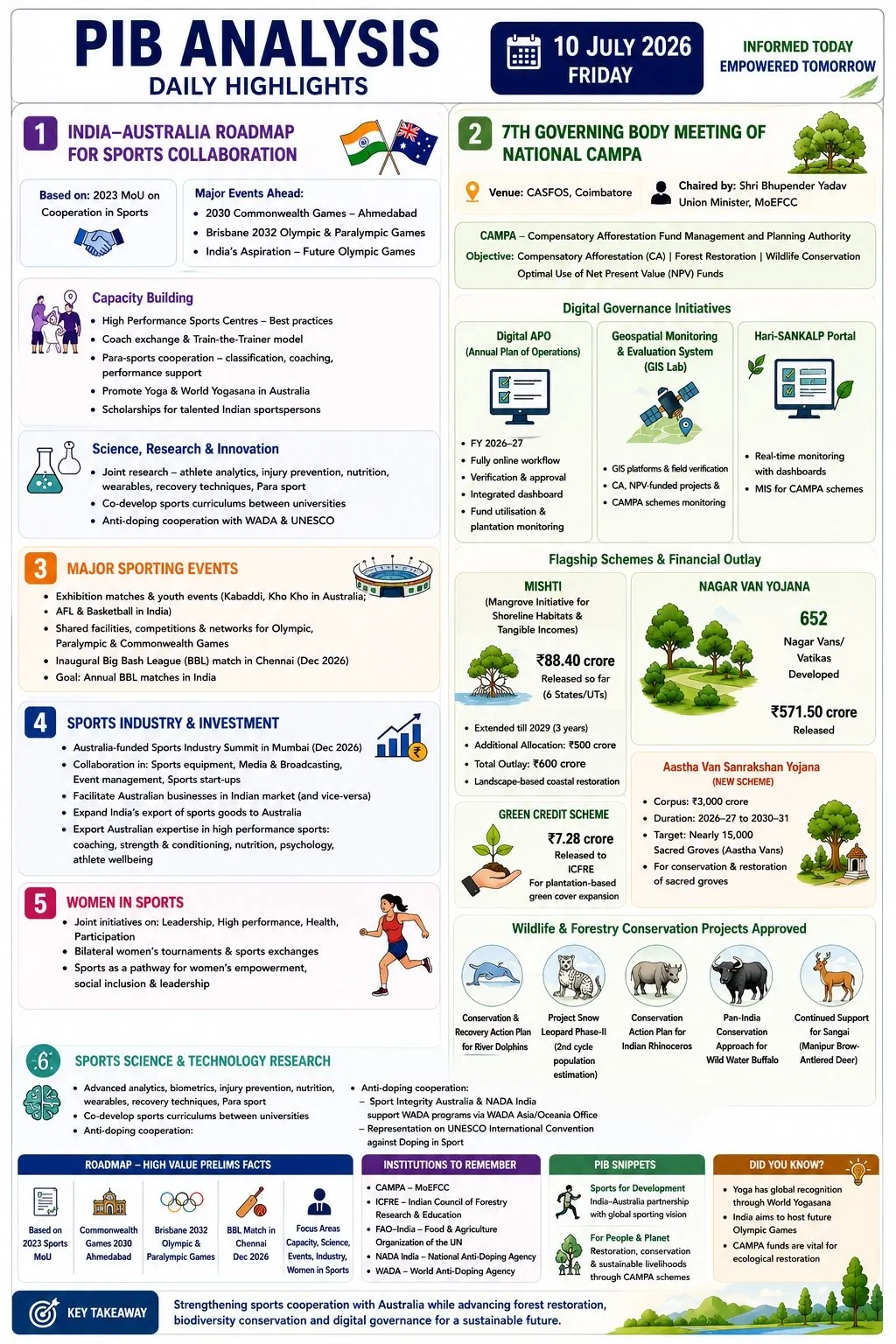
The 7th Governing Body Meeting of National CAMPA focused on forest restoration, compensatory afforestation, wildlife conservation and digital monitoring of CAMPA funds and projects.

CAMPA

Full Form

  • Compensatory Afforestation Fund Management and Planning Authority

Legal Basis

  • Compensatory Afforestation Fund Act, 2016

Ministry

  • Ministry of Environment, Forest and Climate Change

Objective

To manage funds collected when forest land is diverted for non-forest purposes.

These funds are used for:

  • Compensatory afforestation
  • Forest restoration
  • Wildlife conservation
  • Soil and moisture conservation
  • Ecosystem services improvement

Digital Governance Initiatives

1. e-Green Watch / Digital Monitoring

Used for tracking afforestation and forest conservation activities.

2. e-Sakshya / Evidence-Based Monitoring

Supports verification and transparency in project implementation.

3. Hariyali / CAMPA-linked Portals

Support real-time monitoring, data dashboards and fund utilisation tracking.

Major Schemes / Projects Highlighted

MISHTI

Mangrove Initiative for Shoreline Habitats and Tangible Incomes

Focuses on mangrove restoration and coastal ecosystem conservation.

Nagar Van Yojana

Promotes urban forests and green spaces.

Green Credit Scheme

Encourages plantation and environment-positive actions.

Wildlife and Forestry Conservation Projects

Approved projects include conservation support for:

Significance

  • Promotes ecological restoration.
  • Improves accountability in forest fund use.
  • Supports endangered species recovery.
  • Strengthens forest and biodiversity governance.
  • Uses technology for transparency and monitoring.
  • Links compensatory afforestation with larger ecosystem restoration.

Key Takeaway

CAMPA is not only about planting trees. It is also about restoring ecosystems, conserving wildlife and ensuring that forest diversion is compensated through accountable and measurable ecological action.

India Australia Sports Collaboration Roadmap UPSC

Context: India Australia Sports Collaboration Roadmap
India and Australia are strengthening sports cooperation through a roadmap focused on training, sports science, athlete development, major events, women in sports and sports industry partnerships.

Basis

The roadmap builds on India–Australia cooperation in sports and people-to-people relations.

Major Events Ahead

  • 2030 Commonwealth Games — Ahmedabad
  • 2032 Olympic and Paralympic Games — Brisbane
  • India’s aspiration for future Olympic Games

Key Areas of Cooperation

1. Capacity Building

Cooperation in:

  • High Performance Sports Centres
  • Coach exchange programmes
  • Train-the-trainer models
  • Para-sports cooperation
  • Classification support
  • Performance support

2. Sports Science and Innovation

Joint research in:

  • Athlete analytics
  • Injury prevention
  • Nutrition
  • Wearables
  • Recovery techniques
  • Sports technology
  • Anti-doping cooperation

3. Women in Sports

Focus on:

  • Leadership
  • High-performance pathways
  • Health participation
  • Bilateral women’s tournaments
  • Sports as a tool for empowerment and inclusion

4. Sports Industry and Investment

Cooperation in:

  • Sports equipment
  • Sports media and broadcasting
  • Event management
  • Sports start-ups
  • Exports of sports goods
  • High-performance coaching
  • Conditioning
  • Nutrition
  • Psychology
  • Athlete wellbeing

5. Major Sporting Events

Collaboration in:

  • Event planning
  • Venue management
  • Volunteer systems
  • Security planning
  • Legacy planning
  • Sustainability practices

Significance

  • Strengthens India–Australia people-to-people ties.
  • Supports India’s sports ecosystem.
  • Improves athlete preparation.
  • Helps India learn from Australia’s sports science systems.
  • Supports women’s participation in sports.
  • Promotes sports diplomacy.
  • Builds capacity for hosting global sporting events.

Key Takeaway

Sports cooperation is becoming a new pillar of India–Australia relations, linking diplomacy with athlete development, sports science, gender inclusion and future mega-event readiness.

About the UPSC Civil Services Examination (UPSC CSE)

The UPSC Civil Services Examination (CSE) is one of the most competitive and esteemed examinations in India, conducted by the Union Public Service Commission to recruit officers for services such as the Indian Administrative Service (IAS), Indian Police Service (IPS), Indian Foreign Service (IFS), and others. The exam comprises three stages — Prelims, Mains, and the Personality Test (Interview) — designed to test a candidate’s knowledge, aptitude, decision-making, and leadership skills.


How to Prepare Effectively for UPSC CSE

Cracking the UPSC CSE requires a deep understanding of the syllabus, consistent revision, structured answer writing, and smart test-taking strategies. The Prelims test analytical and conceptual clarity, the Mains focuses on critical thinking, articulation, and subject mastery, while the Interview assesses presence of mind, ethical judgment, and personality traits relevant to public service.

At UnderStand UPSC, we empower aspirants with a personalized and focused approach to each stage of the exam.


Why Choose UnderStand UPSC?

UnderStand UPSC is a mentorship-driven platform offering a clear, clutter-free strategy to tackle the Civil Services Examination. Our programs like Transform (for beginners and intermediate learners) and Conquer (for advanced mains preparation) provide structured study plans, syllabus-wise video content, interactive live sessions, and answer writing support.

We emphasize:

  • Concept clarity through topic-wise lectures

  • Test series designed around real UPSC standards

  • Personalized mentorship in small groups

  • Regular performance tracking and peer benchmarking

  • Doubt-clearing sessions, current affairs analysis, and monthly magazines


Join the UnderStand UPSC Learning Community

Our mission is to make UPSC preparation less overwhelming and more strategic. We combine mentorship, discipline, and academic rigor to help you clear CSE with confidence. Whether you’re preparing from Delhi, Mumbai, Bangalore, or a remote village — our online-first model ensures quality guidance reaches every corner of India.

Join the thousands of aspirants who trust UnderStand UPSC to guide their journey toward becoming civil servants.

Stay connected with us through our Telegram, YouTube, and Instagram channels for daily tips, strategies, and updates.

Copyright © 2026 USARAMBHA EDUCATION (UnderStand UPSC). All Rights Reserved.

UpSurge Mains Test Series 2027

Fill out the form

Fill out the form for

Downloading the free Agriculture Short Notes