Batch 2 Starts 16 Nov: Admissions Open! Enroll Now
US
UnderStand UPSC Daily Current Affairs Practice
0.00Score / 12
0 / 6MCQs Attempted
0%Accuracy
14 November 2026 • UPSC CSE

Read the news. Test the concept. Write the Mains answer.

This interactive edition converts each current-affairs item into one Prelims-level MCQ, one Mains-level question, and a compact value-addition section for revision.

+2 correct −0.66 incorrect Explanation after attempt Image/PDF answer upload
NEWS 1 GS3 • Indian Economy | Infrastructure & Inclusive Growth Source: The Statesman

Paradox of India's Infrastructure-led Growth

Context: India's public capital expenditure has risen to record levels, yet private investment has not grown at the same pace. Critics argue that a focus on premium assets, weak last-mile links and skewed transport costs is limiting the growth multiplier.
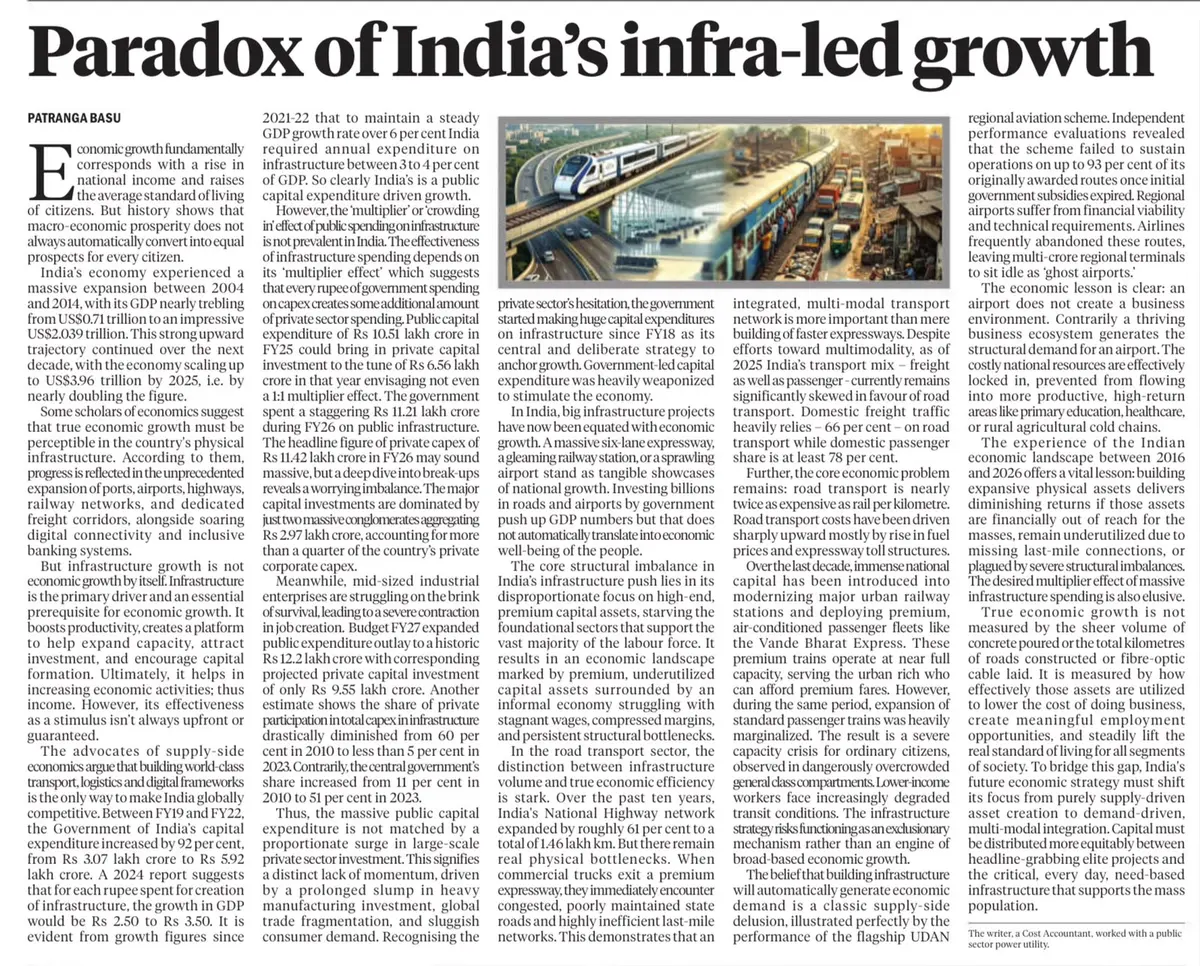
Paradox of India's infra-led growth – public capex, private investment and transport imbalance (The Statesman)
Paradox of India's infra-led growth. Source: The Statesman

India's Infrastructure Push

GDP
US$0.71 trillion (2004) → US$3.96 trillion (2025).
Capex jump
Centre's capex up 92% between FY19 and FY22 (₹3.07 → ₹5.92 lakh crore).
Record outlays
₹10.51 lakh crore (FY25), ₹11.21 lakh crore (FY26), ₹12.2 lakh crore budgeted (FY27).
Multiplier
Each ₹1 on infrastructure may add ₹2.50–3.50 to GDP (2024 report).
Requirement
Steady 6%+ growth needs infra spending of 3–4% of GDP a year.

The Paradox: Weak Crowding-in

Private share
Private share in infra capex fell from 60% (2010) to below 5% (2023).
Centre's share
Rose from 11% (2010) to 51% (2023).
Concentration
Two conglomerates account for ₹2.97 lakh crore – over a quarter of private capex.
MSMEs
Mid-sized firms are struggling, hurting job creation.
Causes
Slump in heavy manufacturing, global trade fragmentation, weak consumer demand.

Structural Bottlenecks

Premium bias
Focus on expressways, airports, Vande Bharat; standard trains and basic services neglected.
Road dependence
Freight 66% and passengers at least 78% rely on roads.
Cost gap
Road transport is nearly twice as costly as rail per km.
Last mile
NH network grew ~61% to 1.46 lakh km, but trucks exit into congested state roads.
Ghost airports
UDAN failed to sustain up to 93% of awarded routes after subsidies ended.

Why Spending ≠ Growth

Weak multiplier
Public investment is not pulling in proportionate private capex.
Demand gap
Assets without demand stay underutilised.
Jobs
Capital-intensive projects create fewer direct jobs.
Access
Premium services serve the urban rich; masses face overcrowding.

Way Forward

Multimodal
Integrate rail, road, waterways and logistics (PM Gati Shakti, NLP).
Balance
Shift capital to need-based assets – public transport, schools, health, cold chains.
Private capex
Policy certainty and support beyond large conglomerates.
Outcomes
Judge projects by jobs, utilisation, logistics cost, not km built.
Key Takeaway: Growth is measured not by the concrete poured but by how well assets are used. India's next phase must move from supply-driven asset creation to demand-driven, multimodal and inclusive infrastructure.

Prelims Practice MCQ

+2 correct • −0.66 wrong

Consider the following statements:
1. 'Crowding-in' refers to a situation where public investment encourages additional private investment.
2. Rail freight in India costs more per kilometre than road freight.
3. The share of the private sector in India's infrastructure capex has risen steadily since 2010.
Which of the statements given above is/are correct?

Explanation: Crowding-in means public spending stimulates private investment, so Statement 1 is correct. Road transport is nearly twice as expensive as rail per km, so Statement 2 is wrong. The private share in infra capex fell from 60% in 2010 to below 5% in 2023, so Statement 3 is wrong.

UPSC Mains Question

GS3 • PYQ 2021 • 15 Marks

"Investment in infrastructure is essential for more rapid and inclusive economic growth." Discuss in the light of India's experience.

Attempt before opening the value-addition tab.
Accepted: JPG, JPEG, PNG, WEBP or PDF. The standalone file previews your answer locally; connect the API hook for real server submission.
Use after attempting the Mains answer
  • Schemes — PM Gati Shakti, National Logistics Policy (2022), National Infrastructure Pipeline, UDAN, Bharatmala, Sagarmala.
  • Concepts — fiscal multiplier, crowding-in vs crowding-out, demand-driven vs supply-driven growth.
  • Data use — 66% freight on roads, private share below 5% (2023), UDAN 93% routes not sustained.
  • Keywords — last-mile connectivity, asset utilisation, multimodal integration, inclusive infrastructure.
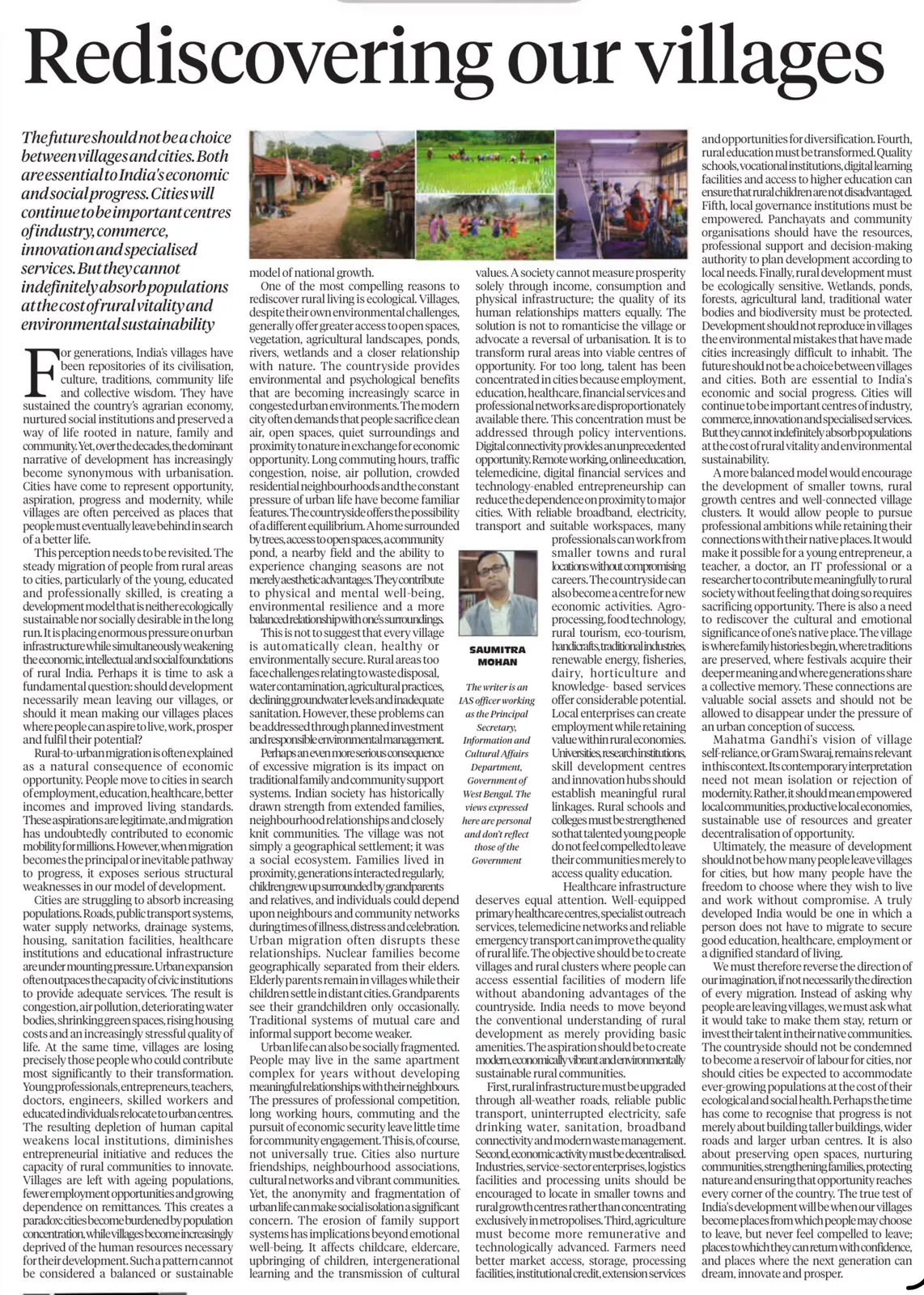
NEWS 2 GS3 • Rural Development | GS1 • Urbanisation & Migration Source: The Statesman

Rediscovering Our Villages: Balanced Rural–Urban Development

Context: India's development model has become synonymous with urbanisation. Cities cannot indefinitely absorb rural migrants, so villages must become productive, empowered and sustainable places where migration is a choice, not a compulsion.

Rediscovering our villages – rural development, migration and balanced rural-urban growth (The Statesman)
Rediscovering our villages. Source: The Statesman

Rethinking the Development Model

Urban-centric
Development has become synonymous with urbanisation.
Limits
Cities cannot absorb migrants indefinitely without strain on housing, transport and environment.
Complementary
Villages and cities should be partners, not rivals.
Migration by choice
Education, health and jobs should not require leaving home.

Costs of Unbalanced Urbanisation

Rural drain
Educated youth, skilled workers and entrepreneurs leave – human capital depletion.
Ageing villages
Fewer jobs, ageing population, dependence on remittances.
Social fragmentation
Weakening of joint families, community support and elder care.
Urban stress
Congestion, pollution, informal settlements, shrinking green spaces.

Untapped Rural Potential

Allied sectors
Food processing, dairy, fisheries, horticulture.
Enterprise
Handicrafts, rural & eco-tourism, renewable energy.
Digital
Remote work, telemedicine, online education, digital finance.
Growth centres
Smaller towns and village clusters as hubs (rurban model).

Roadmap for Rural Transformation

Infrastructure
All-weather roads, reliable power, drinking water, sanitation, broadband.
Decentralise economy
Industries and logistics in smaller towns, not only metros.
Agriculture
Market access, storage, institutional credit, extension services.
Human development
Quality schools, vocational institutes, PHCs and telemedicine.
Governance
Empower Panchayats with funds, functions and functionaries.
Ecology
Protect wetlands, ponds, forests and traditional water bodies.

Constitutional Linkages

Article 40
DPSP – organise village panchayats as units of self-government.
73rd CAA, 1992
Constitutional status to PRIs; added Part IX and Eleventh Schedule (29 subjects).
Article 243G
Powers and responsibilities of Panchayats for economic development and social justice.
Gram Swaraj
Gandhian idea of self-reliant villages and decentralisation.
Key Takeaway: A truly developed India is one where people do not have to migrate for good education, healthcare and jobs. The test is not how many leave villages, but how many have the freedom to stay.

Prelims Practice MCQ

+2 correct • −0.66 wrong

Consider the following statements:
1. Article 40 of the Constitution, which directs the State to organise village panchayats, is a Directive Principle of State Policy.
2. The 73rd Constitutional Amendment Act, 1992 added the Eleventh Schedule containing 29 subjects.
3. Article 243G provides for reservation of seats for Scheduled Castes in panchayats.
Which of the statements given above is/are correct?

Explanation: Article 40 is a DPSP, and the 73rd Amendment added Part IX and the Eleventh Schedule with 29 subjects. Article 243G deals with the powers and responsibilities of panchayats; reservation of seats is under Article 243D, so Statement 3 is wrong.

UPSC Mains Question

GS1 • PYQ 2016 • 12.5 Marks

"Smart cities in India cannot sustain without smart villages." Discuss this statement in the backdrop of rural-urban integration.

Attempt before opening the value-addition tab.
Accepted: JPG, JPEG, PNG, WEBP or PDF. The standalone file previews your answer locally; connect the API hook for real server submission.
Use after attempting the Mains answer
  • Schemes — Shyama Prasad Mukherji Rurban Mission, Vibrant Villages Programme, PMGSY, BharatNet, SVAMITVA, DAY-NRLM.
  • Thinkers — Gandhi's Gram Swaraj; PURA (Providing Urban Amenities in Rural Areas) by Dr APJ Abdul Kalam.
  • Use in Essay — balanced regional development, distress migration, dignity of rural life.
  • Keywords — rurbanisation, reverse migration, decentralisation of opportunity, cluster development.
NEWS 3 GS3 • Science & Technology | Energy Storage Source: Financial Express

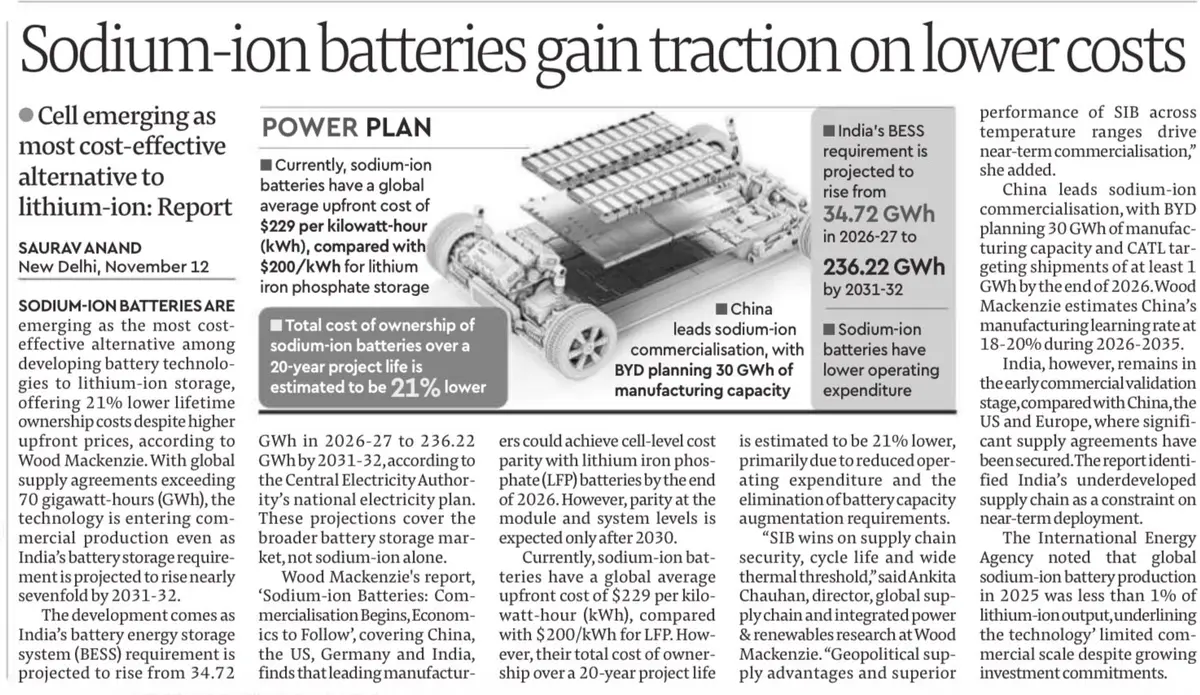
Sodium-Ion Batteries Gain Traction on Lower Costs

Context: A Wood Mackenzie report finds sodium-ion batteries (SIBs) emerging as the most cost-effective alternative to lithium-ion storage, with about 21% lower lifetime ownership costs despite higher upfront prices. Global supply agreements now exceed 70 GWh.

Sodium-ion batteries gain traction on lower costs – cost per kWh, total cost of ownership and India's BESS demand (Financial Express)
Sodium-ion batteries: costs and India's BESS outlook. Source: Financial Express

What Are Sodium-Ion Batteries?

Working
Sodium ions shuttle between cathode and anode during charge and discharge.
Abundance
Sodium is far more abundant than lithium (e.g. from common salt).
No critical minerals
Avoids heavy use of lithium, cobalt and nickel.
Trade-off
Lower energy density – better for stationary storage than long-range EVs.

Cost Comparison

Upfront
SIB $229/kWh vs LFP $200/kWh.
Lifetime
Total cost of ownership 21% lower over a 20-year project life.
Why
Lower operating costs; no capacity augmentation needed.
Parity
Cell-level parity with LFP by end-2026; module/system level after 2030.

Advantages & Uses

Supply security
Less exposure to concentrated mineral supply chains.
Thermal range
Works across a wide temperature range – suits Indian climate.
Safety & life
Better cycle life and thermal threshold.
BESS
Grid storage for solar and wind; grid stability.

Global Picture & India

China leads
BYD plans 30 GWh capacity; CATL targets 1 GWh shipments by end-2026.
Scale
Global SIB output in 2025 was less than 1% of lithium-ion (IEA).
India's BESS need
34.72 GWh (2026–27) → 236.22 GWh (2031–32) (CEA) – nearly 7x.
India's gap
Still at early commercial validation; weak domestic supply chain.

Way Forward

Scale up
Pilot projects and domestic cell manufacturing.
Policy
Extend PLI-ACC and VGF for BESS to cover SIBs.
R&D
Improve energy density, charging and durability.
Integration
Use SIBs in renewable parks and grid storage.
Key Takeaway: Sodium-ion batteries cost more upfront but less over their life. For India's fast-growing storage needs, they offer a way to cut dependence on imported lithium – if domestic manufacturing scales up in time.

Prelims Practice MCQ

+2 correct • −0.66 wrong

With reference to sodium-ion batteries, consider the following statements:
1. At present, their upfront cost per kWh is lower than that of lithium iron phosphate (LFP) batteries.
2. Sodium is more abundant in the Earth's crust than lithium.
3. Their total cost of ownership over a 20-year project life is estimated to be lower than that of LFP batteries.
Which of the statements given above are correct?

Explanation: Sodium-ion batteries currently cost about $229/kWh upfront against $200/kWh for LFP, so Statement 1 is wrong. Sodium is far more abundant than lithium, and the lifetime ownership cost of SIBs is estimated to be about 21% lower.

UPSC Mains Question

GS3 • PYQ 2015 • 12.5 Marks

To what factors can the recent dramatic fall in equipment costs and tariff of solar energy be attributed? What implications does the trend hold for the thermal power producers and the related industry?

Attempt before opening the value-addition tab.
Accepted: JPG, JPEG, PNG, WEBP or PDF. The standalone file previews your answer locally; connect the API hook for real server submission.
Use after attempting the Mains answer
  • Schemes — PLI for Advanced Chemistry Cell (ACC) battery storage, VGF for BESS, National Critical Mineral Mission (2025).
  • Link — India's 500 GW non-fossil capacity target by 2030 needs large-scale storage.
  • Compare — lithium-ion vs sodium-ion vs LFP: cost, energy density, safety, raw materials.
  • Keywords — energy storage, total cost of ownership, supply-chain resilience, grid stability.
NEWS 4 GS2 • Indian Polity | Judiciary & Judicial Reforms Source: The Hindu

To Strengthen the Supreme Court, Divide It

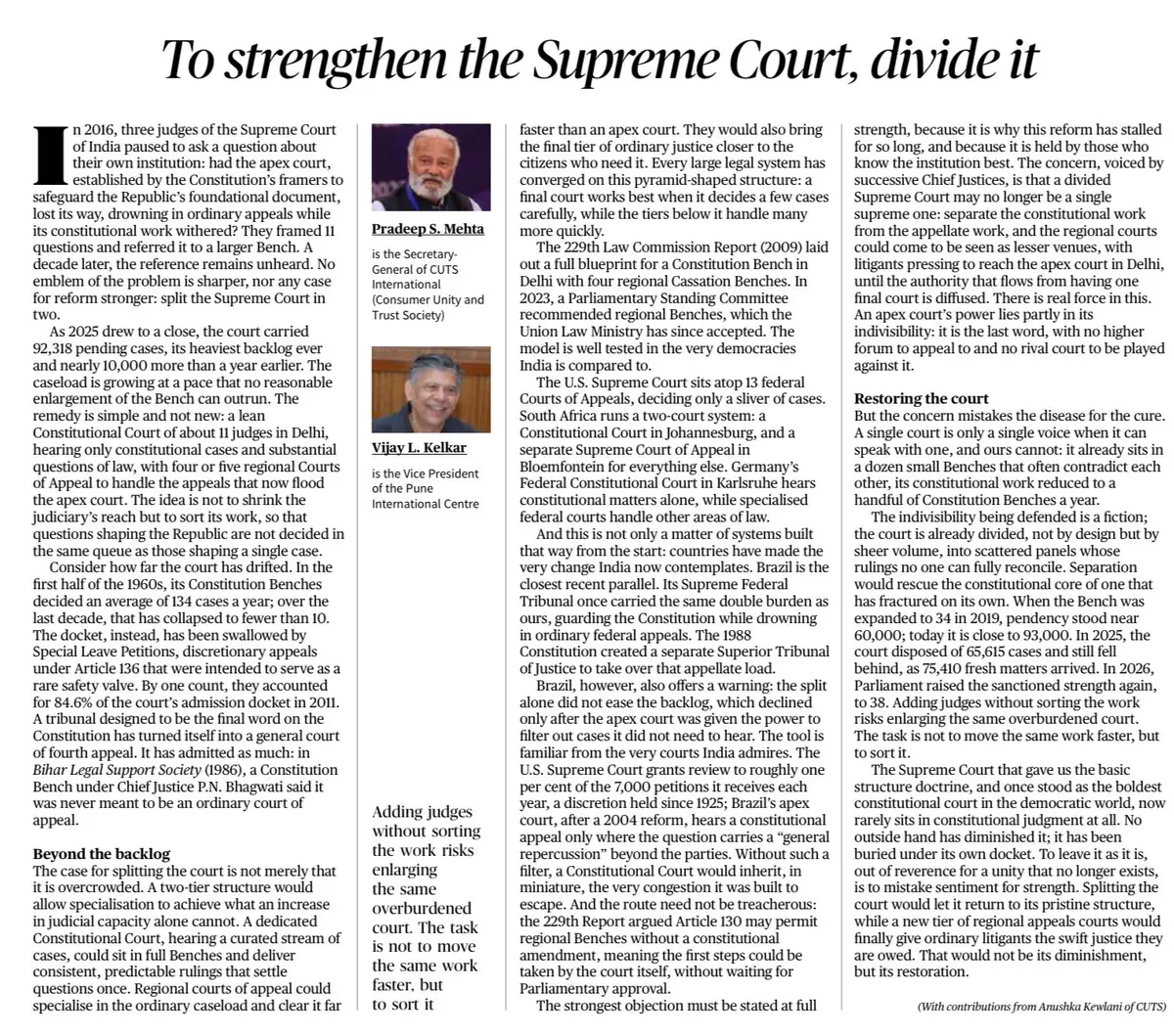
Context: With pendency at a record high, an op-ed argues for splitting the Supreme Court into a Constitutional Court in Delhi and four or five regional Courts of Appeal, so that constitutional questions are not decided in the same queue as routine appeals.

To strengthen the Supreme Court, divide it – Constitutional Court and regional Courts of Appeal (The Hindu)
To strengthen the Supreme Court, divide it. Source: The Hindu

The Problem

Pendency
92,318 cases at end-2025 – highest ever, ~10,000 more than a year earlier.
2025 data
Disposed 65,615 cases but 75,410 fresh matters arrived.
Constitution Benches
Avg 134 cases/year in the early 1960s → fewer than 10 in the last decade.
SLPs
Article 136 SLPs were 84.6% of the admission docket (2011).
Judges
Strength raised to 34 (2019); pendency still rose from ~60,000 to ~93,000.

The Proposal

Constitutional Court
About 11 judges in Delhi – constitutional cases and substantial questions of law.
Courts of Appeal
4–5 regional courts for ordinary civil and criminal appeals.
Benefits
Full Benches, consistent rulings, justice closer to citizens.
Case filter
Without a filter, the new court will inherit the same congestion.

Framework & Past Recommendations

Article 130
SC sits in Delhi or other places the CJI appoints with the President's approval.
Article 136
Special Leave Petition – discretionary appeal, meant as a rare safety valve.
229th Law Commission (2009)
Constitution Bench in Delhi + four regional Cassation Benches.
Parliamentary Committee (2023)
Recommended regional Benches.
Bihar Legal Support Society (1986)
SC said it is not meant to be an ordinary court of appeal.

Global Models

USA
Supreme Court above 13 federal Courts of Appeals; hears ~1% of 7,000 petitions.
South Africa
Constitutional Court (Johannesburg) + Supreme Court of Appeal (Bloemfontein).
Germany
Federal Constitutional Court (Karlsruhe) for constitutional matters only.
Brazil
Superior Tribunal of Justice (1988); backlog fell only after a 'general repercussion' filter (2004).

Concerns & Way Forward

Concern
A divided court may no longer be one supreme voice; regional courts seen as lesser.
Counter
The court is already divided into many small, often conflicting Benches.
Filter
Clear criteria for admitting appeals.
Capacity
Court management, technology and clear jurisdiction to keep precedents consistent.
Key Takeaway: Adding judges without sorting the work only enlarges the same overburdened court. Separating constitutional and appellate work, with a strong case filter, could restore the Supreme Court's role as a constitutional court.

Prelims Practice MCQ

+2 correct • −0.66 wrong

With reference to the Supreme Court of India, consider the following statements:
1. Under Article 130, the Supreme Court may sit at places other than Delhi as the Chief Justice of India may appoint with the approval of the President.
2. Special Leave Petitions under Article 136 can be entertained only in criminal matters.
3. The 229th Law Commission Report recommended a Constitution Bench in Delhi and regional Cassation Benches.
Which of the statements given above are correct?

Explanation: Article 130 allows sittings outside Delhi with the President's approval, and the 229th Law Commission (2009) proposed a Constitution Bench in Delhi with four regional Cassation Benches. Article 136 covers any judgment or order of any court or tribunal, not just criminal matters, so Statement 2 is wrong.

UPSC Mains Question

GS2 • PYQ 2023 • 10 Marks

"Constitutionally guaranteed judicial independence is a prerequisite of democracy." Comment.

Attempt before opening the value-addition tab.
Accepted: JPG, JPEG, PNG, WEBP or PDF. The standalone file previews your answer locally; connect the API hook for real server submission.
Use after attempting the Mains answer
  • Articles — 124 (establishment), 130 (seat), 136 (SLP), 145 (rules; Constitution Bench of minimum 5 judges).
  • Reports — 229th Law Commission (2009), Parliamentary Standing Committee (2023), National Court of Appeal idea (Bihar Legal Support Society, 1986).
  • Data use — 92,318 pending cases; Constitution Bench output fell from 134 to under 10 a year.
  • Keywords — judicial pendency, court of fourth appeal, cassation benches, access to justice.
NEWS 5 GS3 • Indian Economy | External Sector Source: The Hindu

Exports Touch Record High as Diversification Pays Off

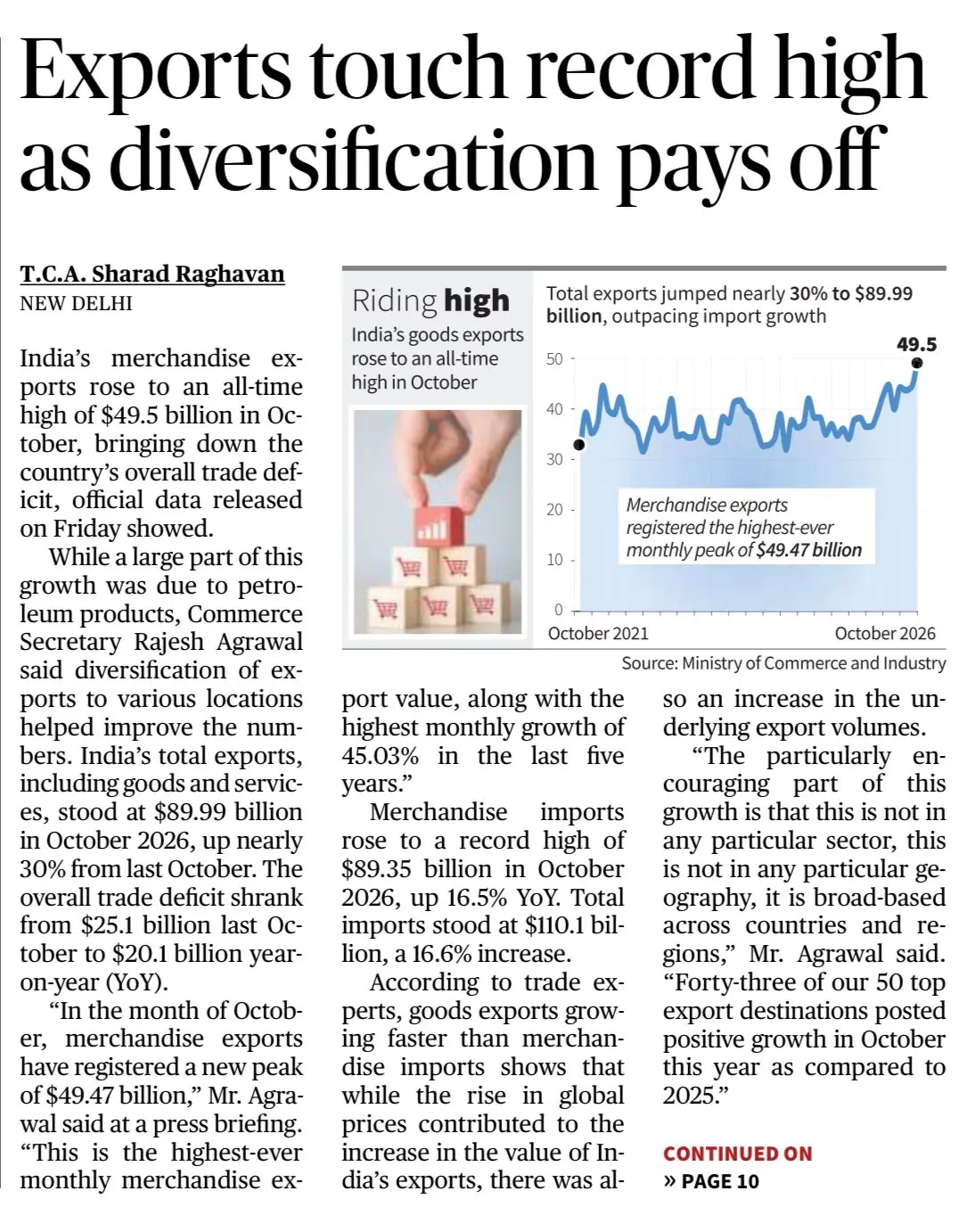
Context: India's merchandise exports hit an all-time monthly high of $49.47 billion in October 2026, narrowing the trade deficit. The Commerce Secretary credited broad-based growth across markets, with 43 of the top 50 destinations posting gains.

Exports touch record high as diversification pays off – India's merchandise exports October 2026 (The Hindu)
India's goods exports hit an all-time high in October 2026. Source: The Hindu / Ministry of Commerce and Industry

October 2026 Numbers

Merchandise exports
$49.47 billion – highest-ever month; 45.03% growth, best in 5 years.
Total exports
Goods + services $89.99 billion, up ~30% YoY.
Imports
Merchandise $89.35 billion (+16.5%); total $110.1 billion (+16.6%).
Trade deficit
Overall deficit narrowed from $25.1 bn to $20.1 bn.
Breadth
43 of top 50 export destinations grew.

Bigger Picture

FY 2025–26
Total exports US$863.1 billion – record.
Split
Merchandise US$441.8 bn; services US$421.3 bn.
Services
Now nearly half of India's export earnings.
Global share
About 1.8% of world merchandise exports; 18th largest exporter (WTO, 2024).

Drivers & Significance

Diversification
New markets reduce dependence on a few destinations.
Petroleum
Large share of October growth came from petroleum products.
Volumes
Not just prices – export volumes also rose.
BoP
Higher exports narrow the current account deficit and support the rupee.

Challenges

Import dependence
Merchandise imports still far exceed exports.
Commodity reliance
Over-reliance on petroleum and price effects.
Competitiveness
Low value addition, high logistics costs.
Protectionism
Tariffs and fragmented global trade.

Way Forward

FTAs
Use FTAs with UAE, Australia, UK, EFTA and new CEPAs.
MSMEs
Link MSMEs to global value chains; Export Promotion Mission.
Logistics
Cut costs via PM Gati Shakti and port upgrades.
Value addition
Shift to high-tech manufactured exports – electronics, engineering, pharma.
Key Takeaway: Record exports and a narrower deficit show the gains of market diversification. To sustain them, India must reduce its reliance on petroleum and raise manufacturing competitiveness.

Prelims Practice MCQ

+2 correct • −0.66 wrong

Consider the following statements regarding India's trade in October 2026:
1. Merchandise exports reached their highest-ever monthly level.
2. The overall trade deficit widened compared with October 2025.
3. The trade balance is recorded in the current account of the Balance of Payments.
Which of the statements given above are correct?

Explanation: Merchandise exports hit a record $49.47 billion, and the trade balance is part of the current account of the BoP. The overall trade deficit narrowed from $25.1 billion to $20.1 billion, so Statement 2 is wrong.

UPSC Mains Question

GS3 • PYQ 2025 • 10 Marks

What are the challenges before the Indian economy when the world is moving away from free trade and multilateralism to protectionism and bilateralism? How can these challenges be met?

Attempt before opening the value-addition tab.
Accepted: JPG, JPEG, PNG, WEBP or PDF. The standalone file previews your answer locally; connect the API hook for real server submission.
Use after attempting the Mains answer
  • Policies — Foreign Trade Policy 2023, Export Promotion Mission, Districts as Export Hubs, RoDTEP.
  • Concepts — trade deficit vs current account deficit, price effect vs volume effect, export diversification.
  • Data use — $49.47 bn record merchandise exports; 43 of top 50 markets grew; services ~half of exports.
  • Keywords — broad-based growth, global value chains, export competitiveness.
NEWS 6 GS2 • International Relations | GS3 • Trade & Critical Minerals Source: Financial Express

India–Canada CEPA Talks to Finish by December

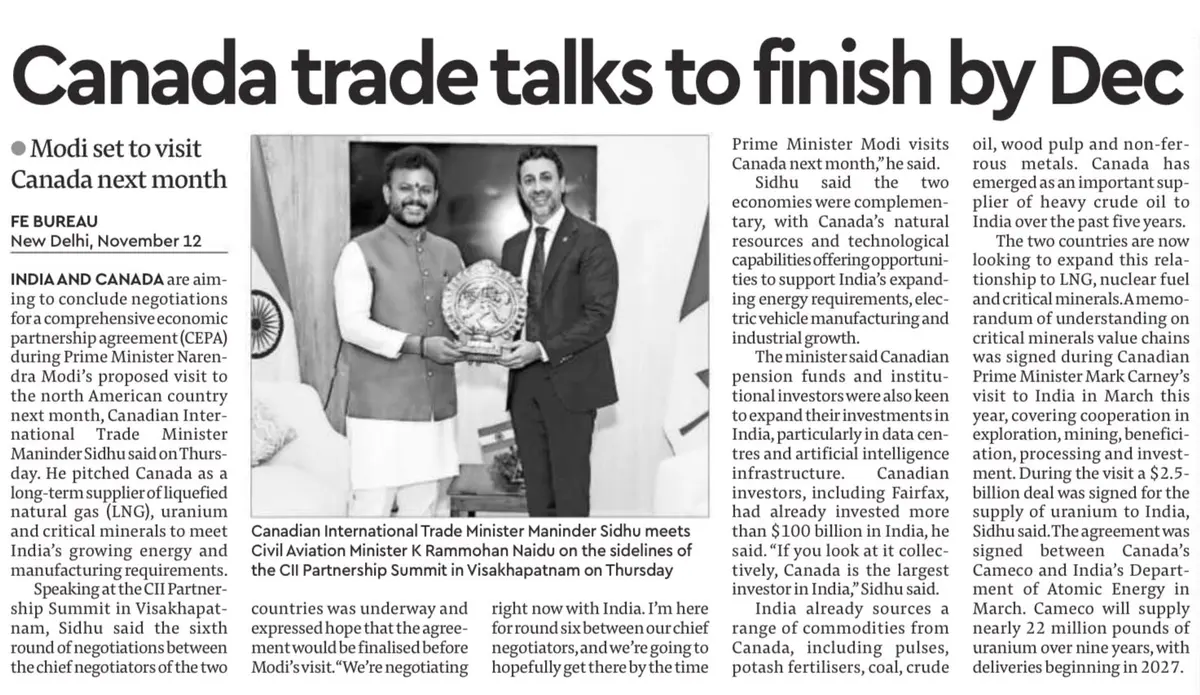
Context: Canada's International Trade Minister Maninder Sidhu said India and Canada aim to conclude the Comprehensive Economic Partnership Agreement (CEPA) during PM Modi's proposed visit to Canada next month. The sixth round of talks is underway.

Canada trade talks to finish by December – Canadian Trade Minister Maninder Sidhu meets K Rammohan Naidu at CII Partnership Summit (Financial Express)
Canada trade talks to finish by December. Source: Financial Express

Latest Developments

CEPA
Sixth round of talks underway; target: before PM Modi's December visit.
Where
Announced at the CII Partnership Summit, Visakhapatnam.
Reset
PM Mark Carney's March 2026 visit revived ties.
Investment
Canadian investors (incl. Fairfax) have put over $100 billion into India.
New areas
Pension funds eye data centres and AI infrastructure.

Trade Snapshot (FY 2025–26)

Exports to Canada
US$4.67 bn – engineering goods, pharma, gems & jewellery.
Imports from Canada
US$3.28 bn – pulses, potash, coal, crude, wood pulp.
Total
US$7.95 bn; India has a merchandise surplus.
Services
Canada has a large surplus, driven by Indian students' education spending.

Energy & Critical Minerals

Uranium
$2.5 billion deal: Cameco to supply ~22 million pounds to DAE over 9 years, from 2027.
Energy
Canada pitched as long-term supplier of LNG, uranium; key heavy crude supplier.
Critical minerals
MoU on critical minerals value chains – exploration, mining, processing.
Complementarity
Canada's resources + India's EV, manufacturing and energy demand.

Challenges

Past strain
2023 diplomatic row froze talks (then called EPTA).
Market access
Sensitive areas – agriculture, dairy, pharma standards.
Mobility
Visa and student/professional mobility concerns.
Stability
Need predictable political ties.

Way Forward

Balanced CEPA
Fair concessions, investment protection, dispute resolution.
Minerals
Long-term supply deals and joint processing projects.
Clean energy
LNG, nuclear fuel, SMRs and clean-tech partnerships.
People
Use the diaspora and institutional dialogue to keep ties steady.
Key Takeaway: Canada's resources and India's demand make the two economies complementary. A balanced CEPA can turn a strained relationship into a stable partnership for energy, minerals and investment.

Prelims Practice MCQ

+2 correct • −0.66 wrong

Consider the following statements:
1. Cameco, which signed a uranium supply agreement with India's Department of Atomic Energy, is a Canadian company.
2. A Comprehensive Economic Partnership Agreement (CEPA) covers only trade in goods.
3. Canada is a member of the G7.
Which of the statements given above are correct?

Explanation: Cameco is a Canadian uranium company, and Canada is a G7 member. A CEPA is broader than a goods-only FTA; it also covers services, investment and other economic cooperation, so Statement 2 is wrong.

UPSC Mains Question

GS3 • PYQ 2025 • 10 Marks

What are the challenges before the Indian economy when the world is moving away from free trade and multilateralism to protectionism and bilateralism? How can these challenges be met?

Attempt before opening the value-addition tab.
Accepted: JPG, JPEG, PNG, WEBP or PDF. The standalone file previews your answer locally; connect the API hook for real server submission.
Use after attempting the Mains answer
  • Background — CEPA talks (2010), EPTA talks paused in 2023, revived after Carney's 2026 visit.
  • Nuclear — India–Canada Nuclear Cooperation Agreement (2010); Cameco supply deals (2015, 2026).
  • Links — critical minerals security, Mineral Security Partnership, energy diversification, diaspora diplomacy.
  • Keywords — CEPA, resource complementarity, supply-chain resilience, strategic economic partnership.

Copyright © 2026 USARAMBHA EDUCATION (UnderStand UPSC). All Rights Reserved.