22 July 2026 | UPSC Daily Current Affairs

22 July 2026 | UPSC Daily Current Affairs

White-bellied Heron Hydropower Project Explained

Context: White-bellied Heron hydropower project
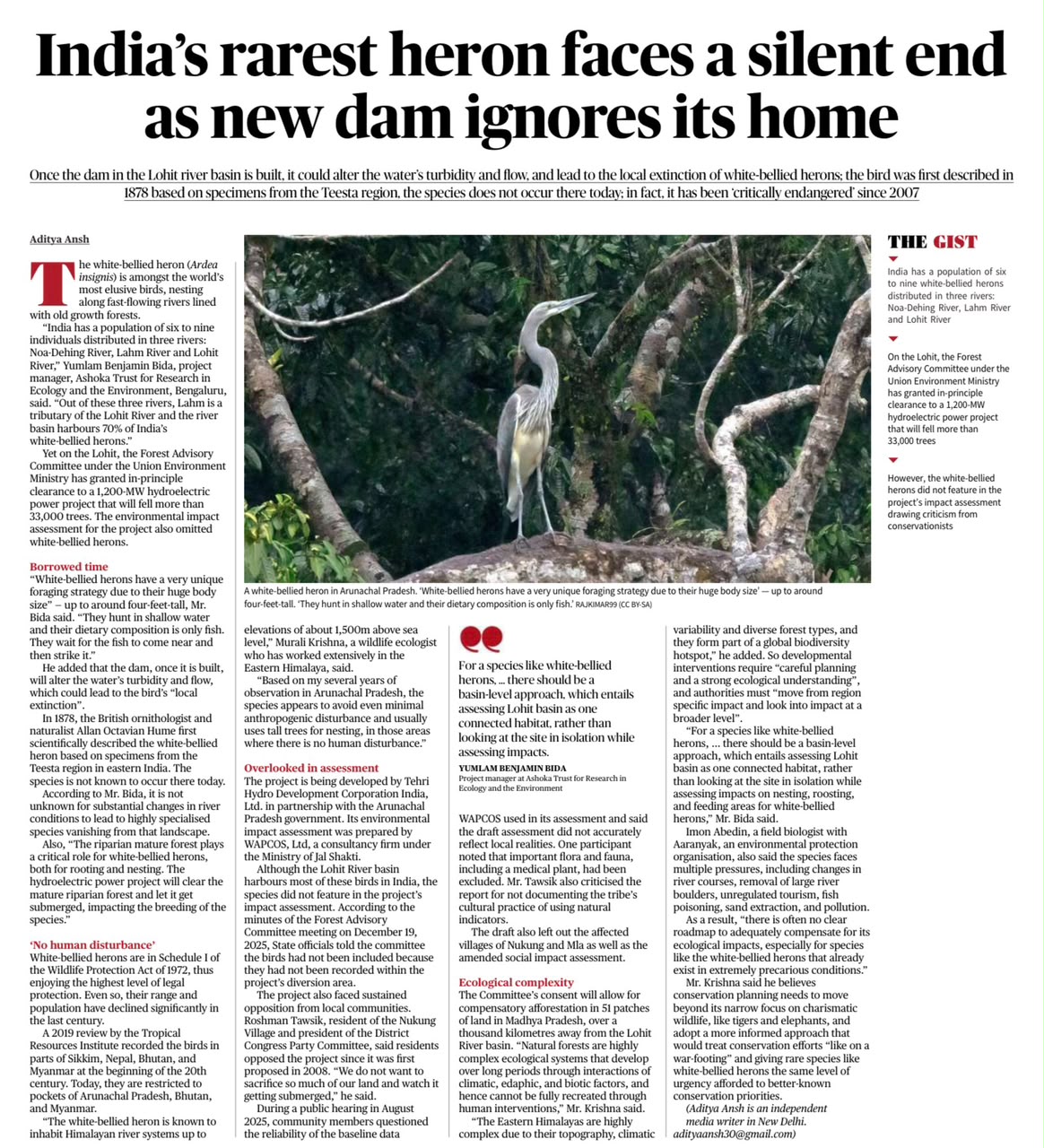
The Union Environment Ministry has granted in-principle environmental clearance to a 1,200 MW hydropower project in the Lohit River basin of Arunachal Pradesh.

Conservationists have raised concerns that changes in river flow, turbidity and riparian forests may threaten the White-bellied Heron, one of the world’s rarest herons.

White-bellied Heron

Scientific Name

  • Ardea insignis

IUCN Red List

  • Critically Endangered

Wildlife Protection Act, 1972

  • Schedule I

Distribution

The White-bellied Heron is found in:

  • India
  • Bhutan
  • Myanmar

In India, it is mainly found in Arunachal Pradesh, especially in:

  • Lohit River basin
  • Noa-Dihing River basin
  • Lam River basin

About 70% of India’s population occurs in the Lohit basin.

Habitat

The species prefers:

  • Fast-flowing Himalayan rivers
  • Undisturbed riparian forests
  • Rocky riverbeds
  • Shallow water areas

Diet and Behaviour

It feeds mainly on fish.

It hunts in shallow water using an ambush strategy, waiting quietly for fish to come close before striking.

Major Threats

  • Hydropower projects
  • Habitat loss
  • Altered river flow
  • Increased turbidity
  • Removal of river boulders
  • Pollution
  • Human disturbance

Key Takeaway

The issue is not only about one bird species. It is about balancing hydropower development with the protection of fragile Himalayan river ecosystems.
White-bellied Heron hydropower project

AISHE 2023-24 Undergraduate Enrolment Decline Explained

Context: AISHE 2023-24 undergraduate enrolment
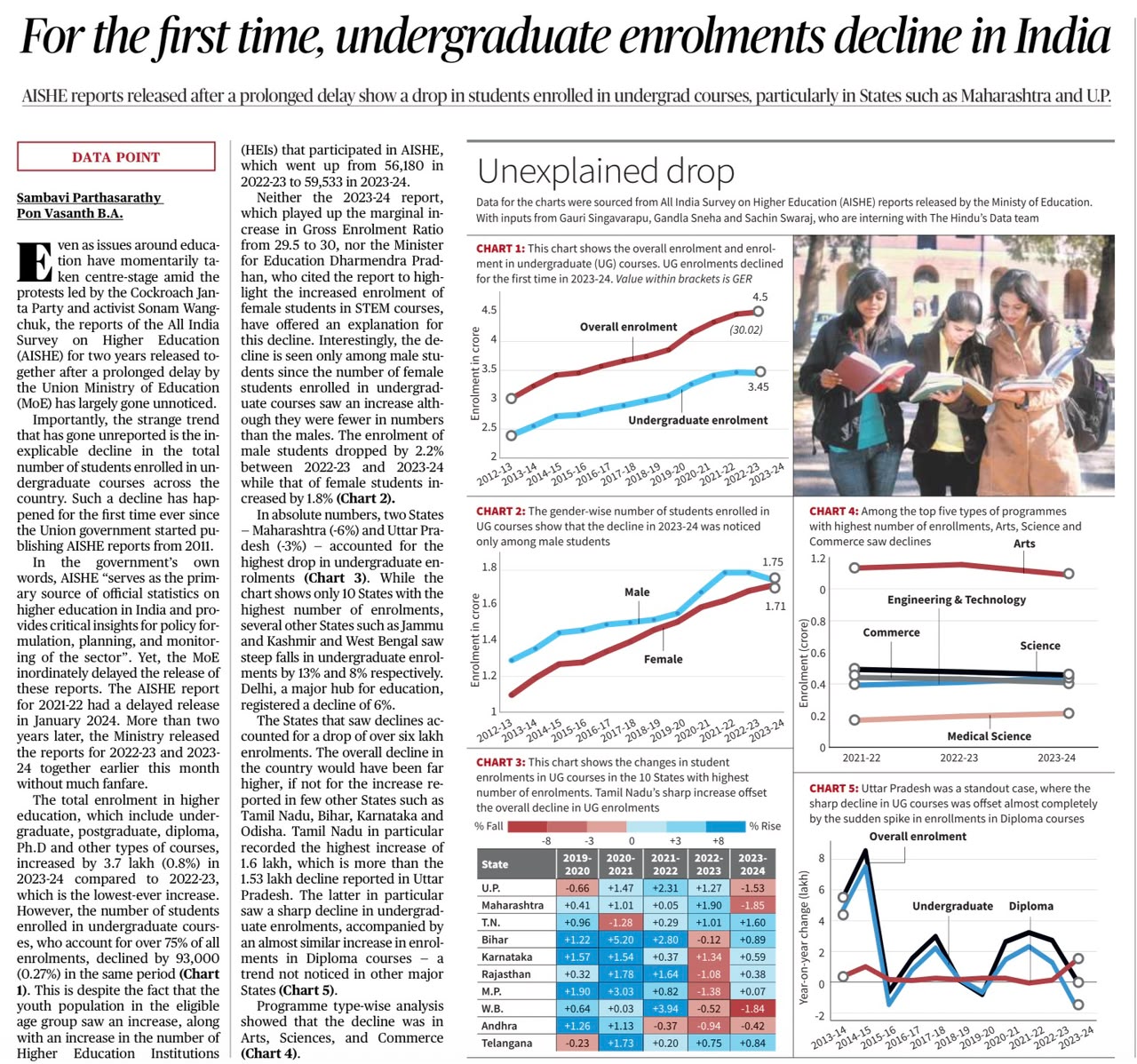
The latest All India Survey on Higher Education 2023–24 reports a decline in undergraduate enrolment for the first time since 2011.

This has happened despite an overall rise in higher education enrolment and Gross Enrolment Ratio.

All India Survey on Higher Education

AISHE is an annual survey conducted by the Ministry of Education.

It is India’s key database on higher education and covers:

  • Enrolment
  • Institutions
  • Faculty
  • Infrastructure
  • Educational outcomes

Important Data

Overall Higher Education Enrolment

  • 4.50 crore
  • Increased by 3.7 lakh
  • Growth of 0.8% over 2022–23

Undergraduate Enrolment

  • 3.45 crore
  • Declined by 93,000
  • Decline of 0.27%
  • First decline since 2011

Gross Enrolment Ratio

  • Increased from 29.5 to 30.02

Higher Education Institutions Covered

  • Increased from 56,180 to 59,533

Gender-wise Trend

Male UG Enrolment

  • Declined by 2.2%

Female UG Enrolment

  • Increased by 1.8%

This means the overall UG decline is mainly because of a fall in male enrolment.

State-wise Trend

Largest Decline

  • Maharashtra: -6%
  • Uttar Pradesh: -3%

Largest Increase

  • Tamil Nadu: +1.6 lakh

Programme-wise Trend

Decline was seen in:

  • Arts
  • Science
  • Commerce

Medical Sciences registered a marginal increase.

Key Takeaway

The fall in UG enrolment is small in percentage terms, but important because it breaks a long trend of expansion in higher education.

AISHE 2023-24 undergraduate enrolment

India FTA Negotiations Delayed by Global Conflicts

Context: India FTA negotiations delayed
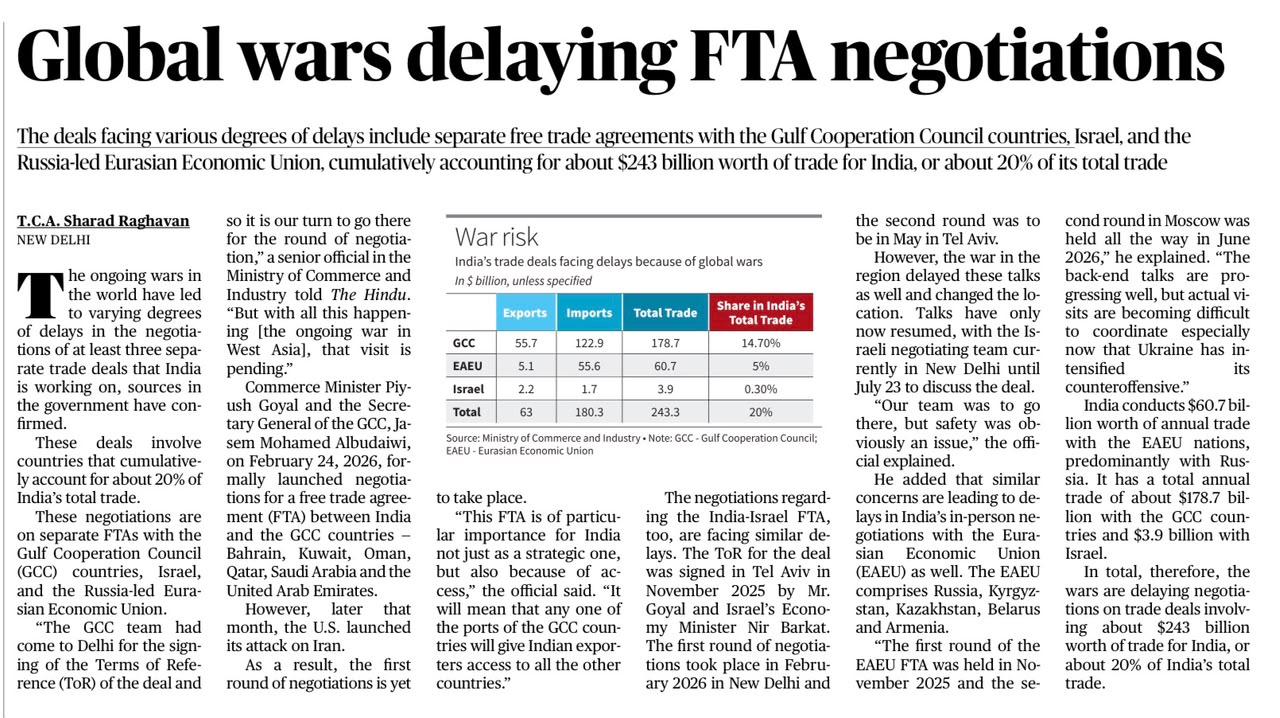
Ongoing conflicts in West Asia and Eastern Europe have delayed India’s Free Trade Agreement negotiations with:

These trade partnerships together account for nearly 20% of India’s total merchandise trade.

Free Trade Agreement

A Free Trade Agreement is an arrangement between countries to reduce or remove trade barriers such as tariffs and quotas.

It aims to improve:

  • Market access
  • Trade competitiveness
  • Investment flows
  • Supply-chain integration

Gulf Cooperation Council

Established

  • 1981

Headquarters

  • Riyadh, Saudi Arabia

Members

  • Bahrain
  • Kuwait
  • Oman
  • Qatar
  • Saudi Arabia
  • United Arab Emirates

Eurasian Economic Union

Established

  • 2015

Headquarters

  • Moscow, Russia

Members

  • Russia
  • Belarus
  • Kazakhstan
  • Armenia
  • Kyrgyzstan

Important Trade Data

India–GCC Trade

  • US$178.7 billion
  • Around 14.7% of India’s total trade

India–EAEU Trade

  • US$60.7 billion
  • Around 5% of India’s total trade

India–Israel Trade

  • US$3.9 billion

Total Trade Affected

  • US$243.3 billion
  • Nearly 20% of India’s total trade

Key Points

Geopolitical conflicts have disrupted physical negotiations, although technical-level discussions continue.

The India–GCC FTA is strategically important because one agreement would give Indian exporters wider market access across all six Gulf countries.

Delays in India–Israel and India–EAEU FTAs may affect India’s efforts to diversify export markets and strengthen supply chains.

Key Takeaway

Global conflicts are now directly affecting India’s trade diplomacy. Timely FTAs are important for export growth, supply-chain resilience and deeper integration with global value chains.

India FTA negotiations delayed

UNFPA Demographic Futures Survey and India’s Youth

Context: UNFPA Demographic Futures Survey
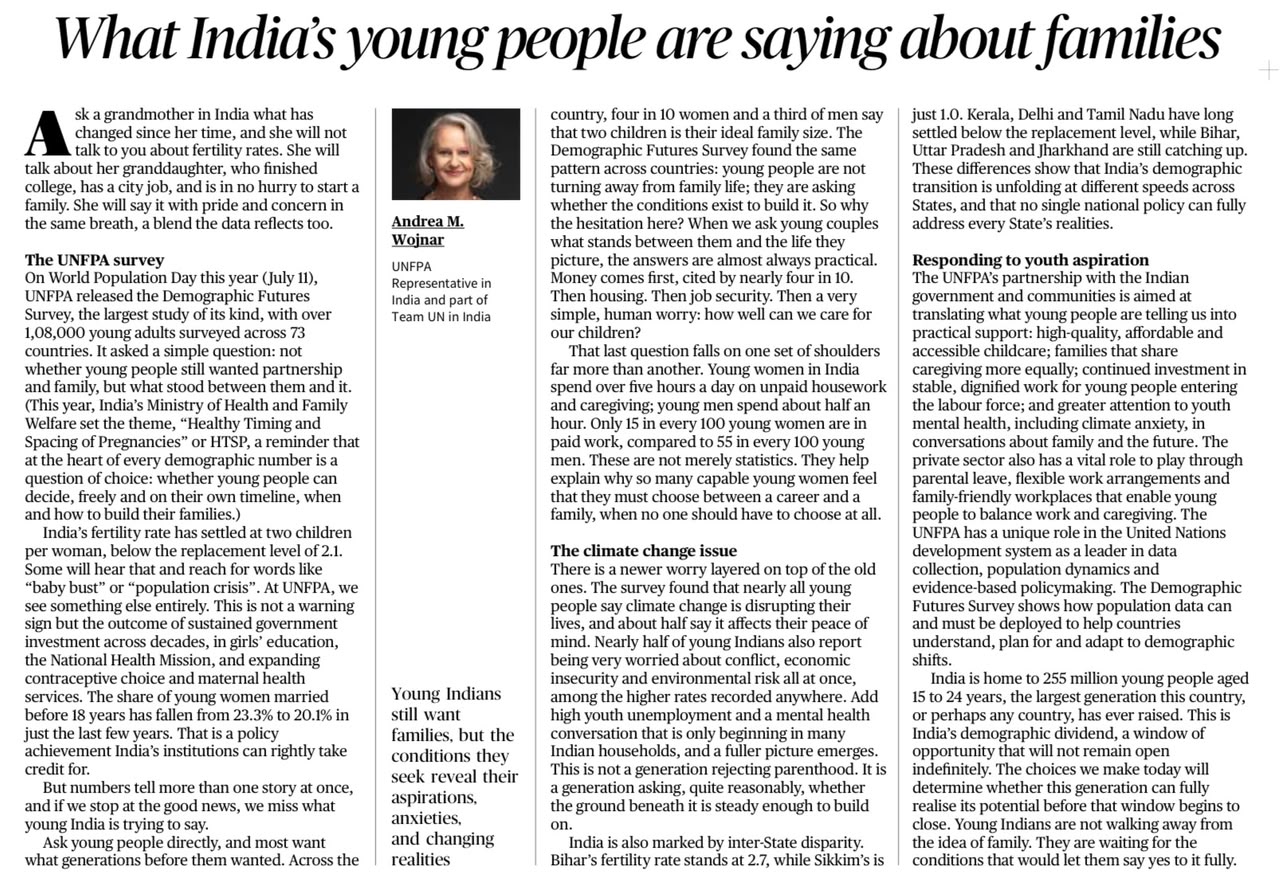
The UNFPA Demographic Futures Survey 2025 shows that Indian youth still aspire for marriage and parenthood.

However, socio-economic, gender and environmental factors are changing when and how families are formed.

Key Findings

Family Aspirations Remain Strong

Most young Indians still prefer marriage and children.

Two children continue to emerge as the ideal family size.

India’s Total Fertility Rate has declined to 2.0, below the replacement level of 2.1.

This reflects demographic transition, not a rejection of family life.

Economic Security Shapes Family Decisions

Young people are delaying marriage and parenthood because of concerns such as:

  • Financial stability
  • Affordable housing
  • Secure employment
  • Cost of raising children
  • Social security

Gender Equality Is Central

Women continue to carry a disproportionate burden of unpaid care work.

Lower female labour force participation also affects family and fertility decisions.

Better demographic outcomes require:

  • Shared caregiving
  • Quality childcare
  • Family-friendly workplaces
  • Equal opportunities for women

Demographic Transition Is Becoming Complex

Fertility behaviour is now affected by:

  • Climate change
  • Mental health concerns
  • Economic uncertainty
  • Regional differences
  • Urbanisation
  • Employment insecurity

UPSC Value Addition

Important Data

  • UNFPA Demographic Futures Survey: over 1.08 lakh respondents across 73 countries
  • India’s youth population aged 15–24 years: 255 million
  • TFR: 2.0
  • Replacement level: 2.1
  • Bihar TFR: 2.7
  • Sikkim TFR: 1.0

Policy Priorities

  • Improve women’s labour force participation.
  • Expand affordable childcare.
  • Provide parental support.
  • Generate quality employment for youth.
  • Strengthen reproductive healthcare.
  • Strengthen mental health services.
  • Use State-specific demographic policies.

Key Takeaway

India’s fertility decline should not be seen only as a population-control success. It also reflects young people’s concerns about jobs, housing, care work, gender equality and future security.

UNFPA Demographic Futures Survey

India Philanthropy Ecosystem and Domestic Giving

Context: India philanthropy ecosystem
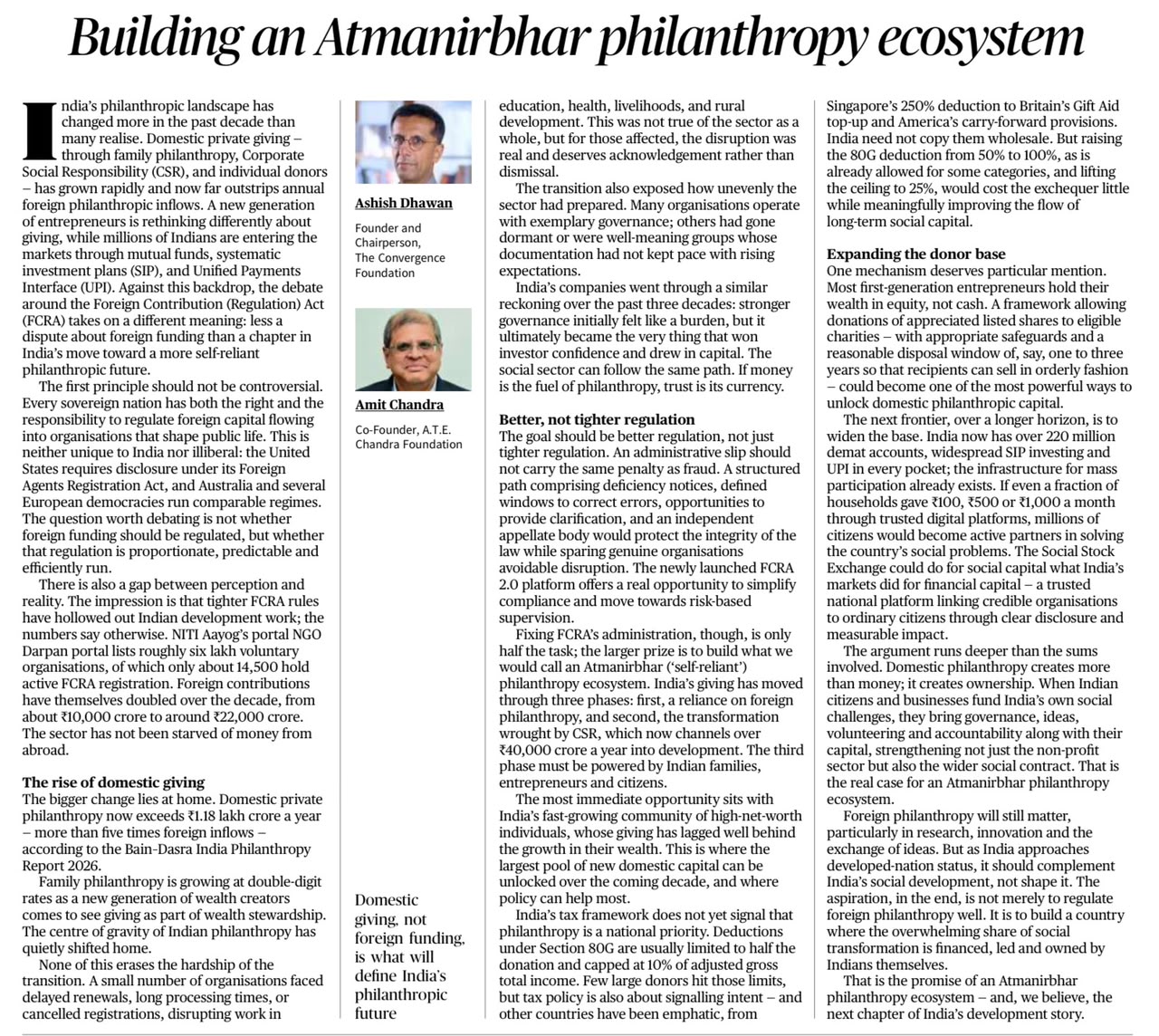
India is moving towards a more self-reliant philanthropic ecosystem.

Domestic giving is becoming the dominant source of social sector funding, while the policy challenge is to maintain transparency, accountability and national security.

Sources of Philanthropy in India

India’s philanthropy ecosystem includes:

Relevant Laws

Foreign Contribution Regulation Act, 2010

Regulates acceptance and use of foreign contributions by individuals, NGOs and associations.

Its purpose is to ensure transparency and safeguard national interests.

Companies Act, 2013 — Section 135

Mandates CSR spending by eligible companies on specified social development activities.

Income Tax Act, 1961 — Section 80G

Provides tax deductions for donations made to eligible charitable institutions.

Important Data

  • Domestic private philanthropy: ₹1.18 lakh crore annually
  • Foreign philanthropic inflows: around ₹22,000 crore annually
  • CSR spending: over ₹40,000 crore annually
  • Around 6 lakh NGOs are registered on NGO Darpan
  • Only around 14,500 NGOs have active FCRA registration

Key Points

Domestic philanthropy is now a major pillar of India’s social sector funding and reduces dependence on foreign contributions.

India needs a balanced framework that protects national security but also allows credible civil society organisations to work effectively.

Compliance should be:

  • Predictable
  • Proportionate
  • Transparent

Domestic philanthropy can be strengthened through better tax incentives, digital giving, donations of appreciated assets and greater citizen participation.

Key Takeaway

Atmanirbhar philanthropy means building a domestic, transparent and accountable funding ecosystem that supports social development without excessive dependence on foreign money.

India philanthropy ecosystem

FIFA World Cup 2026 Highlights for UPSC

Context: FIFA World Cup 2026
FIFA World Cup 2026 was held as the 23rd FIFA World Cup and became the biggest edition in tournament history.

Host Countries

The tournament was jointly hosted by:

  • United States
  • Canada
  • Mexico

Tournament Format

Teams

  • 48 teams

Groups

  • 12 groups of 4 teams

Knockout Stage

  • Round of 32 introduced

Total Matches

  • 104 matches

Venues

  • 16 venues across the three host countries

Tournament Dates

  • 11 June to 19 July 2026

Final

Spain defeated Argentina 1–0.

Mikel Oyarzabal scored the winning goal in the 63rd minute.

Champion

Spain won the FIFA World Cup 2026.

This was Spain’s second FIFA World Cup title.

Spain’s Titles

  • 2010
  • 2026

Individual Awards

Golden Ball

  • Rodri — Spain

Golden Boot

  • Kylian Mbappé — France — 10 goals

Golden Glove

  • Unai Simón — Spain

Best Young Player

  • Pau Cubarsí — Spain

Key Takeaway

FIFA World Cup 2026 was historic because of its expanded 48-team format, three-nation hosting model and Spain’s second World Cup title.

FIFA World Cup 2026
FIFA World Cup 2026

About the UPSC Civil Services Examination (UPSC CSE)

The UPSC Civil Services Examination (CSE) is one of the most competitive and esteemed examinations in India, conducted by the Union Public Service Commission to recruit officers for services such as the Indian Administrative Service (IAS), Indian Police Service (IPS), Indian Foreign Service (IFS), and others. The exam comprises three stages — Prelims, Mains, and the Personality Test (Interview) — designed to test a candidate’s knowledge, aptitude, decision-making, and leadership skills.


How to Prepare Effectively for UPSC CSE

Cracking the UPSC CSE requires a deep understanding of the syllabus, consistent revision, structured answer writing, and smart test-taking strategies. The Prelims test analytical and conceptual clarity, the Mains focuses on critical thinking, articulation, and subject mastery, while the Interview assesses presence of mind, ethical judgment, and personality traits relevant to public service.

At UnderStand UPSC, we empower aspirants with a personalized and focused approach to each stage of the exam.


Why Choose UnderStand UPSC?

UnderStand UPSC is a mentorship-driven platform offering a clear, clutter-free strategy to tackle the Civil Services Examination. Our programs like Transform (for beginners and intermediate learners) and Conquer (for advanced mains preparation) provide structured study plans, syllabus-wise video content, interactive live sessions, and answer writing support.

We emphasize:

  • Concept clarity through topic-wise lectures

  • Test series designed around real UPSC standards

  • Personalized mentorship in small groups

  • Regular performance tracking and peer benchmarking

  • Doubt-clearing sessions, current affairs analysis, and monthly magazines


Join the UnderStand UPSC Learning Community

Our mission is to make UPSC preparation less overwhelming and more strategic. We combine mentorship, discipline, and academic rigor to help you clear CSE with confidence. Whether you’re preparing from Delhi, Mumbai, Bangalore, or a remote village — our online-first model ensures quality guidance reaches every corner of India.

Join the thousands of aspirants who trust UnderStand UPSC to guide their journey toward becoming civil servants.

Stay connected with us through our Telegram, YouTube, and Instagram channels for daily tips, strategies, and updates.

Copyright © 2026 USARAMBHA EDUCATION (UnderStand UPSC). All Rights Reserved.

Fill out the form

Fill out the form for

Downloading the free Agriculture Short Notes