6 August 2026 | UPSC Daily Current Affairs

6 August 2026 | UPSC Daily Current Affairs

Sustainable Crop Protection in India: UPSC Notes

Context: Sustainable Crop Protection in India
India is strengthening science-based crop protection through safer technologies, precision agriculture and better regulation to ensure food security, public health and export competitiveness.

Crop Protection in Indian Agriculture

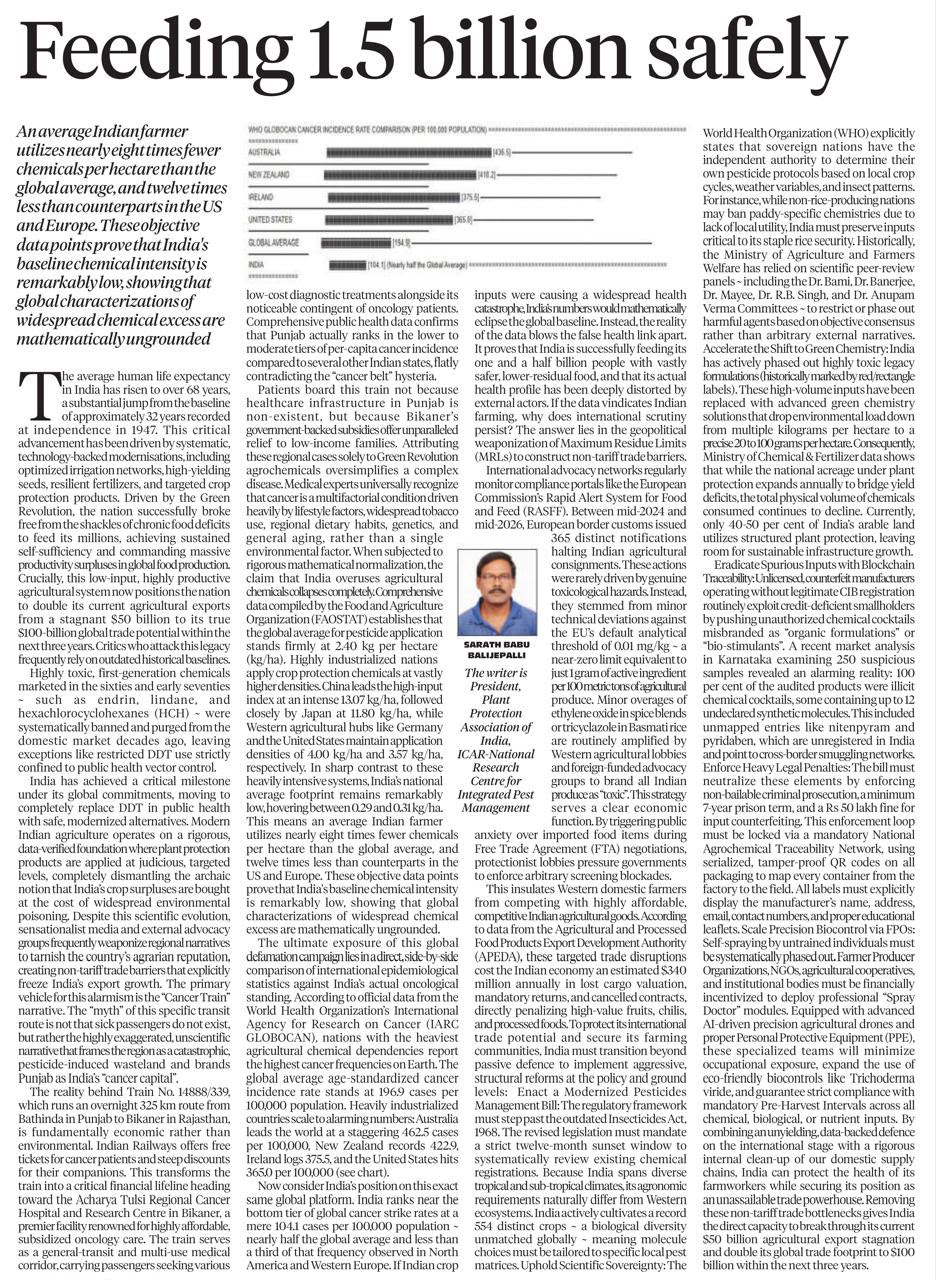
India uses only 0.31 kg/ha of pesticides, compared to the global average of 2.40 kg/ha.

This means India’s pesticide use is nearly one-eighth of the global average.

About 40–50% of India’s arable land is under structured plant protection.

Crop protection has played an important role in India’s agricultural transformation.

It supported the Green Revolution and helped India move from a food-deficit country to a food-surplus nation.

It has also contributed to agricultural exports of nearly $100 billion.

Transition Towards Sustainable Crop Protection

India has phased out DDT from agricultural use.

The country is gradually shifting towards safer and more targeted pesticides.

Precision agriculture has reduced pesticide application to 20–100 g/ha in several crops.

Modern crop protection is no longer only about increasing yield.

It now has to balance:

  • Productivity
  • Environmental sustainability
  • Public health
  • Export quality

Challenges

Cancer incidence in India is 104.1 per 100,000, which is lower than Australia, New Zealand, Ireland and the USA.

However, health outcomes depend on several factors beyond pesticide exposure.

India also faces stricter international food-safety standards.

Maximum Residue Limits, or MRLs, and Rapid Alert System for Food and Feed standards have become major challenges for India’s agricultural exports.

These can often work as non-tariff trade barriers.

Another major concern is the spread of illegal and counterfeit pesticides.

A survey detected undeclared chemicals in sampled products, which creates risks for:

  • Farmers
  • Consumers
  • Agricultural exports

Way Forward

India should periodically review pesticide regulations based on Indian agro-climatic conditions and scientific evidence.

Integrated Pest Management should be expanded.

Precision agriculture, drone spraying and AI-based advisory services should be promoted.

QR-based traceability, quality surveillance and stronger enforcement against counterfeit pesticides are also needed.

Key Takeaway

India’s food security depends not only on producing more, but on producing safely. Crop protection must combine science, regulation, farmer support and export-quality standards.
Sustainable Crop Protection in India

Space and Nuclear Manpower Challenges for UPSC

Context: Space and Nuclear Manpower Challenges
India’s strategic sectors are undergoing structural reforms.

As private participation expands in space and nuclear energy, skilled manpower has become a critical factor for sustaining technological progress and industrial growth.

Growth of India’s Space Sector

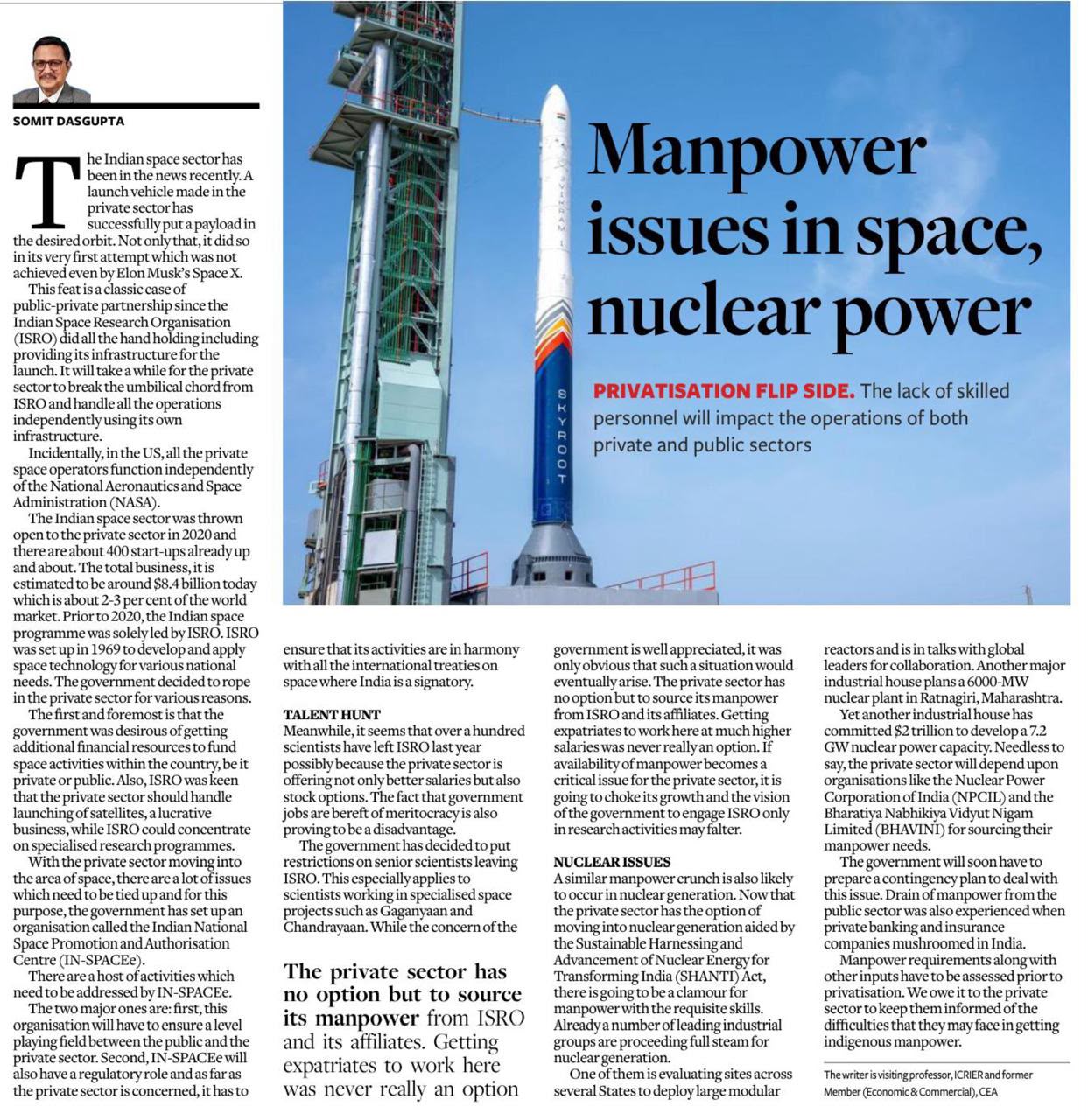
India opened the space sector in 2020.

Since then, nearly 400 start-ups have emerged.

The Indian space market is about $8.4 billion, which is around 2–3% of the global market.

ISRO’s role has shifted from being the sole operator to becoming an enabler.

IN-SPACe was created to regulate private participation and ensure a level playing field.

India’s Model vs United States

In the United States, private companies often operate independently of NASA.

In India, private space companies still depend heavily on ISRO for:

  • Infrastructure
  • Technology
  • Technical support
  • Experience
  • Skilled manpower

The long-term goal is to build an independent and globally competitive private space ecosystem.

Emerging Manpower Challenge

As private companies expand, competition for experienced scientists and engineers has increased.

Better salaries and stock options have accelerated talent movement from ISRO to private firms.

Restrictions on the movement of scientists may offer only a temporary solution.

If the private sector continues to depend heavily on ISRO for manpower, it may weaken both:

  • Private-sector expansion
  • ISRO’s research capabilities

Similar Concerns in Nuclear Sector

Private participation in nuclear energy under the Sustainable Harnessing and Advancements in Nuclear Energy Act is expected to create similar demand for specialised manpower.

Projects involving Small Modular Reactors, the proposed 6000-MW Ratnagiri plant, and planned 7.2 GW nuclear capacity will require a large pool of skilled scientists, engineers and technicians.

Way Forward

India needs a long-term national manpower strategy for strategic sectors.

STEM education must be strengthened.

Specialised training and industry-academia collaboration should be expanded.

Public research institutions must offer better career opportunities.

India also needs a sustainable talent pipeline for both public and private sectors.

Key Takeaway

Private participation in strategic sectors will succeed only if India builds enough skilled manpower. Space and nuclear growth need not just investment, but a deep talent pipeline.

Space and Nuclear Manpower Challenges

Multipolar World and Forever Wars for UPSC Notes

Context: Multipolar World and Forever Wars
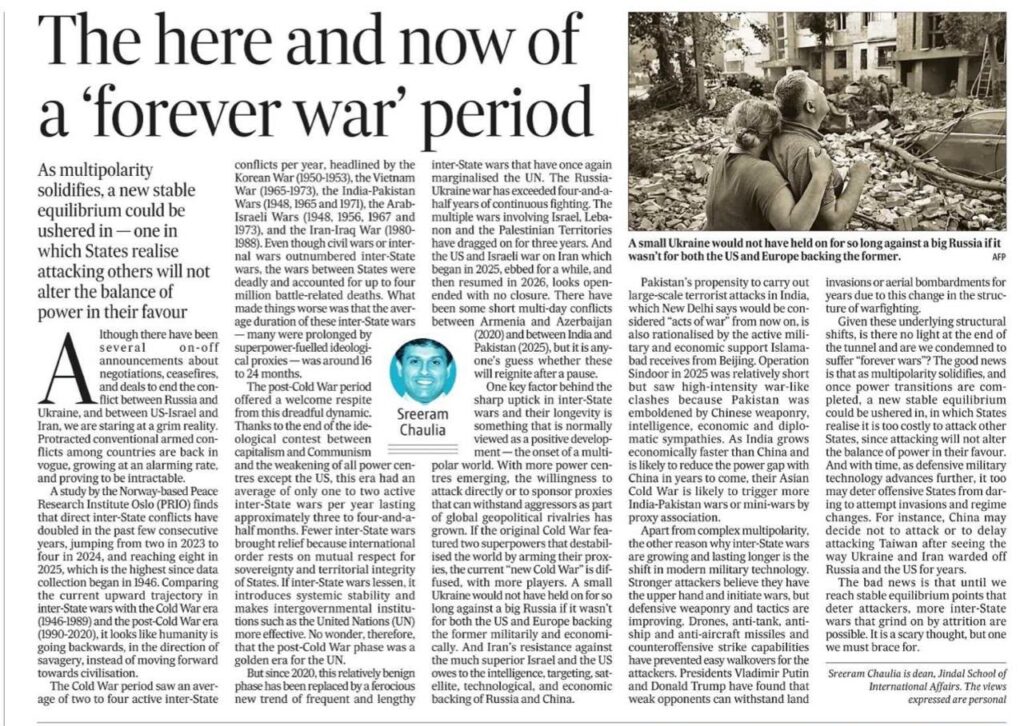
The global order is moving from a unipolar system to a multipolar one.

This transition is leading to renewed geopolitical competition, prolonged interstate conflicts and changing patterns of warfare.

Changing Global Security Landscape

Interstate conflicts are increasing after the relatively stable post-Cold War period.

According to the Peace Research Institute Oslo, interstate conflicts rose from:

  • 2 in 2023
  • 4 in 2024
  • 8 in 2025

This is the highest level since 1946.

Unlike the post-Cold War period, prolonged conventional wars are again becoming a major feature of international politics.

From Unipolarity to Multipolarity

The post-Cold War order was marked by U.S. dominance.

That period saw fewer interstate wars and stronger respect for sovereignty and territorial integrity.

But the rise of multiple power centres has increased:

  • Strategic competition
  • Proxy conflicts
  • Geopolitical rivalries

Major powers increasingly support allies through military, economic and technological assistance instead of direct intervention.

New Nature of Warfare

Contemporary wars are becoming longer, costlier and attrition-based.

They are often sustained by external military and economic support.

Examples include:

  • Russia–Ukraine war
  • Conflicts involving Israel, Lebanon and Palestine
  • U.S.–Israel–Iran confrontation

Modern technologies have made quick victories difficult.

These include:

  • Drones
  • Precision missiles
  • Anti-tank systems
  • Air-defence systems

Such technologies strengthen defenders and prolong wars.

Implications for India

China’s growing military capability and continued support to Pakistan can intensify India’s security challenges.

Proxy conflicts and prolonged regional confrontations may increase as strategic competition deepens in Asia.

India must strengthen:

  • Military preparedness
  • Technological capability
  • Strategic partnerships
  • Deterrence capacity

Future Outlook

Multipolarity may eventually create a new balance of power.

Once power transitions stabilise, incentives for direct aggression may reduce.

But until that happens, the world may witness more prolonged interstate conflicts.

This requires stronger deterrence, resilient institutions and sustained diplomacy.

Key Takeaway

The world is entering a period where wars may become longer, more technology-driven and harder to end. India must prepare for a security environment shaped by multipolar rivalry and prolonged conflicts.

Multipolar World and Forever Wars

Fiscal Federalism in India: 16th Finance Commission

Context: Fiscal Federalism in India
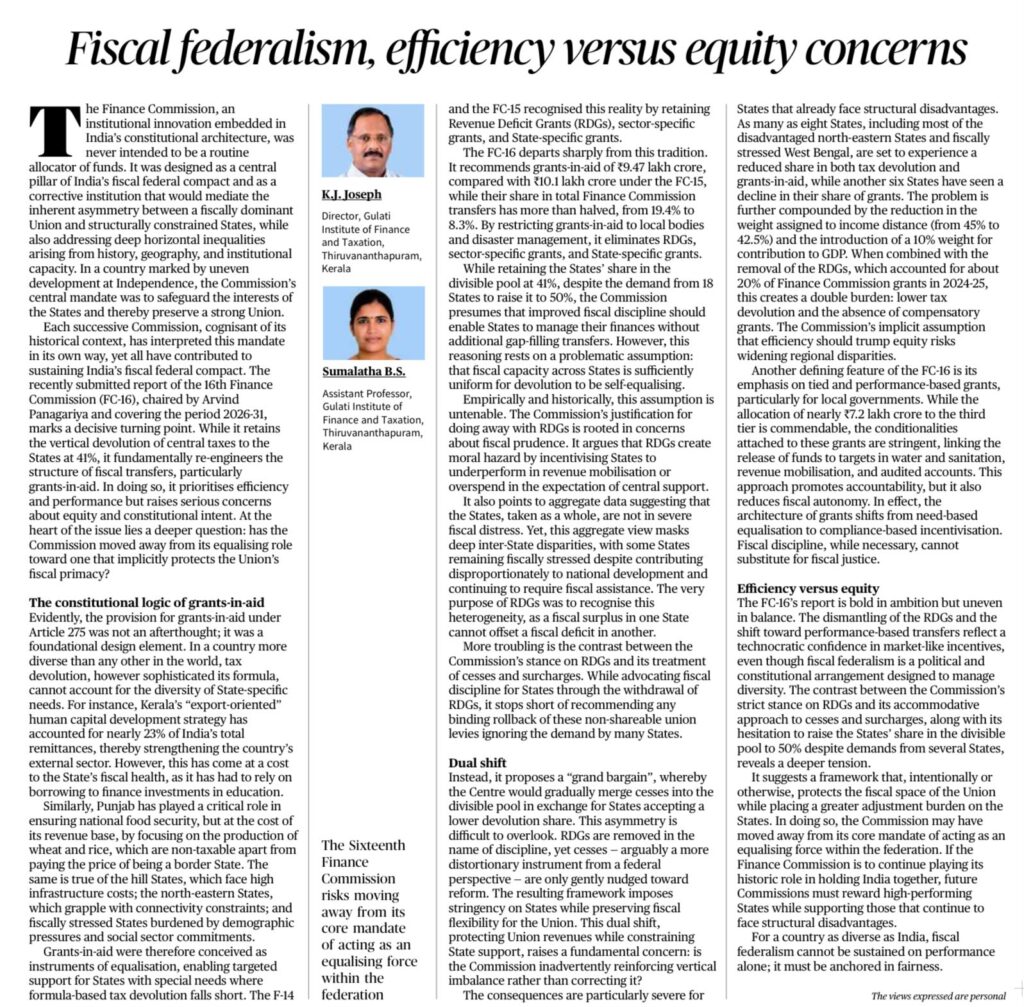
The recommendations of the 16th Finance Commission for 2026–31 have revived the debate over whether India’s fiscal transfer system should prioritise efficiency or continue its constitutional role of reducing regional disparities.

Constitutional Role of the Finance Commission

The Finance Commission is established under Article 280.

Its role is to maintain fiscal balance between the Union and the States through tax devolution and grants-in-aid.

Article 275 provides for grants-in-aid to support States with special needs and reduce horizontal fiscal inequalities.

Fiscal federalism is meant to strengthen cooperative federalism by balancing fiscal capacity across States.

Major Changes in the 16th Finance Commission

The Commission has retained the States’ share in the divisible pool at 41% under Article 270.

However, it has significantly restructured transfers.

It recommends ₹9.47 lakh crore as grants-in-aid, compared with ₹10.1 lakh crore under the 15th Finance Commission.

The share of grants in total Finance Commission transfers has declined from 19.4% to 8.3%.

Revenue Deficit Grants, sector-specific grants and State-specific grants have largely been discontinued.

There is greater emphasis on local body grants and disaster management grants.

Efficiency versus Equity

The recommendations assume that stronger fiscal discipline will improve State finances by reducing dependence on Central transfers.

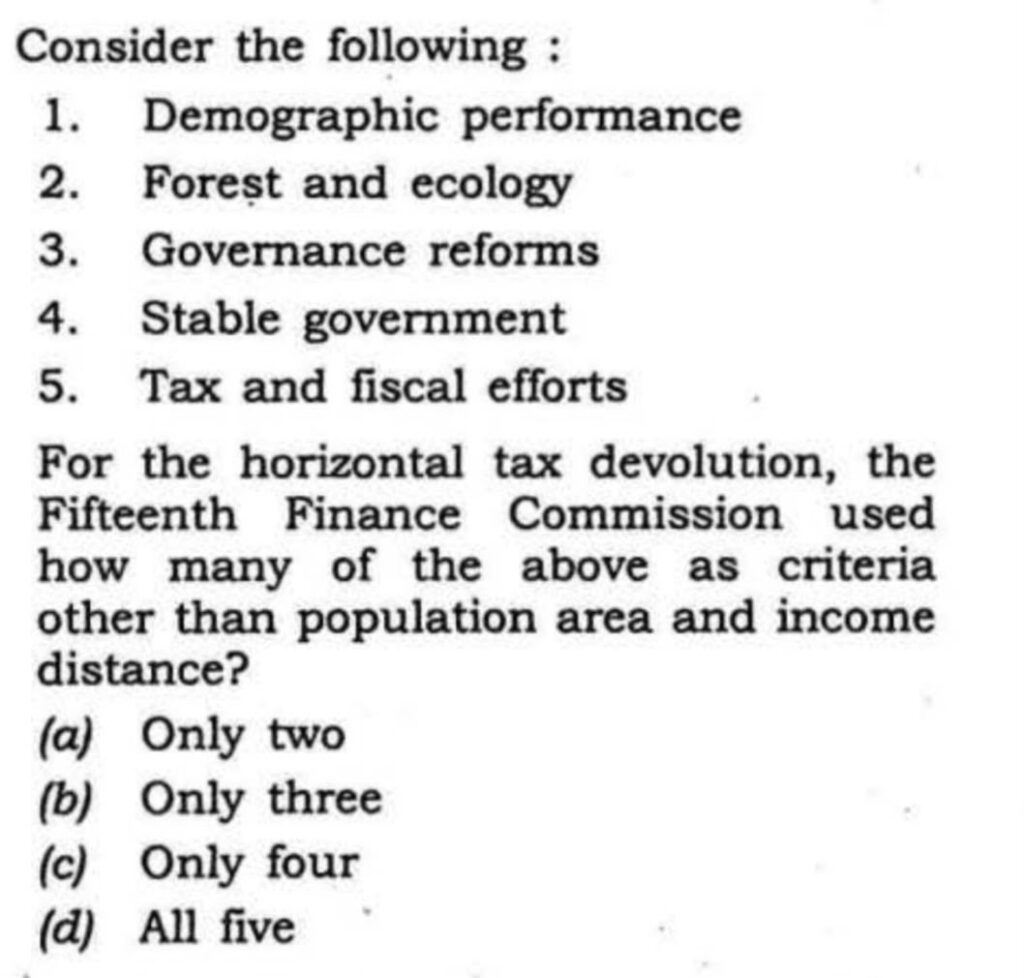
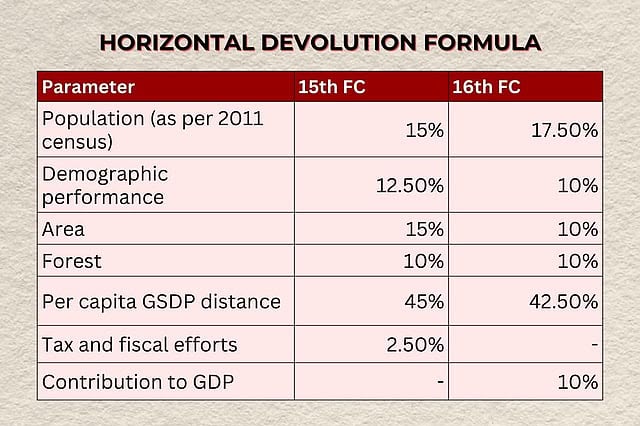
The weight assigned to income distance has been reduced from 45% to 42.5%.

A new 10% weight for contribution to GDP has been introduced.

This favours relatively stronger economies.

States with structural disadvantages, especially several North-Eastern States and fiscally stressed States such as West Bengal, may receive relatively lower support.

Concerns for Fiscal Federalism

The withdrawal of Revenue Deficit Grants weakens an important equalisation tool for fiscally weaker States.

Continued reliance on cesses and surcharges, which remain outside the divisible pool, limits the effectiveness of tax devolution.

Greater reliance on performance-based grants may improve accountability, but it can also reduce fiscal autonomy and ignore differences in State capacity.

Way Forward

India must preserve the constitutional objective of equalisation while promoting fiscal responsibility.

Cesses and surcharges should be rationalised by increasing their inclusion in the divisible pool.

Finance Commission criteria should recognise:

  • Regional diversity
  • Historical disadvantages
  • Differential fiscal capacity
  • Need-based support

Performance incentives should be balanced with adequate need-based grants.

Key Takeaway

Fiscal federalism cannot be sustained only through performance incentives. India needs a balance between efficiency and equity so that weaker States are not left behind.

Fiscal Federalism in India

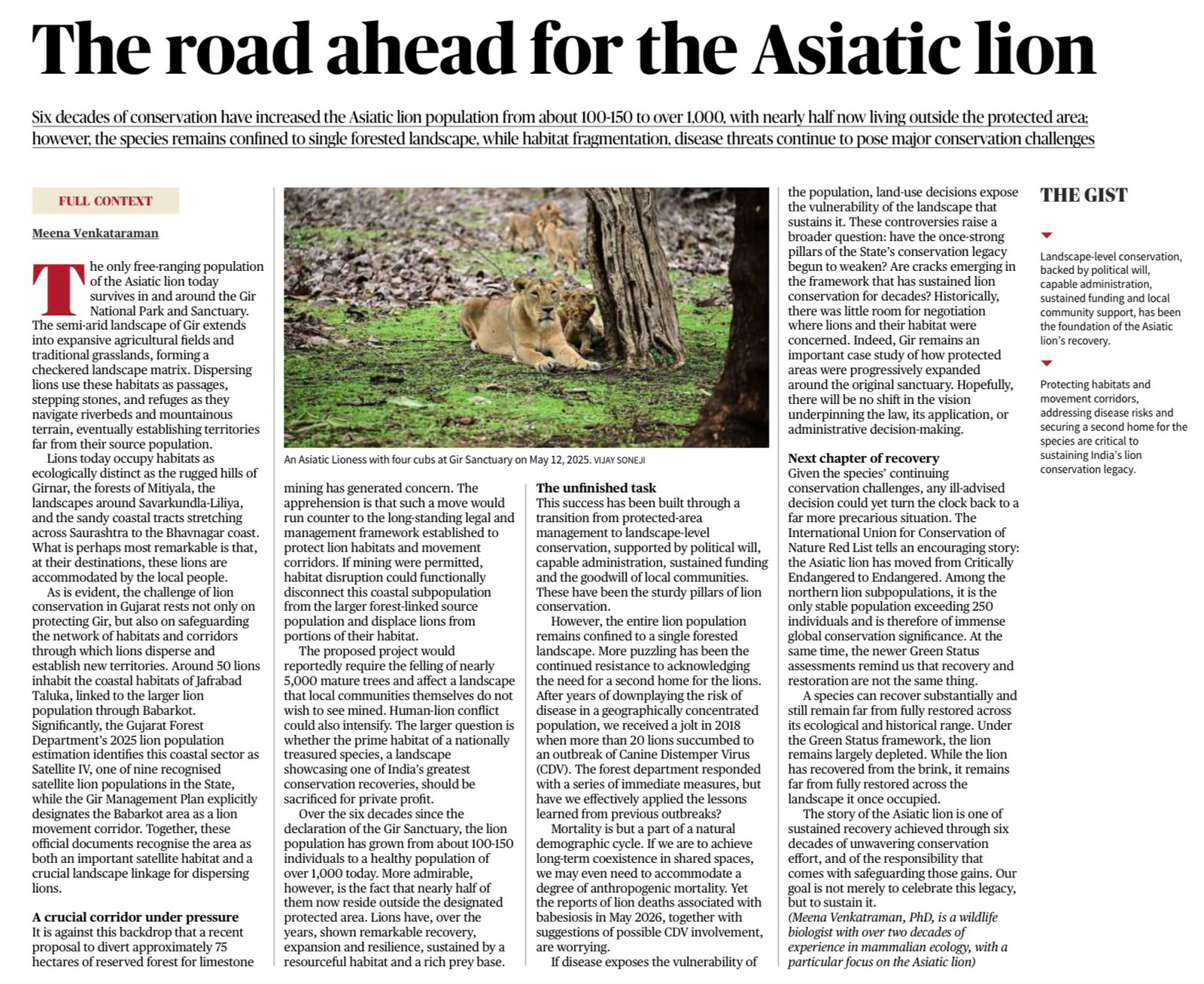
Asiatic Lion Conservation in India: UPSC Notes

Context: Asiatic Lion Conservation in India
The Asiatic lion has recovered significantly over the past six decades.

However, its continued confinement to a single landscape has renewed the focus on long-term conservation strategies.

Asiatic Lion: Prelims Focus

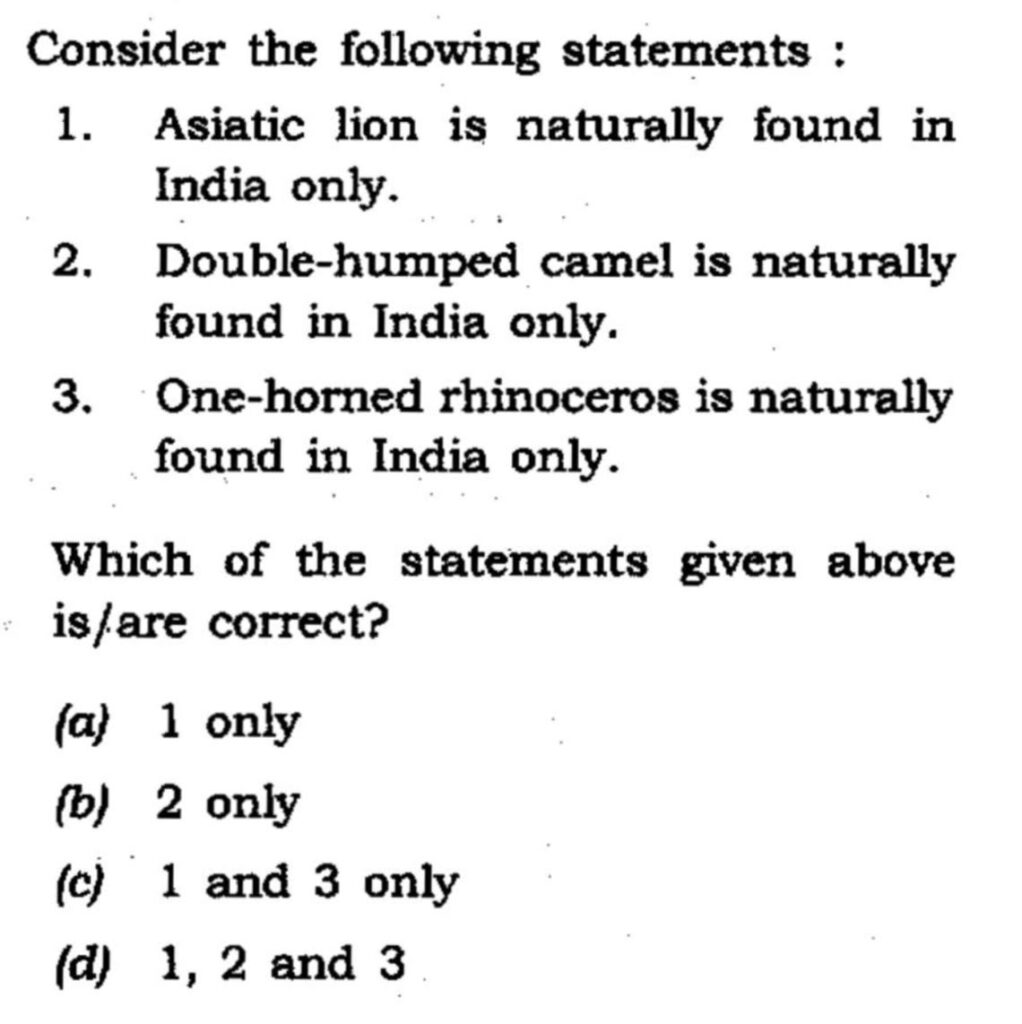
Scientific Name: Panthera leo persica

Distribution: Endemic to the Gir Landscape, Gujarat.

It is the world’s only free-ranging Asiatic lion population.

Habitat: Dry deciduous forests, scrublands, grasslands and savannah ecosystems.

IUCN Red List: Endangered

CITES: Appendix I

Wild Life Protection Act, 1972: Schedule I

Conservation Success

The declaration of Gir Wildlife Sanctuary in 1965 marked the beginning of organised lion conservation.

This was supported by:

  • Habitat protection
  • Prey-base improvement
  • Political commitment
  • Community participation

The population has increased from about 100–150 lions in the 1960s to over 1,000 today.

Nearly half the population now lives outside protected areas, showing successful natural dispersal.

Conservation Beyond Gir

Project Lion, 2020 promotes:

  • Habitat connectivity
  • Scientific monitoring
  • Disease management
  • Community participation
  • Establishment of additional free-ranging populations across suitable landscapes

The Asiatic Lion Conservation Project, 2018–19 strengthened:

  • Habitat improvement
  • Veterinary infrastructure
  • Disease surveillance
  • Conflict mitigation
  • Technology-based wildlife monitoring

Emerging Challenges

Despite population recovery, the entire wild population remains concentrated in one geographical landscape.

This creates vulnerability to:

  • Disease outbreaks
  • Natural disasters
  • Habitat fragmentation

Developmental activities, mining and infrastructure projects can disrupt wildlife corridors and reduce genetic connectivity.

Disease outbreaks such as Canine Distemper Virus and recent concerns regarding babesiosis underline the need for continuous wildlife health surveillance.

Way Forward

India should establish a second free-ranging wild population to reduce extinction risk.

Ecological corridors and satellite habitats should be protected through landscape-level planning.

Disease surveillance, scientific monitoring and veterinary preparedness must be strengthened.

Community-based conservation should continue while balancing development with ecological sustainability.

Key Takeaway

The Asiatic lion is a conservation success story, but its future depends on moving beyond single-landscape protection towards disease preparedness, corridor protection and a second wild population.

Asiatic Lion Conservation in India

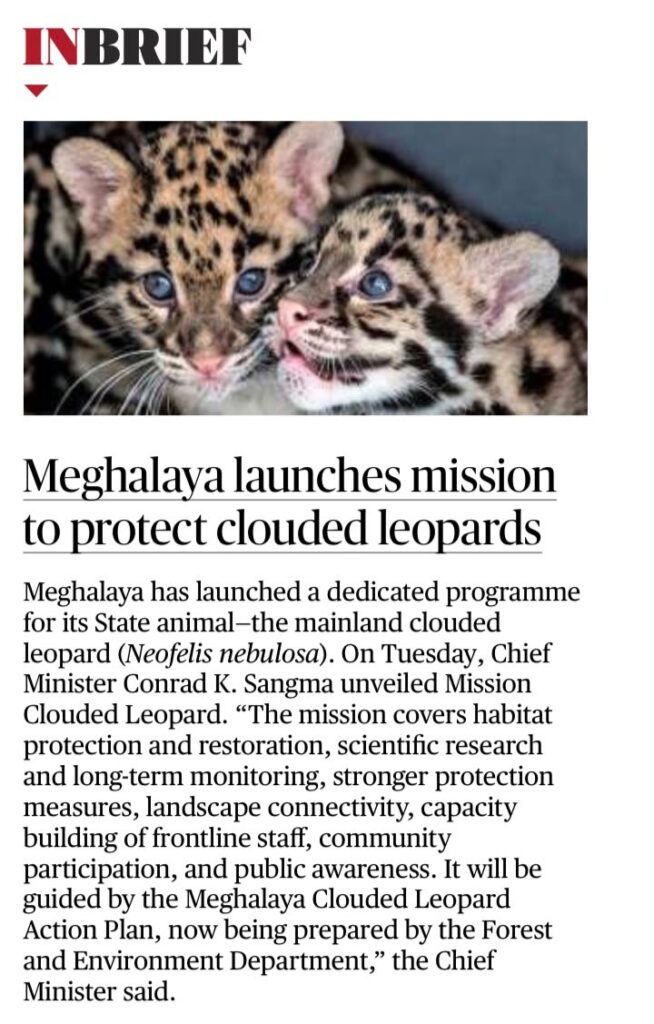
Mission Clouded Leopard Meghalaya for UPSC Notes

Context: Mission Clouded Leopard Meghalaya
Meghalaya has launched Mission Clouded Leopard to protect its State animal.

The mission focuses on habitat conservation, scientific monitoring and community participation for the long-term survival of the species.

About Clouded Leopard

Scientific Name: Neofelis nebulosa

State Animal: Meghalaya

Habitat: Tropical and subtropical forests

Distribution: North-East India, Nepal, Bhutan, Myanmar, southern China and Southeast Asia

IUCN Status: Vulnerable

CITES: Appendix I

Wild Life Protection Act, 1972: Schedule I

Mission Clouded Leopard

The mission focuses on:

  • Habitat restoration
  • Landscape connectivity
  • Scientific research
  • Long-term monitoring
  • Capacity building of frontline staff
  • Stronger protection measures
  • Community participation
  • Public awareness

It will be guided by the Meghalaya Clouded Leopard Action Plan.

Clouded Leopard vs Snow Leopard

The Clouded Leopard is an arboreal cat found in tropical forests of North-East India.

It has cloud-shaped blotches.

The Snow Leopard, or Panthera uncia, is a high-altitude Himalayan species.

It has rosette-shaped spots and is adapted to cold mountain ecosystems.

Both species are protected under:

  • IUCN: Vulnerable
  • CITES: Appendix I
  • Wild Life Protection Act, 1972: Schedule I

However, their conservation initiatives differ.

Clouded Leopard conservation is linked with Mission Clouded Leopard in Meghalaya.

Snow Leopard conservation is linked with Project Snow Leopard, 2009.

Key Takeaway

Mission Clouded Leopard shows that species conservation needs habitat protection, scientific monitoring, landscape connectivity and community participation together.

Mission Clouded Leopard Meghalaya

Copyright © 2026 USARAMBHA EDUCATION (UnderStand UPSC). All Rights Reserved.

Inquiry form for Takshila Residential Program